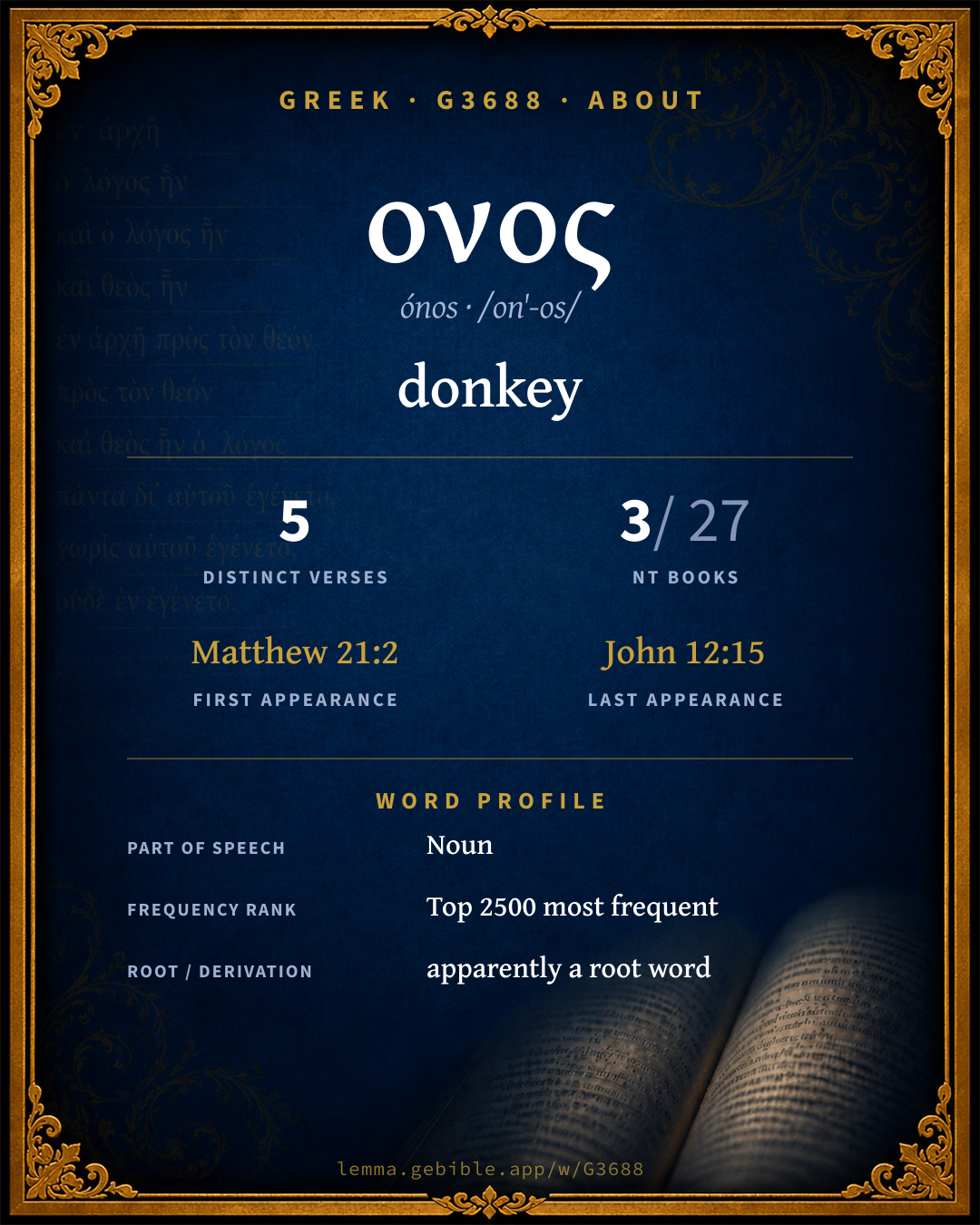
ὄνος
donkey
Full lexicon entry — Thayer's Greek Lexicon
From Thayer's Greek Lexicon
Where this word appears
Grammar key — what these labels mean
Part of speech
- Noun
- A naming word — a person, place, thing, or idea.
Case
- Accusative
- The case of the direct object and of extent.
- Genitive
- The case of source, possession, or “of” — answers “whose / from what.”
Gender
- Feminine
- Grammatically feminine.
- Masculine
- Grammatically masculine.
Number
- Singular
- One.
Every verse where G3688 appears in the Book of John — 1 distinct verse. Click any verse to open its interlinear word-by-word view. Verse text shown in the World English Bible for context — . Each verse’s Greek form is shown with its reference; the English is not keyword-highlighted, since the data carries no word-level English alignment. Use “Compare translations” on any verse to read it across multiple English versions. This concordance covers the Greek New Testament; Septuagint (Greek Old Testament) occurrences of this word are not indexed here.
John
About this entry
At a glance — auto-summarized from this page’s data, not written by a person. Every figure links to its source below. This summary describes the numbers; it doesn’t interpret them.
ονος — transliterated ónos — is a Greek noun carrying the sense “donkey.” A scarce word — 5 verses in all of the Greek New Testament. Its uses cluster heavily in Matthew (60% of all occurrences). Debuting at Matthew 21:2, it then recurs through the corpus. From the same root come οναριον and ονικος. See the sense tree, 5-verse concordance, and the renderings breakdown below.
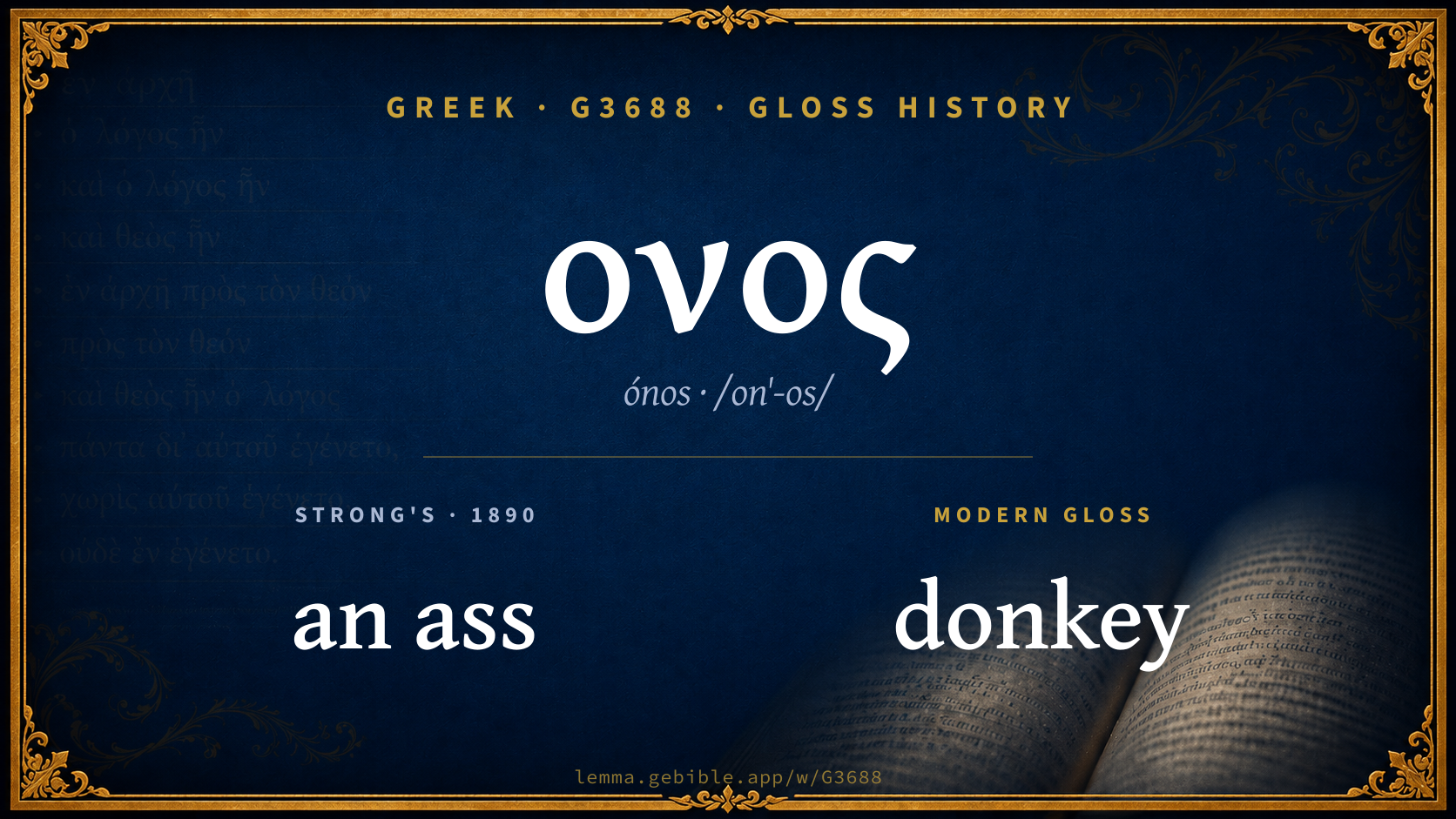
Gloss history
Strong's 1890 vs modern scholarship
About this word
Strong's G3688 catalogs a Greek word from the Greek New Testament.
These counts are not copied from any lexicon or concordance. They are computed here, from the morphology-tagged Greek New Testament. What Lemma adds →
- 5
- distinct verses
- The word appears in 5 distinct verses.
- 3 / 27
- NT books
- The word appears in 3 of 27 New Testament books.
- #1,648
- by frequency
- Top 2500 most frequent Greek words (rank 1,648 of 5,347 Greek words by occurrence).
View all 5 occurrences in the concordance →
By section of the New Testament
By traditional corpus
Conventional, traditional groupings — biblical authorship is debated, so this is a traditional corpus grouping, not an authorship claim. Some books belong to more than one corpus (Luke is in both the Gospels and the Lukan corpus, and so on), so these shares overlap and need not total 100%. Each figure is a share of the word’s 5 distinct verses.
- Gospels 5 verses · 100%
- Lukan (Luke–Acts) 1 verse · 20%
- Johannine 1 verse · 20%
How translations render this word
Counts come from each version’s own published word-to-Strong’s tagging or interlinear alignment — an approximate guide to how each version renders this word, not a word-level alignment the data otherwise carries. Because each total is that version’s own tagged count, the per-version totals vary from one another and need not match the appearance or distinct-verse counts above. These counts may also differ from a printed concordance because Lemma counts each distinctly tagged rendering and does not collapse phrase taggings into a single head-word total. This is a fixed set of word-tagged versions (KJV, ASV, BSB, ULT) and does not change with the reading translation you choose elsewhere. Each version’s license is shown beside its name below (and on Sources).
- King James Version: Ass 4×
- American Standard Version: Ass 6×
- Berean Standard Bible: Donkey 5×
- unfoldingWord Literal Text: Donkey 5×
King James Version Public Domain
Renders G3688 across 6 tagged occurrences — most commonly:
Plus 2 renderings that appear only once — usually multi-word phrases or single function words the recovered tagging swept in, not distinct renderings.
American Standard Version Public Domain
Renders G3688 across 6 tagged occurrences — most commonly:
Berean Standard Bible Public Domain
Renders G3688 across 5 tagged occurrences — most commonly:
unfoldingWord Literal Text CC BY-SA 4.0
Renders G3688 across 5 tagged occurrences — most commonly:
Senses in Thayer's
The 1 sense Thayer's distinguishes for this word, in lexicon order (not ranked by frequency or importance). The full entry — with sub-senses — is in the Lexicon Entry tab.
- an ass
Word origin
Origin: apparently a root word
Apparently a primary word; a donkey : - ass.
— Strong’s Exhaustive Concordance (1890), public domain.
Forms in the corpus
The 2 distinct written forms G3688 takes in the Greek New Testament, most frequent first — each parse links to that case’s occurrences in the concordance.
| Form | Parsing | Example | Uses |
|---|---|---|---|
| ὄνον ónon | Noun, Accusative, Singular, Feminine | Matthew 21:2 | 4 |
| ὄνου ónou | Noun, Genitive, Singular, Feminine | John 12:15 | 1 |
Same root — word family
Other Thayer's entries built from the same root as G3688, grouped by Strong’s listed origin. These share a root / origin per the lexicon — not necessarily a shared meaning. Each links to that word’s own entry.
Derived from this word
Compare all same-root words → They share a root, not necessarily a meaning.
Septuagint usage
The same Greek word ονος appears 112 times in the Greek Old Testament (Septuagint), across 103 verses in 19 books.
- 112
- LXX occurrences
- Tagged occurrences of this Greek word in the Septuagint.
- 103
- verses
- Distinct Septuagint verses containing this word.
- 19 / 39
- OT books
- The word appears in 19 of the 39 Old Testament books.
Sample Septuagint occurrences
- Genesis 12:16 ὄνος
- Exodus 13:13 ὄνος
- Leviticus 15:9 ὄνος
- Numbers 22:21 ὄνος
- Deuteronomy 22:3 ὄνος
- Joshua 9:4 ὄνος
- Judges 5:10 ὄνος
- 1 Samuel 8:16 ὄνος
- 2 Samuel 16:1 ὄνος
- 1 Kings 2:40 ὄνος
- 2 Kings 4:22 ὄνος
- 1 Chronicles 5:21 ὄνος
Septuagint occurrences (same lexeme)
Every verse where the same Strong’s number (G3688) appears in the Greek Septuagint — showing the first 50 of 103. Verse text shown in the World English Bible for context; the Greek form is the matched word — the English is not keyword-highlighted.
- Genesis 12:16 ὄνος He dealt well with Abram for her sake. He had sheep, and oxen, and male donkeys, and men-servants, and maid-servants, and female donkeys, and camels.
- Genesis 22:3 ὄνος Abraham rose early in the morning, and saddled his donkey, and took two of his young men with him, and Isaac his son. He split the wood for the burnt offering, and rose up, and went to the place of which God had told him.
- Genesis 22:5 ὄνος Abraham said to his young men, "Stay here with the donkey. The boy and I will go yonder. We will worship, and come back to you.
- Genesis 24:35 ὄνος Yahweh has blessed my master greatly. He has become great. He has given him flocks and herds, silver and gold, men-servants and maid-servants, and camels and donkeys.
- Genesis 30:43 ὄνος The man increased exceedingly, and had large flocks, maid-servants and men-servants, and camels and donkeys.
- Genesis 32:6 ὄνος The messengers returned to Jacob, saying, "We came to your brother Esau. Not only that, but he comes to meet you, and four hundred men with him."
- Genesis 32:16 ὄνος He delivered them into the hands of his servants, every herd by itself, and said to his servants, "Pass over before me, and put a space between herd and herd."
- Genesis 34:28 ὄνος They took their flocks, their herds, their donkeys, that which was in the city, that which was in the field;
- Genesis 42:26 ὄνος They loaded their donkeys with their grain, and departed from there.
- Genesis 42:27 ὄνος As one of them opened his sack to give his donkey food in the lodging-place, he saw his money. Behold, it was in the mouth of his sack.
- Genesis 43:18 ὄνος The men were afraid, because they were brought to Joseph's house; and they said, "Because of the money that was returned in our sacks at the first time are we brought in; that he may seek occasion against us, and fall on us, and take us for bondservants, along with our donkeys."
- Genesis 43:24 ὄνος The man brought the men into Joseph's house, and gave them water, and they washed their feet. He gave their donkeys fodder.
- Genesis 44:3 ὄνος As soon as the morning was light, the men were sent away, they and their donkeys.
- Genesis 44:13 ὄνος Then they tore their clothes, and loaded every man his donkey, and returned to the city.
- Genesis 45:23 ὄνος To his father, he sent after this manner: ten donkeys loaded with the good things of Egypt, and ten female donkeys loaded with grain and bread and provision for his father by the way.
- Genesis 47:17 ὄνος They brought their cattle to Joseph, and Joseph gave them bread in exchange for the horses, and for the flocks, and for the herds, and for the donkeys: and he fed them with bread in exchange for all their cattle for that year.
- Genesis 49:11 ὄνος Binding his foal to the vine, His donkey's colt to the choice vine; He has washed his garments in wine, His robes in the blood of grapes:
- Exodus 13:13 ὄνος Every firstborn of a donkey you shall redeem with a lamb; and if you will not redeem it, then you shall break its neck; and you shall redeem all the firstborn of man among your sons.
- Exodus 21:33 ὄνος "If a man opens a pit, or if a man digs a pit and doesn't cover it, and a bull or a donkey falls into it,
- Exodus 22:3 ὄνος If the sun has risen on him, there shall be guilt of bloodshed for him; he shall make restitution. If he has nothing, then he shall be sold for his theft.
- Leviticus 15:9 ὄνος "'Whatever saddle he who has the discharge rides on shall be unclean.
- Numbers 22:21 ὄνος Balaam rose up in the morning, and saddled his donkey, and went with the princes of Moab.
- Numbers 22:22 ὄνος God's anger was kindled because he went; and the angel of Yahweh placed himself in the way for an adversary against him. Now he was riding on his donkey, and his two servants were with him.
- Numbers 22:23 ὄνος The donkey saw the angel of Yahweh standing in the way, with his sword drawn in his hand; and the donkey turned aside out of the way, and went into the field: and Balaam struck the donkey, to turn her into the way.
- Numbers 22:25 ὄνος The donkey saw the angel of Yahweh, and she thrust herself to the wall, and crushed Balaam's foot against the wall: and he struck her again.
- Numbers 22:27 ὄνος The donkey saw the angel of Yahweh, and she lay down under Balaam: and Balaam's anger was kindled, and he struck the donkey with his staff.
- Numbers 22:28 ὄνος Yahweh opened the mouth of the donkey, and she said to Balaam, What have I done to you, that you have struck me these three times?
- Numbers 22:29 ὄνος Balaam said to the donkey, Because you have mocked me, I would there were a sword in my hand, for now I had killed you.
- Numbers 22:30 ὄνος The donkey said to Balaam, Am I not your donkey, on which you have ridden all your life long to this day? was I ever wont to do so to you? and he said, No.
- Numbers 22:32 ὄνος The angel of Yahweh said to him, Why have you struck your donkey these three times? behold, I am come forth for an adversary, because your way is perverse before me:
- Numbers 22:33 ὄνος and the donkey saw me, and turned aside before me these three times: unless she had turned aside from me, surely now I had even slain you, and saved her alive.
- Numbers 31:30 ὄνος Of the children of Israel's half, you shall take one drawn out of every fifty, of the persons, of the oxen, of the donkeys, and of the flocks, [even] of all the cattle, and give them to the Levites, who keep the charge of the tent of Yahweh.
- Numbers 31:34 ὄνος and seventy-one thousand donkeys,
- Numbers 31:39 ὄνος The donkeys were thirty thousand five hundred; of which Yahweh's tribute was sixty-one.
- Numbers 31:45 ὄνος and thirty thousand five hundred donkeys,
- Deuteronomy 22:3 ὄνος So shall you do with his donkey; and so shall you do with his garment; and so shall you do with every lost thing of your brother's, which he has lost, and you have found: you may not hide yourself.
- Deuteronomy 22:4 ὄνος You shall not see your brother's donkey or his ox fallen down by the way, and hide yourself from them: you shall surely help him to lift them up again.
- Deuteronomy 22:10 ὄνος You shall not plow with an ox and a donkey together.
- Deuteronomy 28:31 ὄνος Your ox shall be slain before your eyes, and you shall not eat of it: your donkey shall be violently taken away from before your face, and shall not be restored to you: your sheep shall be given to your enemies, and you shall have none to save you.
- Joshua 9:4 ὄνος they also resorted to a ruse, and went and made as if they had been ambassadors, and took old sacks on their donkeys, and wine-skins, old and torn and bound up,
- Joshua 15:18 ὄνος It happened, when she came [to him], that she moved him to ask of her father a field: and she alighted from off her donkey; and Caleb said, What would you?
- Judges 5:10 ὄνος Tell [of it], you who ride on white donkeys, You who sit on rich carpets, You who walk by the way.
- Judges 6:4 ὄνος and they encamped against them, and destroyed the increase of the earth, until you come to Gaza, and left no sustenance in Israel, neither sheep, nor ox, nor donkey.
- Judges 15:15 ὄνος He found a fresh jawbone of a donkey, and put forth his hand, and took it, and struck a thousand men therewith.
- Judges 15:16 ὄνος Samson said, With the jawbone of a donkey, heaps on heaps, With the jawbone of a donkey I have struck a thousand men.
- Judges 19:3 ὄνος Her husband arose, and went after her, to speak kindly to her, to bring her again, having his servant with him, and a couple of donkeys: and she brought him into her father's house; and when the father of the young lady saw him, he rejoiced to meet him.
- Judges 19:10 ὄνος But the man wouldn't stay that night, but he rose up and departed, and came over against Jebus (the same is Jerusalem): and there were with him a couple of donkeys saddled; his concubine also was with him.
- Judges 19:19 ὄνος Yet there is both straw and provender for our donkeys; and there is bread and wine also for me, and for your handmaid, and for the young man who is with your servants: there is no want of anything.
- Judges 19:21 ὄνος So he brought him into his house, and gave the donkeys fodder; and they washed their feet, and ate and drink.
- Judges 19:28 ὄνος He said to her, Up, and let us be going; but none answered: then he took her up on the donkey; and the man rose up, and got him to his place.
These are occurrences of the same Greek lexeme (G3688) in the Septuagint — not a translation of any one Hebrew word. The store carries no word-level Hebrew↔Greek alignment, so no Hebrew original is asserted here. Counts come from the recovered LXX Strong's tagging — high-frequency vocabulary is well covered, while rare or late forms may be untagged — so they reflect tagged occurrences and may slightly undercount.