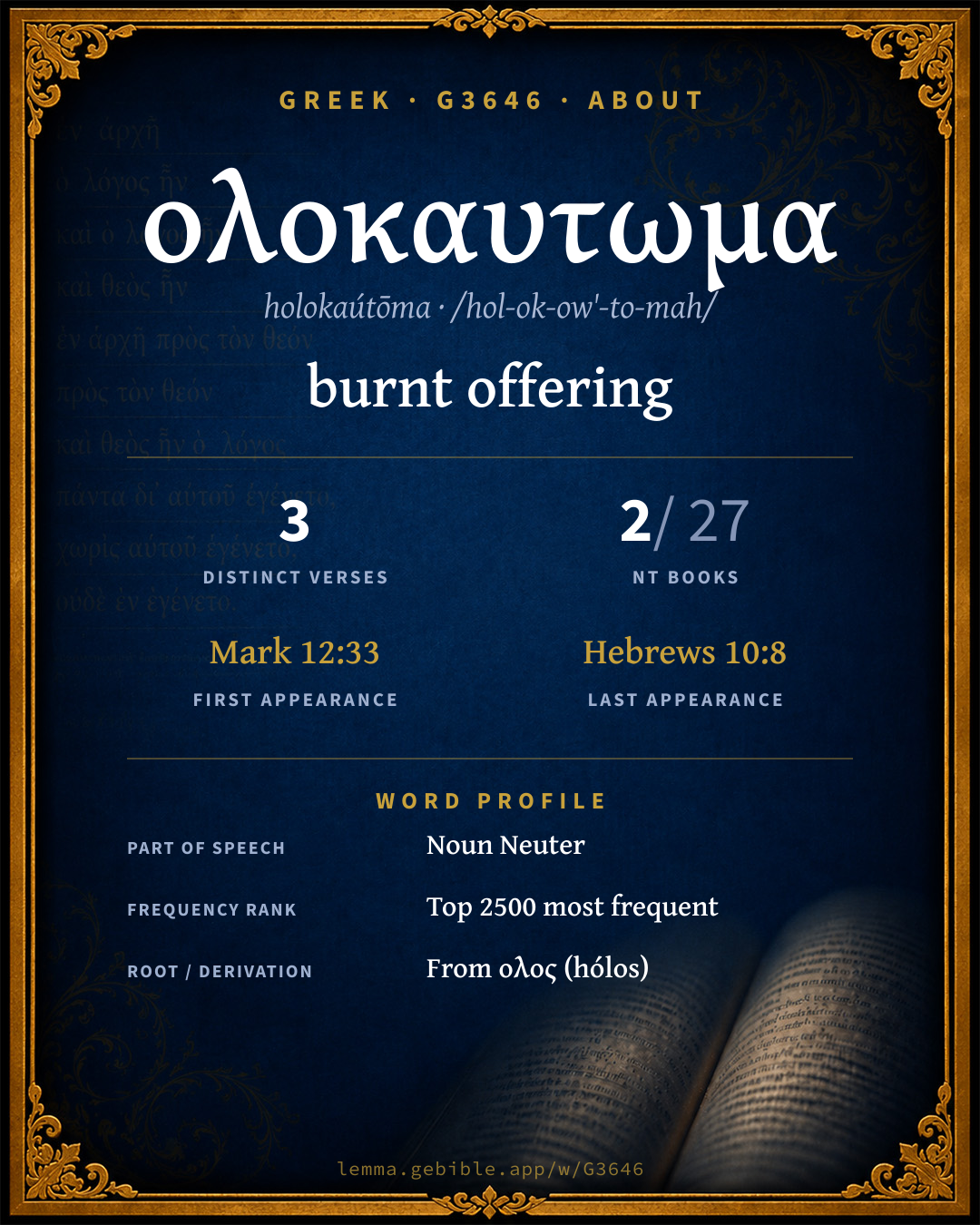
ὁλοκαύτωμα
burnt offering
Full lexicon entry — Thayer's Greek Lexicon
From Thayer's Greek Lexicon
Where this word appears
Grammar key — what these labels mean
Part of speech
- Noun
- A naming word — a person, place, thing, or idea.
Case
- Accusative
- The case of the direct object and of extent.
- Genitive
- The case of source, possession, or “of” — answers “whose / from what.”
Gender
- Neuter
- Grammatically neuter.
Number
- Plural
- More than one.
Every verse where G3646 appears in the Book of Mark — 1 distinct verse. Click any verse to open its interlinear word-by-word view. Verse text shown in the World English Bible for context — . Each verse’s Greek form is shown with its reference; the English is not keyword-highlighted, since the data carries no word-level English alignment. Use “Compare translations” on any verse to read it across multiple English versions. This concordance covers the Greek New Testament; Septuagint (Greek Old Testament) occurrences of this word are not indexed here.
Mark
About this entry
At a glance — auto-summarized from this page’s data, not written by a person. Every figure links to its source below. This summary describes the numbers; it doesn’t interpret them.
At its core, ολοκαυτωμα (holokaútōma) means “burnt offering.” It occurs a mere 3 verses across Scripture. Its uses cluster heavily in Hebrews (67% of all occurrences). Scripture first uses it in Mark 12:33. From the same root come ολος, ολοκληρος and ολοτελης. Dig into 3-verse concordance and the renderings breakdown below.
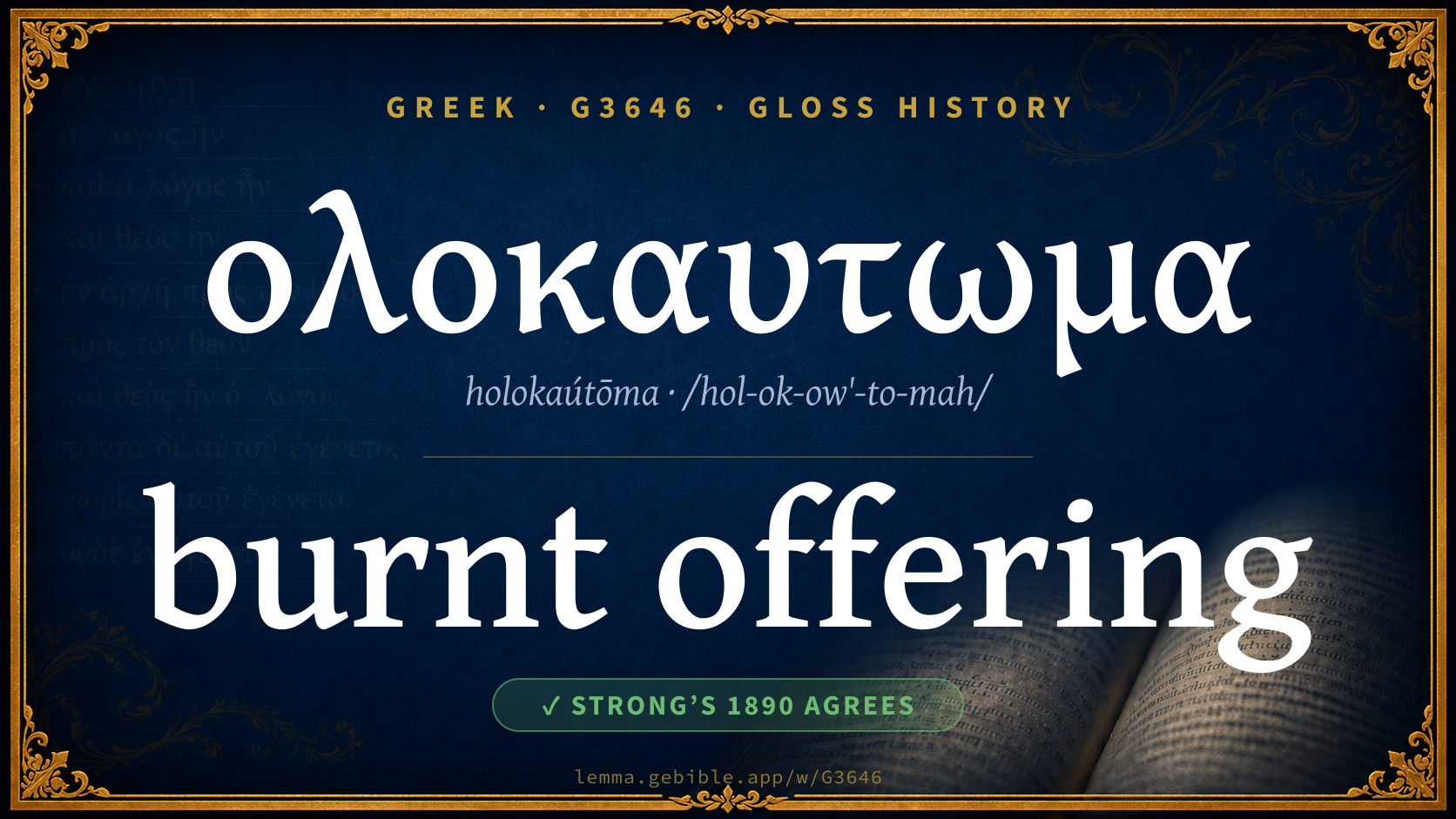
Gloss history
Strong's 1890 vs modern scholarship
About this word
Strong's G3646 catalogs a Greek word from the Greek New Testament.
These counts are not copied from any lexicon or concordance. They are computed here, from the morphology-tagged Greek New Testament. What Lemma adds →
- 3
- distinct verses
- The word appears in 3 distinct verses.
- 2 / 27
- NT books
- The word appears in 2 of 27 New Testament books.
- #2,203
- by frequency
- Top 2500 most frequent Greek words (rank 2,203 of 5,347 Greek words by occurrence).
View all 3 occurrences in the concordance →
By traditional corpus
Conventional, traditional groupings — biblical authorship is debated, so this is a traditional corpus grouping, not an authorship claim. Some books belong to more than one corpus (Luke is in both the Gospels and the Lukan corpus, and so on), so these shares overlap and need not total 100%. Each figure is a share of the word’s 3 distinct verses.
- Hebrews 2 verses · 67%
- Gospels 1 verse · 33%
How translations render this word
Counts come from each version’s own published word-to-Strong’s tagging or interlinear alignment — an approximate guide to how each version renders this word, not a word-level alignment the data otherwise carries. Because each total is that version’s own tagged count, the per-version totals vary from one another and need not match the appearance or distinct-verse counts above. These counts may also differ from a printed concordance because Lemma counts each distinctly tagged rendering and does not collapse phrase taggings into a single head-word total. This is a fixed set of word-tagged versions (KJV, ASV, BSB, ULT) and does not change with the reading translation you choose elsewhere. Each version’s license is shown beside its name below (and on Sources).
- King James Version: Burnt offerings 2×
- American Standard Version: Whole burnt offerings 2×
- Berean Standard Bible: Burnt offerings 3×
- unfoldingWord Literal Text: Whole burnt offerings 2×
King James Version Public Domain
Renders G3646 across 3 tagged occurrences — most commonly:
Plus 1 rendering that appears only once — usually multi-word phrases or single function words the recovered tagging swept in, not distinct renderings.
American Standard Version Public Domain
Renders G3646 across 3 tagged occurrences — most commonly:
Plus 1 rendering that appears only once — usually multi-word phrases or single function words the recovered tagging swept in, not distinct renderings.
Berean Standard Bible Public Domain
Renders G3646 across 3 tagged occurrences — most commonly:
unfoldingWord Literal Text CC BY-SA 4.0
Renders G3646 across 4 tagged occurrences — most commonly:
Plus 2 renderings that appear only once — usually multi-word phrases or single function words the recovered tagging swept in, not distinct renderings.
Senses in Thayer's
The 1 sense Thayer's distinguishes for this word, in lexicon order (not ranked by frequency or importance). The full entry — with sub-senses — is in the Lexicon Entry tab.
- a victim the whole (and not like other victims only a part) of which was burned
Word origin
Derived from ολος (hólos) (G3650) — all.
Forms in the corpus
The 2 distinct written forms G3646 takes in the Greek New Testament, most frequent first — each parse links to that case’s occurrences in the concordance.
| Form | Parsing | Example | Uses |
|---|---|---|---|
| ὁλοκαυτώματα holokautṓmata | Noun, Accusative, Plural, Neuter | Hebrews 10:6 | 2 |
| ὁλοκαυτωμάτων holokautōmátōn | Noun, Genitive, Plural, Neuter | Mark 12:33 | 1 |
Same root — word family
Other Thayer's entries built from the same root as G3646, grouped by Strong’s listed origin. These share a root / origin per the lexicon — not necessarily a shared meaning. Each links to that word’s own entry.
Derives from
Shares the same root
Derived from this word
Compare all same-root words → Showing 4 of 6 — not the complete family. They share a root, not necessarily a meaning.
Septuagint usage
The same Greek word ολοκαυτωμα appears 184 times in the Greek Old Testament (Septuagint), across 176 verses in 21 books.
- 184
- LXX occurrences
- Tagged occurrences of this Greek word in the Septuagint.
- 176
- verses
- Distinct Septuagint verses containing this word.
- 21 / 39
- OT books
- The word appears in 21 of the 39 Old Testament books.
Sample Septuagint occurrences
- Exodus 10:25 ὁλοκαύτωμα
- Leviticus 1:3 ὁλοκαύτωμα
- Numbers 6:11 ὁλοκαύτωμα
- Deuteronomy 12:6 ὁλοκαύτωμα
- Joshua 9:2 ὁλοκαύτωμα
- Judges 6:26 ὁλοκαύτωμα
- 1 Samuel 15:22 ὁλοκαύτωμα
- 2 Samuel 6:17 ὁλοκαύτωμα
- 1 Kings 18:29 ὁλοκαύτωμα
- 2 Kings 3:27 ὁλοκαύτωμα
- 1 Chronicles 6:34 ὁλοκαύτωμα
- 2 Chronicles 2:3 ὁλοκαύτωμα
Septuagint occurrences (same lexeme)
Every verse where the same Strong’s number (G3646) appears in the Greek Septuagint — showing the first 50 of 176. Verse text shown in the World English Bible for context; the Greek form is the matched word — the English is not keyword-highlighted.
- Exodus 10:25 ὁλοκαύτωμα Moses said, "You must also give into our hand sacrifices and burnt-offerings, that we may sacrifice to Yahweh our God.
- Exodus 18:12 ὁλοκαύτωμα Jethro, Moses' father-in-law, took a burnt offering and sacrifices for God. Aaron came with all of the elders of Israel, to eat bread with Moses' father-in-law before God.
- Exodus 20:24 ὁλοκαύτωμα You shall make an altar of earth for me, and shall sacrifice on it your burnt offerings and your peace-offerings, your sheep and your oxen. In every place where I record my name I will come to you and I will bless you.
- Exodus 24:5 ὁλοκαύτωμα He sent young men of the children of Israel, who offered burnt offerings and sacrificed peace-offerings of oxen to Yahweh.
- Exodus 29:18 ὁλοκαύτωμα You shall burn the whole ram on the altar: it is a burnt offering to Yahweh; it is a sweet savor, an offering made by fire to Yahweh.
- Exodus 30:20 ὁλοκαύτωμα When they go into the tent of meeting, they shall wash with water, that they not die; or when they come near to the altar to minister, to burn an offering made by fire to Yahweh.
- Exodus 30:28 ὁλοκαύτωμα the altar of burnt offering with all its utensils, and the basin with its base.
- Exodus 32:6 ὁλοκαύτωμα They rose up early on the next day, and offered burnt offerings, and brought peace-offerings; and the people sat down to eat and to drink, and rose up to play.
- Leviticus 1:3 ὁλοκαύτωμα "'If his offering is a burnt offering from the herd, he shall offer a male without blemish. He shall offer it at the door of the Tent of Meeting, that he may be accepted before Yahweh.
- Leviticus 1:6 ὁλοκαύτωμα He shall flay the burnt offering, and cut it into pieces.
- Leviticus 1:10 ὁλοκαύτωμα "'If his offering is from the flock, from the sheep, or from the goats, for a burnt offering, he shall offer a male without blemish.
- Leviticus 3:2 ὁλοκαύτωμα He shall lay his hand on the head of his offering, and kill it at the door of the tent of meeting: and Aaron's sons the priests shall sprinkle the blood on the altar round about.
- Leviticus 3:5 ὁλοκαύτωμα Aaron's sons shall burn it on the altar on the burnt offering, which is on the wood that is on the fire: it is an offering made by fire, of a sweet savor to Yahweh.
- Leviticus 4:7 ὁλοκαύτωμα The priest shall put some of the blood on the horns of the altar of sweet incense before Yahweh, which is in the tent of meeting; and he shall pour out all the blood of the bull out at the base of the altar of burnt offering, which is at the door of the Tent of Meeting.
- Leviticus 4:24 ὁλοκαύτωμα He shall lay his hand on the head of the goat, and kill it in the place where they kill the burnt offering before Yahweh. It is a sin offering.
- Leviticus 4:25 ὁλοκαύτωμα The priest shall take some of the blood of the sin offering with his finger, and put it on the horns of the altar of burnt offering. He shall pour out the rest of its blood at the base of the altar of burnt offering.
- Leviticus 4:29 ὁλοκαύτωμα He shall lay his hand on the head of the sin offering, and kill the sin offering in the place of burnt offering.
- Leviticus 4:30 ὁλοκαύτωμα The priest shall take some of its blood with his finger, and put it on the horns of the altar of burnt offering; and the rest of its blood he shall pour out at the base of the altar.
- Leviticus 4:33 ὁλοκαύτωμα He shall lay his hand on the head of the sin offering, and kill it for a sin offering in the place where they kill the burnt offering.
- Leviticus 4:35 ὁλοκαύτωμα All its fat he shall take away, like the fat of the lamb is taken away from the sacrifice of peace offerings; and the priest shall burn them on the altar, on the offerings of Yahweh made by fire; and the priest shall make atonement for him concerning his sin that he has sinned, and he will be forgiven.
- Leviticus 5:7 ὁλοκαύτωμα "'If he can't afford a lamb, then he shall bring his trespass offering for that in which he has sinned, two turtledoves, or two young pigeons, to Yahweh; one for a sin offering, and the other for a burnt offering.
- Leviticus 5:10 ὁλοκαύτωμα He shall offer the second for a burnt offering, according to the ordinance; and the priest shall make atonement for him concerning his sin which he has sinned, and he shall be forgiven.
- Leviticus 5:12 ὁλοκαύτωμα He shall bring it to the priest, and the priest shall take his handful of it as the memorial portion, and burn it on the altar, on the offerings of Yahweh made by fire. It is a sin offering.
- Leviticus 6:18 ὁλοκαύτωμα Every male among the children of Aaron shall eat of it, as their portion forever throughout your generations, from the offerings of Yahweh made by fire. Whoever touches them shall be holy.'"
- Leviticus 7:2 ὁλοκαύτωμα In the place where they kill the burnt offering, he shall kill the trespass offering; and its blood he shall sprinkle on the altar round about.
- Leviticus 7:8 ὁλοκαύτωμα The priest who offers any man's burnt offering, even the priest shall have for himself the skin of the burnt offering which he has offered.
- Leviticus 7:37 ὁλοκαύτωμα This is the law of the burnt offering, of the meal offering, and of the sin offering, and of the trespass offering, and of the consecration, and of the sacrifice of peace offerings;
- Leviticus 8:18 ὁλοκαύτωμα He presented the ram of the burnt offering: and Aaron and his sons laid their hands on the head of the ram.
- Leviticus 8:21 ὁλοκαύτωμα He washed the innards and the legs with water; and Moses burned the whole ram on the altar. It was a burnt offering for a sweet savor. It was an offering made by fire to Yahweh; as Yahweh commanded Moses.
- Leviticus 8:28 ὁλοκαύτωμα Moses took them from their hands, and burned them on the altar on the burnt offering. They were a consecration for a sweet savor. It was an offering made by fire to Yahweh.
- Leviticus 9:2 ὁλοκαύτωμα and he said to Aaron, "Take a calf from the herd for a sin offering, and a ram for a burnt offering, without blemish, and offer them before Yahweh.
- Leviticus 9:7 ὁλοκαύτωμα Moses said to Aaron, "Draw near to the altar, and offer your sin offering, and your burnt offering, and make atonement for yourself, and for the people; and offer the offering of the people, and make atonement for them; as Yahweh commanded."
- Leviticus 9:12 ὁλοκαύτωμα He killed the burnt offering; and Aaron's sons delivered the blood to him, and he sprinkled it on the altar round about.
- Leviticus 9:13 ὁλοκαύτωμα They delivered the burnt offering to him, piece by piece, and the head: and he burned them upon the altar.
- Leviticus 9:14 ὁλοκαύτωμα He washed the innards and the legs, and burned them on the burnt offering on the altar.
- Leviticus 9:16 ὁλοκαύτωμα He presented the burnt offering, and offered it according to the ordinance.
- Leviticus 9:17 ὁλοκαύτωμα He presented the meal offering, and filled his hand from there, and burned it upon the altar, besides the burnt offering of the morning.
- Leviticus 9:22 ὁλοκαύτωμα Aaron lifted up his hands toward the people, and blessed them; and he came down from offering the sin offering, and the burnt offering, and the peace offerings.
- Leviticus 9:24 ὁλοκαύτωμα There came forth fire from before Yahweh, and consumed the burnt offering and the fat upon the altar: and when all the people saw it, they shouted, and fell on their faces.
- Leviticus 10:19 ὁλοκαύτωμα Aaron spoke to Moses, "Behold, this day they have offered their sin offering and their burnt offering before Yahweh; and such things as these have happend to me: and if I had eaten the sin offering today, would it have been pleasing in the sight of Yahweh?"
- Leviticus 12:6 ὁλοκαύτωμα "'When the days of her purification are completed, for a son, or for a daughter, she shall bring to the priest at the door of the Tent of Meeting, a year old lamb for a burnt offering, and a young pigeon, or a turtledove, for a sin offering:
- Leviticus 12:8 ὁλοκαύτωμα If she cannot afford a lamb, then she shall take two turtledoves, or two young pigeons; the one for a burnt offering, and the other for a sin offering: and the priest shall make atonement for her, and she shall be clean.'"
- Leviticus 14:13 ὁλοκαύτωμα He shall kill the male lamb in the place where they kill the sin offering and the burnt offering, in the place of the sanctuary; for as the sin offering is the priest's, so is the trespass offering. It is most holy.
- Leviticus 14:19 ὁλοκαύτωμα "The priest shall offer the sin offering, and make atonement for him who is to be cleansed because of his uncleanness: and afterward he shall kill the burnt offering;
- Leviticus 14:20 ὁλοκαύτωμα and the priest shall offer the burnt offering and the meal offering on the altar. The priest shall make atonement for him, and he shall be clean.
- Leviticus 14:22 ὁλοκαύτωμα and two turtledoves, or two young pigeons, such as he is able to afford; and the one shall be a sin offering, and the other a burnt offering.
- Leviticus 14:31 ὁλοκαύτωμα even such as he is able to afford, the one for a sin offering, and the other for a burnt offering, with the meal offering. The priest shall make atonement for him who is to be cleansed before Yahweh."
- Leviticus 15:15 ὁλοκαύτωμα and the priest shall offer them, the one for a sin offering, and the other for a burnt offering. The priest shall make atonement for him before Yahweh for his discharge.
- Leviticus 15:30 ὁλοκαύτωμα The priest shall offer the one for a sin offering, and the other for a burnt offering; and the priest shall make atonement for her before Yahweh for the uncleanness of her discharge.
- Leviticus 16:3 ὁλοκαύτωμα "Herewith shall Aaron come into the sanctuary: with a young bull for a sin offering, and a ram for a burnt offering.
These are occurrences of the same Greek lexeme (G3646) in the Septuagint — not a translation of any one Hebrew word. The store carries no word-level Hebrew↔Greek alignment, so no Hebrew original is asserted here. Counts come from the recovered LXX Strong's tagging — high-frequency vocabulary is well covered, while rare or late forms may be untagged — so they reflect tagged occurrences and may slightly undercount.