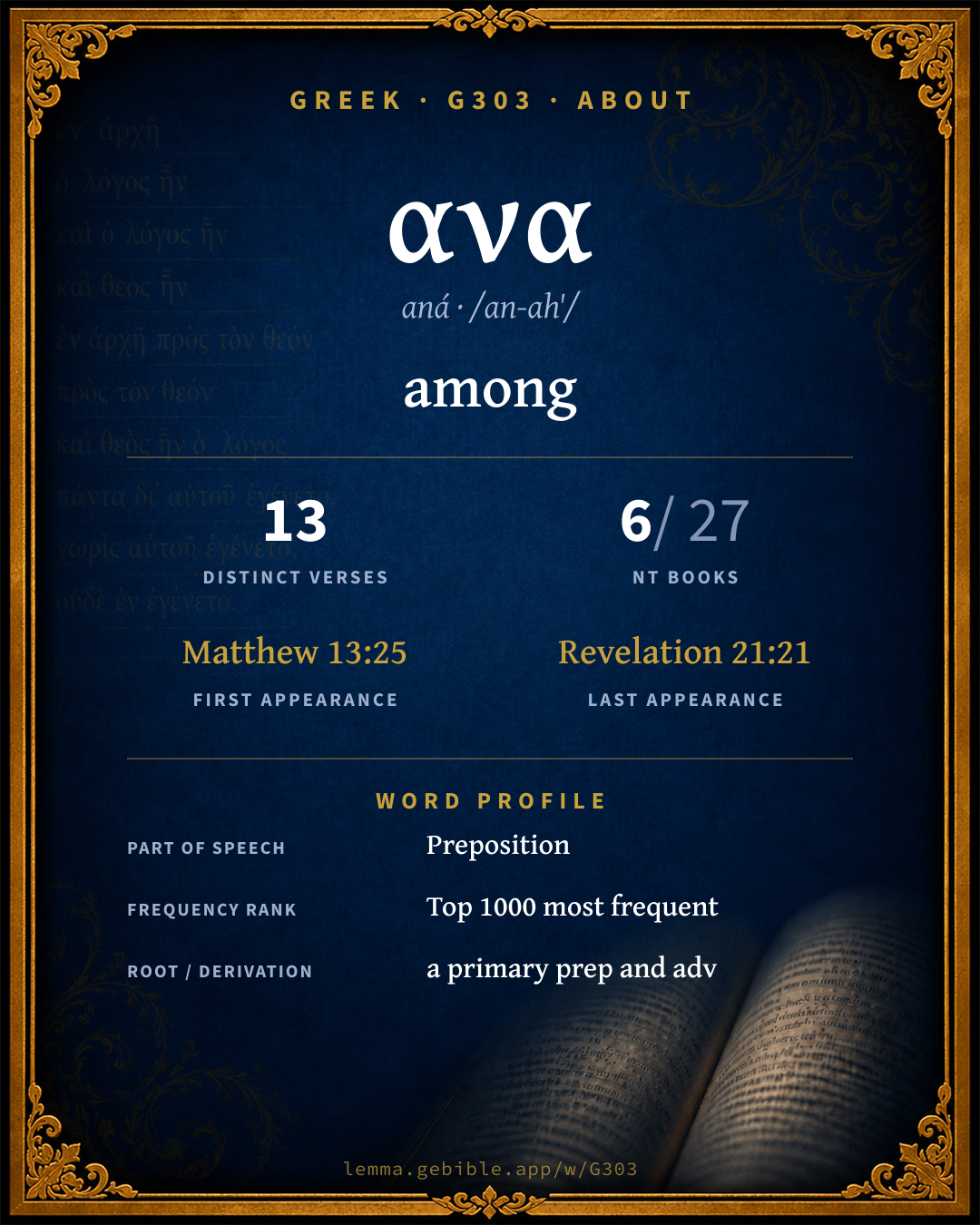
ἀνά
among
Full lexicon entry — Thayer's Greek Lexicon
From Thayer's Greek Lexicon
Where this word appears
Grammar key — what these labels mean
Part of speech
- Preposition
- A relational word governing a noun in a particular case.
Every verse where G303 appears in the Book of Mark — 1 distinct verse. Click any verse to open its interlinear word-by-word view. Verse text shown in the World English Bible for context — . Each verse’s Greek form is shown with its reference; the English is not keyword-highlighted, since the data carries no word-level English alignment. Use “Compare translations” on any verse to read it across multiple English versions. This concordance covers the Greek New Testament; Septuagint (Greek Old Testament) occurrences of this word are not indexed here.
Mark
About this entry
At a glance — auto-summarized from this page’s data, not written by a person. Every figure links to its source below. This summary describes the numbers; it doesn’t interpret them.
ανα (aná) is a Greek preposition most often rendered “among.” Scripture first uses it in Matthew 13:25. Spanning 13 verses in 6 books, it ranks among the uncommon words of the Greek New Testament. Sharing its root, it stands alongside αναβαινω, αναβαλλομαι and αναβιβαζω. The sections below give every sense, occurrence, and version rendering.
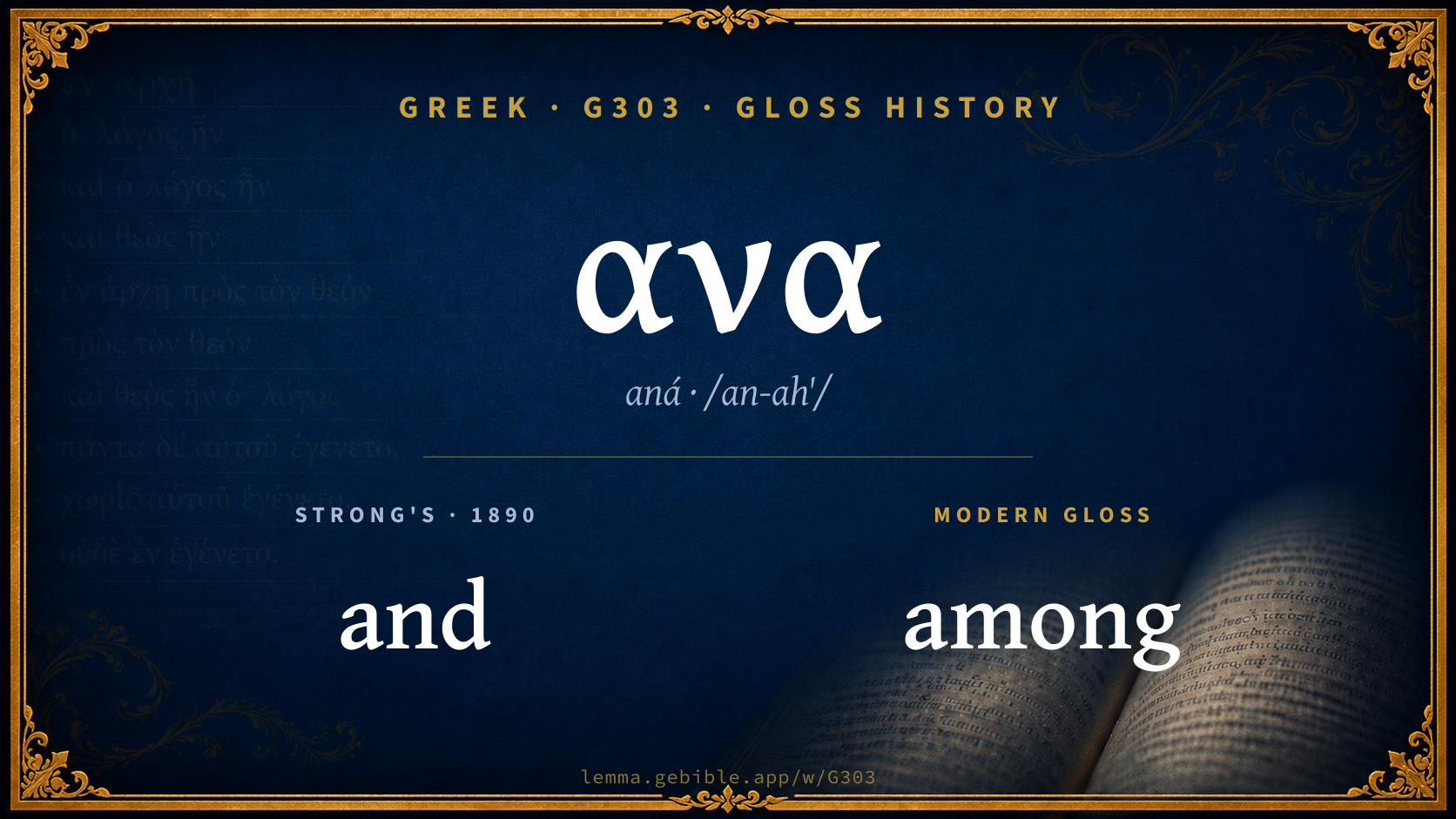
Gloss history
Strong's 1890 vs modern scholarship
About this word
Strong's G303 catalogs a Greek word from the Greek New Testament.
These counts are not copied from any lexicon or concordance. They are computed here, from the morphology-tagged Greek New Testament. What Lemma adds →
- 13
- distinct verses
- The word appears in 13 distinct verses.
- 6 / 27
- NT books
- The word appears in 6 of 27 New Testament books.
- #863
- by frequency
- Top 1000 most frequent Greek words (rank 863 of 5,347 Greek words by occurrence).
View all 13 occurrences in the concordance →
Most concentrated in
- Matthew 3 verses 23%
- Luke 3 verses 23%
- Revelation 3 verses 23%
By section of the New Testament
By traditional corpus
Conventional, traditional groupings — biblical authorship is debated, so this is a traditional corpus grouping, not an authorship claim. Some books belong to more than one corpus (Luke is in both the Gospels and the Lukan corpus, and so on), so these shares overlap and need not total 100%. Each figure is a share of the word’s 13 distinct verses.
- Gospels 8 verses · 62%
- Johannine 4 verses · 31%
- Lukan (Luke–Acts) 3 verses · 23%
- Revelation 3 verses · 23%
- Pauline corpus 2 verses · 15%
How translations render this word
Counts come from each version’s own published word-to-Strong’s tagging or interlinear alignment — an approximate guide to how each version renders this word, not a word-level alignment the data otherwise carries. Because each total is that version’s own tagged count, the per-version totals vary from one another and need not match the appearance or distinct-verse counts above. These counts may also differ from a printed concordance because Lemma counts each distinctly tagged rendering and does not collapse phrase taggings into a single head-word total. This is a fixed set of word-tagged versions (KJV, ASV, BSB, ULT) and does not change with the reading translation you choose elsewhere. Each version’s license is shown beside its name below (and on Sources).
- King James Version: By 4×, Apiece 2×
- American Standard Version: By 2×, Every man 2×
- Berean Standard Bible: In 3×, Each 2×
- unfoldingWord Literal Text: Each 4×
King James Version Public Domain
Renders G303 across 13 tagged occurrences — most commonly:
Plus 7 renderings that appear only once — usually multi-word phrases or single function words the recovered tagging swept in, not distinct renderings. Not rendered by a distinct English word in 2 further occurrences.
American Standard Version Public Domain
Renders G303 across 13 tagged occurrences — most commonly:
Plus 9 renderings that appear only once — usually multi-word phrases or single function words the recovered tagging swept in, not distinct renderings.
Berean Standard Bible Public Domain
Renders G303 across 8 tagged occurrences — most commonly:
Plus 3 renderings that appear only once — usually multi-word phrases or single function words the recovered tagging swept in, not distinct renderings. Not rendered by a distinct English word in 3 further occurrences.
unfoldingWord Literal Text CC BY-SA 4.0
Renders G303 across 12 tagged occurrences — most commonly:
Plus 8 renderings that appear only once — usually multi-word phrases or single function words the recovered tagging swept in, not distinct renderings.
Senses in Thayer's
The 1 sense Thayer's distinguishes for this word, in lexicon order (not ranked by frequency or importance). The full entry — with sub-senses — is in the Lexicon Entry tab.
- into the midst, in the midst, amidst, among, between
Word origin
Origin: a primary prep and adv
A primary preposition and adverb; properly up ; but (by extension) used (distributively) severally or (locally) at (etc.): - and apiece by each every (man) in through. In compounds (as a prefix) it often means (by implication) repetition intensity reversal etc.
— Strong’s Exhaustive Concordance (1890), public domain.
Same root — word family
Other Thayer's entries built from the same root as G303, grouped by Strong’s listed origin. These share a root / origin per the lexicon — not necessarily a shared meaning. Each links to that word’s own entry.
Derived from this word
- αναβαινω anabaínō G305 to ascend
- αναβαλλομαι anabállomai G306 to delay
- αναβιβαζω anabibázō G307 to draw up
- αναβλεπω anablépō G308 to look up
- αναβοαω anaboáō G310 to cry out
- αναγγελλω anangéllō G312 to announce
- αναγενναω anagennáō G313 to be born again
- αναγινωσκω anaginṓskō G314 to recognize
- αναγκη anánkē G318 necessity
- αναγνωριζομαι anagnōrízomai G319 to recognize
- αναγω anágō G321 to lead up
- αναδεικνυμι anadeíknymi G322 to proclaim
- αναδεχομαι anadéchomai G324 to take up
- αναδιδωμι anadídōmi G325 to give forth
- αναζαω anazáō G326 to live again
- αναζητεω anazētéō G327 to search out
- αναζωννυμι anazṓnnymi G328 to gird up
- αναζωπυρεω anazōpyréō G329 to inflame
- αναθαλλω anathállō G330 to sprout up
- αναθεωρεω anatheōréō G333 to observe
- αναιρεω anairéō G337 to take away
- ανακαθιζω anakathízō G339 to sit up
- ανακαινιζω anakainízō G340 to renew
- ανακαινοω anakainóō G341 to make new
+52 more words derive from G303 (not shown).
Compare all same-root words → Showing 4 of 77 — not the complete family. They share a root, not necessarily a meaning.
Septuagint usage
The same Greek word ανα appears 342 times in the Greek Old Testament (Septuagint), across 223 verses in 30 books.
- 342
- LXX occurrences
- Tagged occurrences of this Greek word in the Septuagint.
- 223
- verses
- Distinct Septuagint verses containing this word.
- 30 / 39
- OT books
- The word appears in 30 of the 39 Old Testament books.
Sample Septuagint occurrences
- Genesis 1:4 ἀνά
- Exodus 8:19 ἀνά
- Leviticus 10:10 ἀνά
- Numbers 7:89 ἀνά
- Deuteronomy 1:1 ἀνά
- Joshua 3:4 ἀνά
- Judges 4:5 ἀνά
- Ruth 1:17 ἀνά
- 1 Samuel 7:12 ἀνά
- 2 Samuel 3:1 ἀνά
- 1 Kings 3:9 ἀνά
- 2 Kings 2:11 ἀνά
Septuagint occurrences (same lexeme)
Every verse where the same Strong’s number (G303) appears in the Greek Septuagint — showing the first 50 of 223. Verse text shown in the World English Bible for context; the Greek form is the matched word — the English is not keyword-highlighted.
- Genesis 1:4 ἀνά God saw the light, and saw that it was good. God divided the light from the darkness.
- Genesis 1:6 ἀνά God said, "Let there be an expanse in the midst of the waters, and let it divide the waters from the waters."
- Genesis 1:7 ἀνά God made the expanse, and divided the waters which were under the expanse from the waters which were above the expanse, and it was so.
- Genesis 1:14 ἀνά God said, "Let there be lights in the expanse of sky to divide the day from the night; and let them be for signs, and for seasons, and for days and years;
- Genesis 1:18 ἀνά and to rule over the day and over the night, and to divide the light from the darkness. God saw that it was good.
- Genesis 3:15 ἀνά I will put enmity between you and the woman, and between your offspring and her offspring. He will bruise your head, and you will bruise his heel."
- Genesis 9:12 ἀνά God said, "This is the token of the covenant which I make between me and you and every living creature that is with you, for perpetual generations:
- Genesis 9:13 ἀνά I set my rainbow in the cloud, and it will be for a sign of a covenant between me and the earth.
- Genesis 9:15 ἀνά and I will remember my covenant, which is between me and you and every living creature of all flesh, and the waters will no more become a flood to destroy all flesh.
- Genesis 9:16 ἀνά The rainbow will be in the cloud. I will look at it, that I may remember the everlasting covenant between God and every living creature of all flesh that is on the earth."
- Genesis 9:17 ἀνά God said to Noah, "This is the token of the covenant which I have established between me and all flesh that is on the earth."
- Genesis 10:12 ἀνά and Resen between Nineveh and Calah (the same is the great city).
- Genesis 13:3 ἀνά He went on his journeys from the South even to Bethel, to the place where his tent had been at the beginning, between Bethel and Ai,
- Genesis 13:7 ἀνά There was a strife between the herdsmen of Abram's cattle and the herdsmen of Lot's cattle: and the Canaanite and the Perizzite lived then in the land.
- Genesis 13:8 ἀνά Abram said to Lot, "Please, let there be no strife between me and you, and between my herdsmen and your herdsmen; for we are relatives.
- Genesis 15:17 ἀνά It came to pass that, when the sun went down, and it was dark, behold, a smoking furnace, and a flaming torch passed between these pieces.
- Genesis 16:5 ἀνά Sarai said to Abram, "This wrong is your fault. I gave my handmaid into your bosom, and when she saw that she had conceived, I was despised in her eyes. Yahweh judge between me and you."
- Genesis 16:14 ἀνά Therefore the well was called Beer Lahai Roi. Behold, it is between Kadesh and Bered.
- Genesis 17:2 ἀνά I will make my covenant between me and you, and will multiply you exceedingly."
- Genesis 17:7 ἀνά I will establish my covenant between me and you and your seed after you throughout their generations for an everlasting covenant, to be a God to you and to your seed after you.
- Genesis 17:10 ἀνά This is my covenant, which you shall keep, between me and you and your seed after you. Every male among you shall be circumcised.
- Genesis 17:11 ἀνά You shall be circumcised in the flesh of your foreskin. It will be a token of a covenant between me and you.
- Genesis 20:1 ἀνά Abraham traveled from there toward the land of the South, and lived between Kadesh and Shur. He lived as a foriegner in Gerar.
- Genesis 23:15 ἀνά "My lord, listen to me. What is a piece of land worth four hundred shekels of silver between me and you? Therefore bury your dead."
- Genesis 24:22 ἀνά It happened, as the camels had done drinking, that the man took a golden ring of half a shekel weight, and two bracelets for her hands of ten shekels weight of gold,
- Genesis 26:28 ἀνά They said, "We saw plainly that Yahweh was with you. We said, 'Let there now be an oath between us, even between us and you, and let us make a covenant with you,
- Genesis 30:36 ἀνά He set three days' journey between himself and Jacob, and Jacob fed the rest of Laban's flocks.
- Genesis 31:37 ἀνά Now that you have felt around in all my stuff, what have you found of all your household stuff? Set it here before my relatives and your relatives, that they may judge between us two.
- Genesis 31:44 ἀνά Now come, let us make a covenant, you and I; and let it be for a witness between me and you."
- Genesis 31:46 ἀνά Jacob said to his relatives, "Gather stones." They took stones, and made a heap. They ate there by the heap.
- Genesis 31:48 ἀνά Laban said, "This heap is witness between me and you this day." Therefore it was named Galeed
- Genesis 31:49 ἀνά and Mizpah, for he said, "Yahweh watch between me and you, when we are absent one from another.
- Genesis 31:53 ἀνά The God of Abraham, and the God of Nahor, the God of their father, judge between us." Then Jacob swore by the fear of his father, Isaac.
- Genesis 32:17 ἀνά He commanded the foremost, saying, "When Esau, my brother, meets you, and asks you, saying, 'Whose are you? Where are you going? Whose are these before you?'
- Genesis 36:2 ανα Esau took his wives from the daughters of Canaan: Adah the daughter of Elon, the Hittite; and Oholibamah the daughter of Anah, the daughter of Zibeon, the Hivite;
- Genesis 36:14 ανα These were the sons of Oholibamah, the daughter of Anah, the daughter of Zibeon, Esau's wife: she bore to Esau Jeush, Jalam, and Korah.
- Genesis 36:20 ανα These are the sons of Seir the Horite, the inhabitants of the land: Lotan, Shobal, Zibeon, Anah,
- Genesis 36:25 ανα These are the children of Anah: Dishon and Oholibamah, the daughter of Anah.
- Genesis 36:29 ανα These are the chiefs who came of the Horites: chief Lotan, chief Shobal, chief Zibeon, chief Anah,
- Genesis 42:23 ἀνά They didn't know that Joseph understood them; for there was an interpreter between them.
- Genesis 49:14 ἀνά "Issachar is a strong donkey, Lying down between the saddlebags.
- Exodus 8:19 ἀνά Then the magicians said to Pharaoh, "This is the finger of God:" and Pharaoh's heart was hardened, and he didn't listen to them; as Yahweh had spoken.
- Exodus 9:4 ἀνά Yahweh will make a distinction between the cattle of Israel and the cattle of Egypt; and there shall nothing die of all that belongs to the children of Israel."'"
- Exodus 11:7 ἀνά But against any of the children of Israel a dog won't even bark or move its tongue, against man or animal; that you may know that Yahweh makes a distinction between the Egyptians and Israel.
- Exodus 14:2 ἀνά "Speak to the children of Israel, that they turn back and encamp before Pihahiroth, between Migdol and the sea, before Baal Zephon. You shall encamp opposite it by the sea.
- Exodus 14:20 ἀνά It came between the camp of Egypt and the camp of Israel; and there was the cloud and the darkness, yet gave it light by night: and the one didn't come near the other all the night.
- Exodus 16:1 ἀνά They took their journey from Elim, and all the congregation of the children of Israel came to the wilderness of Sin, which is between Elim and Sinai, on the fifteenth day of the second month after their departing out of the land of Egypt.
- Exodus 22:10 ἀνά "If a man delivers to his neighbor a donkey, an ox, a sheep, or any animal to keep, and it dies or is injured, or driven away, no man seeing it;
- Exodus 25:22 ἀνά There I will meet with you, and I will tell you from above the mercy seat, from between the two cherubim which are on the ark of the testimony, all that I command you for the children of Israel.
- Exodus 26:10 ἀνά You shall make fifty loops on the edge of the one curtain that is outmost in the coupling, and fifty loops on the edge of the curtain which is outmost in the second coupling.
These are occurrences of the same Greek lexeme (G303) in the Septuagint — not a translation of any one Hebrew word. The store carries no word-level Hebrew↔Greek alignment, so no Hebrew original is asserted here. Counts come from the recovered LXX Strong's tagging — high-frequency vocabulary is well covered, while rare or late forms may be untagged — so they reflect tagged occurrences and may slightly undercount.