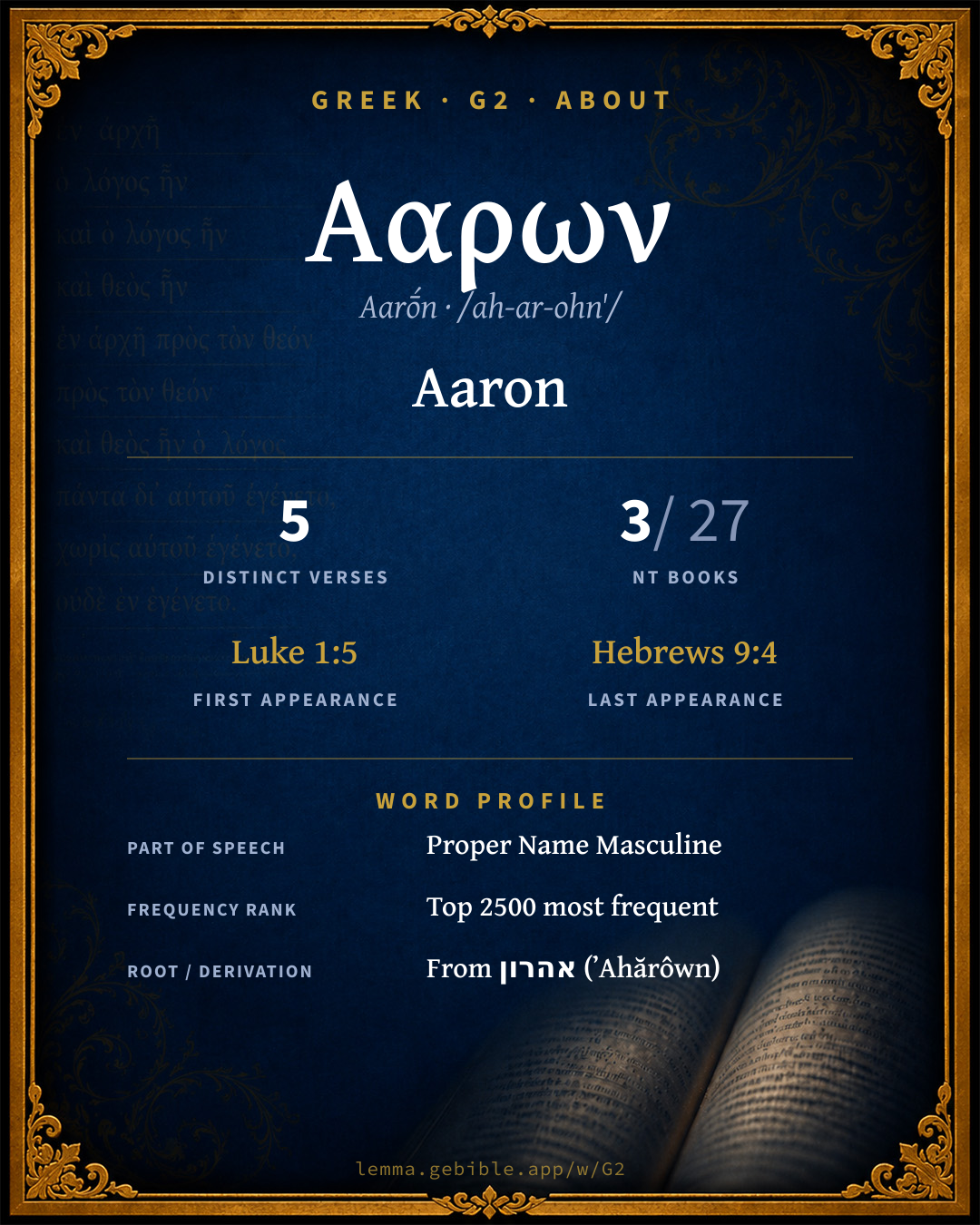
Ἀαρών
Aaron
Thayer's lists 2 entries for ‘Aaron’ fuller range ↓
Full lexicon entry — Thayer's Greek Lexicon
From Thayer's Greek Lexicon
Where this word appears
Every verse where G2 appears in the Book of Acts — 1 distinct verse. Click any verse to open its interlinear word-by-word view. Verse text shown in the World English Bible for context — . Each verse’s Greek form is shown with its reference; the English is not keyword-highlighted, since the data carries no word-level English alignment. Use “Compare translations” on any verse to read it across multiple English versions. This concordance covers the Greek New Testament; Septuagint (Greek Old Testament) occurrences of this word are not indexed here.
Acts
About this entry
At a glance — auto-summarized from this page’s data, not written by a person. Every figure links to its source below. This summary describes the numbers; it doesn’t interpret them.
“Aaron” is the headline sense of the Greek name Ααρων (Aarṓn). It occurs a mere 5 verses across Scripture. More than half of its appearances fall in Hebrews. Its earliest occurrence is Luke 1:5. See 5-verse concordance and the renderings breakdown below.
Gloss history
Strong's 1890 vs modern scholarship

About this word
Strong's G2 catalogs a Greek word from the Greek New Testament.
These counts are not copied from any lexicon or concordance. They are computed here, from the morphology-tagged Greek New Testament. What Lemma adds →
- 5
- distinct verses
- The word appears in 5 distinct verses.
- 3 / 27
- NT books
- The word appears in 3 of 27 New Testament books.
- #1,648
- by frequency
- Top 2500 most frequent Greek words (rank 1,648 of 5,347 Greek words by occurrence).
View all 5 occurrences in the concordance →
By section of the New Testament
By traditional corpus
Conventional, traditional groupings — biblical authorship is debated, so this is a traditional corpus grouping, not an authorship claim. Some books belong to more than one corpus (Luke is in both the Gospels and the Lukan corpus, and so on), so these shares overlap and need not total 100%. Each figure is a share of the word’s 5 distinct verses.
- Hebrews 3 verses · 60%
- Lukan (Luke–Acts) 2 verses · 40%
- Gospels 1 verse · 20%
How translations render this word
Counts come from each version’s own published word-to-Strong’s tagging or interlinear alignment — an approximate guide to how each version renders this word, not a word-level alignment the data otherwise carries. Because each total is that version’s own tagged count, the per-version totals vary from one another and need not match the appearance or distinct-verse counts above. These counts may also differ from a printed concordance because Lemma counts each distinctly tagged rendering and does not collapse phrase taggings into a single head-word total. This is a fixed set of word-tagged versions (KJV, ASV, BSB, ULT) and does not change with the reading translation you choose elsewhere. Each version’s license is shown beside its name below (and on Sources).
- King James Version: Aaron 3×
- American Standard Version: Aaron 4×
- Berean Standard Bible: Aaron 4×
- unfoldingWord Literal Text: Aaron 5×
King James Version Public Domain
Renders G2 across 5 tagged occurrences — most commonly:
Plus 2 renderings that appear only once — usually multi-word phrases or single function words the recovered tagging swept in, not distinct renderings.
American Standard Version Public Domain
Renders G2 across 5 tagged occurrences — most commonly:
Plus 1 rendering that appears only once — usually multi-word phrases or single function words the recovered tagging swept in, not distinct renderings.
Berean Standard Bible Public Domain
Renders G2 across 5 tagged occurrences — most commonly:
Plus 1 rendering that appears only once — usually multi-word phrases or single function words the recovered tagging swept in, not distinct renderings.
unfoldingWord Literal Text CC BY-SA 4.0
Renders G2 across 6 tagged occurrences — most commonly:
Plus 1 rendering that appears only once — usually multi-word phrases or single function words the recovered tagging swept in, not distinct renderings.
Senses in Thayer's
The 2 senses Thayer's distinguishes for this word, in lexicon order (not ranked by frequency or importance). The full entry — with sub-senses — is in the Lexicon Entry tab.
- Aaron = "light-bringer"
- the brother of Moses, the first high priest of Israel and head of the whole priestly order
Word origin
Derived from אהרון (ʼAhărôwn) (H175) — Aaron.
Of hebrew origin [ H175 ]; Aaron the brother of Moses : - Aaron.
— Strong’s Exhaustive Concordance (1890), public domain.
Forms in the corpus
The 2 distinct written forms G2 takes in the Greek New Testament, most frequent first — each parse links to that case’s occurrences in the concordance.
| Form | Parsing | Example | Uses |
|---|---|---|---|
| Ἀαρών Aarṓn | Noun, Proper, indeclinable | Luke 1:5 | 3 |
| Ἀαρὼν Aarṑn | Noun, Proper, indeclinable | Hebrews 7:11 | 2 |
Bible dictionary
Public-domain dictionary articles matched to this entry by name (Aaron). A biblical name can be shared by more than one person or place, so an article may treat several.
Easton's Bible Dictionary · M. G. Easton, 1897
The eldest son of Amram and Jochebed, a daughter of Levi (Ex. 6:20). Some explain the name as meaning mountaineer, others mountain of strength, illuminator. He was born in Egypt three years before his brother Moses, and a number of years after his sister Miriam (2:1, 4; 7:7). He married Elisheba, the daughter of Amminadab of the house of Judah (6:23; 1 Chr. 2:10), by whom he had four sons, Nadab and Abihu, Eleazar and Ithamar. When the time for the deliverance of Isarael out of Egypt drew nigh, he was sent by God (Ex. 4:14, 27-30) to meet his long-absent brother, that he might co-operate with him in all that they were required to do in bringing about the Exodus. He was to be the "mouth" or "prophet" of Moses, i.e., was to speak for him, because he was a man of a ready utterance (7:1, 2, 9, 10, 19). He was faithful to his trust, and stood by Moses in all his interviews with Pharaoh.
When the ransomed tribes fought their first battle with Amalek in Rephidim, Moses stood on a hill overlooking the scene of the conflict with the rod of God in his outstretched hand. On this occasion he was attended by Aaron and Hur, his sister's husband, who held up his wearied hands till Joshua and the chosen warriors of Israel gained the victory (17:8-13).
Afterwards, when encamped before Sinai, and when Moses at the command of God ascended the mount to receive the tables of the law, Aaron and his two sons, Nadab and Abihu, along with seventy of the elders of Israel, were permitted to accompany him part of the way, and to behold afar off the manifestation of the glory of Israel's God (Ex. 19:24; 24:9-11). While Moses remained on the mountain with God, Aaron returned unto the people; and yielding through fear, or ignorance, or instability of character, to their clamour, made unto them a golden calf, and set it up as an object of worship (Ex. 32:4; Ps. 106:19). On the return of Moses to the camp, Aaron was sternly rebuked by him for the part he had acted in this matter; but he interceded for him before God, who forgave his sin (Deut. 9:20).
On the mount, Moses received instructions regarding the system of worship which was to be set up among the people; and in accordance therewith Aaron and his sons were consecrated to the priest's office (Lev. 8; 9). Aaron, as high priest, held henceforth the prominent place appertaining to that office.
When Israel had reached Hazeroth, in "the wilderness of Paran," Aaron joined with his sister Miriam in murmuring against Moses, "because of the Ethiopian woman whom he had married," probably after the death of Zipporah. But the Lord vindicated his servant Moses, and punished Miriam with leprosy (Num. 12). Aaron acknowledged his own and his sister's guilt, and at the intercession of Moses they were forgiven.
Twenty years after this, when the children of Israel were encamped in the wilderness of Paran, Korah, Dathan, and Abiram conspired against Aaron and his sons; but a fearful judgment from God fell upon them, and they were destroyed, and the next day thousands of the people also perished by a fierce pestilence, the ravages of which were only stayed by the interposition of Aaron (Num. 16). That there might be further evidence of the divine appointment of Aaron to the priestly office, the chiefs of the tribes were each required to bring to Moses a rod bearing on it the name of his tribe. And these, along with the rod of Aaron for the tribe of Levi, were laid up overnight in the tabernacle, and in the morning it was found that while the other rods remained unchanged, that of Aaron "for the house of Levi" budded, blossomed, and yielded almonds (Num. 17:1-10). This rod was afterwards preserved in the tabernacle (Heb. 9:4) as a memorial of the divine attestation of his appointment to the priesthood.
Aaron was implicated in the sin of his brother at Meribah (Num. 20:8-13), and on that account was not permitted to enter the Promised Land. When the tribes arrived at Mount Hor, "in the edge of the land of Edom," at the command of God Moses led Aaron and his son Eleazar to the top of that mountain, in the sight of all the people. There he stripped Aaron of his priestly vestments, and put them upon Eleazar; and there Aaron died on the top of the mount, being 123 years old (Num. 20:23-29. Comp. Deut. 10:6; 32:50), and was "gathered unto his people." The people, "even all the house of Israel," mourned for him thirty days. Of Aaron's sons two survived him, Eleazar, whose family held the high-priesthood till the time of Eli; and Ithamar, in whose family, beginning with Eli, the high-priesthood was held till the time of Solomon. Aaron's other two sons had been struck dead (Lev. 10:1, 2) for the daring impiety of offering "strange fire" on the alter of incense.
The Arabs still show with veneration the traditionary site of Aaron's grave on one of the two summits of Mount Hor, which is marked by a Mohammedan chapel. His name is mentioned in the Koran, and there are found in the writings of the rabbins many fabulous stories regarding him.
He was the first anointed priest. His descendants, "the house of Aaron," constituted the priesthood in general. In the time of David they were very numerous (1 Chr. 12:27). The other branches of the tribe of Levi held subordinate positions in connection with the sacred office. Aaron was a type of Christ in his official character as the high priest. His priesthood was a "shadow of heavenly things," and was intended to lead the people of Israel to look forward to the time when "another priest" would arise "after the order of Melchizedek" (Heb. 6:20). (See MOSES.)
Smith's Bible Dictionary · William Smith, 1863
(a teacher, or lofty), the son of Amram and Jochebed, and the older brother of Moses and Miriam. (Numbers 26:59; 33:39) (B.C. 1573.) He was a Levite, and is first mentioned in (Exodus 4:14) He was appointed by Jehovah to be the interpreter, (Exodus 4:16) of his brother Moses, who was "slow of speech;" and accordingly he was not only the organ of communication with the Israelites and with Pharaoh, (Exodus 4:30; 7:2) but also the actual instrument of working most of the miracles of the Exodus. (Exodus 7:19) etc. On the way to Mount Sinai, during the battle with Amalek, Aaron with Hur stayed up the weary hands of Moses when they were lifted up for the victory of Israel. (Exodus 17:9) He is mentioned as dependent upon his brother and deriving all his authority from him. Left, on Moses' departure into Sinai, to guide the people, Aaron is tried for a moment on his own responsibility, and he fails from a weak inability to withstand the demand of the people for visible "gods to go before them," by making an image of Jehovah, in the well-known form of Egyptian idolatry (Apis or Mnevis). He repented of his sin, and Moses gained forgiveness for him. (9:20) Aaron was not consecrated by Moses to the new office of the high priesthood. (Exodus 29:9) From this time the history of Aaron is almost entirely that of the priesthood, and its chief feature is the great rebellion of Korah and the Levites. Leaning, as he seems to have done, wholly on Moses, it is not strange that he should have shared his sin at Meribah and its punishment. See Moses. (Numbers 20:10-12) Aaron's death seems to have followed very speedily. It took place on Mount Hor, after the transference of his robes and office to Eleazar. (Numbers 20:28) This mount is still called the "Mountain of Aaron." See Hor. The wife of Aaron was Elisheba, (Exodus 6:23) and the two sons who survived him, Eleazar and Ithamar. The high priesthood descended to the former, and to his descendants until the time of Eli, who, although of the house of Ithamar, received the high priesthood and transmitted it to his children; with them it continued till the accession of Solomon, who took it from Abiathar and restored it to Zadok (of the house of Eleazar). See Abiathar.
Hitchcock's Bible Names Dictionary · Roswell D. Hitchcock, 1869
a teacher; lofty; mountain of strength
Classic public-domain reference works; full attribution on Sources.
Septuagint usage
The same Greek word Ααρων appears 356 times in the Greek Old Testament (Septuagint), across 335 verses in 12 books.
- 356
- LXX occurrences
- Tagged occurrences of this Greek word in the Septuagint.
- 335
- verses
- Distinct Septuagint verses containing this word.
- 12 / 39
- OT books
- The word appears in 12 of the 39 Old Testament books.
Sample Septuagint occurrences
- Exodus 4:14 ααρων
- Leviticus 1:5 ἀαρών
- Numbers 1:3 ἀαρών
- Deuteronomy 9:20 ἀαρών
- Joshua 21:4 ἀαρών
- Judges 20:28 ἀαρών
- 1 Samuel 12:6 ἀαρών
- 1 Chronicles 5:29 ἀαρών
- 2 Chronicles 13:9 ἀαρών
- Ezra 7:5 ἀαρών
- Psalms 76:21 ἀαρών
- Micah 6:4 ἀαρών
Septuagint occurrences (same lexeme)
Every verse where the same Strong’s number (G2) appears in the Greek Septuagint — showing the first 50 of 335. Verse text shown in the World English Bible for context; the Greek form is the matched word — the English is not keyword-highlighted.
- Exodus 4:14 ααρων The anger of Yahweh was kindled against Moses, and he said, "What about Aaron, your brother, the Levite? I know that he can speak well. Also, behold, he comes forth to meet you. When he sees you, he will be glad in his heart.
- Exodus 4:27 ααρων Yahweh said to Aaron, "Go into the wilderness to meet Moses." He went, and met him on God's mountain, and kissed him.
- Exodus 4:28 ααρων Moses told Aaron all the words of Yahweh with which he had sent him, and all the signs with which he had charged him.
- Exodus 4:29 ααρων Moses and Aaron went and gathered together all the elders of the children of Israel.
- Exodus 4:30 ααρων Aaron spoke all the words which Yahweh had spoken to Moses, and did the signs in the sight of the people.
- Exodus 5:1 ααρων Afterward Moses and Aaron came, and said to Pharaoh, "This is what Yahweh, the God of Israel, says, 'Let my people go, that they may hold a feast to me in the wilderness.'"
- Exodus 5:4 ααρων The king of Egypt said to them, "Why do you, Moses and Aaron, take the people from their work? Get back to your burdens!"
- Exodus 5:20 ααρων They met Moses and Aaron, who stood in the way, as they came forth from Pharaoh:
- Exodus 6:13 ααρων Yahweh spoke to Moses and to Aaron, and gave them a charge to the children of Israel, and to Pharaoh king of Egypt, to bring the children of Israel out of the land of Egypt.
- Exodus 6:20 ααρων Amram took Jochebed his father's sister to himself as wife; and she bore him Aaron and Moses: and the years of the life of Amram were a hundred and thirty-seven years.
- Exodus 6:23 ααρων Aaron took Elisheba, the daughter of Amminadab, the sister of Nahshon, as his wife; and she bore him Nadab and Abihu, Eleazar and Ithamar.
- Exodus 6:25 ααρων Eleazar Aaron's son took one of the daughters of Putiel as his wife; and she bore him Phinehas. These are the heads of the fathers' houses of the Levites according to their families.
- Exodus 6:26 ααρων These are that Aaron and Moses, to whom Yahweh said, "Bring out the children of Israel from the land of Egypt according to their hosts."
- Exodus 6:27 ααρων These are those who spoke to Pharaoh king of Egypt, to bring out the children of Israel from Egypt. These are that Moses and Aaron.
- Exodus 7:1 ααρων Yahweh said to Moses, "Behold, I have made you as God to Pharaoh; and Aaron your brother shall be your prophet.
- Exodus 7:2 ααρων You shall speak all that I command you; and Aaron your brother shall speak to Pharaoh, that he let the children of Israel go out of his land.
- Exodus 7:6 ααρων Moses and Aaron did so. As Yahweh commanded them, so they did.
- Exodus 7:7 ααρων Moses was eighty years old, and Aaron eighty-three years old, when they spoke to Pharaoh.
- Exodus 7:8 ααρων Yahweh spoke to Moses and to Aaron, saying,
- Exodus 7:9 ααρων "When Pharaoh speaks to you, saying, 'Perform a miracle!' then you shall tell Aaron, 'Take your rod, and cast it down before Pharaoh, that it become a serpent.'"
- Exodus 7:10 ααρων Moses and Aaron went in to Pharaoh, and they did so, as Yahweh had commanded: and Aaron cast down his rod before Pharaoh and before his servants, and it became a serpent.
- Exodus 7:12 ααρων For they cast down every man his rod, and they became serpents: but Aaron's rod swallowed up their rods.
- Exodus 7:19 ααρων Yahweh said to Moses, "Tell Aaron, 'Take your rod, and stretch out your hand over the waters of Egypt, over their rivers, over their streams, and over their pools, and over all their ponds of water, that they may become blood; and there shall be blood throughout all the land of Egypt, both in vessels of wood and in vessels of stone.'"
- Exodus 7:20 ααρων Moses and Aaron did so, as Yahweh commanded; and he lifted up the rod, and struck the waters that were in the river, in the sight of Pharaoh, and in the sight of his servants; and all the waters that were in the river were turned to blood.
- Exodus 8:1 ααρων Yahweh spoke to Moses, Go in to Pharaoh, and tell him, "This is what Yahweh says, 'Let my people go, that they may serve me.
- Exodus 8:2 ααρων If you refuse to let them go, behold, I will plague all your borders with frogs:
- Exodus 8:4 ααρων and the frogs shall come up both on you, and on your people, and on all your servants.'"
- Exodus 8:8 ααρων Then Pharaoh called for Moses and Aaron, and said, "Entreat Yahweh, that he take away the frogs from me, and from my people; and I will let the people go, that they may sacrifice to Yahweh."
- Exodus 8:12 ααρων Moses and Aaron went out from Pharaoh, and Moses cried to Yahweh concerning the frogs which he had brought on Pharaoh.
- Exodus 8:13 ααρων Yahweh did according to the word of Moses, and the frogs died out of the houses, out of the courts, and out of the fields.
- Exodus 8:21 ααρων Else, if you will not let my people go, behold, I will send swarms of flies on you, and on your servants, and on your people, and into your houses: and the houses of the Egyptians shall be full of swarms of flies, and also the ground whereon they are.
- Exodus 9:8 ααρων Yahweh said to Moses and to Aaron, "Take to you handfuls of ashes of the furnace, and let Moses sprinkle it toward the sky in the sight of Pharaoh.
- Exodus 9:27 ααρων Pharaoh sent, and called for Moses and Aaron, and said to them, "I have sinned this time. Yahweh is righteous, and I and my people are wicked.
- Exodus 10:3 ααρων Moses and Aaron went in to Pharaoh, and said to him, "This is what Yahweh, the God of the Hebrews, says: 'How long will you refuse to humble yourself before me? Let my people go, that they may serve me.
- Exodus 10:8 ααρων Moses and Aaron were brought again to Pharaoh, and he said to them, "Go, serve Yahweh your God; but who are those who will go?"
- Exodus 10:16 ααρων Then Pharaoh called for Moses and Aaron in haste, and he said, "I have sinned against Yahweh your God, and against you.
- Exodus 10:24 ααρων Pharaoh called to Moses, and said, "Go, serve Yahweh. Only let your flocks and your herds stay behind. Let your little ones also go with you."
- Exodus 11:10 ααρων Moses and Aaron did all these wonders before Pharaoh, and Yahweh hardened Pharaoh's heart, and he didn't let the children of Israel go out of his land.
- Exodus 12:1 ααρων Yahweh spoke to Moses and Aaron in the land of Egypt, saying,
- Exodus 12:28 ααρων The children of Israel went and did so; as Yahweh had commanded Moses and Aaron, so they did.
- Exodus 12:31 ααρων He called for Moses and Aaron by night, and said, "Rise up, get out from among my people, both you and the children of Israel; and go, serve Yahweh, as you have said!
- Exodus 12:43 ααρων Yahweh said to Moses and Aaron, "This is the ordinance of the Passover. There shall no foreigner eat of it,
- Exodus 12:50 ααρων Thus did all the children of Israel. As Yahweh commanded Moses and Aaron, so they did.
- Exodus 15:20 ααρων Miriam the prophetess, the sister of Aaron, took a tambourine in her hand; and all the women went out after her with tambourines and with dances.
- Exodus 16:2 ααρων The whole congregation of the children of Israel murmured against Moses and against Aaron in the wilderness;
- Exodus 16:6 ααρων Moses and Aaron said to all the children of Israel, "At evening, then you shall know that Yahweh has brought you out from the land of Egypt;
- Exodus 16:9 ααρων Moses said to Aaron, "Tell all the congregation of the children of Israel, 'Come near before Yahweh, for he has heard your murmurings.'"
- Exodus 16:10 ααρων It happened, as Aaron spoke to the whole congregation of the children of Israel, that they looked toward the wilderness, and, behold, the glory of Yahweh appeared in the cloud.
- Exodus 16:33 ααρων Moses said to Aaron, "Take a pot, and put an omer-full of manna in it, and lay it up before Yahweh, to be kept throughout your generations."
- Exodus 16:34 ααρων As Yahweh commanded Moses, so Aaron laid it up before the Testimony, to be kept.
These are occurrences of the same Greek lexeme (G2) in the Septuagint — not a translation of any one Hebrew word. The store carries no word-level Hebrew↔Greek alignment, so no Hebrew original is asserted here. Counts come from the recovered LXX Strong's tagging — high-frequency vocabulary is well covered, while rare or late forms may be untagged — so they reflect tagged occurrences and may slightly undercount.