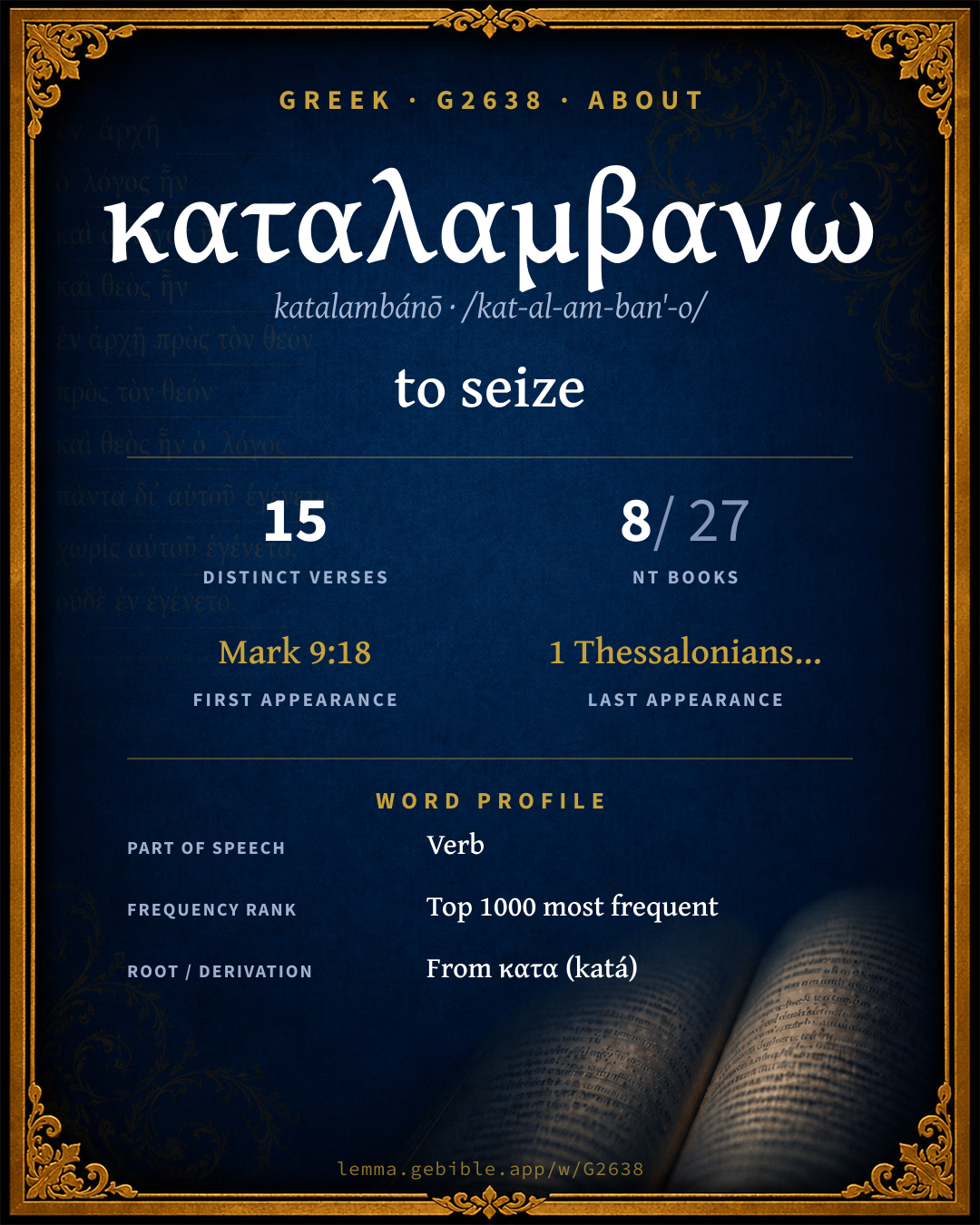
καταλαμβάνω
to seize
‘to seize’ is one of 4 main senses fuller range ↓
Full lexicon entry — Thayer's Greek Lexicon
From Thayer's Greek Lexicon
Where this word appears
See every Aorist-tense verb in the Greek New Testament →
Grammar key — what these labels mean
Part of speech
- Verb
- An action or state-of-being word.
Tense
- Aorist
- Action viewed as a simple whole, without regard to duration — often past (perfective aspect).
- Present
- Ongoing or general action in present time (imperfective aspect).
- Perfect
- A completed past action with continuing present results.
Voice
- Active
- The subject performs the action.
- Middle
- The subject acts on or for itself, or with special interest in the action.
- Passive
- The subject receives the action.
Mood
- Indicative
- States a fact or asks a factual question (the mood of reality).
- Subjunctive
- Expresses probability, purpose, or possibility (the mood of contingency).
- Infinitive
- A verbal noun (“to write”), unmarked for person or number.
- Participle
- A verbal adjective (“writing,” “having written”).
Case
- Nominative
- The case of the subject (and the predicate nominative).
- Accusative
- The case of the direct object and of extent.
Person
- 3rd person
- The one spoken about (“he / she / it / they”).
- 1st person
- The speaker (“I / we”).
- 2nd person
- The one addressed (“you”).
Gender
- Masculine
- Grammatically masculine.
- Feminine
- Grammatically feminine.
Number
- Singular
- One.
- Plural
- More than one.
Grammatical forms 12 distinct
- Verb, Aorist, Active, Indicative, 3rd person, Singular 3 times (19%)
- Verb, Aorist, Active, Subjunctive, 3rd person, Singular 3 times (19%)
- Verb, Aorist, Active, Subjunctive, 1st person, Singular 1 time (6%)
- Verb, Aorist, Active, Subjunctive, 2nd person, Plural 1 time (6%)
- Verb, Aorist, Middle, Indicative, 1st person, Singular 1 time (6%)
- Verb, Aorist, Middle, Infinitive 1 time (6%)
- Verb, Aorist, Middle, Participle, Nominative, Plural, Masculine 1 time (6%)
- Verb, Aorist, Passive, Indicative, 1st person, Singular 1 time (6%)
+4 more forms (4 occurrences)
Parsed forms decoded from the imported morphology (Robinson–Tischendorf, public domain), counted across 16 parsed occurrences — not distinct verses.
Every verse where G2638 appears — 15 distinct verses across 8 books. Click any verse to open its interlinear word-by-word view. Verse text shown in the World English Bible for context — . Each verse’s Greek form is shown with its reference; the English is not keyword-highlighted, since the data carries no word-level English alignment. Use “Compare translations” on any verse to read it across multiple English versions. This concordance covers the Greek New Testament; Septuagint (Greek Old Testament) occurrences of this word are not indexed here.
Mark 1 verse
John 5 verses
- John 1:5 κατέλαβεν aor act ind 3sg The light shines in the darkness, and the darkness hasn't overcome it.
- John 6:17 κατέλαβεν aor act ind 3sg and they entered into the boat, and were going over the sea to Capernaum. It was now dark, and Jesus had not come to them.
- John 8:3 κατειλημμένην perf pass ptcp acc sg fem The scribes and the Pharisees brought a woman taken in adultery. Having set her in the midst,
- John 8:4 κατειλήφθη aor pass ind 3sg they told him, "Teacher, we found this woman in adultery, in the very act.
- John 12:35 καταλάβῃ aor act subj 3sg Jesus therefore said to them, "Yet a little while the light is with you. Walk while you have the light, that darkness doesn't overtake you. He who walks in the darkness doesn't know where he is going.
Acts 3 verses
- Acts 4:13 καταλαβόμενοι aor mid ptcp nom pl masc Now when they saw the boldness of Peter and John, and had perceived that they were unlearned and ignorant men, they marveled. They recognized that they had been with Jesus.
- Acts 10:34 καταλαμβάνομαι pres mid ind 1sg Peter opened his mouth and said, "Truly I perceive that God doesn't show favoritism;
- Acts 25:25 κατελαβόμην aor mid ind 1sg But when I found that he had committed nothing worthy of death, and as he himself appealed to the emperor I determined to send him.
Romans 1 verse
1 Corinthians 1 verse
Ephesians 1 verse
Philippians 2 verses
- Philippians 3:12 καταλάβω κατελήμφθην aor act subj 1sg aor pass ind 1sg Not that I have already obtained, or am already made perfect; but I press on, if it is so that I may take hold of that for which also I was taken hold of by Christ Jesus.
- Philippians 3:13 κατειληφέναι perf act inf Brothers, I don't regard myself as yet having taken hold, but one thing I do. Forgetting the things which are behind, and stretching forward to the things which are before,
1 Thessalonians 1 verse
About this entry
At a glance — auto-summarized from this page’s data, not written by a person. Every figure links to its source below. This summary describes the numbers; it doesn’t interpret them.
“to seize” is the headline sense of the Greek verb καταλαμβανω (katalambánō). Catalogued under 4 senses, its meaning is not single-sense. With 15 verses in 8 books, it is an uncommon word in the Greek New Testament. It concentrates in John, which alone accounts for 33% of its uses. Scripture first uses it in Mark 9:18. See the sense tree, 15-verse concordance, and the renderings breakdown below.
Gloss history
Strong's 1890 vs modern scholarship

About this word
Strong's G2638 catalogs a Greek word from the Greek New Testament.
These counts are not copied from any lexicon or concordance. They are computed here, from the morphology-tagged Greek New Testament. What Lemma adds →
- 15
- distinct verses
- The word appears in 15 distinct verses.
- 8 / 27
- NT books
- The word appears in 8 of 27 New Testament books.
- #726
- by frequency
- Top 1000 most frequent Greek words (rank 726 of 5,347 Greek words by occurrence).
View all 15 occurrences in the concordance →
Most concentrated in
- John 5 verses 33%
- Acts 3 verses 20%
- Philippians 2 verses 13%
By section of the New Testament
By traditional corpus
Conventional, traditional groupings — biblical authorship is debated, so this is a traditional corpus grouping, not an authorship claim. Some books belong to more than one corpus (Luke is in both the Gospels and the Lukan corpus, and so on), so these shares overlap and need not total 100%. Each figure is a share of the word’s 15 distinct verses.
- Gospels 6 verses · 40%
- Pauline corpus 6 verses · 40%
- Johannine 5 verses · 33%
- Lukan (Luke–Acts) 3 verses · 20%
How translations render this word
Counts come from each version’s own published word-to-Strong’s tagging or interlinear alignment — an approximate guide to how each version renders this word, not a word-level alignment the data otherwise carries. Because each total is that version’s own tagged count, the per-version totals vary from one another and need not match the appearance or distinct-verse counts above. These counts may also differ from a printed concordance because Lemma counts each distinctly tagged rendering and does not collapse phrase taggings into a single head-word total. This is a fixed set of word-tagged versions (KJV, ASV, BSB, ULT) and does not change with the reading translation you choose elsewhere. Each version’s license is shown beside its name below (and on Sources).
- King James Version: Come upon 1×, Comprehend 1×, Comprehended 1×
- American Standard Version: Apprehend 1×, Apprehended 1×, Attained to 1×
- Berean Standard Bible: Caught 1×, Comprehend 1×, Found 1×
- unfoldingWord Literal Text: It 2×
King James Version Public Domain
Renders G2638 across 15 tagged occurrences — most commonly:
Plus other, less common renderings.
American Standard Version Public Domain
Renders G2638 across 15 tagged occurrences — most commonly:
Plus other, less common renderings.
Berean Standard Bible Public Domain
Renders G2638 across 15 tagged occurrences — most commonly:
Plus other, less common renderings.
unfoldingWord Literal Text CC BY-SA 4.0
Renders G2638 across 20 tagged occurrences — most commonly:
Plus 18 renderings that appear only once — usually multi-word phrases or single function words the recovered tagging swept in, not distinct renderings.
Senses in Thayer's
The 4 senses Thayer's distinguishes for this word, in lexicon order (not ranked by frequency or importance). The full entry — with sub-senses — is in the Lexicon Entry tab.
- to lay hold of so as to make one's own, to obtain, attain to, to make one's own, to take into one's self, appropriate
- to seize upon, take possession of
- to detect, catch
- to lay hold of with the mind
Word origin
Derived from κατα (katá) (G2596) — down.
Forms in the corpus
The 12 distinct written forms G2638 takes in the Greek New Testament, most frequent first — each parse links to that tense’s occurrences in the concordance.
Same root — word family
Other Thayer's entries built from the same root as G2638, grouped by Strong’s listed origin. These share a root / origin per the lexicon — not necessarily a shared meaning. Each links to that word’s own entry.
Derives from
Shares the same root
- καθα kathá G2505 according as
- καθαιρεω kathairéō G2507 to tear down
- καθαπτω katháptō G2510 to fasten down
- καθεδρα kathédra G2515 seat
- καθεζομαι kathézomai G2516 to sit down
- καθεξης kathexēs G2517 in order
- καθευδω katheúdō G2518 to fall asleep
- καθηγητης kathēgētḗs G2519 guide
- καθηκω kathḗkō G2520 to come down
- καθημαι káthēmai G2521 to sit down
- καθημερινος kathēmerinós G2522 daily
- καθιημι kathíēmi G2524 to send down
- καθιστημι kathístēmi G2525 to place
- καθο kathó G2526 according to what
- καθολου kathólou G2527 wholly
- καθοπλιζω kathoplízō G2528 to arm
- καθοραω kathoráō G2529 to see clearly
- καθοτι kathóti G2530 according to what
- καθως kathṓs G2531 according as
- καμμυω kammýō G2576 to close eyes
- καταβαινω katabaínō G2597 to descend
- καταβαλλω katabállō G2598 to cast down
- καταβαρεω katabaréō G2599 to weigh down
- καταβιβαζω katabibázō G2601 to bring down
+103 more words share this root (not shown).
Compare all same-root words → Showing 4 of 129 — not the complete family. They share a root, not necessarily a meaning.
Septuagint usage
The same Greek word καταλαμβανω appears 101 times in the Greek Old Testament (Septuagint), across 94 verses in 27 books.
- 101
- LXX occurrences
- Tagged occurrences of this Greek word in the Septuagint.
- 94
- verses
- Distinct Septuagint verses containing this word.
- 27 / 39
- OT books
- The word appears in 27 of the 39 Old Testament books.
Sample Septuagint occurrences
- Genesis 19:19 καταλαμβάνω
- Exodus 15:9 καταλαμβάνω
- Leviticus 26:5 καταλαμβάνω
- Numbers 11:23 καταλαμβάνω
- Deuteronomy 19:6 καταλαμβάνω
- Joshua 2:5 καταλαμβάνω
- Judges 1:5 καταλαμβάνω
- 1 Samuel 30:8 καταλαμβάνω
- 2 Samuel 5:7 καταλαμβάνω
- 1 Kings 5:14 καταλαμβάνω
- 2 Kings 12:18 καταλαμβάνω
- 1 Chronicles 11:5 καταλαμβάνω
Septuagint occurrences (same lexeme)
Every verse where the same Strong’s number (G2638) appears in the Greek Septuagint — showing the first 50 of 94. Verse text shown in the World English Bible for context; the Greek form is the matched word — the English is not keyword-highlighted.
- Genesis 19:19 καταλαμβάνω See now, your servant has found favor in your sight, and you have magnified your loving kindness, which you have shown to me in saving my life. I can't escape to the mountain, lest evil overtake me, and I die.
- Genesis 31:23 καταλαμβάνω He took his relatives with him, and pursued after him seven days' journey. He overtook him in the mountain of Gilead.
- Genesis 31:25 καταλαμβάνω Laban caught up with Jacob. Now Jacob had pitched his tent in the mountain, and Laban with his relatives encamped in the mountain of Gilead.
- Genesis 44:4 καταλαμβάνω When they had gone out of the city, and were not yet far off, Joseph said to his steward, "Up, follow after the men. When you overtake them, ask them, 'Why have you rewarded evil for good?
- Exodus 15:9 καταλαμβάνω The enemy said, 'I will pursue, I will overtake, I will divide the spoil. My desire shall be satisfied on them. I will draw my sword, my hand shall destroy them.'
- Exodus 22:3 καταλαμβάνω If the sun has risen on him, there shall be guilt of bloodshed for him; he shall make restitution. If he has nothing, then he shall be sold for his theft.
- Leviticus 26:5 καταλαμβάνω Your threshing shall reach to the vintage, and the vintage shall reach to the sowing time; and you shall eat your bread to the full, and dwell in your land safely.
- Numbers 11:23 καταλαμβάνω Yahweh said to Moses, Has Yahweh's hand grown short? now shall you see whether my word shall happen to you or not.
- Numbers 21:32 καταλαμβάνω Moses sent to spy out Jazer; and they took the towns of it, and drove out the Amorites who were there.
- Numbers 32:23 καταλαμβάνω But if you will not do so, behold, you have sinned against Yahweh; and be sure your sin will find you out.
- Deuteronomy 19:6 καταλαμβάνω lest the avenger of blood pursue the manslayer, while his heart is hot, and overtake him, because the way is long, and strike him mortally; whereas he was not worthy of death, inasmuch as he didn't hate him in time past.
- Deuteronomy 28:15 καταλαμβάνω But it shall come to pass, if you will not listen to the voice of Yahweh your God, to observe to do all his commandments and his statutes which I command you this day, that all these curses shall come on you, and overtake you.
- Deuteronomy 28:45 καταλαμβάνω All these curses shall come on you, and shall pursue you, and overtake you, until you are destroyed; because you didn't listen to the voice of Yahweh your God, to keep his commandments and his statutes which he commanded you:
- Joshua 2:5 καταλαμβάνω and it happened about the time of the shutting of the gate, when it was dark, that the men went out; where the men went I don't know: pursue after them quickly; for you will overtake them.
- Joshua 8:19 καταλαμβάνω The ambush arose quickly out of their place, and they ran as soon as he had stretched out his hand, and entered into the city, and took it; and they hurried and set the city on fire.
- Joshua 10:19 καταλαμβάνω but don't stay; pursue after your enemies, and strike the hindmost of them; don't allow them to enter into their cities: for Yahweh your God has delivered them into your hand.
- Joshua 11:10 καταλαμβάνω Joshua turned back at that time, and took Hazor, and struck the king of it with the sword: for Hazor before was the head of all those kingdoms.
- Joshua 19:48 καταλαμβάνω This is the inheritance of the tribe of the children of Dan according to their families, these cities with their villages.
- Judges 1:5 καταλαμβάνω They found Adoni-bezek in Bezek; and they fought against him, and they struck the Canaanites and the Perizzites.
- Judges 1:6 καταλαμβάνω But Adoni-bezek fled; and they pursued after him, and caught him, and cut off his thumbs and his great toes.
- Judges 1:8 καταλαμβάνω The children of Judah fought against Jerusalem, and took it, and struck it with the edge of the sword, and set the city on fire.
- Judges 1:12 καταλαμβάνω Caleb said, He who strikes Kiriath Sepher, and takes it, to him will I give Achsah my daughter as wife.
- Judges 1:13 καταλαμβάνω Othniel the son of Kenaz, Caleb's younger brother, took it: and he gave him Achsah his daughter as wife.
- Judges 3:28 καταλαμβάνω He said to them, Follow after me; for Yahweh has delivered your enemies the Moabites into your hand. They went down after him, and took the fords of the Jordan against the Moabites, and didn't allow a man to pass over.
- Judges 7:24 καταλαμβάνω Gideon sent messengers throughout all the hill-country of Ephraim, saying, Come down against Midian, and take before them the waters, as far as Beth Barah, even the Jordan. So all the men of Ephraim were gathered together, and took the waters as far as Beth Barah, even the Jordan.
- Judges 9:45 καταλαμβάνω Abimelech fought against the city all that day; and he took the city, and killed the people who were therein: and he beat down the city, and sowed it with salt.
- Judges 9:50 καταλαμβάνω Then went Abimelech to Thebez, and encamped against Thebez, and took it.
- Judges 12:5 καταλαμβάνω The Gileadites took the fords of the Jordan against the Ephraimites. It was so, that when [any of] the fugitives of Ephraim said, Let me go over, the men of Gilead said to him, Are you an Ephraimite? If he said, No;
- Judges 18:22 καταλαμβάνω When they were a good way from the house of Micah, the men who were in the houses near to Micah's house were gathered together, and overtook the children of Dan.
- Judges 20:39 καταλαμβάνω The men of Israel turned in the battle, and Benjamin began to strike and kill of the men of Israel about thirty persons; for they said, Surely they are struck down before us, as in the first battle.
- 1 Samuel 30:8 καταλαμβάνω David inquired of Yahweh, saying, If I pursue after this troop, shall I overtake them? He answered him, Pursue; for you shall surely overtake [them], and shall without fail recover [all].
- 2 Samuel 5:7 καταλαμβάνω Nevertheless David took the stronghold of Zion; the same is the city of David.
- 2 Samuel 8:4 καταλαμβάνω David took from him one thousand seven hundred horsemen, and twenty thousand footmen: and David hamstrung all the chariot horses, but reserved of them for one hundred chariots.
- 2 Samuel 12:26 καταλαμβάνω Now Joab fought against Rabbah of the children of Ammon, and took the royal city.
- 2 Samuel 12:27 καταλαμβάνω Joab sent messengers to David, and said, I have fought against Rabbah; yes, I have taken the city of waters.
- 2 Samuel 12:28 καταλαμβάνω Now therefore gather the rest of the people together, and encamp against the city, and take it; lest I take the city, and it be called after my name.
- 2 Samuel 12:29 καταλαμβάνω David gathered all the people together, and went to Rabbah, and fought against it, and took it.
- 2 Samuel 15:14 καταλαμβάνω David said to all his servants who were with him at Jerusalem, Arise, and let us flee; for else none of us shall escape from Absalom: make speed to depart, lest he overtake us quickly, and bring down evil on us, and strike the city with the edge of the sword.
- 2 Samuel 21:11 καταλαμβάνω It was told David what Rizpah the daughter of Aiah, the concubine of Saul, had done.
- 1 Kings 5:14 καταλαμβάνω He sent them to Lebanon, ten thousand a month by courses; a month they were in Lebanon, and two months at home; and Adoniram was over the men subject to forced labor.
- 1 Kings 11:14 καταλαμβάνω Yahweh raised up an adversary to Solomon, Hadad the Edomite: he was of the king's seed in Edom.
- 1 Kings 16:18 καταλαμβάνω It happened, when Zimri saw that the city was taken, that he went into the castle of the king's house, and burnt the king's house over him with fire, and died,
- 1 Kings 18:44 καταλαμβάνω It happened at the seventh time, that he said, "Behold, a small cloud, like a man's hand, is rising out of the sea." He said, Go up, tell Ahab, Make ready [your chariot], and get you down, that the rain not stop you.
- 2 Kings 12:18 καταλαμβάνω Jehoash king of Judah took all the holy things that Jehoshaphat and Jehoram and Ahaziah, his fathers, kings of Judah, had dedicated, and his own holy things, and all the gold that was found in the treasures of the house of Yahweh, and of the king's house, and sent it to Hazael king of Syria: and he went away from Jerusalem.
- 2 Kings 18:10 καταλαμβάνω At the end of three years they took it: in the sixth year of Hezekiah, which was the ninth year of Hoshea king of Israel, Samaria was taken.
- 2 Kings 25:5 καταλαμβάνω But the army of the Chaldeans pursued after the king, and overtook him in the plains of Jericho; and all his army was scattered from him.
- 1 Chronicles 11:5 καταλαμβάνω The inhabitants of Jebus said to David, You shall not come in here. Nevertheless David took the stronghold of Zion; the same is the city of David.
- 1 Chronicles 18:4 καταλαμβάνω David took from him one thousand chariots, and seven thousand horsemen, and twenty thousand footmen; and David hamstrung all the chariot horses, but reserved of them for one hundred chariots.
- 2 Chronicles 9:20 καταλαμβάνω All king Solomon's drinking vessels were of gold, and all the vessels of the house of the forest of Lebanon were of pure gold: silver was nothing accounted of in the days of Solomon.
- 2 Chronicles 13:19 καταλαμβάνω Abijah pursued after Jeroboam, and took cities from him, Bethel with the towns of it, and Jeshanah with the towns of it, and Ephron with the towns of it.
These are occurrences of the same Greek lexeme (G2638) in the Septuagint — not a translation of any one Hebrew word. The store carries no word-level Hebrew↔Greek alignment, so no Hebrew original is asserted here. Counts come from the recovered LXX Strong's tagging — high-frequency vocabulary is well covered, while rare or late forms may be untagged — so they reflect tagged occurrences and may slightly undercount.