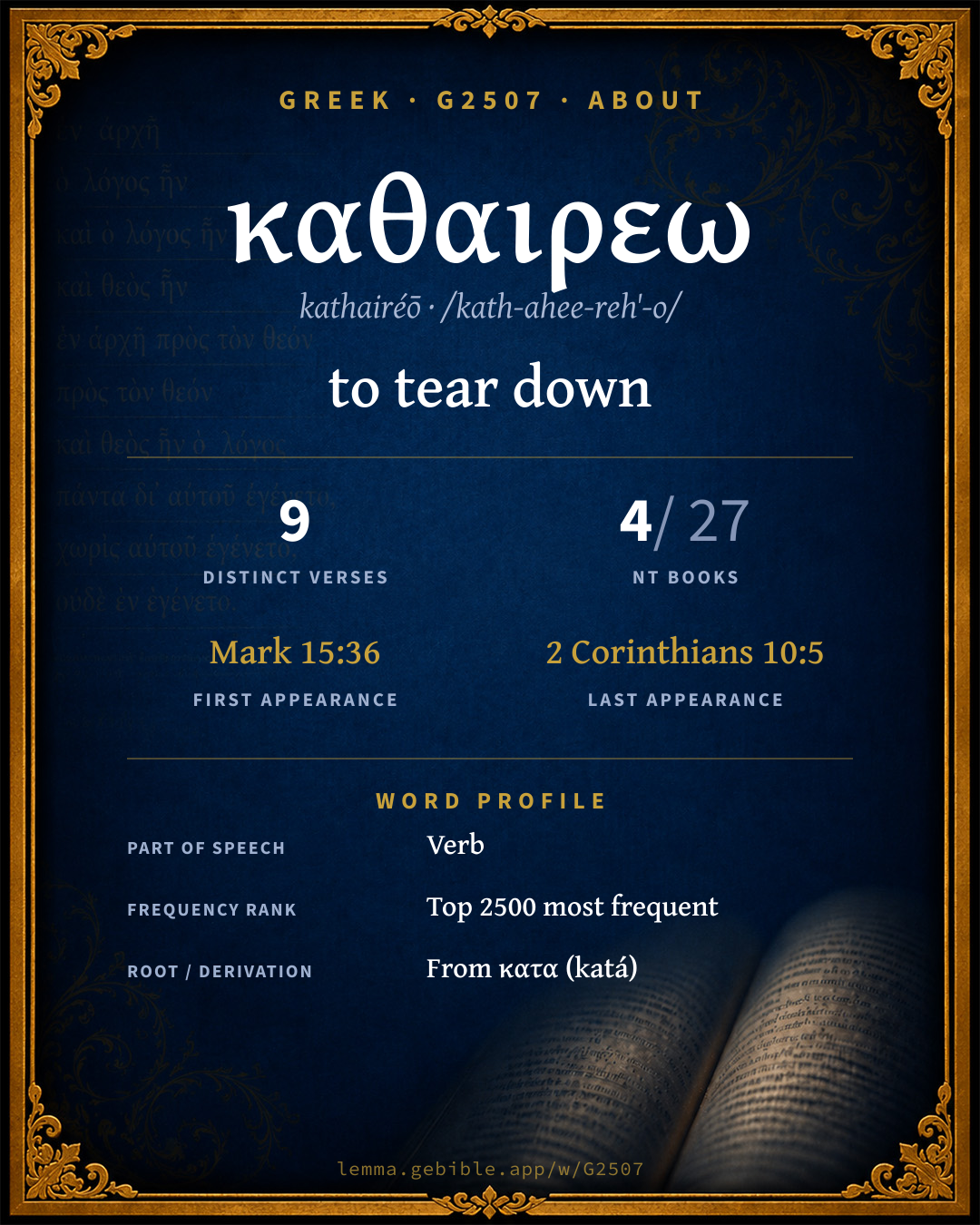
καθαιρέω
to tear down
‘to tear down’ is one of 3 main senses fuller range ↓
Full lexicon entry — Thayer's Greek Lexicon
From Thayer's Greek Lexicon
Where this word appears
See every Aorist-tense verb in the Greek New Testament →
Grammar key — what these labels mean
Part of speech
- Verb
- An action or state-of-being word.
Tense
- Aorist
- Action viewed as a simple whole, without regard to duration — often past (perfective aspect).
- Future
- Action expected in future time.
- Present
- Ongoing or general action in present time (imperfective aspect).
Voice
- Active
- The subject performs the action.
- Passive
- The subject receives the action.
Mood
- Participle
- A verbal adjective (“writing,” “having written”).
- Indicative
- States a fact or asks a factual question (the mood of reality).
- Infinitive
- A verbal noun (“to write”), unmarked for person or number.
Case
- Nominative
- The case of the subject (and the predicate nominative).
Person
- 3rd person
- The one spoken about (“he / she / it / they”).
- 1st person
- The speaker (“I / we”).
Gender
- Masculine
- Grammatically masculine.
Number
- Singular
- One.
- Plural
- More than one.
Every verse where G2507 appears in the Book of Luke — 3 distinct verses. Click any verse to open its interlinear word-by-word view. Verse text shown in the World English Bible for context — . Each verse’s Greek form is shown with its reference; the English is not keyword-highlighted, since the data carries no word-level English alignment. Use “Compare translations” on any verse to read it across multiple English versions. This concordance covers the Greek New Testament; Septuagint (Greek Old Testament) occurrences of this word are not indexed here.
Luke
- Luke 1:52 καθεῖλεν aor act ind 3sg He has put down princes from their thrones. And has exalted the lowly.
- Luke 12:18 καθελῶ fut act ind 1sg He said, 'This is what I will do. I will pull down my barns, and build bigger ones, and there I will store all my grain and my goods.
- Luke 23:53 καθελὼν aor act ptcp nom sg masc He took it down, and wrapped it in a linen cloth, and laid him in a tomb that was cut in stone, where no one had ever been laid.
About this entry
At a glance — auto-summarized from this page’s data, not written by a person. Every figure links to its source below. This summary describes the numbers; it doesn’t interpret them.
καθαιρεω — transliterated kathairéō — is a Greek verb carrying the sense “to tear down.” It first appears in Mark 15:36. The Greek New Testament uses it across 9 verses — uncommon. More than a third of its appearances fall in Luke. Its lexical range runs to 3 senses. See the sense tree, 9-verse concordance, and the renderings breakdown below.
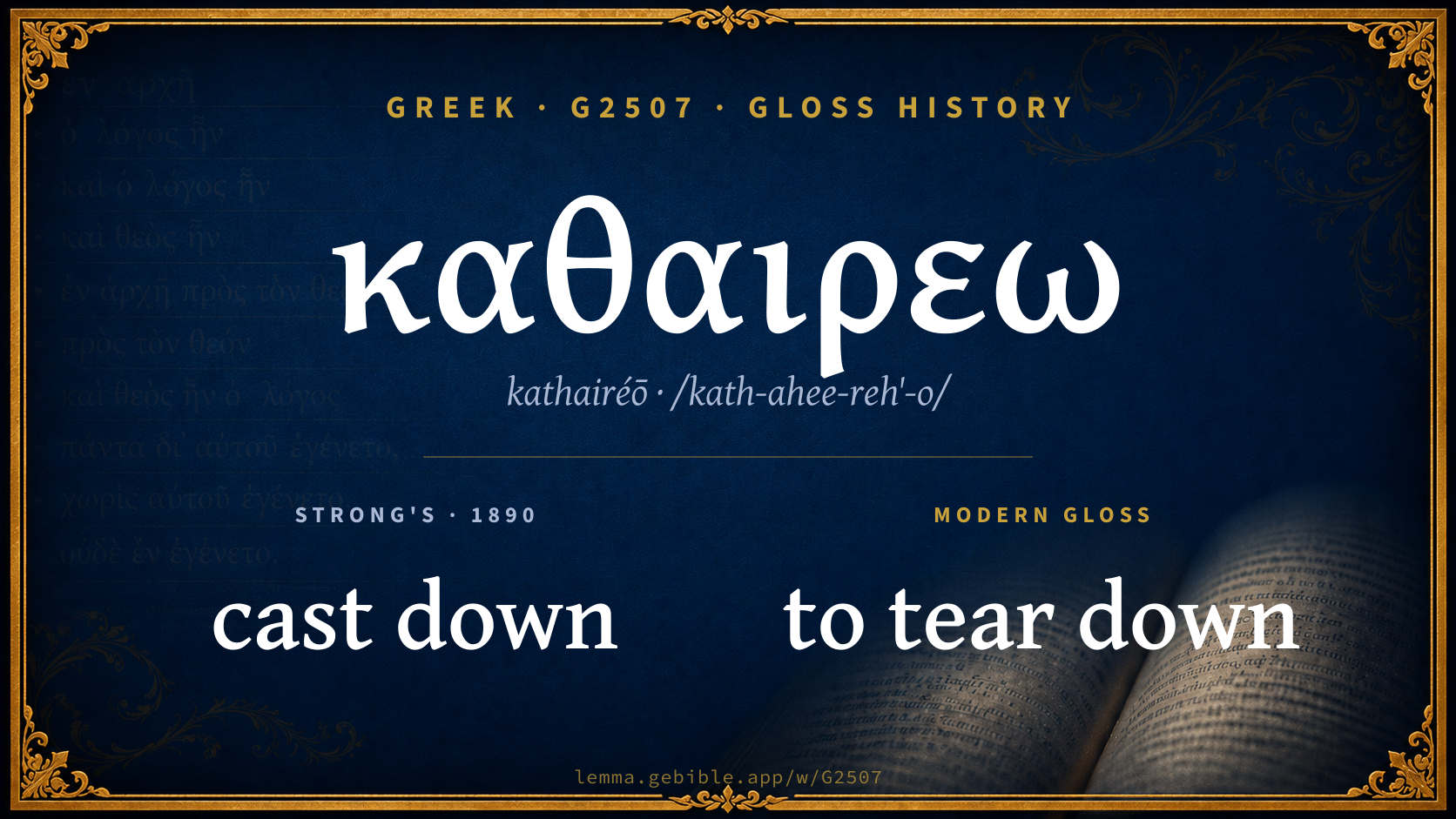
Gloss history
Strong's 1890 vs modern scholarship
About this word
Strong's G2507 catalogs a Greek word from the Greek New Testament.
These counts are not copied from any lexicon or concordance. They are computed here, from the morphology-tagged Greek New Testament. What Lemma adds →
- 9
- distinct verses
- The word appears in 9 distinct verses.
- 4 / 27
- NT books
- The word appears in 4 of 27 New Testament books.
- #1,140
- by frequency
- Top 2500 most frequent Greek words (rank 1,140 of 5,347 Greek words by occurrence).
View all 9 occurrences in the concordance →
By section of the New Testament
By traditional corpus
Conventional, traditional groupings — biblical authorship is debated, so this is a traditional corpus grouping, not an authorship claim. Some books belong to more than one corpus (Luke is in both the Gospels and the Lukan corpus, and so on), so these shares overlap and need not total 100%. Each figure is a share of the word’s 9 distinct verses.
- Lukan (Luke–Acts) 6 verses · 67%
- Gospels 5 verses · 56%
- Pauline corpus 1 verse · 11%
How translations render this word
Counts come from each version’s own published word-to-Strong’s tagging or interlinear alignment — an approximate guide to how each version renders this word, not a word-level alignment the data otherwise carries. Because each total is that version’s own tagged count, the per-version totals vary from one another and need not match the appearance or distinct-verse counts above. These counts may also differ from a printed concordance because Lemma counts each distinctly tagged rendering and does not collapse phrase taggings into a single head-word total. This is a fixed set of word-tagged versions (KJV, ASV, BSB, ULT) and does not change with the reading translation you choose elsewhere. Each version’s license is shown beside its name below (and on Sources).
- King James Version: Down 2×
- American Standard Version: Down 3×
- Berean Standard Bible: Deposed 1×, Having vanquished 1×, He has brought down 1×
- unfoldingWord Literal Text: Down 3×, Having taken 2×
King James Version Public Domain
Renders G2507 across 11 tagged occurrences — most commonly:
Plus 9 renderings that appear only once — usually multi-word phrases or single function words the recovered tagging swept in, not distinct renderings.
American Standard Version Public Domain
Renders G2507 across 12 tagged occurrences — most commonly:
Plus 9 renderings that appear only once — usually multi-word phrases or single function words the recovered tagging swept in, not distinct renderings.
Berean Standard Bible Public Domain
Renders G2507 across 9 tagged occurrences — most commonly:
unfoldingWord Literal Text CC BY-SA 4.0
Renders G2507 across 12 tagged occurrences — most commonly:
Plus 7 renderings that appear only once — usually multi-word phrases or single function words the recovered tagging swept in, not distinct renderings.
Senses in Thayer's
The 3 senses Thayer's distinguishes for this word, in lexicon order (not ranked by frequency or importance). The full entry — with sub-senses — is in the Lexicon Entry tab.
- without the notion of violence: to detach from the cross, one crucified
- with the use of force: to throw down, cast down
- the subtle reasonings (of opponents) likened to a fortress, i.e. to refute, to destroy
Word origin
Derived from κατα (katá) (G2596) — down.
Forms in the corpus
The 7 distinct written forms G2507 takes in the Greek New Testament, most frequent first — each parse links to that tense’s occurrences in the concordance.
| Form | Parsing | Example | Uses |
|---|---|---|---|
| καθελὼν kathelṑn | Verb, Aorist, Active, Participle, Nominative, Singular, Masculine | Mark 15:46 | 3 |
| καθαιρεῖσθαι kathaireîsthai | Verb, Present, Passive, Infinitive | Acts 19:27 | 1 |
| καθαιροῦντες kathairoûntes | Verb, Present, Active, Participle, Nominative, Plural, Masculine | 2 Corinthians 10:5 | 1 |
| καθελεῖν katheleîn | Verb, Aorist, Active, Infinitive | Mark 15:36 | 1 |
| καθελόντες kathelóntes | Verb, Aorist, Active, Participle, Nominative, Plural, Masculine | Acts 13:29 | 1 |
| καθελῶ kathelō̂ | Verb, Future, Active, Indicative, 1st person, Singular | Luke 12:18 | 1 |
| καθεῖλεν katheîlen | Verb, Aorist, Active, Indicative, 3rd person, Singular | Luke 1:52 | 1 |
Same root — word family
Other Thayer's entries built from the same root as G2507, grouped by Strong’s listed origin. These share a root / origin per the lexicon — not necessarily a shared meaning. Each links to that word’s own entry.
Derives from
Shares the same root
- καθα kathá G2505 according as
- καθαπτω katháptō G2510 to fasten down
- καθεδρα kathédra G2515 seat
- καθεζομαι kathézomai G2516 to sit down
- καθεξης kathexēs G2517 in order
- καθευδω katheúdō G2518 to fall asleep
- καθηγητης kathēgētḗs G2519 guide
- καθηκω kathḗkō G2520 to come down
- καθημαι káthēmai G2521 to sit down
- καθημερινος kathēmerinós G2522 daily
- καθιημι kathíēmi G2524 to send down
- καθιστημι kathístēmi G2525 to place
- καθο kathó G2526 according to what
- καθολου kathólou G2527 wholly
- καθοπλιζω kathoplízō G2528 to arm
- καθοραω kathoráō G2529 to see clearly
- καθοτι kathóti G2530 according to what
- καθως kathṓs G2531 according as
- καμμυω kammýō G2576 to close eyes
- καταβαινω katabaínō G2597 to descend
- καταβαλλω katabállō G2598 to cast down
- καταβαρεω katabaréō G2599 to weigh down
- καταβιβαζω katabibázō G2601 to bring down
- καταβραβευω katabrabeúō G2603 to defraud
+103 more words share this root (not shown).
Derived from this word
Compare all same-root words → Showing 4 of 130 — not the complete family. They share a root, not necessarily a meaning.
Septuagint usage
The same Greek word καθαιρεω appears 67 times in the Greek Old Testament (Septuagint), across 66 verses in 20 books.
- 67
- LXX occurrences
- Tagged occurrences of this Greek word in the Septuagint.
- 66
- verses
- Distinct Septuagint verses containing this word.
- 20 / 39
- OT books
- The word appears in 20 of the 39 Old Testament books.
Sample Septuagint occurrences
- Genesis 24:18 κατααἱρέω
- Exodus 23:24 κατααἱρέω
- Leviticus 11:35 κατααἱρέω
- Numbers 1:51 κατααἱρέω
- Deuteronomy 7:5 κατααἱρέω
- Joshua 8:29 κατααἱρέω
- Judges 2:2 κατααἱρέω
- 1 Kings 19:14 κατααἱρέω
- 2 Kings 3:25 κατααἱρέω
- 2 Chronicles 30:14 κατααἱρέω
- Ezra 6:11 κατααἱρέω
- Job 19:2 κατααἱρέω
Septuagint occurrences (same lexeme)
Every verse where the same Strong’s number (G2507) appears in the Greek Septuagint — showing the first 50 of 66. Verse text shown in the World English Bible for context; the Greek form is the matched word — the English is not keyword-highlighted.
- Genesis 24:18 κατααἱρέω She said, "Drink, my lord." She hurried, and let down her pitcher on her hand, and gave him drink.
- Genesis 24:46 κατααἱρέω She hurried and let down her pitcher from her shoulder, and said, 'Drink, and I will also give your camels a drink.' So I drank, and she made the camels drink also.
- Genesis 27:40 κατααἱρέω By your sword will you live, and you will serve your brother. It will happen, when you will break loose, That you shall shake his yoke from off your neck."
- Genesis 44:11 κατααἱρέω Then they hurried, and took down every man his sack to the ground, and opened every man his sack.
- Exodus 23:24 κατααἱρέω You shall not bow down to their gods, nor serve them, nor follow their practices, but you shall utterly overthrow them and demolish their pillars.
- Exodus 34:13 κατααἱρέω but you shall break down their altars, and dash in pieces their pillars, and you shall cut down their Asherim;
- Leviticus 11:35 κατααἱρέω Everything whereupon part of their carcass falls shall be unclean; whether oven, or range for pots, it shall be broken in pieces: they are unclean, and shall be unclean to you.
- Leviticus 14:45 κατααἱρέω He shall break down the house, its stones, and its timber, and all the house's mortar. He shall carry them out of the city into an unclean place.
- Numbers 1:51 κατααἱρέω When the tabernacle is to move, the Levites shall take it down; and when the tabernacle is to be set up, the Levites shall set it up. The stranger who comes near shall be put to death.
- Numbers 4:5 κατααἱρέω When the camp moves forward, Aaron shall go in, and his sons, and they shall take down the veil of the screen, and cover the ark of the Testimony with it,
- Numbers 10:17 κατααἱρέω The tent was taken down; and the sons of Gershon and the sons of Merari, who bore the tent, set forward.
- Deuteronomy 7:5 κατααἱρέω But thus shall you deal with them: you shall break down their altars, and dash in pieces their pillars, and hew down their Asherim, and burn their engraved images with fire.
- Deuteronomy 28:52 κατααἱρέω They shall besiege you in all your gates, until your high and fortified walls come down, in which you trusted, throughout all your land; and they shall besiege you in all your gates throughout all your land, which Yahweh your God has given you.
- Joshua 8:29 κατααἱρέω The king of Ai he hanged on a tree until the evening: and at the going down of the sun Joshua commanded, and they took his body down from the tree, and cast it at the entrance of the gate of the city, and raised thereon a great heap of stones, to this day.
- Joshua 10:27 κατααἱρέω It happened at the time of the going down of the sun, that Joshua commanded, and they took them down off the trees, and cast them into the cave in which they had hidden themselves, and laid great stones on the mouth of the cave, to this very day.
- Judges 2:2 κατααἱρέω and you shall make no covenant with the inhabitants of this land; you shall break down their altars. But you have not listened to my voice: why have you done this?
- Judges 6:25 κατααἱρέω It happened the same night, that Yahweh said to him, Take your father's bull, even the second bull seven years old, and throw down the altar of Baal that your father has, and cut down the Asherah that is by it;
- Judges 6:28 κατααἱρέω When the men of the city arose early in the morning, behold, the altar of Baal was broken down, and the Asherah was cut down that was by it, and the second bull was offered on the altar that was built.
- Judges 6:30 κατααἱρέω Then the men of the city said to Joash, Bring out your son, that he may die, because he has broken down the altar of Baal, and because he has cut down the Asherah that was by it.
- Judges 6:31 κατααἱρέω Joash said to all who stood against him, Will you contend for Baal? Or will you save him? he who will contend for him, let him be put to death while [it is yet] morning: if he be a god, let him contend for himself, because one has broken down his altar.
- Judges 6:32 κατααἱρέω Therefore on that day he named him Jerubbaal, saying, Let Baal contend against him, because he has broken down his altar.
- Judges 9:45 κατααἱρέω Abimelech fought against the city all that day; and he took the city, and killed the people who were therein: and he beat down the city, and sowed it with salt.
- 1 Kings 19:14 κατααἱρέω He said, I have been very jealous for Yahweh, the God of hosts; for the children of Israel have forsaken your covenant, thrown down your altars, and slain your prophets with the sword; and I, even I only, am left; and they seek my life, to take it away.
- 2 Kings 3:25 κατααἱρέω They beat down the cities; and on every good piece of land they cast every man his stone, and filled it; and they stopped all the springs of water, and felled all the good trees, until in Kir Hareseth [only] they left the stones of it; however the men armed with slings went about it, and struck it.
- 2 Kings 10:27 κατααἱρέω They broke down the pillar of Baal, and broke down the house of Baal, and made it a latrine, to this day.
- 2 Kings 14:13 κατααἱρέω Jehoash king of Israel took Amaziah king of Judah, the son of Jehoash the son of Ahaziah, at Beth-shemesh, and came to Jerusalem, and broke down the wall of Jerusalem from the gate of Ephraim to the corner gate, four hundred cubits.
- 2 Kings 16:17 κατααἱρέω King Ahaz cut off the panels of the bases, and removed the basin from off them, and took down the sea from off the brazen oxen that were under it, and put it on a pavement of stone.
- 2 Kings 23:7 κατααἱρέω He broke down the houses of the sodomites, that were in the house of Yahweh, where the women wove hangings for the Asherah.
- 2 Kings 23:8 κατααἱρέω He brought all the priests out of the cities of Judah, and defiled the high places where the priests had burned incense, from Geba to Beersheba; and he broke down the high places of the gates that were at the entrance of the gate of Joshua the governor of the city, which were on a man's left hand at the gate of the city.
- 2 Kings 23:12 κατααἱρέω The altars that were on the roof of the upper chamber of Ahaz, which the kings of Judah had made, and the altars which Manasseh had made in the two courts of the house of Yahweh, did the king break down, and beat [them] down from there, and cast the dust of them into the brook Kidron.
- 2 Chronicles 30:14 κατααἱρέω They arose and took away the altars that were in Jerusalem, and all the altars for incense took they away, and cast them into the brook Kidron.
- Ezra 6:11 κατααἱρέω Also I have made a decree, that whoever shall alter this word, let a beam be pulled out from his house, and let him be lifted up and fastened thereon; and let his house be made a dunghill for this:
- Ezra 11:3 κατααἱρέω
- Ezra 12:13 κατααἱρέω
- Ezra 13:35 κατααἱρέω
- Job 19:2 κατααἱρέω "How long will you torment me, And crush me with words?
- Psalms 9:7 κατααἱρέω But Yahweh reigns forever. He has prepared his throne for judgment.
- Psalms 10:3 κατααἱρέω For the wicked boasts of his heart's cravings, He blesses the greedy, and condemns Yahweh.
- Psalms 27:5 κατααἱρέω For in the day of trouble he will keep me secretly in his pavilion. In the covert of his tent he will hide me. He will lift me up on a rock.
- Psalms 51:7 κατααἱρέω Purify me with hyssop, and I will be clean. Wash me, and I will be whiter than snow.
- Psalms 59:3 κατααἱρέω For, behold, they lie in wait for my soul. The mighty gather themselves together against me, Not for my disobedience, nor for my sin, Yahweh.
- Psalms 79:13 κατααἱρέω So we, your people and sheep of your pasture, Will give you thanks forever. We will praise you forever, to all generations.
- Psalms 88:41 κατααἱρέω
- Proverbs 21:22 κατααἱρέω A wise man scales the city of the mighty, And brings down the strength of its confidence.
- Ecclesiastes 3:3 κατααἱρέω A time to kill, And a time to heal; A time to break down, And a time to build up;
- Ecclesiastes 10:8 κατααἱρέω He who digs a pit may fall into it; and whoever breaks through a wall may be bitten by a snake.
- Isaiah 5:5 κατααἱρέω Now I will tell you what I will do to my vineyard. I will take away its hedge, and it will be eaten up. I will break down its wall of it, and it will be trampled down.
- Isaiah 14:17 κατααἱρέω who made the world as a wilderness, and overthrew the cities of it; who didn't let loose his prisoners to their home?"
- Isaiah 22:10 κατααἱρέω and you numbered the houses of Jerusalem, and you broke down the houses to fortify the wall;
- Isaiah 49:17 κατααἱρέω Your children make haste; your destroyers and those who made you waste shall go forth from you.
These are occurrences of the same Greek lexeme (G2507) in the Septuagint — not a translation of any one Hebrew word. The store carries no word-level Hebrew↔Greek alignment, so no Hebrew original is asserted here. Counts come from the recovered LXX Strong's tagging — high-frequency vocabulary is well covered, while rare or late forms may be untagged — so they reflect tagged occurrences and may slightly undercount.