
Ezra 6:11

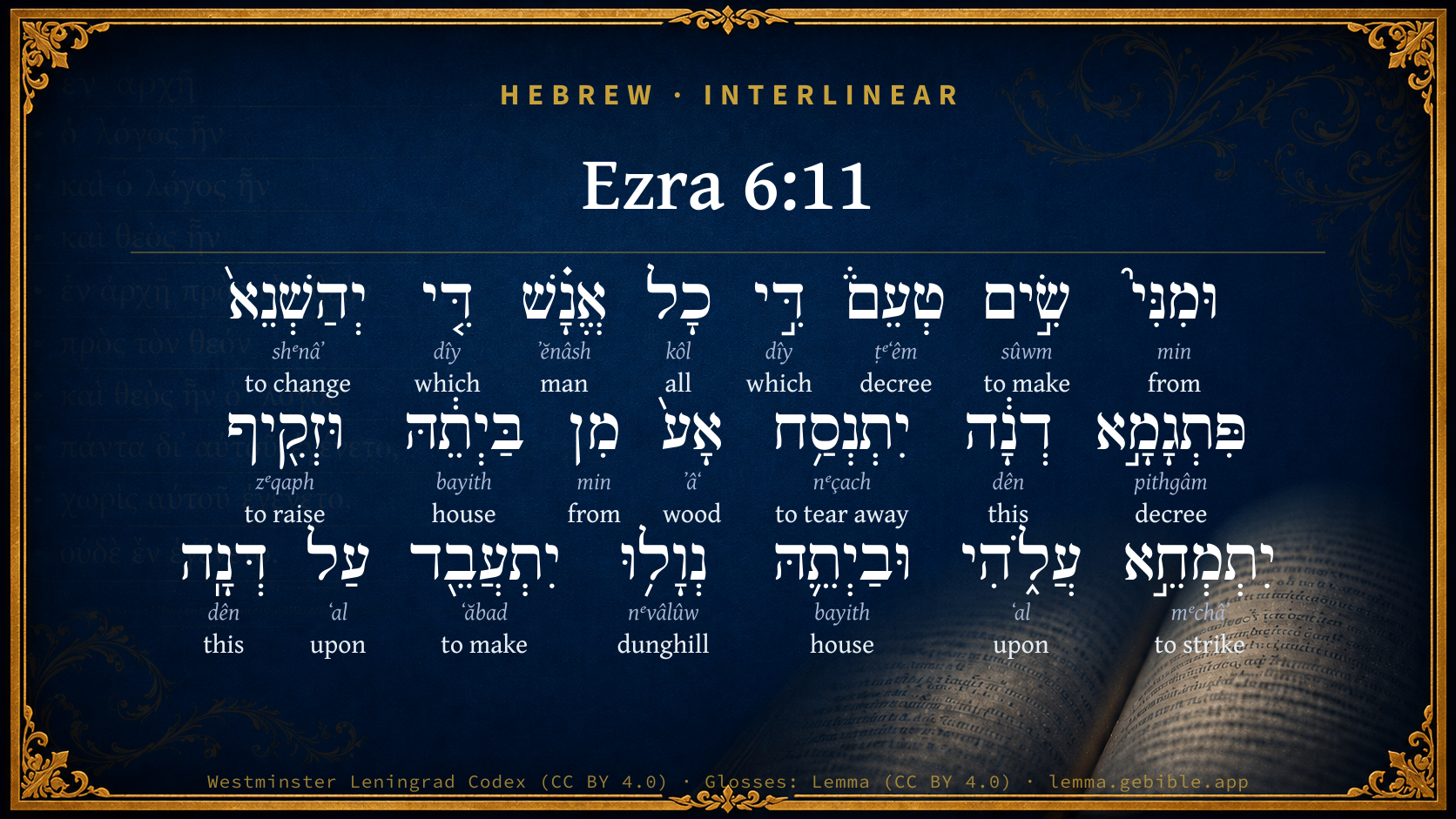
Hebrew (Westminster Leningrad Codex) Ezra 6:11 appears in the Hebrew Old Testament. The text above is from the Westminster Leningrad Codex. Each word links to its Strong’s number, a concise gloss, and parsing drawn from the Open Scriptures Hebrew Bible morphology. Click any word for its full Brown-Driver-Briggs (BDB) entry.
Download image
Cite this verse

Ezra 6:11 (World English Bible). Public Domain. Lemma interlinear Bible study tool, https://lemma.gebible.app/v/ezra/6/11.

Show BibTeX & RIS
BibTeX
RIS
English Translation
Also I have made a decree, that whoever shall alter this word, let a beam be pulled out from his house, and let him be lifted up and fastened thereon; and let his house be made a dunghill for this:
World English Bible · Public Domain
Highlights
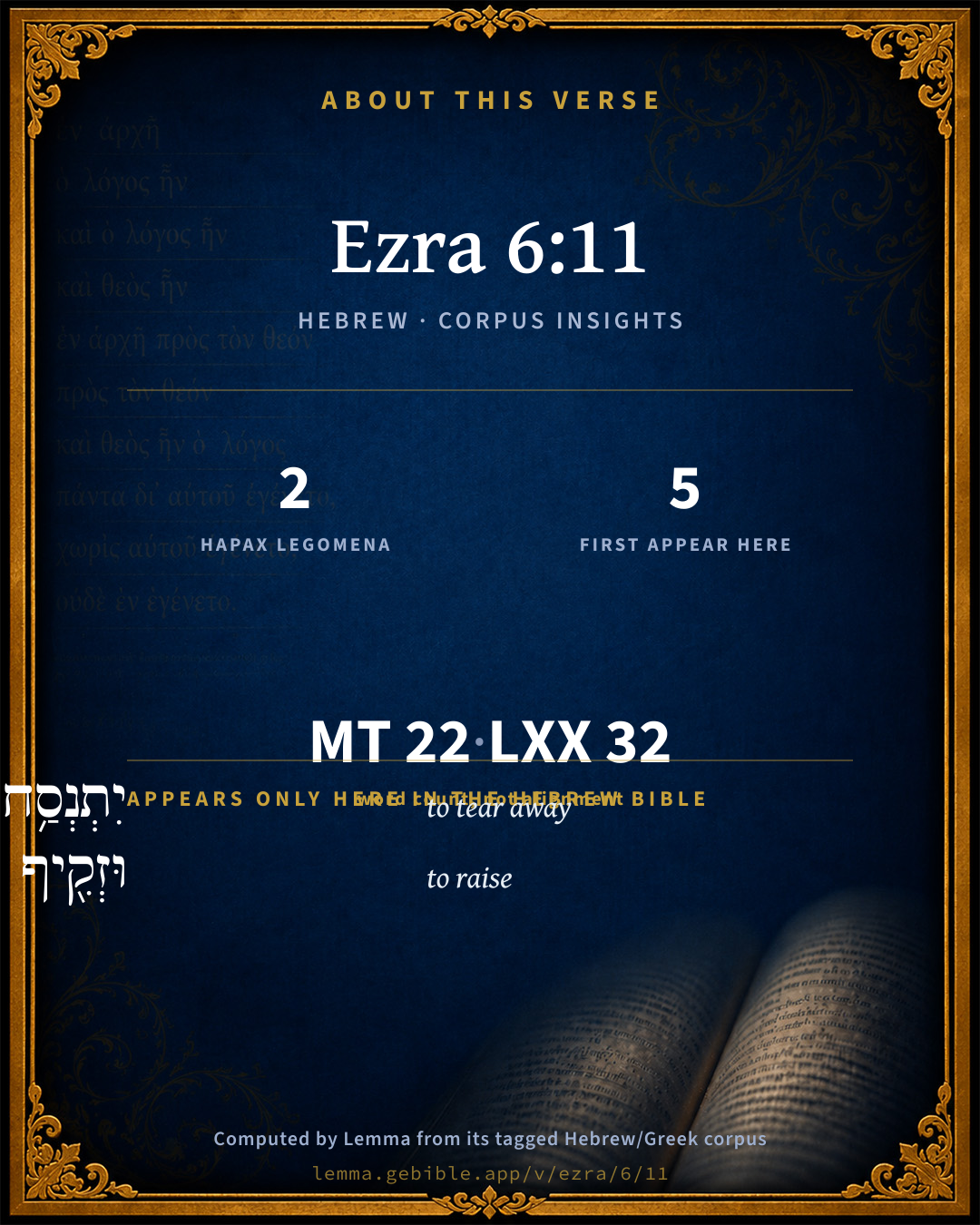
  • 2 hapax legomena — only here in the Hebrew Bible
  • 5 first appearances in the Hebrew Bible
Full analysis ↓
Download a study sheet

One document with this verse’s original text, its word-by-word gloss line, the meaning frame, cross-references with their text, attributed commentary, and full source and license credits — printable, and it pastes into notes with its structure intact.

This verse Autodidact and up

Study sheet (.html) Plain text (.txt)

A passage Seminary Student

Up to 50 verses in one chapter. A passage sheet keeps up to 6 commentary sources and 12 cross-references per verse, in the order this page ranks them, and says so on the sheet whenever that leaves anything out. Ask for a single verse and you get the Autodidact verse sheet above.

Everything on this page stays free to read, with no account — the sheet is a download of what is already on screen, not access to it.

Want to remove ads? Support Godless Engineer
Compare translations 3

The same verse in 3 English versions, stacked beneath the original-language interlinear above. Click any original word for its lexicon entry.

Each is an independent rendering of the whole verse — the interlinear is not word-aligned to these translations.

Highlighted words mark where these versions differ — a whole-verse word diff, not a word-by-word alignment.

  • World English Bible Public Domain
    Also I have made a decree, that whoever shall alter this word, let a beam be pulled out from his house, and let him be lifted up and fastened thereon; and let his house be made a dunghill for this:
  • King James Version Public Domain
    Also I have made a decree, that whosoever shall alter this word, let timber be pulled down from his house, and being set up, let him be hanged thereon; and let his house be made a dunghill for this.
  • unfoldingWord Literal Text CC BY-SA 4.0
    And from me is set a decree that, for any man who changes this edict, a beam shall be pulled from his house, and, being erect, he shall be impaled on it. And his house shall be made a rubbish heap on account of this.

unfoldingWord Literal Text — © unfoldingWord, licensed CC BY-SA 4.0. Word-aligned USFM3 via Door43 (git.door43.org/unfoldingWord/en_ult).

Versions to compare (up to 4)

3 of 4 selected

Show all 18 translations

Every available English version of this verse, each an independent rendering of the whole verse.

  • World English Bible Public Domain
    Also I have made a decree, that whoever shall alter this word, let a beam be pulled out from his house, and let him be lifted up and fastened thereon; and let his house be made a dunghill for this:
  • Berean Standard Bible Public Domain
    I also decree that if any man interferes with this directive, a beam is to be torn from his house and raised up, and he is to be impaled on it. And his own house shall be made a pile of rubble for this offense.
  • Majority Standard Bible Public Domain
    I also decree that if any man interferes with this directive, a beam is to be torn from his house and raised up, and he is to be impaled on it. And his own house shall be made a pile of rubble for this offense.
  • King James Version Public Domain
    Also I have made a decree, that whosoever shall alter this word, let timber be pulled down from his house, and being set up, let him be hanged thereon; and let his house be made a dunghill for this.
  • American Standard Version (1901) Public Domain
    Also I have made a decree, that whosoever shall alter this word, let a beam be pulled out from his house, and let him be lifted up and fastened thereon; and let his house be made a dunghill for this:
  • Revised Version (1885) Public Domain
    Also I have made a decree, that whosoever shall alter this word, let a beam be pulled out from his house, and let him be lifted up and fastened thereon; and let his house be made a dunghill for this:
  • Geneva Bible (1599) Public Domain
    And I haue made a decree, that whosoeuer shall alter this sentence, the wood shall be pulled downe from his house, and shall be set vp, and he shalbe hanged thereon, and his house shalbe made a dunghill for this.
  • Douay-Rheims (1899) Public Domain
    And I have made a decree: That ii any whosoever, shall alter this commandment, a beam be taken from his house. and set up, and he be nailed upon it, and his house be confiscated.
  • Young's Literal Translation Public Domain
    `And by me is made a decree, that any one who changeth this thing, let wood be pulled down from his house, and being raised up, let him be smitten on it, and his house let be made a dunghill for this.
  • Literal Standard Version CC BY-SA 4.0
    And a decree is made by me, that anyone who changes this thing, let wood be pulled down from his house, and being raised up, let him be struck on it, and let his house be made a dunghill for this.
  • Unlocked Literal Bible CC BY-SA 4.0
    I am ordering that if anyone violates this decree, a beam must be pulled from his house and he must be impaled on it. His house must then be turned into a rubbish heap because of this.
  • unfoldingWord Literal Text CC BY-SA 4.0
    And from me is set a decree that, for any man who changes this edict, a beam shall be pulled from his house, and, being erect, he shall be impaled on it. And his house shall be made a rubbish heap on account of this.
  • Darby Bible Public Domain
    Also I have given order that whosoever shall alter this rescript, let timber be pulled down from his house, and being set up, let him be hanged thereon, and let his house be made a dunghill for this.
  • World Messianic Bible Public Domain
    I have also made a decree that whoever alters this message, let a beam be pulled out from his house, and let him be lifted up and fastened on it; and let his house be made a dunghill for this.
  • Webster's Bible Public Domain
    Also I have made a decree, that whoever shall alter this word, let timber be pulled down from his house, and being set up, let him be hanged upon it; and let his house be made a dunghill for this.
  • Free Bible Version CC BY-SA 4.0
    Further I declare that if any man interferes with this decree, a beam is to be ripped from his house and set in the ground, and he is to be impaled on top of it. His own house shall be turned into a pile of rubble for disobeying this decree.
  • Bible in Basic English Public Domain
    And I have given orders that if anyone makes any change in this word, one of the supports is to be pulled out of his house, and he is to be lifted up and fixed to it; and his house is to be made waste for this;
  • JPS Tanakh (1917) Public Domain
    Also I have made a decree, that whosoever shall alter this word, let a beam be pulled out from his house, and let him be lifted up and fastened thereon; and let his house be made a dunghill for this;

Literal Standard Version (2020), Covenant Press — licensed CC BY-SA 4.0. Text via the HelloAO Bible API (eBible.org). Unlocked Literal Bible (unfoldingWord) — licensed CC BY-SA 4.0. Text via the HelloAO Bible API (eBible.org). unfoldingWord Literal Text — © unfoldingWord, licensed CC BY-SA 4.0. Word-aligned USFM3 via Door43 (git.door43.org/unfoldingWord/en_ult). Free Bible Version, Dr. Jonathan Gallagher — licensed CC BY-SA 4.0. Text via the HelloAO Bible API (eBible.org).

Word by word

More ways to search: Search by grammar → Find every occurrence → Compare this word →

Practice this passage: Drill this verse → Learn its vocabulary →

יִתְנְסַ֥ח
nᵉçach
H5256
“to tear away”
Adjective, V
Part of Speech
Adjective
Full BDB Definition

Origin: corresponding to H5255

TWOT: 2865

to pull or tear away - (Ithpeal) to be torn away
  1. וּמִנִּי֮ min H4481 “and · from · his” Adjective, C + Noun, Common, Masculine, Plural, Construct + Suffix, Personal, 3rd Person, Masculine, Singular
  2. שִׂ֣ים sûwm H7761 “to make” Adjective, V, Plural
  3. טְעֵם֒ ṭᵉʻêm H2942 “decree” Adjective, N, Common
  4. דִּ֣י dîy H1768 “which” Adjective, T
  5. כָל kôl H3606 “all of” Adjective, N, Common
  6. אֱנָ֗שׁ ʼĕnâsh H606 “man” Adjective, N, Common
  7. דִּ֤י dîy H1768 “which” Adjective, T
  8. יְהַשְׁנֵא֙ shᵉnâʼ H8133 “to change” Adjective, V
  9. פִּתְגָמָ֣א pithgâm H6600 “decree · the” Adjective, N, Common + Particle, Definite Article
  10. דְנָ֔ה dên H1836 “this” Adjective, P
  11. אָע֙ ʼâʻ H636 “wood” Adjective, N, Common
  12. מִן min H4481 “from” Adjective, R
  13. בַּיְתֵ֔הּ bayith H1005 “house · his” Adjective, N, Common + Suffix, Personal, 3rd Person, Masculine, Singular
  14. וּזְקִ֖יף zᵉqaph H2211 “and · raised” Adjective, C + Verb, Qal Passive, Participle Passive, Masculine, Singular, Absolute
  15. יִתְמְחֵ֣א mᵉchâʼ H4223 “to strike” Adjective, V
  16. עֲלֹ֑הִי ʻal H5922 “upon · him” Adjective, R + Suffix, Personal, 3rd Person, Masculine, Singular
  17. וּבַיְתֵ֛הּ bayith H1005 “and · house · his” Adjective, C + Noun, Common, Masculine, Singular, Construct + Suffix, Personal, 3rd Person, Masculine, Singular
  18. נְוָל֥וּ nᵉvâlûw H5122 “dunghill” Adjective, N, Common
  19. יִתְעֲבֵ֖ד ʻăbad H5648 “to make” Adjective, V
  20. עַל ʻal H5922 “upon” Adjective, R
  21. דְּנָֽה dên H1836 “this” Adjective, P, Construct

About this verse

These counts appear in no published source. They are computed here, from the morphology-tagged text and Lemma’s own curated glosses. What Lemma adds →

22
words
17
distinct lemmas
Historical
section

Notable vocabulary

2 hapax legomena — words that appear only here in the entire Hebrew Bible:

  • יִתְנְסַ֥ח to tear away H5256
  • וּזְקִ֖יף to raise H2211

First appearance in Scripture

These words make their first canonical appearance in the Hebrew Bible here:

  • יְהַשְׁנֵא֙ to change H8133
  • יִתְנְסַ֥ח to tear away H5256
  • וּזְקִ֖יף to raise H2211
  • יִתְמְחֵ֣א to strike H4223
  • נְוָל֥וּ dunghill H5122

Shared distinctive vocabulary

נְוָל֥וּ dunghill H5122 occurs in 3 verses of the Hebrew Bible. Also found in:

Grammatical profile

  • 1 verb
  • 2 nouns
  • 18 adjectives
  • 1 particle

Verb forms

  • וּזְקִ֖יף Qal Passive · Participle Passive

Repetition

Words recur within this verse — often emphatic in Hebrew:

  • בַּיְתֵ֔הּ house H1005 ×2
  • עֲלֹ֑הִי upon H5922 ×2
  • וּמִנִּי֮ from H4481 ×2
  • דִּ֣י which H1768 ×2
  • דְנָ֔ה this H1836 ×2

Hebrew & Septuagint length

In English translation the verse runs 40 words from the Hebrew and 40 from the Septuagint (LXX English) — the same length.

A rough comparison of the two English renderings, which tokenize alike — not a word-level alignment.

Word counts can differ between the Hebrew and the Greek without any difference in meaning — e.g. the Hebrew direct-object marker אֵת has no separate Greek word, and Greek often adds the article ὁ.

In the original languages it is 22 Hebrew tokens and 32 Greek tokens — but the two are counted differently (Hebrew bundles its prefixes and suffixes into one token; the Greek is in lemma form), so that isn’t a like-for-like length.

Cross-references

7

Topical passages linked to Ezra 6:11 in the Treasury of Scripture Knowledge — connected by theme and wording, ordered by reader-vote popularity; previews shown in the World English Bible.

  • Daniel 3:29 Therefore I make a decree, that every people, nation, and language, which speak anything evil against the God of Shadrach, Meshach, and Abednego, shall be cut in pieces, and their houses shall be made a dunghill; because there is no other god who is able to deliver after this sort.
  • Ezra 7:26 Whoever will not do the law of your God, and the law of the king, let judgment be executed on him with all diligence, whether it be to death, or to banishment, or to confiscation of goods, or to imprisonment.
  • Daniel 2:5 The king answered the Chaldeans, The thing is gone from me: if you don't make known to me the dream and the interpretation of it, you shall be cut in pieces, and your houses shall be made a dunghill.
  • 2 Kings 9:37 and the body of Jezebel shall be as dung on the face of the field in the portion of Jezreel, so that they shall not say, This is Jezebel.
  • 2 Kings 10:27 They broke down the pillar of Baal, and broke down the house of Baal, and made it a latrine, to this day.
  • Esther 5:4 Esther said, If it seem good to the king, let the king and Haman come this day to the banquet that I have prepared for him.
  • Esther 7:10 So they hanged Haman on the gallows that he had prepared for Mordecai. Then was the king's wrath pacified.

Cross-references courtesy of OpenBible.info (CC BY 4.0).

Hebrew and Greek witnesses Masoretic Hebrew ↔ Greek Septuagint

The same verse in the two great witnesses to the Old Testament, shown verse-for-verse.

These are two independent witnesses, not word-aligned to each other, and the Septuagint is shown in lemma (dictionary) form.

Hebrew Ezra 6:11 Masoretic · Westminster Leningrad Codex

וּמִנִּי֮ שִׂ֣ים טְעֵם֒ דִּ֣י כָל אֱנָ֗שׁ דִּ֤י יְהַשְׁנֵא֙ פִּתְגָמָ֣א דְנָ֔ה יִתְנְסַ֥ח אָע֙ מִן בַּיְתֵ֔הּ וּזְקִ֖יף יִתְמְחֵ֣א עֲלֹ֑הִי וּבַיְתֵ֛הּ נְוָל֥וּ יִתְעֲבֵ֖ד עַל דְּנָֽה

Also I have made a decree, that whoever shall alter this word, let a beam be pulled out from his house, and let him be lifted up and fastened thereon; and let his house be made a dunghill for this:

World English Bible · Public Domain

Greek LXX Ezra 6:11 Septuagint · lemma form

καί ἀπό ἐγώ τίθημι γνώμη ὅτι πᾶς ἄνθρωπος ὅς ἀλλάσσω ὁ ῥῆμα οὗτος κατααἱρέω ξύλον ἐκ ὁ οἰκία αὐτός καί ὀρθόω πήγνυμι ἐπί αὐτός καί ὁ οἶκος αὐτός ὁ κατά ἐγώ ποιέω

And a decree has been made by me, that every man who shall alter this word, timber shall be pulled down from his house, and let him be lifted up and slain upon it, and his house shall be confiscated.

LXX2012 (modern English Septuagint) · Public Domain

In the Septuagint this is one book — Esdras B (2 Esdras): Ezra is chapters 1–10, Nehemiah 11–23.

On this verse, Haydock's Catholic Bible Commentary discusses the Septuagint’s reading. Read the note in Commentary ↓

Hebrew: Westminster Leningrad Codex (CC BY 4.0). Greek: Septuagint (public domain); English from LXX2012 (modern English Septuagint) (Public Domain). How the Septuagint differs from the Hebrew →

Commentary

Notes on Ezra 6:11 from classic Christian and Jewish commentators (each source and its license shown beneath its notes). The classic Christian expositions comment on the surrounding passage and are grouped to its opening verse, so a note may address several verses; the Jewish commentaries on the Tanakh (Rashi and others) are per-verse, so they appear only where the commentator wrote on this verse.

Lemma curates 59 commentaries, every one of them public domain or Creative Commons licensed, each selected and text-cleaned for this edition rather than reprinted as found. About our sources →

Trapp's Complete Commentary

John Trapp

Ezr 6:11 Also I have made a decree, that whosoever shall alter this word, let timber be pulled down from his house, and being set up, let him be hanged thereon; and let his house be made a dunghill for this.

Ver. 11. Let timber be pulled down from his house] 1. Let his house be pulled down for a penalty. The Popish Council of Toulouse called together against the Albigenses (those ancient Protestants) made this cruel constitution, We decree that that house, wherein is found a heretic, be pulled down to the ground. 2. Let that timber be set up for a gibbet, and let him be hanged thereon Chaldee, destroyed. Compare that of the apostle, 1Co 3:17, If any man destroy the temple of God (which temple ye are), him shall God destroy; and let those look to it who turn it into a den of thieves, into a brothel house, slaughter house, pest house of noisome lusts, qui podicem ex ore faciunt, by their unsavoury speeches, and spoil themselves worse than by tumbling in an out house.

John Trapp, A Commentary or Exposition upon All the Books of the Old and New Testament (1647–1656) — public domain. Text from a community e-Sword module.

Tyndale Open Study Notes

Tyndale Open Resources

6:11-12 Those who violate this decree: Inscriptions and official decrees often included curses on those who opposed the will of the king (cp. Dan 2:5).

Tyndale Open Study Notes — © Tyndale Open Resources, licensed CC BY-SA 4.0. Text via the HelloAO Bible API.

Jamieson, Fausset & Brown

Robert Jamieson, A. R. Fausset & David Brown

whosoever shall alter this word--The warning was specially directed against the turbulent and fanatical Samaritans. The extremely favorable purport of this edict was no doubt owing in some measure to the influence of Cyrus, of whom Darius entertained a high admiration, and whose two daughters he had married. But it proceeded still more from the deep impressions made even on the idolatrous people of that country and that age, as to the being and providence of the God of Israel.

Jamieson, Fausset & Brown — Commentary Critical and Explanatory on the Whole Bible (1871) — public domain (CC PDM 1.0). Text via the HelloAO Bible API.

Adam Clarke's Commentary

Verse 11. Let timber be pulled down] Whether this refers to the punishment of hanging and gibbeting of whipping at a post, or of empaling, is not quite clear. In China they tie culprits to posts; and the executioner cuts them open while alive, takes out their bowels, &c. Empaling thrusting a sharp stake through the body till it comes out at the side of the neck, or hanging, seems to be intended here.

Let his house be made a dunghill] Let it be reduced to ruins, and never more used, except for the most sordid and unclean purposes.

Adam Clarke's Commentary on the Bible (1810–1826) — public domain. Text from a community e-Sword/MySword module.

Ellicott's Commentary for English Readers

(11) Alter this word seems to mean “violate this command,” since the alteration of a decree was a thing unheard of.

Hanged is literally crucified. Among the Persians crucifixion was generally the nailing of a body to a cross after decapitation; among the Assyrians it was transfixion or impalement. Here the “being set up” refers of course to the man, and not to the beam.

A Bible Commentary for English Readers, edited by Charles John Ellicott (1878–1897) — public domain. Text from a community e-Sword module.

The Cambridge Bible for Schools and Colleges

gen. ed. J. J. S. Perowne

11. The penalty.

Also I have made a decree] The same words as in Ezr_6:8, Ezr_4:19.

whosoever shall alter] See especially Dan_6:15. The word ‘alter’ here probably includes infringement of the decree as well as alteration of its terms.

let timber be pulled down] R.V. let a beam be pulled out, more correctly. The beams of the man’s own house should be the instruments of execution.

and being set up, let him be hanged thereon] R.V. let him be lifted up and fastened thereon. The subject of both words is the malefactor. The punishment here referred to is probably that of impalement, to which allusion is frequently made in Assyrian and Persian inscriptions. It may indeed be a form of crucifixion, such as is also implied in Gen_40:19 and Est_2:23. The passages in Num_25:4; Deu_21:22-23; Jos_8:29, where this frightful form of punishment is spoken of, seem to show that among the Israelites the victims were often first executed, and that the corpses were then hung upon a tree till nightfall. The Hebrew and Aramaic word for ‘lift up’ which is used in a perfectly general sense for elevation of any sort, e.g. Psa_145:14; Psa_146:8, and Targum of Psa_93:3, Jer_3:2, was applied technically to execution by impalement or crucifixion, as in the Targum of Est_7:10. This double meaning of the word may illustrate the Saviour’s word ‘I, if I be lifted up from the earth’ (Joh_12:32).

and let his house be made a dunghill for this] See 2Ki_10:27; Dan_2:5; Dan_3:29. A repulsive metaphor for shameful overthrow, cf. 1Ki_14:10; Job_20:7; Zep_1:17.

The Cambridge Bible for Schools and Colleges (gen. ed. J. J. S. Perowne; Cambridge University Press, 1878–1918) — public domain. Text from a community e-Sword module.

John Gill's Exposition

And the God that hath caused his name to dwell there,.... Whose name is not only called upon there, and that called by his name; but who grants his presence, and causes his Shechinah, or divine Majesty, to dwell there, as in Solomon's temple, which Darius had some knowledge of:

destroy all kings and people; let them be who they will, high or low:

that shall put to their hand to alter and to destroy this house of God, which is at Jerusalem; this he said to deter from hindering the building of it now, and from attempting to destroy it hereafter:

I Darius have made a decree, let it be done with speed; be carried immediately into execution, especially with respect to the disbursement for the building of the temple, and for the sacrifices of it.

John Gill's Exposition of the Whole Bible (1746–1763) — public domain (CC PDM 1.0). Text via the HelloAO Bible API.

Albert Barnes' Notes on the Bible

Being set up, let him be hanged thereon - Rather, “let him be lifted up and crucified upon it.” Crucifixion was the most common form of capital punishment among the Persians.

Albert Barnes' Notes on the Bible (1834–1885) — public domain. Text from a community e-Sword/MySword module.

Haydock's Catholic Bible Commentary

Nailed. Protestants, "hanged." Septuagint, "covered with wounds, or fastened on it." (Haydock) --- Some think that the criminal was to be scourged. (De Dieu) --- "Let him be hanged on the wood, which shall stand upright, after his house shall have been demolished." (Vatable) --- Such was the custom of the Persians. (Grotius) --- Aman perished on the gallows, which he had erected in his own house for Mardocheus, Esther vii. 9. --- Confiscated. Protestants, "be made a dunghill for this." (Haydock) (Syriac, &c.) --- We find some examples of such a treatment, 4 Kings x. 27., and Daniel iii. 5., and ix. 6. The effects of those who were condemned to die, in Persia, were generally confiscated, Esther iii. 13., and viii. 11., and ix. 14.

George Leo Haydock (1774–1849), Haydock's Catholic Family Bible and Commentary, 1859 edition — public domain. Excludes Psalms (Douay-Rheims chapter numbering differs from Protestant) and Deuterocanonical books (Catholic canon only).

Whedon's Commentary on the Bible

Daniel D. Whedon

11. Let him be hanged thereon — Or, fastened thereon, that is, crucified, or impaled, a mode of execution common among many ancient nations.

See note on Est_2:23.

Let his house be made a dunghill — A proverbial saying, indicating that the houses were to be reduced to ruinous heaps, and made receptacles for all manner of filth.

Daniel D. Whedon (gen. ed.), Commentary on the Old and New Testaments (1874–1909) — public domain. Text from a community e-Sword module.

The Pulpit Commentary

Whoever shall alter this word. Rather, "this edict." To alter the terms of a royal decree would in any country be a heinous offence. In Persia, where the monarch was absolute, and where decrees were regarded as "altering not", (Dan_6:8, Dan_6:12) it was a crime of the deepest dye. Hence the severity of the punishment threatened. The punishment has been explained as crucifixion, impalement, and "whipping at a post;" but there seems to be no real doubt that crucifixion is intended. Great criminals were almost always crucified by the Persians (see Brisson, "De Regno Persarum," 2. pp. 327-329; and comp. "Behist. Inscr.," col. 2. par. 14; col. 3. par. 8). Let his house be made a dunghill Some render be confiscated," but wrongly. The best Hebraists agree with our translators.

The practice of concluding important documents with maledictions was common to the Persians, with the Assyrians, Babylonians, and others (see "Records of the Past," vol. 1. pp. 53, 105, 126; vol. 5. p. 26; vol. 7. pp. 19, 20, 56; vol. 9. pp. 35, 36, 95, 100 107, etc.).

The Pulpit Commentary (1880–1919), ed. H.D.M. Spence-Jones & Joseph S. Exell — public domain. Text from a community e-Sword module.

unfoldingWord translationNotes

Door43 World Missions Community

General Information:

This continues the record of King Cyrus's command that the Jews rebuild God's temple in Jerusalem, which began in Esra 6:3.

a beam must be pulled from his house and he must be impaled on it. His house must then be turned into a rubbish heap

This can be translated in active form. AT: "I command my officials to pull a beam from his house and impale him on it. They are then to turn his house into a rubbish heap" (See: Active or Passive)

beam

a long, sturdy piece of wood, supporting the roof of a house

impaled

pierced through

who lifts a hand to change ... or to destroy

Lifting the hand represents trying or daring to do something. AT: "who tries to change ... or to destroy" or "who dares to change ... or to destroy" (See: Metonymy)

to change this decree

The abstract noun "decree" can be expressed with the phrase "what I have decreed." AT: "to change what I have decreed" or "to say that I have decreed something else" (See: Abstract Nouns)

translationWords

decree

God

Darius

unfoldingWord translationNotes — © Distant Shores Media and the Door43 World Missions Community, licensed CC BY-SA 4.0. Source: git.door43.org/Door43/en_tn.

Rashi

Rabbi Shlomo Yitzchaki (Rashi)

And an order is issued by me And a command is issued by me, along with the issue of a word regarding any person who disobeys this word.

shall be torn Aram. יִתְנְסַח. The beams of his house shall be destroyed. יִתְנְסַח is like (Deut. 28:63): “and you shall be uprooted (וְנִסַחְתֶּם) from the land.”

and a gallows upon which to place him And a gallows upon which to hang him shall be [raised up] high, so that he be hanged upon the gallows.

and his house shall be made a dungheap and his house shall be made a dungheap because of this.

נְוָלוּ connotes filth and excrement.

Rashi on the Tanakh — English translations: “The Judaica Press complete Tanach with Rashi, translated by A. J. Rosenberg” (CC BY 4.0); “Pentateuch with Rashi's commentary by M. Rosenbaum and A.M. Silbermann, 1929-1934” (public domain); “The Metsudah Tanach series, Lakewood, N.J” (CC BY 4.0); and “The Book of Joshua, Metsudah Publications, 1997” (CC BY 4.0). Text via Sefaria.

Lesson kit

Teaching starters — assembled from the data on this page, not authored interpretation. Every prompt links to the verse data it draws on. Edit before teaching.

Ezra, in the Historical, opens this verse with 22 words (17 distinct Hebrew lemmas). Its most distinctive word is nᵉçach (“to tear away”). A historical commentator’s framing appears above. Read the whole chapter for the surrounding context.

Discussion questions

  1. The word nᵉçach carries the sense “to tear away.” How does it shape the verse?
  2. This verse holds 2 words here found nowhere else in the Hebrew Bible. What might the rare words draw attention to?
  3. 5 words here appear for the first time in Scripture. What is being introduced at this debut?
  4. Daniel 2:5 shares the word «dunghill» with this verse. How do the two illuminate each other?
  5. “house” occurs 2× in this one verse. What is the effect of the repetition?
  6. These translations render this verse differently; the difference is in the English rendering, not the original. What questions does that raise?
  7. The verb «וּזְקִ֖יף» is Qal Passive Participle Passive. How does its form color the action?
  8. Reading how Trapp's Complete Commentary and Tyndale Open Study Notes read this verse, where do the two commentators agree and where do they part?

Things to notice

  • 2 words in this verse appear nowhere else in the Hebrew Bible.
  • 5 words make their first canonical appearance in Scripture here.
  • This verse counts 22 Hebrew ↔ 32 Greek words.
  • These translations choose different wording for 32 words in this verse.
  • “house” occurs 2× in this single verse.

Reading settings

Reading text

Shown beneath each verse's original-language words.

Old Testament
Old Testament edition

Read the OT as the Masoretic Hebrew (MT) or the Greek Septuagint (LXX).

English shown for the Greek Septuagint (in the Hebrew ↔ Greek comparison).

Comparing translations? Open the Compare panel on any verse page to stack up to four side by side.