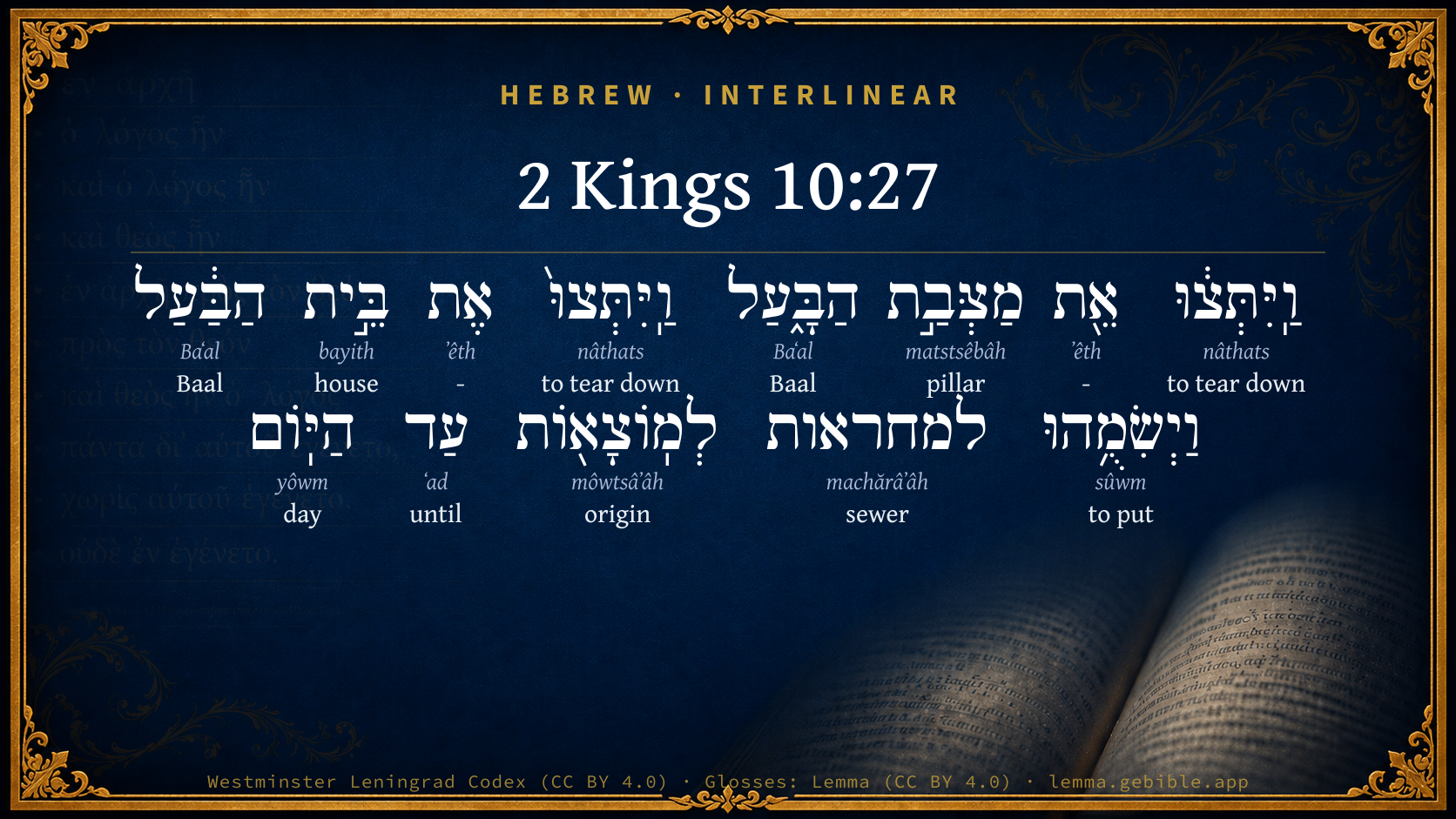
2 Kings 10:27

Hebrew (Westminster Leningrad Codex) 2 Kings 10:27 appears in the Hebrew Old Testament. The text above is from the Westminster Leningrad Codex. Each word links to its Strong’s number, a concise gloss, and parsing drawn from the Open Scriptures Hebrew Bible morphology. Click any word for its full Brown-Driver-Briggs (BDB) entry.
Download image
Cite this verse

2 Kings 10:27 (World English Bible). Public Domain. Lemma interlinear Bible study tool, https://lemma.gebible.app/v/2-kings/10/27.

Show BibTeX & RIS
BibTeX
RIS
English Translation
They broke down the pillar of Baal, and broke down the house of Baal, and made it a latrine, to this day.
World English Bible · Public Domain
Highlights
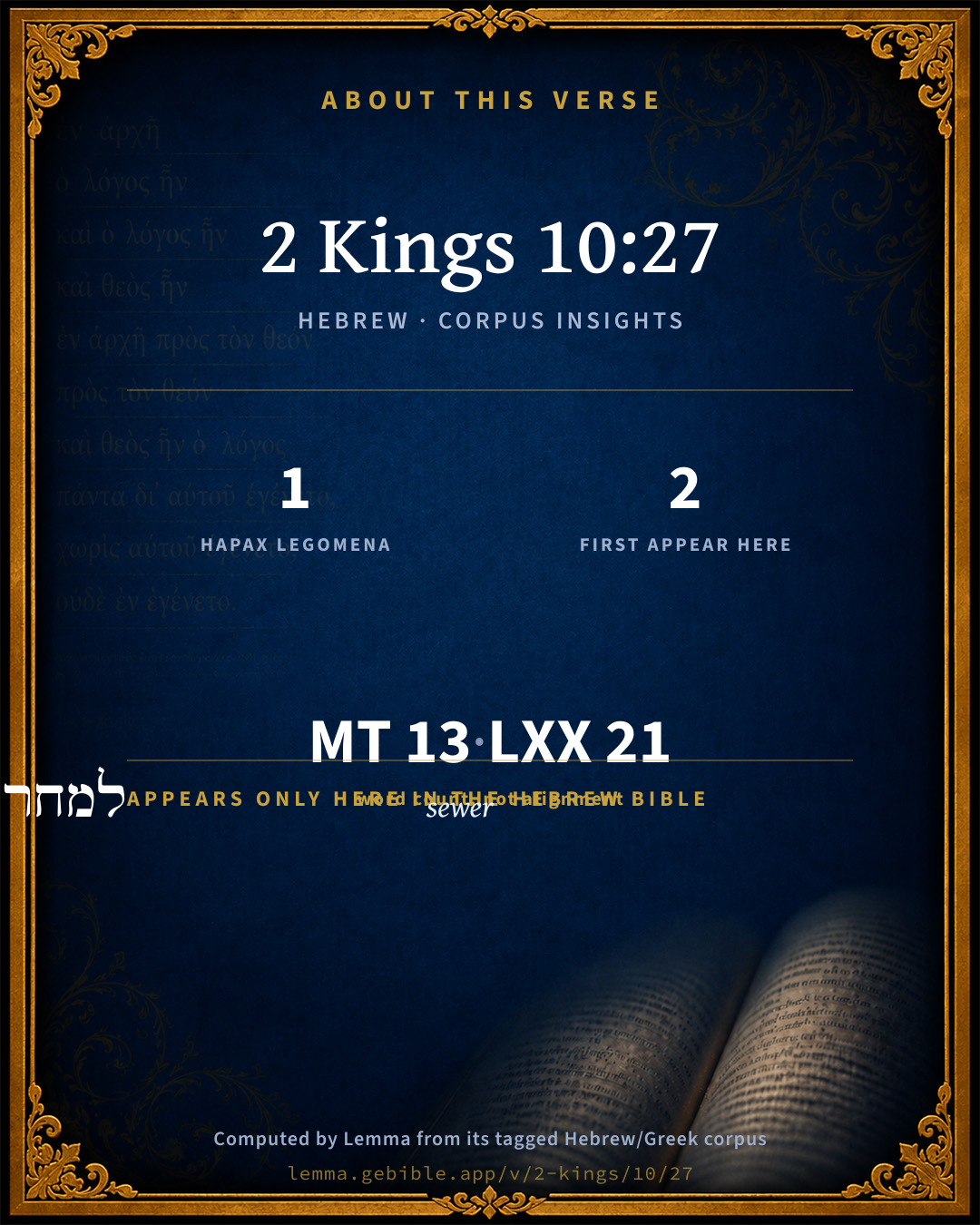
  • 1 hapax legomenon — only here in the Hebrew Bible
  • 2 first appearances in the Hebrew Bible
Full analysis ↓
Download a study sheet

One document with this verse’s original text, its word-by-word gloss line, the meaning frame, cross-references with their text, attributed commentary, and full source and license credits — printable, and it pastes into notes with its structure intact.

This verse Autodidact and up

Study sheet (.html) Plain text (.txt)

A passage Seminary Student

Up to 50 verses in one chapter. A passage sheet keeps up to 6 commentary sources and 12 cross-references per verse, in the order this page ranks them, and says so on the sheet whenever that leaves anything out. Ask for a single verse and you get the Autodidact verse sheet above.

Everything on this page stays free to read, with no account — the sheet is a download of what is already on screen, not access to it.

Want to remove ads? Support Godless Engineer
Compare translations 3

The same verse in 3 English versions, stacked beneath the original-language interlinear above. Click any original word for its lexicon entry.

Each is an independent rendering of the whole verse — the interlinear is not word-aligned to these translations.

Highlighted words mark where these versions differ — a whole-verse word diff, not a word-by-word alignment.

  • World English Bible Public Domain
    They broke down the pillar of Baal, and broke down the house of Baal, and made it a latrine, to this day.
  • King James Version Public Domain
    And they brake down the image of Baal, and brake down the house of Baal, and made it a draught house unto this day.
  • unfoldingWord Literal Text CC BY-SA 4.0
    And they broke down the pillar of Baal, and they broke down the house of Baal, and they made it a latrine, to this day.

unfoldingWord Literal Text — © unfoldingWord, licensed CC BY-SA 4.0. Word-aligned USFM3 via Door43 (git.door43.org/unfoldingWord/en_ult).

Versions to compare (up to 4)

3 of 4 selected

Show all 18 translations

Every available English version of this verse, each an independent rendering of the whole verse.

  • World English Bible Public Domain
    They broke down the pillar of Baal, and broke down the house of Baal, and made it a latrine, to this day.
  • Berean Standard Bible Public Domain
    They also demolished the sacred pillar of Baal. Then they tore down the temple of Baal and made it into a latrine, which it is to this day.
  • Majority Standard Bible Public Domain
    They also demolished the sacred pillar of Baal. Then they tore down the temple of Baal and made it into a latrine, which it is to this day.
  • King James Version Public Domain
    And they brake down the image of Baal, and brake down the house of Baal, and made it a draught house unto this day.
  • American Standard Version (1901) Public Domain
    And they brake down the pillar of Baal, and brake down the house of Baal, and made it a draught-house, unto this day.
  • Revised Version (1885) Public Domain
    And they brake down the pillar of Baal, and brake down the house of Baal, and made it a draught house, unto this day.
  • Geneva Bible (1599) Public Domain
    And they destroyed the image of Baal, and threwe downe the house of Baal, and made a iakes of it vnto this day.
  • Douay-Rheims (1899) Public Domain
    And broke it in pieces. They destroyed also the temple of Baal, and made a jakes in its place unto this day.
  • Young's Literal Translation Public Domain
    and break down the standing-pillar of Baal, and break down the house of Baal, and appoint it for a draught-house unto this day.
  • Literal Standard Version CC BY-SA 4.0
    and break down the standing-pillar of Ba‘al, and break down the house of Ba‘al, and appoint it for a latrine to this day.
  • Unlocked Literal Bible CC BY-SA 4.0
    Then they broke down the pillar of Baal, and destroyed the house of Baal and made it a latrine, which it is to this day.
  • unfoldingWord Literal Text CC BY-SA 4.0
    And they broke down the pillar of Baal, and they broke down the house of Baal, and they made it a latrine, to this day.
  • Darby Bible Public Domain
    and they broke down the column of Baal, and broke down the house of Baal, and made it a draught-house to this day.
  • World Messianic Bible Public Domain
    They broke down the pillar of Baal, and broke down the house of Baal, and made it a latrine, to this day.
  • Webster's Bible Public Domain
    And they broke down the image of Baal, and broke down the house of Baal, and made it a draught-house to this day.
  • Free Bible Version CC BY-SA 4.0
    They smashed the sacred pillar of Baal, and tore down the temple of Baal and turned it into a toilet, which it still is to this day.
  • Bible in Basic English Public Domain
    The altar of Baal was pulled down and the house of Baal was broken up and made an unclean place, as it is to this day.
  • JPS Tanakh (1917) Public Domain
    And they broke down the pillar of Baal, and broke down the house of Baal, and made it a draught-house, unto this day.

Literal Standard Version (2020), Covenant Press — licensed CC BY-SA 4.0. Text via the HelloAO Bible API (eBible.org). Unlocked Literal Bible (unfoldingWord) — licensed CC BY-SA 4.0. Text via the HelloAO Bible API (eBible.org). unfoldingWord Literal Text — © unfoldingWord, licensed CC BY-SA 4.0. Word-aligned USFM3 via Door43 (git.door43.org/unfoldingWord/en_ult). Free Bible Version, Dr. Jonathan Gallagher — licensed CC BY-SA 4.0. Text via the HelloAO Bible API (eBible.org).

Word by word

More ways to search: Search by grammar → Find every occurrence → Compare this word →

Practice this passage: Drill this verse → Learn its vocabulary →

למחראות
machărâʼâh
H4280
“to/for · sewers”
Preposition + Noun, Common, Feminine, Plural, Absolute
Part of Speech
Preposition + Noun
Type
Common
Gender
Feminine
Number
Plural
State
Absolute
Full BDB Definition

Origin: from the same as H2716

TWOT: 730b

sewer, cesspool, cloaca - (TWOT) draught house
  1. וַֽיִּתְּצ֔וּ nâthats H5422 “and · to tear down” Conjunction + Verb, Qal, Sequential Imperfect, 3rd Person, Masculine, Plural
  2. אֵ֖ת ʼêth H853 “-” Particle, Direct Object
  3. מַצְּבַ֣ת matstsêbâh H4676 “pillar of” Noun, Common, Feminine, Singular, Construct
  4. הַבָּ֑עַל Baʻal H1168 “the · Baal” Particle, Definite Article + Noun, Proper
  5. וַֽיִּתְּצוּ֙ nâthats H5422 “and · to tear down” Conjunction + Verb, Qal, Sequential Imperfect, 3rd Person, Masculine, Plural
  6. אֶת ʼêth H853 “-” Particle, Direct Object
  7. בֵּ֣ית bayith H1004 “house of” Noun, Common, Masculine, Singular, Construct
  8. הַבַּ֔עַל Baʻal H1168 “the · Baal” Particle, Definite Article + Noun, Proper
  9. וַיְשִׂמֻ֥הוּ sûwm H7760 “and · to put · him” Conjunction + Verb, Qal, Sequential Imperfect, 3rd Person, Masculine, Plural + Suffix, Personal, 3rd Person, Masculine, Singular
  10. לְמֽוֹצָא֖וֹת môwtsâʼâh H4163 “to/for · origins” Preposition + Noun, Common, Feminine, Plural, Absolute
  11. עַד ʻad H5704 “until” Preposition
  12. הַיּֽוֹם yôwm H3117 “the · day” Particle, Definite Article + Noun, Common, Masculine, Singular, Absolute

About this verse

These counts appear in no published source. They are computed here, from the morphology-tagged text and Lemma’s own curated glosses. What Lemma adds →

13
words
10
distinct lemmas
Historical
section

Notable vocabulary

1 hapax legomenon — a word that appears only here in the entire Hebrew Bible:

  • למחראות sewer H4280

First appearance in Scripture

These words make their first canonical appearance in the Hebrew Bible here:

  • למחראות sewer H4280
  • לְמֽוֹצָא֖וֹת origin H4163

Shared distinctive vocabulary

לְמֽוֹצָא֖וֹת origin H4163 occurs in 2 verses of the Hebrew Bible. Also found in:

Grammatical profile

  • 3 verbs
  • 7 nouns
  • 1 preposition
  • 2 particles

Verb forms

  • וַֽיִּתְּצ֔וּ Qal · Sequential Imperfect
  • וַֽיִּתְּצוּ֙ Qal · Sequential Imperfect
  • וַיְשִׂמֻ֥הוּ Qal · Sequential Imperfect

Repetition

Words recur within this verse — often emphatic in Hebrew:

  • וַֽיִּתְּצ֔וּ to tear down H5422 ×2
  • הַבָּ֑עַל Baal H1168 ×2

Hebrew & Septuagint length

In English translation the verse runs 22 words from the Hebrew and 17 from the Septuagint (LXX English) — closely comparable.

A rough comparison of the two English renderings, which tokenize alike — not a word-level alignment.

Word counts can differ between the Hebrew and the Greek without any difference in meaning — e.g. the Hebrew direct-object marker אֵת has no separate Greek word, and Greek often adds the article ὁ.

In the original languages it is 13 Hebrew tokens and 21 Greek tokens — but the two are counted differently (Hebrew bundles its prefixes and suffixes into one token; the Greek is in lemma form), so that isn’t a like-for-like length.

Cross-references

10

Topical passages linked to 2 Kings 10:27 in the Treasury of Scripture Knowledge — connected by theme and wording, ordered by reader-vote popularity; previews shown in the World English Bible.

  • Ezra 6:11 Also I have made a decree, that whoever shall alter this word, let a beam be pulled out from his house, and let him be lifted up and fastened thereon; and let his house be made a dunghill for this:
  • Daniel 2:5 The king answered the Chaldeans, The thing is gone from me: if you don't make known to me the dream and the interpretation of it, you shall be cut in pieces, and your houses shall be made a dunghill.
  • Daniel 3:29 Therefore I make a decree, that every people, nation, and language, which speak anything evil against the God of Shadrach, Meshach, and Abednego, shall be cut in pieces, and their houses shall be made a dunghill; because there is no other god who is able to deliver after this sort.
  • 1 Kings 16:32 He reared up an altar for Baal in the house of Baal, which he had built in Samaria.
  • Leviticus 26:30 I will destroy your high places, and cut down your incense altars, and cast your dead bodies upon the bodies of your idols; and my soul will abhor you.
  • Deuteronomy 7:5 But thus shall you deal with them: you shall break down their altars, and dash in pieces their pillars, and hew down their Asherim, and burn their engraved images with fire.
  • Deuteronomy 7:25 The engraved images of their gods shall you burn with fire: you shall not covet the silver or the gold that is on them, nor take it to you, lest you be snared therein; for it is an abomination to Yahweh your God.
  • 2 Kings 18:4 He removed the high places, and broke the pillars, and cut down the Asherah: and he broke in pieces the brazen serpent that Moses had made; for to those days the children of Israel did burn incense to it; and he called it Nehushtan.
  • 2 Kings 23:7–14 He broke down the houses of the sodomites, that were in the house of Yahweh, where the women wove hangings for the Asherah.
  • 2 Chronicles 34:3–7 For in the eighth year of his reign, while he was yet young, he began to seek after the God of David his father; and in the twelfth year he began to purge Judah and Jerusalem from the high places, and the Asherim, and the engraved images, and the molten images.

Cross-references courtesy of OpenBible.info (CC BY 4.0).

Hebrew and Greek witnesses Masoretic Hebrew ↔ Greek Septuagint

The same verse in the two great witnesses to the Old Testament, shown verse-for-verse.

These are two independent witnesses, not word-aligned to each other, and the Septuagint is shown in lemma (dictionary) form.

Hebrew 2 Kings 10:27 Masoretic · Westminster Leningrad Codex

וַֽיִּתְּצ֔וּ אֵ֖ת מַצְּבַ֣ת הַבָּ֑עַל וַֽיִּתְּצוּ֙ אֶת בֵּ֣ית הַבַּ֔עַל וַיְשִׂמֻ֥הוּ למחראות לְמֽוֹצָא֖וֹת עַד הַיּֽוֹם

They broke down the pillar of Baal, and broke down the house of Baal, and made it a latrine, to this day.

World English Bible · Public Domain

Greek LXX 2 Kings 10:27 Septuagint · lemma form

καί κατασπάω ὁ στήλη ὁ βααλ καί κατααἱρέω ὁ οἶκος ὁ βααλ καί τάσσω αὐτός εἰς λυτρών ἕως ὁ ἡμέρα οὗτος

And they tore down the pillars of Baal, and made his house a draught-house until this day.

LXX2012 (modern English Septuagint) · Public Domain

On this verse, The Cambridge Bible for Schools and Colleges discusses the Septuagint’s reading. Read the note in Commentary ↓

Hebrew: Westminster Leningrad Codex (CC BY 4.0). Greek: Septuagint (public domain); English from LXX2012 (modern English Septuagint) (Public Domain). How the Septuagint differs from the Hebrew →

Targum (Aramaic paraphrase)

1

The Targum is the ancient Jewish Aramaic paraphrase of the Hebrew Scriptures — an interpretive translation, not the Hebrew text itself. Onkelos (literal) and Pseudo-Jonathan (expansive) render the Torah, and Jonathan the Prophets. Coverage is partial: where no permissively-licensed English translation exists for a verse, only the Aramaic is shown. This is verse-level text, not a word-by-word alignment to the Hebrew.

  1. Targum Jonathan Prophets (Joshua–Malachi)
    וּתְרָעוּ יַת קָמַת בְּעָלָא וּתְרָעוּ יַת בֵּית בַּעֲלָא וְשַׁוְיוּהָא לְבֵית מַפְקַת אֱנָשָׁא עַד יוֹמָא דֵין:

    (no public-domain English translation for this verse)

    Targum Jonathan — Aramaic: “Mikraot Gedolot” (public domain). English: “Sefaria Community Translation” (CC0 1.0 (public-domain dedication)); “London "Chaldee Paraphrase," 1871” (public domain). Text via Sefaria.

Commentary

Notes on 2 Kings 10:27 from classic Christian and Jewish commentators (each source and its license shown beneath its notes). The classic Christian expositions comment on the surrounding passage and are grouped to its opening verse, so a note may address several verses; the Jewish commentaries on the Tanakh (Rashi and others) are per-verse, so they appear only where the commentator wrote on this verse.

Lemma curates 59 commentaries, every one of them public domain or Creative Commons licensed, each selected and text-cleaned for this edition rather than reprinted as found. About our sources →

Trapp's Complete Commentary

John Trapp

2Ki 10:27 And they brake down the image of Baal, and brake down the house of Baal, and made it a draught house unto this day.

Ver. 27. And brake down the house of Baal.] So Theodosius pulled down the idol temples, which Constantine had shut only, but Julian opened them again; and our Henry VIII demolished the abbeys and monasteries, using these words, Corvorum nidi sunt penitus disturbandi, ne iterum ad cohabitandum convolent: Those crows’ nests are to be utterly destroyed, that they be no more frequented and re-inhabited.

And made it a draught house.] Or, Jakes or out house. Here the Masorites put a more cleanly word in their Keri in the margin; as if they would prompt to the Holy Ghost a more mannerly speech. {a} {Hebrew Text Note} So they do in Deu 28:30 Jer 3:2. Less marvel, then, if they deal so with the words of Rabshakeh, Isa 36:12.

{a} Dr Rich.

John Trapp, A Commentary or Exposition upon All the Books of the Old and New Testament (1647–1656) — public domain. Text from a community e-Sword module.

Tyndale Open Study Notes

Tyndale Open Resources

10:27 Turning the destroyed temple of Baal . . . into a public toilet rendered it unclean, unfit for future religious ceremonies.

Tyndale Open Study Notes — © Tyndale Open Resources, licensed CC BY-SA 4.0. Text via the HelloAO Bible API.

Adam Clarke's Commentary

Verse 27. Made it a draught house] A place for human excrement; so all the versions understand it. Nothing could be more degrading than this; he made it a public necessary.

Adam Clarke's Commentary on the Bible (1810–1826) — public domain. Text from a community e-Sword/MySword module.

Ellicott's Commentary for English Readers

(27) The image of Baal.—Again the word is pillar, which in this case is the conical pillar of stone representing the Baal himself. The wooden pillars of 2Ki_10:26 probably symbolised companion deities (παρέδρυι συμβώμοι) of the principal idol.

Made it a draught house.—By way of utter desecration. (Comp. Eze_6:11; Dan_2:5.)

Unto this day.—On the bearing of this phrase, see the Introduction to the Books of Kings.

A Bible Commentary for English Readers, edited by Charles John Ellicott (1878–1897) — public domain. Text from a community e-Sword module.

The Cambridge Bible for Schools and Colleges

gen. ed. J. J. S. Perowne

27. they brake down the image of Baal] As the verb is the same as that used immediately afterwards for the breaking down of the house, we may be almost certain that this chief object of worship was of stone. The verb is constantly employed of pulling down buildings. The LXX. omits the next clause, ‘And brake down the house of Baal’.

a draught house] The word ‘draught’ is found again in Mat_15:17; Mar_12:19. Cf. also Burton, Anatomy, p. 165, ‘Muck hills, draughts, sinks, where any carcasses or carrion lies’. For the idea cf. Ezr_6:11; Dan_2:5; Dan_3:29, ‘their houses shall be made a dunghill’.

unto this day] See above on 2Ki_8:22. For the commands in the law to destroy the objects of heathen worship cf. Deu_7:5; Deu_7:25; Deu_12:2-3, where a destruction like that described here is enjoined.

The Cambridge Bible for Schools and Colleges (gen. ed. J. J. S. Perowne; Cambridge University Press, 1878–1918) — public domain. Text from a community e-Sword module.

John Gill's Exposition

Thus Jehu destroyed Baal out of Israel. His images and temples being served thus in all places, throughout the land of Israel, where there were any.

Thus Jehu destroyed Baal out of Israel. His images and temples being served thus in all places, throughout the land of Israel, where there were any.

2 Kings 10:29

kg2 10:29

kg2 10:29

kg2 10:29Howbeit from the sins of Jeroboam the son of Nebat, who made Israel to sin,.... Which is the common character given of that king, a blot never to be wiped off:

Jehu departed not from after them, to wit, the golden calves that were in Bethel, and that were in Dan: he did not abstain from the worship of them, partly because he might not think it idolatry, because God was worshipped in them; hence he calls the worshippers of the calves the servants of the Lord, Kg2 10:23, and partly that he might not displease the princes of the people of Israel, who generally gave in to the worship of them; but chiefly lest the kingdom of Israel should return to the house of David, the worship of the calves being a piece of state policy, to keep them from going to Jerusalem to worship, lest thereby they should be drawn off from their allegiance to the king of Israel.

John Gill's Exposition of the Whole Bible (1746–1763) — public domain (CC PDM 1.0). Text via the HelloAO Bible API.

Albert Barnes' Notes on the Bible

And they brake down the image of Baal - The other images, it appears, were not images of Baal, but of inferior deities. The image of Baal, which was “broken down,” and not burned, would seem to have been of stone, perhaps erected in front of the temple.

Albert Barnes' Notes on the Bible (1834–1885) — public domain. Text from a community e-Sword/MySword module.

Haydock's Catholic Bible Commentary

A jakes, or necessary [latrine]. (Haydock) --- See 1 Esdras vi. 11., and Daniel ii. 5.

George Leo Haydock (1774–1849), Haydock's Catholic Family Bible and Commentary, 1859 edition — public domain. Excludes Psalms (Douay-Rheims chapter numbering differs from Protestant) and Deuterocanonical books (Catholic canon only).

Matthew Poole's English Annotations

The image of Baal; the chief image, which they worshipped more than the rest.

Brake down the house of Baal; and the like they did with the rest of the houses of Baal in Israel; as may be gathered both from the nature and reason of the thing, and from 2Ki 10:28.

Matthew Poole's English Annotations on the Holy Bible (1683–1685) — public domain. Text from a community e-Sword/MySword module.

Whedon's Commentary on the Bible

Daniel D. Whedon

27. The image of Baal — This was probably a vast molten statue of the god, erected outside of the temple, perhaps at the portal.

A draught house — A place of refuse and filth. The Masoretes have substituted a word which signifies sewers.

Thus did Jehu terribly destroy these worshippers of Baal, mingling their blood with the sacrifices of the altar, and making the very site of their great temple a place of filth. This would cover the very name of Baal with infamy and reproach.

Daniel D. Whedon (gen. ed.), Commentary on the Old and New Testaments (1874–1909) — public domain. Text from a community e-Sword module.

The Pulpit Commentary

And they brake down the image of Baal; rather, they brake in pieces the pillar of Baal. The representation of Baal, the main stele of the temple, being of stone or metal, could not be destroyed by fire, and was therefore broken to pieces. (comp. 2Ki_23:14) And brake down the house of Baali.e. partially ruined it, but still left portions of it standing, as a memorial of the sin and of its punishment a solemn warning, one would have thought, to the people of the capitaland made it a draught-house unto this day; made it, i.e. , "a depository for all the filth of the town" (Stanley); comp. Ezr_6:11; Dan_2:5 Dan_3:29; and for the word "draught" in this sense, see Mat_15:17. Such a use was the greatest possible desecration.

The Pulpit Commentary (1880–1919), ed. H.D.M. Spence-Jones & Joseph S. Exell — public domain. Text from a community e-Sword module.

John Wesley's Explanatory Notes

Draught-house - A sink or common shore.

John Wesley, Explanatory Notes Upon the Whole Bible (1754–1765) — public domain. Text via the GEBible commentary corpus.

Keil & Delitzsch

C. F. Keil & F. Delitzsch

Lastly, they destroyed the temple itself and made it למחראות, privies, for which the Masoretes have substituted the euphemistic מוצאות, sinks, as a mark of the greatest insult, many examples of which are to be met with among Oriental tribes (vid., Ezr 6:11; Dan 2:5, and Haevernick in loc.). - Thus Jehu exterminated Baal from Israel. This remark in Kg2 10:28 forms the introduction to the history of Jehu's reign, with which the last epoch in the history of the ten tribes begins.

Keil & Delitzsch — Biblical Commentary on the Old Testament (1861–1891) — public domain (CC PDM 1.0). Text via the HelloAO Bible API. (Old Testament only.)

Rashi

Rabbi Shlomo Yitzchaki (Rashi)

Into an outhouse. An expression meaning a privy, and similarly [it states], “to eat their excrement [=חוראיהם].”

Rashi on the Tanakh — English translations: “The Judaica Press complete Tanach with Rashi, translated by A. J. Rosenberg” (CC BY 4.0); “Pentateuch with Rashi's commentary by M. Rosenbaum and A.M. Silbermann, 1929-1934” (public domain); “The Metsudah Tanach series, Lakewood, N.J” (CC BY 4.0); and “The Book of Joshua, Metsudah Publications, 1997” (CC BY 4.0). Text via Sefaria.

Lesson kit

Teaching starters — assembled from the data on this page, not authored interpretation. Every prompt links to the verse data it draws on. Edit before teaching.

2 Kings, in the Historical, opens this verse with 13 words (10 distinct Hebrew lemmas). Its most distinctive word is machărâʼâh (“sewer”). A historical commentator’s framing appears above. Read the whole chapter for the surrounding context.

Discussion questions

  1. What does “sewer” (machărâʼâh) contribute to the verse as a whole?
  2. This verse holds 1 word here found nowhere else in the Hebrew Bible. What might the rare word draw attention to?
  3. 2 words here appear for the first time in Scripture. What is being introduced at this debut?
  4. Micah 5:2 shares the word «origin» with this verse. How do the two illuminate each other?
  5. “to tear down” occurs 2× in this one verse. What is the effect of the repetition?
  6. The translations on this page render this verse differently — a whole-verse word diff, not a word-by-word alignment. What might account for the different wordings?
  7. The verb «וַֽיִּתְּצ֔וּ» is Qal Sequential Imperfect. How does its form color the action?
  8. Reading how Trapp's Complete Commentary and Tyndale Open Study Notes read this verse, where do the two commentators agree and where do they part?

Things to notice

  • 1 word in this verse appears nowhere else in the Hebrew Bible.
  • 2 words make their first canonical appearance in Scripture here.
  • This verse counts 13 Hebrew ↔ 21 Greek words.
  • These translations choose different wording for 6 words in this verse.
  • “to tear down” occurs 2× in this single verse.

Reading settings

Reading text

Shown beneath each verse's original-language words.

Old Testament
Old Testament edition

Read the OT as the Masoretic Hebrew (MT) or the Greek Septuagint (LXX).

English shown for the Greek Septuagint (in the Hebrew ↔ Greek comparison).

Comparing translations? Open the Compare panel on any verse page to stack up to four side by side.