
Job 19:2

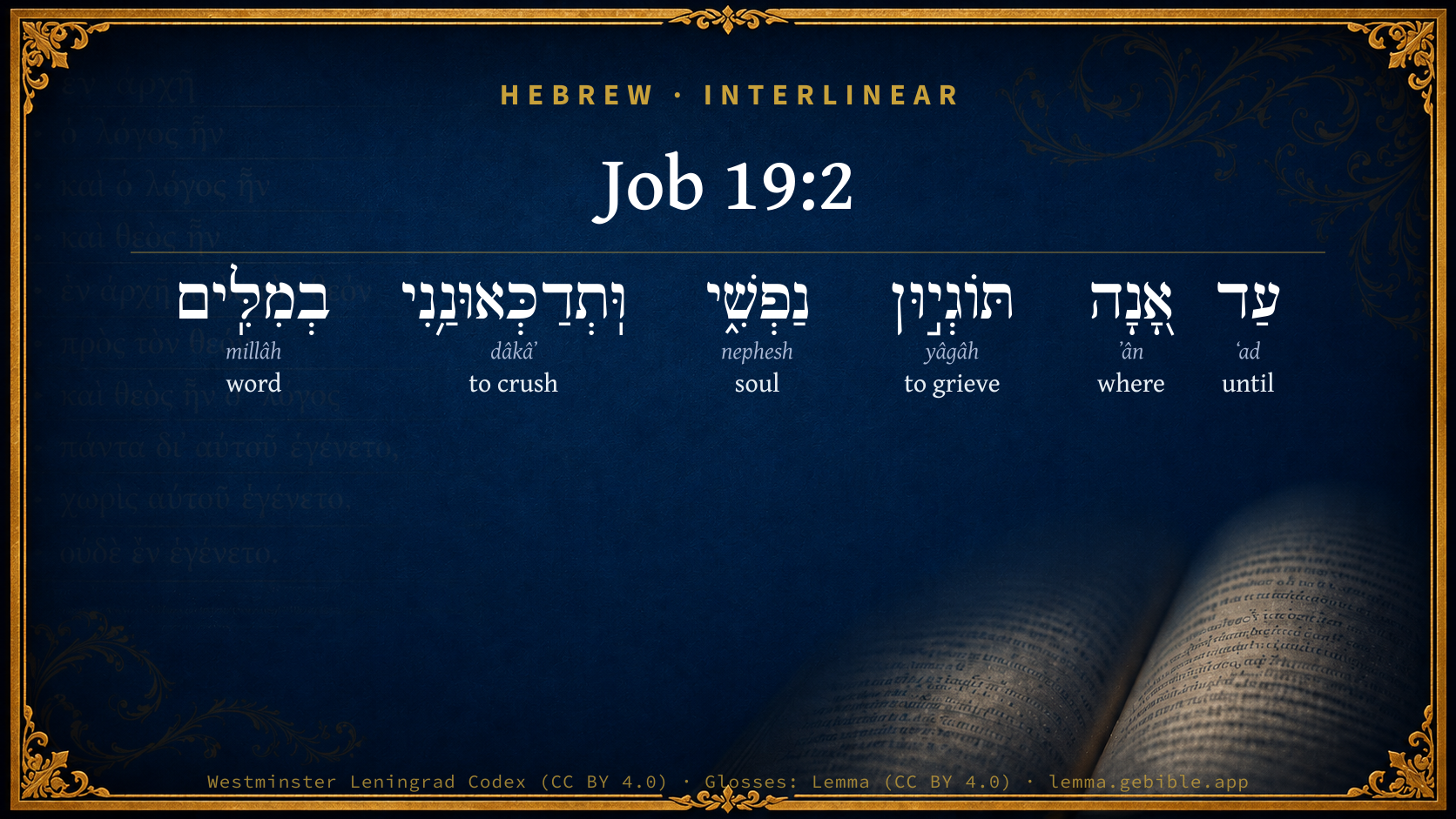
Hebrew (Westminster Leningrad Codex) Job 19:2 appears in the Hebrew Old Testament. The text above is from the Westminster Leningrad Codex. Each word links to its Strong’s number, a concise gloss, and parsing drawn from the Open Scriptures Hebrew Bible morphology. Click any word for its full Brown-Driver-Briggs (BDB) entry.
Download image
Cite this verse

Job 19:2 (World English Bible). Public Domain. Lemma interlinear Bible study tool, https://lemma.gebible.app/v/job/19/2.

Show BibTeX & RIS
BibTeX
RIS
English Translation
"How long will you torment me, And crush me with words?
World English Bible · Public Domain
Highlights Full analysis ↓
Download a study sheet

One document with this verse’s original text, its word-by-word gloss line, the meaning frame, cross-references with their text, attributed commentary, and full source and license credits — printable, and it pastes into notes with its structure intact.

This verse Autodidact and up

Study sheet (.html) Plain text (.txt)

A passage Seminary Student

Up to 50 verses in one chapter. A passage sheet keeps up to 6 commentary sources and 12 cross-references per verse, in the order this page ranks them, and says so on the sheet whenever that leaves anything out. Ask for a single verse and you get the Autodidact verse sheet above.

Everything on this page stays free to read, with no account — the sheet is a download of what is already on screen, not access to it.

Want to remove ads? Support Godless Engineer
Compare translations 3

The same verse in 3 English versions, stacked beneath the original-language interlinear above. Click any original word for its lexicon entry.

Each is an independent rendering of the whole verse — the interlinear is not word-aligned to these translations.

Highlighted words mark where these versions differ — a whole-verse word diff, not a word-by-word alignment.

  • World English Bible Public Domain
    "How long will you torment me, And crush me with words?
  • King James Version Public Domain
    How long will ye vex my soul, and break me in pieces with words?
  • unfoldingWord Literal Text CC BY-SA 4.0
    “Until when will you afflict my soul and crush me with words?

unfoldingWord Literal Text — © unfoldingWord, licensed CC BY-SA 4.0. Word-aligned USFM3 via Door43 (git.door43.org/unfoldingWord/en_ult).

Versions to compare (up to 4)

3 of 4 selected

Show all 18 translations

Every available English version of this verse, each an independent rendering of the whole verse.

  • World English Bible Public Domain
    "How long will you torment me, And crush me with words?
  • Berean Standard Bible Public Domain
    “How long will you torment me and crush me with your words?
  • Majority Standard Bible Public Domain
    “How long will you torment me and crush me with your words?
  • King James Version Public Domain
    How long will ye vex my soul, and break me in pieces with words?
  • American Standard Version (1901) Public Domain
    How long will ye vex my soul, And break me in pieces with words?
  • Revised Version (1885) Public Domain
    How long will ye vex my soul and break me in pieces with words?
  • Geneva Bible (1599) Public Domain
    Howe long will yee vexe my soule, and torment me with wordes?
  • Douay-Rheims (1899) Public Domain
    How long do you afflict my soul, and break me in pieces with words?
  • Young's Literal Translation Public Domain
    Till when do ye afflict my soul, And bruise me with words?
  • Literal Standard Version CC BY-SA 4.0
    “Until when do you afflict my soul, || And bruise me with words?
  • Unlocked Literal Bible CC BY-SA 4.0
    “How long will you make me suffer and break me into pieces with words?
  • unfoldingWord Literal Text CC BY-SA 4.0
    “Until when will you afflict my soul and crush me with words?
  • Darby Bible Public Domain
    How long will ye vex my soul, and crush me with words?
  • World Messianic Bible Public Domain
    “How long will you torment me, and crush me with words?
  • Webster's Bible Public Domain
    How long will ye vex my soul, and break me in pieces with words?
  • Free Bible Version CC BY-SA 4.0
    “How long will you go on tormenting me? How long will you go on crushing me with words?
  • Bible in Basic English Public Domain
    How long will you make my life bitter, crushing me with words?
  • JPS Tanakh (1917) Public Domain
    How long will ye vex my soul, and crush me with words?

Literal Standard Version (2020), Covenant Press — licensed CC BY-SA 4.0. Text via the HelloAO Bible API (eBible.org). Unlocked Literal Bible (unfoldingWord) — licensed CC BY-SA 4.0. Text via the HelloAO Bible API (eBible.org). unfoldingWord Literal Text — © unfoldingWord, licensed CC BY-SA 4.0. Word-aligned USFM3 via Door43 (git.door43.org/unfoldingWord/en_ult). Free Bible Version, Dr. Jonathan Gallagher — licensed CC BY-SA 4.0. Text via the HelloAO Bible API (eBible.org).

Word by word

More ways to search: Search by grammar → Find every occurrence → Compare this word →

Practice this passage: Drill this verse → Learn its vocabulary →

About this verse

These counts appear in no published source. They are computed here, from the morphology-tagged text and Lemma’s own curated glosses. What Lemma adds →

6
words
6
distinct lemmas
Wisdom
section

Notable vocabulary

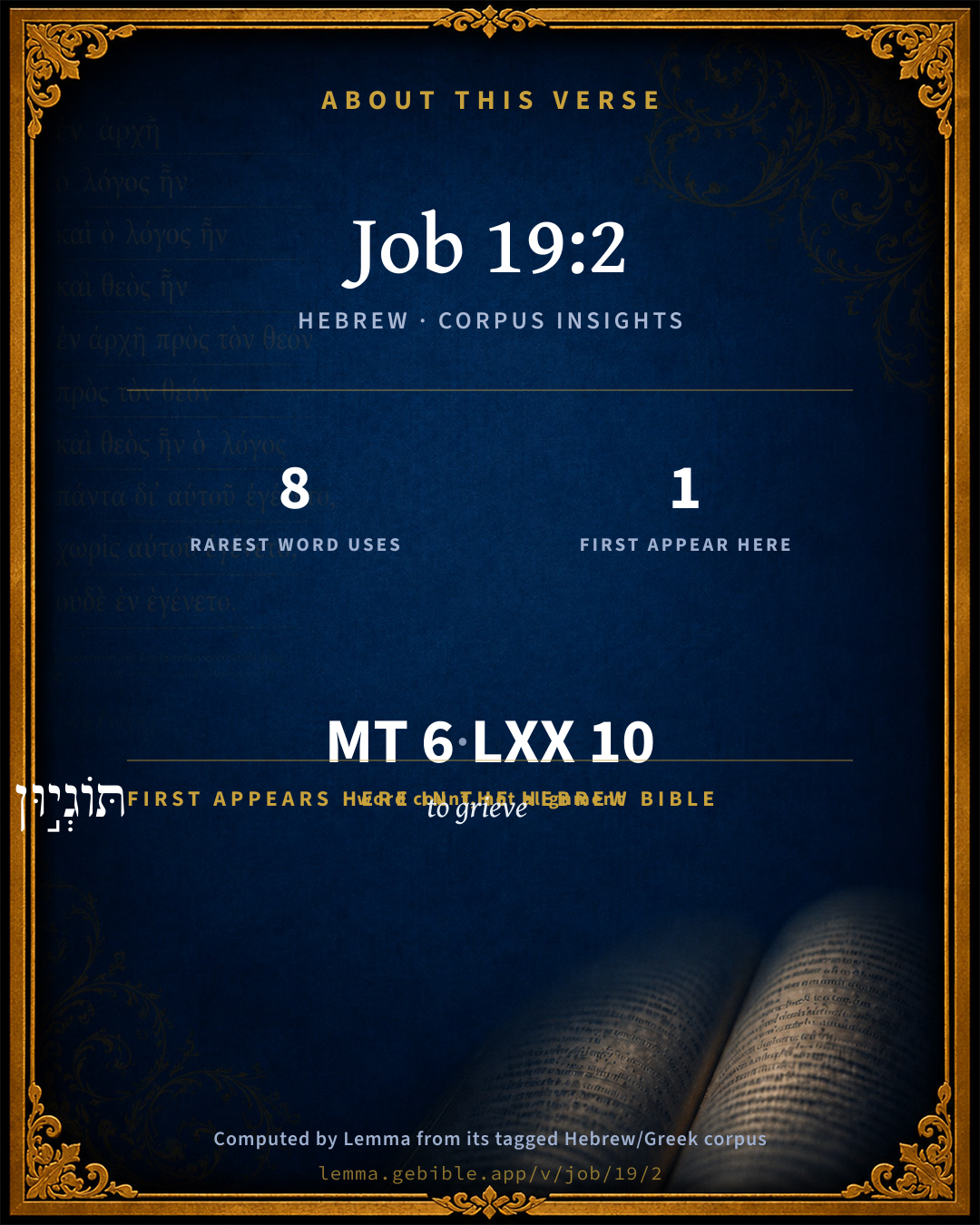
The rarest word here is תּוֹגְי֣וּן to grieve H3013 — appearing just 8 times in the whole Hebrew Bible.

First appearance in Scripture

This word makes its first canonical appearance in the Hebrew Bible here:

  • תּוֹגְי֣וּן to grieve H3013

Shared distinctive vocabulary

תּוֹגְי֣וּן to grieve H3013 occurs in 8 verses of the Hebrew Bible. Also found in:

Grammatical profile

  • 2 verbs
  • 2 nouns
  • 1 preposition
  • 1 adverb

Verb forms

  • תּוֹגְי֣וּן Hiphil · Imperfect
  • וּֽתְדַכְּאוּנַ֥נִי Piel · Imperfect

Hebrew & Septuagint length

In English translation the verse runs 11 words from the Hebrew and 22 from the Septuagint (LXX English) — the Septuagint runs noticeably longer here. See the side-by-side →

A rough comparison of the two English renderings, which tokenize alike — not a word-level alignment.

Word counts can differ between the Hebrew and the Greek without any difference in meaning — e.g. the Hebrew direct-object marker אֵת has no separate Greek word, and Greek often adds the article ὁ.

In the original languages it is 6 Hebrew tokens and 10 Greek tokens — but the two are counted differently (Hebrew bundles its prefixes and suffixes into one token; the Greek is in lemma form), so that isn’t a like-for-like length.

Cross-references

15

Topical passages linked to Job 19:2 in the Treasury of Scripture Knowledge — connected by theme and wording, ordered by reader-vote popularity; previews shown in the World English Bible.

  • Judges 16:16 It happened, when she pressed him daily with her words, and urged him, that his soul was vexed to death.
  • Job 8:2 "How long will you speak these things? Shall the words of your mouth be a mighty wind?
  • Job 18:2 "How long will you hunt for words? Consider, and afterwards we will speak.
  • Job 27:2 "As God lives, who has taken away my right, The Almighty, who has made my soul bitter.
  • Psalms 6:2–3 Have mercy on me, Yahweh, for I am faint. Yahweh, heal me, for my bones are troubled.
  • Psalms 13:1 How long, Yahweh? Will you forget me forever? How long will you hide your face from me?
  • Psalms 42:10 As with a sword in my bones, my adversaries reproach me, While they continually ask me, "Where is your God?"
  • Psalms 55:21 His mouth was smooth as butter, But his heart was war. His words were softer than oil, Yet they were drawn swords.
  • Psalms 59:7 Behold, they spew with their mouth. Swords are in their lips, "For," they say, "who hears us?"
  • Psalms 64:3 Who sharpen their tongue like a sword, And aim their arrows, deadly words,
  • Proverbs 12:18 There is one who speaks rashly like the piercing of a sword, But the tongue of the wise heals.
  • Proverbs 18:21 Death and life are in the power of the tongue; Those who love it will eat its fruit.
  • James 3:6–8 And the tongue is a fire. The world of iniquity among our members is the tongue, which defiles the whole body, and sets on fire the course of nature, and is set on fire by Gehenna.
  • 2 Peter 2:7–8 and delivered righteous Lot, who was very distressed by the lustful life of the wicked
  • Revelation 6:10 They cried with a loud voice, saying, "How long, Master, the holy and true, until you judge and avenge our blood on those who dwell on the earth?"

Cross-references courtesy of OpenBible.info (CC BY 4.0).

Hebrew and Greek witnesses Masoretic Hebrew ↔ Greek Septuagint

The same verse in the two great witnesses to the Old Testament, shown verse-for-verse.

Here the Septuagint runs noticeably longer than the Hebrew — LXX2012 (modern English Septuagint) 22 words vs World English Bible 11. A rough length comparison of the two English translations, not a word-level alignment — read both below.

These are two independent witnesses, not word-aligned to each other, and the Septuagint is shown in lemma (dictionary) form.

Hebrew Job 19:2 Masoretic · Westminster Leningrad Codex

עַד אָ֭נָה תּוֹגְי֣וּן נַפְשִׁ֑י וּֽתְדַכְּאוּנַ֥נִי בְמִלִּֽים

"How long will you torment me, And crush me with words?

World English Bible · Public Domain

Greek LXX Job 19:2 Septuagint · lemma form

ἕως τίς ἔγκοπος ποιέω ψυχή ἐγώ καί κατααἱρέω ἐγώ λόγος

How long will you⌃ vex my soul, and destroy me with words? only know that the Lord has dealt with me thus.

LXX2012 (modern English Septuagint) · Public Domain

Hebrew: Westminster Leningrad Codex (CC BY 4.0). Greek: Septuagint (public domain); English from LXX2012 (modern English Septuagint) (Public Domain). How the Septuagint differs from the Hebrew →

Commentary

Notes on Job 19:2 from classic Christian and Jewish commentators (each source and its license shown beneath its notes). The classic Christian expositions comment on the surrounding passage and are grouped to its opening verse, so a note may address several verses; the Jewish commentaries on the Tanakh (Rashi and others) are per-verse, so they appear only where the commentator wrote on this verse.

Lemma curates 59 commentaries, every one of them public domain or Creative Commons licensed, each selected and text-cleaned for this edition rather than reprinted as found. About our sources →

Trapp's Complete Commentary

John Trapp

Job 19:2 How long will ye vex my soul, and break me in pieces with words?

Ver. 2. How long will ye vex my soul?] viz. With your furious and reproachful charges and criminations? Have I not misery enough already, but you must lay more load of scorn and contempt upon me; and so go on to trouble me by adding to my saddest sorrows, such as pierce to the very soul? Call you this comforting an afflicted friend? Hoccine est maestum consolari?

How long will ye break me in pieces with words?] Words also have their weight, and if hard and harsh, Leniter volant, non leniter violant. Like mauls, they break the heart in pieces; like a rack, they torment it, Psa 42:10. As with a murdering weapon in my bones, mine enemies reproached me. You shall find some, saith Erasmus, that if death be threatened can despise it; but to be belied, reproached, slandered, they cannot brook, nor from revenge contain themselves. Job was a strong man both in faith and patience, yet put hard to it by the hard words given him by Bildad and the rest, who did rather hurt his ear, by the loudness of their voices, than helped his heart, by the force of their reproofs. God’s servants "must not strive, but be gentle," 2Ti 2:23-24, "showing all meekness to all men," Tit 3:2 Jas 3:17. Gentle showers comfort the earth, when dashing storms drown the seed. There is a twofold inconvenience followeth upon bitter and boisterous proceedings with a supposed offender. First, the party looketh not so much to his own failing as to their passion. Secondly, as he is unconvinced, so they are not esteemed; but though they have the right on their side, yet they lose the due regard of their cause and reverence of their persons.

John Trapp, A Commentary or Exposition upon All the Books of the Old and New Testament (1647–1656) — public domain. Text from a community e-Sword module.

Joseph Benson's Commentary

Job 19:2-3. And break me in pieces with words — With mere empty words, void of sense or argument; with your impertinent and unedifying discourses and bitter reproaches. These ten times have ye reproached me — That is, many times, a certain number being put for an uncertain. Ye make yourselves strange — You carry yourselves like strangers to me, are not affected with my calamities, and condemn me as if you had never known my integrity and piety.

Joseph Benson's Commentary on the Old and New Testaments (1811–1818) — public domain. Text from a community e-Sword module.

Whedon's Commentary on the Bible

Daniel D. Whedon

JOB’S FIFTH REPLY

1. Then Job answered — His friends ought to be ashamed of their ill-treatment, for he, and he alone, has the brunt of his error, if error there be, to bear; and the cause at issue really lies between him and his God. It was not enough, however, that God should have overthrown him, hedged him in, degraded and altogether ruined him; but his brethren, his wife, and his bosom friends, and even his servants, have turned against him. His wreck is so complete that he has thus far escaped only with the skin of his teeth. Yet in the darkest of all mortal hours there gleams upon him an incomparable revelation of hope, which he esteems so precious that he would have it inscribed on the rock, where all the world might see and read, and that forever.

Introduction — Even suppose there should be error, it is sad enough for Job that he bear its consequences, without being perpetually and maliciously reminded not only of his error but of his shame, Job_19:2-5.

2. Bildad’s repeated how long, (see chap. 18,) Job hurls back with an indignation which is reflected in an exaggerated “ten times” of the next verse.

Daniel D. Whedon (gen. ed.), Commentary on the Old and New Testaments (1874–1909) — public domain. Text from a community e-Sword module.

Adam Clarke's Commentary

Verse 2. How long will ye vex my soul] Every thing that was irritating, vexatious, and opprobrious, his friends had recourse to, in order to support their own system, and overwhelm him. Not one of them seems to have been touched with a feeling of tenderness towards him, nor does a kind expression drop at any time from their lips! They were called friends; but this term, in reference to them, must be taken in the sense of cold-blooded acquaintances. However, there are many in the world that go under the sacred name of friends, who, in times of difficulty, act a similar part. Job's friends have been, by the general consent of posterity, consigned to endless infamy. May all those who follow their steps be equally enrolled in the annals of bad fame!

Adam Clarke's Commentary on the Bible (1810–1826) — public domain. Text from a community e-Sword/MySword module.

Ellicott's Commentary for English Readers

XIX.

(2) How long?—Job begins as Bildad himself had begun in both cases. His last speech had been so offensive and unfeeling that Job may well ask “How long will ye vex my soul, and break me in pieces with words?” Moreover, Bildad had infused a kind of personal malice into his charges, which Job felt most keenly, so that he is constrained to ask, “If indeed I have erred, doth not my error remain with myself? I alone suffer for it, and ye do not even sympathise or suffer with me.”

A Bible Commentary for English Readers, edited by Charles John Ellicott (1878–1897) — public domain. Text from a community e-Sword module.

The Cambridge Bible for Schools and Colleges

gen. ed. J. J. S. Perowne

2. Job_19:13-22. Then even a more touching complaint of the alienation of men from him—which God has caused.

2. There is more than impatience expressed in the words vex (afflict) and “break in pieces”; the words suggest the crushing effect which the friends’ insinuations of wickedness had on Job’s spirit.

Job, forsaken of God and men, and without hope in this life, rises to the assurance that God will yet appear to vindicate him, and that his eyes shall see him on his side in joy

2–5. Job expresses his impatience of his friends’ words; and repudiates the inferences of his guilt which they draw from his calamities, declaring that his calamities are due to the unjust dealing of God.

The Cambridge Bible for Schools and Colleges (gen. ed. J. J. S. Perowne; Cambridge University Press, 1878–1918) — public domain. Text from a community e-Sword module.

John Gill's Exposition

These ten times have ye reproached me,.... Referring not to ten sections or paragraphs, in which they had done it, as Jarchi; or to the five speeches his friends, in which their reproaches were doubled; or to Job's words, and their answer, as Saadiah; for it does not denote an exact number of their reproaches, which Job was not so careful to count; but it signifies that he had been many times reproached by them; so Aben Ezra, and in which sense the phrase is often used, see Gen 31:7; it is the lot of good men in all ages to be reproached by carnal and profane sinners, on account of religion, and for righteousness' sake, as Christians are for the sake of Christ and his Gospel; and which Moses esteemed greater riches than all the treasures of Egypt; but to be reproached by friends, and that as an hypocrite and a wicked man, as Job was, must be very cutting; and this being often repeated, as it was an aggravation of the sin of his friends, so likewise of his affliction and patience:

ye are not ashamed, so that ye make yourselves strange to me; they looked shy at him; would not be free and friendly with him, but carried it strange to him, and seemed to have their affections alienated from him. There should not be a strangeness in good men one to another, since they are not aliens from the commonwealth of Israel, and strangers to the covenants of promise, to the grace of God, and communion with him; since they are fellow citizens, and of the household of God; belong to the same city, share in the same privileges, are of the same family, children of the same father, and brethren one of another, members of the same body, heirs of the same grace and glory, and are to dwell together in heaven to all eternity; wherefore they should not make themselves strange to each other, but should speak often, kindly, and affectionately, one to another, and freely converse together about spiritual things; should pray with one another, and build up each other on their most holy faith, and by love serve one another, and do all good offices mutually that lie in their power, and bear one another's burdens, and so fulfil the law Christ: but, instead of this, Job's friends would scarcely look at him, much less speak one kind word to him; yea, they "hardened themselves against" him, as some (e) render the word; had no compassion on him or pity for him in his distressed circumstances, which their relation to him obliged unto, and was due unto him on the score of friendship; nay, they "mocked" at him, which is the sense of the word, according to Ben Gersom (f); and of this he had complained before, Job 12:4; and with some (g) it has the signification of impudence and audaciousness, from the sense of the word in the Arabic language, see Isa 3:9; as if they behaved towards him in a very impudent manner: or, though they "knew" him, as the Targum paraphrases it, yet they were "not ashamed" to reproach him; though they knew that he was a man that feared God; they knew his character and conversation before his all afflictions came on, and yet traduced him as an hypocrite and a wicked man. Whatever is sinful, men should be ashamed of, and will be sooner or later; not to be ashamed thereof is an argument of great hardness and impenitence; and among other things it becomes saints to be ashamed of their making themselves strange to one another. Some render it interrogatively (h), "are ye not ashamed?" &c. you may well be ashamed, if you are not; this is put in order to make them ashamed.

(e) "indurastis facies vestras contra me", Vatablus; so Broughton. (f) "Erubescitis subsannare me", Pagninus. (g) Drusius; so Schultens. (h) So Junius & Tremellius, Piscator.

John Gill's Exposition of the Whole Bible (1746–1763) — public domain (CC PDM 1.0). Text via the HelloAO Bible API.

Albert Barnes' Notes on the Bible

How long will ye vex my soul? - Perhaps designing to reply to the taunting speech of Bildad; Job 18:2. “He” had asked “how long it would be ere Job would make an end of empty talk?” “Job” asks, in reply, “how long” they would torture and afflict his soul? Or whether there was on hope that this would ever come to an end!

And break me in pieces - Crush me, or bruise me - like breaking any thing in a mortar, or breaking rocks by repeated blows of the hammer. “Noyes.” He says they had crushed him, as if by repeated blows.

Albert Barnes' Notes on the Bible (1834–1885) — public domain. Text from a community e-Sword/MySword module.

Matthew Poole's English Annotations

With mere empty words, void of sense or argument; with your impertinent and unedifying discourses, and bitter reproaches, as it followeth.

Matthew Poole's English Annotations on the Holy Bible (1683–1685) — public domain. Text from a community e-Sword/MySword module.

Rashi

Rabbi Shlomo Yitzchaki (Rashi)

Job’s Replywill you grieve Heb. תגיון, an expression of grief (תוגה).

Rashi on the Tanakh — English translations: “The Judaica Press complete Tanach with Rashi, translated by A. J. Rosenberg” (CC BY 4.0); “Pentateuch with Rashi's commentary by M. Rosenbaum and A.M. Silbermann, 1929-1934” (public domain); “The Metsudah Tanach series, Lakewood, N.J” (CC BY 4.0); and “The Book of Joshua, Metsudah Publications, 1997” (CC BY 4.0). Text via Sefaria.

Lesson kit

Teaching starters — assembled from the data on this page, not authored interpretation. Every prompt links to the verse data it draws on. Edit before teaching.

Job, in the Wisdom, opens this verse with 6 words (6 distinct Hebrew lemmas). Its most distinctive word is yâgâh (“to grieve”). The Greek Septuagint runs longer here. A historical commentator’s framing appears above. Read the whole chapter for the surrounding context.

Discussion questions

  1. How does “to grieve” (yâgâh) shape what this verse is saying?
  2. This is the first place “to grieve” appears in Scripture (first appears here). What does its debut here establish?
  3. How does Isaiah 51:23, which shares the word «to grieve», read alongside this verse?
  4. The Septuagint runs longer here than the Hebrew. What might account for the difference?
  5. These translations render this verse differently; the difference is in the English rendering, not the original. What questions does that raise?
  6. «תּוֹגְי֣וּן» is a Hiphil Imperfect verb. How does that grammatical form shape the action described?
  7. Compare how Trapp's Complete Commentary and Joseph Benson's Commentary read this verse. Where do they agree or differ?

Things to notice

Reading settings

Reading text

Shown beneath each verse's original-language words.

Old Testament
Old Testament edition

Read the OT as the Masoretic Hebrew (MT) or the Greek Septuagint (LXX).

English shown for the Greek Septuagint (in the Hebrew ↔ Greek comparison).

Comparing translations? Open the Compare panel on any verse page to stack up to four side by side.