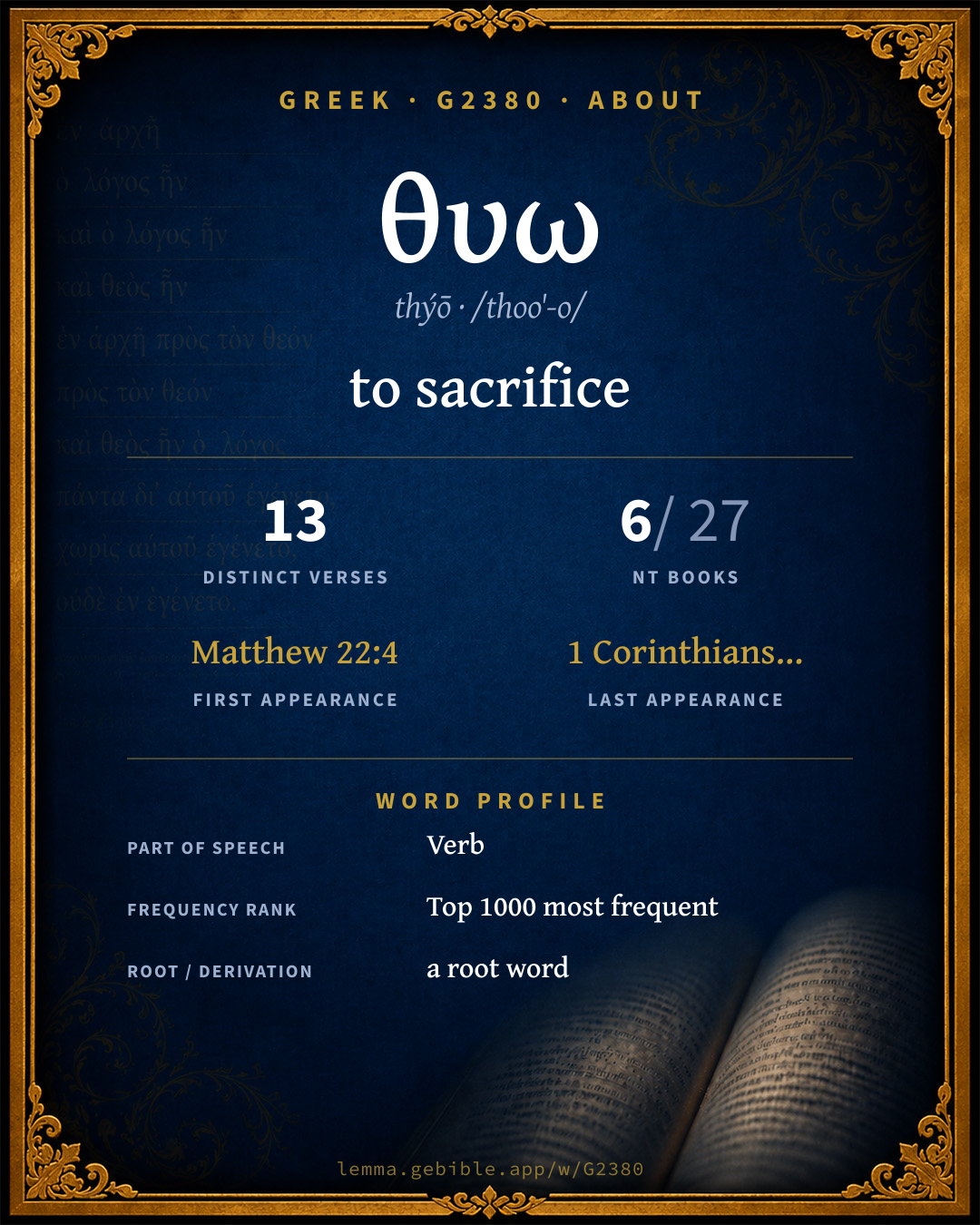
θύω
to sacrifice
‘to sacrifice’ is one of 3 main senses fuller range ↓
Full lexicon entry — Thayer's Greek Lexicon
From Thayer's Greek Lexicon
Where this word appears
See every Aorist-tense verb in the Greek New Testament →
Grammar key — what these labels mean
Part of speech
- Verb
- An action or state-of-being word.
Tense
- Aorist
- Action viewed as a simple whole, without regard to duration — often past (perfective aspect).
- Present
- Ongoing or general action in present time (imperfective aspect).
- Imperfect
- Continuous or repeated action in past time (“was writing”).
- Perfect
- A completed past action with continuing present results.
Voice
- Active
- The subject performs the action.
- Passive
- The subject receives the action.
Mood
- Imperative
- Expresses a command or request.
- Indicative
- States a fact or asks a factual question (the mood of reality).
- Infinitive
- A verbal noun (“to write”), unmarked for person or number.
- Subjunctive
- Expresses probability, purpose, or possibility (the mood of contingency).
- Participle
- A verbal adjective (“writing,” “having written”).
Case
- Nominative
- The case of the subject (and the predicate nominative).
Person
- 2nd person
- The one addressed (“you”).
- 3rd person
- The one spoken about (“he / she / it / they”).
Gender
- Neuter
- Grammatically neuter.
Number
- Singular
- One.
- Plural
- More than one.
2 verses where G2380 appears in the Aorist tense in the Book of Acts. Filtered view — show all forms. Click any verse to open its interlinear word-by-word view. Verse text shown in the World English Bible for context — . Each verse’s Greek form is shown with its reference; the English is not keyword-highlighted, since the data carries no word-level English alignment. Use “Compare translations” on any verse to read it across multiple English versions. This concordance covers the Greek New Testament; Septuagint (Greek Old Testament) occurrences of this word are not indexed here.
Acts
About this entry
At a glance — auto-summarized from this page’s data, not written by a person. Every figure links to its source below. This summary describes the numbers; it doesn’t interpret them.
“to sacrifice” is the headline sense of the Greek verb θυω (thýō). Scripture first uses it in Matthew 22:4. With 13 verses in 6 books, it is an uncommon word in the Greek New Testament. It concentrates in Luke, which alone accounts for 31% of its uses. Catalogued under 3 senses, its meaning is not single-sense. See the sense tree, 13-verse concordance, and the renderings breakdown below.
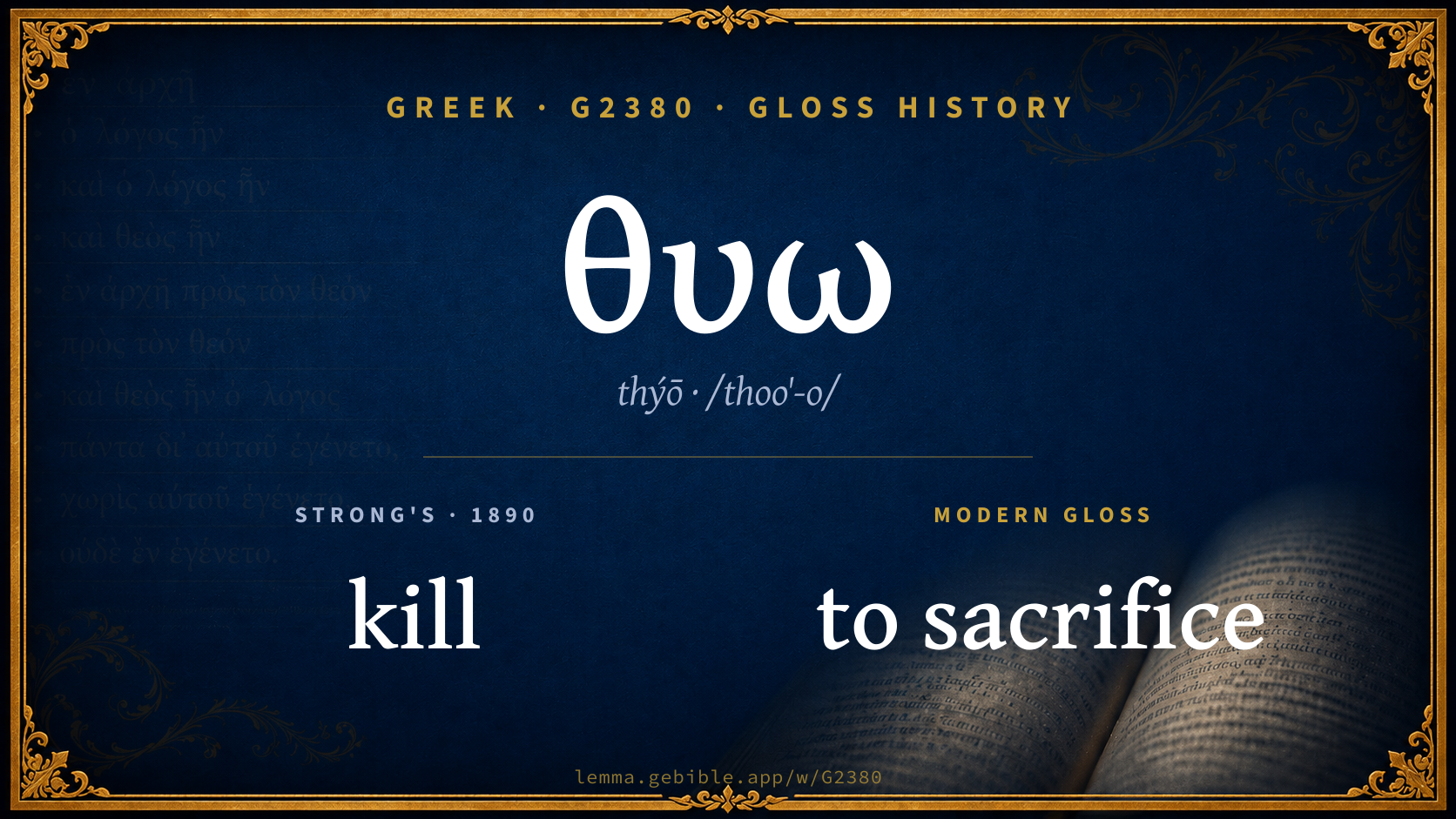
Gloss history
Strong's 1890 vs modern scholarship
About this word
Strong's G2380 catalogs a Greek word from the Greek New Testament.
These counts are not copied from any lexicon or concordance. They are computed here, from the morphology-tagged Greek New Testament. What Lemma adds →
- 13
- distinct verses
- The word appears in 13 distinct verses.
- 6 / 27
- NT books
- The word appears in 6 of 27 New Testament books.
- #814
- by frequency
- Top 1000 most frequent Greek words (rank 814 of 5,347 Greek words by occurrence).
View all 13 occurrences in the concordance →
Most concentrated in
- Luke 4 verses 31%
- Acts 4 verses 31%
- 1 Corinthians 2 verses 15%
By section of the New Testament
By traditional corpus
Conventional, traditional groupings — biblical authorship is debated, so this is a traditional corpus grouping, not an authorship claim. Some books belong to more than one corpus (Luke is in both the Gospels and the Lukan corpus, and so on), so these shares overlap and need not total 100%. Each figure is a share of the word’s 13 distinct verses.
- Lukan (Luke–Acts) 8 verses · 62%
- Gospels 7 verses · 54%
- Pauline corpus 2 verses · 15%
- Johannine 1 verse · 8%
How translations render this word
Counts come from each version’s own published word-to-Strong’s tagging or interlinear alignment — an approximate guide to how each version renders this word, not a word-level alignment the data otherwise carries. Because each total is that version’s own tagged count, the per-version totals vary from one another and need not match the appearance or distinct-verse counts above. These counts may also differ from a printed concordance because Lemma counts each distinctly tagged rendering and does not collapse phrase taggings into a single head-word total. This is a fixed set of word-tagged versions (KJV, ASV, BSB, ULT) and does not change with the reading translation you choose elsewhere. Each version’s license is shown beside its name below (and on Sources).
- King James Version: Kill 3×
- American Standard Version: Kill 4×, Sacrifice 2×
- Berean Standard Bible: Kill 4×
- unfoldingWord Literal Text: Kill 4×, Sacrifice 4×
King James Version Public Domain
Renders G2380 across 15 tagged occurrences — most commonly:
Plus 12 renderings that appear only once — usually multi-word phrases or single function words the recovered tagging swept in, not distinct renderings.
American Standard Version Public Domain
Renders G2380 across 14 tagged occurrences — most commonly:
Plus 8 renderings that appear only once — usually multi-word phrases or single function words the recovered tagging swept in, not distinct renderings.
Berean Standard Bible Public Domain
Renders G2380 across 14 tagged occurrences — most commonly:
Plus 10 renderings that appear only once — usually multi-word phrases or single function words the recovered tagging swept in, not distinct renderings.
unfoldingWord Literal Text CC BY-SA 4.0
Renders G2380 across 17 tagged occurrences — most commonly:
Plus 9 renderings that appear only once — usually multi-word phrases or single function words the recovered tagging swept in, not distinct renderings.
Senses in Thayer's
The 3 senses Thayer's distinguishes for this word, in lexicon order (not ranked by frequency or importance). The full entry — with sub-senses — is in the Lexicon Entry tab.
- to sacrifice, immolate
- of the paschal lamb
- slaughter
Word origin
Origin: a root word
A primary verb; properly to rush ( breathe hard blow smoke ) that is (by implication) to sacrifice (properly by fire but generally); by extension to immolate ( slaughter for any purpose): - kill (do) sacrifice slay.
— Strong’s Exhaustive Concordance (1890), public domain.
Forms in the corpus
The 11 distinct written forms G2380 takes in the Greek New Testament, most frequent first — each parse links to that tense’s occurrences in the concordance.
| Form | Parsing | Example | Uses |
|---|---|---|---|
| θύειν thýein | Verb, Present, Active, Infinitive | Acts 14:13 | 2 |
| θύουσιν thýousin | Verb, Present, Active, Indicative, 3rd person, Plural | 1 Corinthians 10:20 | 2 |
| θῦσον thŷson | Verb, Aorist, Active, Imperative, 2nd person, Singular | Acts 10:13 | 2 |
| θύεσθαι thýesthai | Verb, Present, Passive, Infinitive | Luke 22:7 | 1 |
| θύσατε thýsate | Verb, Aorist, Active, Imperative, 2nd person, Plural | Luke 15:23 | 1 |
| θύσῃ thýsē | Verb, Aorist, Active, Subjunctive, 3rd person, Singular | John 10:10 | 1 |
| τεθυμένα tethyména | Verb, Perfect, Passive, Participle, Nominative, Plural, Neuter | Matthew 22:4 | 1 |
| ἐτύθη etýthē | Verb, Aorist, Passive, Indicative, 3rd person, Singular | 1 Corinthians 5:7 | 1 |
| ἔθυον éthyon | Verb, Imperfect, Active, Indicative, 3rd person, Plural | Mark 14:12 | 1 |
| ἔθυσας éthysas | Verb, Aorist, Active, Indicative, 2nd person, Singular | Luke 15:30 | 1 |
| ἔθυσεν éthysen | Verb, Aorist, Active, Indicative, 3rd person, Singular | Luke 15:27 | 1 |
Same root — word family
Other Thayer's entries built from the same root as G2380, grouped by Strong’s listed origin. These share a root / origin per the lexicon — not necessarily a shared meaning. Each links to that word’s own entry.
Derived from this word
- θυελλα thýella G2366 tempest
- θυινος thýïnos G2367 citrus tree
- θυμιαω thymiáō G2370 to burn incense
- θυμος thymós G2372 anger
- θυσια thysía G2378 sacrifice
Compare all same-root words → Showing 4 of 6 — not the complete family. They share a root, not necessarily a meaning.
Septuagint usage
The same Greek word θυω appears 118 times in the Greek Old Testament (Septuagint), across 112 verses in 21 books.
- 118
- LXX occurrences
- Tagged occurrences of this Greek word in the Septuagint.
- 112
- verses
- Distinct Septuagint verses containing this word.
- 21 / 39
- OT books
- The word appears in 21 of the 39 Old Testament books.
Sample Septuagint occurrences
- Genesis 31:54 θύω
- Exodus 3:18 θύω
- Leviticus 17:5 θύω
- Numbers 22:40 θύω
- Deuteronomy 12:15 θύω
- Judges 12:6 θύω
- 1 Samuel 1:3 θύω
- 1 Kings 3:3 θύω
- 2 Kings 17:36 θύω
- 1 Chronicles 15:26 θύω
- 2 Chronicles 5:6 θύω
- Ezra 22:43 θύω
Septuagint occurrences (same lexeme)
Every verse where the same Strong’s number (G2380) appears in the Greek Septuagint — showing the first 50 of 112. Verse text shown in the World English Bible for context; the Greek form is the matched word — the English is not keyword-highlighted.
- Genesis 31:54 θύω Jacob offered a sacrifice in the mountain, and called his relatives to eat bread. They ate bread, and stayed all night in the mountain.
- Genesis 46:1 θύω Israel traveled with all that he had, and came to Beersheba, and offered sacrifices to the God of his father, Isaac.
- Exodus 3:18 θύω They will listen to your voice, and you shall come, you and the elders of Israel, to the king of Egypt, and you shall tell him, 'Yahweh, the God of the Hebrews, has met with us. Now please let us go three days' journey into the wilderness, that we may sacrifice to Yahweh, our God.'
- Exodus 5:3 θύω They said, "The God of the Hebrews has met with us. Please let us go three days' journey into the wilderness, and sacrifice to Yahweh, our God, lest he fall on us with pestilence, or with the sword."
- Exodus 5:8 θύω The number of the bricks, which they made before, you require from them. You shall not diminish anything of it, for they are idle; therefore they cry, saying, 'Let us go and sacrifice to our God.'
- Exodus 5:17 θύω But he said, "You are idle! You are idle! Therefore you say, 'Let us go and sacrifice to Yahweh.'
- Exodus 8:4 θύω and the frogs shall come up both on you, and on your people, and on all your servants.'"
- Exodus 8:21 θύω Else, if you will not let my people go, behold, I will send swarms of flies on you, and on your servants, and on your people, and into your houses: and the houses of the Egyptians shall be full of swarms of flies, and also the ground whereon they are.
- Exodus 8:22 θύω I will set apart in that day the land of Goshen, in which my people dwell, that no swarms of flies shall be there; to the end you may know that I am Yahweh in the midst of the earth.
- Exodus 8:23 θύω I will put a division between my people and your people: by tomorrow shall this sign be."'"
- Exodus 8:24 θύω Yahweh did so; and there came grievous swarms of flies into the house of Pharaoh, and into his servants' houses: and in all the land of Egypt the land was corrupted by reason of the swarms of flies.
- Exodus 8:25 θύω Pharaoh called for Moses and for Aaron, and said, "Go, sacrifice to your God in the land!"
- Exodus 12:21 θύω Then Moses called for all the elders of Israel, and said to them, "Draw out, and take lambs according to your families, and kill the Passover.
- Exodus 13:15 θύω and it happened, when Pharaoh would hardly let us go, that Yahweh killed all the firstborn in the land of Egypt, both the firstborn of man, and the firstborn of animal. Therefore I sacrifice to Yahweh all that opens the womb, being males; but all the firstborn of my sons I redeem.'
- Exodus 20:24 θύω You shall make an altar of earth for me, and shall sacrifice on it your burnt offerings and your peace-offerings, your sheep and your oxen. In every place where I record my name I will come to you and I will bless you.
- Exodus 23:18 θύω "You shall not offer the blood of my sacrifice with leavened bread, neither shall the fat of my feast remain all night until the morning.
- Exodus 24:5 θύω He sent young men of the children of Israel, who offered burnt offerings and sacrificed peace-offerings of oxen to Yahweh.
- Exodus 32:8 θύω They have turned aside quickly out of the way which I commanded them. They have made themselves a molten calf, and have worshiped it, and have sacrificed to it, and said, 'These are your gods, Israel, which brought you up out of the land of Egypt.'"
- Exodus 34:15 θύω Don't make a covenant with the inhabitants of the land, lest they play the prostitute after their gods, and sacrifice to their gods, and one call you and you eat of his sacrifice;
- Leviticus 17:5 θύω This is to the end that the children of Israel may bring their sacrifices, which they sacrifice in the open field, that they may bring them to Yahweh, to the door of the Tent of Meeting, to the priest, and sacrifice them for sacrifices of peace offerings to Yahweh.
- Leviticus 17:7 θύω They shall no more sacrifice their sacrifices to the goat idols, after which they play the prostitute. This shall be a statute forever to them throughout their generations.'
- Leviticus 19:5 θύω "'When you offer a sacrifice of peace offerings to Yahweh, you shall offer it so that you may be accepted.
- Leviticus 19:6 θύω It shall be eaten the same day you offer it, and on the next day: and if anything remains until the third day, it shall be burned with fire.
- Leviticus 22:29 θύω "When you sacrifice a sacrifice of thanksgiving to Yahweh, you shall sacrifice it so that you may be accepted.
- Numbers 22:40 θύω Balak sacrificed oxen and sheep, and sent to Balaam, and to the princes who were with him.
- Deuteronomy 12:15 θύω Notwithstanding, you may kill and eat flesh within all your gates, after all the desire of your soul, according to the blessing of Yahweh your God which he has given you: the unclean and the clean may eat of it, as of the gazelle, and as of the hart.
- Deuteronomy 12:21 θύω If the place which Yahweh your God shall choose, to put his name there, be too far from you, then you shall kill of your herd and of your flock, which Yahweh has given you, as I have commanded you; and you may eat within your gates, after all the desire of your soul.
- Deuteronomy 15:21 θύω If it have any blemish, [as if it be] lame or blind, any ill blemish whatever, you shall not sacrifice it to Yahweh your God.
- Deuteronomy 16:2 θύω You shall sacrifice the Passover to Yahweh your God, of the flock and the herd, in the place which Yahweh shall choose, to cause his name to dwell there.
- Deuteronomy 16:4 θύω There shall be no yeast seen with you in all your borders seven days; neither shall any of the flesh, which you sacrifice the first day at even, remain all night until the morning.
- Deuteronomy 16:5 θύω You may not sacrifice the Passover within any of your gates, which Yahweh your God gives you;
- Deuteronomy 16:6 θύω but at the place which Yahweh your God shall choose, to cause his name to dwell in, there you shall sacrifice the Passover at even, at the going down of the sun, at the season that you came forth out of Egypt.
- Deuteronomy 17:1 θύω You shall not sacrifice to Yahweh your God an ox, or a sheep, in which is a blemish, [or] anything evil; for that is an abomination to Yahweh your God.
- Deuteronomy 18:3 θύω This shall be the priests' due from the people, from those who offer a sacrifice, whether it be ox or sheep, that they shall give to the priest the shoulder, and the two cheeks, and the maw.
- Deuteronomy 27:7 θύω and you shall sacrifice peace-offerings, and shall eat there; and you shall rejoice before Yahweh your God.
- Deuteronomy 32:17 θύω They sacrificed to demons, [which were] no God, To gods that they didn't know, To new [gods] that came up of late, Which your fathers didn't dread.
- Deuteronomy 33:19 θύω They shall call the peoples to the mountain; There shall they offer sacrifices of righteousness: For they shall suck the abundance of the seas, The hidden treasures of the sand.
- Judges 12:6 θύω then said they to him, Say now Shibboleth; and he said Sibboleth; for he couldn't manage to pronounce it right: then they laid hold on him, and killed him at the fords of the Jordan. There fell at that time of Ephraim forty-two thousand.
- Judges 16:23 θύω The lords of the Philistines gathered them together to offer a great sacrifice to Dagon their god, and to rejoice; for they said, Our god has delivered Samson our enemy into our hand.
- 1 Samuel 1:3 θύω This man went up out of his city from year to year to worship and to sacrifice to Yahweh of Hosts in Shiloh. The two sons of Eli, Hophni and Phinehas, priests to Yahweh, were there.
- 1 Samuel 1:4 θύω When the day came that Elkanah sacrificed, he gave to Peninnah his wife, and to all her sons and her daughters, portions:
- 1 Samuel 1:21 θύω The man Elkanah, and all his house, went up to offer to Yahweh the yearly sacrifice, and his vow.
- 1 Samuel 2:13 θύω The custom of the priests with the people was that when any man offered sacrifice, the priest's servant came, while the flesh was boiling, with a flesh-hook of three teeth in his hand;
- 1 Samuel 2:14 θύω and he struck it into the pan, or kettle, or caldron, or pot; all that the flesh-hook brought up the priest took therewith. So they did in Shiloh to all the Israelites who came there.
- 1 Samuel 2:15 θύω Yes, before they burnt the fat, the priest's servant came, and said to the man who sacrificed, Give flesh to roast for the priest; for he will not have boiled flesh of you, but raw.
- 1 Samuel 2:16 θύω If the man said to him, They will surely burn the fat first, and then take as much as your soul desires; then he would say, No, but you shall give it me now: and if not, I will take it by force.
- 1 Samuel 2:19 θύω Moreover his mother made him a little robe, and brought it to him from year to year, when she came up with her husband to offer the yearly sacrifice.
- 1 Samuel 11:15 θύω All the people went to Gilgal; and there they made Saul king before Yahweh in Gilgal; and there they offered sacrifices of peace-offerings before Yahweh; and there Saul and all the men of Israel rejoiced greatly.
- 1 Samuel 15:15 θύω Saul said, They have brought them from the Amalekites: for the people spared the best of the sheep and of the oxen, to sacrifice to Yahweh your God; and the rest we have utterly destroyed.
- 1 Samuel 15:21 θύω But the people took of the spoil, sheep and oxen, the chief of the devoted things, to sacrifice to Yahweh your God in Gilgal.
These are occurrences of the same Greek lexeme (G2380) in the Septuagint — not a translation of any one Hebrew word. The store carries no word-level Hebrew↔Greek alignment, so no Hebrew original is asserted here. Counts come from the recovered LXX Strong's tagging — high-frequency vocabulary is well covered, while rare or late forms may be untagged — so they reflect tagged occurrences and may slightly undercount.