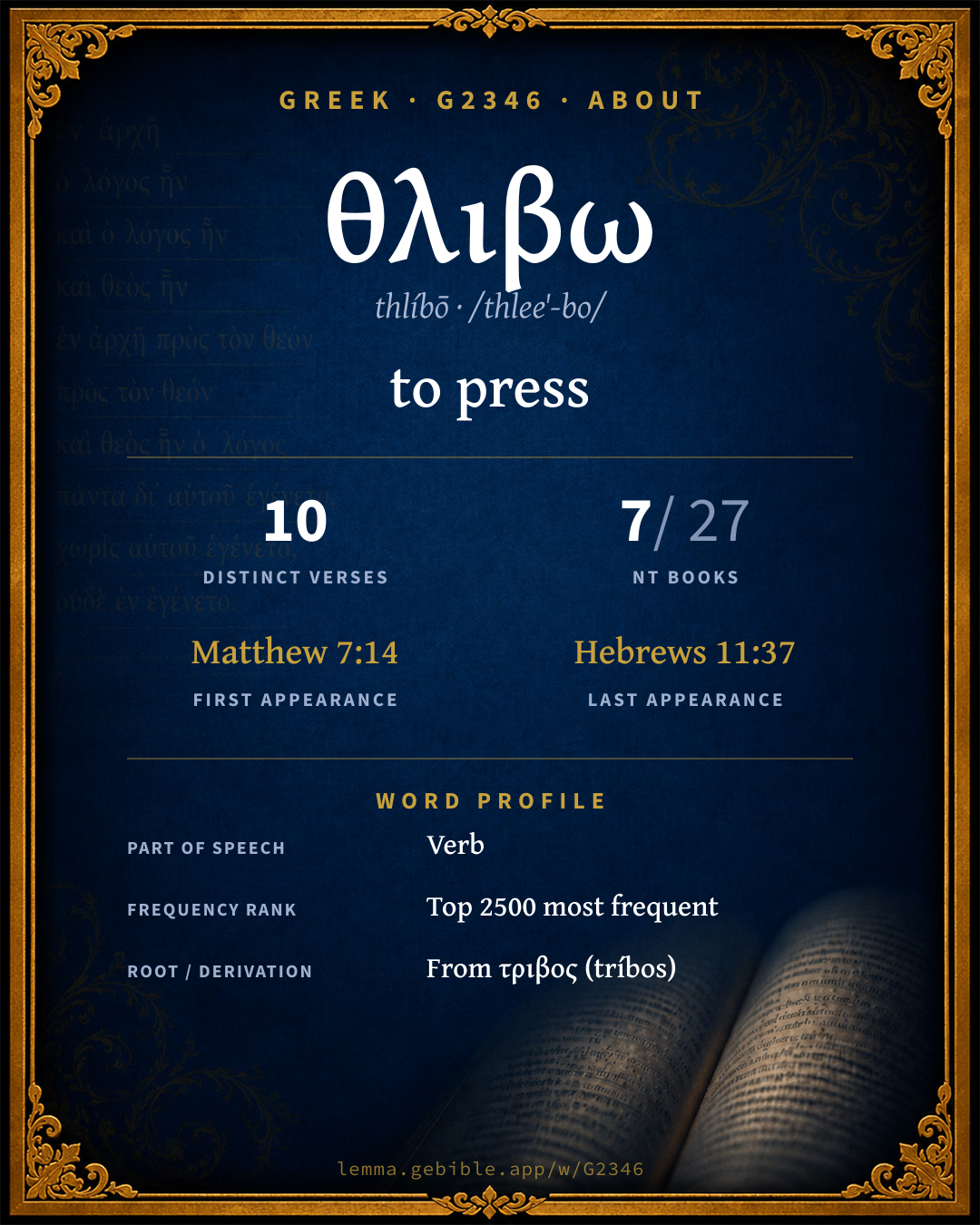
θλίβω
to press
‘to press’ is one of 3 main senses fuller range ↓
Full lexicon entry — Thayer's Greek Lexicon
From Thayer's Greek Lexicon
Where this word appears
See every Present-tense verb in the Greek New Testament →
Grammar key — what these labels mean
Part of speech
- Verb
- An action or state-of-being word.
Tense
- Present
- Ongoing or general action in present time (imperfective aspect).
- Perfect
- A completed past action with continuing present results.
Voice
- Passive
- The subject receives the action.
- Active
- The subject performs the action.
Mood
- Participle
- A verbal adjective (“writing,” “having written”).
- Subjunctive
- Expresses probability, purpose, or possibility (the mood of contingency).
- Indicative
- States a fact or asks a factual question (the mood of reality).
- Infinitive
- A verbal noun (“to write”), unmarked for person or number.
Case
- Nominative
- The case of the subject (and the predicate nominative).
- Dative
- The case of the indirect object, means, or location — “to / for / with / in.”
Person
- 3rd person
- The one spoken about (“he / she / it / they”).
- 1st person
- The speaker (“I / we”).
Gender
- Masculine
- Grammatically masculine.
- Feminine
- Grammatically feminine.
Number
- Plural
- More than one.
- Singular
- One.
Grammatical forms
- Verb, Present, Passive, Participle, Nominative, Plural, Masculine 3 times (30%)
- Verb, Present, Passive, Participle, Dative, Plural, Masculine 2 times (20%)
- Verb, Present, Active, Participle, Dative, Plural, Masculine 1 time (10%)
- Verb, Present, Active, Subjunctive, 3rd person, Plural 1 time (10%)
- Verb, Present, Passive, Indicative, 1st person, Plural 1 time (10%)
- Verb, Present, Passive, Infinitive 1 time (10%)
- Verb, Perfect, Passive, Participle, Nominative, Singular, Feminine 1 time (10%)
Parsed forms decoded from the imported morphology (Robinson–Tischendorf, public domain), counted across 10 parsed occurrences — not distinct verses.
Every verse where G2346 appears — 10 distinct verses across 7 books. Click any verse to open its interlinear word-by-word view. Verse text shown in the World English Bible for context — . Each verse’s Greek form is shown with its reference; the English is not keyword-highlighted, since the data carries no word-level English alignment. Use “Compare translations” on any verse to read it across multiple English versions. This concordance covers the Greek New Testament; Septuagint (Greek Old Testament) occurrences of this word are not indexed here.
Matthew 1 verse
Mark 1 verse
2 Corinthians 3 verses
- 2 Corinthians 1:6 θλιβόμεθα pres pass ind 1pl But if we are afflicted, it is for your comfort and salvation. If we are comforted, it is for your comfort, which produces in you the patient enduring of the same sufferings which we also suffer.
- 2 Corinthians 4:8 θλιβόμενοι pres pass ptcp nom pl masc We are pressed on every side, yet not crushed; perplexed, yet not to despair;
- 2 Corinthians 7:5 θλιβόμενοι pres pass ptcp nom pl masc For even when we had come into Macedonia, our flesh had no relief, but we were afflicted on every side. Fightings were outside. Fear was inside.
1 Thessalonians 1 verse
2 Thessalonians 2 verses
- 2 Thessalonians 1:6 θλίβουσιν pres act ptcp dat pl masc Since it is a righteous thing with God to repay affliction to those who afflict you,
- 2 Thessalonians 1:7 θλιβομένοις pres pass ptcp dat pl masc and to give relief to you that are afflicted with us, when the Lord Jesus is revealed from heaven with his mighty angels in flaming fire,
1 Timothy 1 verse
Hebrews 1 verse
About this entry
At a glance — auto-summarized from this page’s data, not written by a person. Every figure links to its source below. This summary describes the numbers; it doesn’t interpret them.
At its core, θλιβω (thlíbō) means “to press.” It first appears in Matthew 7:14. It turns up in 10 verses across 7 books, an uncommon footprint. The word gravitates to 2 Corinthians (30%), then 2 Thessalonians and Matthew. Ranging over 3 senses, it is not a single-sense word. Dig into 10-verse concordance and the renderings breakdown below.
Gloss history
Strong's 1890 vs modern scholarship

About this word
Strong's G2346 catalogs a Greek word from the Greek New Testament.
These counts are not copied from any lexicon or concordance. They are computed here, from the morphology-tagged Greek New Testament. What Lemma adds →
- 10
- distinct verses
- The word appears in 10 distinct verses.
- 7 / 27
- NT books
- The word appears in 7 of 27 New Testament books.
- #1,056
- by frequency
- Top 2500 most frequent Greek words (rank 1,056 of 5,347 Greek words by occurrence).
View all 10 occurrences in the concordance →
Most concentrated in
- 2 Corinthians 3 verses 30%
- 2 Thessalonians 2 verses 20%
- Matthew 1 verse 10%
By section of the New Testament
By traditional corpus
Conventional, traditional groupings — biblical authorship is debated, so this is a traditional corpus grouping, not an authorship claim. Some books belong to more than one corpus (Luke is in both the Gospels and the Lukan corpus, and so on), so these shares overlap and need not total 100%. Each figure is a share of the word’s 10 distinct verses.
- Pauline corpus 7 verses · 70%
- Gospels 2 verses · 20%
- Hebrews 1 verse · 10%
How translations render this word
Counts come from each version’s own published word-to-Strong’s tagging or interlinear alignment — an approximate guide to how each version renders this word, not a word-level alignment the data otherwise carries. Because each total is that version’s own tagged count, the per-version totals vary from one another and need not match the appearance or distinct-verse counts above. These counts may also differ from a printed concordance because Lemma counts each distinctly tagged rendering and does not collapse phrase taggings into a single head-word total. This is a fixed set of word-tagged versions (KJV, ASV, BSB, ULT) and does not change with the reading translation you choose elsewhere. Each version’s license is shown beside its name below (and on Sources).
- King James Version: Afflicted 2×
- American Standard Version: Afflicted 2×
- Berean Standard Bible: Afflict 1×, Afflicted 1×, Are oppressed 1×
- unfoldingWord Literal Text: Afflicted 1×, Afflicting 1×, Be afflicted 1×
King James Version Public Domain
Renders G2346 across 10 tagged occurrences — most commonly:
Plus 8 renderings that appear only once — usually multi-word phrases or single function words the recovered tagging swept in, not distinct renderings.
American Standard Version Public Domain
Renders G2346 across 11 tagged occurrences — most commonly:
Plus 9 renderings that appear only once — usually multi-word phrases or single function words the recovered tagging swept in, not distinct renderings.
Berean Standard Bible Public Domain
Renders G2346 across 10 tagged occurrences — most commonly:
unfoldingWord Literal Text CC BY-SA 4.0
Renders G2346 across 11 tagged occurrences — most commonly:
Senses in Thayer's
The 3 senses Thayer's distinguishes for this word, in lexicon order (not ranked by frequency or importance). The full entry — with sub-senses — is in the Lexicon Entry tab.
- to press (as grapes), press hard upon
- narrow straitened, contracted
- metaph. to trouble, afflict, distress
Word origin
Derived from τριβος (tríbos) (G5147) — path.
Akin to the base of G5147 ; to crowd (literally or figuratively): - afflict narrow throng suffer tribulation trouble.
— Strong’s Exhaustive Concordance (1890), public domain.
Forms in the corpus
The 7 distinct written forms G2346 takes in the Greek New Testament, most frequent first — each parse links to that tense’s occurrences in the concordance.
| Form | Parsing | Example | Uses |
|---|---|---|---|
| θλιβόμενοι thlibómenoi | Verb, Present, Passive, Participle, Nominative, Plural, Masculine | 2 Corinthians 4:8 | 3 |
| θλιβομένοις thliboménois | Verb, Present, Passive, Participle, Dative, Plural, Masculine | 2 Thessalonians 1:7 | 2 |
| θλίβεσθαι thlíbesthai | Verb, Present, Passive, Infinitive | 1 Thessalonians 3:4 | 1 |
| θλίβουσιν thlíbousin | Verb, Present, Active, Participle, Dative, Plural, Masculine | 2 Thessalonians 1:6 | 1 |
| θλίβωσιν thlíbōsin | Verb, Present, Active, Subjunctive, 3rd person, Plural | Mark 3:9 | 1 |
| θλιβόμεθα thlibómetha | Verb, Present, Passive, Indicative, 1st person, Plural | 2 Corinthians 1:6 | 1 |
| τεθλιμμένη tethlimménē | Verb, Perfect, Passive, Participle, Nominative, Singular, Feminine | Matthew 7:14 | 1 |
Same root — word family
Other Thayer's entries built from the same root as G2346, grouped by Strong’s listed origin. These share a root / origin per the lexicon — not necessarily a shared meaning. Each links to that word’s own entry.
Derives from
Derived from this word
Compare all same-root words → They share a root, not necessarily a meaning.
Septuagint usage
The same Greek word θλιβω appears 81 times in the Greek Old Testament (Septuagint), across 76 verses in 18 books.
- 81
- LXX occurrences
- Tagged occurrences of this Greek word in the Septuagint.
- 76
- verses
- Distinct Septuagint verses containing this word.
- 18 / 39
- OT books
- The word appears in 18 of the 39 Old Testament books.
Sample Septuagint occurrences
- Exodus 3:9 θλίβω
- Leviticus 19:33 θλίβω
- Deuteronomy 23:17 θλίβω
- Joshua 19:47 θλίβω
- Judges 4:3 θλίβω
- 1 Samuel 10:18 θλίβω
- 2 Samuel 13:2 θλίβω
- 1 Kings 8:37 θλίβω
- 2 Kings 13:4 θλίβω
- 2 Chronicles 6:28 θλίβω
- Ezra 4:1 θλίβω
- Job 20:22 θλίβω
Septuagint occurrences (same lexeme)
Every verse where the same Strong’s number (G2346) appears in the Greek Septuagint — showing the first 50 of 76. Verse text shown in the World English Bible for context; the Greek form is the matched word — the English is not keyword-highlighted.
- Exodus 3:9 θλίβω Now, behold, the cry of the children of Israel has come to me. Moreover I have seen the oppression with which the Egyptians oppress them.
- Exodus 22:20 θλίβω "He who sacrifices to any god, except to Yahweh only, shall be utterly destroyed.
- Exodus 23:9 θλίβω "You shall not oppress an alien, for you know the heart of an alien, seeing you were aliens in the land of Egypt.
- Leviticus 19:33 θλίβω "'If a stranger lives as a foreigner with you in your land, you shall not do him wrong.
- Leviticus 25:14 θλίβω "'If you sell anything to your neighbor, or buy from your neighbor, you shall not wrong one another.
- Leviticus 25:17 θλίβω You shall not wrong one another; but you shall fear your God: for I am Yahweh your God.
- Leviticus 26:26 θλίβω When I break your staff of bread, ten women shall bake your bread in one oven, and they shall deliver your bread again by weight: and you shall eat, and not be satisfied.
- Deuteronomy 23:17 θλίβω There shall be no prostitute of the daughters of Israel, neither shall there be a sodomite of the sons of Israel.
- Deuteronomy 28:52 θλίβω They shall besiege you in all your gates, until your high and fortified walls come down, in which you trusted, throughout all your land; and they shall besiege you in all your gates throughout all your land, which Yahweh your God has given you.
- Deuteronomy 28:53 θλίβω You shall eat the fruit of your own body, the flesh of your sons and of your daughters, whom Yahweh your God has given you, in the siege and in the distress with which your enemies shall distress you.
- Deuteronomy 28:55 θλίβω so that he will not give to any of them of the flesh of his children whom he shall eat, because he has nothing left him, in the siege and in the distress with which your enemy shall distress you in all your gates.
- Deuteronomy 28:57 θλίβω and toward her young one who comes out from between her feet, and toward her children whom she shall bear; for she shall eat them for want of all things secretly, in the siege and in the distress with which your enemy shall distress you in your gates.
- Joshua 19:47 θλίβω The border of the children of Dan went out beyond them; for the children of Dan went up and fought against Leshem, and took it, and struck it with the edge of the sword, and possessed it, and lived therein, and called Leshem, Dan, after the name of Dan their father.
- Judges 4:3 θλίβω The children of Israel cried to Yahweh: for he had nine hundred chariots of iron; and twenty years he mightily oppressed the children of Israel.
- Judges 6:9 θλίβω and I delivered you out of the hand of the Egyptians, and out of the hand of all who oppressed you, and drove them out from before you, and gave you their land;
- Judges 8:34 θλίβω The children of Israel didn't remember Yahweh their God, who had delivered them out of the hand of all their enemies on every side;
- Judges 10:8 θλίβω They vexed and oppressed the children of Israel that year: eighteen years [oppressed they] all the children of Israel that were beyond the Jordan in the land of the Amorites, which is in Gilead.
- Judges 10:9 θλίβω The children of Ammon passed over the Jordan to fight also against Judah, and against Benjamin, and against the house of Ephraim; so that Israel was sore distressed.
- Judges 10:12 θλίβω The Sidonians also, and the Amalekites, and the Maonites, did oppress you; and you cried to me, and I saved you out of their hand.
- 1 Samuel 10:18 θλίβω and he said to the children of Israel, Thus says Yahweh, the God of Israel, I brought up Israel out of Egypt, and I delivered you out of the hand of the Egyptians, and out of the hand of all the kingdoms that oppressed you:
- 1 Samuel 28:15 θλίβω Samuel said to Saul, Why have you disquieted me, to bring me up? Saul answered, I am sore distressed; for the Philistines make war against me, and God is departed from me, and answers me no more, neither by prophets, nor by dreams: therefore I have called you, that you may make known to me what I shall do.
- 1 Samuel 30:6 θλίβω David was greatly distressed; for the people spoke of stoning him, because the soul of all the people was grieved, every man for his sons and for his daughters: but David strengthened himself in Yahweh his God.
- 2 Samuel 13:2 θλίβω Amnon was so vexed that he fell sick because of his sister Tamar; for she was a virgin; and it seemed hard to Amnon to do anything to her.
- 2 Samuel 22:7 θλίβω In my distress I called on Yahweh; Yes, I called to my God: He heard my voice out of his temple, My cry [came] into his ears.
- 1 Kings 8:37 θλίβω If there be in the land famine, if there be pestilence, if there be blasting [or] mildew, locust [or] caterpillar; if their enemy besiege them in the land of their cities; whatever plague, whatever sickness there be;
- 2 Kings 13:4 θλίβω Jehoahaz begged Yahweh, and Yahweh listened to him; for he saw the oppression of Israel, how that the king of Syria oppressed them.
- 2 Chronicles 6:28 θλίβω If there be in the land famine, if there be pestilence, if there be blasting or mildew, locust or caterpillar; if their enemies besiege them in the land of their cities; whatever plague or whatever sickness there be;
- 2 Chronicles 28:22 θλίβω In the time of his distress did he trespass yet more against Yahweh, this same king Ahaz.
- 2 Chronicles 33:12 θλίβω When he was in distress, he begged Yahweh his God, and humbled himself greatly before the God of his fathers.
- Ezra 4:1 θλίβω Now when the adversaries of Judah and Benjamin heard that the children of the captivity were building a temple to Yahweh, the God of Israel;
- Ezra 14:5 θλίβω
- Ezra 19:27 θλίβω
- Job 20:22 θλίβω In the fullness of his sufficiency, distress shall overtake him: The hand of everyone who is in misery shall come on him.
- Job 36:15 θλίβω He delivers the afflicted by their affliction, And opens their ear in oppression.
- Psalms 3:2 θλίβω Many there are who say of my soul, "There is no help for him in God." Selah.
- Psalms 12:5 θλίβω "Because of the oppression of the weak and because of the groaning of the needy, I will now arise," says Yahweh; "I will set him in safety from those who malign him."
- Psalms 17:7 θλίβω Show your marvelous loving kindness, You who save those who take refuge by your right hand from their enemies.
- Psalms 22:5 θλίβω They cried to you, and were delivered. They trusted in you, and were not disappointed.
- Psalms 26:2 θλίβω Examine me, Yahweh, and prove me. Try my heart and my mind.
- Psalms 26:12 θλίβω My foot stands in an even place. In the congregations I will bless Yahweh.
- Psalms 30:10 θλίβω Hear, Yahweh, and have mercy on me. Yahweh, be my helper."
- Psalms 41:11 θλίβω By this I know that you delight in me, Because my enemy doesn't triumph over me.
- Psalms 43:8 θλίβω
- Psalms 55:2 θλίβω Attend to me, and answer me. I am restless in my complaint, and moan,
- Psalms 59:14 θλίβω At evening let them return. Let them howl like a dog, and go around the city.
- Psalms 68:18 θλίβω You have ascended on high. You have led away captives. You have received gifts among men, Yes, among the rebellious also, that Yah God might dwell there.
- Psalms 68:20 θλίβω God is to us a God of deliverance. To Yahweh, the Lord, belongs escape from death.
- Psalms 77:42 θλίβω
- Psalms 80:15 θλίβω The stock which your right hand planted, The branch that you made strong for yourself.
- Psalms 101:3 θλίβω I will set no vile thing before my eyes. I hate the deeds of faithless men. They will not cling to me.
These are occurrences of the same Greek lexeme (G2346) in the Septuagint — not a translation of any one Hebrew word. The store carries no word-level Hebrew↔Greek alignment, so no Hebrew original is asserted here. Counts come from the recovered LXX Strong's tagging — high-frequency vocabulary is well covered, while rare or late forms may be untagged — so they reflect tagged occurrences and may slightly undercount.