
Job 20:22

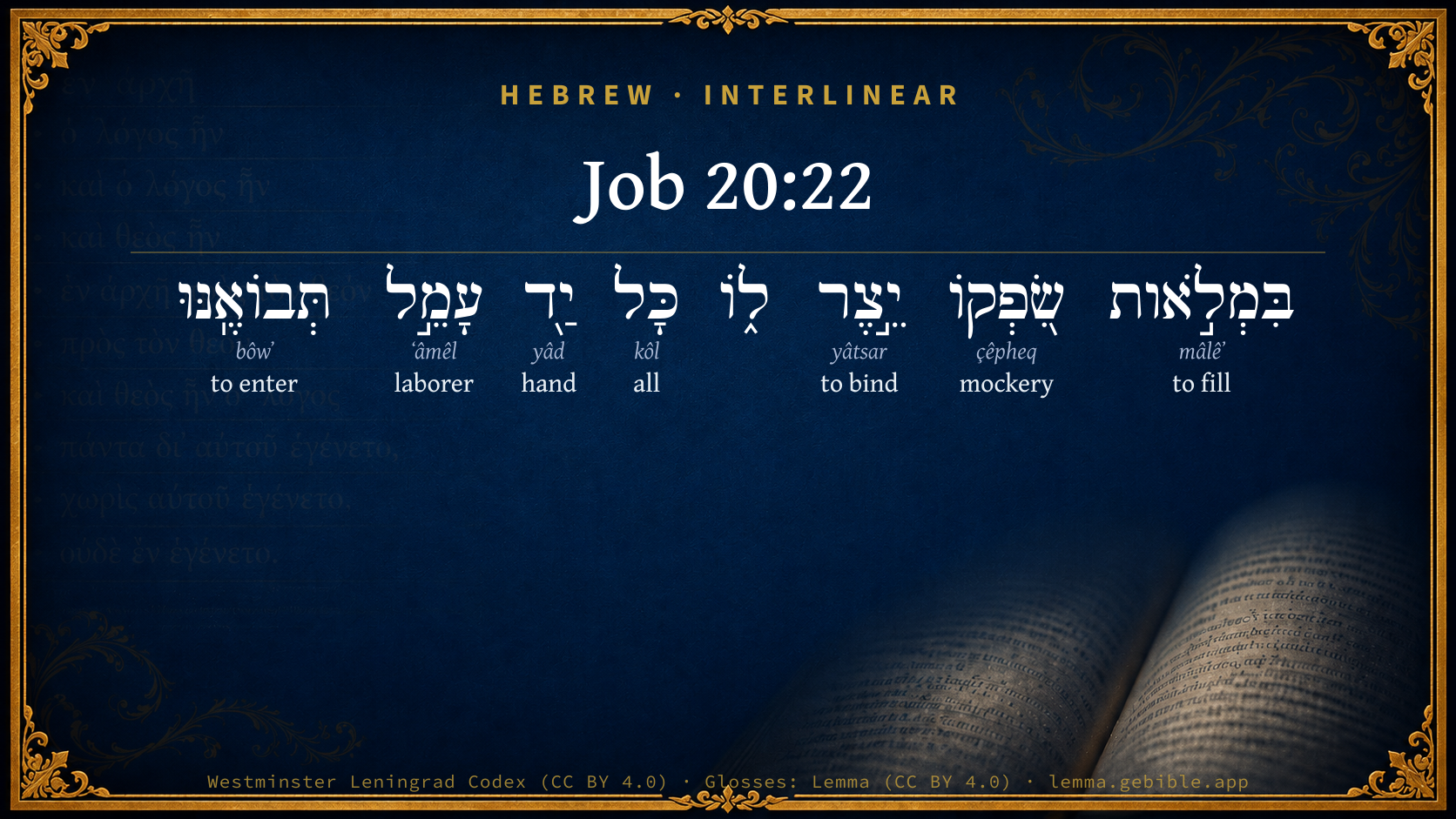
Hebrew (Westminster Leningrad Codex) Job 20:22 appears in the Hebrew Old Testament. The text above is from the Westminster Leningrad Codex. Each word links to its Strong’s number, a concise gloss, and parsing drawn from the Open Scriptures Hebrew Bible morphology. Click any word for its full Brown-Driver-Briggs (BDB) entry.
Download image
Cite this verse

Job 20:22 (World English Bible). Public Domain. Lemma interlinear Bible study tool, https://lemma.gebible.app/v/job/20/22.

Show BibTeX & RIS
BibTeX
RIS
English Translation
In the fullness of his sufficiency, distress shall overtake him: The hand of everyone who is in misery shall come on him.
World English Bible · Public Domain
Highlights
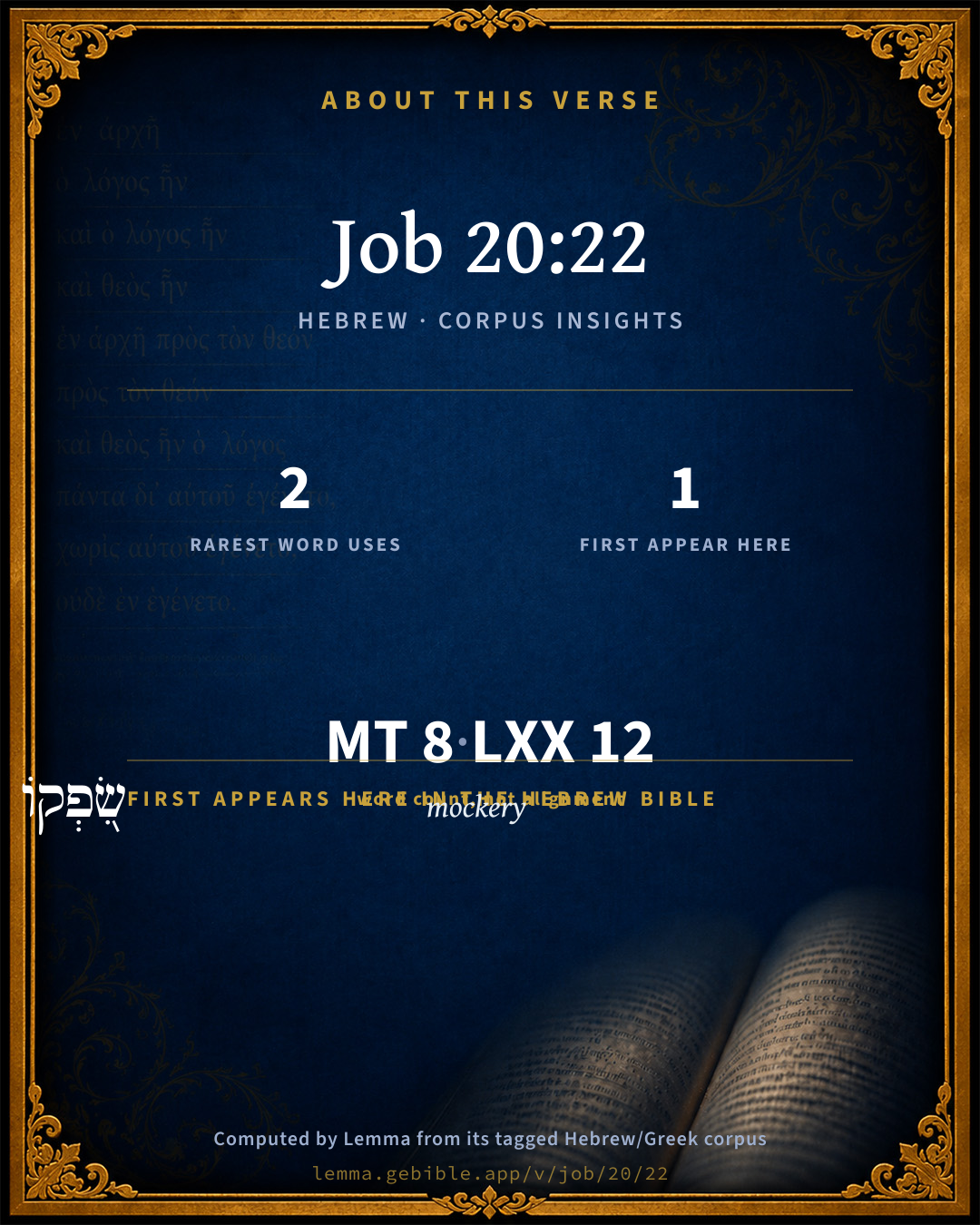
  • 1 first appearance in the Hebrew Bible
Full analysis ↓
Download a study sheet

One document with this verse’s original text, its word-by-word gloss line, the meaning frame, cross-references with their text, attributed commentary, and full source and license credits — printable, and it pastes into notes with its structure intact.

This verse Autodidact and up

Study sheet (.html) Plain text (.txt)

A passage Seminary Student

Up to 50 verses in one chapter. A passage sheet keeps up to 6 commentary sources and 12 cross-references per verse, in the order this page ranks them, and says so on the sheet whenever that leaves anything out. Ask for a single verse and you get the Autodidact verse sheet above.

Everything on this page stays free to read, with no account — the sheet is a download of what is already on screen, not access to it.

Want to remove ads? Support Godless Engineer
Compare translations 3

The same verse in 3 English versions, stacked beneath the original-language interlinear above. Click any original word for its lexicon entry.

Each is an independent rendering of the whole verse — the interlinear is not word-aligned to these translations.

Highlighted words mark where these versions differ — a whole-verse word diff, not a word-by-word alignment.

  • World English Bible Public Domain
    In the fullness of his sufficiency, distress shall overtake him: The hand of everyone who is in misery shall come on him.
  • King James Version Public Domain
    In the fulness of his sufficiency he shall be in straits: every hand of the wicked shall come upon him.
  • unfoldingWord Literal Text CC BY-SA 4.0
    In the filling of his wealth it will become narrow to him; every hand of the troubling will come against him.

unfoldingWord Literal Text — © unfoldingWord, licensed CC BY-SA 4.0. Word-aligned USFM3 via Door43 (git.door43.org/unfoldingWord/en_ult).

Versions to compare (up to 4)

3 of 4 selected

Show all 18 translations

Every available English version of this verse, each an independent rendering of the whole verse.

  • World English Bible Public Domain
    In the fullness of his sufficiency, distress shall overtake him: The hand of everyone who is in misery shall come on him.
  • Berean Standard Bible Public Domain
    In the midst of his plenty, he will be distressed; the full force of misery will come upon him.
  • Majority Standard Bible Public Domain
    In the midst of his plenty, he will be distressed; the full force of misery will come upon him.
  • King James Version Public Domain
    In the fulness of his sufficiency he shall be in straits: every hand of the wicked shall come upon him.
  • American Standard Version (1901) Public Domain
    In the fulness of his sufficiency he shall be in straits: The hand of every one that is in misery shall come upon him.
  • Revised Version (1885) Public Domain
    In the fulness of his sufficiency he shall be in straits: the hand of every one that is in misery shall come upon him.
  • Geneva Bible (1599) Public Domain
    When he shalbe filled with his abundance, he shalbe in paine, and the hand of all the wicked shall assaile him.
  • Douay-Rheims (1899) Public Domain
    When he shall be filled, he shall be straitened, he shall burn, and every sorrow shall fall upon him.
  • Young's Literal Translation Public Domain
    In the fulness of his sufficiency he is straitened. Every perverse hand doth meet him.
  • Literal Standard Version CC BY-SA 4.0
    In the fullness of his sufficiency he is constricted. Every perverse hand meets him.
  • Unlocked Literal Bible CC BY-SA 4.0
    In the abundance of his wealth he will fall into trouble; the hand of everyone who is in poverty will come against him.
  • unfoldingWord Literal Text CC BY-SA 4.0
    In the filling of his wealth it will become narrow to him; every hand of the troubling will come against him.
  • Darby Bible Public Domain
    In the fulness of his sufficiency he shall be in straits; every hand of the wretched shall come upon him.
  • World Messianic Bible Public Domain
    In the fullness of his sufficiency, distress will overtake him. The hand of everyone who is in misery will come on him.
  • Webster's Bible Public Domain
    In the fullness of his sufficiency he shall be in straits: every hand of the wicked shall come upon him.
  • Free Bible Version CC BY-SA 4.0
    Even when the wicked have all that they want they run into trouble; all kinds of misery will fall upon them.
  • Bible in Basic English Public Domain
    Even when his wealth is great, he is full of care, for the hand of everyone who is in trouble is turned against him.
  • JPS Tanakh (1917) Public Domain
    In the fulness of his sufficiency he shall be in straits; the hand of every one that is in misery shall come upon him.

Literal Standard Version (2020), Covenant Press — licensed CC BY-SA 4.0. Text via the HelloAO Bible API (eBible.org). Unlocked Literal Bible (unfoldingWord) — licensed CC BY-SA 4.0. Text via the HelloAO Bible API (eBible.org). unfoldingWord Literal Text — © unfoldingWord, licensed CC BY-SA 4.0. Word-aligned USFM3 via Door43 (git.door43.org/unfoldingWord/en_ult). Free Bible Version, Dr. Jonathan Gallagher — licensed CC BY-SA 4.0. Text via the HelloAO Bible API (eBible.org).

Word by word

More ways to search: Search by grammar → Find every occurrence → Compare this word →

Practice this passage: Drill this verse → Learn its vocabulary →

About this verse

These counts appear in no published source. They are computed here, from the morphology-tagged text and Lemma’s own curated glosses. What Lemma adds →

8
words
7
distinct lemmas
Wisdom
section

Notable vocabulary

The rarest word here is שִׂ֭פְקוֹ mockery H5607 — appearing just 2 times in the whole Hebrew Bible.

First appearance in Scripture

This word makes its first canonical appearance in the Hebrew Bible here:

  • שִׂ֭פְקוֹ mockery H5607

Shared distinctive vocabulary

שִׂ֭פְקוֹ mockery H5607 occurs in 2 verses of the Hebrew Bible. Also found in:

Grammatical profile

  • 3 verbs
  • 3 nouns
  • 1 adjective
  • 1 preposition

Verb forms

  • בִּמְלֹ֣אות Qal · Infinitive Construct
  • יֵ֣צֶר Qal · Imperfect
  • תְּבוֹאֶֽנּוּ Qal · Imperfect

Hebrew & Septuagint length

In English translation the verse runs 22 words from the Hebrew and 20 from the Septuagint (LXX English) — closely comparable.

A rough comparison of the two English renderings, which tokenize alike — not a word-level alignment.

Word counts can differ between the Hebrew and the Greek without any difference in meaning — e.g. the Hebrew direct-object marker אֵת has no separate Greek word, and Greek often adds the article ὁ.

In the original languages it is 8 Hebrew tokens and 12 Greek tokens — but the two are counted differently (Hebrew bundles its prefixes and suffixes into one token; the Greek is in lemma form), so that isn’t a like-for-like length.

Cross-references

11

Topical passages linked to Job 20:22 in the Treasury of Scripture Knowledge — connected by theme and wording, ordered by reader-vote popularity; previews shown in the World English Bible.

  • Job 15:29 He shall not be rich, neither shall his substance continue, Neither shall their possessions be extended on the earth.
  • Revelation 18:7 However much she glorified herself, and grew wanton, so much give her of torment and mourning. For she says in her heart, 'I sit a queen, and am no widow, and will in no way see mourning.'
  • 2 Kings 24:2 Yahweh sent against him bands of the Chaldeans, and bands of the Syrians, and bands of the Moabites, and bands of the children of Ammon, and sent them against Judah to destroy it, according to the word of Yahweh, which he spoke by his servants the prophets.
  • Job 1:15 and the Sabeans attacked, and took them away. Yes, they have killed the servants with the edge of the sword, and I alone have escaped to tell you."
  • Job 1:17 While he was still speaking, there came also another, and said, "The Chaldeans made three bands, and swept down on the camels, and have taken them away, yes, and killed the servants with the edge of the sword; and I alone have escaped to tell you."
  • Job 3:17 There the wicked cease from troubling; There the weary are at rest.
  • Job 16:11 God delivers me to the ungodly, And casts me into the hands of the wicked.
  • Job 18:7 The steps of his strength shall be shortened, His own counsel shall cast him down.
  • Psalms 39:5 Behold, you have made my days handbreadths. My lifetime is as nothing before you. Surely every man stands as a breath." Selah.
  • Ecclesiastes 2:18–20 I hated all my labor in which I labored under the sun, seeing that I must leave it to the man who comes after me.
  • Isaiah 10:6 I will send him against a profane nation, and against the people of my wrath will I give him a charge, to take the spoil, and to take the prey, and to tread them down like the mire of the streets.

Cross-references courtesy of OpenBible.info (CC BY 4.0).

Hebrew and Greek witnesses Masoretic Hebrew ↔ Greek Septuagint

The same verse in the two great witnesses to the Old Testament, shown verse-for-verse.

These are two independent witnesses, not word-aligned to each other, and the Septuagint is shown in lemma (dictionary) form.

Hebrew Job 20:22 Masoretic · Westminster Leningrad Codex

בִּמְלֹ֣אות שִׂ֭פְקוֹ יֵ֣צֶר ל֑וֹ כָּל יַ֖ד עָמֵ֣ל תְּבוֹאֶֽנּוּ

In the fullness of his sufficiency, distress shall overtake him: The hand of everyone who is in misery shall come on him.

World English Bible · Public Domain

Greek LXX Job 20:22 Septuagint · lemma form

ὅταν δέ δοκέω ἤδη πληρόω θλίβω πᾶς δέ ἀνάγκη ἐπί αὐτός ἐπιἔρχομαι

But when he shall seem to be just satisfied, he shall be straitened; and all distress shall come upon him.

LXX2012 (modern English Septuagint) · Public Domain

Hebrew: Westminster Leningrad Codex (CC BY 4.0). Greek: Septuagint (public domain); English from LXX2012 (modern English Septuagint) (Public Domain). How the Septuagint differs from the Hebrew →

Commentary

Notes on Job 20:22 from classic Christian and Jewish commentators (each source and its license shown beneath its notes). The classic Christian expositions comment on the surrounding passage and are grouped to its opening verse, so a note may address several verses; the Jewish commentaries on the Tanakh (Rashi and others) are per-verse, so they appear only where the commentator wrote on this verse.

Lemma curates 59 commentaries, every one of them public domain or Creative Commons licensed, each selected and text-cleaned for this edition rather than reprinted as found. About our sources →

Trapp's Complete Commentary

John Trapp

Job 20:22 In the fulness of his sufficiency he shall be in straits: every hand of the wicked shall come upon him.

Ver. 22. In the fulness of his sufficiency he shall be in straits] The covetous man never hath a sufficiency (but is as greedily gasping still after more, as if he were not worth a halfpenny), much less a fulness of sufficiency, a superfluity, a superabundance. Whatsoever Esau pretended in his, "I have enough, my brother," Gen 33:9, Jacob could indeed say truly, I have enough, Gen 33:11, for godliness only hath an autarchy, 1Ti 6:6. True piety hath true plenty, and is never without a well contenting sufficiency, wherein the good man is, when in the fulness of straits. See it in David, 1Sa 30:6, in Habakkuk, Hab 3:16-17, in Paul, 2Co 6:10 Php 4:11, he had nothing, and yet possessed all things. But that which Zophar here drives at, is to show that the oppressor shall be ruined when at highest, and when he least looketh for it; as was Nebuchadnezzar, Haman, Belshazzar, Babylon the Great, Rev 18:7-8. How was Alexander the Great surprised at a feast! Caesar in the senate house! many of the emperors in their own palaces! &c.

Every hand of the wicked shall come upon him] Or, of the labourer, whose wages he hath detained. Or, of the poor oppressed, whom he hath forced to labour hard for a poor living. Broughton rendereth it, Each hand of the injured and grieved shall come upon him; and so he shall have many fists about his ears, many ready to rifle him and to pull a fleece from him.

John Trapp, A Commentary or Exposition upon All the Books of the Old and New Testament (1647–1656) — public domain. Text from a community e-Sword module.

Geneva Bible (1599)

Geneva Bible translators

The wicked shall never be in rest: for one wicked man shall seek to destroy another.

Geneva Bible (1599) marginal notes — public domain. Text via Bolls.life.

Jamieson, Fausset & Brown

Robert Jamieson, A. R. Fausset & David Brown

shall be--rather, "he is (feeleth) straitened." The next clause explains in what respect.

wicked--Rather, "the whole hand of the miserable (whom he had oppressed) cometh upon him"; namely, the sense of his having oppressed the poor, now in turn comes with all its power (hand) on him. This caused his "straitened" feeling even in prosperity.

Jamieson, Fausset & Brown — Commentary Critical and Explanatory on the Whole Bible (1871) — public domain (CC PDM 1.0). Text via the HelloAO Bible API.

Adam Clarke's Commentary

Verse 22. In the fullness of his sufficiency he shall be in straits] This is a fine saying, and few of the menders of Job's text have been able to improve the version. It is literally true of every great, rich, wicked man; he has no God, and anxieties and perplexities torment him, notwithstanding he has his portion in this life.

Every hand of the wicked shall come upon him.] All kinds of misery shall be his portion. Coverdale translates: Though he had plenteousnesse of every thinge, yet was he poore; and, therefore, he is but a wretch on every syde.

Adam Clarke's Commentary on the Bible (1810–1826) — public domain. Text from a community e-Sword/MySword module.

Ellicott's Commentary for English Readers

(22) The hand of every one that is in misery shall come upon him: i.e., in retaliation, or possibly, but less probably, every blow of a miserable man, which can render a man miserable, shall come upon him.

A Bible Commentary for English Readers, edited by Charles John Ellicott (1878–1897) — public domain. Text from a community e-Sword module.

The Cambridge Bible for Schools and Colleges

gen. ed. J. J. S. Perowne

22. In the moment of his great abundance his straitness comes suddenly upon him.

every hand of the wicked] Rather, of the wretched (ch. Job_3:20, him that is in misery). All those in destitution, and the lawless, both those whom he has oppressed and those perhaps who make common cause with them, shall rise up against him and make him their prey. The picture is similar to that drawn by Eliphaz, ch. Job_5:5.

The Cambridge Bible for Schools and Colleges (gen. ed. J. J. S. Perowne; Cambridge University Press, 1878–1918) — public domain. Text from a community e-Sword module.

John Gill's Exposition

In the fulness of his sufficiency he shall be in straits,.... For though he may not only have a sufficient competency to live upon, but even a fulness of temporal blessings, have as much as heart can wish, or more, even good things, and plenty of them laid up for many years; yet amidst it all shall be reduced to the utmost straits and difficulties, either through fear of losing what he has, insomuch that his abundance will not suffer him to sleep in the night, nor to enjoy an hour's pleasure in the day; or being so narrow spirited, notwithstanding his fulness, that he cannot allow himself to eat of the fruit of his labours, and rejoice therein; or fearing, notwithstanding all his plenty, that he shall come to want and poverty; or rather while he is in the most flourishing circumstances, and in the height of his prosperity, he is suddenly, as Nebuchadnezzar was, dispossessed of all, and reduced to the utmost extremity, Dan 4:31; the Targum is,

"when his measure is filled, he shall take vengeance on him:''

every hand of the wicked shall come upon him: or of the labourer, as the Targum, the hire of whose labour he has detained, or has taken away from him that which he laboured for; and so Broughton,

"the hand of the injured or grieved;''

such as he had been injurious to, and had grieved by his oppressions of them; or rather every troublesome wicked man, the hand of every thief or robber; respect seems to be had to the hand of the Sabeans and Chaldeans, that had been on Job and his substance.

John Gill's Exposition of the Whole Bible (1746–1763) — public domain (CC PDM 1.0). Text via the HelloAO Bible API.

Albert Barnes' Notes on the Bible

In the fulness of his sufficiency - When he seems to have an abundance.

He shall be in straits - Either by the dread of calamity, or because calamity shall come suddenly upon him, and his property shall be swept away. When everything seemed to be abundant he should be reduced to want.

Every hand of the wicked shall come upon him - Margin, “or, troublesome” The meaning is, that all that the wretched or miserable endure should come suddenly upon him. Rosenmuller suggests, however, that it means that all the poor, and all who had been oppressed and robbed by him, would suddenly come upon him to recover their own property, and would scatter all that he had. The general meaning is clear, that he would be involved in misery from every quarter, or on every hand.

Albert Barnes' Notes on the Bible (1834–1885) — public domain. Text from a community e-Sword/MySword module.

Matthew Poole's English Annotations

In the fulness of his sufficiency he shall be in straits; i.e. the height of prosperity and abundance he shall be distressed and tormented, either by the horrors of an unquiet mind and guilty conscience, which makes him every moment expect Divine vengeance to fall upon his head; or rather, because of the sudden and unexpected assault of other men combining against him, and spoiling all his goods, as it follows.

Every hand of the wicked, who lives by injury and the spoiling of others, and by God’s providence are directed to fall upon him. Or, of the labourer, whose wages possibly he hath detained; or, of such as are in trouble or misery, as this word signifies, Job 3:20, who may jointly invade him, either because their necessity tempts and drives them to spoil others; or rather, because they were such as had been brought into their calamity by his oppressions, and therefore now take reparations from him.

Matthew Poole's English Annotations on the Holy Bible (1683–1685) — public domain. Text from a community e-Sword/MySword module.

Whedon's Commentary on the Bible

Daniel D. Whedon

22. The wicked — עמל, wretched. Covetousness, which is the idolatry of wealth, shrivels the soul, and converts the imagination into an engine of terror. The fear of want comes upon the soul like “a strong man armed.” A guilty conscience sees in every man an enemy, “an officer in every bush,” every hand of the wretched comes upon him.

Daniel D. Whedon (gen. ed.), Commentary on the Old and New Testaments (1874–1909) — public domain. Text from a community e-Sword module.

The Pulpit Commentary

In the fulness of his sufficiency he shall be in straits. Even while his wealth and prosperity remain, he shall find himself in difficulties, since every hand of the wicked (or rather, the hand of every one that is wretched ) shall come upon him; i.e. all those who are poor and miserable, especially such as he has made poor and miserable, shall turn against him, and vex him.

Straitened in the time of fulness.

I SUDDEN DISASTER. This had come upon Job. It looks as if the pragmatic Zophar was rude enough to insinuate that the picture he was painting would be recognized by the patriarch as a portrait of himself. Now, the external part of the picture was true to the circumstances of Job. Therefore the broad hint that the internal part also applied to him was the more cruel. Job"s sufferings were extreme, but they were not contrary to precedent. Sudden disaster is not unknown. The rich man is beggared by an unexpected commercial collapse. An epidemic or a storm at sea suddenly bereaves a father of his whole family. Death snatches the prosperous person away at the height of his success.

1. This is not expected. Although it is not uncommon, people are generally unprepared for it; and when it comes they are astounded and dismayed. We are deceived by present appearances. It is difficult to believe in the overthrow of that which gives no sign of being in danger.

2. This is crushing. The pain of a fall is determined by the height from which one descends as much as By the depth that is reach, d. The troubles of those who were once prosperous are far worse to bear than the troubles of people who do not know what earthly happiness means.

3. This should teach us to look beyond the present.

(1) In preparation for possible disaster. We should not, however, be always brooding over the possibility. "Sufficient unto the day is the evil thereof." Still, we should be fortified against it.

(2) In the possession of better than earthly things. We can endure the shocks that strike our earthly tabernacle, if we have "a building of God, a house not made with hands, eternal in the heavens". (2Co_5:1)

II INTERNAL POVERTY. The ruin may take another form. There may be no such external and visible calamities as those that came upon Job. The normal coupe of events may be unbroken, the material prosperity may be unaffected. Yet there may be distress and misery. Then the soul is straitened although the fulness of earthly sufficiency is not touched.

1. This comes from our spiritual nature. The body has been fed, but the soul has been starved; therefore the soul is straitened. There are times when we perceive deeper needs than any earthly bread can satisfy; "for man shall not live by bread alone," etc. (Mat_4:4)

2. This is felt in the awakening of conscience. A voice within calls us to a service for which our earthly sufficiency affords no rapport. On the contrary, the wealth of external things seems a sort of hindrance, distracting our thoughts and absorbing our care when we should be turning to more spiritual affairs. The spiritual nature, once aroused, feels cramped and oppressed by the very fulness of earthly sufficiency.

3. This should drive us to the wells of living water. We are tempted to neglect those sources of spiritual life when the streams of earthly blessings flow in fulness. Yet nothing but the water of life can nourish the soul. Without this we are thirsty still. We are straitened that we may turn to Christ for the water which he gives, and for his bread of life. W.F.A.

The Pulpit Commentary (1880–1919), ed. H.D.M. Spence-Jones & Joseph S. Exell — public domain. Text from a community e-Sword module.

John Wesley's Explanatory Notes

In, &c. - In the height of prosperity he shall be distressed. Hand, &c. - So his wickedness shall be punished by those as wicked as himself.

John Wesley, Explanatory Notes Upon the Whole Bible (1754–1765) — public domain. Text via the GEBible commentary corpus.

Rashi

Rabbi Shlomo Yitzchaki (Rashi)

When his desire has been filled sufficiently when the desire of his heart has been filled sufficiently, then... he will be in straits Trouble will come upon him.

סִפְקוֹ is an expression of sufficiency, as is translated into Aramaic (Gen. 24:22): “When the camels finished (ספיקו) drinking”; (Num. 11:22): “so that it may be enough for them (היספקון).”

the hand of every laborer will come upon him The hand of the poor shall overwhelm him and come upon him.

Rashi on the Tanakh — English translations: “The Judaica Press complete Tanach with Rashi, translated by A. J. Rosenberg” (CC BY 4.0); “Pentateuch with Rashi's commentary by M. Rosenbaum and A.M. Silbermann, 1929-1934” (public domain); “The Metsudah Tanach series, Lakewood, N.J” (CC BY 4.0); and “The Book of Joshua, Metsudah Publications, 1997” (CC BY 4.0). Text via Sefaria.

Lesson kit

Teaching starters — assembled from the data on this page, not authored interpretation. Every prompt links to the verse data it draws on. Edit before teaching.

Job, in the Wisdom, opens this verse with 8 words (7 distinct Hebrew lemmas). Its most distinctive word is çêpheq (“mockery”). A historical commentator’s framing appears above. Read the whole chapter for the surrounding context.

Discussion questions

  1. How does “mockery” (çêpheq) shape what this verse is saying?
  2. This is the first place “mockery” appears in Scripture (first appears here). What does its debut here establish?
  3. How does Job 36:18, which shares the word «mockery», read alongside this verse?
  4. These translations render this verse differently. What is at stake in choosing one wording over another?
  5. «בִּמְלֹ֣אות» is a Qal Infinitive Construct verb. How does that grammatical form shape the action described?
  6. Compare how Trapp's Complete Commentary and Geneva Bible (1599) read this verse. Where do they agree or differ?

Things to notice

Reading settings

Reading text

Shown beneath each verse's original-language words.

Old Testament
Old Testament edition

Read the OT as the Masoretic Hebrew (MT) or the Greek Septuagint (LXX).

English shown for the Greek Septuagint (in the Hebrew ↔ Greek comparison).

Comparing translations? Open the Compare panel on any verse page to stack up to four side by side.