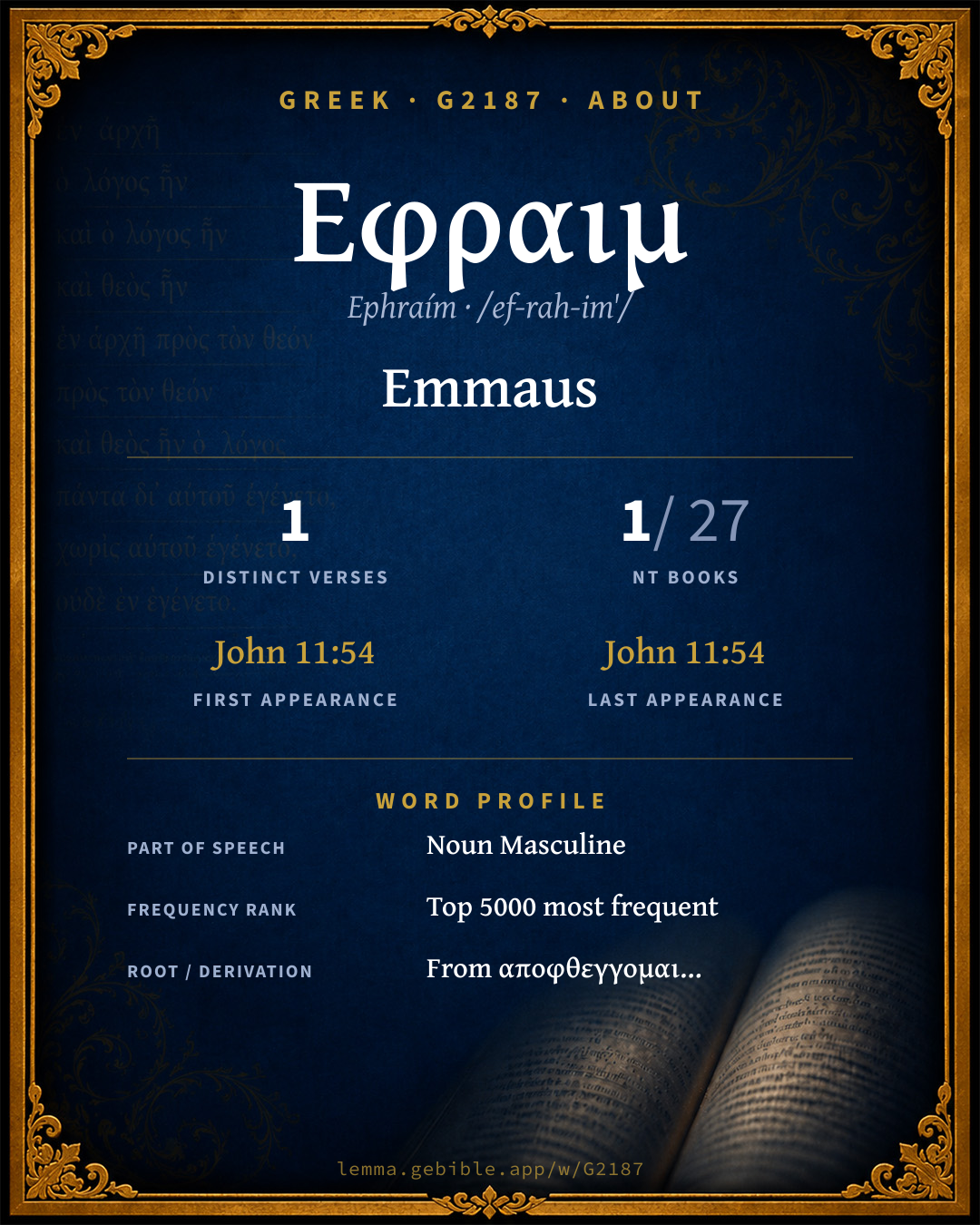
Ἐφραΐ́μ
Emmaus
Thayer's lists 2 entries for ‘Emmaus’ fuller range ↓
Full lexicon entry — Thayer's Greek Lexicon
From Thayer's Greek Lexicon
Where this word appears
Every verse where G2187 appears — 1 distinct verse across 1 book. Click any verse to open its interlinear word-by-word view. Verse text shown in the World English Bible for context — . Each verse’s Greek form is shown with its reference; the English is not keyword-highlighted, since the data carries no word-level English alignment. Use “Compare translations” on any verse to read it across multiple English versions. This concordance covers the Greek New Testament; Septuagint (Greek Old Testament) occurrences of this word are not indexed here.
John 1 verse
About this entry
At a glance — auto-summarized from this page’s data, not written by a person. Every figure links to its source below. This summary describes the numbers; it doesn’t interpret them.
Εφραιμ — transliterated Ephraím — is a Greek name carrying the sense “Emmaus.” It occurs a mere 1 verse across Scripture. More than three-quarters of its appearances fall in John. Its lone occurrence is John 11:54. See 1-verse concordance and the renderings breakdown below.
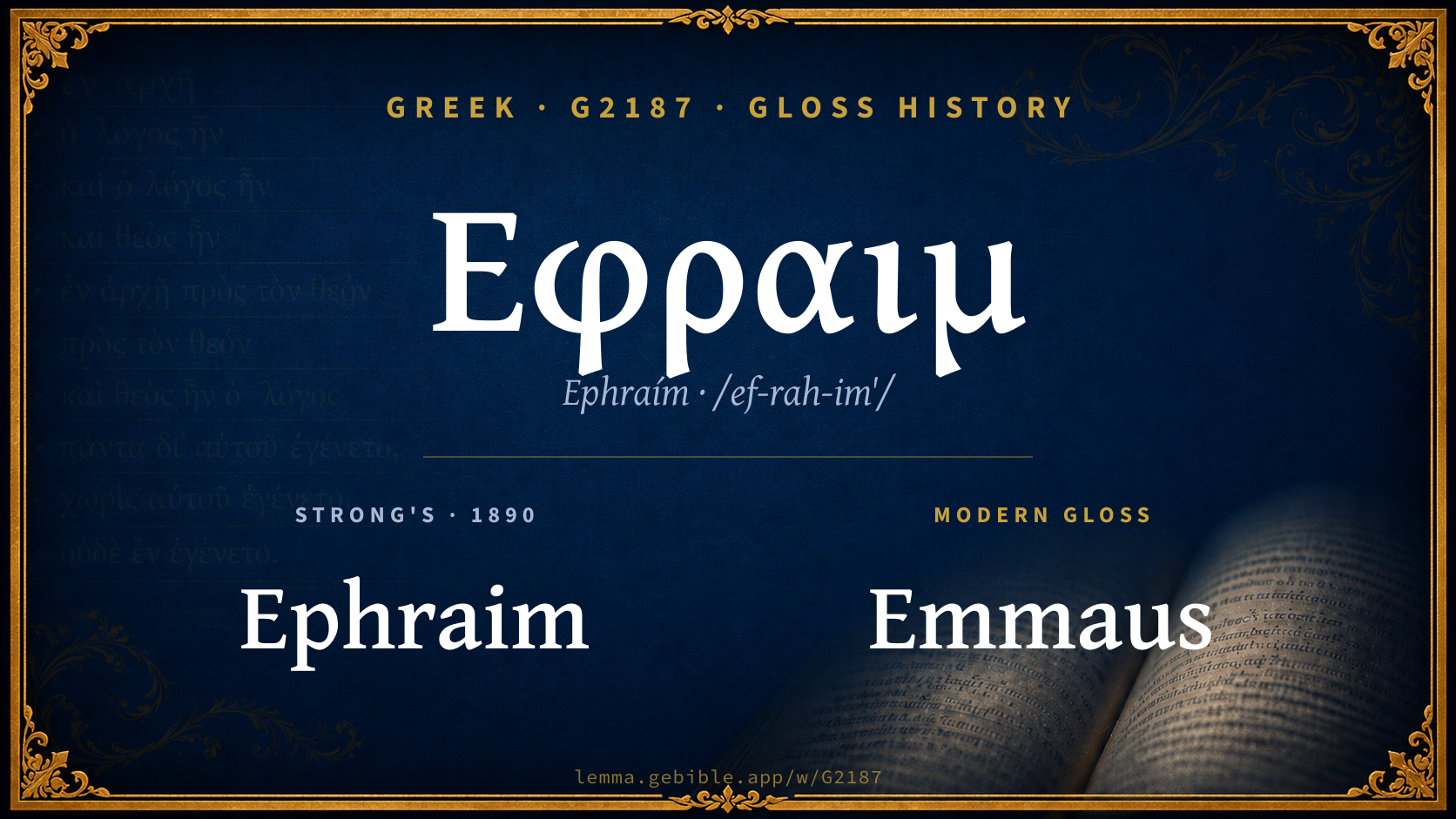
Gloss history
Strong's 1890 vs modern scholarship
About this word
Strong's G2187 catalogs a Greek word from the Greek New Testament.
These counts are not copied from any lexicon or concordance. They are computed here, from the morphology-tagged Greek New Testament. What Lemma adds →
- 1
- distinct verses
- The word appears in 1 distinct verse.
- 1 / 27
- NT books
- The word appears in 1 of 27 New Testament books.
- #3,503
- by frequency
- Top 5000 most frequent Greek words (rank 3,503 of 5,347 Greek words by occurrence).
View all 1 occurrence in the concordance →
Most concentrated in
- John 1 verse 100%
By section of the New Testament
By traditional corpus
Conventional, traditional groupings — biblical authorship is debated, so this is a traditional corpus grouping, not an authorship claim. Some books belong to more than one corpus (Luke is in both the Gospels and the Lukan corpus, and so on), so these shares overlap and need not total 100%. Each figure is a share of the word’s 1 distinct verse.
- Gospels 1 verse · 100%
- Johannine 1 verse · 100%
How translations render this word
Counts come from each version’s own published word-to-Strong’s tagging or interlinear alignment — an approximate guide to how each version renders this word, not a word-level alignment the data otherwise carries. Because each total is that version’s own tagged count, the per-version totals vary from one another and need not match the appearance or distinct-verse counts above. These counts may also differ from a printed concordance because Lemma counts each distinctly tagged rendering and does not collapse phrase taggings into a single head-word total. This is a fixed set of word-tagged versions (KJV, ASV, BSB, ULT) and does not change with the reading translation you choose elsewhere. Each version’s license is shown beside its name below (and on Sources).
- King James Version: Ephraim 1×
- American Standard Version: Ephraim 1×
- Berean Standard Bible: Ephraim 1×
- unfoldingWord Literal Text: Ephraim 1×
King James Version Public Domain
Renders G2187 across 1 tagged occurrence — most commonly:
American Standard Version Public Domain
Renders G2187 across 1 tagged occurrence — most commonly:
Berean Standard Bible Public Domain
Renders G2187 across 1 tagged occurrence — most commonly:
unfoldingWord Literal Text CC BY-SA 4.0
Renders G2187 across 1 tagged occurrence — most commonly:
Senses in Thayer's
The 2 senses Thayer's distinguishes for this word, in lexicon order (not ranked by frequency or importance). The full entry — with sub-senses — is in the Lexicon Entry tab.
- Ephraim = "double fruitfulness"
- a city about a short day's journey from Jerusalem
Word origin
Derived from αποφθεγγομαι (apophthéngomai) (G669) — to speak forth.
Bible dictionary
Public-domain dictionary articles matched to this entry by name (Emmaus). A biblical name can be shared by more than one person or place, so an article may treat several.
Easton's Bible Dictionary · M. G. Easton, 1897
Hot baths, a village "three-score furlongs" from jerusalem, where our Lord had an interview with two of his disciples on the day of his resurrection (Luke 24:13). This has been identified with the modern el-Kubeibeh, lying over 7 miles north-west of Jerusalem. This name, el-Kubeibeh, meaning "little dome," is derived from the remains of the Crusaders' church yet to be found there. Others have identified it with the modern Khurbet Khamasa i.e., "the ruins of Khamasa", about 8 miles south-west of Jerusalem, where there are ruins also of a Crusaders' church. Its site, however has been much disputed.
Hitchcock's Bible Names Dictionary · Roswell D. Hitchcock, 1869
people despised or obscure
Classic public-domain reference works; full attribution on Sources.
Septuagint usage
The same Greek word Εφραιμ appears 195 times in the Greek Old Testament (Septuagint), across 171 verses in 21 books.
- 195
- LXX occurrences
- Tagged occurrences of this Greek word in the Septuagint.
- 171
- verses
- Distinct Septuagint verses containing this word.
- 21 / 39
- OT books
- The word appears in 21 of the 39 Old Testament books.
Sample Septuagint occurrences
- Genesis 41:52 ἐφράιμ
- Numbers 1:10 ἐφράιμ
- Deuteronomy 33:17 ἐφράιμ
- Joshua 14:4 ἐφράιμ
- Judges 1:29 ἐφράιμ
- 1 Samuel 1:1 ἐφράιμ
- 2 Samuel 2:9 ἐφράιμ
- 1 Kings 4:8 ἐφράιμ
- 2 Kings 5:22 ἐφράιμ
- 1 Chronicles 6:51 ἐφράιμ
- 2 Chronicles 13:4 ἐφράιμ
- Ezra 18:16 ἐφράιμ
Septuagint occurrences (same lexeme)
Every verse where the same Strong’s number (G2187) appears in the Greek Septuagint — showing the first 50 of 171. Verse text shown in the World English Bible for context; the Greek form is the matched word — the English is not keyword-highlighted.
- Genesis 41:52 ἐφράιμ The name of the second, he called Ephraim: "For God has made me fruitful in the land of my affliction."
- Genesis 46:20 ἐφράιμ To Joseph in the land of Egypt were born Manasseh and Ephraim, whom Asenath, the daughter of Potiphera, priest of On, bore to him.
- Genesis 48:1 ἐφράιμ It happened after these things, that someone said to Joseph, "Behold, your father is sick." He took with him his two sons, Manasseh and Ephraim.
- Genesis 48:5 ἐφράιμ Now your two sons, who were born to you in the land of Egypt before I came to you into Egypt, are mine; Ephraim and Manasseh, even as Reuben and Simeon, will be mine.
- Genesis 48:13 ἐφράιμ Joseph took them both, Ephraim in his right hand toward Israel's left hand, and Manasseh in his left hand toward Israel's right hand, and brought them near to him.
- Genesis 48:14 ἐφράιμ Israel stretched out his right hand, and laid it on Ephraim's head, who was the younger, and his left hand on Manasseh's head, guiding his hands knowingly, for Manasseh was the firstborn.
- Genesis 48:17 ἐφράιμ When Joseph saw that his father laid his right hand on the head of Ephraim, it displeased him. He held up his father's hand, to remove it from Ephraim's head to Manasseh's head.
- Genesis 48:20 ἐφράιμ He blessed them that day, saying, "In you will Israel bless, saying, 'God make you as Ephraim and as Manasseh'" He set Ephraim before Manasseh.
- Genesis 50:23 ἐφράιμ Joseph saw Ephraim's children to the third generation. The children also of Machir, the son of Manasseh, were born on Joseph's knees.
- Numbers 1:10 ἐφράιμ Of the children of Joseph: Of Ephraim: Elishama the son of Ammihud. Of Manasseh: Gamaliel the son of Pedahzur.
- Numbers 1:30 ἐφράιμ Of the children of Zebulun, their generations, by their families, by their fathers' houses, according to the number of the names, from twenty years old and upward, all who were able to go out to war;
- Numbers 1:31 ἐφράιμ those who were numbered of them, of the tribe of Zebulun, were fifty-seven thousand four hundred.
- Numbers 2:18 ἐφράιμ "On the west side shall be the standard of the camp of Ephraim according to their divisions: and the prince of the children of Ephraim shall be Elishama the son of Ammihud.
- Numbers 2:24 ἐφράιμ "All who were numbered of the camp of Ephraim were one hundred eight thousand one hundred, according to their divisions. They shall set out third.
- Numbers 7:48 ἐφράιμ On the seventh day Elishama the son of Ammihud, prince of the children of Ephraim
- Numbers 10:22 ἐφράιμ The standard of the camp of the children of Ephraim set forward according to their hosts: and over his host was Elishama the son of Ammihud.
- Numbers 13:8 ἐφράιμ Of the tribe of Ephraim, Hoshea the son of Nun.
- Numbers 26:32 ἐφράιμ and [of] Shemida, the family of the Shemidaites; and [of] Hepher, the family of the Hepherites.
- Numbers 26:39 ἐφράιμ of Shephupham, the family of the Shuphamites; of Hupham, the family of the Huphamites.
- Numbers 26:41 ἐφράιμ These are the sons of Benjamin after their families; and those who were numbered of them were forty-five thousand six hundred.
- Numbers 34:24 ἐφράιμ Of the tribe of the children of Ephraim a prince, Kemuel the son of Shiphtan.
- Deuteronomy 33:17 ἐφράιμ The firstborn of his herd, majesty is his; His horns are the horns of the wild-ox: With them he shall push the peoples all of them, [even] the ends of the earth: They are the ten thousands of Ephraim, They are the thousands of Manasseh.
- Deuteronomy 34:2 ἐφράιμ and all Naphtali, and the land of Ephraim and Manasseh, and all the land of Judah, to the hinder sea,
- Joshua 14:4 ἐφράιμ For the children of Joseph were two tribes, Manasseh and Ephraim: and they gave no portion to the Levites in the land, save cities to dwell in, with the suburbs of it for their cattle and for their substance.
- Joshua 16:4 ἐφράιμ The children of Joseph, Manasseh and Ephraim, took their inheritance.
- Joshua 16:5 ἐφράιμ The border of the children of Ephraim according to their families was [thus]: the border of their inheritance eastward was Ataroth Addar, to Beth Horon the upper;
- Joshua 16:8 ἐφράιμ From Tappuah the border went along westward to the brook of Kanah; and the goings out of it were at the sea. This is the inheritance of the tribe of the children of Ephraim according to their families;
- Joshua 16:9 ἐφράιμ together with the cities which were set apart for the children of Ephraim in the midst of the inheritance of the children of Manasseh, all the cities with their villages.
- Joshua 16:10 ἐφράιμ They didn't drive out the Canaanites who lived in Gezer: but the Canaanites dwell in the midst of Ephraim to this day, and are become servants to do forced labor.
- Joshua 17:8 ἐφράιμ The land of Tappuah belonged to Manasseh; but Tappuah on the border of Manasseh belonged to the children of Ephraim.
- Joshua 17:9 ἐφράιμ The border went down to the brook of Kanah, southward of the brook: these cities belonged to Ephraim among the cities of Manasseh: and the border of Manasseh was on the north side of the brook, and the goings out of it were at the sea:
- Joshua 17:10 ἐφράιμ southward it was Ephraim's, and northward it was Manasseh's, and the sea was his border; and they reached to Asher on the north, and to Issachar on the east.
- Joshua 17:15 ἐφράιμ Joshua said to them, If you are a great people, go up to the forest, and cut down for yourself there in the land of the Perizzites and of the Rephaim; since the hill-country of Ephraim is too narrow for you.
- Joshua 17:16 ἐφράιμ The children of Joseph said, The hill-country is not enough for us: and all the Canaanites who dwell in the land of the valley have chariots of iron, both they who are in Beth-shean and its towns, and they who are in the valley of Jezreel.
- Joshua 19:48 ἐφράιμ This is the inheritance of the tribe of the children of Dan according to their families, these cities with their villages.
- Joshua 19:50 ἐφράιμ according to the commandment of Yahweh they gave him the city which he asked, even Timnathserah in the hill-country of Ephraim; and he built the city, and lived therein.
- Joshua 20:4 ἐφράιμ He shall flee to one of those cities, and shall stand at the entrance of the gate of the city, and declare his cause in the ears of the elders of that city; and they shall take him into the city to them, and give him a place, that he may dwell among them.
- Joshua 21:5 ἐφράιμ The rest of the children of Kohath had by lot out of the families of the tribe of Ephraim, and out of the tribe of Dan, and out of the half-tribe of Manasseh, ten cities.
- Joshua 21:20 ἐφράιμ The families of the children of Kohath, the Levites, even the rest of the children of Kohath, they had the cities of their lot out of the tribe of Ephraim.
- Joshua 21:42 ἐφράιμ These cities were every one with their suburbs round about them: thus it was with all these cities.
- Joshua 24:31 ἐφράιμ Israel served Yahweh all the days of Joshua, and all the days of the elders who outlived Joshua, and had known all the work of Yahweh, that he had worked for Israel.
- Joshua 24:33 ἐφράιμ Eleazar the son of Aaron died; and they buried him in the hill of Phinehas his son, which was given him in the hill-country of Ephraim.
- Judges 1:29 ἐφράιμ Ephraim didn't drive out the Canaanites who lived in Gezer; but the Canaanites lived in Gezer among them.
- Judges 2:9 ἐφράιμ They buried him in the border of his inheritance in Timnath Heres, in the hill country of Ephraim, on the north of the mountain of Gaash.
- Judges 3:27 ἐφράιμ It happened, when he had come, that he blew a trumpet in the hill-country of Ephraim; and the children of Israel went down with him from the hill-country, and he before them.
- Judges 4:5 ἐφράιμ She lived under the palm tree of Deborah between Ramah and Bethel in the hill-country of Ephraim: and the children of Israel came up to her for judgment.
- Judges 5:14 ἐφράιμ Out of Ephraim [came down] they whose root is in Amalek; After you, Benjamin, among your peoples; Out of Machir came down governors, Out of Zebulun those who handle the marshal's staff.
- Judges 7:24 ἐφράιμ Gideon sent messengers throughout all the hill-country of Ephraim, saying, Come down against Midian, and take before them the waters, as far as Beth Barah, even the Jordan. So all the men of Ephraim were gathered together, and took the waters as far as Beth Barah, even the Jordan.
- Judges 8:1 ἐφράιμ The men of Ephraim said to him, Why have you served us thus, that you didn't call us, when you went to fight with Midian? They did chide with him sharply.
- Judges 8:2 ἐφράιμ He said to them, What have I now done in comparison with you? Isn't the gleaning of the grapes of Ephraim better than the vintage of Abiezer?
These are occurrences of the same Greek lexeme (G2187) in the Septuagint — not a translation of any one Hebrew word. The store carries no word-level Hebrew↔Greek alignment, so no Hebrew original is asserted here. Counts come from the recovered LXX Strong's tagging — high-frequency vocabulary is well covered, while rare or late forms may be untagged — so they reflect tagged occurrences and may slightly undercount.