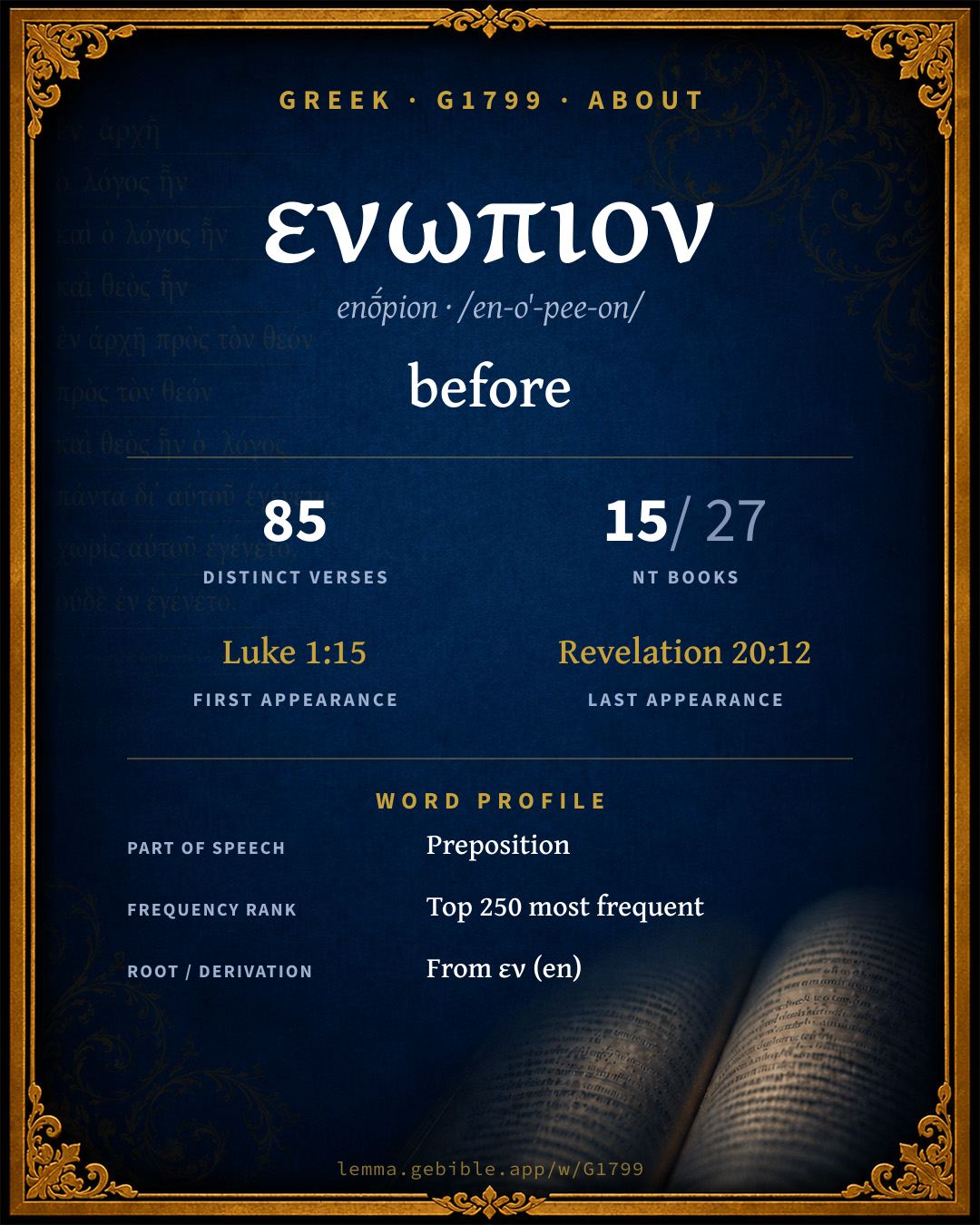
ἐνώπιον
before
Full lexicon entry — Thayer's Greek Lexicon
From Thayer's Greek Lexicon
Where this word appears
Grammar key — what these labels mean
Part of speech
- Adverb
- A word that modifies a verb, adjective, or other adverb.
Every verse where G1799 appears in the Book of John — 1 distinct verse. Click any verse to open its interlinear word-by-word view. Verse text shown in the World English Bible for context — . Each verse’s Greek form is shown with its reference; the English is not keyword-highlighted, since the data carries no word-level English alignment. Use “Compare translations” on any verse to read it across multiple English versions. This concordance covers the Greek New Testament; Septuagint (Greek Old Testament) occurrences of this word are not indexed here.
John
About this entry
At a glance — auto-summarized from this page’s data, not written by a person. Every figure links to its source below. This summary describes the numbers; it doesn’t interpret them.
ενωπιον (enṓpion) is a Greek preposition most often rendered “before.” Scripture first uses it in Luke 1:15. It turns up in 85 verses across 15 books, a moderately common footprint. It concentrates in Revelation, which alone accounts for 35% of its uses. It clusters with εν, εγγραφω and εγγυος under a shared root. The sections below give every sense, occurrence, and version rendering.
Gloss history
Strong's 1890 vs modern scholarship
About this word
Strong's G1799 catalogs a Greek word from the Greek New Testament.
These counts are not copied from any lexicon or concordance. They are computed here, from the morphology-tagged Greek New Testament. What Lemma adds →
- 85
- distinct verses
- The word appears in 85 distinct verses.
- 15 / 27
- NT books
- The word appears in 15 of 27 New Testament books.
- #186
- by frequency
- Top 250 most frequent Greek words (rank 186 of 5,347 Greek words by occurrence).
View all 85 occurrences in the concordance →
Most concentrated in
- Revelation 30 verses 35%
- Luke 19 verses 22%
- Acts 13 verses 15%
By section of the New Testament
By traditional corpus
Conventional, traditional groupings — biblical authorship is debated, so this is a traditional corpus grouping, not an authorship claim. Some books belong to more than one corpus (Luke is in both the Gospels and the Lukan corpus, and so on), so these shares overlap and need not total 100%. Each figure is a share of the word’s 85 distinct verses.
- Johannine 33 verses · 39%
- Lukan (Luke–Acts) 32 verses · 38%
- Revelation 30 verses · 35%
- Gospels 20 verses · 24%
- Pauline corpus 16 verses · 19%
- General (Catholic) Epistles 4 verses · 5%
- Hebrews 2 verses · 2%
How translations render this word
Counts come from each version’s own published word-to-Strong’s tagging or interlinear alignment — an approximate guide to how each version renders this word, not a word-level alignment the data otherwise carries. Because each total is that version’s own tagged count, the per-version totals vary from one another and need not match the appearance or distinct-verse counts above. These counts may also differ from a printed concordance because Lemma counts each distinctly tagged rendering and does not collapse phrase taggings into a single head-word total. This is a fixed set of word-tagged versions (KJV, ASV, BSB, ULT) and does not change with the reading translation you choose elsewhere. Each version’s license is shown beside its name below (and on Sources).
- King James Version: Before 61×, Sight 21×, Presence 9×
- American Standard Version: Before 46×, Sight 25×, Sight of 9×
- Berean Standard Bible: Before 44×, Presence 8×, Sight 8×
- unfoldingWord Literal Text: Before 92×
King James Version Public Domain
Renders G1799 across 97 tagged occurrences — most commonly:
Plus 6 renderings that appear only once — usually multi-word phrases or single function words the recovered tagging swept in, not distinct renderings. Not rendered by a distinct English word in 1 further occurrence.
American Standard Version Public Domain
Renders G1799 across 100 tagged occurrences — most commonly:
Plus 4 renderings that appear only once — usually multi-word phrases or single function words the recovered tagging swept in, not distinct renderings.
Berean Standard Bible Public Domain
Renders G1799 across 85 tagged occurrences — most commonly:
Plus 4 renderings that appear only once — usually multi-word phrases or single function words the recovered tagging swept in, not distinct renderings. Not rendered by a distinct English word in 8 further occurrences.
unfoldingWord Literal Text CC BY-SA 4.0
Renders G1799 across 94 tagged occurrences — most commonly:
Plus 2 renderings that appear only once — usually multi-word phrases or single function words the recovered tagging swept in, not distinct renderings.
Senses in Thayer's
The 1 sense Thayer's distinguishes for this word, in lexicon order (not ranked by frequency or importance). The full entry — with sub-senses — is in the Lexicon Entry tab.
- in the presence of, before
Word origin
Derived from εν (en) (G1722).
Forms in the corpus
The 2 distinct written forms G1799 takes in the Greek New Testament, most frequent first — each parse links to that case’s occurrences in the concordance.
| Form | Parsing | Example | Uses |
|---|---|---|---|
| ἐνώπιον enṓpion | Adverb | Luke 1:15 | 86 |
| ἐνώπιόν enṓpión | Adverb | Luke 13:26 | 7 |
Same root — word family
Other Thayer's entries built from the same root as G1799, grouped by Strong’s listed origin. These share a root / origin per the lexicon — not necessarily a shared meaning. Each links to that word’s own entry.
Derives from
Shares the same root
- εγγραφω engráphō G1449 to inscribe
- εγγυος éngyos G1450 surety
- εγκαθετος enkáthetos G1455 to spy
- εγκαινια enkaínia G1456 dedication
- εγκαλεω enkaléō G1458 to accuse
- εγκαταλειπω enkataleípō G1459 to abandon
- εγκατοικεω enkatoikéō G1460 to dwell
- εγκεντριζω enkentrízō G1461 to graft
- εγκομβοομαι enkombóomai G1463 band
- εγκοπτω enkóptō G1465 to hinder
- εγκρατης enkratḗs G1468 strong
- εγκρινω enkrínō G1469 to judge worthy
- εγκρυπτω enkrýptō G1470 to conceal
- εγκυος énkyos G1471 pregnant
- εγχριω enchríō G1472 to anoint
- ελλογεω ellogéō G1677 impute
- εμβαινω embaínō G1684 to enter
- εμβαλλω embállō G1685 to cast in
- εμβαπτω embáptō G1686 to dip in
- εμβατευω embateúō G1687 to enter
- εμβιβαζω embibázō G1688 to lead in
- εμβλεπω emblépō G1689 to look at
- εμβριμαομαι embrimáomai G1690 to warn sternly
- εμμαινομαι emmaínomai G1693 to rage against
+58 more words share this root (not shown).
Compare all same-root words → Showing 4 of 84 — not the complete family. They share a root, not necessarily a meaning.
Septuagint usage
The same Greek word ενωπιον appears 420 times in the Greek Old Testament (Septuagint), across 393 verses in 28 books.
- 420
- LXX occurrences
- Tagged occurrences of this Greek word in the Septuagint.
- 393
- verses
- Distinct Septuagint verses containing this word.
- 28 / 39
- OT books
- The word appears in 28 of the 39 Old Testament books.
Sample Septuagint occurrences
- Genesis 11:28 ἐνώπιον
- Exodus 3:6 ἐνώπιον
- Leviticus 4:4 ἐνώπιον
- Numbers 13:33 ἐνώπιον
- Deuteronomy 1:8 ἐνώπιον
- Joshua 9:2 ἐνώπιον
- Judges 2:11 ἐνώπιον
- 1 Samuel 1:9 ἐνώπιον
- 2 Samuel 2:14 ἐνώπιον
- 1 Kings 1:25 ἐνώπιον
- 2 Kings 1:18 ἐνώπιον
- 1 Chronicles 17:17 ἐνώπιον
Septuagint occurrences (same lexeme)
Every verse where the same Strong’s number (G1799) appears in the Greek Septuagint — showing the first 50 of 393. Verse text shown in the World English Bible for context; the Greek form is the matched word — the English is not keyword-highlighted.
- Genesis 11:28 ἐνώπιον Haran died before his father Terah in the land of his birth, in Ur of the Chaldees.
- Genesis 16:13 ἐνώπιον She called the name of Yahweh who spoke to her, "You are a God who sees," for she said, "Have I even stayed alive after seeing him?"
- Genesis 16:14 ἐνώπιον Therefore the well was called Beer Lahai Roi. Behold, it is between Kadesh and Bered.
- Genesis 24:51 ἐνώπιον Behold, Rebekah is before you, take her, and go, and let her be your master's son's wife, as Yahweh has spoken."
- Genesis 30:33 ἐνώπιον So my righteousness will answer for me hereafter, when you come concerning my hire that is before you. Everyone that is not speckled and spotted among the goats, and black among the sheep, that might be with me, will be counted stolen."
- Genesis 30:38 ἐνώπιον He set the rods which he had peeled opposite the flocks in the gutters in the watering-troughs where the flocks came to drink. They conceived when they came to drink.
- Genesis 31:35 ἐνώπιον She said to her father, "Don't let my lord be angry that I can't rise up before you; for the manner of women is on me." He searched, but didn't find the teraphim.
- Exodus 3:6 ἐνώπιον Moreover he said, "I am the God of your father, the God of Abraham, the God of Isaac, and the God of Jacob." Moses hid his face; for he was afraid to look at God.
- Exodus 14:2 ἐνώπιον "Speak to the children of Israel, that they turn back and encamp before Pihahiroth, between Migdol and the sea, before Baal Zephon. You shall encamp opposite it by the sea.
- Exodus 21:1 ἐνώπιον "Now these are the ordinances which you shall set before them.
- Exodus 22:7 ἐνώπιον "If a man delivers to his neighbor money or stuff to keep, and it is stolen out of the man's house; if the thief is found, he shall pay double.
- Exodus 22:8 ἐνώπιον If the thief isn't found, then the master of the house shall come near to God, to find out if he hasn't put his hand to his neighbor's goods.
- Exodus 23:15 ἐνώπιον You shall observe the feast of unleavened bread. Seven days you shall eat unleavened bread, as I commanded you, at the time appointed in the month Abib (for in it you came out from Egypt), and no one shall appear before me empty.
- Exodus 23:17 ἐνώπιον Three times in the year all your males shall appear before the Lord Yahweh.
- Exodus 32:33 ἐνώπιον Yahweh said to Moses, "Whoever has sinned against me, him will I blot out of my book.
- Exodus 33:17 ἐνώπιον Yahweh said to Moses, "I will do this thing also that you have spoken; for you have found favor in my sight, and I know you by name."
- Exodus 34:9 ἐνώπιον He said, "If now I have found favor in your sight, Lord, please let the Lord go in the midst of us; although this is a stiff-necked people; pardon our iniquity and our sin, and take us for your inheritance."
- Exodus 34:10 ἐνώπιον He said, "Behold, I make a covenant: before all your people I will do marvels, such as have not been worked in all the earth, nor in any nation; and all the people among which you are shall see the work of Yahweh; for it is an awesome thing that I do with you.
- Exodus 34:20 ἐνώπιον The firstborn of a donkey you shall redeem with a lamb: and if you will not redeem it, then you shall break its neck. All the firstborn of your sons you shall redeem. No one shall appear before me empty.
- Exodus 34:23 ἐνώπιον Three times in the year all your males shall appear before the Lord Yahweh, the God of Israel.
- Leviticus 4:4 ἐνώπιον He shall bring the bull to the door of the Tent of Meeting before Yahweh; and he shall lay his hand on the head of the bull, and kill the bull before Yahweh.
- Leviticus 4:18 ἐνώπιον He shall put some of the blood on the horns of the altar which is before Yahweh, that is in the Tent of Meeting; and the rest of the blood he shall pour out at the base of the altar of burnt offering, which is at the door of the Tent of Meeting.
- Leviticus 4:24 ἐνώπιον He shall lay his hand on the head of the goat, and kill it in the place where they kill the burnt offering before Yahweh. It is a sin offering.
- Leviticus 13:37 ἐνώπιον But if in his eyes the itch is arrested, and black hair has grown in it; the itch is healed, he is clean. The priest shall pronounce him clean.
- Leviticus 20:17 ἐνώπιον "'If a man takes his sister, his father's daughter, or his mother's daughter, and sees her nakedness, and she sees his nakedness; it is a shameful thing; and they shall be cut off in the sight of the children of their people: he has uncovered his sister's nakedness; he shall bear his iniquity.
- Leviticus 24:3 ἐνώπιον Outside of the veil of the Testimony, in the Tent of Meeting, shall Aaron keep it in order from evening to morning before Yahweh continually: it shall be a statute forever throughout your generations.
- Leviticus 24:8 ἐνώπιον Every Sabbath day he shall set it in order before Yahweh continually. It is on the behalf of the children of Israel an everlasting covenant.
- Leviticus 25:53 ἐνώπιον As a servant hired year by year shall he be with him: he shall not rule with harshness over him in your sight.
- Numbers 13:33 ἐνώπιον There we saw the Nephilim, the sons of Anak, who come of the Nephilim: and we were in our own sight as grasshoppers, and so we were in their sight.
- Numbers 17:25 ἐνώπιον
- Numbers 19:3 ἐνώπιον You shall give her to Eleazar the priest, and he shall bring her forth outside of the camp, and one shall kill her before his face:
- Numbers 32:4 ἐνώπιον the land which Yahweh struck before the congregation of Israel, is a land for cattle; and your servants have cattle.
- Numbers 32:5 ἐνώπιον They said, If we have found favor in your sight, let this land be given to your servants for a possession; don't bring us over the Jordan.
- Deuteronomy 1:8 ἐνώπιον Behold, I have set the land before you: go in and possess the land which Yahweh swore to your fathers, to Abraham, to Isaac, and to Jacob, to give to them and to their seed after them.
- Deuteronomy 1:42 ἐνώπιον Yahweh said to me, Tell them, Don't go up, neither fight; for I am not among you; lest you be struck before your enemies.
- Deuteronomy 4:8 ἐνώπιον What great nation is there, that has statutes and ordinances so righteous as all this law, which I set before you this day?
- Deuteronomy 4:34 ἐνώπιον Or has God tried to go and take him a nation from the midst of [another] nation, by trials, by signs, and by wonders, and by war, and by a mighty hand, and by an outstretched arm, and by great terrors, according to all that Yahweh your God did for you in Egypt before your eyes?
- Deuteronomy 4:44 ἐνώπιον This is the law which Moses set before the children of Israel:
- Deuteronomy 6:22 ἐνώπιον and Yahweh shown signs and wonders, great and sore, on Egypt, on Pharaoh, and on all his house, before our eyes;
- Deuteronomy 11:26 ἐνώπιον Behold, I set before you this day a blessing and a curse:
- Deuteronomy 11:32 ἐνώπιον You shall observe to do all the statutes and the ordinances which I set before you this day.
- Deuteronomy 12:8 ἐνώπιον You shall not do after all the things that we do here this day, every man whatever is right in his own eyes;
- Deuteronomy 16:16 ἐνώπιον Three times in a year shall all your males appear before Yahweh your God in the place which he shall choose: in the feast of unleavened bread, and in the feast of weeks, and in the feast of tents; and they shall not appear before Yahweh empty:
- Deuteronomy 29:1 ἐνώπιον These are the words of the covenant which Yahweh commanded Moses to make with the children of Israel in the land of Moab, besides the covenant which he made with them in Horeb.
- Deuteronomy 31:11 ἐνώπιον when all Israel is come to appear before Yahweh your God in the place which he shall choose, you shall read this law before all Israel in their hearing.
- Joshua 9:2 ἐνώπιον that they gathered themselves together, to fight with Joshua and with Israel, with one accord.
- Joshua 10:8 ἐνώπιον Yahweh said to Joshua, Don't fear them: for I have delivered them into your hands; there shall not a man of them stand before you.
- Joshua 24:25 ἐνώπιον So Joshua made a covenant with the people that day, and set them a statute and an ordinance in Shechem.
- Judges 2:11 ἐνώπιον The children of Israel did that which was evil in the sight of Yahweh, and served the Baals;
- Judges 3:12 ἐνώπιον The children of Israel again did that which was evil in the sight of Yahweh: and Yahweh strengthened Eglon the king of Moab against Israel, because they had done that which was evil in the sight of Yahweh.
These are occurrences of the same Greek lexeme (G1799) in the Septuagint — not a translation of any one Hebrew word. The store carries no word-level Hebrew↔Greek alignment, so no Hebrew original is asserted here. Counts come from the recovered LXX Strong's tagging — high-frequency vocabulary is well covered, while rare or late forms may be untagged — so they reflect tagged occurrences and may slightly undercount.