Leviticus 25:53

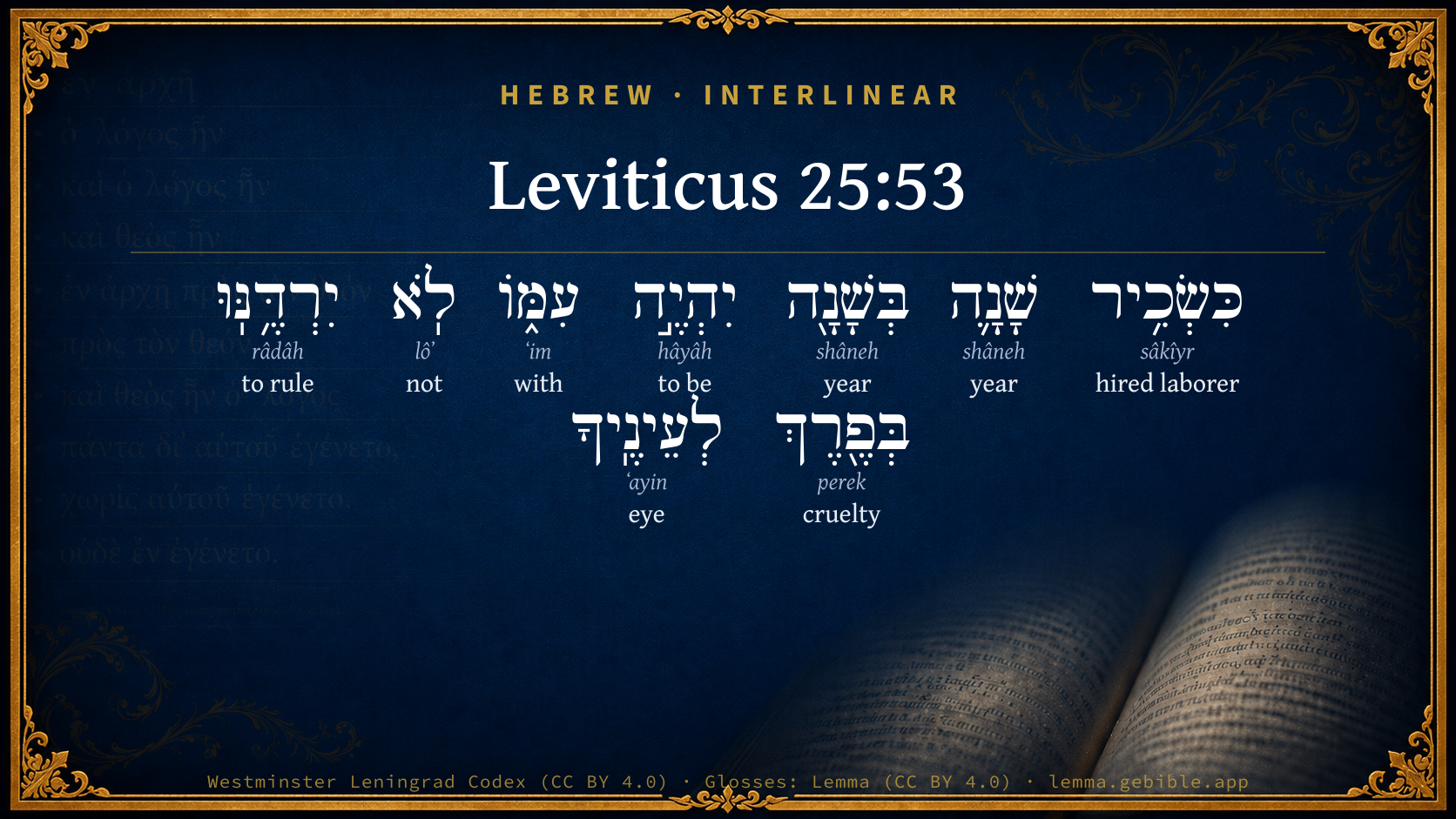
Hebrew (Westminster Leningrad Codex) Leviticus 25:53 appears in the Hebrew Old Testament. The text above is from the Westminster Leningrad Codex. Each word links to its Strong’s number, a concise gloss, and parsing drawn from the Open Scriptures Hebrew Bible morphology. Click any word for its full Brown-Driver-Briggs (BDB) entry.
Download image
Cite this verse

Leviticus 25:53 (World English Bible). Public Domain. Lemma interlinear Bible study tool, https://lemma.gebible.app/v/leviticus/25/53.

Show BibTeX & RIS
BibTeX
RIS
English Translation
As a servant hired year by year shall he be with him: he shall not rule with harshness over him in your sight.
World English Bible · Public Domain
Download a study sheet

One document with this verse’s original text, its word-by-word gloss line, the meaning frame, cross-references with their text, attributed commentary, and full source and license credits — printable, and it pastes into notes with its structure intact.

This verse Autodidact and up

Study sheet (.html) Plain text (.txt)

A passage Seminary Student

Up to 50 verses in one chapter. A passage sheet keeps up to 6 commentary sources and 12 cross-references per verse, in the order this page ranks them, and says so on the sheet whenever that leaves anything out. Ask for a single verse and you get the Autodidact verse sheet above.

Everything on this page stays free to read, with no account — the sheet is a download of what is already on screen, not access to it.

Want to remove ads? Support Godless Engineer
Compare translations 3

The same verse in 3 English versions, stacked beneath the original-language interlinear above. Click any original word for its lexicon entry.

Each is an independent rendering of the whole verse — the interlinear is not word-aligned to these translations.

Highlighted words mark where these versions differ — a whole-verse word diff, not a word-by-word alignment.

  • World English Bible Public Domain
    As a servant hired year by year shall he be with him: he shall not rule with harshness over him in your sight.
  • King James Version Public Domain
    And as a yearly hired servant shall he be with him: and the other shall not rule with rigor over him in thy sight.
  • unfoldingWord Literal Text CC BY-SA 4.0
    Like a hired worker year by year he shall be with him. He shall not rule over him with harshness before your eyes.

unfoldingWord Literal Text — © unfoldingWord, licensed CC BY-SA 4.0. Word-aligned USFM3 via Door43 (git.door43.org/unfoldingWord/en_ult).

Versions to compare (up to 4)

3 of 4 selected

Show all 18 translations

Every available English version of this verse, each an independent rendering of the whole verse.

  • World English Bible Public Domain
    As a servant hired year by year shall he be with him: he shall not rule with harshness over him in your sight.
  • Berean Standard Bible Public Domain
    He shall be treated like a man hired from year to year, but a foreign owner must not rule over him harshly in your sight.
  • Majority Standard Bible Public Domain
    He shall be treated like a man hired from year to year, but a foreign owner must not rule over him harshly in your sight.
  • King James Version Public Domain
    And as a yearly hired servant shall he be with him: and the other shall not rule with rigor over him in thy sight.
  • American Standard Version (1901) Public Domain
    As a servant hired year by year shall he be with him: he shall not rule with rigor over him in thy sight.
  • Revised Version (1885) Public Domain
    As a servant hired year by year shall he be with him: he shall not rule with rigour over him in thy sight.
  • Geneva Bible (1599) Public Domain
    He shalbe with him yeere by yeere as an hired seruant: he shall not rule cruelly ouer him in thy sight.
  • Douay-Rheims (1899) Public Domain
    His wages being allowed for which he served before: he shall not afflict him violently in thy sight.
  • Young's Literal Translation Public Domain
    as an hireling, year by year, he is with him, and he doth not rule him with rigour before thine eyes.
  • Literal Standard Version CC BY-SA 4.0
    as a hired worker, year by year, he is with him, and he does not rule him with rigor before your eyes.
  • Unlocked Literal Bible CC BY-SA 4.0
    He is to be treated like a man hired year by year. You must make sure he is not treated with harshness.
  • unfoldingWord Literal Text CC BY-SA 4.0
    Like a hired worker year by year he shall be with him. He shall not rule over him with harshness before your eyes.
  • Darby Bible Public Domain
    As a hired servant shall he be with him year by year; [his master] shall not rule with rigour over him before thine eyes.
  • World Messianic Bible Public Domain
    As a servant hired year by year shall he be with him. He shall not rule with harshness over him in your sight.
  • Webster's Bible Public Domain
    And as a yearly hired servant shall he be with him: and the other shall not rule with rigor over him in thy sight.
  • Free Bible Version CC BY-SA 4.0
    They are to live with their foreign owner just like a paid worker, hired from year to year, but see to it that the owner doesn't treat him brutally.
  • Bible in Basic English Public Domain
    And he will be with him as a servant working for payment year by year; his master is not to be cruel to him before your eyes.
  • JPS Tanakh (1917) Public Domain
    As a servant hired year by year shall he be with him; he shall not rule with rigour over him in thy sight.

Literal Standard Version (2020), Covenant Press — licensed CC BY-SA 4.0. Text via the HelloAO Bible API (eBible.org). Unlocked Literal Bible (unfoldingWord) — licensed CC BY-SA 4.0. Text via the HelloAO Bible API (eBible.org). unfoldingWord Literal Text — © unfoldingWord, licensed CC BY-SA 4.0. Word-aligned USFM3 via Door43 (git.door43.org/unfoldingWord/en_ult). Free Bible Version, Dr. Jonathan Gallagher — licensed CC BY-SA 4.0. Text via the HelloAO Bible API (eBible.org).

Word by word

More ways to search: Search by grammar → Find every occurrence → Compare this word →

Practice this passage: Drill this verse → Learn its vocabulary →

בְּפֶ֖רֶךְ
perek
H6531
“in/at · cruelty”
Preposition + Noun, Common, Masculine, Singular, Absolute
Part of Speech
Preposition + Noun
Type
Common
Gender
Masculine
Number
Singular
State
Absolute
Full BDB Definition

Origin: from an unused root meaning to break apart

TWOT: 1817a

harshness, severity, cruelty
  1. כִּשְׂכִ֥יר sâkîyr H7916 “like/as · hired laborer of” Preposition + Adjective, Adjective, Masculine, Singular, Construct
  2. שָׁנָ֛ה shâneh H8141 “year” Noun, Common, Feminine, Singular, Absolute
  3. בְּשָׁנָ֖ה shâneh H8141 “in/at · year” Preposition + Noun, Common, Feminine, Singular, Absolute
  4. יִהְיֶ֣ה hâyâh H1961 “to be” Verb, Qal, Imperfect, 3rd Person, Masculine, Singular
  5. עִמּ֑וֹ ʻim H5973 “with · him” Preposition + Suffix, Personal, 3rd Person, Masculine, Singular
  6. לֹֽא lôʼ H3808 “not” Particle, Negative
  7. יִרְדֶּ֥נּֽוּ râdâh H7287 “to rule · him” Verb, Qal, Imperfect, 3rd Person, Masculine, Singular + Suffix, Personal, 3rd Person, Masculine, Singular
  8. לְעֵינֶֽיךָ ʻayin H5869 “to/for · eyes · your” Preposition + Noun, Common, Both, Dual, Construct + Suffix, Personal, 2nd Person, Masculine, Singular

About this verse

These counts appear in no published source. They are computed here, from the morphology-tagged text and Lemma’s own curated glosses. What Lemma adds →

9
words
8
distinct lemmas
Pentateuch
section

Notable vocabulary

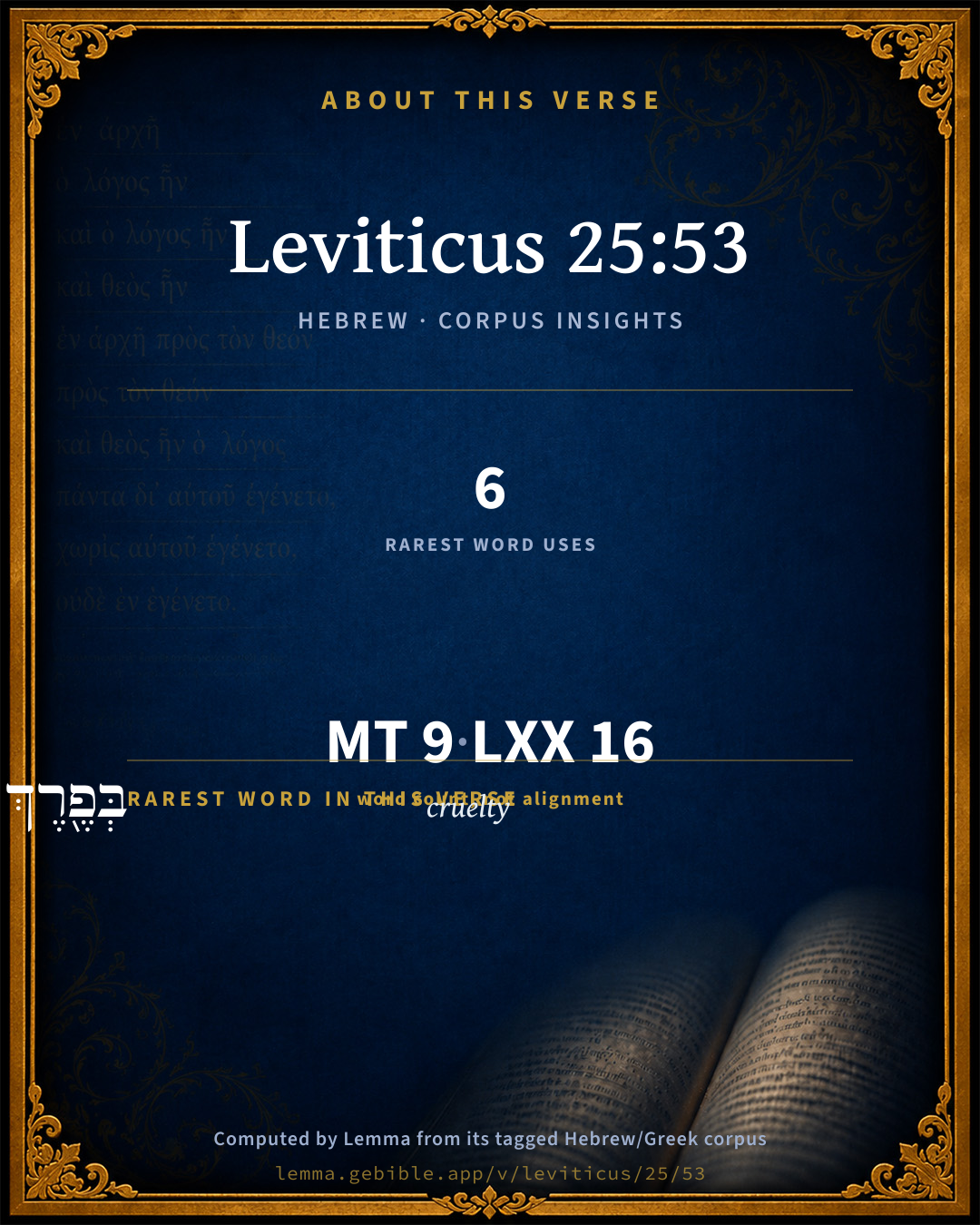
The rarest word here is בְּפֶ֖רֶךְ cruelty H6531 — appearing just 6 times in the whole Hebrew Bible.

Shared distinctive vocabulary

בְּפֶ֖רֶךְ cruelty H6531 occurs in 6 verses of the Hebrew Bible. Also found in:

Grammatical profile

  • 2 verbs
  • 4 nouns
  • 1 adjective
  • 1 preposition
  • 1 particle

Verb forms

  • יִהְיֶ֣ה Qal · Imperfect
  • יִרְדֶּ֥נּֽוּ Qal · Imperfect

Repetition

A word recurs within this verse — often emphatic in Hebrew:

  • שָׁנָ֛ה year H8141 ×2

Hebrew & Septuagint length

In English translation the verse runs 23 words from the Hebrew and 21 from the Septuagint (LXX English) — closely comparable.

A rough comparison of the two English renderings, which tokenize alike — not a word-level alignment.

Word counts can differ between the Hebrew and the Greek without any difference in meaning — e.g. the Hebrew direct-object marker אֵת has no separate Greek word, and Greek often adds the article ὁ.

In the original languages it is 9 Hebrew tokens and 16 Greek tokens — but the two are counted differently (Hebrew bundles its prefixes and suffixes into one token; the Greek is in lemma form), so that isn’t a like-for-like length.

Cross-references

2

Topical passages linked to Leviticus 25:53 in the Treasury of Scripture Knowledge — connected by theme and wording, ordered by reader-vote popularity; previews shown in the World English Bible.

  • Leviticus 25:43 You shall not rule over him with harshness, but shall fear your God.
  • Leviticus 25:46 You may make them an inheritance for your children after you, to hold for a possession; of them may you take your slaves forever: but over your brothers the children of Israel you shall not rule, one over another, with harshness.

Cross-references courtesy of OpenBible.info (CC BY 4.0).

Hebrew and Greek witnesses Masoretic Hebrew ↔ Greek Septuagint

The same verse in the two great witnesses to the Old Testament, shown verse-for-verse.

These are two independent witnesses, not word-aligned to each other, and the Septuagint is shown in lemma (dictionary) form.

Hebrew Leviticus 25:53 Masoretic · Westminster Leningrad Codex

כִּשְׂכִ֥יר שָׁנָ֛ה בְּשָׁנָ֖ה יִהְיֶ֣ה עִמּ֑וֹ לֹֽא יִרְדֶּ֥נּֽוּ בְּפֶ֖רֶךְ לְעֵינֶֽיךָ

As a servant hired year by year shall he be with him: he shall not rule with harshness over him in your sight.

World English Bible · Public Domain

Greek LXX Leviticus 25:53 Septuagint · lemma form

ὡς μισθωτός ἐνιαυτός ἐκ ἐνιαυτός εἰμί μετά αὐτός οὐ κατατείνω αὐτός ἐν ὁ μόχθος ἐνώπιον σύ

as a hireling; he shall be with him from year to year; you shall not oppress him with labor before you.

LXX2012 (modern English Septuagint) · Public Domain

Hebrew: Westminster Leningrad Codex (CC BY 4.0). Greek: Septuagint (public domain); English from LXX2012 (modern English Septuagint) (Public Domain). How the Septuagint differs from the Hebrew →

Targum (Aramaic paraphrase)

2

The Targum is the ancient Jewish Aramaic paraphrase of the Hebrew Scriptures — an interpretive translation, not the Hebrew text itself. Onkelos (literal) and Pseudo-Jonathan (expansive) render the Torah, and Jonathan the Prophets. Coverage is partial: where no permissively-licensed English translation exists for a verse, only the Aramaic is shown. This is verse-level text, not a word-by-word alignment to the Hebrew.

  1. Targum Onkelos Torah (Genesis–Deuteronomy)
    כַּאֲגִיר שְׁנָא בִּשְׁנָא יְהֵי עִמֵהּ לָא יִפְלַח בֵּהּ בְּקַשְׁיוּ לְעֵינָיךְ

    (no public-domain English translation for this verse)

    Targum Onkelos — Aramaic: “Onkelos Genesis” (public domain); “Onkelos Exodus” (public domain); “Onkelos Leviticus” (public domain); “Onkelos Numbers” (public domain); “Onkelos Deuteronomy” (public domain). English: “Sefaria Community Translation” (CC0 1.0 (public-domain dedication)); “J.W. Etheridge. The Targums of Onkelos and Jonathan Ben Uzziel on the Pentateuch. London: Longmans, Green, 1862” (public domain). Text via Sefaria.

  2. Targum Pseudo-Jonathan Torah (Genesis–Deuteronomy)
    הֵי כְּאָגִיר שְׁנָא בִּשְׁנָא יְהֵי עִמֵיהּ לָא יְשַׁעְבֵּיד בֵּיהּ בְּקַשְׁיוּ וְאַנְתְּ חָמֵי לֵיהּ

    As a hireling by the year shall he be with him, and his master shall not make him to serve with rigour while thou see it.

    Targum Pseudo-Jonathan — Aramaic: “Targum Jonathan on Genesis” (public domain); “Targum Jonathan on Exodus” (public domain); “Targum Jonathan on Leviticus” (public domain); “Targum Jonathan on Numbers” (public domain); “Targum Jonathan on Deuteronomy” (public domain). English: “The Targum of Jonathan ben Uzziel, trans. J. W. Etheridge, London, 1862” (public domain). Text via Sefaria.

Commentary

Notes on Leviticus 25:53 from classic Christian and Jewish commentators (each source and its license shown beneath its notes). The classic Christian expositions comment on the surrounding passage and are grouped to its opening verse, so a note may address several verses; the Jewish commentaries on the Tanakh (Rashi and others) are per-verse, so they appear only where the commentator wrote on this verse.

Lemma curates 59 commentaries, every one of them public domain or Creative Commons licensed, each selected and text-cleaned for this edition rather than reprinted as found. About our sources →

Joseph Benson's Commentary

Lev 25:53. In thy sight — Thou shalt not suffer this to be done, but whether thou art a magistrate or a private person, thou shalt take care according to thy capacity to get it remedied.

Joseph Benson's Commentary on the Old and New Testaments (1811–1818) — public domain. Text from a community e-Sword module.

Geneva Bible (1599)

Geneva Bible translators

Thou shalt not suffer him to entreat him rigorously, if thou know it.

Geneva Bible (1599) marginal notes — public domain. Text via Bolls.life.

Ellicott's Commentary for English Readers

(53) And as a yearly hired servant shall he be.—Better, As a yearly servant, &c, without the “and,” which is not in the original, and is not wanted. That is, as long as he is in service his master must not treat him like a slave, but is to behave to him as if he were simply one who hires out his services from year to year, and who, after a short time, will be his own master again.

And the other shall not rule with rigour over him.—Better, he shall not rule, &c, that is, the heathen master. The words “and the other” are not in the original, and the sense of the passage is quite plain without them.

In thy sight.—The Israelite is here admonished not to be a tacit spectator of the cruel treatment of his brother Israelite by a heathen master, and though he is not to resent in the same way in which the Lawgiver himself resented it (Exo_2:11-12), still he is to remonstrate with the cruel Gentile, and invoke the protection of the powers that be.

A Bible Commentary for English Readers, edited by Charles John Ellicott (1878–1897) — public domain. Text from a community e-Sword module.

The Cambridge Bible for Schools and Colleges

gen. ed. J. J. S. Perowne

53. in thy sight] whenever thou art cognizant of it.

The Cambridge Bible for Schools and Colleges (gen. ed. J. J. S. Perowne; Cambridge University Press, 1878–1918) — public domain. Text from a community e-Sword module.

John Gill's Exposition

And as a yearly hired servant shall he be with him,.... Being redeemable every year, and upon his redemption might quit his master's service, as an hireling may; and the price of his redemption to be valued according to the years he served, and as if he had been hired for so much a year; as well as he was to be treated in a kind and gentle manner, not as a bondman, but as if he was an hired servant, as follows:

and the other shall not rule with rigour over him in thy sight; the person he is sold unto, his master, a sojourner or stranger, he might not use an Hebrew he had bought with any severity; for if an Hebrew master might not use an Hebrew servant with rigour, it was not by any means to be admitted in the commonwealth of Israel for a proselyte to use one in such a manner, and that openly, in the sight of an Israelite his neighbour; he looking on and not remonstrating against it, or acquainting the civil magistrate with it, who had it in his power to redress such a grievance, and ought to do it.

John Gill's Exposition of the Whole Bible (1746–1763) — public domain (CC PDM 1.0). Text via the HelloAO Bible API.

Haydock's Catholic Bible Commentary

Wages. Hebrew, "as a yearly hired servant shall he be with him." What was customarily given to a hired servant for a certain number of years, might be a rule to judge how much was to be paid for redemption. (Haydock) --- Thus if a man had engaged to serve 20 years for 100 sicles, and at the expiration of 10 years wished to redeem himself, he might do it for half that sum. Some think, that those Hebrews who had sold themselves to a Gentile, sojourning among them, could not take the benefit of the sabbatic year, (Exodus xxi. 6,) because Moses is silent on this head. But this argument is not satisfactory. (Calmet)

George Leo Haydock (1774–1849), Haydock's Catholic Family Bible and Commentary, 1859 edition — public domain. Excludes Psalms (Douay-Rheims chapter numbering differs from Protestant) and Deuterocanonical books (Catholic canon only).

Matthew Poole's English Annotations

Thou shalt not suffer this to be done, but whether thou art a magistrate, or a private person, thou shalt take care according to thy capacity to get it remedied.

Matthew Poole's English Annotations on the Holy Bible (1683–1685) — public domain. Text from a community e-Sword/MySword module.

Whedon's Commentary on the Bible

Daniel D. Whedon

53. As a yearly hired servant — He shall be treated mercifully, and all his rights shall be respected as if serving for wages. It was the duty of an Israelite when he saw his brother Hebrew abused by a Jew or by a stranger to give information to the magistrate, and it was incumbent on this officer to call the oppressor to account.

Daniel D. Whedon (gen. ed.), Commentary on the Old and New Testaments (1874–1909) — public domain. Text from a community e-Sword module.

John Wesley's Explanatory Notes

In thy sight - Thou shalt not suffer this to be done, but whethe thou art a magistrate, or a private person, thou shalt take care according to thy capacity to get it remedied.

John Wesley, Explanatory Notes Upon the Whole Bible (1754–1765) — public domain. Text via the GEBible commentary corpus.

unfoldingWord translationNotes

Door43 World Missions Community

He is to be treated

This can be stated in active form. AT: "The foreigner who bought him as a slave must treat him" (See: Active or Passive)

he is not treated with harshness

This can be stated in active form. AT: "no one treats him badly" (See: Active or Passive)

If he is not redeemed by these means

This can be stated in active form, and who he is to be redeemed from can be stated clearly. AT: "If no one redeems him by these means from the one who bought him as a slave" (See: Active or Passive and Assumed Knowledge and Implicit Information)

by these means

"in this way"

he must serve until the year of Jubilee, he and his children with him

The Israelite slave and his children would serve the foreigner until the year of Jubilee, and then the foreigner would have to set the Israelite and his children free.

To me the people of Israel are servants

"For it is to me that the people of Israel are servants." This is the reason that God wanted the Israelites to be set free in the year of jubilee. They were his servants. They were not permitted to be anyone else's permanent slave.

translationWords

redeem

servant

children

people group

Israel

Egypt

Yahweh

God

unfoldingWord translationNotes — © Distant Shores Media and the Door43 World Missions Community, licensed CC BY-SA 4.0. Source: git.door43.org/Door43/en_tn.

Rashi

Rabbi Shlomo Yitzchaki (Rashi)

לא ירדנו בפרך לעיניך HE SHALL NOT RULE WITH RIGOUR OVER HIM IN THY EYES — that is to say, you looking on unconcernedly (Sifra, Behar, Chapter 8 9; cf. Targum Jonathan on).

Rashi on the Tanakh — English translations: “The Judaica Press complete Tanach with Rashi, translated by A. J. Rosenberg” (CC BY 4.0); “Pentateuch with Rashi's commentary by M. Rosenbaum and A.M. Silbermann, 1929-1934” (public domain); “The Metsudah Tanach series, Lakewood, N.J” (CC BY 4.0); and “The Book of Joshua, Metsudah Publications, 1997” (CC BY 4.0). Text via Sefaria.

Lesson kit

Teaching starters — assembled from the data on this page, not authored interpretation. Every prompt links to the verse data it draws on. Edit before teaching.

Leviticus, in the Pentateuch, opens this verse with 9 words (8 distinct Hebrew lemmas). Its most distinctive word is perek (“cruelty”). A historical commentator’s framing appears above. Read the whole chapter for the surrounding context.

Discussion questions

  1. The word perek carries the sense “cruelty.” How does it shape the verse?
  2. How does Exodus 1:13, which shares the word «cruelty», read alongside this verse?
  3. What does the repetition of “year” (2× in this one verse) do in this verse?
  4. These translations render this verse differently. What is at stake in choosing one wording over another?
  5. «יִהְיֶ֣ה» is a Qal Imperfect verb. How does that grammatical form shape the action described?
  6. Compare how Joseph Benson's Commentary and Geneva Bible (1599) read this verse. Where do they agree or differ?

Things to notice

Reading settings

Reading text

Shown beneath each verse's original-language words.

Old Testament
Old Testament edition

Read the OT as the Masoretic Hebrew (MT) or the Greek Septuagint (LXX).

English shown for the Greek Septuagint (in the Hebrew ↔ Greek comparison).

Comparing translations? Open the Compare panel on any verse page to stack up to four side by side.