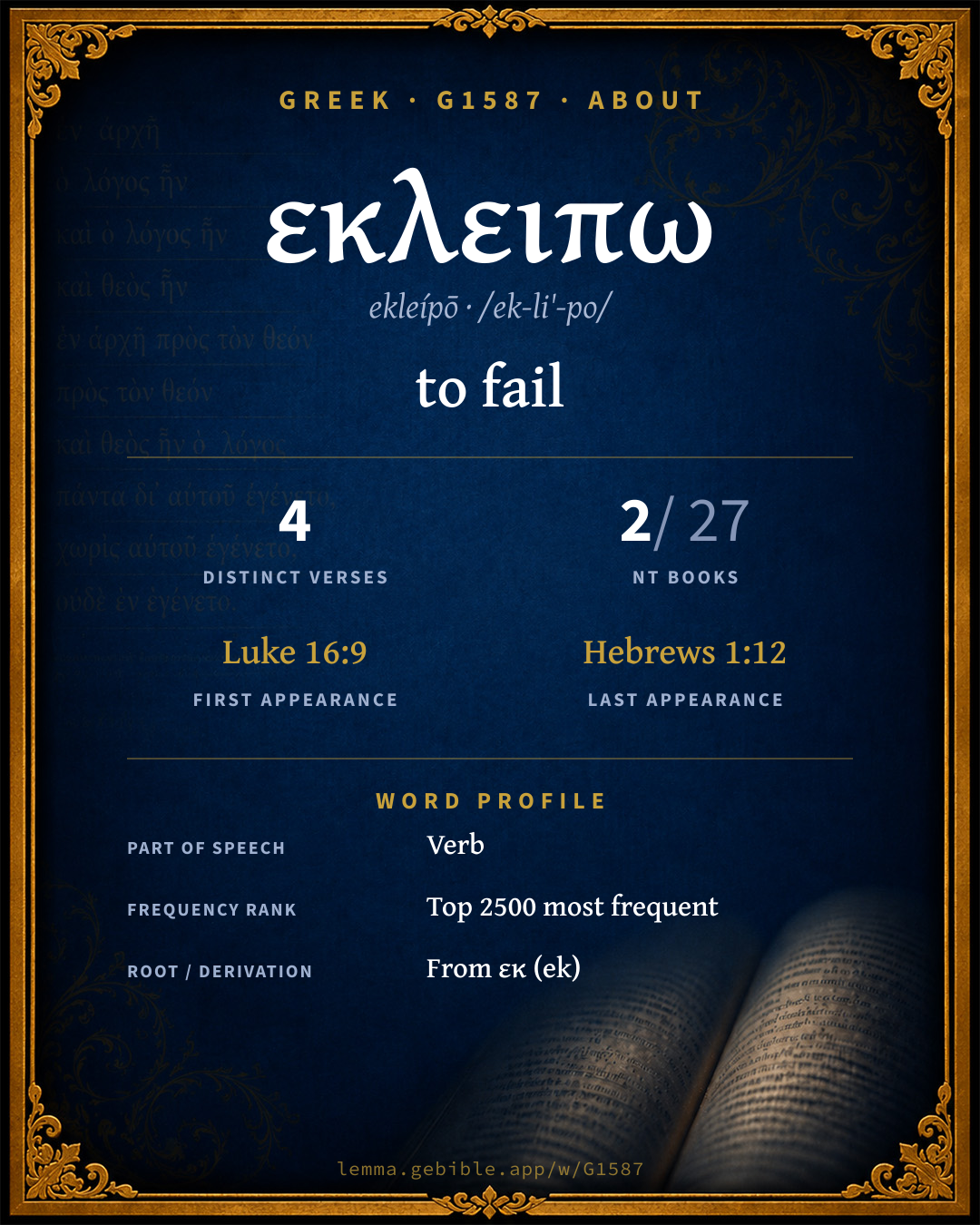
ἐκλείπω
to fail
‘to fail’ is one of 3 main senses fuller range ↓
Full lexicon entry — Thayer's Greek Lexicon
From Thayer's Greek Lexicon
Where this word appears
See every Aorist-tense verb in the Greek New Testament →
Grammar key — what these labels mean
Part of speech
- Verb
- An action or state-of-being word.
Tense
- Aorist
- Action viewed as a simple whole, without regard to duration — often past (perfective aspect).
- Future
- Action expected in future time.
Voice
- Active
- The subject performs the action.
Mood
- Subjunctive
- Expresses probability, purpose, or possibility (the mood of contingency).
- Participle
- A verbal adjective (“writing,” “having written”).
- Indicative
- States a fact or asks a factual question (the mood of reality).
Case
- Genitive
- The case of source, possession, or “of” — answers “whose / from what.”
Person
- 3rd person
- The one spoken about (“he / she / it / they”).
Gender
- Masculine
- Grammatically masculine.
Number
- Singular
- One.
- Plural
- More than one.
Grammatical forms
- Verb, Aorist, Active, Subjunctive, 3rd person, Singular 2 times (50%)
- Verb, Aorist, Active, Participle, Genitive, Singular, Masculine 1 time (25%)
- Verb, Future, Active, Indicative, 3rd person, Plural 1 time (25%)
Parsed forms decoded from the imported morphology (Robinson–Tischendorf, public domain), counted across 4 parsed occurrences — not distinct verses.
Every verse where G1587 appears — 4 distinct verses across 2 books. Click any verse to open its interlinear word-by-word view. Verse text shown in the World English Bible for context — . Each verse’s Greek form is shown with its reference; the English is not keyword-highlighted, since the data carries no word-level English alignment. Use “Compare translations” on any verse to read it across multiple English versions. This concordance covers the Greek New Testament; Septuagint (Greek Old Testament) occurrences of this word are not indexed here.
Luke 3 verses
- Luke 16:9 ἐκλίπῃ aor act subj 3sg I tell you, make for yourselves friends by means of unrighteous mammon, so that when you fail, they may receive you into the eternal tents.
- Luke 22:32 ἐκλίπῃ aor act subj 3sg but I prayed for you, that your faith wouldn't fail. You, when once you have turned again, establish your brothers."
- Luke 23:45 ἐκλιπόντος aor act ptcp gen sg masc The sun was darkened, and the veil of the temple was torn in two.
Hebrews 1 verse
About this entry
At a glance — auto-summarized from this page’s data, not written by a person. Every figure links to its source below. This summary describes the numbers; it doesn’t interpret them.
At its core, εκλειπω (ekleípō) means “to fail.” It is rare — just 4 verses in the entire Greek New Testament. Its uses cluster heavily in Luke (75% of all occurrences). It first appears in Luke 16:9. Ranging over 3 senses, it is not a single-sense word. Dig into 4-verse concordance and the renderings breakdown below.
Gloss history
Strong's 1890 vs modern scholarship
About this word
Strong's G1587 catalogs a Greek word from the Greek New Testament.
These counts are not copied from any lexicon or concordance. They are computed here, from the morphology-tagged Greek New Testament. What Lemma adds →
- 4
- distinct verses
- The word appears in 4 distinct verses.
- 2 / 27
- NT books
- The word appears in 2 of 27 New Testament books.
- #1,877
- by frequency
- Top 2500 most frequent Greek words (rank 1,877 of 5,347 Greek words by occurrence).
View all 4 occurrences in the concordance →
By traditional corpus
Conventional, traditional groupings — biblical authorship is debated, so this is a traditional corpus grouping, not an authorship claim. Some books belong to more than one corpus (Luke is in both the Gospels and the Lukan corpus, and so on), so these shares overlap and need not total 100%. Each figure is a share of the word’s 4 distinct verses.
- Gospels 3 verses · 75%
- Lukan (Luke–Acts) 3 verses · 75%
- Hebrews 1 verse · 25%
How translations render this word
Counts come from each version’s own published word-to-Strong’s tagging or interlinear alignment — an approximate guide to how each version renders this word, not a word-level alignment the data otherwise carries. Because each total is that version’s own tagged count, the per-version totals vary from one another and need not match the appearance or distinct-verse counts above. These counts may also differ from a printed concordance because Lemma counts each distinctly tagged rendering and does not collapse phrase taggings into a single head-word total. This is a fixed set of word-tagged versions (KJV, ASV, BSB, ULT) and does not change with the reading translation you choose elsewhere. Each version’s license is shown beside its name below (and on Sources).
- King James Version: Fail 2×
- American Standard Version: Fail 2×
- Berean Standard Bible: Is gone 1×, Was darkened 1×, Will never end 1×
- unfoldingWord Literal Text: Fail 2×
King James Version Public Domain
Renders G1587 across 4 tagged occurrences — most commonly:
Plus 2 renderings that appear only once — usually multi-word phrases or single function words the recovered tagging swept in, not distinct renderings.
American Standard Version Public Domain
Renders G1587 across 4 tagged occurrences — most commonly:
Plus 2 renderings that appear only once — usually multi-word phrases or single function words the recovered tagging swept in, not distinct renderings.
Berean Standard Bible Public Domain
Renders G1587 across 4 tagged occurrences — most commonly:
unfoldingWord Literal Text CC BY-SA 4.0
Renders G1587 across 6 tagged occurrences — most commonly:
Plus 4 renderings that appear only once — usually multi-word phrases or single function words the recovered tagging swept in, not distinct renderings.
Senses in Thayer's
The 3 senses Thayer's distinguishes for this word, in lexicon order (not ranked by frequency or importance). The full entry — with sub-senses — is in the Lexicon Entry tab.
- fail
- to leave off, cease, stop
- of the failing or eclipse of the light of the sun and the moon
Word origin
Derived from εκ (ek) (G1537) — from.
Forms in the corpus
The 3 distinct written forms G1587 takes in the Greek New Testament, most frequent first — each parse links to that tense’s occurrences in the concordance.
| Form | Parsing | Example | Uses |
|---|---|---|---|
| ἐκλίπῃ eklípē | Verb, Aorist, Active, Subjunctive, 3rd person, Singular | Luke 16:9 | 2 |
| ἐκλείψουσιν ekleípsousin | Verb, Future, Active, Indicative, 3rd person, Plural | Hebrews 1:12 | 1 |
| ἐκλιπόντος eklipóntos | Verb, Aorist, Active, Participle, Genitive, Singular, Masculine | Luke 23:45 | 1 |
Same root — word family
Other Thayer's entries built from the same root as G1587, grouped by Strong’s listed origin. These share a root / origin per the lexicon — not necessarily a shared meaning. Each links to that word’s own entry.
Derives from
Shares the same root
- εκβαλλω ekbállō G1544 to cast out
- εκβασις ékbasis G1545 exit
- εκγαμιζω ekgamízō G1547 to give in marriage
- εκγαμισκω ekgamískō G1548 to give in marriage
- εκγονον ékgonon G1549 offspring
- εκδαπαναω ekdapanáō G1550 to spend
- εκδεχομαι ekdéchomai G1551 to receive
- εκδηλος ékdēlos G1552 evident
- εκδημεω ekdēméō G1553 to depart
- εκδιδωμι ekdídōmi G1554 to give out
- εκδιηγεομαι ekdiēgéomai G1555 to relate
- εκδικος ékdikos G1558 without justice
- εκδιωκω ekdiṓkō G1559 to banish
- εκδοτος ékdotos G1560 delivered up
- εκδυω ekdýō G1562 to put off
- εκζητεω ekzētéō G1567 to seek out
- εκθαμβος ékthambos G1569 astonished
- εκθετος ékthetos G1570 exposed
- εκκαθαιρω ekkathaírō G1571 to cleanse
- εκκαιω ekkaíō G1572 to burn
- εκκακεω ekkakéō G1573 to be exhausted
- εκκεντεω ekkentéō G1574 to pierce
- εκκλαω ekkláō G1575 to cut off
- εκκλειω ekkleíō G1576 to shut out
+88 more words share this root (not shown).
Compare all same-root words → Showing 4 of 114 — not the complete family. They share a root, not necessarily a meaning.
Septuagint usage
The same Greek word εκλειπω appears 155 times in the Greek Old Testament (Septuagint), across 143 verses in 26 books.
- 155
- LXX occurrences
- Tagged occurrences of this Greek word in the Septuagint.
- 143
- verses
- Distinct Septuagint verses containing this word.
- 26 / 39
- OT books
- The word appears in 26 of the 39 Old Testament books.
Sample Septuagint occurrences
- Genesis 8:13 ἐκλείπω
- Exodus 13:22 ἐκλείπω
- Numbers 11:33 ἐκλείπω
- Deuteronomy 15:11 ἐκλείπω
- Joshua 3:13 ἐκλείπω
- Judges 5:6 ἐκλείπω
- 1 Samuel 2:33 ἐκλείπω
- 2 Samuel 3:29 ἐκλείπω
- 1 Kings 17:14 ἐκλείπω
- 2 Kings 7:13 ἐκλείπω
- 2 Chronicles 4:18 ἐκλείπω
- Esther 9:28 ἐκλείπω
Septuagint occurrences (same lexeme)
Every verse where the same Strong’s number (G1587) appears in the Greek Septuagint — showing the first 50 of 143. Verse text shown in the World English Bible for context; the Greek form is the matched word — the English is not keyword-highlighted.
- Genesis 8:13 ἐκλείπω It happened in the six hundred first year, in the first month, the first day of the month, the waters were dried up from off the earth. Noah removed the covering of the ark, and looked. He saw that the surface of the ground was dried.
- Genesis 11:6 ἐκλείπω Yahweh said, "Behold, they are one people, and they have all one language; and this is what they begin to do. Now nothing will be withheld from them, which they intend to do.
- Genesis 18:11 ἐκλείπω Now Abraham and Sarah were old, well advanced in age. It had ceased to be with Sarah after the manner of women.
- Genesis 21:15 ἐκλείπω The water in the bottle was spent, and she cast the child under one of the shrubs.
- Genesis 25:8 ἐκλείπω Abraham gave up the spirit, and died in a good old age, an old man, and full of years, and was gathered to his people.
- Genesis 25:17 ἐκλείπω These are the years of the life of Ishmael: one hundred thirty-seven years. He gave up the spirit and died, and was gathered to his people.
- Genesis 25:29 ἐκλείπω Jacob boiled stew. Esau came in from the field, and he was famished.
- Genesis 25:30 ἐκλείπω Esau said to Jacob, "Please feed me with that same red stew, for I am famished." Therefore his name was called Edom.
- Genesis 35:29 ἐκλείπω Isaac gave up the spirit, and died, and was gathered to his people, old and full of days. Esau and Jacob, his sons, buried him.
- Genesis 47:13 ἐκλείπω There was no bread in all the land; for the famine was very severe, so that the land of Egypt and the land of Canaan fainted by reason of the famine.
- Genesis 47:15 ἐκλείπω When the money was all spent in the land of Egypt, and in the land of Canaan, all the Egyptians came to Joseph, and said, "Give us bread, for why should we die in your presence? For our money fails."
- Genesis 47:16 ἐκλείπω Joseph said, "Give your cattle; and I will give you food for your cattle, if money fails."
- Genesis 47:18 ἐκλείπω When that year was ended, they came to him the second year, and said to him, "We will not hide from my lord how our money is all spent, and the herds of cattle are my lord's. There is nothing left in the sight of my lord, but our bodies, and our lands.
- Genesis 49:10 ἐκλείπω The scepter will not depart from Judah, Nor the ruler's staff from between his feet, Until he comes to whom it belongs. To him will the obedience of the peoples be.
- Genesis 49:33 ἐκλείπω When Jacob made an end of charging his sons, he gathered up his feet into the bed, and yielded up the spirit, and was gathered to his people.
- Exodus 13:22 ἐκλείπω the pillar of cloud by day, and the pillar of fire by night, didn't depart from before the people.
- Numbers 11:33 ἐκλείπω While the flesh was yet between their teeth, before it was chewed, the anger of Yahweh was kindled against the people, and Yahweh struck the people with a very great plague.
- Deuteronomy 15:11 ἐκλείπω For the poor will never cease out of the land: therefore I command you, saying, You shall surely open your hand to your brother, to your needy, and to your poor, in your land.
- Deuteronomy 28:65 ἐκλείπω Among these nations shall you find no ease, and there shall be no rest for the sole of your foot: but Yahweh will give you there a trembling heart, and failing of eyes, and pining of soul;
- Deuteronomy 32:36 ἐκλείπω For Yahweh will judge his people, Repent himself for his servants; When he sees that [their] power is gone, There is none [remaining], shut up or left at large.
- Joshua 3:13 ἐκλείπω It shall come to pass, when the soles of the feet of the priests who bear the ark of Yahweh, the Lord of all the earth, shall rest in the waters of the Jordan, that the waters of the Jordan shall be cut off, even the waters that come down from above; and they shall stand in one heap.
- Joshua 3:16 ἐκλείπω that the waters which came down from above stood, and rose up in one heap, a great way off, at Adam, the city that is beside Zarethan; and those that went down toward the sea of the Arabah, even the Salt Sea, were wholly cut off: and the people passed over right against Jericho.
- Joshua 4:7 ἐκλείπω then you shall tell them, Because the waters of the Jordan were cut off before the ark of the covenant of Yahweh; when it passed over the Jordan, the waters of the Jordan were cut off: and these stones shall be for a memorial to the children of Israel forever.
- Joshua 5:12 ἐκλείπω The manna ceased on the next day, after they had eaten of the produce of the land; neither had the children of Israel manna any more; but they ate of the fruit of the land of Canaan that year.
- Joshua 9:23 ἐκλείπω Now therefore you are cursed, and there shall never fail to be of you bondservants, both wood cutters and drawers of water for the house of my God.
- Judges 5:6 ἐκλείπω In the days of Shamgar the son of Anath, In the days of Jael, the highways were unoccupied, The travelers walked through byways.
- Judges 5:7 ἐκλείπω The rulers ceased in Israel, they ceased, Until that I Deborah arose, That I arose a mother in Israel.
- Judges 8:5 ἐκλείπω He said to the men of Succoth, Please give loaves of bread to the people who follow me; for they are faint, and I am pursuing after Zebah and Zalmunna, the kings of Midian.
- Judges 8:15 ἐκλείπω He came to the men of Succoth, and said, See Zebah and Zalmunna, concerning whom you did taunt me, saying, Are the hands of Zebah and Zalmunna now in your hand, that we should give bread to your men who are weary?
- 1 Samuel 2:33 ἐκλείπω The man of yours, [whom] I shall not cut off from my altar, [shall be] to consume your eyes, and to grieve your heart; and all the increase of your house shall die in the flower of their age.
- 1 Samuel 16:11 ἐκλείπω Samuel said to Jesse, Are here all your children? He said, There remains yet the youngest, and, behold, he is keeping the sheep. Samuel said to Jesse, Send and get him; for we will not sit down until he come here.
- 2 Samuel 3:29 ἐκλείπω let it fall on the head of Joab, and on all his father's house; and let there not fail from the house of Joab one who has an issue, or who is a leper, or who leans on a staff, or who falls by the sword, or who lacks bread.
- 2 Samuel 20:18 ἐκλείπω Then she spoke, saying, They were wont to speak in old time, saying, They shall surely ask [counsel] at Abel: and so they ended [the matter].
- 1 Kings 17:14 ἐκλείπω For thus says Yahweh, the God of Israel, The jar of meal shall not empty, neither shall the jar of oil fail, until the day that Yahweh sends rain on the earth.
- 1 Kings 17:16 ἐκλείπω The jar of meal didn't empty, neither did the jar of oil fail, according to the word of Yahweh, which he spoke by Elijah.
- 2 Kings 7:13 ἐκλείπω One of his servants answered, Please let some take five of the horses that remain, which are left in the city (behold, they are as all the multitude of Israel who are left in it; behold, they are as all the multitude of Israel who are consumed); and let us send and see.
- 2 Chronicles 4:18 ἐκλείπω Thus Solomon made all these vessels in great abundance: for the weight of the brass could not be found out.
- 2 Chronicles 6:16 ἐκλείπω Now therefore, Yahweh, the God of Israel, keep with your servant David my father that which you have promised him, saying, There shall not fail you a man in my sight to sit on the throne of Israel, if only your children take heed to their way, to walk in my law as you have walked before me.
- Esther 9:28 ἐκλείπω and that these days should be remembered and kept throughout every generation, every family, every province, and every city; and that these days of Purim should not fail from among the Jews, nor the memory of them perish from their seed.
- Job 6:15 ἐκλείπω My brothers have dealt deceitfully as a brook, As the channel of brooks that pass away;
- Job 13:19 ἐκλείπω Who is he who will contend with me? For then would I hold my peace and give up the spirit.
- Job 14:7 ἐκλείπω "For there is hope for a tree, If it is cut down, that it will sprout again, That the tender branch of it will not cease.
- Job 21:19 ἐκλείπω You say, 'God lays up his iniquity for his children.' Let him recompense it to himself, that he may know it.
- Job 31:26 ἐκλείπω If I have seen the sun when it shined, Or the moon moving in splendor,
- Psalms 9:7 ἐκλείπω But Yahweh reigns forever. He has prepared his throne for judgment.
- Psalms 11:2 ἐκλείπω For, behold, the wicked bend their bows. They set their arrows on the strings, That they may shoot in darkness at the upright in heart.
- Psalms 17:38 ἐκλείπω
- Psalms 30:11 ἐκλείπω You have turned my mourning into dancing for me. You have removed my sackcloth, and clothed me with gladness,
- Psalms 36:20 ἐκλείπω
- Psalms 38:11 ἐκλείπω My lovers and my friends stand aloof from my plague. My kinsmen stand far away.
These are occurrences of the same Greek lexeme (G1587) in the Septuagint — not a translation of any one Hebrew word. The store carries no word-level Hebrew↔Greek alignment, so no Hebrew original is asserted here. Counts come from the recovered LXX Strong's tagging — high-frequency vocabulary is well covered, while rare or late forms may be untagged — so they reflect tagged occurrences and may slightly undercount.