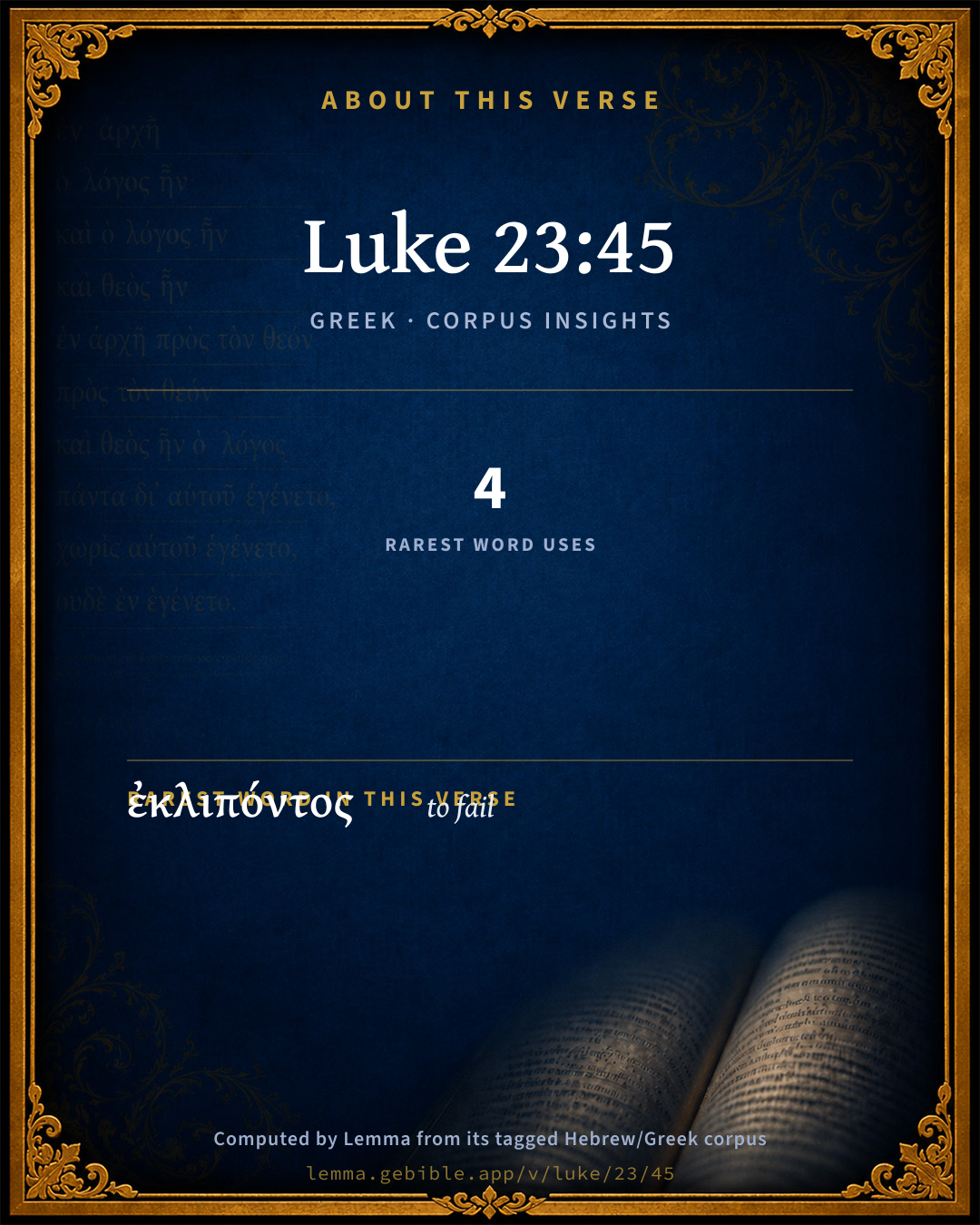
Luke 23:45

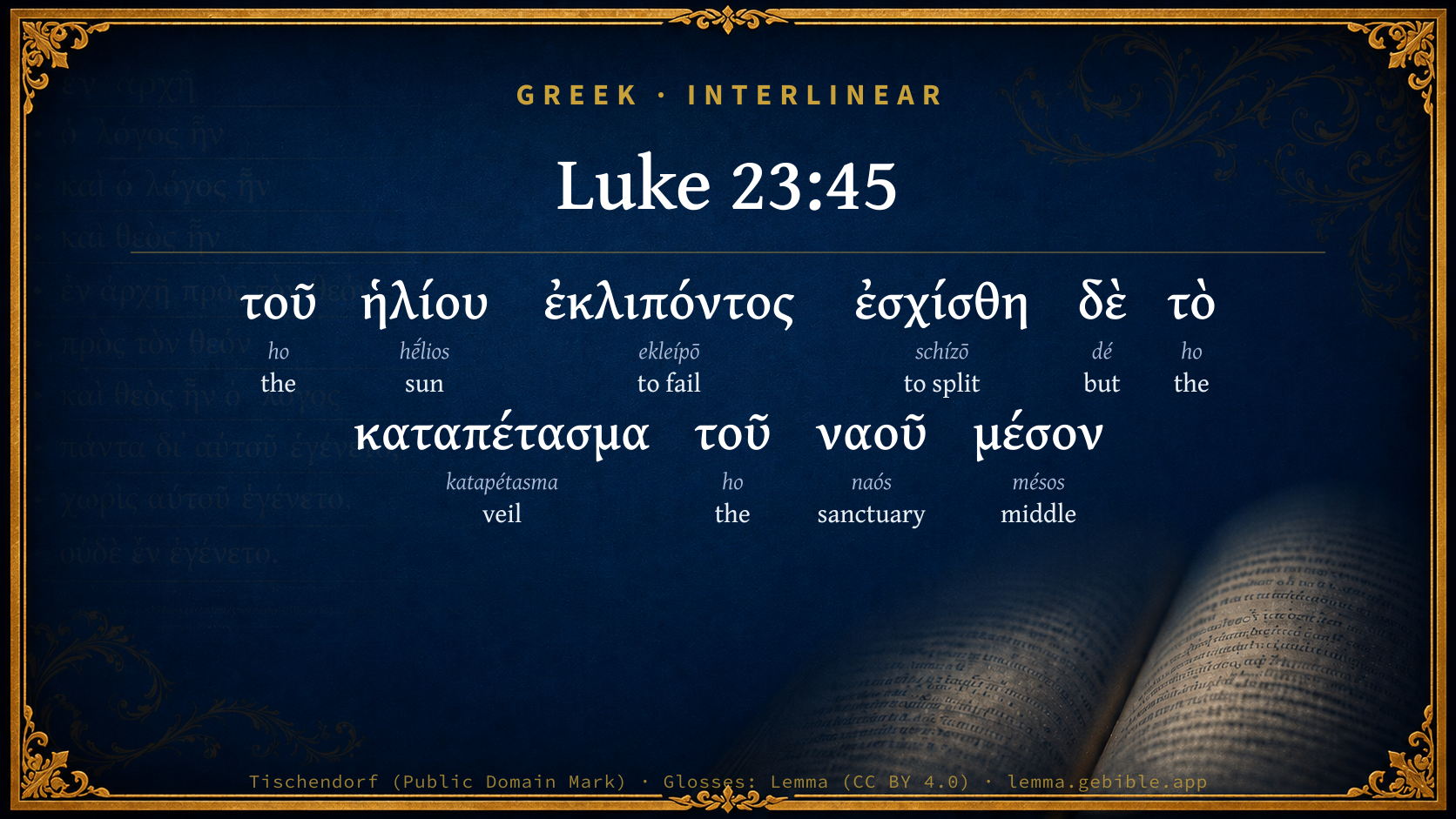
Greek (Tischendorf 8th ed.) Luke 23:45 appears in the Greek New Testament. The text above is from the Tischendorf 8th edition. Each word links to its Strong’s number and a concise gloss. Click any word for its full Thayer’s Greek Lexicon entry.
Download image
Cite this verse

Luke 23:45 (World English Bible). Public Domain. Lemma interlinear Bible study tool, https://lemma.gebible.app/v/luke/23/45.

Show BibTeX & RIS
BibTeX
RIS
English Translation
The sun was darkened, and the veil of the temple was torn in two.
World English Bible · Public Domain
Download a study sheet

One document with this verse’s original text, its word-by-word gloss line, the meaning frame, cross-references with their text, attributed commentary, and full source and license credits — printable, and it pastes into notes with its structure intact.

This verse Autodidact and up

Study sheet (.html) Plain text (.txt)

A passage Seminary Student

Up to 50 verses in one chapter. A passage sheet keeps up to 6 commentary sources and 12 cross-references per verse, in the order this page ranks them, and says so on the sheet whenever that leaves anything out. Ask for a single verse and you get the Autodidact verse sheet above.

Everything on this page stays free to read, with no account — the sheet is a download of what is already on screen, not access to it.

Want to remove ads? Support Godless Engineer
Compare translations 3

The same verse in 3 English versions, stacked beneath the original-language interlinear above. Click any original word for its lexicon entry.

Each is an independent rendering of the whole verse — the interlinear is not word-aligned to these translations.

Highlighted words mark where these versions differ — a whole-verse word diff, not a word-by-word alignment.

  • World English Bible Public Domain
    The sun was darkened, and the veil of the temple was torn in two.
  • King James Version Public Domain
    And the sun was darkened, and the veil of the temple was rent in the midst.
  • unfoldingWord Literal Text CC BY-SA 4.0
    The sun failed, and the curtain of the temple was split in the middle.

unfoldingWord Literal Text — © unfoldingWord, licensed CC BY-SA 4.0. Word-aligned USFM3 via Door43 (git.door43.org/unfoldingWord/en_ult).

Versions to compare (up to 4)

3 of 4 selected

Show all 19 translations

Every available English version of this verse, each an independent rendering of the whole verse.

  • World English Bible Public Domain
    The sun was darkened, and the veil of the temple was torn in two.
  • Berean Standard Bible Public Domain
    The sun was darkened, and the veil of the temple was torn down the middle.
  • Majority Standard Bible Public Domain
    The sun was darkened, and the veil of the temple was torn down the middle.
  • King James Version Public Domain
    And the sun was darkened, and the veil of the temple was rent in the midst.
  • American Standard Version (1901) Public Domain
    the sun's light failing: and the veil of the temple was rent in the midst.
  • Revised Version (1885) Public Domain
    the sun’s light failing: and the veil of the temple was rent in the midst.
  • Geneva Bible (1599) Public Domain
    And the Sunne was darkened, and the vaile of the Temple rent through the middes.
  • Douay-Rheims (1899) Public Domain
    And the sun was darkened, and the veil of the temple was rent in the midst.
  • Young's Literal Translation Public Domain
    and the sun was darkened, and the vail of the sanctuary was rent in the midst,
  • Literal Standard Version CC BY-SA 4.0
    and the sun was darkened, and the veil of the temple was torn in the middle,
  • Unlocked Literal Bible CC BY-SA 4.0
    as the sun's light failed. Then the curtain of the temple was split in two.
  • unfoldingWord Literal Text CC BY-SA 4.0
    The sun failed, and the curtain of the temple was split in the middle.
  • Darby Bible Public Domain
    And the sun was darkened, and the veil of the temple rent in the midst.
  • World Messianic Bible Public Domain
    The sun was darkened, and the veil of the temple was torn in two.
  • Webster's Bible Public Domain
    And the sun was darkened, and the vail of the temple was rent in the midst.
  • Free Bible Version CC BY-SA 4.0
    The sun's light was shut out, and the Temple veil was torn in two.
  • Bible in Basic English Public Domain
    The light of the sun went out, and the curtain in the Temple was parted in two.
  • Text-Critical English NT CC BY 4.0
    The sun was darkened, and the veil of the temple was torn down the middle.
  • Tyndale New Testament (1534) Public Domain
    and the sonne was darckened. And the vayle of the temple dyd rent even thorow the myddes.

Literal Standard Version (2020), Covenant Press — licensed CC BY-SA 4.0. Text via the HelloAO Bible API (eBible.org). Unlocked Literal Bible (unfoldingWord) — licensed CC BY-SA 4.0. Text via the HelloAO Bible API (eBible.org). unfoldingWord Literal Text — © unfoldingWord, licensed CC BY-SA 4.0. Word-aligned USFM3 via Door43 (git.door43.org/unfoldingWord/en_ult). Free Bible Version, Dr. Jonathan Gallagher — licensed CC BY-SA 4.0. Text via the HelloAO Bible API (eBible.org).

Word by word

More ways to search: Search by grammar → Find every occurrence → Compare this word →

Practice this passage: Drill this verse → Learn its vocabulary →

About this verse

These counts appear in no published source. They are computed here, from the morphology-tagged text and Lemma’s own curated glosses. What Lemma adds →

10
words
8
distinct lemmas
Gospels
section

Notable vocabulary

The rarest word here is ἐκλιπόντος to fail G1587 — appearing just 4 times in the whole Greek New Testament.

Shared distinctive vocabulary

ἐκλιπόντος to fail G1587 occurs in 4 verses of the Greek New Testament. Also found in:

Repetition

A word recurs within this verse:

Cross-references

8

Topical passages linked to Luke 23:45 in the Treasury of Scripture Knowledge — connected by theme and wording, ordered by reader-vote popularity; previews shown in the World English Bible.

  • Hebrews 10:19–22 Having therefore, brothers, boldness to enter into the holy place by the blood of Jesus,
  • Matthew 27:51 Behold, the veil of the temple was torn in two from the top to the bottom. The earth quaked and the rocks were split.
  • Mark 15:38 The veil of the temple was torn in two from the top to the bottom.
  • Hebrews 9:3–8 After the second veil was the tabernacle which is called the Holy of Holies,
  • Ephesians 2:14–18 For he is our peace, who made both one, and broke down the middle wall of partition,
  • Leviticus 16:12–16 He shall take a censer full of coals of fire from off the altar before Yahweh, and two handfuls of sweet incense beaten small, and bring it within the veil:
  • 2 Chronicles 3:14 He made the veil of blue, and purple, and crimson, and fine linen, and worked cherubim thereon.
  • Hebrews 6:19 This hope we have as an anchor of the soul, a hope both sure and steadfast and entering into that which is within the veil;

Cross-references courtesy of OpenBible.info (CC BY 4.0).

Commentary

Notes on Luke 23:45 from classic Christian and Jewish commentators (each source and its license shown beneath its notes). The classic Christian expositions comment on the surrounding passage and are grouped to its opening verse, so a note may address several verses; the Jewish commentaries on the Tanakh (Rashi and others) are per-verse, so they appear only where the commentator wrote on this verse.

Lemma curates 59 commentaries, every one of them public domain or Creative Commons licensed, each selected and text-cleaned for this edition rather than reprinted as found. About our sources →

The Biblical Illustrator

Joseph S. Exell

Luk_23:45

The veil of the temple was rent

The rent veil

This miraculous event was plainly typical of several important things.

1. This was a type of the violent rending of Christs body on the cross.

2. This typified our Lords own entrance into heaven.

3. This miracle intimated that, by the death of Christ, the ceremonies of the law were, at once, explained and abolished.

4. This miracle intimated that the distinction between Jew and Gentile was at an end.

5. The rending of the veil typified evangelical freeness of access to the throne of grace.

6. The miraculous rending of the veil was typical of Christs having opened up, by His death, an entrance into heaven for all His followers. (James Foote, M. A.)

The rent veil of the temple

I. THE VEIL IS REMOVED FROM HUMANITY. Surrounded by this ethereal light, how pale and sickly is the lamp of philosophy--how shallow are the findings of human reason--how contemptible and unintelligible are the mutterings of infidelity! Both for the reach and the grandeur of its discoveries, Christianity stands alone. Not only is it a mighty advance on all which went before, but it includes within itself that which will take infinite ages to evolve.

II. NATURE IS UNVEILED. It is a fact of which we ought never to lose sight, that there is no discrepancy between the readings of Nature and the higher readings of the Christian Book. Christianity did not come to ignore nature, but rather to unveil her more hidden life and beauty. Amid those disturbing forces which we everywhere find to be at work, we are reminded that the present condition of our world does not correspond with its original integrity; that all nature stands in need of a grand renovation; that this chancre must be brought about by the exertion of Divine power; and that the present throes of creation will result in some mightier birth. All nature will be delivered from the bondage of corruption; and the glorious liberty of the children of God will be preceded by making all things new. Such is the light which Christianity sheds over the constitution, design, and final condition of this material world.

III. TRUTH IS UNVEILED. We say not that this rending of the veil has left no mystery in the great wide field of revelation. Such a result would have been no positive advantage. Progress in discovery and in knowledge seems to be involved in the idea of mental existence and activity. Mind is endued with exhaustless power, and that power must be directed to pursuits and employments corresponding with the dignity of its nature, and the elevation of the ground to which it is raised. For this element of our nature, provision is made in that fulness of revelation which is reserved for another state of being. Heaven is a world of everlasting development.

IV. THE VEIL IS LIFTED FROM THE GRAVE. For the revelation of this immortality we are indebted to the advent and the ministry of Christ. He brought life and incorruption to light.

V. THE GLORIOUS FUTURE IS UNVEILED. It was like a morning without a dawn on which the Saviour rose from the dead. His resurrection was not only the triumph of Life over Death, but it became the pledge and assurance of a glorious immortality. (R. Furguson, LL. D.)

The Biblical Illustrator, edited by Joseph S. Exell (c. 1880s–1900s) — public domain. Text from a community e-Sword module.

Godbey's Commentary on the New Testament

William B. Godbey

CHAPTER 28

CONCURRENT MIRACLES

Luk 23:45-49; Mar 15:38-41; Mat 27:51-56. Our Lord has already expired on the cross, and now we proceed to consider the concurrent miracles so overwhelmingly attesting His Divinity, and pouring a cataract of conviction on the multitude, which rankled like Scythian arrows in their spiritual vitals, preparing them for the glorious Pentecostal revival which followed at the end of fifty days. “And, behold, the veil of the temple was rent in twain from the top to the bottom.” The old dispensation was on the plane of justification, which is symbolized by the outer court of the temple, in which the shewbread had to be renewed frequently, as it would get stale and moldy, while the lamps had to be supplied with oil and lighted, or they would go out, thus in constant need of human agency and attention. Not so with the inner court of the temple, the Holy of Holies. There the manna in the golden pot was always fresh and delicious, while Aaron’s rod constantly exhibited swelling buds, evolving leaves, blooming flowers, growing fruits, and ripe almonds, delicious to the taste and ready to be eaten. Meanwhile the Shekinah, the symbol of the Divine presence, kept the temple bright as cloudless noonday all the time, so no one could discriminate the night as it went by, as perennial noonday did there abide, so wonderfully illustrating the truly sanctified experience. The moment Jesus expired on the cross, the dispensation of Christian perfection was inaugurated, God with His own hand tearing down the veil, and admitting all the inmates of His temple into the Holy of Holies, the Old Testament saints being priests and the New Testament saints high priests unto God. You see this veil was rent from the top to the bottom, showing that the sanctifying power always comes from heaven. When you get it by priestcraft or carnal ordinances, it is always spurious.

“The earth did quake, and the rocks were rent.” During both of my tours in the Holy Land, as Calvary had more charms for me than any other spot, I spent much time praying and meditating on this holy mount, where Jesus laid down His life for me. I could have no idea as to the number of my visits to that hallowed summit, or the time I spent there. Though one thousand eight hundred and sixty-seven years have rolled away, the footprints of the old earthquake that visited the land are still obvious. I saw them in the irregular ruptures of the great rocks.

“The tombs were opened, and many bodies of the sleeping saints did rise, and coming out from the tombs after His resurrection, did come into the holy city, and were made manifest unto many.” There is an Oriental tradition that Abraham, Isaac, and Jacob, as well as other eminent prophets and saints, did rise at that time. We have no revelation as to what became of them. I doubt not but that they accompanied our Lord the ensuing forty days and ascended with Him to heaven. You see that though the great stone tombs were broken up by the earthquake, occurring at 3 P.M., Friday, when Jesus bowed His head and died, yet they did not come out of the tombs till after He arose at the early dawn the ensuing Sunday morning.

Good reasons for this: He was to be “the first fruits of them that slept,” the antecedent resurrections being abnormal and abortive, as the persons arose with their mortal bodies, and consequently died again. As these resurrections, above described, were subsequent to our Lord’s, they of course received their immortal bodies, no more subject to death, and consequently flew away to heaven, constituting a prelude of the glorious first resurrection, including all the members of the Bridehood, and taking place at the Lord’s premilennial coming. (Rev 20:4-6.)

Mar 15:39-41. “And the centurion, standing in front of Him, and thus crying out He expired, said, Truly this was the Son of God. And there were women from a distance looking on, among whom was Mary Magdalene, and Mary the mother of James the Less and Joses, and Salome; who , when He was in Galilee, were accustomed to follow Him, and minister unto Him; and many other women having come up along with Him to Jerusalem.” Luk 23:47-48 : “And the centurion seeing that which took place, glorified God, saying, Truly this was a righteous Man. And all the multitudes being present at this sight, seeing the things which took place, were going away, beating their breasts.” Mat 27:54 : “And the centurion, and those along with him, having charge of Jesus, seeing the earthquake and the events which took place, became alarmed exceedingly, saying, Truly this was the Son of God.” Thus you see, an awful pall fell on the vast multitude, so that even the heathen Roman soldiers, who, under the rigor of military law, had been forced to execute this bloody work — stalwart men, who never knew fear on the battle-field — tremble and quake with paralyzing trepidation and heart-convulsing terror, confessing outright, “Surely this was the Son of God.” Among the Jews, “beating the breast” denoted the deepest sorrow and most terrible anguish. Luke says the multitudes who were present at that awful scene went away beating their breasts. O what a volcano of conviction came upon the Jews, who were there from all parts of the world attending the Passover, and returning to their homes in all lands were thus so wonderfully prepared for the coming of the apostles and the preaching of Jesus! As these Roman soldiers were Gentiles, and the time had arrived for the evangelization of the Gentile world, I trow the convictions fastened on them transformed them into prolific seed-corn, soon to germinate in many countries throughout the world-wide Roman Empire.

William B. Godbey, Commentary on the New Testament (1896–1900) — public domain. Text from a community e-Sword module.

Tyndale Open Study Notes

Tyndale Open Resources

23:45 the curtain in the sanctuary of the Temple: One curtain separated the Temple courtyard from the Holy Place, and another separated the Holy Place from the Most Holy Place. Luke does not say which was torn down the middle, but it was probably the latter—Jesus’ death put an end to the sacrificial system of the Temple and opened a new and permanent way into the presence of God (see Heb 10:19-20).

Tyndale Open Study Notes — © Tyndale Open Resources, licensed CC BY-SA 4.0. Text via the HelloAO Bible API.

Expositor's Greek Testament

ed. W. Robertson Nicoll

Luk 23:45 . τοῦ ἡλίου ἐκλιπόντος : this phrase (a well-attested reading as against the T.R. ἐσκοτίσθη ὁ ἥ .) ought to mean the sun being eclipsed, an impossibility when the moon is full. If all that was meant was the sun’s light totally failing, darkened, e.g. , by a sand storm, the natural expression would be ἐσκοτίσθη .

The Expositor's Greek Testament, edited by W. Robertson Nicoll (1897–1910) — public domain. Text from a community e-Sword module.

Geneva Bible (1599)

Geneva Bible translators

Christ entereth stoutly into the very darkness of death, for to overcome death even within his most secret places.

Geneva Bible (1599) marginal notes — public domain. Text via Bolls.life.

Adam Clarke's Commentary

Verse 45. The sun was darkened] See an examination of the accounts of Phlegon, Thallus, and Dionysius, on Mt 27:45.

The veil - was rent] See Mt 27:51.

Adam Clarke's Commentary on the Bible (1810–1826) — public domain. Text from a community e-Sword/MySword module.

The Cambridge Bible for Schools and Colleges

gen. ed. J. J. S. Perowne

45. And the sun was darkened] Instead of these words some MSS. (א, B, C, &c.) read “the sun eclipsing,” or “failing.” The reading seems only to be an attempt, and that a very unsuccessful one, to account for the darkness. That it could not have been due to an eclipse is certain, for the Paschal moon was at the full.

the vail of the temple was rent in the midst] The veil intended must be what was called the Parocheth, or inner veil, which hung between the Holy Place and the Holy of Holies. It was very heavy, and splendid with embroidery. It is alluded to in Heb_6:19; Heb_9:3; Heb_10:19-20. The obvious significance of the portent was the departure of the Shechinah or Presence of God from His now-deserted Temple. This particular event is (naturally) not mentioned by the Jews, but we may have a reference to it in the various omens of coming wrath which they say occurred “forty years” before the destruction of the Temple, and in which Jochanan Ben Zakkai saw the fulfilment of Zec_11:1. For a fuller account of these events see Mat_27:51-53; Mar_15:33. Jerome on Mat_27:51 says that a great lintel over the gate of the Temple fell and was shattered.

The Cambridge Bible for Schools and Colleges (gen. ed. J. J. S. Perowne; Cambridge University Press, 1878–1918) — public domain. Text from a community e-Sword module.

John Gill's Exposition

The same had not consented to the counsel and deed of them,.... Though he was with the Jews, the chief priests, Scribes, and elders, in the high priest's palace, being one of that great council; yet he did not agree with them; nor was it his advice and counsel, that they should put Christ to death; he was against it, at least did not consent to it:

he was of Arimathea, a city of the Jews; See Gill on Mat 27:57. This clause in the Syriac and Persic versions stands in the preceding verse, and follows after the mention of his name and office, and where it seems most natural;

who also himself waited for the kingdom of God; See Gill on Mar 15:43.

John Gill's Exposition of the Whole Bible (1746–1763) — public domain (CC PDM 1.0). Text via the HelloAO Bible API.

Trapp's Complete Commentary

John Trapp

45 And the sun was darkened, and the veil of the temple was rent in the midst.

Ver. 45. See Mat 27:51; Mar 15:38.

John Trapp, A Commentary or Exposition upon All the Books of the Old and New Testament (1647–1656) — public domain. Text from a community e-Sword module.

The Pulpit Commentary

And the veil of the temple was rent in the midst. This was the inner veil, which hung between the holy place and the holy of holies. It was rich with costly embroidery, and very heavy. Before the willing surrender of life told of in the next verse (46), our Lord spoke twice more. These fifth and sixth words from the cross are preserved by St. John. (Joh_19:28, Joh_19:30) The first of these, "I thirst an expression of bodily exhaustion, of physical suffering was predicted as part of the agony of tile Servant of God. (Psa_69:21) The second, "It is finished!" tells that "the earthly life had been carried to its issue. That every essential point in the prophetic portraiture of Messiah had been realized. The last suffering for sin had been endured. The end of all had been gained. Nothing was left undone or unborne" (Westcott).

The rent veil.

At the time when Jesus died it is exceedingly probable that there would be priests in the "holy place." It was now afternoon, it was drawing toward the time of evening sacrifice; they would be in attendance rendering the service of the sanctuary; they would certainly be aware of what was happening just outside Jerusalem, and would be powerfully affected by the fact. Suddenly, as if grasped and rent by unseen hands, that most sacred veil interposing between the antechamber and the reception-room of God himself, was torn in twain, "from the top to the bottom." The incident was undeniably miraculous. No Jew would have dreamed of daring to do an act that would have been so impious in a man. A Divine hand must have been there, and when they entered into the mysterious darkness and felt the earthquake, must not these priests have asked themselves whether the rending of the veil did not signify a new epoch in the kingdom of God? May not the conversion of a "great company of the priests" (Act_6:7) be partly accounted for by this striking and significant event? But what did it symbolize?

I THAT GOD HAD ADOPTED A NEW METHOD OF ASSERTING HIS HOLINESS AND IMPRESSING IT ON THE MIND AND HEART OF THE WORLD. That veil was an essential part of a system of carefully graduated approach to God. It divided the "holy" from the "most holy" place, and beyond it none might pass but the high priest, and he only once a year. It was intended to teach the absolute holiness of God that it was only as men were prepared, and as they were separated from sin that they could be admitted to his presence. It was not without effect on the Jewish mind; that nation had thus grasped the idea of the purity and perfection of God. But now his character was so revealed that all such symbolism was no longer needed. The death of Jesus Christ his Son, as the Sacrifice for the sin of the world, was an expression of Divine holiness incomparably superior to the symbolism of the temple and for ever superseding it. Henceforth, when men wanted to know what God felt about sin how he hated it, what he thought it worth while to do and to suffer in order to expel it they would look to that cross at Calvary, and there read his mind and know his will. Holy places were no longer needed.

II THAT GOD HAD NOW PROVIDED ANOTHER AND BETTER WAY OF MERCY FOR MANKIND. Behind the veil was the innermost chamber; and of this chamber the furniture was the ark with the two tables of the Law, and the mercy-seat above it; we read of this compartment thus: "within the veil before the mercy-seat." Mercy was thus resting on Law. Mercy always must be founded on holiness; lot without holiness there can be no mercy worthy of the name. And on the great Day of Atonement the high priest entered this "holy of holies," and sprinkled blood upon the mercy-seat for the cleansing of the sins of the nation. But the cross of Jesus Christ spoke of the Divine mercy as no temple furniture could do; there needed nothing to teach the supremacy of mercy above Law after the dying love of the Redeemer of mankind, and there needed no more sprinkling of blood upon a mercy-seat after this great Day of Atonement, when "by one sacrifice of himself for ever" the spotless Lamb of God presented "a Propitiation for the sins of the world." The temple rites then became obsolete; its services were past; there need be no more guarding of one sacred place from another; let the sacred curtain be taken down or rent in twain.

III THAT THE WAY TO THE HOLY ONE HIMSELF IS NOW OPEN TO ALL MANKIND. "That veil was an instrument that not only secluded, but excluded; through it no eye might venture to glance, no intruding hand might reach, no presumptuous feet might step. To pass that limit was to incur the heaviest penalty; "the Holy Ghost this signifying, that the way into the holiest of all was not yet made manifest." But now "the good High Priest is come, supplying Aaron"s place" and having offered up the one all-sufficient sacrifice, having obtained thereby "eternal redemption," that excluding veil is rent in twain, that barrier is broken down; there are no more limitations, no more distinctions; there is access for every child of man to the mercy-seat of God to the Holy One himself, to seek his grace and find his favor. Are we drawing nigh? Are we entering in? Are we availing ourselves of this priceless privilege, this glorious provision for our spirit"s need? In many words and ways God invites us to draw nigh to himself: he did so when his invisible hand rent in twain that separating veil. "Having therefore boldness to enter into the holiest by the blood of Jesus... let us draw near with a true heart in full assurance of faith. C.

The Pulpit Commentary (1880–1919), ed. H.D.M. Spence-Jones & Joseph S. Exell — public domain. Text from a community e-Sword module.

John Wesley's Explanatory Notes

Mark xv, 38.

John Wesley, Explanatory Notes Upon the Whole Bible (1754–1765) — public domain. Text via the GEBible commentary corpus.

Cambridge Greek Testament for Schools and Colleges

45. καὶ ἐσκοτίσθη ὁ ἥλιος. omitted in C2. τοῦ ἡλίου ἐκλείποντος B, ἐκλιπόντος אC1L.

45. ἐσκοτίσθη ὁ ἥλιος. Instead of these words some MSS. (אBC, &c.) read “the sun eclipsing,” or “failing.” The reading seems only to be an attempt, and that a very unsuccessful one, to account for the darkness. That it could not have been due to an eclipse is certain, for the Paschal moon was at the full. It may have been a local and temporary darkness due to atmospheric causes, such as was observed in the years 1106, 1208, 1547, 1716, 1860. See Godet’s note.

τὸ καταπέτασμα. The veil intended must be what was called the Parocheth, or inner veil, which hung between the Holy Place and the Holy of Holies. It was very heavy, and splendid with embroidery. It is alluded to in Heb 6:19; Heb 9:3; Heb 10:19-20. The obvious significance of the portent was the departure of the Shechinah or Presence of God from His now-deserted Temple. This particular event is (naturally) not mentioned by the Jews, but we may have a reference to it in the various omens of coming wrath which they say occurred “forty years” before the destruction of the Temple, and in which Jochanan Ben Zakkai saw the fulfilment of Zec 11:1. For a fuller account of these events see Mat 27:51-53; Mar 15:33. Jerome on Mat 27:51 says that a great lintel over the gate of the Temple fell and was shattered.

Cambridge Greek Testament for Schools and Colleges (Cambridge University Press, 1896; 21 vols, various authors incl. Carr, Maclear, Plummer, Farrar, Lumby, Moule, M. R. James, Simcox) — public domain. Text from a community e-Sword module.

Alford’s Greek Testament

Henry Alford

45.] The words ἐσκοτ. ὁ ἥλ. are probably added to give solemnity to the preceding, assigning its reason; so that the gloss τοῦ ἡλ. ἐκλείποντος shews a right apprehension of the words. It can hardly be, as ., that the earth was darkened till the ninth hour, and then the sun became dark also.

Henry Alford, The Greek Testament (1849–1861) — public domain. Text from a community e-Sword module.

International Critical Commentary

45. τοῦ ἡλίου ἐλέποντος. The reading is doubtful; but this is probably correct, although ἐλιπόντος may possibly be correct. “The sun failing,” or “the sun having failed.” is the meaning: and we must leave it doubtful whether Lk. supposes that there was an eclipse (which is impossible at full moon), or uses ἐκλείπειν in its originally vague sense of “fail.” The latter is probable. Neither in LXX nor elsewhere in N.T. is ἐκλείπω used of the sun. The fact that it might mean an eclipse, and that an eclipse was known to be impossible, would tempt copyists to substitute a phrase that would be free from objection; whereas no one would want to change ἐσκοτίσθη ὁ ἣλιος. The Gospel of Peter states that “many went about with lamps, supposing it is night.” and that the darkness lasted until Jesus was taken from the cross, when the earthquake took place: “then the sun shone out, and it was found to be the ninth hour.” See Charles. Assump. of Moses, 41, 87.

The evidence stands thus:—

τοῦ ἡλίου ἐκλείπόντος (or ἐκλιπόντος א L al., Tisch.) א B C* (?) L codd. ap. Orig. Aegyptt. Orig. “Cels.” WH. RV. Weiss. καὶ ἐσκοτίσθη ὁ ἥλιος A C3 D Q R X Γ etc., codd. ap. Orig-lat. Latt. Syr. Marcion ap. Epiph. Lach. Treg. D has ἐσκ. δέ. The Latin renderings are intenebricatus est sol (a),tenebricavit sol (c), obscuratus est sol (d e f Vulg.). See WH. ii. App. pp. 69-71 for a full discussion of the evidence.

Julius Africanus (c. a.d. 220) in his Chronica opposes the heathen historian Thallus for explaining this darkness as an eclipse, which at the Passover would be impossible (Routh, Rel Sacr. ii. pp. 297, 476). In the Acta Pilati, A. xi. the Jews are represented as explaining away the darkness in a similar manner: ἔκλειψις ἡλίου γέγονεν κατὰ τὸ εἰωθός!

Origen (Con. Cels, ii. 33, 59; comp. 14) tells us that Phlegon (a freedman of Hadrian) recorded the earthquake and the darkness in his Chronicles. Eusebius in his Chronicle quotes the words of Phlegon, stating that in the 202nd Olympiad (4th year of the 203rd, Arm. Vers.) there was a very great eclipse; also that there was a great earthquake in Bithynia, which destroyed a great part of Nicæa (Eus. Chron. p. 148, ed. Schœne). It is impossible to determine whether the events recorded by Phlegon have any connexion with the phenomenoa which accompanied the death of Christ.

ἐσχίσθη δὲ τὸ καταπέτασμα. Between the Holy Place and the Holy of Holies (Exo 26:31; Lev 21:23, Lev 21:24:3; Heb 6:19; comp. Heb 10:20) there was a curtain called τὸ δεύτερον καταπέτασμα (Heb 9:3), to distinguish it from the curtain which separated the outer court from the Holy Place. The latter was more accurately, but not invariably, called τὸ κάλυμμα (Exo 27:16; Num 3:25). But Jewish traditions state that there were two curtains, one cubit apart, between the Holy Place and the Holy of Holies, the space between them being called τάραξις because of the perplexity which led to this arrangement (J. Light. foot on Mat 27:51). It is not clear how many curtains are included in τὰ καταπετάσματα in 1 Mac. 4:51. It is futile to speculate how the curtain was rent; but the fact would be well known to the priests, “a great company” of whom soon afterwards became “obedient to do faith” (Act 6:7). The μέσον of Lk. is more classical than the εἰς δύο of Mt. Mk. and the Gospel of Peter. 1

International Critical Commentary — older volumes (1896–1929), various authors — public domain. Text from a community e-Sword module.

Vincent's Word Studies in the New Testament

Marvin R. Vincent

Veil. See on Mt 27:51.

Marvin R. Vincent, Word Studies in the New Testament (1887–1900) — public domain. Text from a community e-Sword/MySword module.

Lesson kit

Teaching starters — assembled from the data on this page, not authored interpretation. Every prompt links to the verse data it draws on. Edit before teaching.

Luke, in the Gospels, opens this verse with 10 words (8 distinct Greek lemmas). Its most distinctive word is ekleípō (“to fail”). A historical commentator’s framing appears above. Read the whole chapter for the surrounding context.

Discussion questions

  1. How does “to fail” (ekleípō) shape what this verse is saying?
  2. How does Luke 16:9, which shares the word «to fail», read alongside this verse?
  3. What does the repetition of “the” (3× in this one verse) do in this verse?
  4. These translations render this verse differently. What is at stake in choosing one wording over another?
  5. Compare how The Biblical Illustrator and Godbey's Commentary on the New Testament read this verse. Where do they agree or differ?

Things to notice

Reading settings

Reading text

Shown beneath each verse's original-language words.

Old Testament
Old Testament edition

Read the OT as the Masoretic Hebrew (MT) or the Greek Septuagint (LXX).

English shown for the Greek Septuagint (in the Hebrew ↔ Greek comparison).

Comparing translations? Open the Compare panel on any verse page to stack up to four side by side.