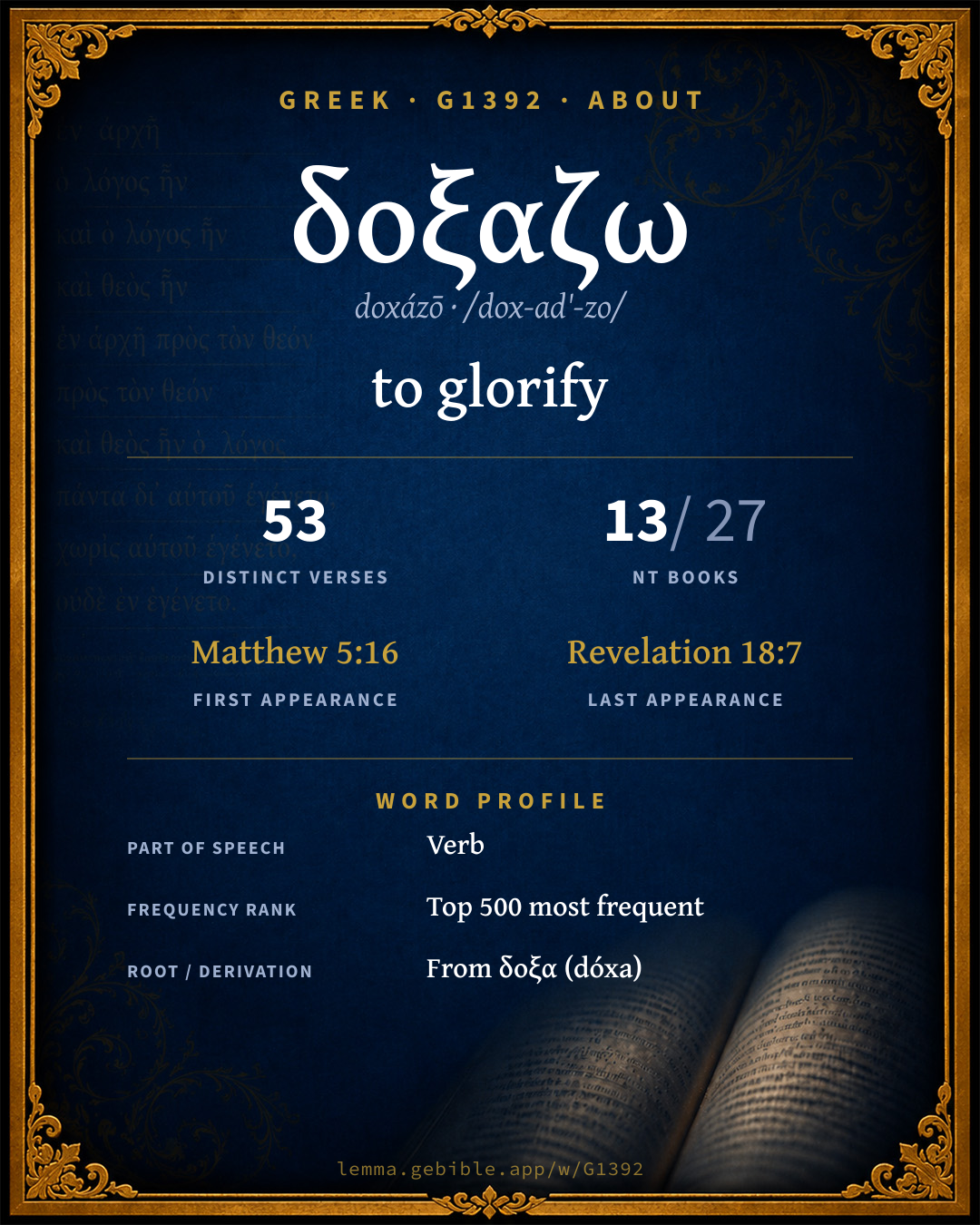
δοξάζω
to glorify
‘to glorify’ is one of 4 main senses fuller range ↓
Full lexicon entry — Thayer's Greek Lexicon
From Thayer's Greek Lexicon
Where this word appears
Grammar key — what these labels mean
Part of speech
- Verb
- An action or state-of-being word.
Tense
- Aorist
- Action viewed as a simple whole, without regard to duration — often past (perfective aspect).
- Imperfect
- Continuous or repeated action in past time (“was writing”).
- Future
- Action expected in future time.
- Present
- Ongoing or general action in present time (imperfective aspect).
- Perfect
- A completed past action with continuing present results.
Voice
- Passive
- The subject receives the action.
- Active
- The subject performs the action.
Mood
- Indicative
- States a fact or asks a factual question (the mood of reality).
- Participle
- A verbal adjective (“writing,” “having written”).
- Imperative
- Expresses a command or request.
- Subjunctive
- Expresses probability, purpose, or possibility (the mood of contingency).
- Infinitive
- A verbal noun (“to write”), unmarked for person or number.
Case
- Nominative
- The case of the subject (and the predicate nominative).
- Dative
- The case of the indirect object, means, or location — “to / for / with / in.”
Person
- 3rd person
- The one spoken about (“he / she / it / they”).
- 2nd person
- The one addressed (“you”).
- 1st person
- The speaker (“I / we”).
Gender
- Masculine
- Grammatically masculine.
- Feminine
- Grammatically feminine.
- Neuter
- Grammatically neuter.
Number
- Singular
- One.
- Plural
- More than one.
Every verse where G1392 appears in the Book of Mark — 1 distinct verse. Click any verse to open its interlinear word-by-word view. Verse text shown in the World English Bible for context — . Each verse’s Greek form is shown with its reference; the English is not keyword-highlighted, since the data carries no word-level English alignment. Use “Compare translations” on any verse to read it across multiple English versions. This concordance covers the Greek New Testament; Septuagint (Greek Old Testament) occurrences of this word are not indexed here.
Mark
About this entry
At a glance — auto-summarized from this page’s data, not written by a person. Every figure links to its source below. This summary describes the numbers; it doesn’t interpret them.
The Greek verb δοξαζω centers on the idea of “to glorify.” Thayer's distinguishes 4 senses for it. It turns up in 53 verses across 13 books, a moderately common footprint. The word gravitates to John (30%), then Luke and Acts. Its earliest occurrence is Matthew 5:16. Dig into 53-verse concordance and the renderings breakdown below.
Gloss history
Strong's 1890 vs modern scholarship
About this word
Strong's G1392 catalogs a Greek word from the Greek New Testament.
These counts are not copied from any lexicon or concordance. They are computed here, from the morphology-tagged Greek New Testament. What Lemma adds →
- 53
- distinct verses
- The word appears in 53 distinct verses.
- 13 / 27
- NT books
- The word appears in 13 of 27 New Testament books.
- #267
- by frequency
- Top 500 most frequent Greek words (rank 267 of 5,347 Greek words by occurrence).
View all 53 occurrences in the concordance →
By section of the New Testament
By traditional corpus
Conventional, traditional groupings — biblical authorship is debated, so this is a traditional corpus grouping, not an authorship claim. Some books belong to more than one corpus (Luke is in both the Gospels and the Lukan corpus, and so on), so these shares overlap and need not total 100%. Each figure is a share of the word’s 53 distinct verses.
- Gospels 30 verses · 57%
- Johannine 18 verses · 34%
- Lukan (Luke–Acts) 14 verses · 26%
- Pauline corpus 11 verses · 21%
- General (Catholic) Epistles 4 verses · 8%
- Revelation 2 verses · 4%
- Hebrews 1 verse · 2%
How translations render this word
Counts come from each version’s own published word-to-Strong’s tagging or interlinear alignment — an approximate guide to how each version renders this word, not a word-level alignment the data otherwise carries. Because each total is that version’s own tagged count, the per-version totals vary from one another and need not match the appearance or distinct-verse counts above. These counts may also differ from a printed concordance because Lemma counts each distinctly tagged rendering and does not collapse phrase taggings into a single head-word total. This is a fixed set of word-tagged versions (KJV, ASV, BSB, ULT) and does not change with the reading translation you choose elsewhere. Each version’s license is shown beside its name below (and on Sources).
- King James Version: Glorified 12×, Glorify 10×, They glorified 6×
- American Standard Version: Glorified 12×, Glorify 11×, They glorified 5×
- Berean Standard Bible: Glorify 9×, They glorified 5×, Glorified 4×
- unfoldingWord Literal Text: Glorify 9×, Glorified 7×, Glorifying 7×
King James Version Public Domain
Renders G1392 across 71 tagged occurrences — most commonly:
Plus 32 renderings that appear only once — usually multi-word phrases or single function words the recovered tagging swept in, not distinct renderings.
American Standard Version Public Domain
Renders G1392 across 71 tagged occurrences — most commonly:
Plus 34 renderings that appear only once — usually multi-word phrases or single function words the recovered tagging swept in, not distinct renderings.
Berean Standard Bible Public Domain
Renders G1392 across 61 tagged occurrences — most commonly:
Plus 27 renderings that appear only once — usually multi-word phrases or single function words the recovered tagging swept in, not distinct renderings.
unfoldingWord Literal Text CC BY-SA 4.0
Renders G1392 across 70 tagged occurrences — most commonly:
Plus other, less common renderings. Plus 24 renderings that appear only once — usually multi-word phrases or single function words the recovered tagging swept in, not distinct renderings.
Senses in Thayer's
The 4 senses Thayer's distinguishes for this word, in lexicon order (not ranked by frequency or importance). The full entry — with sub-senses — is in the Lexicon Entry tab.
- to think, suppose, be of opinion
- to praise, extol, magnify, celebrate
- to honour, do honour to, hold in honour
- to make glorious, adorn with lustre, clothe with splendour
Word origin
Derived from δοξα (dóxa) (G1391) — glory.
From G1391 ; to render (or esteem ) glorious (in a wide application): - (make) glorify (-ious) full of (have) glory honour magnify.
— Strong’s Exhaustive Concordance (1890), public domain.
Forms in the corpus
The 28 distinct written forms G1392 takes in the Greek New Testament, most frequent first — each parse links to that tense’s occurrences in the concordance.
Septuagint usage
The same Greek word δοξαζω appears 67 times in the Greek Old Testament (Septuagint), across 65 verses in 16 books.
- 67
- LXX occurrences
- Tagged occurrences of this Greek word in the Septuagint.
- 65
- verses
- Distinct Septuagint verses containing this word.
- 16 / 39
- OT books
- The word appears in 16 of the 39 Old Testament books.
Sample Septuagint occurrences
- Exodus 15:1 δοξάζω
- Leviticus 10:3 δοξάζω
- Deuteronomy 33:16 δοξάζω
- Judges 9:9 δοξάζω
- 1 Samuel 2:29 δοξάζω
- 2 Samuel 6:20 δοξάζω
- 1 Chronicles 17:18 δοξάζω
- Ezra 7:27 δοξάζω
- Esther 3:1 δοξάζω
- Psalms 14:4 δοξάζω
- Proverbs 13:18 δοξάζω
- Isaiah 5:16 δοξάζω
Septuagint occurrences (same lexeme)
Every verse where the same Strong’s number (G1392) appears in the Greek Septuagint — showing the first 50 of 65. Verse text shown in the World English Bible for context; the Greek form is the matched word — the English is not keyword-highlighted.
- Exodus 15:1 δοξάζω Then Moses and the children of Israel sang this song to Yahweh, and said, "I will sing to Yahweh, for he has triumphed gloriously: The horse and his rider he has thrown into the sea.
- Exodus 15:2 δοξάζω Yah is my strength and song, He has become my salvation: This is my God, and I will praise him; My father's God, and I will exalt him.
- Exodus 15:6 δοξάζω Your right hand, Yahweh, is glorious in power, Your right hand, Yahweh, dashes the enemy in pieces.
- Exodus 15:11 δοξάζω Who is like you, Yahweh, among the gods? Who is like you, glorious in holiness, Fearful in praises, doing wonders?
- Exodus 15:21 δοξάζω Miriam answered them, "Sing to Yahweh, for he has triumphed gloriously: The horse and his rider he has thrown into the sea."
- Exodus 34:29 δοξάζω It happened, when Moses came down from Mount Sinai with the two tablets of the testimony in Moses' hand, when he came down from the mountain, that Moses didn't know that the skin of his face shone by reason of his speaking with him.
- Exodus 34:30 δοξάζω When Aaron and all the children of Israel saw Moses, behold, the skin of his face shone; and they were afraid to come near him.
- Exodus 34:35 δοξάζω The children of Israel saw Moses' face, that the skin of Moses' face shone: and Moses put the veil on his face again, until he went in to speak with him.
- Leviticus 10:3 δοξάζω Then Moses said to Aaron, "This is what Yahweh spoke of, saying, "'I will show myself holy to those who come near me, And before all the people I will be glorified.'" Aaron held his peace.
- Deuteronomy 33:16 δοξάζω For the precious things of the earth and the fullness of it, The good will of him who lived in the bush. Let [the blessing] come on the head of Joseph, On the crown of the head of him who was separate from his brothers.
- Judges 9:9 δοξάζω But the olive tree said to them, Should I leave my fatness, with which by me they honor God and man, and go to wave back and forth over the trees?
- Judges 13:17 δοξάζω Manoah said to the angel of Yahweh, What is your name, that when your words happen, we may honor you?
- 1 Samuel 2:29 δοξάζω Why kick you at my sacrifice and at my offering, which I have commanded in [my] habitation, and honor your sons above me, to make yourselves fat with the best of all the offerings of Israel my people?
- 1 Samuel 2:30 δοξάζω Therefore Yahweh, the God of Israel, says, I said indeed that your house, and the house of your father, should walk before me forever: but now Yahweh says, Be it far from me; for those who honor me I will honor, and those who despise me shall be lightly esteemed.
- 1 Samuel 15:30 δοξάζω Then he said, I have sinned: yet honor me now, Please, before the elders of my people, and before Israel, and turn again with me, that I may worship Yahweh your God.
- 2 Samuel 6:20 δοξάζω Then David returned to bless his household. Michal the daughter of Saul came out to meet David, and said, How glorious was the king of Israel today, who uncovered himself today in the eyes of the handmaids of his servants, as one of the vain fellows shamelessly uncovers himself!
- 2 Samuel 6:22 δοξάζω I will be yet more vile than this, and will be base in my own sight: but of the handmaids of whom you have spoken, they shall honor me.
- 2 Samuel 10:3 δοξάζω But the princes of the children of Ammon said to Hanun their lord, Do you think that David honors your father, in that he has sent comforters to you? Hasn't David sent his servants to you to search the city, and to spy it out, and to overthrow it?
- 1 Chronicles 17:18 δοξάζω What can David [say] yet more to you concerning the honor which is done to your servant? for you know your servant.
- 1 Chronicles 19:3 δοξάζω But the princes of the children of Ammon said to Hanun, Think you that David does honor your father, in that he has sent comforters to you? Aren't his servants come to you to search, and to overthrow, and to spy out the land?
- Ezra 7:27 δοξάζω Blessed be Yahweh, the God of our fathers, who has put such a thing as this in the king's heart, to beautify the house of Yahweh which is in Jerusalem;
- Ezra 8:36 δοξάζω They delivered the king's commissions to the king's satraps, and to the governors beyond the River: and they furthered the people and the house of God.
- Esther 3:1 δοξάζω After these things did king Ahasuerus promote Haman the son of Hammedatha the Agagite, and advanced him, and set his seat above all the princes who were with him.
- Esther 6:6 δοξάζω So Haman came in. The king said to him, What shall be done to the man whom the king delights to honor? Now Haman said in his heart, To whom would the king delight to do honor more than to myself?
- Esther 6:7 δοξάζω Haman said to the king, For the man whom the king delights to honor,
- Esther 6:9 δοξάζω and let the clothing and the horse be delivered to the hand of one of the king's most noble princes, that they may array the man therewith whom the king delights to honor, and cause him to ride on horseback through the street of the city, and proclaim before him, Thus shall it be done to the man whom the king delights to honor.
- Esther 6:11 δοξάζω Then took Haman the clothing and the horse, and arrayed Mordecai, and caused him to ride through the street of the city, and proclaimed before him, Thus shall it be done to the man whom the king delights to honor.
- Esther 10:3 δοξάζω For Mordecai the Jew was next to king Ahasuerus, and great among the Jews, and accepted of the multitude of his brothers, seeking the good of his people, and speaking peace to all his seed.
- Psalms 14:4 δοξάζω Have all the workers of iniquity no knowledge, Who eat up my people as they eat bread, And don't call on Yahweh?
- Psalms 21:24 δοξάζω
- Psalms 36:20 δοξάζω
- Psalms 49:15 δοξάζω But God will redeem my soul from the power of Sheol, For he will receive me. Selah.
- Psalms 49:23 δοξάζω
- Psalms 85:9 δοξάζω Surely his salvation is near those who fear him, That glory may dwell in our land.
- Psalms 85:12 δοξάζω Yes, Yahweh will give that which is good. Our land will yield its increase.
- Psalms 86:3 δοξάζω Be merciful to me, Lord, For I call to you all day long.
- Psalms 90:15 δοξάζω Make us glad for as many days as you have afflicted us, For as many years as we have seen evil.
- Proverbs 13:18 δοξάζω Poverty and shame come to him who refuses discipline, But he who heeds correction shall be honored.
- Isaiah 5:16 δοξάζω But Yahweh of Hosts is exalted in justice, And God the Holy One is sanctified in righteousness.
- Isaiah 10:15 δοξάζω Shall the axe boast itself against him who hews therewith? Shall the saw magnify itself against him who wields it? as if a rod should wield those who lift it up, [or] as if a staff should lift up [him who is] not wood.
- Isaiah 24:23 δοξάζω Then the moon shall be confounded, and the sun ashamed; for Yahweh of Hosts will reign on Mount Zion, and in Jerusalem; and before his elders shall be glory.
- Isaiah 25:1 δοξάζω Yahweh, you are my God; I will exalt you, I will praise your name; for you have done wonderful things, [even] counsels of old, in faithfulness [and] truth.
- Isaiah 33:10 δοξάζω Now will I arise, says Yahweh; now will I lift up myself; now will I be exalted.
- Isaiah 42:10 δοξάζω Sing to Yahweh a new song, and his praise from the end of the earth; you who go down to the sea, and all that is therein, the isles, and the inhabitants of it.
- Isaiah 43:4 δοξάζω Since you have been precious in my sight, [and] honorable, and I have loved you; therefore will I give men in your place, and peoples instead of your life.
- Isaiah 43:23 δοξάζω You have not brought me of your sheep for burnt offerings; neither have you honored me with your sacrifices. I have not burdened you with offerings, nor wearied you with frankincense.
- Isaiah 44:23 δοξάζω Sing, you heavens, for Yahweh has done it; shout, you lower parts of the earth; break forth into singing, you mountains, O forest, and every tree therein: for Yahweh has redeemed Jacob, and will glorify himself in Israel.
- Isaiah 49:3 δοξάζω and he said to me, You are my servant; Israel, in whom I will be glorified.
- Isaiah 49:5 δοξάζω Now says Yahweh who formed me from the womb to be his servant, to bring Jacob again to him, and that Israel be gathered to him (for I am honorable in the eyes of Yahweh, and my God is become my strength);
- Isaiah 52:13 δοξάζω Behold, my servant shall deal wisely, he shall be exalted and lifted up, and shall be very high.
These are occurrences of the same Greek lexeme (G1392) in the Septuagint — not a translation of any one Hebrew word. The store carries no word-level Hebrew↔Greek alignment, so no Hebrew original is asserted here. Counts come from the recovered LXX Strong's tagging — high-frequency vocabulary is well covered, while rare or late forms may be untagged — so they reflect tagged occurrences and may slightly undercount.