
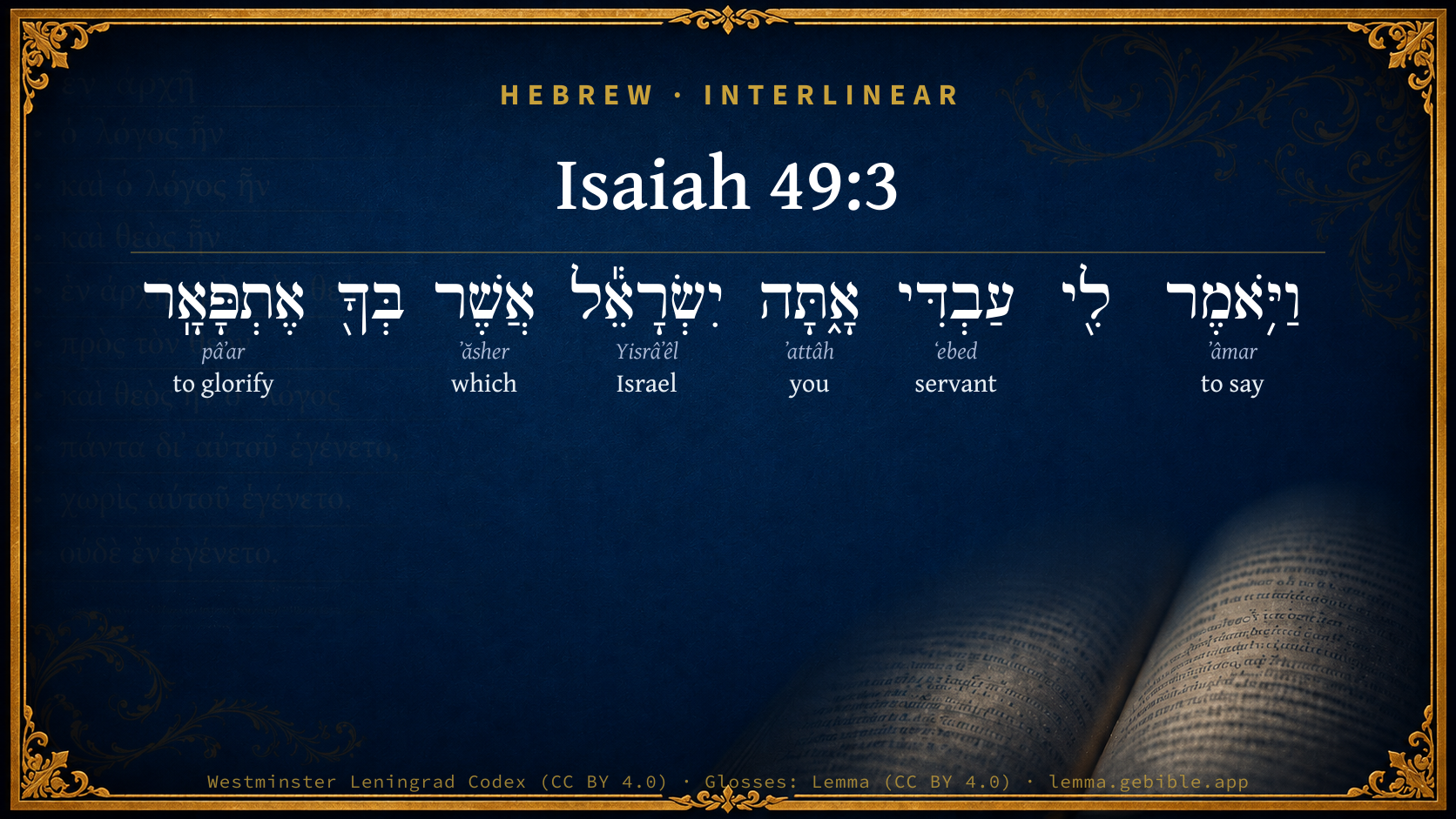
Isaiah 49:3

Hebrew (Westminster Leningrad Codex) Isaiah 49:3 appears in the Hebrew Old Testament. The text above is from the Westminster Leningrad Codex. Each word links to its Strong’s number, a concise gloss, and parsing drawn from the Open Scriptures Hebrew Bible morphology. Click any word for its full Brown-Driver-Briggs (BDB) entry.
Download image
Cite this verse

Isaiah 49:3 (World English Bible). Public Domain. Lemma interlinear Bible study tool, https://lemma.gebible.app/v/isaiah/49/3.

Show BibTeX & RIS
BibTeX
RIS
English Translation
and he said to me, You are my servant; Israel, in whom I will be glorified.
World English Bible · Public Domain
Download a study sheet

One document with this verse’s original text, its word-by-word gloss line, the meaning frame, cross-references with their text, attributed commentary, and full source and license credits — printable, and it pastes into notes with its structure intact.

This verse Autodidact and up

Study sheet (.html) Plain text (.txt)

A passage Seminary Student

Up to 50 verses in one chapter. A passage sheet keeps up to 6 commentary sources and 12 cross-references per verse, in the order this page ranks them, and says so on the sheet whenever that leaves anything out. Ask for a single verse and you get the Autodidact verse sheet above.

Everything on this page stays free to read, with no account — the sheet is a download of what is already on screen, not access to it.

Want to remove ads? Support Godless Engineer
Compare translations 3

The same verse in 3 English versions, stacked beneath the original-language interlinear above. Click any original word for its lexicon entry.

Each is an independent rendering of the whole verse — the interlinear is not word-aligned to these translations.

Highlighted words mark where these versions differ — a whole-verse word diff, not a word-by-word alignment.

  • World English Bible Public Domain
    and he said to me, You are my servant; Israel, in whom I will be glorified.
  • King James Version Public Domain
    And said unto me, Thou art my servant, O Israel, in whom I will be glorified.
  • unfoldingWord Literal Text CC BY-SA 4.0
    And he said to me, “You my servant, Israel, in whom I will glorify myself.”

unfoldingWord Literal Text — © unfoldingWord, licensed CC BY-SA 4.0. Word-aligned USFM3 via Door43 (git.door43.org/unfoldingWord/en_ult).

Versions to compare (up to 4)

3 of 4 selected

Show all 18 translations

Every available English version of this verse, each an independent rendering of the whole verse.

  • World English Bible Public Domain
    and he said to me, You are my servant; Israel, in whom I will be glorified.
  • Berean Standard Bible Public Domain
    He said to Me, “You are My Servant, Israel, in whom I will display My glory.”
  • Majority Standard Bible Public Domain
    He said to Me, “You are My Servant, Israel, in whom I will display My glory.”
  • King James Version Public Domain
    And said unto me, Thou art my servant, O Israel, in whom I will be glorified.
  • American Standard Version (1901) Public Domain
    and he said unto me, Thou art my servant; Israel, in whom I will be glorified.
  • Revised Version (1885) Public Domain
    and he said unto me, Thou art my servant; Israel, in whom I will be glorified.
  • Geneva Bible (1599) Public Domain
    And sayd vnto me, Thou art my seruaunt, Israel, for I will be glorious in thee.
  • Douay-Rheims (1899) Public Domain
    And he said to me: Thou art my servant Israel, for in thee will I glory.
  • Young's Literal Translation Public Domain
    And He saith to me, `My servant Thou art, O Israel, In whom I beautify Myself.'
  • Literal Standard Version CC BY-SA 4.0
    And He says to me, “You are My servant, O Israel, || In whom I beautify Myself.”
  • Unlocked Literal Bible CC BY-SA 4.0
    He said to me, “You are my servant, Israel, through whom I show my glory.”
  • unfoldingWord Literal Text CC BY-SA 4.0
    And he said to me, “You my servant, Israel, in whom I will glorify myself.”
  • Darby Bible Public Domain
    And he said unto me, Thou art my servant, Israel, in whom I will glorify myself.
  • World Messianic Bible Public Domain
    He said to me, “You are my servant, Israel, in whom I will be glorified.”
  • Webster's Bible Public Domain
    And said to me, Thou art my servant, O Israel, in whom I will be glorified.
  • Free Bible Version CC BY-SA 4.0
    He told me, “You are my servant, Israel, and I will reveal my glory through you.”
  • Bible in Basic English Public Domain
    And he said to me, You are my servant, Israel, in whom my glory will be seen;
  • JPS Tanakh (1917) Public Domain
    And He said unto me: 'Thou art My servant, Israel, in whom I will be glorified.'

Literal Standard Version (2020), Covenant Press — licensed CC BY-SA 4.0. Text via the HelloAO Bible API (eBible.org). Unlocked Literal Bible (unfoldingWord) — licensed CC BY-SA 4.0. Text via the HelloAO Bible API (eBible.org). unfoldingWord Literal Text — © unfoldingWord, licensed CC BY-SA 4.0. Word-aligned USFM3 via Door43 (git.door43.org/unfoldingWord/en_ult). Free Bible Version, Dr. Jonathan Gallagher — licensed CC BY-SA 4.0. Text via the HelloAO Bible API (eBible.org).

Word by word

More ways to search: Search by grammar → Find every occurrence → Compare this word →

Practice this passage: Drill this verse → Learn its vocabulary →

אֶתְפָּאָֽר
pâʼar
H6286
“to glorify”
Verb, Hithpael, Imperfect, 1st Person, Common, Singular
Part of Speech
Verb
Stem
Hithpael
Form
Imperfect
Person
1st Person
Gender
Common
Number
Singular
Full BDB Definition

Origin: a primitive root

TWOT: 1726 , 1727

to glorify, beautify, adorn - (Piel) to glorify, beautify - (Hithpael) - to glorify oneself - to get glory to oneself, be glorified - (Piel) to go over the boughs
  1. וַיֹּ֥אמֶר ʼâmar H559 “and · to say” Conjunction + Verb, Qal, Sequential Imperfect, 3rd Person, Masculine, Singular
  2. עַבְדִּי ʻebed H5650 “servant · my” Noun, Common, Masculine, Singular, Construct + Suffix, Personal, 1st Person, Common, Singular
  3. אָ֑תָּה ʼattâh H859 “you” Pronoun, Personal, 2nd Person, Masculine, Singular
  4. יִשְׂרָאֵ֕ל Yisrâʼêl H3478 “Israel” Noun, Proper
  5. אֲשֶׁר ʼăsher H834 “which” Particle, Relative

About this verse

These counts appear in no published source. They are computed here, from the morphology-tagged text and Lemma’s own curated glosses. What Lemma adds →

8
words
6
distinct lemmas
Prophets
section

Notable vocabulary

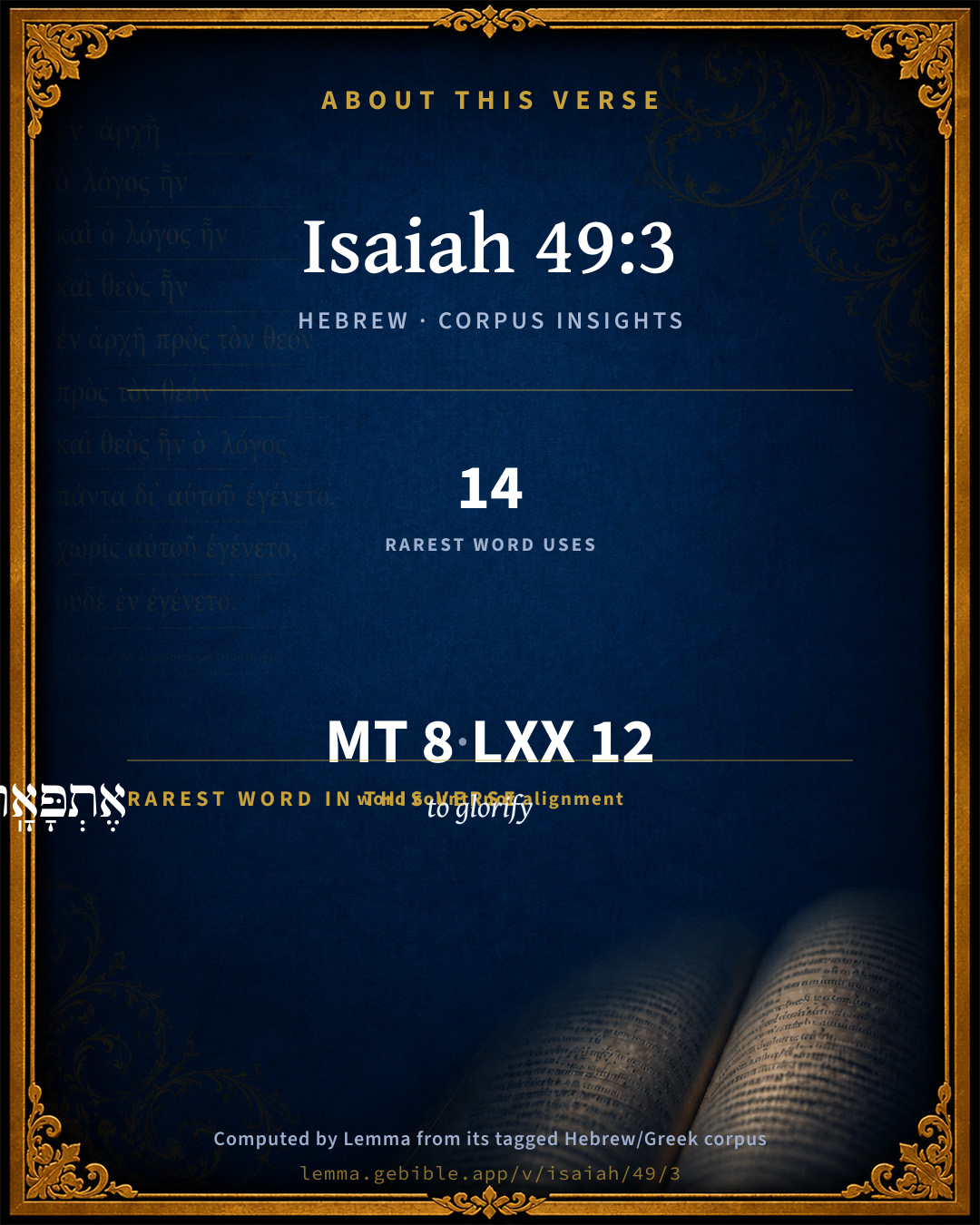
The rarest word here is אֶתְפָּאָֽר to glorify H6286 — appearing just 14 times in the whole Hebrew Bible.

Shared distinctive vocabulary

אֶתְפָּאָֽר to glorify H6286 occurs in 14 verses of the Hebrew Bible. Also found in:

Grammatical profile

  • 2 verbs
  • 2 nouns
  • 1 pronoun
  • 2 prepositions
  • 1 particle

Verb forms

  • וַיֹּ֥אמֶר Qal · Sequential Imperfect
  • אֶתְפָּאָֽר Hithpael · Imperfect

Hebrew & Septuagint length

In English translation the verse runs 16 words from the Hebrew and 17 from the Septuagint (LXX English) — closely comparable.

A rough comparison of the two English renderings, which tokenize alike — not a word-level alignment.

Word counts can differ between the Hebrew and the Greek without any difference in meaning — e.g. the Hebrew direct-object marker אֵת has no separate Greek word, and Greek often adds the article ὁ.

In the original languages it is 8 Hebrew tokens and 12 Greek tokens — but the two are counted differently (Hebrew bundles its prefixes and suffixes into one token; the Greek is in lemma form), so that isn’t a like-for-like length.

Cross-references

16

Topical passages linked to Isaiah 49:3 in the Treasury of Scripture Knowledge — connected by theme and wording, ordered by reader-vote popularity; previews shown in the World English Bible.

  • Isaiah 42:1 Behold, my servant, whom I uphold; my chosen, in whom my soul delights: I have put my Spirit on him; he will bring forth justice to the Gentiles.
  • 1 Peter 2:9 But you are a chosen race, a royal priesthood, a holy nation, a people for God's own possession, that you may show forth the excellencies of him who called you out of darkness into his marvelous light:
  • Isaiah 44:23 Sing, you heavens, for Yahweh has done it; shout, you lower parts of the earth; break forth into singing, you mountains, O forest, and every tree therein: for Yahweh has redeemed Jacob, and will glorify himself in Israel.
  • Isaiah 52:13 Behold, my servant shall deal wisely, he shall be exalted and lifted up, and shall be very high.
  • John 17:1 Jesus said these things, and lifting up his eyes to heaven, he said, "Father, the time has come. Glorify your Son, that your Son may also glorify you;
  • Zechariah 3:8 Hear now, Joshua the high priest, you and your fellows who sit before you; for they are men who are a sign: for, behold, I will bring forth my servant, the Branch.
  • John 17:4 I glorified you on the earth. I have accomplished the work which you have given me to do.
  • Isaiah 53:10 Yet it pleased Yahweh to bruise him; he has put him to grief: when you shall make his soul an offering for sin, he shall see [his] seed, he shall prolong his days, and the pleasure of Yahweh shall prosper in his hand.
  • Luke 2:10–14 The angel said to them, "Don't be afraid, for behold, I bring you good news of great joy which will be to all the people.
  • John 13:31–32 When he had gone out, Jesus said, "Now the Son of Man has been glorified, and God has been glorified in him.
  • Isaiah 43:21 the people which I formed for myself, that they might set forth my praise.
  • Matthew 17:5 While he was still speaking, behold, a bright cloud overshadowed them. Behold, a voice came out of the cloud, saying, "This is my beloved Son, in whom I am well pleased. Listen to him."
  • John 12:28 Father, glorify your name!" Then there came a voice out of the sky, saying, "I have both glorified it, and will glorify it again."
  • John 15:8 "In this is my Father glorified, that you bear much fruit; and so you will be my disciples.
  • Ephesians 1:6 to the praise of the glory of his grace, by which he freely bestowed favor on us in the Beloved,
  • Philippians 2:6–11 who, existing in the form of God, didn't consider it robbery to be equal with God,

Cross-references courtesy of OpenBible.info (CC BY 4.0).

Hebrew and Greek witnesses Masoretic Hebrew ↔ Greek Septuagint

The same verse in the two great witnesses to the Old Testament, shown verse-for-verse.

These are two independent witnesses, not word-aligned to each other, and the Septuagint is shown in lemma (dictionary) form.

Hebrew Isaiah 49:3 Masoretic · Westminster Leningrad Codex

וַיֹּ֥אמֶר לִ֖י עַבְדִּי אָ֑תָּה יִשְׂרָאֵ֕ל אֲשֶׁר בְּךָ֖ אֶתְפָּאָֽר

and he said to me, You are my servant; Israel, in whom I will be glorified.

World English Bible · Public Domain

Greek LXX Isaiah 49:3 Septuagint · lemma form

καί εἶπον ἐγώ δοῦλος ἐγώ εἰμί σύ ἰσραήλ καί ἐν σύ δοξάζω

and said to me, You are my servant, O Israel, and in you I will be glorified.

LXX2012 (modern English Septuagint) · Public Domain

Hebrew: Westminster Leningrad Codex (CC BY 4.0). Greek: Septuagint (public domain); English from LXX2012 (modern English Septuagint) (Public Domain). How the Septuagint differs from the Hebrew →

Targum (Aramaic paraphrase)

1

The Targum is the ancient Jewish Aramaic paraphrase of the Hebrew Scriptures — an interpretive translation, not the Hebrew text itself. Onkelos (literal) and Pseudo-Jonathan (expansive) render the Torah, and Jonathan the Prophets. Coverage is partial: where no permissively-licensed English translation exists for a verse, only the Aramaic is shown. This is verse-level text, not a word-by-word alignment to the Hebrew.

  1. Targum Jonathan Prophets (Joshua–Malachi)
    וַאֲמַר לִי עַבְדִי אַתְּ יִשְׂרָאֵל דְבָךְ אֶשְׁתַּבָּח:

    And said unto me, Thou art my servant, O Israel, in whom I will be glorified.

    Targum Jonathan — Aramaic: “Mikraot Gedolot” (public domain). English: “Sefaria Community Translation” (CC0 1.0 (public-domain dedication)); “London "Chaldee Paraphrase," 1871” (public domain). Text via Sefaria.

Commentary

Notes on Isaiah 49:3 from classic Christian and Jewish commentators (each source and its license shown beneath its notes). The classic Christian expositions comment on the surrounding passage and are grouped to its opening verse, so a note may address several verses; the Jewish commentaries on the Tanakh (Rashi and others) are per-verse, so they appear only where the commentator wrote on this verse.

Lemma curates 59 commentaries, every one of them public domain or Creative Commons licensed, each selected and text-cleaned for this edition rather than reprinted as found. About our sources →

Trapp's Complete Commentary

John Trapp

Isa 49:3 And said unto me, Thou [art] my servant, O Israel, in whom I will be glorified.

Ver. 3. Thou art my servant, O Israel,] i.e., O Christ, who best deservest to be called by that name, who art also the head of the elect, that Israel of God. {Gal 6:16}

John Trapp, A Commentary or Exposition upon All the Books of the Old and New Testament (1647–1656) — public domain. Text from a community e-Sword module.

The Biblical Illustrator

Joseph S. Exell

Isa_49:3-4

And said unto me, Thou art My servant

The service of man the manifestation of Gods highest glory

How numerous are Gods servants! All things in heaven and upon earth, all worlds, all elements, and all creatures are His servants, which obey His word, and declare His greatness and glory.

But of all Gods servants in this world man ranks highest, and through his service God is glorified in a sense that He could not be glorified through the service of any other creature. Israel was Gods servant in a pre-eminent sense, whether the word be taken to mean the nation as Gods chosen people or an individual as Gods messenger to do His will. But the ideal of Gods servant in this book was realised only in the Lord Jesus Christ. Man appears greatest when he serves, and there is no way to true greatness but through service. And God appears greatest when He condescends to serve. The Son of God looks more Divine on the Cross of His humiliation than on the throne of His glory, for on the Cross that which was deepest in His nature became visible. And it may be said that in every good man God becomes incarnate, and takes upon Himself the form of a servant, and by so doing bestows upon him the highest greatness. God says to every one of His faithful children, Thou art My servant, in whom I will be glorified. The way to glorify God is by serving man.

I. WHAT IS MEAT BY GODS GLORY? With glory we associate the ideas of purity, beauty, and sublimity; and Gods glory is the energetic expression of His holiness in all His works, in myriad different forms and ways.

II. THE SERVICE OF MAN AS THE MANIFESTATION OF GODS HIGHEST GLORY. Man has been created for the revelation of the highest glory of the Divine nature, and when he serves God faithfully, God breaks forth into glory in his character and work. This is the glory of His moral attributes, the glory of His love, mercy, compassion, and tenderness, which is infinitely greater than all the glory of the material universe. You can never learn the character of God from the facts of nature, any more than you can learn the character of the artist from his paintings, of the architect from the buildings he has planned, or of the builder from his work. In every gentle and kind word spoken to the affected, in every look of compassion, in every tear of sympathy, and in every deed of kindness, God breaks into glory that would make you tremble and adore if you were spiritual enough to see it. How the Divine glory shone in the life of the apostle Paul! In a dark age, when the superstition of the Papacy covered the land, God called Martin Luther, and said, Thou art My servant, in whom I will be glorified. And in Rowlands, Whitefield, Wesley, and others, Gods glory broke forth in a similar manner. In the only-begotten Son was revealed the glory of God as the Eternal Father (Joh_1:14). Before the same glory shines forth in us we must become something more than professed Christians, we must become Christs. (Z. Mather.)

Gods servants

Painters, poets, and musicians are Gods servants, and in their masterly ]productions the Divine glory bursts forth. Raphael was Gods servant, and m the Transfiguration Gods glory broke forth. Handel was Gods servant, and in his Messiah Gods glory broke forth. Milton was Gods servant, and in his Paradise Lost the Divine glory majestically broke forth. Statesmen, reformers, and philanthropists are also Gods servants, and He says to each one of them, Thou art My servant, in whom I will be glorified. But the shining of the Divine glory is not confined to the highly gifted, but breaks forth in those who faithfully serve God in obscure spheres of labour, unnoticed by the world. (W. Hay Aliken, M. A.)

The three-fold experience of Christ

I. THE CONSCIOUSNESS OF A HIGH VOCATION. He said unto Me, Thou art My servant, &c. Just as the words, Out of Egypt have I called My son, never found their full significance until they were applied to Gods greater Son, so the name Israel was never fulfilled finally in Jacob, who first bore it, nor even in the nation that has borne it after him, but has found its ultimate fulfilment in Him who is pre-eminently a Prince with God, and our Prince, because He is our Saviour. We have, therefore, here a prediction of the consciousness of a high mission which possessed the Christ, and brought Him to this world of ours. Some of us will never forget the day when we were conscious for the first time of the inspiring fact that God had spoken to us, and through that experience of ours we may be able--as, indeed, the prophet through his experience was supremely able--tounderstand something of the ecstasy with which Christ, conscious of His glorious mission, came to this world of ours. It was that that Christ remembered throughout His life, and it was that which sustained Him throughout His personal ministry in the face of opposition and discouragement of every kind. He knew that He was doing His Fathers will, and it was this consciousness that found expression in the prayer which He uttered on the eve of His great passion, I have finished the work which Thou gavest Me to do. It was this assurance, too, that He sought to give to His disciples as the mainspring of all their heroism. As the Father hath sent Me, even so send I you. Israel, in whom I will be glorified. Scholars are divided here in opinion. Some say that this ought to be translated, In whom I will burst forth into glory. This is a translation that charms me. Jesus was indeed the effulgence of the Fathers glory--the shining forth of the light which had ever been the light, but which would have been largely invisible to man apart from the Incarnation. Then there is the other translation, In whom I will beautify--or glorify--Myself. In harmony with this Jesus exclaimed near the close of His life, Father . . . glorify Thy Son, that Thy Son also may glorify Thee. Did not the Son glorify the Father by the very outburst of light which distinguished His life among men?

II. THE CONSCIOUSNESS OF APPARENT FAILURE. I have laboured in vain, I have spent my strength for nought and in vain. We trace this consciousness at times even in the Master in Gospel story. His disappointment in the face of human unbelief, His sorrow over human sinfulness and ingratitude, the apparent waste of the Divinest life that was ever lived among men in precept and example--these weighed heavily upon Him. In this respect, as in many others, He was touched with the feeling of our infirmity.

III. THE ASSURANCE OF FINAL VINDICATION. Yet surely My judgment is with the Lord, and My recompense with My God. In other words, He knows the motives which have prompted Me, and what led Me on step by step. Whether life be a failure or not, whether My self-sacrifice appear fruitless or not, He knows what is the root of all. Yea, I know more than that--I know not only that He will vindicate Me and the motives which prompted Me; but I also know that My work must find its reward; that all that is apparent failure is only apparent; that My toil must bring forth fruit--Surely . . . My work is with My God (or, according to the R.V., My recompense is with My God). Here again there is the double meaning, and therefore a special wealth of significance. The word denotes more than the work, and more than the recompense. It denotes the work and its result; all that the work meant: the toil of saving men, and the reward of seeing them saved. Thus the Christ Himself, amidst all the ignominy and anguish of the Cross and Passion, fell back upon the assurance of the Fathers final vindication. These, then, being pre-eminently the words of the worlds Redeemer, are surely an example and an inspiration to us to follow His example. (D. Davies.)

The Biblical Illustrator, edited by Joseph S. Exell (c. 1880s–1900s) — public domain. Text from a community e-Sword module.

Tyndale Open Study Notes

Tyndale Open Resources

49:3 The suffering servant would come out of Israel (see 41:8) and would himself be the true Israel. He would serve as both king (42:1) and prophet (49:1), anointed with the Spirit of God (61:1) and commissioned (48:16) as a faithful witness to God’s purposes (43:12; 48:20). In his mission toward both Israel and the other nations (49:6), he would suffer rejection and disgrace while being faithful, unlike the nation of Israel (see 50:4-9). His suffering would be on behalf of God’s chosen people. Jesus became the ultimate fulfillment of the suffering servant (see study note on 52:13–53:12).

Tyndale Open Study Notes — © Tyndale Open Resources, licensed CC BY-SA 4.0. Text via the HelloAO Bible API.

Geneva Bible (1599)

Geneva Bible translators

By Israel is meant Christ, and all the body of the faithful, as the members, and their head.

Geneva Bible (1599) marginal notes — public domain. Text via Bolls.life.

Jamieson, Fausset & Brown

Robert Jamieson, A. R. Fausset & David Brown

Israel--applied to Messiah, according to the true import of the name, the Prince who had power with God in wrestling in behalf of man, and who prevails (Gen 32:28; Hos 12:3-4). He is also the ideal Israel, the representative man of the nation (compare Mat 2:15 with Hos 11:1).

in whom . . . glorified-- (Joh 14:13; Joh 17:1-5).

Jamieson, Fausset & Brown — Commentary Critical and Explanatory on the Whole Bible (1871) — public domain (CC PDM 1.0). Text via the HelloAO Bible API.

Ellicott's Commentary for English Readers

(3) Thou art my servant, O Israel.—Not that the “Servant” is merely the nation, but that he fulfils its ideal. “Israel” had begun with being an individual name. It should be so once more in the person of Him who would be truly “a prince with God.”

In whom I will be glorified.—Better, in whom I will glorify myself. The words find a conscious echo in Joh_13:31-32; Joh_17:1-5.

A Bible Commentary for English Readers, edited by Charles John Ellicott (1878–1897) — public domain. Text from a community e-Sword module.

The Cambridge Bible for Schools and Colleges

gen. ed. J. J. S. Perowne

3. The word Israel may be read either as a vocative or as a continuation of the predicate: “(Thou art) Israel &c.” (see R.V.). On either view it presents insuperable difficulties to those who hold that the Servant is an individual. To say that as the supreme personage of Israel’s history he receives the name “Israel” is an arbitrary explanation, which is not to be justified by the observation that the name originally belonged to an individual. Since, however, the most important idea of the verse is contained in the words my servant, to which the clause in whom I will be glorified (better: glorify myself) naturally attaches itself, it is possible that Israel may be a gloss, and for that reason no great stress can be laid on the word as an argument for the national interpretation of the passage.

The Cambridge Bible for Schools and Colleges (gen. ed. J. J. S. Perowne; Cambridge University Press, 1878–1918) — public domain. Text from a community e-Sword module.

John Gill's Exposition

And said unto me,.... Both in the everlasting council, and when he made a covenant with him in eternity; when he found him and anointed him, and laid help on him; and also when he brought him, his first begotten, into the world, at his incarnation:

thou art my servant; of his choosing, appointing, calling, sending, bringing forth, and supporting; so he was as Mediator, especially in his estate of humiliation, when he appeared in the form of a servant, and came not to be ministered unto, but to minister, and give his life a ransom for many; thereby to obtain redemption, which was the great work and service he was appointed to; which he readily undertook, and willingly and cheerfully engaged in, and diligently and faithfully performed; to whom justly belong the characters of an obedient, diligent, prudent, and faithful servant; in answering which he showed his regard to his Father's will, his love to his people, and his great humility and condescension:

O Israel; a name of Christ, and which properly belongs to him, being the antitype of Jacob or Israel; the Head and representative of the whole Israel of God; who was of Israel according to the flesh, and an Israelite indeed in a spiritual sense, and was only sent to the lost sheep of the house of Israel. Israel is a name of the church, often given to it in this prophecy; Christ and his church, by virtue of the union between them, have the same names; as she is sometimes called by his names, Christ, and the Lord our righteousness, so he is here called by her name Israel, Co1 12:12,

in whom I will be glorified; this is Jehovah's end in all he does in nature or grace; and is what Christ had in view in working out our salvation; and all the divine perfections are glorified in it by him, the wisdom, power, faithfulness, holiness, justice, love, grace, and mercy of God. Some render the words actively, "in thee" or "in whom I will glory" (t); as his own Son, in whom he is well pleased, being the brightness of his glory, and the express image of his person; and in whom also all the seed of Israel glory, as well as are justified. Or, as others, Israel is he, of "whom by thee I will glory", or "glorify" (u); meaning, that it was the spiritual and mystical Israel, the church, whom he would save by his Son and servant, the Messiah, and bring to glory.

(t) "in quo gloriabor", Munster, Tigurine version, De Dieu; "quia in te gloriabor", V. L. (u) "Israel est is de quo, per te gloriaturus sum", Junius & Tremellius, Piscator; "vel glorificaturus", Gal.

John Gill's Exposition of the Whole Bible (1746–1763) — public domain (CC PDM 1.0). Text via the HelloAO Bible API.

Albert Barnes' Notes on the Bible

And said unto me - That is, as I suppose, to the Messiah. God said to him that he was his servant; he by whom he would be particularly glorified and honored.

Thou art my servant, O Israel - There has been great variety, as was intimated in the analysis of the chapter, in the interpretation of this verse. The question of difficulty is, to whom does the word ‘Israel’ refer? And if it refer to the Messiah, why is this name given to him? There is no variety in the ancient versions, or in the MSS. The opinions which have been maintained have been referred to in the analysis, and are briefly these:

1. The most obvious interpretation of the verse, if it stood alone, would be to refer it to the Jews as ‘the servant of Jehovah,’ in accordance with Isa 41:8, by whom he would be glorified in accordance with the declaration in Isa 44:23. This is the opinion of Rosenmuller and of some others. But the objection to this is, that the things which are affirmed of this ‘servant,’ by no means apply to the Jews. It is evidently an individual that is addressed; and in no conceivable sense can that be true of the Jews at large which is affirmed of this person in Isa 49:4 ff.

2. It has been referred to Isaiah. This was the opinion of Grotius, Dathe, Saadias, Doderlin, and others. Grotius supposes it means, ‘thou art my servant for the good of Israel.’ So Dathe renders it: ‘It is for Israel’s benefit that I will glorify myself in thee.’ Saadias renders it, ‘Thou art my ambassador to Israel.’ Aben Ezra says of the passage, ‘Thou art my servant, descended from Israel, in whom I will be glorified. Or, the sense is this: Thou who in my eyes art reputed as equal to all Israel.’ But, as has been remarked in the analysis, this interpretation is attended with all the difficulty of the interpretation which refers it to the Messiah, and is inconsistent with the known character of Isaiah, and with the declarations made of the person referred to in the following verses. There is certainly no more reason why the name ‘Israel’ should be given to Isaiah, than there is why it should be given to the Messiah; and it is certain that Isaiah never arrogated to himself such high honor as that of being a light to the Gentiles, and a covenant of the people, and as being one before whom kings would rise up, and to whom princes would do homage.

3. Gesenius supposes that the word ‘Israel’ is not genuine, but has come by error into the text. But for this there is no authority except one manuscript, to which he himself attaches no weight.

4. The only other interpretation, therefore, is that which refers it to the Messiah. This, which has been the common exposition of commentators, most manifestly agrees with the verses which follow, and with the account which occurs in the New Testament.

The account in Isa 49:4-8, is such as can be applied to no other one than he, and is as accurate and beautiful a description of him as if it had been made by one who had witnessed his labors, and heard from him the statement of his own plans. But still, a material question arises, why is this name ‘Israel’ applied to the Messiah? It is applied to him nowhere else, and it is certainly remarkable that a name should be applied to an individual which is usually applied to an entire people. To this question the following answers, which are, indeed, little more than conjectures, may be returned:

1. Lowth and Vitringa suppose that it is because the name, in its full import and signification, can be given only to him; and that there is a reference here to the fact recorded in Gen 32:28, where Jacob is said to have wrestled with God, and prevailed, and was, in consequence of that, called Israel. The full import of that name, says Lowth, pertains only to the Messiah, ‘who contended powerfully with God in behalf of mankind.’

2. It is common in the Scriptures to use the names which occurred in the history of the Jews as descriptive of things which were to occur under the times of the Messiah, or as representing in general events that might occur at any time. Thus the names, Moab, Edom, Ashur, were used to denote the foes of God in general; the name of Elijah was given to John the Baptist (Hengstenberg).

3. In accordance with this, the name David is not unfrequently given to the Messiah, and he is spoken of under this name, as he was to be his descendant and successor.

4. For the same reason, the name Israel may be given to him - nor as the name of the Jewish people - but the name of the illustrious ancestor of the Jewish race, because he would possess his spirit, and would, like him, wrestle with God. He was to be a prince having power with God (compare Gen 32:28), and would prevail. In many respects there would be a resemblance between him and this pious and illustrious ancestor of the Jewish people.

In whom I will be glorified - This means that the result of the Redeemer’s work would be such as eminently to honor God. He would be glorified by the gift of such a Saviour; by his instructions, his example, the effect of his ministry while on earth, and by his death. The effect of the work of the Messiah as adapted to glorify God, is often referred to in the New Testament (see Joh 12:28; Joh 13:31-32; Joh 14:13; Joh 16:14; Joh 17:1-5).

Albert Barnes' Notes on the Bible (1834–1885) — public domain. Text from a community e-Sword/MySword module.

Haydock's Catholic Bible Commentary

Glory. In the Church, God is adored in spirit and truth. Isaias is ordered thus to address the Israelites.

George Leo Haydock (1774–1849), Haydock's Catholic Family Bible and Commentary, 1859 edition — public domain. Excludes Psalms (Douay-Rheims chapter numbering differs from Protestant) and Deuterocanonical books (Catholic canon only).

Matthew Poole's English Annotations

As the name of David is sometimes given to his successors, 1Ki 12:16, and particularly to Christ, Jer 30:9; Eze 34:23; Hos 3:5, and Jacob is called, as many think, by the name of his grandfather, Abraham, Act 7:16, and the name of Isaac is given to his posterity, Amo 7:9; so here the name of Israel may not unfitly be given to Christ, not only because he descended from his loins, but also because he was the true and the great Israel, who, in a more eminent manner, prevailed with God, that name signifies, of whom Jacob, who was first called Israel, was but a type. And as the name of Christ, the Head, is sometimes given to the body, the church, as 1Co 12:12; so it is not strange if, on the contrary, the name of Israel, which properly belongs to the church, be given to Christ the Head of it. But this word may be otherwise rendered, being joined either,

1. With the foregoing words,

Thou art my servant unto, or in, or

for Israel, i.e. to bring them back unto me, from whom they have revolted; or,

2. With the following words; it is Israel,

in whom I will glorify myself by thee.

Matthew Poole's English Annotations on the Holy Bible (1683–1685) — public domain. Text from a community e-Sword/MySword module.

Whedon's Commentary on the Bible

Daniel D. Whedon

3. Thou art my servant, O Israel — Already has it been seen, (Isa_42:1,) that Israel as a nation formed with our prophet a basis idea contained in the terms, servant of Jehovah; then, true to his calling and faithful to Jehovah, Israel became the central idea in that term; and, lastly, Israel, as God’s personal servant, is found in the idea of the true Israel’s highest headship, the Messiah. In this last sense is the word servant of Jehovah, or the Church and its Head in one, to be taken here.

In whom I will be glorified — “Glorified” through his instrumentality — the consecrated Church and its Head — in saving the world. The innermost holy Israel as an agency is personified in the term “servant.” A like example of appealing to a representative quality is in Mat_16:18, “Thou art Peter;” representing the Peter, on the one hand, a rock-like man confessing Christ as Son of the living God, and on the other hand, Christ, the eternal One confessed; and both together concreted into one term, namely, Confession, the ROCK on which the God’s Church is built.

Daniel D. Whedon (gen. ed.), Commentary on the Old and New Testaments (1874–1909) — public domain. Text from a community e-Sword module.

The Pulpit Commentary

Thou art my Servant, O Israel. That the literal "Israel," is not intended appears plainly from ver. 5. The Servant himself is addressed as "Israel," because he "would stand as a new federal head to the nation" (Kay), which would be summed up in him, and also because he would be, in a truer sense than any other, an "Israel," or "Prince with God." In whom I will be glorified. (comp. Joh_13:31, "Now is the Son of man glorified, and God is glorified in him He who is "the Brightness of the Father"s glory" sets forth that glory before men, and causes them to glorify him, both with their tongues and in their lives.

The Pulpit Commentary (1880–1919), ed. H.D.M. Spence-Jones & Joseph S. Exell — public domain. Text from a community e-Sword module.

John Wesley's Explanatory Notes

O Israel - As the name of David is sometimes given to his successors, so here the name of Israel may not unfitly be given to Christ, not only because he descended from his loins; but also because he was the true and the great Israel, who, in a more eminent manner, prevailed with God, as that name signifies, of whom Jacob, who was first called Israel, was but a type.

John Wesley, Explanatory Notes Upon the Whole Bible (1754–1765) — public domain. Text via the GEBible commentary corpus.

J. A. Alexander on Isaiah

Joseph Addison Alexander

“And He (Jehovah) said to me, Thou art my servant,” (i.e., my instrument or agent) constituted such for a specific and important purpose. In this same character both Israel and the Messiah have before been introduced. There is therefore the less reason for giving any other than the strict sense to the words which follow, “Israel in whom I will be glorified or glorify myself.” The version ‘I will glory’ seems inadequate and not sufficiently sustained by usage. The only supposition which adheres to the natural and obvious meaning of the sentence, and yet agrees with the context, is the one above mentioned, viz. that of a complex subject including the Messiah and His people, or the body with its head.

Joseph Addison Alexander, The Prophecies of Isaiah (1846–1847; New York: Scribner, 1870–1878) — public domain. Text from a community e-Sword module.

unfoldingWord translationNotes

Door43 World Missions Community

General Information:

Yahweh's servant continues speaking.

He said

"Yahweh said"

You are my servant, Israel

"You are my servant, whom I call Israel"

translationWords

servant

Israel

glory

labor

vain

just

Yahweh

reward

God

unfoldingWord translationNotes — © Distant Shores Media and the Door43 World Missions Community, licensed CC BY-SA 4.0. Source: git.door43.org/Door43/en_tn.

Ibn Ezra

Rabbi Abraham ibn Ezra

And said. And God said. ישראל

Israel. That is, Thou art an Israelite of whom I am proud; or Thou art Israel, thou art estimated in mine eyes like all Israelites together. I prefer this latter explanation.

Ibn Ezra on the Tanakh — English translations: “Sefaria Community Translation” (CC0 1.0 (public-domain dedication)); “Yalkut, Sifsei Chachomim Chumash, Metsudah Publications, 2009” (CC BY 4.0); and “Commentary of Ibn Ezra on Isaiah - trans. by M. Friedlander, 1873” (public domain). Text via Sefaria.

Lesson kit

Teaching starters — assembled from the data on this page, not authored interpretation. Every prompt links to the verse data it draws on. Edit before teaching.

Isaiah, in the Prophets, opens this verse with 8 words (6 distinct Hebrew lemmas). Its most distinctive word is pâʼar (“to glorify”). A historical commentator’s framing appears above. Read the whole chapter for the surrounding context.

Discussion questions

  1. What does “to glorify” (pâʼar) contribute to the verse as a whole?
  2. How does Exodus 8:9, which shares the word «to glorify», read alongside this verse?
  3. The translations on this page render this verse differently — a whole-verse word diff, not a word-by-word alignment. What might account for the different wordings?
  4. «וַיֹּ֥אמֶר» is a Qal Sequential Imperfect verb. How does that grammatical form shape the action described?
  5. Compare how Trapp's Complete Commentary and The Biblical Illustrator read this verse. Where do they agree or differ?

Things to notice

Reading settings

Reading text

Shown beneath each verse's original-language words.

Old Testament
Old Testament edition

Read the OT as the Masoretic Hebrew (MT) or the Greek Septuagint (LXX).

English shown for the Greek Septuagint (in the Hebrew ↔ Greek comparison).

Comparing translations? Open the Compare panel on any verse page to stack up to four side by side.