
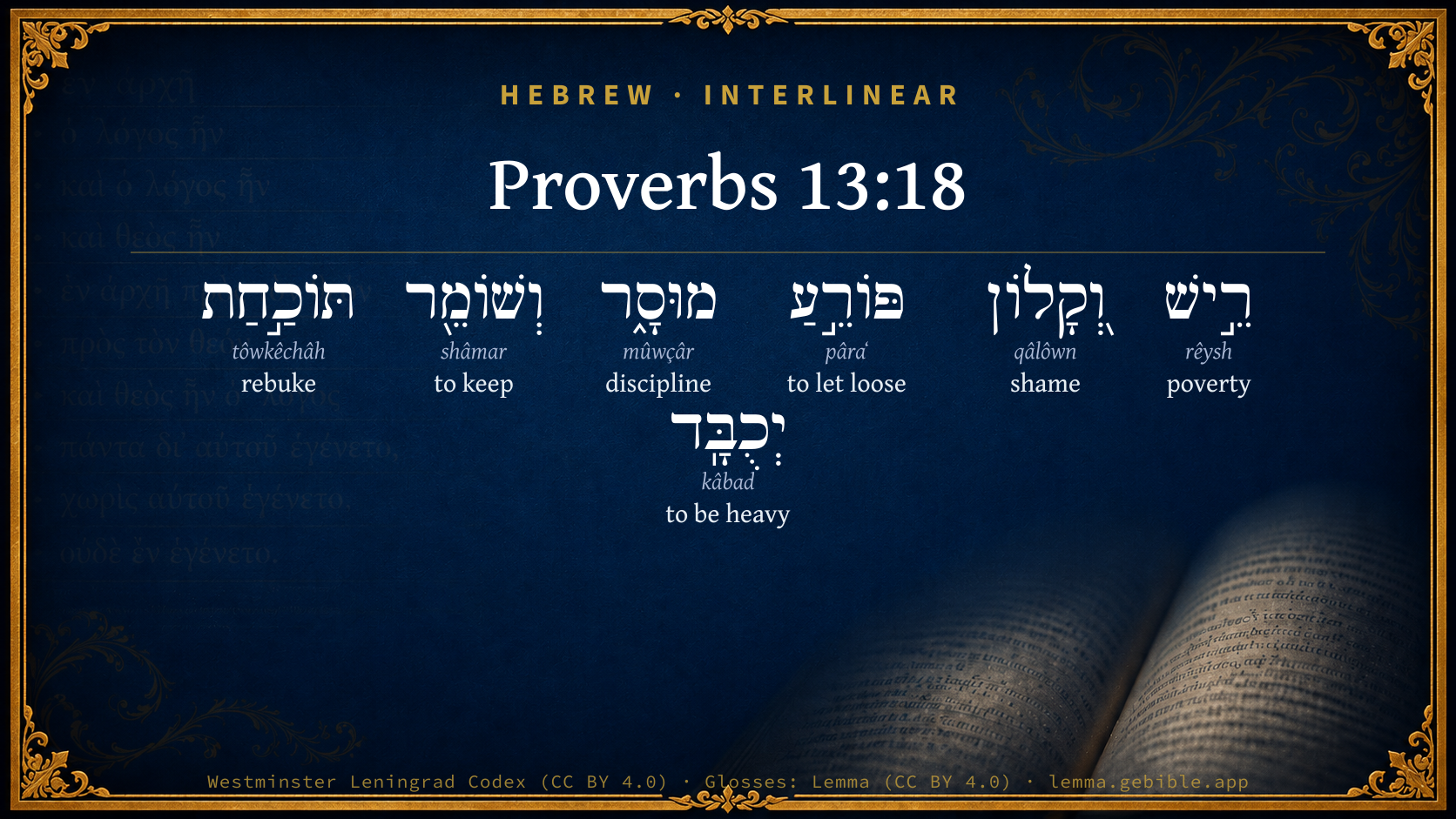
Proverbs 13:18

Hebrew (Westminster Leningrad Codex) Proverbs 13:18 appears in the Hebrew Old Testament. The text above is from the Westminster Leningrad Codex. Each word links to its Strong’s number, a concise gloss, and parsing drawn from the Open Scriptures Hebrew Bible morphology. Click any word for its full Brown-Driver-Briggs (BDB) entry.
Download image
Cite this verse

Proverbs 13:18 (World English Bible). Public Domain. Lemma interlinear Bible study tool, https://lemma.gebible.app/v/proverbs/13/18.

Show BibTeX & RIS
BibTeX
RIS
English Translation
Poverty and shame come to him who refuses discipline, But he who heeds correction shall be honored.
World English Bible · Public Domain
Download a study sheet

One document with this verse’s original text, its word-by-word gloss line, the meaning frame, cross-references with their text, attributed commentary, and full source and license credits — printable, and it pastes into notes with its structure intact.

This verse Autodidact and up

Study sheet (.html) Plain text (.txt)

A passage Seminary Student

Up to 50 verses in one chapter. A passage sheet keeps up to 6 commentary sources and 12 cross-references per verse, in the order this page ranks them, and says so on the sheet whenever that leaves anything out. Ask for a single verse and you get the Autodidact verse sheet above.

Everything on this page stays free to read, with no account — the sheet is a download of what is already on screen, not access to it.

Want to remove ads? Support Godless Engineer
Compare translations 3

The same verse in 3 English versions, stacked beneath the original-language interlinear above. Click any original word for its lexicon entry.

Each is an independent rendering of the whole verse — the interlinear is not word-aligned to these translations.

Highlighted words mark where these versions differ — a whole-verse word diff, not a word-by-word alignment.

  • World English Bible Public Domain
    Poverty and shame come to him who refuses discipline, But he who heeds correction shall be honored.
  • King James Version Public Domain
    Poverty and shame shall be to him that refuseth instruction: but he that regardeth reproof shall be honoured.
  • unfoldingWord Literal Text CC BY-SA 4.0
    Poverty and shame one avoiding correction, but one keeping a rebuke will be honored.

unfoldingWord Literal Text — © unfoldingWord, licensed CC BY-SA 4.0. Word-aligned USFM3 via Door43 (git.door43.org/unfoldingWord/en_ult).

Versions to compare (up to 4)

3 of 4 selected

Show all 18 translations

Every available English version of this verse, each an independent rendering of the whole verse.

  • World English Bible Public Domain
    Poverty and shame come to him who refuses discipline, But he who heeds correction shall be honored.
  • Berean Standard Bible Public Domain
    Poverty and shame come to him who ignores discipline, but whoever heeds correction is honored.
  • Majority Standard Bible Public Domain
    Poverty and shame come to him who ignores discipline, but whoever heeds correction is honored.
  • King James Version Public Domain
    Poverty and shame shall be to him that refuseth instruction: but he that regardeth reproof shall be honoured.
  • American Standard Version (1901) Public Domain
    Poverty and shame `shall be to' him that refuseth correction; But he that regardeth reproof shall be honored.
  • Revised Version (1885) Public Domain
    Poverty and shame shall be to him that refuseth correction: but he that regardeth reproof shall be honoured.
  • Geneva Bible (1599) Public Domain
    Pouertie and shame is to him that refuseth instruction: but hee that regardeth correction, shalbe honoured.
  • Douay-Rheims (1899) Public Domain
    Poverty and shame to him that refuseth instruction: but he that yieldeth to reproof, shall be glorified.
  • Young's Literal Translation Public Domain
    Whoso is refusing instruction -- poverty and shame, And whoso is observing reproof is honoured.
  • Literal Standard Version CC BY-SA 4.0
    Whoever is refusing instruction—poverty and shame, || And whoever is observing reproof is honored.
  • Unlocked Literal Bible CC BY-SA 4.0
    The one who ignores instruction will have poverty and shame, but honor will come to him who learns from correction.
  • unfoldingWord Literal Text CC BY-SA 4.0
    Poverty and shame one avoiding correction, but one keeping a rebuke will be honored.
  • Darby Bible Public Domain
    Poverty and shame shall be [to] him that refuseth instruction; but he that regardeth reproof shall be honoured.
  • World Messianic Bible Public Domain
    Poverty and shame come to him who refuses discipline, but he who heeds correction shall be honored.
  • Webster's Bible Public Domain
    Poverty and shame shall be to him that refuseth instruction: but he that regardeth reproof shall be honored.
  • Free Bible Version CC BY-SA 4.0
    Poverty and disgrace come to those who ignore instruction, but those who accept correction are honored.
  • Bible in Basic English Public Domain
    Need and shame will be the fate of him who is uncontrolled by training; but he who takes note of teaching will be honoured.
  • JPS Tanakh (1917) Public Domain
    Poverty and shame shall be to him that refuseth instruction; but he that regardeth reproof shall be honoured.

Literal Standard Version (2020), Covenant Press — licensed CC BY-SA 4.0. Text via the HelloAO Bible API (eBible.org). Unlocked Literal Bible (unfoldingWord) — licensed CC BY-SA 4.0. Text via the HelloAO Bible API (eBible.org). unfoldingWord Literal Text — © unfoldingWord, licensed CC BY-SA 4.0. Word-aligned USFM3 via Door43 (git.door43.org/unfoldingWord/en_ult). Free Bible Version, Dr. Jonathan Gallagher — licensed CC BY-SA 4.0. Text via the HelloAO Bible API (eBible.org).

Word by word

More ways to search: Search by grammar → Find every occurrence → Compare this word →

Practice this passage: Drill this verse → Learn its vocabulary →

About this verse

These counts appear in no published source. They are computed here, from the morphology-tagged text and Lemma’s own curated glosses. What Lemma adds →

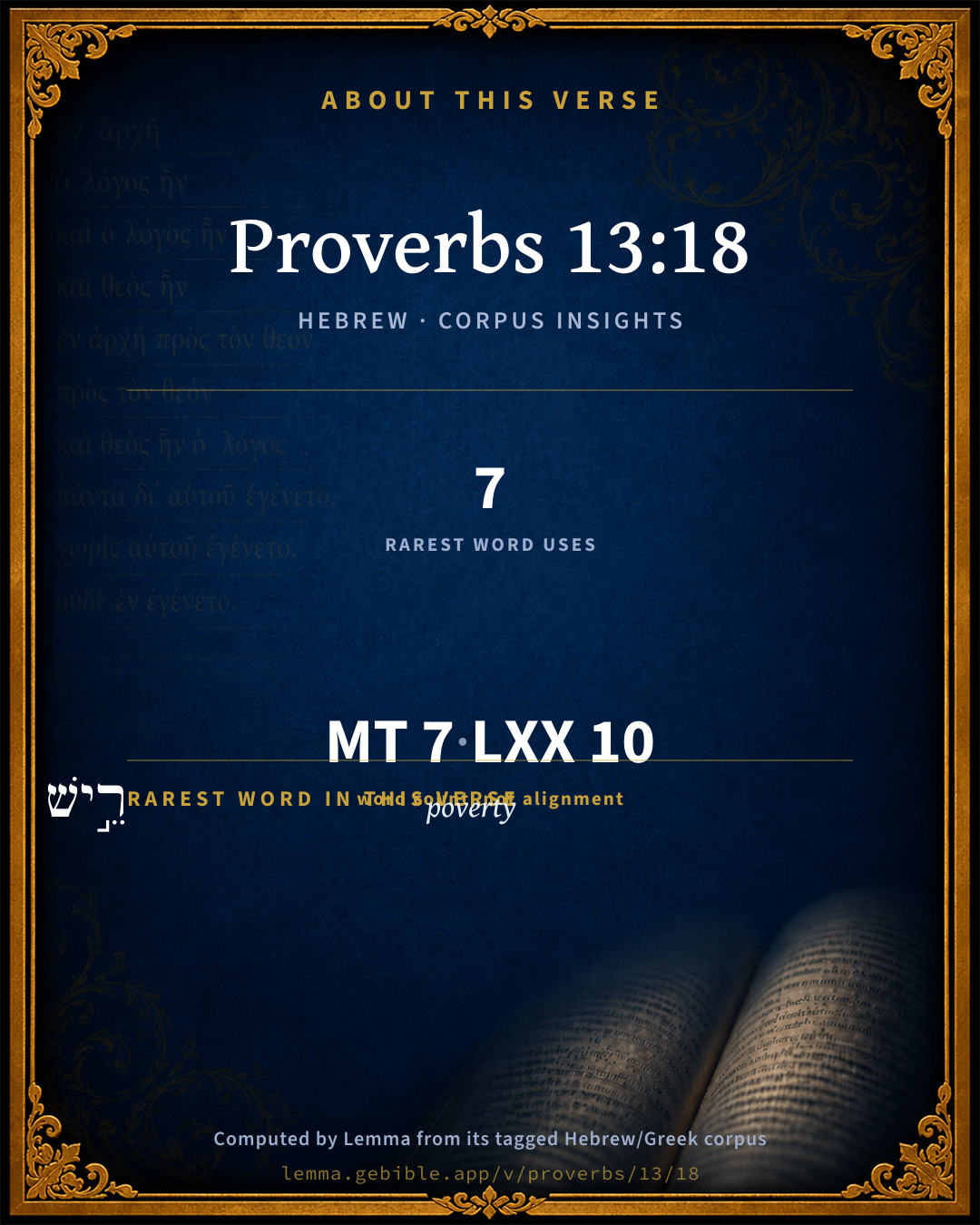
7
words
7
distinct lemmas
Wisdom
section

Notable vocabulary

The rarest word here is רֵ֣ישׁ poverty H7389 — appearing just 7 times in the whole Hebrew Bible.

Shared distinctive vocabulary

רֵ֣ישׁ poverty H7389 occurs in 7 verses of the Hebrew Bible. Also found in:

Grammatical profile

  • 3 verbs
  • 4 nouns

Verb forms

  • פּוֹרֵ֣עַ Qal · Participle Active
  • וְשׁוֹמֵ֖ר Qal · Participle Active
  • יְכֻבָּֽד Pual · Imperfect

Hebrew & Septuagint length

In English translation the verse runs 17 words from the Hebrew and 14 from the Septuagint (LXX English) — closely comparable.

A rough comparison of the two English renderings, which tokenize alike — not a word-level alignment.

Word counts can differ between the Hebrew and the Greek without any difference in meaning — e.g. the Hebrew direct-object marker אֵת has no separate Greek word, and Greek often adds the article ὁ.

In the original languages it is 7 Hebrew tokens and 10 Greek tokens — but the two are counted differently (Hebrew bundles its prefixes and suffixes into one token; the Greek is in lemma form), so that isn’t a like-for-like length.

Cross-references

11

Topical passages linked to Proverbs 13:18 in the Treasury of Scripture Knowledge — connected by theme and wording, ordered by reader-vote popularity; previews shown in the World English Bible.

  • Proverbs 15:5 A fool despises his father's correction, But he who heeds reproof shows prudence.
  • Proverbs 15:31–32 The ear that listens to reproof lives, And will be at home among the wise.
  • Proverbs 12:1 Whoever loves correction loves knowledge, But he who hates reproof is stupid.
  • Proverbs 13:13 Whoever despises instruction will pay for it, But he who respects a command will be rewarded.
  • Proverbs 25:12 As an ear-ring of gold, and an ornament of fine gold, So is a wise reprover to an obedient ear.
  • Proverbs 5:9–14 Lest you give your honor to others, And your years to the cruel one;
  • Proverbs 9:9 Instruct a wise man, and he will be still wiser. Teach a righteous man, and he will increase in learning.
  • Proverbs 19:6 Many will entreat the favor of a ruler, And everyone is a friend to a man who gives gifts.
  • Psalms 141:5 Let the righteous strike me, it is kindness; Let him reprove me, it is like oil on the head; Don't let my head refuse it; Yet my prayer is always against evil deeds.
  • Jeremiah 5:3–9 O Yahweh, don't your eyes look on truth? you have stricken them, but they were not grieved; you have consumed them, but they have refused to receive correction: they have made their faces harder than a rock; they have refused to return.
  • Hebrews 12:25 See that you don't refuse him who speaks. For if they didn't escape when they refused him who warned on the Earth, how much more will we not escape who turn away from him who warns from heaven,

Cross-references courtesy of OpenBible.info (CC BY 4.0).

Hebrew and Greek witnesses Masoretic Hebrew ↔ Greek Septuagint

The same verse in the two great witnesses to the Old Testament, shown verse-for-verse.

These are two independent witnesses, not word-aligned to each other, and the Septuagint is shown in lemma (dictionary) form.

Hebrew Proverbs 13:18 Masoretic · Westminster Leningrad Codex

רֵ֣ישׁ וְ֭קָלוֹן פּוֹרֵ֣עַ מוּסָ֑ר וְשׁוֹמֵ֖ר תּוֹכַ֣חַת יְכֻבָּֽד

Poverty and shame come to him who refuses discipline, But he who heeds correction shall be honored.

World English Bible · Public Domain

Greek LXX Proverbs 13:18 Septuagint · lemma form

πενία καί ἀτιμία ἀποαἱρέω παιδεία ὁ δέ φυλάσσω ἔλεγχος δοξάζω

Instruction removes poverty and disgrace: but he that attends to reproofs shall be honored.

LXX2012 (modern English Septuagint) · Public Domain

On this verse, Haydock's Catholic Bible Commentary discusses the Septuagint’s reading. Read the note in Commentary ↓

Hebrew: Westminster Leningrad Codex (CC BY 4.0). Greek: Septuagint (public domain); English from LXX2012 (modern English Septuagint) (Public Domain). How the Septuagint differs from the Hebrew →

Commentary

Notes on Proverbs 13:18 from classic Christian and Jewish commentators (each source and its license shown beneath its notes). The classic Christian expositions comment on the surrounding passage and are grouped to its opening verse, so a note may address several verses; the Jewish commentaries on the Tanakh (Rashi and others) are per-verse, so they appear only where the commentator wrote on this verse.

Lemma curates 59 commentaries, every one of them public domain or Creative Commons licensed, each selected and text-cleaned for this edition rather than reprinted as found. About our sources →

Trapp's Complete Commentary

John Trapp

Pro 13:18 Poverty and shame [shall be to] him that refuseth instruction: but he that regardeth reproof shall be honoured.

Ver. 18. Poverty and shame.] These two are fitly set together; for poverty is usually slighted, if not shamed. {Jas 2:16}

“ Nil habet infelix paupertas durius in se

Quam quod ridicules homines facit. ”

The world looks over a poor though virtuous man. "This thy son"; {Luk 15:30} not, This my brother. And why, but because in poverty? How much more an uncounsellable and incorrigible man, as here, and as that prodigal had been till he came to himself!

But he that regardeth reproof shall be honoured.] Though not haply enriched, he shall be of good account with the wise and godly, though in meaner condition. Mr Fox being asked whether he knew such an honest poor man who had received help and good counsel from him in time of trouble, answered, ‘I remember him well; I tell you, I forget lords and ladies to remember such.’

John Trapp, A Commentary or Exposition upon All the Books of the Old and New Testament (1647–1656) — public domain. Text from a community e-Sword module.

The Biblical Illustrator

Joseph S. Exell

Pro_13:18

But he that regardeth reproof shall be honoured.

Accepting reproof

One of the weakest traits of any person is to be unwilling to accept honest criticism and correction. From the foolish child who will never listen to parental authority, on to the foolish man who will never listen to rebuke or reason, pride always goeth before a fall. Honest criticism is often a bitter dose to swallow, but most tonics are bitter, and we are the stronger for taking them down bravely. If I am censured, said that godly man, Bishop Griswold, then let me correct, but never justify, my faults. A minister with more zeal than discretion once called on the bishop and belaboured him with rather a harsh denunciation. Instead of showing the man out of the door, the bishop calmly replied, My dear friend, I do not wonder that they who witness the inconsistencies in my daily conduct should think that I have no religion. I often fear this myself, and I feel very grateful to you for giving me this warning. This reply was made in such unaffected meekness and sincerity that the visitor at once begged the bishops pardon, and always regarded him afterwards as one of the most Christlike Christians he had ever known. He is doubly the fool who not only flings himself into a pit, but resents the friendly hand that tries to help him out of it. (T. G. Cuyler.)

The Biblical Illustrator, edited by Joseph S. Exell (c. 1880s–1900s) — public domain. Text from a community e-Sword module.

Joseph Benson's Commentary

Pro 13:18. Poverty, &c., shall be to him, that refuseth instruction — Whereby he might have been preserved from destructive and dishonourable courses; but he that regardeth reproof — That considers it seriously, receives it kindly, and reforms himself by it; shall be honoured — And enriched, which is to be inferred from the former branch. Not indeed that it is always the case, but commonly, and when God sees it will be good for a man. Or, if he do not gain riches, he shall certainly have honour both from God and good men.

Joseph Benson's Commentary on the Old and New Testaments (1811–1818) — public domain. Text from a community e-Sword module.

The Preacher's Complete Homiletical Commentary

Joseph S. Exell (gen. ed.)

MAIN HOMILETICS OF Pro_13:18

THE WAY TO HONOUR

I. Man needs instruction because his natural intuitions are not enough to meet the needs of human life. The instinct of the animal is enough to enable it to fulfil its destiny. Its limited powers find sufficient guidance in the use of the faculties which are born with it. But it is not so with man. If, as some philosophers suppose, a man comes into the world without any ideas, if he receives everything from the outside world, instruction is so much the more needed, but even if he does bring with him a small stock of knowledge, experience shows us that the amount is very small, and he needs instruction for body, soul, and spirit from the first day of his dawning intellect to the last of his probationary life.

II. Instruction is to be obtained. Somebody will teach him either directly or indirectly. He will learn much from observation and much from direct teaching. The word here, as in chap. Pro_12:1, includes the idea of correction. This forms an inevitable part of man’s instruction in matters relating both to his bodily and spiritual life. God has provided for man’s instruction in relation to his spiritual needs. It is within the reach of all men in a Christian nation (See Isa_55:1-3).

III. If he refuses what he needs, he will have what he does not desire. He will have poverty. This is a calamity when self-inflicted. Whatever is the outcome of sin must be a calamity. If a man refuses to submit to the correction and instruction of others in connection with matters relative to every-day life, he shuts himself up to his own ignorance and shuts out all possibility of advancing in any profession or calling. Therefore he must be poor in worldly wealth. And it is pre-eminently true of him who refuses the disciplinary instruction of God. Such a man must be poor in a spiritual sense throughout eternity. And this will bring shame. Shame is always the result of sin. There is no shame in being poor in material things when poverty is the outcome of righteousness, but there is shame in poverty which is the result of neglected opportunities. What is the root of this rejection of instruction? Is it not pride? (See Homiletics on chap. Pro_11:2, page 193; also on chap. Pro_12:1, page 246.)

IV. Reproof is instruction. This is implied here, and in many other passages in this book where the words are used interchangeably. A man who reproves us gives us information about ourselves. He lets us know how we appear in the eyes of others. This ought to be valued by us. We are too partial to see our own defects, therefore we ought to be glad when they are pointed out to us by another.

V. Taking reproof in a spirit of humility is the only road to honour. In the long run, men will give honour where honour is due. They will give their esteem, and respect, and confidence to men who, from moral or intellectual eminence, deserve it. And, as we have seen, this height can be reached only by those who are willing to be taught both by God and by man.

OUTLINES AND SUGGESTIVE COMMENTS

Poverty is in itself a want; but no misery unless shame be joined with it. Shame is in itself a misery; but much greater if joined with poverty, which hath no means to shelter or cover it. Now both are to him that refuseth instruction. For, indeed, instruction is a glorious treasure, offered and opened to him who hath need of it; and, therefore, to refuse it, what can it be but poverty and shame? And, though it be the too common fault of those that are great, either in riches or honour, to despise reproof, yet the most honour, the truest riches, are to those that embrace it. St. Bernard, therefore, writing unto a great person, but deserving reproof, saith “Charity hath forced me to reproof thee, which grieveth with thee, although thou be not grieved, and which pitieth thee, although thou pitieth not thyself, and therefore it doth lament the more, because thou dost not lament, who art to be lamented; therefore doth it pity thee the more, because thou dost not pity thyself, who art in so pitiful a condition.—Jermin.

The Preacher's Complete Homiletical Commentary (gen. ed. Joseph S. Exell; Funk & Wagnalls, c. 1892) — public domain (pre-1929). A full-Bible homiletical/sermon-outline anthology covering 65 of 66 books (2 John is absent from the source module). Text from a community e-Sword module.

Matthew Henry's Commentary

Note, 1. He that is so proud that he scorns to be taught will certainly be abased. he that refuses the good instruction offered him, as if it were a reflection upon his honour and an abridgment of his liberty, poverty and shame shall be to him: he will become a beggar and live and die in disgrace; every one will despise him as foolish, and stubborn, and ungovernable. 2. He that is so humble that he takes it well to be told of his faults shall certainly be exalted: He that regards a reproof, whoever gives it to him, and will mend what is amiss when it is shown him, gains respect as wise and candid; he avoids that which would be a disgrace to him and is in a fair way to make himself considerable.

Matthew Henry's Commentary on the Whole Bible (1708–1710) — public domain (CC PDM 1.0). Text via the HelloAO Bible API.

Jamieson, Fausset & Brown

Robert Jamieson, A. R. Fausset & David Brown

(Compare Pro 10:17; Pro 12:1).

Jamieson, Fausset & Brown — Commentary Critical and Explanatory on the Whole Bible (1871) — public domain (CC PDM 1.0). Text via the HelloAO Bible API.

John Gill's Exposition

Poverty and shame shall be to him that refuseth instruction,.... Of parents, masters, and ministers of the word; the instruction of wisdom, the instruction of the Gospel, in things relating to their present spiritual peace, and to their eternal welfare: such generally come to poverty and disgrace in this life, and to everlasting shame and contempt in another; see Pro 5:11;

but he that regardeth reproof; the reproof of the word, and of the ministers of it, and of all good men, and takes it kindly, and acts according to it,

shall be honoured; with riches and reputation; if not with the riches of this world, yet with the riches of grace and glory; and shall have honour among the saints, and from the Lord himself; who will honour those that honour him, as they do who regard the reproof and instruction of his word, Sa1 2:30.

John Gill's Exposition of the Whole Bible (1746–1763) — public domain (CC PDM 1.0). Text via the HelloAO Bible API.

Haydock's Catholic Bible Commentary

To him. Hebrew, "destroy discipline," so that the most wretched are often noted for immorality. Septuagint, "instruction takes away poverty," as "the whole earth supports the man that has a trade," Greek: technion, according to the Greek proverb. (Calmet)

George Leo Haydock (1774–1849), Haydock's Catholic Family Bible and Commentary, 1859 edition — public domain. Excludes Psalms (Douay-Rheims chapter numbering differs from Protestant) and Deuterocanonical books (Catholic canon only).

Matthew Poole's English Annotations

Instruction; whereby he might have been kept from destructive and dishonourable courses.

He that regardeth reproof, that considers it seriously, receiveth it kindly, and reformeth himself by it, shall be honoured, and enriched, which is implied from the former branch. Not that it is so always, but commonly, and when God sees it good for a man. Or if he do not always gain riches, he shall certainly have honour both from God and men.

Matthew Poole's English Annotations on the Holy Bible (1683–1685) — public domain. Text from a community e-Sword/MySword module.

Whedon's Commentary on the Bible

Daniel D. Whedon

18. Refuseth instruction — “Poverty and shame” shall be the condition of such as thus act.

Daniel D. Whedon (gen. ed.), Commentary on the Old and New Testaments (1874–1909) — public domain. Text from a community e-Sword module.

The Pulpit Commentary

Poverty and shame shall be to him that refuseth instruction; correction, discipline. Nowack takes the two nouns as predicates: "He that refuseth discipline is poverty and shame," i.e. they are his lot. Such a one indulges his own lusts and passions, is headstrong in pursuing his own plans, and thus dissipates his fortune and acquires the contempt of all good men. Septuagint, "Discipline taketh away poverty and disgrace." He that regardeth reproof shall be honoured. To listen to rebuke and to profit thereby is a proof of humility and self-knowledge, which wins respect from others. Lesetre refers to Theodosius"s submission to the sentence imposed upon him by St. Ambrose as a real honour and glory to him. (comp. Pro_12:1 Pro_15:5, Pro_15:32)

Vers. 18-25. The blessings of obedience and their counterpart.

I THE BLESSINGS OF OBEDIENCE.

1. Honour. (Ver. 18) a good brooch to wear in a man"s hat at all times," says one of our old poets. Love is common to all the creatures, as life and death; honour belongs to men alone; and dishonour must be worse than death. The praise of others is the reflection of virtue, and a good name like flagrant ointment.

2. Satisfied desire. (Ver. 19) And what is sweeter than the attainment of worthy "ends and expectations"? And if we will but have faith, this satisfaction may be ours, by setting our hearts on internal blessings, the kingdom of God and his righteousness.

3. Improving companionship. (Ver. 20) Friendship with the wise makes daylight in the understanding out of darkness and confusion of thoughts. Our wits and understanding clarify and break up in communicating and discoursing with one another. "We toss our thoughts more easily, marshal them more soberly; see how they look when turned into words; we wax wiser than ourselves, and that more by an hour"s discourse than by a day"s meditation" (Lord Bacon).

4. Unfailing compensations. All things are double, one against another. An eye for an eye, a tooth for a tooth, on the one side; measure for measure, love for love, on the other. "Give, and it shall be given you;" "He that watereth shall be watered himself." "What will you have?" saith God; "pray for it, and take it." "if you serve an ungrateful master, serve him the more. Put God in your debt. Every stroke shall be repaid. The longer the payment is withholden, the better for you; for compound interest on. compound interest is the rate and usage of this exchequer.

5. Hereditary good. (Ver. 22) We desire to prolong our blessings, in the view of fancy, beyond our lives; and the desire to leave behind a fortune, or a name and fame, is one of the most common and natural. The thought that all the good our life has produced wilt be still a germinant power with our descendants after we are gone, is one of the noblest and most inspiring.

6. Fruitful poverty. (Ver. 23) The image is that of the poor man"s field, which becomes rich in produce through the investment of his toil in it. The improvement of the ground is the most natural way of obtaining riches; it is our great mother"s blessing, the earth. The blessing of God visibly rests upon the behest labour of the poor.

7. Wise training of the young. (Ver. 24) The rod may stand as a figure for all correction, firm yet kindly discipline, and instruction. The wise father will seek to anticipate moral evil by subduing early the passionate temper. He will incessantly follow up his child with prayer, with discipline, with exhortations, that he may not later rue the absence of seasonable warnings.

8. Temperate enjoyment and sufficient supplies. (Ver. 25) The mind governed by religion and wisdom learns to reduce its wants to a small compass; and this is a great secret of content and of true riches. He who wants only what is necessary for the life and free action of the soul may rely with confidence on the infinite bounty of Providence.

II THE COUNTERPART.

1. Poverty and shame. (Ver. 18) The one an outward misery, patent to all; the other not so patent, but more acute; for contempt, as the Indian proverb says, pierces through the shell of the tortoise. So long ago as old Homer, we find the sentiment, "Shame greatly hurts or greatly helps mankind" ("Iliad," 24:45; Hesiod, "Op.," 316). "Take one of the greatest and most approved courage, who makes nothing to look death and danger in the face,...in a base and a shameful action, and the eye of the discoverer, like that of the basilisk, shall strike him dead. So inexpressibly great sometimes are the killing horrors of this passion" (South, vol. 2. ser. 7). The Bible designates this as a peculiar fruit of sin.

2. The unquenchable fire of lust. (Ver. 19) To this the correct rendering of the second member of the verse appears to point. (Jam_1:14, Jam_1:15) "Tis hard to give up the bosom sin, which still in better moments is hated a loathsome tyranny, yet one which cannot be cast off.

3. Depraving companionship. (Ver. 20) Wicked companions invite to hell. "There are like to be short graces when the devil plays the host.

4. Haunting troublers. (Ver. 21) Much romance has been woven about "haunted houses;" but what haunted house so gruesome as the bad man"s heart? His sin draws God"s wrath and punishments after it, even as the shadows follow his feet.

5. Forfeited wealth. (Ver. 22) Riches that come from the devil go back to him. Fraud, oppression, and unjust dealing are not really retentive; or wealth obtained by flattering, complying with others" humours, and servility does not prosper. The Proverbs see the outrush of life with great clearness; they do not always explain the inner connection of cause and effect, which should be clear to us.

6. Self-destruction. (Ver. 23) Many a man is "carried away by his unrighteousness." "In contrast with the contented, humble condition of the good man, the selfish and profligate "lovers of themselves without a rival," are often unfortunate; and whereas they have all their time sacrificed to themselves, they become in the end themselves sacrifices to the inconstancy of fortune, whose wings they thought by their self-wisdom to have pinioned" (Lord Bacon).

7. Weak indulgence to children. (Ver. 24) A most injurious error. It tends to weaken the young minds and foster all the violent passions; just as the opposite extreme tends to debase and incite to deceit. E. Irving, in one of his works, hints that a great proportion of the inmates of lunatic asylums have been only and spoilt children.

8. Want. (Ver. 25) "Great wants," it has been said, "proceed from great wealth; but they are undutiful children, for they sink wealth down to poverty. J.

The Pulpit Commentary (1880–1919), ed. H.D.M. Spence-Jones & Joseph S. Exell — public domain. Text from a community e-Sword module.

Keil & Delitzsch

C. F. Keil & F. Delitzsch

18 Poverty and shame (to him) who rejecteth correction;

But he who regardeth reproof is honoured.

We are neither to supply אישׁ before רישׁ קלונו (or more correctly, abstr. pro concr., as רמיּה, Pro 1:27), nor ל before פורע, as Gesenius (Lehrgeb. 227a) does; nor has the part. פּורע the value of a hypothetical clause like Pro 18:13, Job 41:18, although it may certainly be changed into such without destroying the meaning (Ewald, Hitzig); but "poverty and shame is he who is without correction," is equivalent to, poverty and shame is the conclusion or lot of him who is without correction; it is left to the hearer to find out the reference of the predicate to the subject in the sense of the quality, the consequence, or the lot (cf. e.g., Pro 10:17; Pro 13:1; Pro 14:35).

(Note: Vid., regarding the strong demand which the Hebr. style makes on hearer and reader, my Gesch. der jdischen Poesie (1863), p. 189.)

Regarding פרע, vid., p. 73. The Latin expression corresponding is: qui detrectat disciplinam. He who rejects the admonition and correction of his parents, his pastor, or his friend, and refuses every counsel to duty as a burdensome moralizing, such an one must at last gather wisdom by means of injury if he is at all wise: he grows poorer in consequence of missing the right rule of life, and has in addition thereto to be subject to disgrace through his own fault. On the contrary, to him who has the disgrace to deserve reproof, but who willingly receives it, and gives it effect, the disgrace becomes an honour, for not to reject reproof shows self-knowledge, humility, and good-will; and these properties in the judgment of others bring men to honour, and have the effect of raising them in their position in life and in their calling.

Keil & Delitzsch — Biblical Commentary on the Old Testament (1861–1891) — public domain (CC PDM 1.0). Text via the HelloAO Bible API. (Old Testament only.)

Bridges on Proverbs

Charles Bridges

The instruction of discipline is God’s ordinance. Little do those who refuse it know, what a blessing they cast away! (Heb 12:10-11 .) Poverty and shame are often the Lord’s rod for his wayward children (Luk 15:12-16 ); two dreaded evils — the one bringing them to want; the other hiding their heads; both disappointing "the lust of the flesh, the lust of the eye, and the pride of life." (1Jn 2:16 .) Young persons! learn to dread the liberty of being left to your own choice. Dread the first step in the downward course, refusing instruction — Remember your birth, "as the wild ass’s colt." (Job 11:12 .) Know your besetting temptation, "as the horse and the mule" (Psa 32:9 ), impatient of restraint. If godly remonstrance be slighted, all may end in poverty and shame, embittered with the poignant sting of death-bed remorse. (Pro 5:11 .)

But here is honour contrasted with shame. For reverently to regard reproof will ensure honour from man. (Pro 25:12 .) Honour from God will be abundant. "If ye endure chastening, God dealeth with you as with sons." (Heb 12:7 .) If we be humbled under his reproof, we shall be raised to his throne. (1Pe 5:6 .) Pleasant indeed are his words to his well-disciplined child. To have our ears open to receive discipline, is to walk in the path of life and happiness (Pro 6:23 . Job 36:10-12 ); the honour of conformity to our Divine Savior. (Heb 5:8 .) Man’s pride deems it a degradation to receive reproof. God counts it "brutish to hate it." (Pro 12:1 .) Which judgment is according to truth and right?

Charles Bridges, An Exposition of the Book of Proverbs (1846) — public domain. Text from a community e-Sword module.

Kretzmann's Popular Commentary

Paul E. Kretzmann

v. 18. Poverty and shame shall be to him that refuseth instruction, declining to accept correction and moral training; but he that regarded reproof, observing it carefully, accepting it willingly, shall be honored.

Paul E. Kretzmann, Popular Commentary of the Bible (1921–1924) — public domain. Text from a community e-Sword module.

Rashi

Rabbi Shlomo Yitzchaki (Rashi)

Poverty and disgrace Poverty and disgrace come upon him who spurns discipline.

Rashi on the Tanakh — English translations: “The Judaica Press complete Tanach with Rashi, translated by A. J. Rosenberg” (CC BY 4.0); “Pentateuch with Rashi's commentary by M. Rosenbaum and A.M. Silbermann, 1929-1934” (public domain); “The Metsudah Tanach series, Lakewood, N.J” (CC BY 4.0); and “The Book of Joshua, Metsudah Publications, 1997” (CC BY 4.0). Text via Sefaria.

Lesson kit

Teaching starters — assembled from the data on this page, not authored interpretation. Every prompt links to the verse data it draws on. Edit before teaching.

Proverbs, in the Wisdom, opens this verse with 7 words (7 distinct Hebrew lemmas). Its most distinctive word is rêysh (“poverty”). A historical commentator’s framing appears above. Read the whole chapter for the surrounding context.

Discussion questions

  1. The word rêysh carries the sense “poverty.” How does it shape the verse?
  2. Proverbs 6:11 shares the word «poverty» with this verse. How do the two illuminate each other?
  3. The translations on this page render this verse differently — a whole-verse word diff, not a word-by-word alignment. What might account for the different wordings?
  4. The verb «פּוֹרֵ֣עַ» is Qal Participle Active. How does its form color the action?
  5. Reading how Trapp's Complete Commentary and The Biblical Illustrator read this verse, where do the two commentators agree and where do they part?

Things to notice

Reading settings

Reading text

Shown beneath each verse's original-language words.

Old Testament
Old Testament edition

Read the OT as the Masoretic Hebrew (MT) or the Greek Septuagint (LXX).

English shown for the Greek Septuagint (in the Hebrew ↔ Greek comparison).

Comparing translations? Open the Compare panel on any verse page to stack up to four side by side.