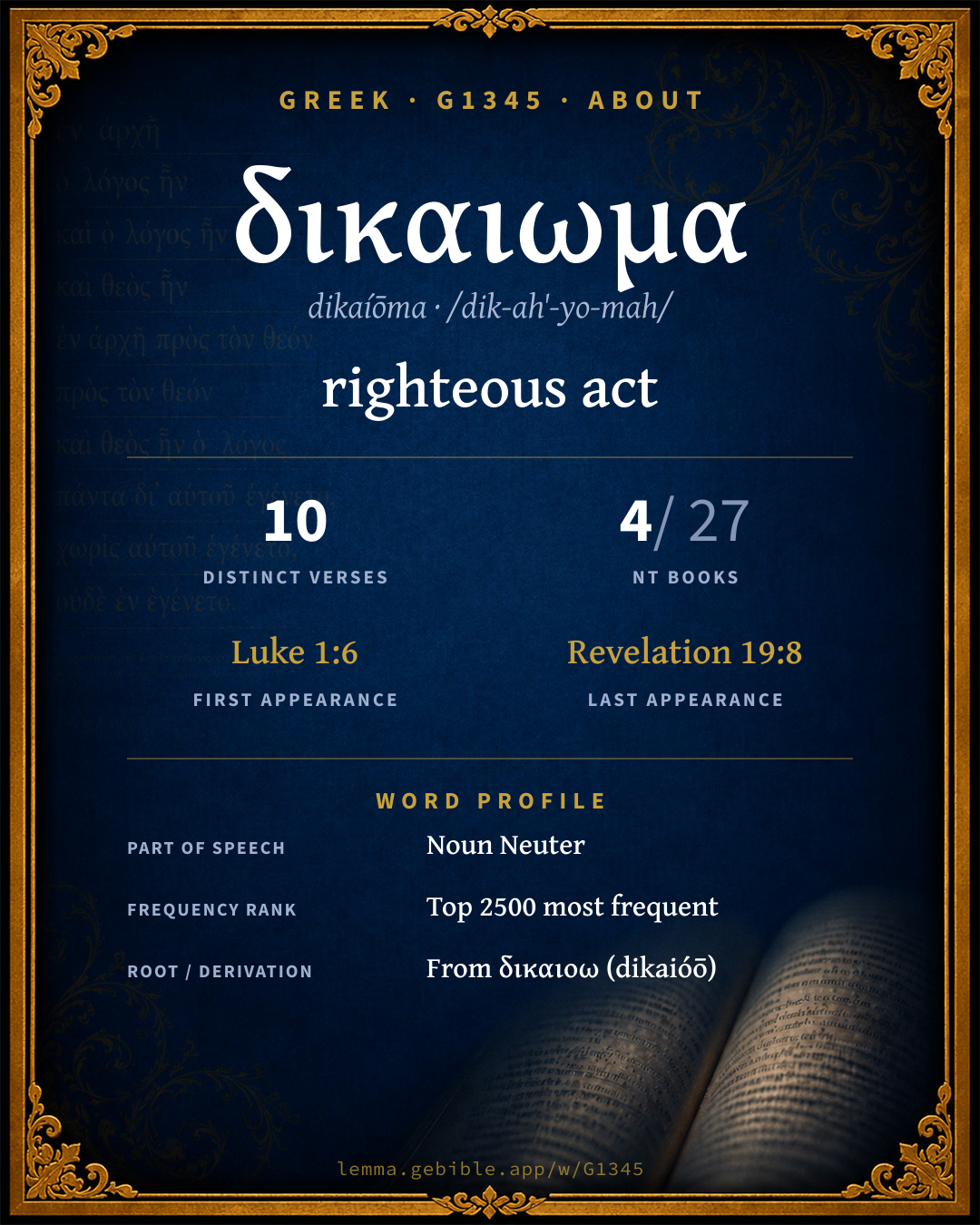
δικαίωμα
righteous act
‘righteous act’ is one of 2 main senses fuller range ↓
Full lexicon entry — Thayer's Greek Lexicon
From Thayer's Greek Lexicon
Where this word appears
See every Accusative-case word in the Greek New Testament →
Grammar key — what these labels mean
Part of speech
- Noun
- A naming word — a person, place, thing, or idea.
Case
- Nominative
- The case of the subject (and the predicate nominative).
- Accusative
- The case of the direct object and of extent.
- Dative
- The case of the indirect object, means, or location — “to / for / with / in.”
- Genitive
- The case of source, possession, or “of” — answers “whose / from what.”
Gender
- Neuter
- Grammatically neuter.
Number
- Plural
- More than one.
- Singular
- One.
1 verse where G1345 appears in the Accusative case in the Book of Hebrews. Filtered view — show all forms. Click any verse to open its interlinear word-by-word view. Verse text shown in the World English Bible for context — . Each verse’s Greek form is shown with its reference; the English is not keyword-highlighted, since the data carries no word-level English alignment. Use “Compare translations” on any verse to read it across multiple English versions. This concordance covers the Greek New Testament; Septuagint (Greek Old Testament) occurrences of this word are not indexed here.
Hebrews
About this entry
At a glance — auto-summarized from this page’s data, not written by a person. Every figure links to its source below. This summary describes the numbers; it doesn’t interpret them.
δικαιωμα (dikaíōma) is a Greek noun most often rendered “righteous act.” Romans dominates its distribution — 5 of 10 verses. The Greek New Testament uses it across 10 verses — uncommon. Debuting at Luke 1:6, it then recurs through the corpus. Its lexical range runs to 2 senses. For the data behind this summary, explore the sense tree and the renderings breakdown below.
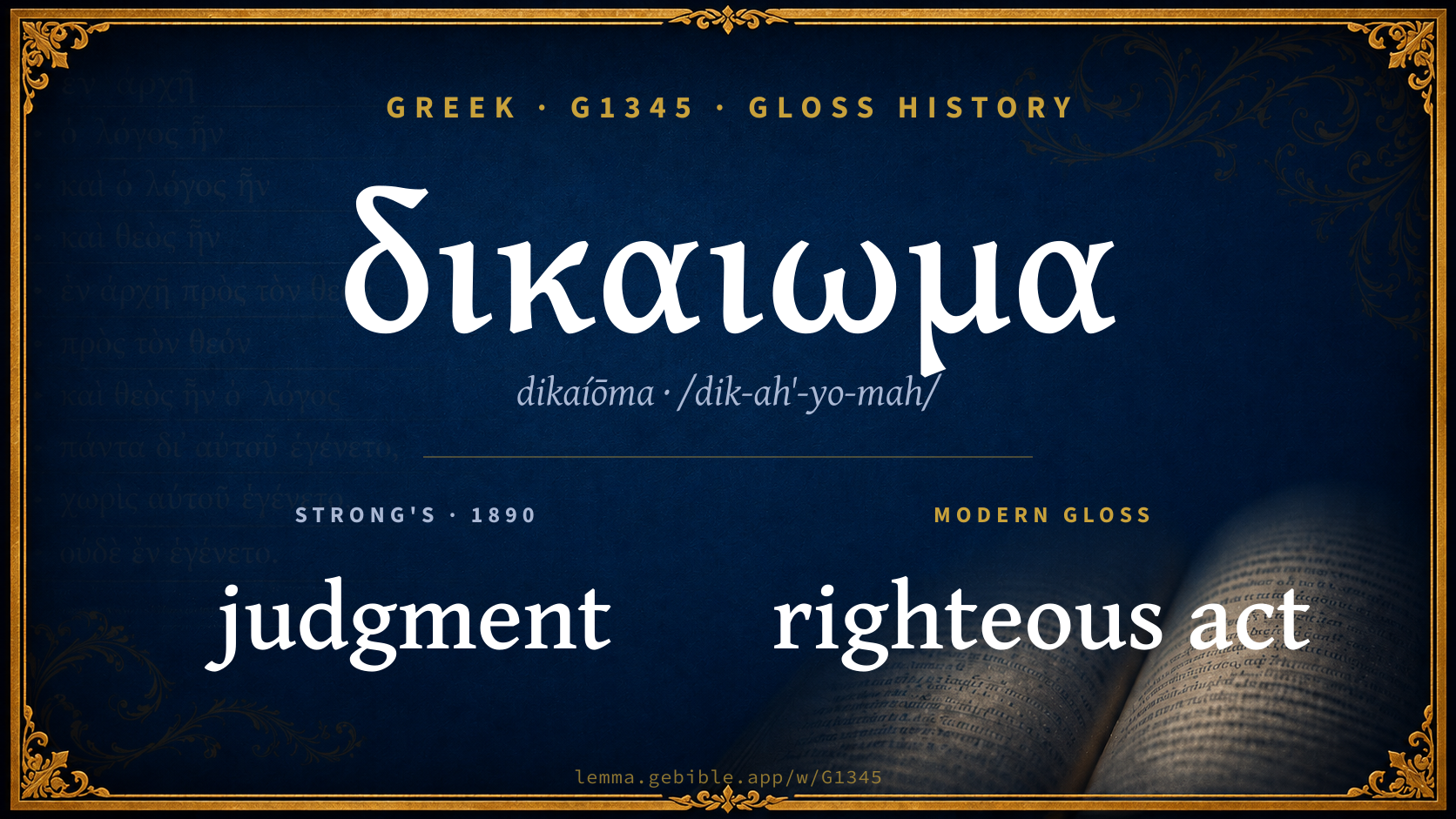
Gloss history
Strong's 1890 vs modern scholarship
About this word
Strong's G1345 catalogs a Greek word from the Greek New Testament.
These counts are not copied from any lexicon or concordance. They are computed here, from the morphology-tagged Greek New Testament. What Lemma adds →
- 10
- distinct verses
- The word appears in 10 distinct verses.
- 4 / 27
- NT books
- The word appears in 4 of 27 New Testament books.
- #1,056
- by frequency
- Top 2500 most frequent Greek words (rank 1,056 of 5,347 Greek words by occurrence).
View all 10 occurrences in the concordance →
Most concentrated in
- Romans 5 verses 50%
- Hebrews 2 verses 20%
- Revelation 2 verses 20%
By section of the New Testament
By traditional corpus
Conventional, traditional groupings — biblical authorship is debated, so this is a traditional corpus grouping, not an authorship claim. Some books belong to more than one corpus (Luke is in both the Gospels and the Lukan corpus, and so on), so these shares overlap and need not total 100%. Each figure is a share of the word’s 10 distinct verses.
- Pauline corpus 5 verses · 50%
- Johannine 2 verses · 20%
- Hebrews 2 verses · 20%
- Revelation 2 verses · 20%
- Gospels 1 verse · 10%
- Lukan (Luke–Acts) 1 verse · 10%
How translations render this word
Counts come from each version’s own published word-to-Strong’s tagging or interlinear alignment — an approximate guide to how each version renders this word, not a word-level alignment the data otherwise carries. Because each total is that version’s own tagged count, the per-version totals vary from one another and need not match the appearance or distinct-verse counts above. These counts may also differ from a printed concordance because Lemma counts each distinctly tagged rendering and does not collapse phrase taggings into a single head-word total. This is a fixed set of word-tagged versions (KJV, ASV, BSB, ULT) and does not change with the reading translation you choose elsewhere. Each version’s license is shown beside its name below (and on Sources).
- King James Version: Righteousness 4×, Ordinances 3×
- American Standard Version: Ordinances 4×, Ordinance 2×
- Berean Standard Bible: Regulations 2×, Righteous acts 2×
- unfoldingWord Literal Text: Regulations 2×, Righteous deeds 2×
King James Version Public Domain
Renders G1345 across 10 tagged occurrences — most commonly:
Plus 3 renderings that appear only once — usually multi-word phrases or single function words the recovered tagging swept in, not distinct renderings.
American Standard Version Public Domain
Renders G1345 across 10 tagged occurrences — most commonly:
Plus 4 renderings that appear only once — usually multi-word phrases or single function words the recovered tagging swept in, not distinct renderings.
Berean Standard Bible Public Domain
Renders G1345 across 10 tagged occurrences — most commonly:
Plus 6 renderings that appear only once — usually multi-word phrases or single function words the recovered tagging swept in, not distinct renderings.
unfoldingWord Literal Text CC BY-SA 4.0
Renders G1345 across 10 tagged occurrences — most commonly:
Plus 6 renderings that appear only once — usually multi-word phrases or single function words the recovered tagging swept in, not distinct renderings.
Senses in Thayer's
The 2 senses Thayer's distinguishes for this word, in lexicon order (not ranked by frequency or importance). The full entry — with sub-senses — is in the Lexicon Entry tab.
- that which has been deemed right so as to have force of law
- a righteous act or deed
Word origin
Derived from δικαιοω (dikaióō) (G1344) — to justify.
From G1344 ; an equitable deed ; by implication a statute or decision : - judgment justification ordinance righteousness.
— Strong’s Exhaustive Concordance (1890), public domain.
Forms in the corpus
The 5 distinct written forms G1345 takes in the Greek New Testament, most frequent first — each parse links to that case’s occurrences in the concordance.
| Form | Parsing | Example | Uses |
|---|---|---|---|
| δικαιώματα dikaiṓmata | Noun, Accusative, Plural, Neuter | Romans 2:26 | 4 |
| δικαίωμα dikaíōma | Noun, Accusative, Singular, Neuter | Romans 1:32 | 3 |
| δικαιώμασιν dikaiṓmasin | Noun, Dative, Plural, Neuter | Luke 1:6 | 1 |
| δικαιώματά dikaiṓmatá | Noun, Nominative, Plural, Neuter | Revelation 15:4 | 1 |
| δικαιώματος dikaiṓmatos | Noun, Genitive, Singular, Neuter | Romans 5:18 | 1 |
Same root — word family
Other Thayer's entries built from the same root as G1345, grouped by Strong’s listed origin. These share a root / origin per the lexicon — not necessarily a shared meaning. Each links to that word’s own entry.
Derives from
Shares the same root
Compare all same-root words → They share a root, not necessarily a meaning.
Septuagint usage
The same Greek word δικαιωμα appears 125 times in the Greek Old Testament (Septuagint), across 122 verses in 19 books.
- 125
- LXX occurrences
- Tagged occurrences of this Greek word in the Septuagint.
- 122
- verses
- Distinct Septuagint verses containing this word.
- 19 / 39
- OT books
- The word appears in 19 of the 39 Old Testament books.
Sample Septuagint occurrences
- Genesis 26:5 δικαίωμα
- Exodus 15:25 δικαίωμα
- Leviticus 25:18 δικαίωμα
- Numbers 15:16 δικαίωμα
- Deuteronomy 4:1 δικαίωμα
- Ruth 4:7 δικαίωμα
- 1 Samuel 2:13 δικαίωμα
- 2 Samuel 19:29 δικαίωμα
- 1 Kings 2:3 δικαίωμα
- 2 Kings 17:8 δικαίωμα
- 2 Chronicles 6:35 δικαίωμα
- Job 34:27 δικαίωμα
Septuagint occurrences (same lexeme)
Every verse where the same Strong’s number (G1345) appears in the Greek Septuagint — showing the first 50 of 122. Verse text shown in the World English Bible for context; the Greek form is the matched word — the English is not keyword-highlighted.
- Genesis 26:5 δικαίωμα because Abraham obeyed my voice, and kept my charge, my commandments, my statutes, and my laws."
- Exodus 15:25 δικαίωμα Then he cried to Yahweh. Yahweh shown him a tree, and he threw it into the waters, and the waters were made sweet. There he made a statute and an ordinance for them, and there he tested them;
- Exodus 15:26 δικαίωμα and he said, "If you will diligently listen to the voice of Yahweh your God, and will do that which is right in his eyes, and will pay attention to his commandments, and keep all his statutes, I will put none of the diseases on you, which I have put on the Egyptians; for I am Yahweh who heals you."
- Exodus 21:1 δικαίωμα "Now these are the ordinances which you shall set before them.
- Exodus 21:9 δικαίωμα If he marries her to his son, he shall deal with her after the manner of daughters.
- Exodus 21:31 δικαίωμα Whether it has gored a son or has gored a daughter, according to this judgment it shall be done to him.
- Exodus 24:3 δικαίωμα Moses came and told the people all the words of Yahweh, and all the ordinances; and all the people answered with one voice, and said, "All the words which Yahweh has spoken will we do."
- Leviticus 25:18 δικαίωμα "'Therefore you shall do my statutes, and keep my ordinances and do them; and you shall dwell in the land in safety.
- Numbers 15:16 δικαίωμα One law and one ordinance shall be for you, and for the stranger who lives as a foreigner with you.
- Numbers 27:11 δικαίωμα If his father have no brothers, then you shall give his inheritance to his kinsman who is next to him of his family, and he shall possess it: and it shall be to the children of Israel a statute [and] ordinance, as Yahweh commanded Moses.
- Numbers 30:17 δικαίωμα
- Numbers 31:21 δικαίωμα Eleazar the priest said to the men of war who went to the battle, This is the statute of the law which Yahweh has commanded Moses:
- Numbers 35:29 δικαίωμα These things shall be for a statute [and] ordinance to you throughout your generations in all your dwellings.
- Numbers 36:13 δικαίωμα These are the commandments and the ordinances which Yahweh commanded by Moses to the children of Israel in the plains of Moab by the Jordan at Jericho.
- Deuteronomy 4:1 δικαίωμα Now, Israel, listen to the statutes and to the ordinances, which I teach you, to do them; that you may live, and go in and possess the land which Yahweh, the God of your fathers, gives you.
- Deuteronomy 4:5 δικαίωμα Behold, I have taught you statutes and ordinances, even as Yahweh my God commanded me, that you should do so in the midst of the land where you go in to possess it.
- Deuteronomy 4:6 δικαίωμα Keep therefore and do them; for this is your wisdom and your understanding in the sight of the peoples, who shall hear all these statutes, and say, Surely this great nation is a wise and understanding people.
- Deuteronomy 4:8 δικαίωμα What great nation is there, that has statutes and ordinances so righteous as all this law, which I set before you this day?
- Deuteronomy 4:14 δικαίωμα Yahweh commanded me at that time to teach you statutes and ordinances, that you might do them in the land where you go over to possess it.
- Deuteronomy 4:40 δικαίωμα You shall keep his statutes, and his commandments, which I command you this day, that it may go well with you, and with your children after you, and that you may prolong your days in the land, which Yahweh your God gives you, forever.
- Deuteronomy 4:45 δικαίωμα these are the testimonies, and the statutes, and the ordinances, which Moses spoke to the children of Israel, when they came forth out of Egypt,
- Deuteronomy 5:1 δικαίωμα Moses called to all Israel, and said to them, Hear, Israel, the statutes and the ordinances which I speak in your ears this day, that you may learn them, and observe to do them.
- Deuteronomy 5:31 δικαίωμα But as for you, stand you here by me, and I will speak to you all the commandment, and the statutes, and the ordinances, which you shall teach them, that they may do them in the land which I give them to possess it.
- Deuteronomy 6:1 δικαίωμα Now this is the commandment, the statutes, and the ordinances, which Yahweh your God commanded to teach you, that you might do them in the land where you go over to possess it;
- Deuteronomy 6:2 δικαίωμα that you might fear Yahweh your God, to keep all his statutes and his commandments, which I command you, you, and your son, and your son's son, all the days of your life; and that your days may be prolonged.
- Deuteronomy 6:4 δικαίωμα Hear, Israel: Yahweh is our God; Yahweh is one:
- Deuteronomy 6:17 δικαίωμα You shall diligently keep the commandments of Yahweh your God, and his testimonies, and his statutes, which he has commanded you.
- Deuteronomy 6:20 δικαίωμα When your son asks you in time to come, saying, What mean the testimonies, and the statutes, and the ordinances, which Yahweh our God has commanded you?
- Deuteronomy 6:24 δικαίωμα Yahweh commanded us to do all these statutes, to fear Yahweh our God, for our good always, that he might preserve us alive, as at this day.
- Deuteronomy 7:11 δικαίωμα You shall therefore keep the commandment, and the statutes, and the ordinances, which I command you this day, to do them.
- Deuteronomy 7:12 δικαίωμα It shall happen, because you listen to these ordinances, and keep and do them, that Yahweh your God will keep with you the covenant and the loving kindness which he swore to your fathers:
- Deuteronomy 8:11 δικαίωμα Beware lest you forget Yahweh your God, in not keeping his commandments, and his ordinances, and his statutes, which I command you this day:
- Deuteronomy 10:13 δικαίωμα to keep the commandments of Yahweh, and his statutes, which I command you this day for your good?
- Deuteronomy 11:1 δικαίωμα Therefore you shall love Yahweh your God, and keep his charge, and his statutes, and his ordinances, and his commandments, always.
- Deuteronomy 17:19 δικαίωμα and it shall be with him, and he shall read therein all the days of his life; that he may learn to fear Yahweh his God, to keep all the words of this law and these statutes, to do them;
- Deuteronomy 26:16 δικαίωμα This day Yahweh your God commands you to do these statutes and ordinances: you shall therefore keep and do them with all your heart, and with all your soul.
- Deuteronomy 26:17 δικαίωμα You have declared Yahweh this day to be your God, and that you would walk in his ways, and keep his statutes, and his commandments, and his ordinances, and listen to his voice:
- Deuteronomy 27:10 δικαίωμα You shall therefore obey the voice of Yahweh your God, and do his commandments and his statutes, which I command you this day.
- Deuteronomy 28:45 δικαίωμα All these curses shall come on you, and shall pursue you, and overtake you, until you are destroyed; because you didn't listen to the voice of Yahweh your God, to keep his commandments and his statutes which he commanded you:
- Deuteronomy 30:10 δικαίωμα if you shall obey the voice of Yahweh your God, to keep his commandments and his statutes which are written in this book of the law; if you turn to Yahweh your God with all your heart, and with all your soul.
- Deuteronomy 30:16 δικαίωμα in that I command you this day to love Yahweh your God, to walk in his ways, and to keep his commandments and his statutes and his ordinances, that you may live and multiply, and that Yahweh your God may bless you in the land where you go in to possess it.
- Deuteronomy 33:10 δικαίωμα They shall teach Jacob your ordinances, Israel your law: They shall put incense before you, Whole burnt offering on your altar.
- Ruth 4:7 δικαίωμα Now this was [the custom] in former time in Israel concerning redeeming and concerning exchanging, to confirm all things: a man drew off his shoe, and gave it to his neighbor; and this was the [manner of] attestation in Israel.
- 1 Samuel 2:13 δικαίωμα The custom of the priests with the people was that when any man offered sacrifice, the priest's servant came, while the flesh was boiling, with a flesh-hook of three teeth in his hand;
- 1 Samuel 8:3 δικαίωμα His sons didn't walk in his ways, but turned aside after lucre, and took bribes, and perverted justice.
- 1 Samuel 8:9 δικαίωμα Now therefore listen to their voice: however you shall protest solemnly to them, and shall show them the manner of the king who shall reign over them.
- 1 Samuel 8:11 δικαίωμα He said, This will be the manner of the king who shall reign over you: he will take your sons, and appoint them to him, for his chariots, and to be his horsemen; and they shall run before his chariots;
- 1 Samuel 10:25 δικαίωμα Then Samuel told the people the manner of the kingdom, and wrote it in a book, and laid it up before Yahweh. Samuel sent all the people away, every man to his house.
- 1 Samuel 27:11 δικαίωμα David saved neither man nor woman alive, to bring them to Gath, saying, Lest they should tell of us, saying, So did David, and so has been his manner all the while he has lived in the country of the Philistines.
- 1 Samuel 30:25 δικαίωμα It was so from that day forward, that he made it a statute and an ordinance for Israel to this day.
These are occurrences of the same Greek lexeme (G1345) in the Septuagint — not a translation of any one Hebrew word. The store carries no word-level Hebrew↔Greek alignment, so no Hebrew original is asserted here. Counts come from the recovered LXX Strong's tagging — high-frequency vocabulary is well covered, while rare or late forms may be untagged — so they reflect tagged occurrences and may slightly undercount.