
Exodus 21:9

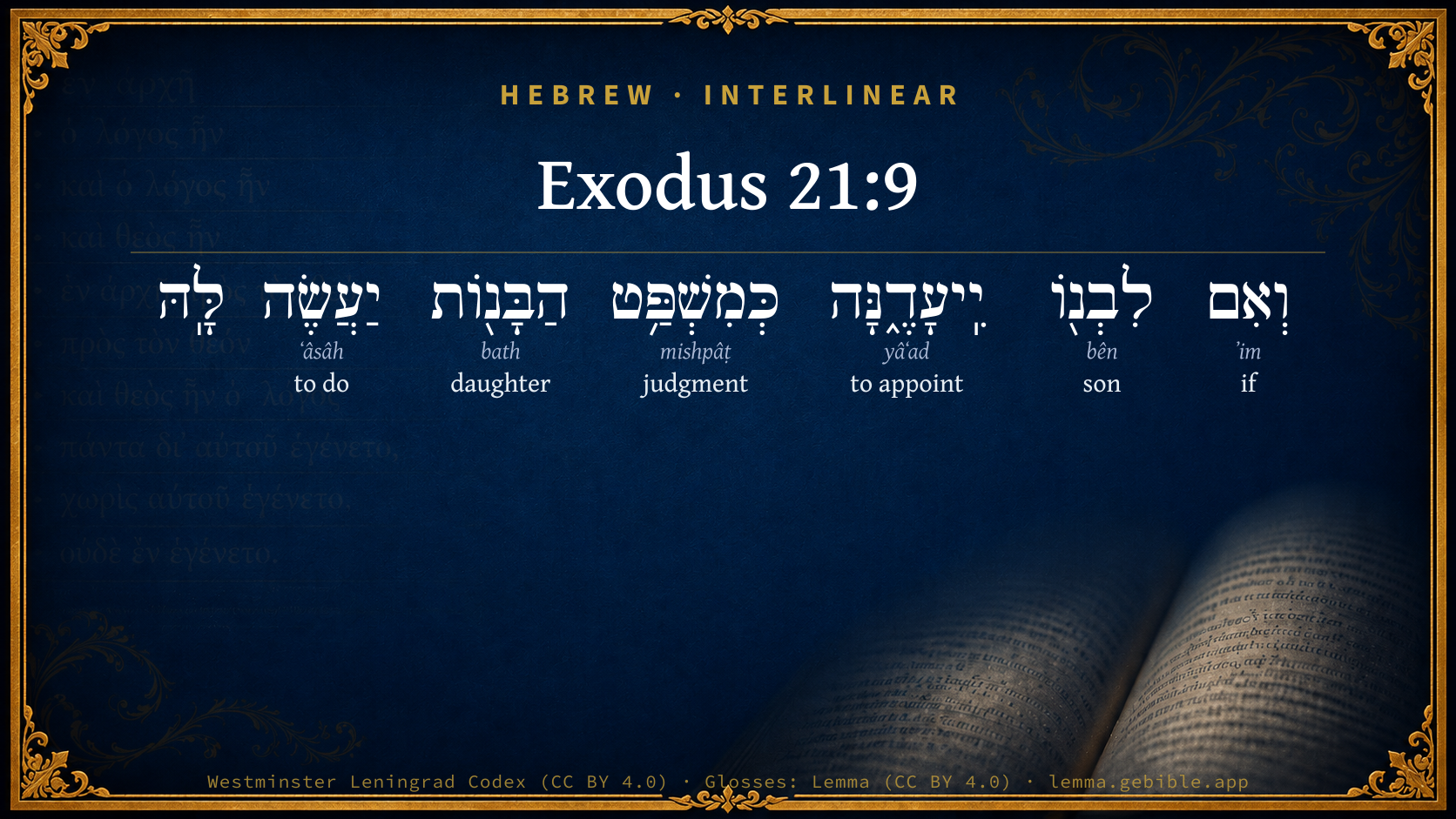
Hebrew (Westminster Leningrad Codex) Exodus 21:9 appears in the Hebrew Old Testament. The text above is from the Westminster Leningrad Codex. Each word links to its Strong’s number, a concise gloss, and parsing drawn from the Open Scriptures Hebrew Bible morphology. Click any word for its full Brown-Driver-Briggs (BDB) entry.
Download image
Cite this verse

Exodus 21:9 (World English Bible). Public Domain. Lemma interlinear Bible study tool, https://lemma.gebible.app/v/exodus/21/9.

Show BibTeX & RIS
BibTeX
RIS
English Translation
If he marries her to his son, he shall deal with her after the manner of daughters.
World English Bible · Public Domain
Download a study sheet

One document with this verse’s original text, its word-by-word gloss line, the meaning frame, cross-references with their text, attributed commentary, and full source and license credits — printable, and it pastes into notes with its structure intact.

This verse Autodidact and up

Study sheet (.html) Plain text (.txt)

A passage Seminary Student

Up to 50 verses in one chapter. A passage sheet keeps up to 6 commentary sources and 12 cross-references per verse, in the order this page ranks them, and says so on the sheet whenever that leaves anything out. Ask for a single verse and you get the Autodidact verse sheet above.

Everything on this page stays free to read, with no account — the sheet is a download of what is already on screen, not access to it.

Want to remove ads? Support Godless Engineer
Compare translations 3

The same verse in 3 English versions, stacked beneath the original-language interlinear above. Click any original word for its lexicon entry.

Each is an independent rendering of the whole verse — the interlinear is not word-aligned to these translations.

Highlighted words mark where these versions differ — a whole-verse word diff, not a word-by-word alignment.

  • World English Bible Public Domain
    If he marries her to his son, he shall deal with her after the manner of daughters.
  • King James Version Public Domain
    And if he have betrothed her unto his son, he shall deal with her after the manner of daughters.
  • unfoldingWord Literal Text CC BY-SA 4.0
    And if he appoints her for his son, he shall act toward her according to the custom of daughters.

unfoldingWord Literal Text — © unfoldingWord, licensed CC BY-SA 4.0. Word-aligned USFM3 via Door43 (git.door43.org/unfoldingWord/en_ult).

Versions to compare (up to 4)

3 of 4 selected

Show all 18 translations

Every available English version of this verse, each an independent rendering of the whole verse.

  • World English Bible Public Domain
    If he marries her to his son, he shall deal with her after the manner of daughters.
  • Berean Standard Bible Public Domain
    And if he chooses her for his son, he must deal with her as with a daughter.
  • Majority Standard Bible Public Domain
    And if he chooses her for his son, he must deal with her as with a daughter.
  • King James Version Public Domain
    And if he have betrothed her unto his son, he shall deal with her after the manner of daughters.
  • American Standard Version (1901) Public Domain
    And if he espouse her unto his son, he shall deal with her after the manner of daughters.
  • Revised Version (1885) Public Domain
    And if he espouse her unto his son, he shall deal with her after the manner of daughters.
  • Geneva Bible (1599) Public Domain
    But if he hath betrothed her vnto his sonne, he shall deale with her according to the custome of the daughters.
  • Douay-Rheims (1899) Public Domain
    But if he have betrothed her to his son, he shall deal with her after the manner of daughters.
  • Young's Literal Translation Public Domain
    `And if to his son he betroth her, according to the right of daughters he doth to her.
  • Literal Standard Version CC BY-SA 4.0
    And if he betroths her to his son, he does to her according to the right of daughters.
  • Unlocked Literal Bible CC BY-SA 4.0
    If her master designates her as a wife for his son, he must treat her the same as if she were his daughter.
  • unfoldingWord Literal Text CC BY-SA 4.0
    And if he appoints her for his son, he shall act toward her according to the custom of daughters.
  • Darby Bible Public Domain
    And if he have appointed her unto his son, he shall deal with her after the law of daughters.
  • World Messianic Bible Public Domain
    If he marries her to his son, he shall deal with her as a daughter.
  • Webster's Bible Public Domain
    And if he hath betrothed her to his son, he shall deal with her after the manner of daughters.
  • Free Bible Version CC BY-SA 4.0
    If he chooses to give her to his son, he must treat her as a daughter.
  • Bible in Basic English Public Domain
    And if he gives her to his son, he is to do everything for her as if she was his daughter.
  • JPS Tanakh (1917) Public Domain
    And if he espouse her unto his son, he shall deal with her after the manner of daughters.

Literal Standard Version (2020), Covenant Press — licensed CC BY-SA 4.0. Text via the HelloAO Bible API (eBible.org). Unlocked Literal Bible (unfoldingWord) — licensed CC BY-SA 4.0. Text via the HelloAO Bible API (eBible.org). unfoldingWord Literal Text — © unfoldingWord, licensed CC BY-SA 4.0. Word-aligned USFM3 via Door43 (git.door43.org/unfoldingWord/en_ult). Free Bible Version, Dr. Jonathan Gallagher — licensed CC BY-SA 4.0. Text via the HelloAO Bible API (eBible.org).

Word by word

More ways to search: Search by grammar → Find every occurrence → Compare this word →

Practice this passage: Drill this verse → Learn its vocabulary →

יִֽיעָדֶ֑נָּה
yâʻad
H3259
“to appoint · her”
Verb, Qal, Imperfect, 3rd Person, Masculine, Singular + Suffix, Personal, 3rd Person, Feminine, Singular
Part of Speech
Verb
Stem
Qal
Form
Imperfect
Person
3rd Person
Gender
Masculine
Number
Singular
Full BDB Definition

Origin: a primitive root

TWOT: 878

to fix, appoint, assemble, meet, set, betroth - (Qal) to appoint, assign, designate - (Niphal) - to meet - to meet by appointment - to gather, assemble by appointment - (Hiphil) to cause to meet - (Hophal) to be set, be placed before, be fixed
  1. וְאִם ʼim H518 “and · if” Conjunction + Conjunction
  2. לִבְנ֖וֹ bên H1121 “to/for · son · his” Preposition + Noun, Common, Masculine, Singular, Construct + Suffix, Personal, 3rd Person, Masculine, Singular
  3. כְּמִשְׁפַּ֥ט mishpâṭ H4941 “like/as · judgment of” Preposition + Noun, Common, Masculine, Singular, Construct
  4. הַבָּנ֖וֹת bath H1323 “the · daughters” Particle, Definite Article + Noun, Common, Feminine, Plural, Absolute
  5. יַעֲשֶׂה ʻâsâh H6213 “to do” Verb, Qal, Imperfect, 3rd Person, Masculine, Singular

About this verse

These counts appear in no published source. They are computed here, from the morphology-tagged text and Lemma’s own curated glosses. What Lemma adds →

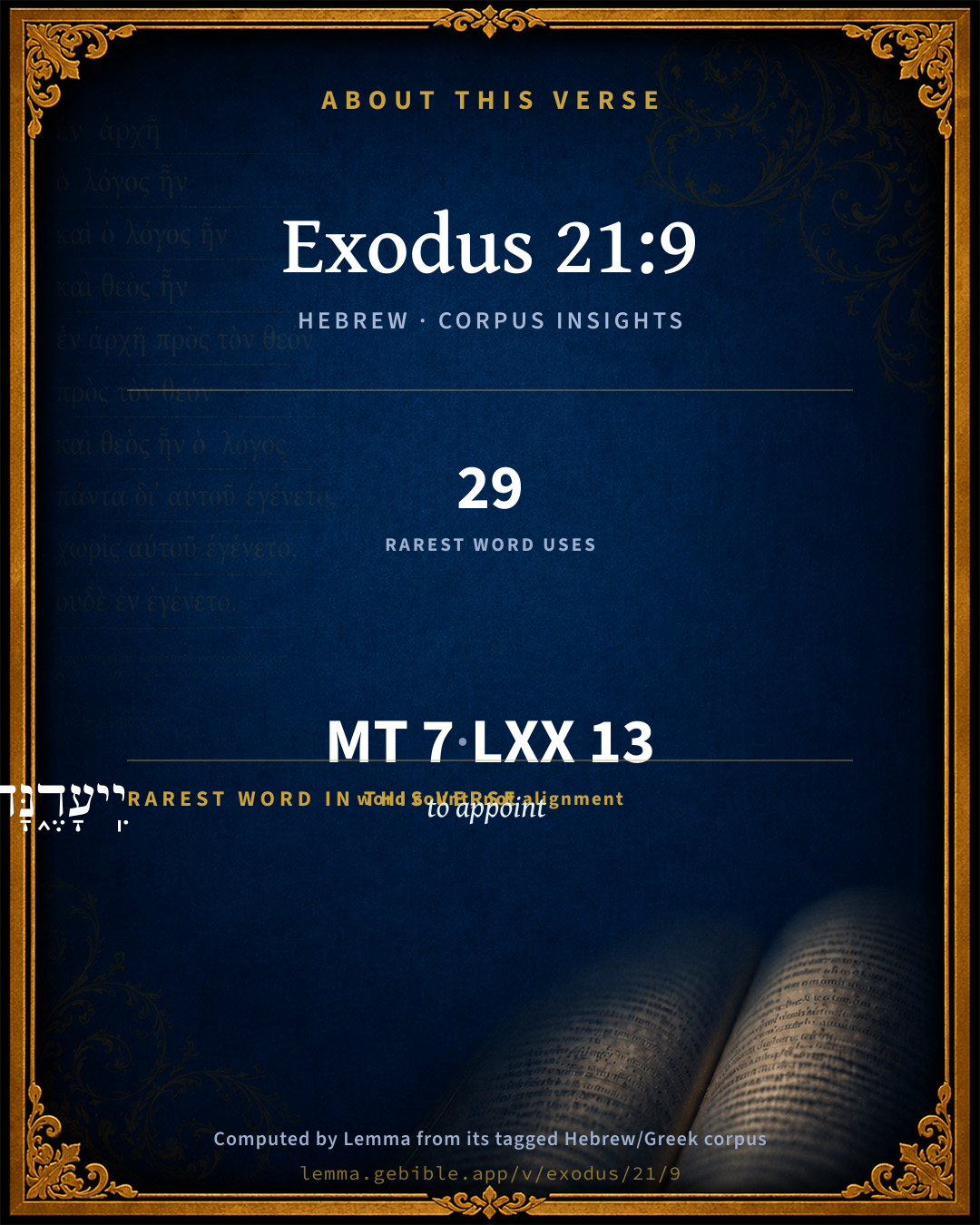
7
words
6
distinct lemmas
Pentateuch
section

Shared distinctive vocabulary

יִֽיעָדֶ֑נָּה to appoint H3259 occurs in 29 verses of the Hebrew Bible. Also found in:

Grammatical profile

  • 2 verbs
  • 3 nouns
  • 1 preposition
  • 1 conjunction

Verb forms

  • יִֽיעָדֶ֑נָּה Qal · Imperfect
  • יַעֲשֶׂה Qal · Imperfect

Hebrew & Septuagint length

In English translation the verse runs 17 words from the Hebrew and 21 from the Septuagint (LXX English) — closely comparable.

A rough comparison of the two English renderings, which tokenize alike — not a word-level alignment.

Word counts can differ between the Hebrew and the Greek without any difference in meaning — e.g. the Hebrew direct-object marker אֵת has no separate Greek word, and Greek often adds the article ὁ.

In the original languages it is 7 Hebrew tokens and 13 Greek tokens — but the two are counted differently (Hebrew bundles its prefixes and suffixes into one token; the Greek is in lemma form), so that isn’t a like-for-like length.

Hebrew and Greek witnesses Masoretic Hebrew ↔ Greek Septuagint

The same verse in the two great witnesses to the Old Testament, shown verse-for-verse.

These are two independent witnesses, not word-aligned to each other, and the Septuagint is shown in lemma (dictionary) form.

Hebrew Exodus 21:9 Masoretic · Westminster Leningrad Codex

וְאִם לִבְנ֖וֹ יִֽיעָדֶ֑נָּה כְּמִשְׁפַּ֥ט הַבָּנ֖וֹת יַעֲשֶׂה לָּֽהּ

If he marries her to his son, he shall deal with her after the manner of daughters.

World English Bible · Public Domain

Greek LXX Exodus 21:9 Septuagint · lemma form

ἐάν δέ ὁ υἱός καταὁμολογέω αὐτός κατά ὁ δικαίωμα ὁ θυγάτηρ ποιέω αὐτός

And if he should have betrothed her to his son, he shall do to her according to the right of daughters.

LXX2012 (modern English Septuagint) · Public Domain

On this verse, Adam Clarke's Commentary discusses the Septuagint’s reading. Read the note in Commentary ↓

Hebrew: Westminster Leningrad Codex (CC BY 4.0). Greek: Septuagint (public domain); English from LXX2012 (modern English Septuagint) (Public Domain). How the Septuagint differs from the Hebrew →

Targum (Aramaic paraphrase)

2

The Targum is the ancient Jewish Aramaic paraphrase of the Hebrew Scriptures — an interpretive translation, not the Hebrew text itself. Onkelos (literal) and Pseudo-Jonathan (expansive) render the Torah, and Jonathan the Prophets. Coverage is partial: where no permissively-licensed English translation exists for a verse, only the Aramaic is shown. This is verse-level text, not a word-by-word alignment to the Hebrew.

  1. Targum Onkelos Torah (Genesis–Deuteronomy)
    וְאִם לִבְרֵהּ יְקַיְמִנַהּ כְּהִלְכַת בְּנַת יִשְׂרָאֵל יַעְבֵּד לַהּ:

    (no public-domain English translation for this verse)

    Targum Onkelos — Aramaic: “Onkelos Genesis” (public domain); “Onkelos Exodus” (public domain); “Onkelos Leviticus” (public domain); “Onkelos Numbers” (public domain); “Onkelos Deuteronomy” (public domain). English: “Sefaria Community Translation” (CC0 1.0 (public-domain dedication)); “J.W. Etheridge. The Targums of Onkelos and Jonathan Ben Uzziel on the Pentateuch. London: Longmans, Green, 1862” (public domain). Text via Sefaria.

  2. Targum Pseudo-Jonathan Torah (Genesis–Deuteronomy)
    וְאִין לְצֵיד בְּרֵיהּ זַמִּין יָתָהּ כְּהִלְכַת בְּנַת יִשְרָאֵל יַעֲבִיד לָהּ

    And if he had intended her for the side of his son, he shall do by her after the manner of the daughters of Israel.

    Targum Pseudo-Jonathan — Aramaic: “Targum Jonathan on Genesis” (public domain); “Targum Jonathan on Exodus” (public domain); “Targum Jonathan on Leviticus” (public domain); “Targum Jonathan on Numbers” (public domain); “Targum Jonathan on Deuteronomy” (public domain). English: “The Targum of Jonathan ben Uzziel, trans. J. W. Etheridge, London, 1862” (public domain). Text via Sefaria.

Commentary

Notes on Exodus 21:9 from classic Christian and Jewish commentators (each source and its license shown beneath its notes). The classic Christian expositions comment on the surrounding passage and are grouped to its opening verse, so a note may address several verses; the Jewish commentaries on the Tanakh (Rashi and others) are per-verse, so they appear only where the commentator wrote on this verse.

Lemma curates 59 commentaries, every one of them public domain or Creative Commons licensed, each selected and text-cleaned for this edition rather than reprinted as found. About our sources →

Trapp's Complete Commentary

John Trapp

Exo 21:9 And if he have betrothed her unto his son, he shall deal with her after the manner of daughters.

Ver. 9. After the manner of daughters.] Not put her off, as they say they do their daughters in Hungary, without a portion, only with a new coat at their wedding: much less set her to sale, as the Thracians did their young brides; quae non moribus nubebant, sed praemiis. {a}

{a} Solin, cap. 15.

John Trapp, A Commentary or Exposition upon All the Books of the Old and New Testament (1647–1656) — public domain. Text from a community e-Sword module.

Joseph Benson's Commentary

Exo 21:9-10. After the manner of daughters — He shall give her a convenient portion, as he doth to his own daughters. Duty of marriage — Termed due benevolence, 1Co 7:3 : or, her dwelling, as the word is often used. Thus the three great conveniences of life are included, food, raiment, and habitation, all which he is to provide for her.

Joseph Benson's Commentary on the Old and New Testaments (1811–1818) — public domain. Text from a community e-Sword module.

Geneva Bible (1599)

Geneva Bible translators

That is, he shall give his dowry.

Geneva Bible (1599) marginal notes — public domain. Text via Bolls.life.

Adam Clarke's Commentary

Verse 9. Betrothed her unto his son, he shall deal with her] He shall give her the same dowry he would give to one of his own daughters. From these laws we learn, that if a man's son married his servant, by his father's consent, the father was obliged to treat her in every respect as a daughter; and if the son married another woman, as it appears he might do, Ex 21:10, he was obliged to make no abatement in the privileges of the first wife, either in her food, raiment, or duty of marriage. The word ענתה onathah, here, is the same with St. Paul's οφειλομενην ευνοιαν, the marriage debt, and with the ομιλιαν of the Septuagint, which signifies the cohabitation of man and wife.

Adam Clarke's Commentary on the Bible (1810–1826) — public domain. Text from a community e-Sword/MySword module.

The Cambridge Bible for Schools and Colleges

gen. ed. J. J. S. Perowne

9. Second special case: if at the time of purchasing the woman, her master intends her for his son.

If he designate her for his son, he shall deal with her according to the rights of daughters] i.e. treat her as a daughter of his own household, give her the maintenance, clothing, &c. which a daughter would naturally have.

for his son] ‘as in Persia (Chardin, Voyage, ii. 259), Arabia, Niebuhr, Arabia, p. 74, Snouck-Hurgronje, Mekka, p. 157’ (Dillm.-Ryss.).

The Cambridge Bible for Schools and Colleges (gen. ed. J. J. S. Perowne; Cambridge University Press, 1878–1918) — public domain. Text from a community e-Sword module.

John Gill's Exposition

And if he have betrothed her unto his son,.... Not caring to betroth and marry her himself, as being more suitable in age for his son than for himself:

he shall deal with her after the manner of daughters; as if she was his daughter, and give her a dowry: or the son shall treat her after the manner the daughters of Israel are treated when married, by giving her food, raiment, and the duty of marriage, so Jarchi: or after the manner of the daughters of Israel that are virgins, and who are not sold, as Aben Ezra.

John Gill's Exposition of the Whole Bible (1746–1763) — public domain (CC PDM 1.0). Text via the HelloAO Bible API.

Haydock's Catholic Bible Commentary

Daughters. When she is old enough to be married, he shall give her a dowry like his own daughter, or like a free woman. (Haydock)

George Leo Haydock (1774–1849), Haydock's Catholic Family Bible and Commentary, 1859 edition — public domain. Excludes Psalms (Douay-Rheims chapter numbering differs from Protestant) and Deuterocanonical books (Catholic canon only).

Matthew Poole's English Annotations

i.e. Give her a convenient portion, as he doth to his own daughters, Exo 22:16.

Matthew Poole's English Annotations on the Holy Bible (1683–1685) — public domain. Text from a community e-Sword/MySword module.

The Pulpit Commentary

And if he hath betrothed her unto his son. A man might have bought the maiden for this object, or finding himself not pleased with her (ver. 8), might have made his son take his place as her husband. In this case but one course was allowed he must give her the status of a daughter thenceforth in his family.

The Pulpit Commentary (1880–1919), ed. H.D.M. Spence-Jones & Joseph S. Exell — public domain. Text from a community e-Sword module.

John Wesley's Explanatory Notes

After the manner of daughters - He shall give her a portion, as to a daughter.

John Wesley, Explanatory Notes Upon the Whole Bible (1754–1765) — public domain. Text via the GEBible commentary corpus.

unfoldingWord translationNotes

Door43 World Missions Community

designates her as a wife for his son

"decides that she is the one who will be his son's wife"

he must not diminish her food, clothing, or her marital rights

This can be stated in a positive form. AT: "he must give the first wife the same food, clothing, and marital rights she had before" (See: Double Negatives)

must not diminish her food

"must not take away her food" or "must not give her less food"

or her marital rights

This includes things that a husband must do for his wife, including sleeping with her. AT: "and he must continue to sleep with her as before" (See: Euphemism)

unfoldingWord translationNotes — © Distant Shores Media and the Door43 World Missions Community, licensed CC BY-SA 4.0. Source: git.door43.org/Door43/en_tn.

Rashi

Rabbi Shlomo Yitzchaki (Rashi)

ואם לבנו יעדנה AND IF HE HATH BETROTHED HER TO HIS SON — “He” means the master (not like “he” in the previous verse where it refers both to the master and to the father). The verse teaches you that the son also may succeed to his father’s rights to betroth her to himself, if his father consents to it. Then it is not necessary for him either (just as is not obligatory for his father; cf. v. 8) to perform another act of betrothal, but he merely says to her: “You are designated for me as my wife by means of the money which your father has received from my father as your price” (Kiddushin 19a).

כמשפט הבנות [HE SHALL DO UNTO HER] AFTER THE MANNER OF DAUGHTERS — who may claim food, clothing and marital duty (Mekhilta).

Rashi on the Tanakh — English translations: “The Judaica Press complete Tanach with Rashi, translated by A. J. Rosenberg” (CC BY 4.0); “Pentateuch with Rashi's commentary by M. Rosenbaum and A.M. Silbermann, 1929-1934” (public domain); “The Metsudah Tanach series, Lakewood, N.J” (CC BY 4.0); and “The Book of Joshua, Metsudah Publications, 1997” (CC BY 4.0). Text via Sefaria.

Ramban (Nachmanides)

Rabbi Moshe ben Nachman (Ramban / Nachmanides)

AND IF ‘YI’ODENAH’ (HE ESPOUSE HER) UNTO HIS SON, HE SHALL DEAL WITH HER AFTER THE MANNER OF DAUGHTERS. In line with the plain meaning of Scripture, it is possible that G-d is saying that if the buyer yi’odenah for his son, which means that he espoused her to him — for the term yi’ud is an expression of appointing, such as: he tarried longer than the set time which ‘y’ado’ (he had appointed him) — then he shall do unto her after the manner that a man does for his own daughters — he is to give her of his own according to the dowry of virgins. He thus commanded this as He did in the law of outfitting the emancipated servant, and it is all an expression of His goodness, magnified be He! And in accordance with the interpretation of our Rabbis, which is the truth, the meaning of the verse is: after the manner of daughters whom parents marry off, so shall the son [of the master] deal with her. And then He explains [what is “the manner of daughters”] that if he take him another wife, her food, her raiment, and her conjugal rights — that is, of this one [the former maidservant] — he shall not diminish. It is obvious that if he did not marry another woman he must not diminish her rights, but Scripture speaks of that which is usual.. But this is by no means to be understood that it was “the usual” thing to take another wife.Now Rashi explained: “sh’eirah means food; k’suthah is, as the literal sense of the word, raiment; onatha is the marital duty.” And so did Onkelos render sh’eirah: zivanah (food). But in the Gemara, Note 204. the Rabbis said with reference to the Sage who held this opinion [that sh’eirah means food]: “And this Tanna, Note 451. holds that the alimentation of one’s wife is a law of the Torah. For we have been taught: sh’eirah — this means her food, and so it says, He caused ‘sh’eir’ (flesh) to rain upon them as the dust etc.” And from the subject under discussion in that Gemara it is understood that this is the opinion of a single Sage, whilst the accepted law is that the alimentation of one’s wife is a Rabbinical enactment. And even according to the plain meaning of Scripture, why should it mention food under the term sh’eir which means “flesh;” it should rather have mentioned lachmah (her bread), for man lives by bread and his obligation towards her is [mainly] in that sustenance. Now Rabbi Abraham ibn Ezra thought to correct this, and so he explained sh’eirah as meaning food which builds up her sh’eir, namely her flesh. But there is no sense in Scripture saying that the “husband diminish not her flesh!”Therefore I say that the meaning of sh’eir everywhere is flesh close and near to one’s own, the root thereof being derived from the expression sh’eir b’saro, that is his close flesh outside that of the flesh of his own body. Thus relatives are called sh’eir: to any sh’eir b’saro’ (that is near of kin to him); they are ‘sha’arah’ (near kinswomen), Verse 17. this being associated with the expressions: surely thou art my bone and my flesh; of whom the flesh is half consumed. Similarly, And I will cut off from Babylon a name, ‘ush’ar’ offshoot and offspring, means a child related to him. Likewise, when thy flesh ‘ush’eirecha’ are consumed, which means “yourself and your children” who are the flesh closest to you. Thus meat is called sh’eir — He caused ‘sh’eir’ to rain upon them as the dust — because meat when eaten is absorbed by the eater and becomes part of his flesh. It is possible that this is the meaning of the expression, when thy flesh ‘ush’eirecha’ are consumed, meaning: when the original flesh of your body, and the nutriment of flesh which came from the food, will be consumed and will no longer be part of your flesh. Thus a woman in relation to her husband is called sh’eir — just as the Rabbis interpreted: “except for ‘lish’eiro,’ sh’eir means his wife;” — the usage of the term being derived from the idea that G-d stated, and he shall cleave unto his wife, and they shall be one flesh. Thus sh’eira here means “the nearness of her flesh;” k’suthah is “the cover of her bed,” just as it is said, for that is his only ‘k’suthoh’ (covering)… wherein shall he sleep? and onathah is “her time,” that he come to her at times of love. And even if we say as some commentators do, that the meaning of sh’eir is like “his flesh,” and the expression, to any ‘sh’eir’ b’saro’ is like “to any flesh of his flesh,” just as it says, for he is our brother, our flesh — in that case we would still explain ‘sh’eirah'… he shall not diminish as meaning that he shall not diminish from her her flesh; that is, the flesh due to her, namely, the flesh of her husband who with her is one flesh. Thus the meaning of the verse is, that G-d says that if the master takes another wife, he shall not diminish from this one the nearness of her flesh, the cover of her bed, and her time of love, for such is the manner of daughters. And the intention is that the other woman should not be sitting upon a stately bed, and there they shall be one flesh, whilst this one is to him merely like a concubine, with whom he lives only by chance, and upon the ground, just like one comes to a harlot. It is for this reason that Scripture has forbidden him to act in this way. And so did the Sages say: “sh’eirah means the nearness of flesh, that he should not behave to her as is the custom among the Persians, who perform their marital rights in their clothes.” This is a correct interpretation, for such is the style of Scripture always to mention sexual intercourse in clean and brief language. Therefore it mentions these duties by means of allusion: sh’eirah k’sutha v’onatha, referring to the three things which are usual when a man comes together with his wife. Thus the verse is properly explained in accordance with the accepted law, whilst alimentation of one’s wife and provision of her raiment are duties put upon the husband by ordinance of the Rabbis.

Ramban (Nachmanides) on the Tanakh — English translation: “Commentary on the Torah by Ramban (Nachmanides). Translated and annotated by Charles B. Chavel. New York, Shilo Pub. House, 1971-1976” (CC BY 4.0). Text via Sefaria.

Lesson kit

Teaching starters — assembled from the data on this page, not authored interpretation. Every prompt links to the verse data it draws on. Edit before teaching.

Exodus, in the Pentateuch, opens this verse with 7 words (6 distinct Hebrew lemmas). Its most distinctive word is yâʻad (“to appoint”). A historical commentator’s framing appears above. Read the whole chapter for the surrounding context.

Discussion questions

  1. How does “to appoint” (yâʻad) shape what this verse is saying?
  2. Exodus 21:8 shares the word «to appoint» with this verse. How do the two illuminate each other?
  3. These translations render this verse differently; the difference is in the English rendering, not the original. What questions does that raise?
  4. The verb «יִֽיעָדֶ֑נָּה» is Qal Imperfect. How does its form color the action?
  5. Reading how Trapp's Complete Commentary and Joseph Benson's Commentary read this verse, where do the two commentators agree and where do they part?

Things to notice

Reading settings

Reading text

Shown beneath each verse's original-language words.

Old Testament
Old Testament edition

Read the OT as the Masoretic Hebrew (MT) or the Greek Septuagint (LXX).

English shown for the Greek Septuagint (in the Hebrew ↔ Greek comparison).

Comparing translations? Open the Compare panel on any verse page to stack up to four side by side.