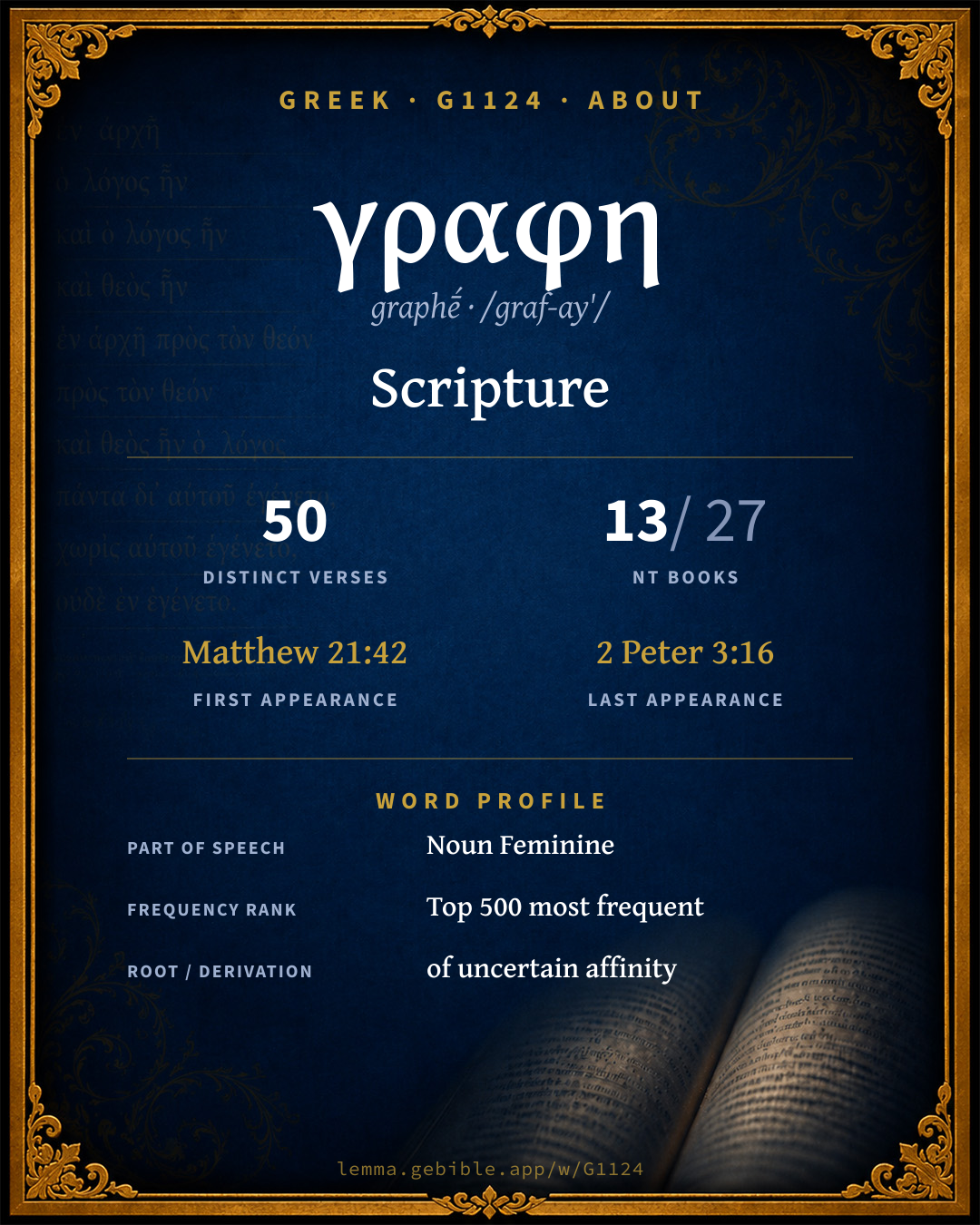
γραφή
Scripture
Thayer's lists 3 entries for ‘Scripture’ fuller range ↓
Full lexicon entry — Thayer's Greek Lexicon
From Thayer's Greek Lexicon
Where this word appears
See every Nominative-case word in the Greek New Testament →
Grammar key — what these labels mean
Part of speech
- Noun
- A naming word — a person, place, thing, or idea.
Case
- Nominative
- The case of the subject (and the predicate nominative).
- Accusative
- The case of the direct object and of extent.
- Dative
- The case of the indirect object, means, or location — “to / for / with / in.”
- Genitive
- The case of source, possession, or “of” — answers “whose / from what.”
Gender
- Feminine
- Grammatically feminine.
Number
- Singular
- One.
- Plural
- More than one.
Grammatical forms
- Noun, Nominative, Singular, Feminine 21 times (42%)
- Noun, Accusative, Plural, Feminine 9 times (18%)
- Noun, Accusative, Singular, Feminine 4 times (8%)
- Noun, Dative, Plural, Feminine 4 times (8%)
- Noun, Genitive, Plural, Feminine 4 times (8%)
- Noun, Genitive, Singular, Feminine 3 times (6%)
- Noun, Nominative, Plural, Feminine 3 times (6%)
- Noun, Dative, Singular, Feminine 2 times (4%)
Parsed forms decoded from the imported morphology (Robinson–Tischendorf, public domain), counted across 50 parsed occurrences — not distinct verses.
Every verse where G1124 appears — 50 distinct verses across 13 books. Click any verse to open its interlinear word-by-word view. Verse text shown in the World English Bible for context — . Each verse’s Greek form is shown with its reference; the English is not keyword-highlighted, since the data carries no word-level English alignment. Use “Compare translations” on any verse to read it across multiple English versions. This concordance covers the Greek New Testament; Septuagint (Greek Old Testament) occurrences of this word are not indexed here.
Matthew 4 verses
- Matthew 21:42 γραφαῖς n dat pl fem Jesus said to them, "Did you never read in the Scriptures, 'The stone which the builders rejected, The same was made the head of the corner. This was from the Lord. It is marvelous in our eyes?'
- Matthew 22:29 γραφὰς n acc pl fem But Jesus answered them, "You are mistaken, not knowing the Scriptures, nor the power of God.
- Matthew 26:54 γραφαὶ n nom pl fem How then would the Scriptures be fulfilled that it must be so?"
- Matthew 26:56 γραφαὶ n nom pl fem But all this has happened, that the Scriptures of the prophets might be fulfilled." Then all the disciples left him, and fled.
Mark 3 verses
- Mark 12:10 γραφὴν n acc sg fem Haven't you even read this Scripture: 'The stone which the builders rejected, The same was made the head of the corner.
- Mark 12:24 γραφὰς n acc pl fem Jesus answered them, "Isn't this because you are mistaken, not knowing the Scriptures, nor the power of God?
- Mark 14:49 γραφαί n nom pl fem I was daily with you in the temple teaching, and you didn't arrest me. But this is so that the Scriptures might be fulfilled."
Luke 4 verses
- Luke 4:21 γραφὴ n nom sg fem He began to tell them, "Today, this Scripture has been fulfilled in your hearing."
- Luke 24:27 γραφαῖς n dat pl fem Beginning from Moses and from all the prophets, he explained to them in all the Scriptures the things concerning himself.
- Luke 24:32 γραφάς n acc pl fem They said one to another, "Weren't our hearts burning within us, while he spoke to us along the way, and while he opened the Scriptures to us?"
- Luke 24:45 γραφάς n acc pl fem Then he opened their minds, that they might understand the Scriptures.
John 12 verses
- John 2:22 γραφῇ n dat sg fem When therefore he was raised from the dead, his disciples remembered that he said this, and they believed the Scripture, and the word which Jesus had said.
- John 5:39 γραφάς n acc pl fem "You search the Scriptures, because you think that in them you have eternal life; and these are they which testify about me.
- John 7:38 γραφή n nom sg fem He who believes in me, as the Scripture has said, from within him will flow rivers of living water."
- John 7:42 γραφὴ n nom sg fem Hasn't the Scripture said that the Christ comes of the seed of David, and from Bethlehem, the village where David was?"
- John 10:35 γραφή n nom sg fem If he called them gods, to whom the word of God came (and the Scripture can't be broken),
- John 13:18 γραφὴ n nom sg fem I don't speak concerning all of you. I know whom I have chosen. But that the Scripture may be fulfilled, 'He who eats bread with me has lifted up his heel against me.'
- John 17:12 γραφὴ n nom sg fem While I was with them in the world, I kept them in your name. Those whom you have given me I have kept. None of them is lost, except the son of destruction, that the Scripture might be fulfilled.
- John 19:24 γραφὴ n nom sg fem Then they said to one another, "Let's not tear it, but cast lots for it to decide whose it will be," that the Scripture might be fulfilled, which says, "They parted my garments among them. For my cloak they cast lots." Therefore the soldiers did these things.
- John 19:28 γραφή n nom sg fem After this, Jesus, seeing that all things were now finished, that the Scripture might be fulfilled, said, "I am thirsty."
- John 19:36 γραφὴ n nom sg fem For these things happened, that the Scripture might be fulfilled, "A bone of him will not be broken."
- John 19:37 γραφὴ n nom sg fem Again another Scripture says, "They will look on him whom they pierced."
- John 20:9 γραφὴν n acc sg fem For as yet they didn't know the Scripture, that he must rise from the dead.
Acts 7 verses
- Acts 1:16 γραφὴν n acc sg fem "Brothers, it was necessary that this Scripture should be fulfilled, which the Holy Spirit spoke before by the mouth of David concerning Judas, who was guide to those who took Jesus.
- Acts 8:32 γραφῆς n gen sg fem Now the passage of the Scripture which he was reading was this, "He was led as a sheep to the slaughter. As a lamb before his shearer is silent, So he doesn't open his mouth.
- Acts 8:35 γραφῆς n gen sg fem Philip opened his mouth, and beginning from this Scripture, preached to him Jesus.
- Acts 17:2 γραφῶν n gen pl fem Paul, as was his custom, went in to them, and for three Sabbath days reasoned with them from the Scriptures,
- Acts 17:11 γραφὰς n acc pl fem Now these were more noble than those in Thessalonica, in that they received the word with all readiness of the mind, examining the Scriptures daily to see whether these things were so.
- Acts 18:24 γραφαῖς n dat pl fem Now a certain Jew named Apollos, an Alexandrian by race, an eloquent man, came to Ephesus. He was mighty in the Scriptures.
- Acts 18:28 γραφῶν n gen pl fem for he powerfully refuted the Jews, publicly showing by the Scriptures that Jesus was the Christ.
Romans 7 verses
- Romans 1:2 γραφαῖς n dat pl fem which he promised before through his prophets in the holy Scriptures,
- Romans 4:3 γραφὴ n nom sg fem For what does the Scripture say? "Abraham believed God, and it was accounted to him for righteousness."
- Romans 9:17 γραφὴ n nom sg fem For the Scripture says to Pharaoh, "For this very purpose I caused you to be raised up, that I might show in you my power, and that my name might be published abroad in all the earth."
- Romans 10:11 γραφή n nom sg fem For the Scripture says, "Whoever believes in him will not be disappointed."
- Romans 11:2 γραφή n nom sg fem God didn't reject his people, which he foreknew. Or don't you know what the Scripture says about Elijah? How he pleads with God against Israel:
- Romans 15:4 γραφῶν n gen pl fem For whatever things were written before were written for our learning, that through patience and through encouragement of the Scriptures we might have hope.
- Romans 16:26 γραφῶν n gen pl fem
1 Corinthians 2 verses
Galatians 3 verses
- Galatians 3:8 γραφὴ n nom sg fem The Scripture, foreseeing that God would justify the Gentiles by faith, preached the Gospel beforehand to Abraham, saying, "In you all the nations will be blessed."
- Galatians 3:22 γραφὴ n nom sg fem But the Scriptures shut up all things under sin, that the promise by faith in Jesus Christ might be given to those who believe.
- Galatians 4:30 γραφή n nom sg fem However what does the Scripture say? "Throw out the handmaid and her son, for the son of the handmaid will not inherit with the son of the free woman."
1 Timothy 1 verse
2 Timothy 1 verse
James 3 verses
- James 2:8 γραφήν n acc sg fem However, if you fulfill the royal law, according to the Scripture, "You shall love your neighbor as yourself," you do well.
- James 2:23 γραφὴ n nom sg fem and the Scripture was fulfilled which says, "Abraham believed God, and it was accounted to him as righteousness;" and he was called the friend of God.
- James 4:5 γραφὴ n nom sg fem Or do you think that the Scripture says in vain, "The Spirit who lives in us yearns jealously"?
1 Peter 1 verse
2 Peter 2 verses
- 2 Peter 1:20 γραφῆς n gen sg fem knowing this first, that no prophecy of Scripture is of private interpretation.
- 2 Peter 3:16 γραφὰς n acc pl fem as also in all of his letters, speaking in them of these things. In those are some things hard to be understood, which the ignorant and unsettled twist, as they also do to the other Scriptures, to their own destruction.
About this entry
At a glance — auto-summarized from this page’s data, not written by a person. Every figure links to its source below. This summary describes the numbers; it doesn’t interpret them.
The Greek name γραφη centers on the idea of “Scripture.” Debuting at Matthew 21:42, it then recurs through the corpus. It appears 50 verses across 13 books of the Greek New Testament, among its moderately common vocabulary. For the data behind this summary, explore 50-verse concordance and the renderings breakdown below.
Gloss history
Strong's 1890 vs modern scholarship
About this word
Strong's G1124 catalogs a Greek word from the Greek New Testament.
These counts are not copied from any lexicon or concordance. They are computed here, from the morphology-tagged Greek New Testament. What Lemma adds →
- 50
- distinct verses
- The word appears in 50 distinct verses.
- 13 / 27
- NT books
- The word appears in 13 of 27 New Testament books.
- #310
- by frequency
- Top 500 most frequent Greek words (rank 310 of 5,347 Greek words by occurrence).
View all 50 occurrences in the concordance →
By section of the New Testament
By traditional corpus
Conventional, traditional groupings — biblical authorship is debated, so this is a traditional corpus grouping, not an authorship claim. Some books belong to more than one corpus (Luke is in both the Gospels and the Lukan corpus, and so on), so these shares overlap and need not total 100%. Each figure is a share of the word’s 50 distinct verses.
- Gospels 23 verses · 46%
- Pauline corpus 14 verses · 28%
- Johannine 12 verses · 24%
- Lukan (Luke–Acts) 11 verses · 22%
- General (Catholic) Epistles 6 verses · 12%
How translations render this word
Counts come from each version’s own published word-to-Strong’s tagging or interlinear alignment — an approximate guide to how each version renders this word, not a word-level alignment the data otherwise carries. Because each total is that version’s own tagged count, the per-version totals vary from one another and need not match the appearance or distinct-verse counts above. These counts may also differ from a printed concordance because Lemma counts each distinctly tagged rendering and does not collapse phrase taggings into a single head-word total. This is a fixed set of word-tagged versions (KJV, ASV, BSB, ULT) and does not change with the reading translation you choose elsewhere. Each version’s license is shown beside its name below (and on Sources).
- King James Version: Scripture 31×, Scriptures 19×
- American Standard Version: Scripture 28×, Scriptures 20×
- Berean Standard Bible: Scripture 30×, Scriptures 18×, Writings 2×
- unfoldingWord Literal Text: Scripture 31×, Scriptures 18×, The 2×
King James Version Public Domain
Renders G1124 across 51 tagged occurrences — most commonly:
Plus 1 rendering that appears only once — usually multi-word phrases or single function words the recovered tagging swept in, not distinct renderings.
American Standard Version Public Domain
Renders G1124 across 48 tagged occurrences — most commonly:
Berean Standard Bible Public Domain
Renders G1124 across 50 tagged occurrences — most commonly:
unfoldingWord Literal Text CC BY-SA 4.0
Renders G1124 across 53 tagged occurrences — most commonly:
Senses in Thayer's
The 3 senses Thayer's distinguishes for this word, in lexicon order (not ranked by frequency or importance). The full entry — with sub-senses — is in the Lexicon Entry tab.
- a writing, thing written
- the Scripture, used to denote either the book itself, or its contents
- a certain portion or section of the Holy Scripture
Word origin
Origin: of uncertain affinity
From G1125 ; a document that is holy Writ (or its contents or a statement in it): - scripture.
— Strong’s Exhaustive Concordance (1890), public domain.
Forms in the corpus
The 12 distinct written forms G1124 takes in the Greek New Testament, most frequent first — each parse links to that case’s occurrences in the concordance.
| Form | Parsing | Example | Uses |
|---|---|---|---|
| γραφὴ graphḕ | Noun, Nominative, Singular, Feminine | Luke 4:21 | 14 |
| γραφή graphḗ | Noun, Nominative, Singular, Feminine | John 7:38 | 7 |
| γραφάς graphás | Noun, Accusative, Plural, Feminine | Luke 24:32 | 5 |
| γραφαῖς graphaîs | Noun, Dative, Plural, Feminine | Matthew 21:42 | 4 |
| γραφὰς graphàs | Noun, Accusative, Plural, Feminine | Matthew 22:29 | 4 |
| γραφῶν graphō̂n | Noun, Genitive, Plural, Feminine | Acts 17:2 | 4 |
| γραφὴν graphḕn | Noun, Accusative, Singular, Feminine | Mark 12:10 | 3 |
| γραφῆς graphē̂s | Noun, Genitive, Singular, Feminine | Acts 8:32 | 3 |
| γραφαὶ graphaì | Noun, Nominative, Plural, Feminine | Matthew 26:54 | 2 |
| γραφῇ graphē̂ | Noun, Dative, Singular, Feminine | John 2:22 | 2 |
| γραφήν graphḗn | Noun, Accusative, Singular, Feminine | James 2:8 | 1 |
| γραφαί graphaí | Noun, Nominative, Plural, Feminine | Mark 14:49 | 1 |
Bible dictionary
Public-domain dictionary articles matched to this entry by name (Scripture). A biblical name can be shared by more than one person or place, so an article may treat several.
Easton's Bible Dictionary · M. G. Easton, 1897
Invariably in the New Testament denotes that definite collection of sacred books, regarded as given by inspiration of God, which we usually call the Old Testament (2 Tim. 3:15, 16; John 20:9; Gal. 3:22; 2 Pet. 1:20). It was God's purpose thus to perpetuate his revealed will. From time to time he raised up men to commit to writing in an infallible record the revelation he gave. The "Scripture," or collection of sacred writings, was thus enlarged from time to time as God saw necessary. We have now a completed "Scripture," consisting of the Old and New Testaments. The Old Testament canon in the time of our Lord was precisely the same as that which we now possess under that name. He placed the seal of his own authority on this collection of writings, as all equally given by inspiration (Matt. 5:17; 7:12; 22:40; Luke 16:29, 31). (See BIBLE; CANON.)
Smith's Bible Dictionary · William Smith, 1863
[See Bible]
Classic public-domain reference works; full attribution on Sources.
Septuagint usage
The same Greek word γραφη appears 28 times in the Greek Old Testament (Septuagint), across 23 verses in 8 books.
- 28
- LXX occurrences
- Tagged occurrences of this Greek word in the Septuagint.
- 23
- verses
- Distinct Septuagint verses containing this word.
- 8 / 39
- OT books
- The word appears in 8 of the 39 Old Testament books.
Sample Septuagint occurrences
- Exodus 32:16 γραφή
- Deuteronomy 10:4 γραφή
- 1 Chronicles 15:15 γραφή
- 2 Chronicles 2:10 γραφή
- Ezra 2:62 γραφή
- Psalms 86:6 γραφή
- Ezekiel 13:9 γραφή
- Daniel 5:6 γραφή
Septuagint occurrences (same lexeme)
Every verse where the same Strong’s number (G1124) appears in the Greek Septuagint. Verse text shown in the World English Bible for context; the Greek form is the matched word — the English is not keyword-highlighted.
- Exodus 32:16 γραφή The tablets were the work of God, and the writing was the writing of God, engraved on the tables.
- Deuteronomy 10:4 γραφή He wrote on the tables, according to the first writing, the ten commandments, which Yahweh spoke to you on the mountain out of the midst of the fire in the day of the assembly: and Yahweh gave them to me.
- 1 Chronicles 15:15 γραφή The children of the Levites bore the ark of God on their shoulders with the poles thereon, as Moses commanded according to the word of Yahweh.
- 1 Chronicles 28:19 γραφή All this, [said David], have I been made to understand in writing from the hand of Yahweh, even all the works of this pattern.
- 2 Chronicles 2:10 γραφή Behold, I will give to your servants, the cutters who cut timber, twenty thousand measures of beaten wheat, and twenty thousand measures of barley, and twenty thousand baths of wine, and twenty thousand baths of oil.
- 2 Chronicles 24:27 γραφή Now concerning his sons, and the greatness of the burdens [laid] on him, and the rebuilding of the house of God, behold, they are written in the commentary of the book of the kings. Amaziah his son reigned in his place.
- 2 Chronicles 30:5 γραφή So they established a decree to make proclamation throughout all Israel, from Beersheba even to Dan, that they should come to keep the Passover to Yahweh, the God of Israel, at Jerusalem: for they had not kept it in great numbers in such sort as it is written.
- 2 Chronicles 30:18 γραφή For a multitude of the people, even many of Ephraim and Manasseh, Issachar and Zebulun, had not cleansed themselves, yet did they eat the Passover otherwise than it is written. For Hezekiah had prayed for them, saying, The good Yahweh pardon everyone
- 2 Chronicles 35:4 γραφή Prepare yourselves after your fathers' houses by your divisions, according to the writing of David king of Israel, and according to the writing of Solomon his son.
- Ezra 2:62 γραφή These sought their register [among] those who were reckoned by genealogy, but they were not found: therefore were they deemed polluted and put from the priesthood.
- Ezra 4:7 γραφή In the days of Artaxerxes wrote Bishlam, Mithredath, Tabeel, and the rest of his companions, to Artaxerxes king of Persia; and the writing of the letter was written in the Syrian [character], and set forth in the Syrian [language].
- Ezra 6:18 γραφή They set the priests in their divisions, and the Levites in their courses, for the service of God, which is at Jerusalem; as it is written in the book of Moses.
- Ezra 7:22 γραφή to one hundred talents of silver, and to one hundred measures of wheat, and to one hundred baths of wine, and to one hundred baths of oil, and salt without prescribing how much.
- Ezra 17:64 γραφή
- Psalms 86:6 γραφή Hear, Yahweh, my prayer. Listen to the voice of my petitions.
- Ezekiel 13:9 γραφή My hand shall be against the prophets who see false visions, and who divine lies: they shall not be in the council of my people, neither shall they be written in the writing of the house of Israel, neither shall they enter into the land of Israel; and you shall know that I am the Lord Yahweh.
- Daniel 5:6 γραφή Then the king's face was changed in him, and his thoughts troubled him; and the joints of his loins were loosened, and his knees struck one against another.
- Daniel 5:7 γραφή The king cried aloud to bring in the enchanters, the Chaldeans, and the soothsayers. The king spoke and said to the wise men of Babylon, Whoever shall read this writing, and show me the interpretation of it, shall be clothed with purple, and have a chain of gold about his neck, and shall be the third ruler in the kingdom.
- Daniel 5:8 γραφή Then came in all the king's wise men; but they could not read the writing, nor make known to the king the interpretation.
- Daniel 5:9 γραφή Then was king Belshazzar greatly troubled, and his face was changed in him, and his lords were perplexed.
- Daniel 5:14 γραφή I have heard of you, that the spirit of the gods is in you, and that light and understanding and excellent wisdom are found in you.
- Daniel 5:15 γραφή Now the wise men, the enchanters, have been brought in before me, that they should read this writing, and make known to me the interpretation of it; but they could not show the interpretation of the thing.
- Daniel 5:17 γραφή Then Daniel answered before the king, Let your gifts be to yourself, and give your rewards to another; nevertheless I will read the writing to the king, and make known to him the interpretation.
These are occurrences of the same Greek lexeme (G1124) in the Septuagint — not a translation of any one Hebrew word. The store carries no word-level Hebrew↔Greek alignment, so no Hebrew original is asserted here. Counts come from the recovered LXX Strong's tagging — high-frequency vocabulary is well covered, while rare or late forms may be untagged — so they reflect tagged occurrences and may slightly undercount.