
Ezra 7:22

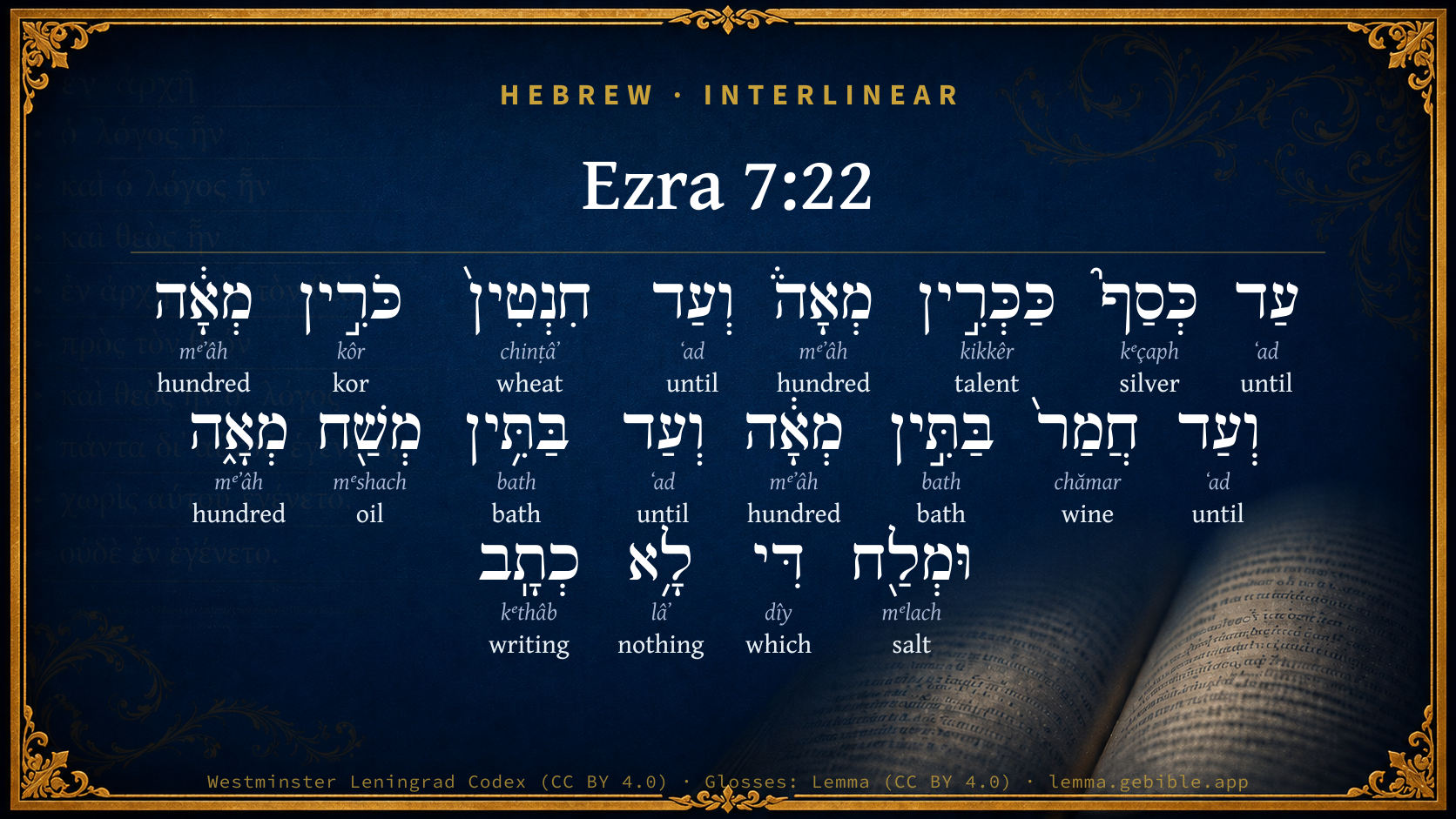
Hebrew (Westminster Leningrad Codex) Ezra 7:22 appears in the Hebrew Old Testament. The text above is from the Westminster Leningrad Codex. Each word links to its Strong’s number, a concise gloss, and parsing drawn from the Open Scriptures Hebrew Bible morphology. Click any word for its full Brown-Driver-Briggs (BDB) entry.
Download image
Cite this verse

Ezra 7:22 (World English Bible). Public Domain. Lemma interlinear Bible study tool, https://lemma.gebible.app/v/ezra/7/22.

Show BibTeX & RIS
BibTeX
RIS
English Translation
to one hundred talents of silver, and to one hundred measures of wheat, and to one hundred baths of wine, and to one hundred baths of oil, and salt without prescribing how much.
World English Bible · Public Domain
Highlights
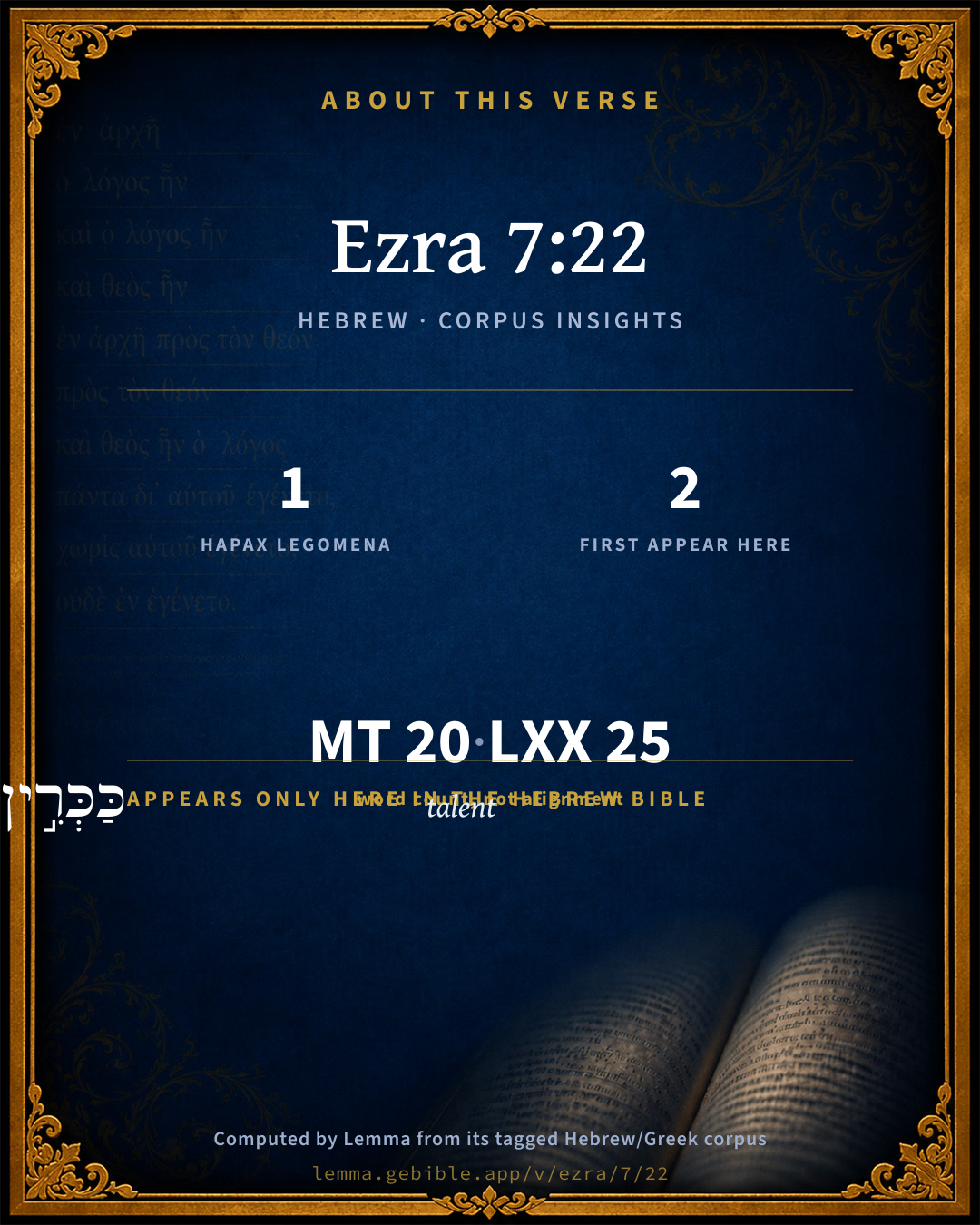
  • 1 hapax legomenon — only here in the Hebrew Bible
  • 2 first appearances in the Hebrew Bible
Full analysis ↓
Download a study sheet

One document with this verse’s original text, its word-by-word gloss line, the meaning frame, cross-references with their text, attributed commentary, and full source and license credits — printable, and it pastes into notes with its structure intact.

This verse Autodidact and up

Study sheet (.html) Plain text (.txt)

A passage Seminary Student

Up to 50 verses in one chapter. A passage sheet keeps up to 6 commentary sources and 12 cross-references per verse, in the order this page ranks them, and says so on the sheet whenever that leaves anything out. Ask for a single verse and you get the Autodidact verse sheet above.

Everything on this page stays free to read, with no account — the sheet is a download of what is already on screen, not access to it.

Want to remove ads? Support Godless Engineer
Compare translations 3

The same verse in 3 English versions, stacked beneath the original-language interlinear above. Click any original word for its lexicon entry.

Each is an independent rendering of the whole verse — the interlinear is not word-aligned to these translations.

Highlighted words mark where these versions differ — a whole-verse word diff, not a word-by-word alignment.

  • World English Bible Public Domain
    to one hundred talents of silver, and to one hundred measures of wheat, and to one hundred baths of wine, and to one hundred baths of oil, and salt without prescribing how much.
  • King James Version Public Domain
    Unto an hundred talents of silver, and to an hundred measures of wheat, and to an hundred baths of wine, and to an hundred baths of oil, and salt without prescribing how much.
  • unfoldingWord Literal Text CC BY-SA 4.0
    as much as 100 silver kikkars, and as much as 100 cors of wheat, and as much as 100 baths of wine, and as much as 100 baths of oil, and salt which is not written.

unfoldingWord Literal Text — © unfoldingWord, licensed CC BY-SA 4.0. Word-aligned USFM3 via Door43 (git.door43.org/unfoldingWord/en_ult).

Versions to compare (up to 4)

3 of 4 selected

Show all 18 translations

Every available English version of this verse, each an independent rendering of the whole verse.

  • World English Bible Public Domain
    to one hundred talents of silver, and to one hundred measures of wheat, and to one hundred baths of wine, and to one hundred baths of oil, and salt without prescribing how much.
  • Berean Standard Bible Public Domain
    up to a hundred talents of silver, a hundred cors of wheat, a hundred baths of wine, a hundred baths of olive oil, and salt without limit.
  • Majority Standard Bible Public Domain
    up to a hundred talents of silver, a hundred cors of wheat, a hundred baths of wine, a hundred baths of olive oil, and salt without limit.
  • King James Version Public Domain
    Unto an hundred talents of silver, and to an hundred measures of wheat, and to an hundred baths of wine, and to an hundred baths of oil, and salt without prescribing how much.
  • American Standard Version (1901) Public Domain
    unto a hundred talents of silver, and to a hundred measures of wheat, and to a hundred baths of wine, and to a hundred baths of oil, and salt without prescribing how much.
  • Revised Version (1885) Public Domain
    unto an hundred talents of silver, and to an hundred measures of wheat, and to an hundred baths of wine, and to an hundred baths of oil, and salt without prescribing how much.
  • Geneva Bible (1599) Public Domain
    Vnto an hundreth talents of siluer, vnto an hundreth measures of wheate, and vnto an hundreth baths of wine, and vnto an hundreth baths of oyle, and salt without writing.
  • Douay-Rheims (1899) Public Domain
    Unto a hundred talents of silver, and unto a hundred cores of wheat, and unto a hundred bates of wine, and unto a hundred bates of oil, and salt without measure.
  • Young's Literal Translation Public Domain
    Unto silver a hundred talents, and unto wheat a hundred cors, and unto wine a hundred baths, and unto oil a hundred baths, and salt without reckoning;
  • Literal Standard Version CC BY-SA 4.0
    To silver one hundred talents, and to wheat one hundred cors, and to wine one hundred baths, and to oil one hundred baths, and salt without reckoning;
  • Unlocked Literal Bible CC BY-SA 4.0
    up to one hundred silver talents, one hundred cors of grain, one hundred baths of wine, and one hundred baths of oil, also salt without limit.
  • unfoldingWord Literal Text CC BY-SA 4.0
    as much as 100 silver kikkars, and as much as 100 cors of wheat, and as much as 100 baths of wine, and as much as 100 baths of oil, and salt which is not written.
  • Darby Bible Public Domain
    unto a hundred talents of silver, and to a hundred measures of wheat, and to a hundred baths of wine, and to a hundred baths of oil, and salt without prescribing [how much].
  • World Messianic Bible Public Domain
    up to one hundred talents of silver, and to one hundred cors of wheat, and to one hundred baths of wine, and to one hundred baths of oil, and salt without prescribing how much.
  • Webster's Bible Public Domain
    To a hundred talents of silver, and to a hundred measures of wheat, and to a hundred baths of wine, and to a hundred baths of oil, and salt without prescribing how much.
  • Free Bible Version CC BY-SA 4.0
    up to one hundred talents of silver, one hundred cors of wheat, one hundred baths of wine, one hundred baths of olive oil, and unrestricted amounts of salt.
  • Bible in Basic English Public Domain
    Up to a hundred talents of silver, a hundred measures of grain, a hundred measures of wine, and a hundred measures of oil, and salt without measure.
  • JPS Tanakh (1917) Public Domain
    unto a hundred talents of silver, and to a hundred measures of wheat, and to a hundred baths of wine, and to a hundred baths of oil, and salt without prescribing how much.

Literal Standard Version (2020), Covenant Press — licensed CC BY-SA 4.0. Text via the HelloAO Bible API (eBible.org). Unlocked Literal Bible (unfoldingWord) — licensed CC BY-SA 4.0. Text via the HelloAO Bible API (eBible.org). unfoldingWord Literal Text — © unfoldingWord, licensed CC BY-SA 4.0. Word-aligned USFM3 via Door43 (git.door43.org/unfoldingWord/en_ult). Free Bible Version, Dr. Jonathan Gallagher — licensed CC BY-SA 4.0. Text via the HelloAO Bible API (eBible.org).

Word by word

More ways to search: Search by grammar → Find every occurrence → Compare this word →

Practice this passage: Drill this verse → Learn its vocabulary →

כַּכְּרִ֣ין
kikkêr
H3604
“talents”
Adjective, N, Common
Part of Speech
Adjective
Gender
Common
Full BDB Definition

Origin: corresponding to H3603

TWOT: 2804a

talent
  1. עַד ʻad H5705 “until” Adjective, R
  2. כְּסַף֮ kᵉçaph H3702 “silver” Adjective, N, Common
  3. מְאָה֒ mᵉʼâh H3969 “hundred” Adjective, A, Common
  4. וְעַד ʻad H5705 “and · until” Adjective, C + Preposition
  5. חִנְטִין֙ chinṭâʼ H2591 “wheat” Adjective, N, Common
  6. כֹּרִ֣ין kôr H3734 “kors” Adjective, N, Common
  7. מְאָ֔ה mᵉʼâh H3969 “hundred” Adjective, A, Common
  8. וְעַד ʻad H5705 “and · until” Adjective, C + Preposition
  9. חֲמַר֙ chămar H2562 “wine” Adjective, N, Common
  10. בַּתִּ֣ין bath H1325 “baths” Adjective, N, Common
  11. מְאָ֔ה mᵉʼâh H3969 “hundred” Adjective, A, Common
  12. וְעַד ʻad H5705 “and · until” Adjective, C + Preposition
  13. בַּתִּ֥ין bath H1325 “baths” Adjective, N, Common
  14. מְשַׁ֖ח mᵉshach H4887 “oil” Adjective, N, Common
  15. מְאָ֑ה mᵉʼâh H3969 “hundred” Adjective, A, Common
  16. וּמְלַ֖ח mᵉlach H4416 “and · salt” Adjective, C + Noun, Common, Masculine, Singular, Absolute
  17. דִּי dîy H1768 “which” Adjective, T
  18. לָ֥א lâʼ H3809 “nothing” Adjective, T
  19. כְתָֽב kᵉthâb H3792 “writing” Adjective, N, Common

About this verse

These counts appear in no published source. They are computed here, from the morphology-tagged text and Lemma’s own curated glosses. What Lemma adds →

20
words
13
distinct lemmas
Historical
section

Notable vocabulary

1 hapax legomenon — a word that appears only here in the entire Hebrew Bible:

  • כַּכְּרִ֣ין talent H3604

First appearance in Scripture

These words make their first canonical appearance in the Hebrew Bible here:

  • כַּכְּרִ֣ין talent H3604
  • בַּתִּ֣ין bath H1325

Shared distinctive vocabulary

חִנְטִין֙ wheat H2591 occurs in 2 verses of the Hebrew Bible. Also found in:

Grammatical profile

  • 1 noun
  • 16 adjectives
  • 3 prepositions

Repetition

Words recur within this verse — often emphatic in Hebrew:

  • עַד until H5705 ×4
  • מְאָה֒ hundred H3969 ×4
  • בַּתִּ֣ין bath H1325 ×2

Hebrew & Septuagint length

In English translation the verse runs 33 words from the Hebrew and 31 from the Septuagint (LXX English) — closely comparable.

A rough comparison of the two English renderings, which tokenize alike — not a word-level alignment.

Word counts can differ between the Hebrew and the Greek without any difference in meaning — e.g. the Hebrew direct-object marker אֵת has no separate Greek word, and Greek often adds the article ὁ.

In the original languages it is 20 Hebrew tokens and 25 Greek tokens — but the two are counted differently (Hebrew bundles its prefixes and suffixes into one token; the Greek is in lemma form), so that isn’t a like-for-like length.

Cross-references

3

Topical passages linked to Ezra 7:22 in the Treasury of Scripture Knowledge — connected by theme and wording, ordered by reader-vote popularity; previews shown in the World English Bible.

  • Leviticus 2:13 Every offering of your meal offering you shall season with salt; neither shall you allow the salt of the covenant of your God to be lacking from your meal offering. With all your offerings you shall offer salt.
  • Ezekiel 45:14 and the set portion of oil, of the bath of oil, the tenth part of a bath out of the cor, [which is] ten baths, even a homer; (for ten baths are a homer;)
  • Luke 16:6–7 He said, 'A hundred batos of oil.' He said to him, 'Take your bill, and sit down quickly and write fifty.'

Cross-references courtesy of OpenBible.info (CC BY 4.0).

Hebrew and Greek witnesses Masoretic Hebrew ↔ Greek Septuagint

The same verse in the two great witnesses to the Old Testament, shown verse-for-verse.

These are two independent witnesses, not word-aligned to each other, and the Septuagint is shown in lemma (dictionary) form.

Hebrew Ezra 7:22 Masoretic · Westminster Leningrad Codex

עַד כְּסַף֮ כַּכְּרִ֣ין מְאָה֒ וְעַד חִנְטִין֙ כֹּרִ֣ין מְאָ֔ה וְעַד חֲמַר֙ בַּתִּ֣ין מְאָ֔ה וְעַד בַּתִּ֥ין מְשַׁ֖ח מְאָ֑ה וּמְלַ֖ח דִּי לָ֥א כְתָֽב

to one hundred talents of silver, and to one hundred measures of wheat, and to one hundred baths of wine, and to one hundred baths of oil, and salt without prescribing how much.

World English Bible · Public Domain

Greek LXX Ezra 7:22 Septuagint · lemma form

ἕως ἀργύριον ταλάντον ἑκατόν καί ἕως πυρός κόρος ἑκατόν καί ἕως οἶνος βάδος ἑκατόν καί ἕως ἔλαιον βάδος ἑκατόν καί ἅλς ὅς οὐ εἰμί γραφή

to the amount of one hundred talents of silver, and one hundred measures of wheat, and one hundred baths of wine, and one hundred baths of oil, and salt without reckoning.

LXX2012 (modern English Septuagint) · Public Domain

In the Septuagint this is one book — Esdras B (2 Esdras): Ezra is chapters 1–10, Nehemiah 11–23.

On this verse, The Cambridge Bible for Schools and Colleges discusses the Septuagint’s reading. Read the note in Commentary ↓

Hebrew: Westminster Leningrad Codex (CC BY 4.0). Greek: Septuagint (public domain); English from LXX2012 (modern English Septuagint) (Public Domain). How the Septuagint differs from the Hebrew →

Commentary

Notes on Ezra 7:22 from classic Christian and Jewish commentators (each source and its license shown beneath its notes). The classic Christian expositions comment on the surrounding passage and are grouped to its opening verse, so a note may address several verses; the Jewish commentaries on the Tanakh (Rashi and others) are per-verse, so they appear only where the commentator wrote on this verse.

Lemma curates 59 commentaries, every one of them public domain or Creative Commons licensed, each selected and text-cleaned for this edition rather than reprinted as found. About our sources →

Trapp's Complete Commentary

John Trapp

Ezr 7:22 Unto an hundred talents of silver, and to an hundred measures of wheat, and to an hundred baths of wine, and to an hundred baths of oil, and salt without prescribing [how much].

Ver. 22. Unto an hundred talents of silver] This was no small sum. How chargeable was the service of God heretofore to what it is now! and yet how heavily do men come off when to expend though but a very small sum that way! Ad quid perditio haec? To what end is this waste? is the common cry in this case. Surely Pagans and Papagans who lavish money out of the bag without measure, dotantque Deos alienos (as some read that text, Psa 16:3), shall have an easier judgment than such pinch penny professors.

John Trapp, A Commentary or Exposition upon All the Books of the Old and New Testament (1647–1656) — public domain. Text from a community e-Sword module.

Joseph Benson's Commentary

Ezr 7:22. Salt, without prescribing how much — He limits all the other expenses, except salt, which was of low price, and of very common and necessary use in all their sacrifices; and therefore, since he would not have any sacrifice hindered, he did not prescribe any measure of it, but permitted them to take as much as they found necessary. The sum here ordered, in silver, amounts to thirty-five thousand three hundred pounds sterling; the wheat to eight hundred bushels; the wine to twelve or thirteen hogsheads; and the oil to the same quantity, which shows the princely liberality of Artaxerxes.

Joseph Benson's Commentary on the Old and New Testaments (1811–1818) — public domain. Text from a community e-Sword module.

Geneva Bible (1599)

Geneva Bible translators

Hebrew, Corim.

Read 1 Kings 7:26; 2 Chron. 2:10.

Geneva Bible (1599) marginal notes — public domain. Text via Bolls.life.

Jamieson, Fausset & Brown

Robert Jamieson, A. R. Fausset & David Brown

an hundred talents of silver--£22,000 according to the rate of the silver talent of Babylon. Fourthly, Artaxerxes gave his royal sanction in the establishment of the divine law, which exempted priests and Levites from taxation or tribute and confirmed to them the exclusive right to officiate in the sacred services of the sanctuary. And, finally, in the expression of the king's desire for the divine blessing upon the king and his government (Ezr 7:23), we see the strong persuasion which pervaded the Persian court, and had been produced by the captivity of the Hebrew people, as to the being and directing providence of the God they worshipped. It will be observed, however, that the commission related exclusively to the rebuilding of the temple--not of the walls. The Samaritans (Ezr 4:20-22) had succeeded in alarming the Persian court by their representations of the danger to the empire of fortifying a city notorious for the turbulent character of its inhabitants and the prowess of its kings.

Jamieson, Fausset & Brown — Commentary Critical and Explanatory on the Whole Bible (1871) — public domain (CC PDM 1.0). Text via the HelloAO Bible API.

Adam Clarke's Commentary

Verse 22. A hundred talents of silver] The talent of silver was 450£.

A hundred measures of wheat] A hundred cors; each cor was a little more than seventy-five gallons, one quart, and a pint, wine measure.

A hundred baths of wine] Each bath was seven gallons and five pints.

Adam Clarke's Commentary on the Bible (1810–1826) — public domain. Text from a community e-Sword/MySword module.

Ellicott's Commentary for English Readers

(22) Unto an hundred talents of silver . . .—A certain restriction is laid upon the amount, although the very restriction seems almost indefinite. The silver might reach £24,000 sterling. As to the rest, Palestine abounded in these productions, which were regularly remitted to the king’s service. Salt especially was plentiful near the Dead Sea.

A Bible Commentary for English Readers, edited by Charles John Ellicott (1878–1897) — public domain. Text from a community e-Sword module.

The Cambridge Bible for Schools and Colleges

gen. ed. J. J. S. Perowne

22. unto an hundred talents of silver] or £37, 500. Money reckoned by weight. A ‘kikkar’ or talent of silver was of value about £375. A talent contained 60 manim or 3000 shekels, cf. on Ezr_2:69.

an hundred measures of wheat] The ‘measure’ or ‘cor’, equivalent to 8 bushels or 1 quarter. We learn from Eze_45:14 that the ‘cor’ contained 10 ‘baths’ and was the same as the ‘homer’, see also 1Ki_4:22; 1Ki_5:11; 2Ch_2:10; 2Ch_27:5.

an hundred baths of wine] The ‘bath’ contained 6 or 7 gallons (= hins).

salt without prescribing how much] The importance of salt in the sacrificial system appears from Lev_2:13 ‘And every oblation of thy meat offering shalt thou season with salt, neither shalt thou suffer the salt of the covenant of thy God to be lacking from thy meat offering: with all thine oblations thou shalt offer salt’, cf. Ezr_6:9; Eze_43:24. The translation of the A.V. and R.V. gives the general sense of the original (= ‘which is not written’); LXX. οὗ οὔκ ἐστιν γραφή. The Vulg. ‘absque mensura’.

The Cambridge Bible for Schools and Colleges (gen. ed. J. J. S. Perowne; Cambridge University Press, 1878–1918) — public domain. Text from a community e-Sword module.

John Gill's Exposition

Also we certify you, that touching any of the priests and Levites, singers, porters, Nethinims, or ministers of this house of God,.... The king had a right and perfect knowledge of the distinct offices and services of those persons, see Ezr 7:7,

it shall not be lawful to impose toll, tribute, or custom, upon them; that they might be the less encumbered with the affairs of life, and be more at leisure to attend divine service, and do it the more readily and freely; it was usual with the Heathens to except ecclesiastics from taxes, tributes, and imposts; so the priests in Egypt (w), and the Druids here in Britain (x).

(w) Diodor. Sicul. l. 1. p. 66. (x) Caesar. Comment. de Bello Gall. l. 6. c. 13.

John Gill's Exposition of the Whole Bible (1746–1763) — public domain (CC PDM 1.0). Text via the HelloAO Bible API.

Albert Barnes' Notes on the Bible

This verse assigns limits to the permission of Ezr 7:20. As the Persian tribute was paid partly in money and partly in kind (see Ezr 4:13 note), the treasuries would be able to supply them as readily as they could furnish money.

Albert Barnes' Notes on the Bible (1834–1885) — public domain. Text from a community e-Sword/MySword module.

Haydock's Catholic Bible Commentary

CHAPTER VII.

Salt was used in all the sacrifices, Leviticus ii. 13. In 3 Esdras no mention is made of oil or salt; but we read, "and all other things in abundance."

George Leo Haydock (1774–1849), Haydock's Catholic Family Bible and Commentary, 1859 edition — public domain. Excludes Psalms (Douay-Rheims chapter numbering differs from Protestant) and Deuterocanonical books (Catholic canon only).

Matthew Poole's English Annotations

Because it was but of mean price, and of very common and necessary use in all their sacrifices, Lev 2:13; Mar 9:49.

Matthew Poole's English Annotations on the Holy Bible (1683–1685) — public domain. Text from a community e-Sword/MySword module.

Whedon's Commentary on the Bible

Daniel D. Whedon

22. A hundred talents of silver — About one hundred and sixty-six thousand dollars.

A hundred measures of wheat — Or a hundred cors, about one thousand one hundred bushels.

A hundred baths — Nearly eight hundred and seventy-five gallons, or more than fifteen hogsheads.

Salt without prescribing — “The enemies of God’s Church had before said that they were salted with the salt of the palace, (Ezr_4:14, margin,) but now the king’s decree gives salt without measure to Ezra and his company.” — Wordsworth.

Daniel D. Whedon (gen. ed.), Commentary on the Old and New Testaments (1874–1909) — public domain. Text from a community e-Sword module.

The Pulpit Commentary

Unto a hundred talents of silver. At the lowest estimate of the Jewish silver talent, this would be a permission to draw on the royal treasury to the amount of sterling. If we adopt the views of Mr. R.S. Peele ("Dict. of the Bible, Articles, MONEY and WEIGHTS AND MEASURES), it would authorise drawing to the amount of A hundred measures of wheat. Literally, "a hundred cors of wheat," as given in the margin. The cor is variously estimated, at 44.25 gallons and at 86.67 gallons. It contained ten baths. Orders on the treasury for so much wheat, wine, oil, and salt sound strangely in modern ears; but were natural enough in the Persian system, where taxation was partly in kind, and every province had to remit to the court the choicest portion of its produce. Wine, corn, oil, and salt were all of them produced abundantly in Palestine, which was "a land of corn and wine, a land of bread and vineyards, a land of off olive, and of honey", (2Ki_18:32) and which, in the region about the Dead Sea, abounded with salt.

The Pulpit Commentary (1880–1919), ed. H.D.M. Spence-Jones & Joseph S. Exell — public domain. Text from a community e-Sword module.

Rashi

Rabbi Shlomo Yitzchaki (Rashi)

which is not written And salt, regarding which no measure is written, they shall give according to how much is needed.

Rashi on the Tanakh — English translations: “The Judaica Press complete Tanach with Rashi, translated by A. J. Rosenberg” (CC BY 4.0); “Pentateuch with Rashi's commentary by M. Rosenbaum and A.M. Silbermann, 1929-1934” (public domain); “The Metsudah Tanach series, Lakewood, N.J” (CC BY 4.0); and “The Book of Joshua, Metsudah Publications, 1997” (CC BY 4.0). Text via Sefaria.

Lesson kit

Teaching starters — assembled from the data on this page, not authored interpretation. Every prompt links to the verse data it draws on. Edit before teaching.

Ezra, in the Historical, opens this verse with 20 words (13 distinct Hebrew lemmas). Its most distinctive word is kikkêr (“talent”). A historical commentator’s framing appears above. Read the whole chapter for the surrounding context.

Discussion questions

  1. How does “talent” (kikkêr) shape what this verse is saying?
  2. 1 word here appears nowhere else in the Hebrew Bible. Why might the author reach for such rare wording?
  3. 2 words make their first appearance in Scripture here. What does this debut establish?
  4. How does Ezra 6:9, which shares the word «wheat», read alongside this verse?
  5. What does the repetition of “until” (4× in this one verse) do in this verse?
  6. These translations render this verse differently; the difference is in the English rendering, not the original. What questions does that raise?
  7. Compare how Trapp's Complete Commentary and Joseph Benson's Commentary read this verse. Where do they agree or differ?

Things to notice

  • 1 word in this verse appears nowhere else in the Hebrew Bible.
  • 2 words make their first canonical appearance in Scripture here.
  • This verse counts 20 Hebrew ↔ 25 Greek words.
  • These translations choose different wording for 12 words in this verse.
  • “until” occurs 4× in this single verse.

Reading settings

Reading text

Shown beneath each verse's original-language words.

Old Testament
Old Testament edition

Read the OT as the Masoretic Hebrew (MT) or the Greek Septuagint (LXX).

English shown for the Greek Septuagint (in the Hebrew ↔ Greek comparison).

Comparing translations? Open the Compare panel on any verse page to stack up to four side by side.