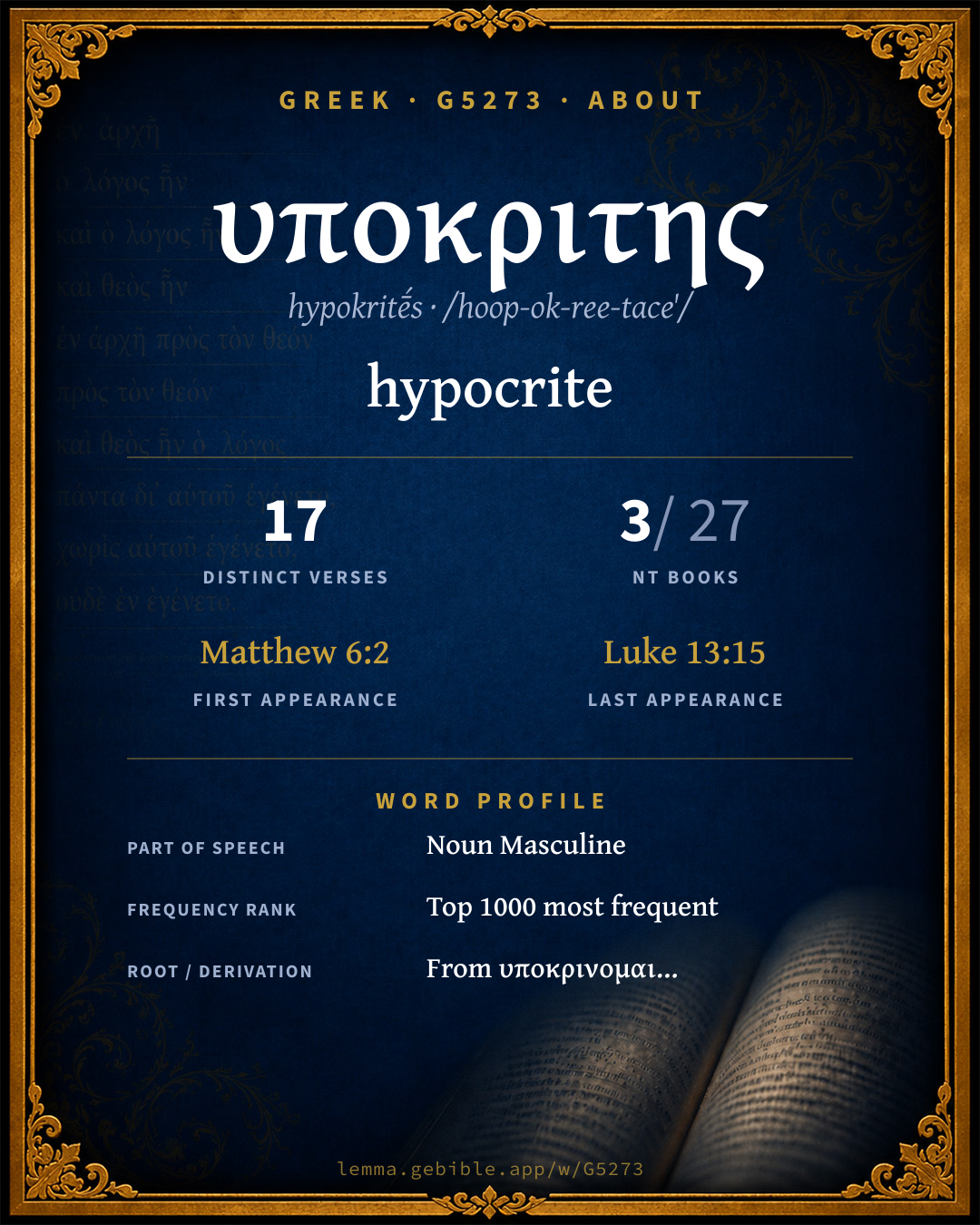
ὑποκριτής
hypocrite
‘hypocrite’ is one of 3 main senses fuller range ↓
Full lexicon entry — Thayer's Greek Lexicon
From Thayer's Greek Lexicon
Where this word appears
See every Vocative-case word in the Greek New Testament →
Grammar key — what these labels mean
Part of speech
- Noun
- A naming word — a person, place, thing, or idea.
Case
- Vocative
- The case of direct address (“O Lord”).
- Nominative
- The case of the subject (and the predicate nominative).
- Genitive
- The case of source, possession, or “of” — answers “whose / from what.”
Gender
- Masculine
- Grammatically masculine.
Number
- Plural
- More than one.
- Singular
- One.
Grammatical forms
- Noun, Vocative, Plural, Masculine 10 times (59%)
- Noun, Nominative, Plural, Masculine 3 times (18%)
- Noun, Genitive, Plural, Masculine 2 times (12%)
- Noun, Vocative, Singular, Masculine 2 times (12%)
Parsed forms decoded from the imported morphology (Robinson–Tischendorf, public domain), counted across 17 parsed occurrences — not distinct verses.
Every verse where G5273 appears — 17 distinct verses across 3 books. Click any verse to open its interlinear word-by-word view. Verse text shown in the World English Bible for context — . Each verse’s Greek form is shown with its reference; the English is not keyword-highlighted, since the data carries no word-level English alignment. Use “Compare translations” on any verse to read it across multiple English versions. This concordance covers the Greek New Testament; Septuagint (Greek Old Testament) occurrences of this word are not indexed here.
Matthew 13 verses
- Matthew 6:2 ὑποκριταὶ n nom pl masc Therefore when you do merciful deeds, don't sound a trumpet before yourself, as the hypocrites do in the synagogues and in the streets, that they may get glory from men. Most assuredly I tell you, they have received their reward.
- Matthew 6:5 ὑποκριταί n nom pl masc "When you pray, you shall not be as the hypocrites, for they love to stand and pray in the synagogues and in the corners of the streets, that they may be seen by men. Most assuredly, I tell you, they have received their reward.
- Matthew 6:16 ὑποκριταὶ n nom pl masc "Moreover when you fast, don't be like the hypocrites, with sad faces. For they disfigure their faces, that they may be seen by men to be fasting. Most assuredly I tell you, they have received their reward.
- Matthew 7:5 ὑποκριτά n voc sg masc You hypocrite! First remove the beam out of your own eye, and then you can see clearly to remove the speck out of your brother's eye.
- Matthew 15:7 ὑποκριταί n voc pl masc You hypocrites! Well did Isaiah prophesy of you, saying,
- Matthew 22:18 ὑποκριταί n voc pl masc But Jesus perceived their wickedness, and said, "Why do you test me, you hypocrites?
- Matthew 23:13 ὑποκριταί n voc pl masc "Woe to you, scribes and Pharisees, hypocrites! For you devour widows' houses, and as a pretense you make long prayers. Therefore you will receive greater condemnation.
- Matthew 23:15 ὑποκριταί n voc pl masc Woe to you, scribes and Pharisees, hypocrites! For you travel around by sea and land to make one proselyte; and when he becomes one, you make him twice as much of a son of Gehenna as yourselves.
- Matthew 23:23 ὑποκριταί n voc pl masc "Woe to you, scribes and Pharisees, hypocrites! For you tithe mint, dill, and cumin, and have left undone the weightier matters of the law: justice, mercy, and faith. But you ought to have done these, and not to have left the other undone.
- Matthew 23:25 ὑποκριταί n voc pl masc "Woe to you, scribes and Pharisees, hypocrites! For you clean the outside of the cup and of the platter, but within they are full of extortion and unrighteousness.
- Matthew 23:27 ὑποκριταί n voc pl masc "Woe to you, scribes and Pharisees, hypocrites! For you are like whitened tombs, which outwardly appear beautiful, but inwardly are full of dead men's bones, and of all uncleanness.
- Matthew 23:29 ὑποκριταί n voc pl masc "Woe to you, scribes and Pharisees, hypocrites! For you build the tombs of the prophets, and decorate the tombs of the righteous,
- Matthew 24:51 ὑποκριτῶν n gen pl masc and will cut him in pieces, and appoint his portion with the hypocrites; there is where the weeping and grinding of teeth will be.
Mark 1 verse
Luke 3 verses
- Luke 6:42 ὑποκριτά n voc sg masc Or how can you tell your brother, 'Brother, let me remove the speck of chaff that is in your eye,' when you yourself don't see the beam that is in your own eye? You hypocrite! First remove the beam from your own eye, and then you can see clearly to remove the speck of chaff that is in your brother's eye.
- Luke 12:56 ὑποκριταί n voc pl masc You hypocrites! You know how to interpret the appearance of the earth and the sky, but how is it that you don't interpret this time?
- Luke 13:15 ὑποκριταί n voc pl masc Therefore the Lord answered him, "You hypocrites! Doesn't each one of you free his ox or his donkey from the stall on the Sabbath, and lead him away to water?
About this entry
At a glance — auto-summarized from this page’s data, not written by a person. Every figure links to its source below. This summary describes the numbers; it doesn’t interpret them.
At its core, υποκριτης (hypokritḗs) means “hypocrite.” The word gravitates to Matthew (76%), then Luke and Mark. It turns up in 17 verses across 3 books, an uncommon footprint. Catalogued under 3 senses, its meaning is not single-sense. Older and newer Bibles part ways — “hypocrites” in the King James Version, “you hypocrites” (Berean Standard Bible) in modern versions. See the renderings breakdown. Each statement above links to its evidence; the full detail follows below.
Gloss history
Strong's 1890 vs modern scholarship
About this word
Strong's G5273 catalogs a Greek word from the Greek New Testament.
These counts are not copied from any lexicon or concordance. They are computed here, from the morphology-tagged Greek New Testament. What Lemma adds →
- 17
- distinct verses
- The word appears in 17 distinct verses.
- 3 / 27
- NT books
- The word appears in 3 of 27 New Testament books.
- #697
- by frequency
- Top 1000 most frequent Greek words (rank 697 of 5,347 Greek words by occurrence).
View all 17 occurrences in the concordance →
By section of the New Testament
By traditional corpus
Conventional, traditional groupings — biblical authorship is debated, so this is a traditional corpus grouping, not an authorship claim. Some books belong to more than one corpus (Luke is in both the Gospels and the Lukan corpus, and so on), so these shares overlap and need not total 100%. Each figure is a share of the word’s 17 distinct verses.
- Gospels 17 verses · 100%
- Lukan (Luke–Acts) 3 verses · 18%
How translations render this word
Counts come from each version’s own published word-to-Strong’s tagging or interlinear alignment — an approximate guide to how each version renders this word, not a word-level alignment the data otherwise carries. Because each total is that version’s own tagged count, the per-version totals vary from one another and need not match the appearance or distinct-verse counts above. These counts may also differ from a printed concordance because Lemma counts each distinctly tagged rendering and does not collapse phrase taggings into a single head-word total. This is a fixed set of word-tagged versions (KJV, ASV, BSB, ULT) and does not change with the reading translation you choose elsewhere. Each version’s license is shown beside its name below (and on Sources).
- King James Version: Hypocrites 13×, Ye hypocrites 4×, Thou hypocrite 3×
- American Standard Version: Hypocrites 11×, Ye hypocrites 4×, Thou hypocrite 2×
- Berean Standard Bible: You hypocrites 9×, Hypocrites 6×
- unfoldingWord Literal Text: Hypocrites 16×, You hypocrite 2×
King James Version Public Domain
Renders G5273 across 20 tagged occurrences — most commonly:
American Standard Version Public Domain
Renders G5273 across 18 tagged occurrences — most commonly:
Plus 1 rendering that appears only once — usually multi-word phrases or single function words the recovered tagging swept in, not distinct renderings.
Berean Standard Bible Public Domain
Renders G5273 across 17 tagged occurrences — most commonly:
Plus 2 renderings that appear only once — usually multi-word phrases or single function words the recovered tagging swept in, not distinct renderings.
unfoldingWord Literal Text CC BY-SA 4.0
Renders G5273 across 18 tagged occurrences — most commonly:
Senses in Thayer's
The 3 senses Thayer's distinguishes for this word, in lexicon order (not ranked by frequency or importance). The full entry — with sub-senses — is in the Lexicon Entry tab.
- one who answers, an interpreter
- an actor, stage player
- a dissembler, pretender, hypocrite
Word origin
Derived from υποκρινομαι (hypokrínomai) (G5271) — to pretend.
From G5271 ; an actor under an assumed character ( stage player ) that is (figuratively) a dissembler (hypocrite): - hypocrite.
— Strong’s Exhaustive Concordance (1890), public domain.
Forms in the corpus
The 4 distinct written forms G5273 takes in the Greek New Testament, most frequent first — each parse links to that case’s occurrences in the concordance.
| Form | Parsing | Example | Uses |
|---|---|---|---|
| ὑποκριταί hypokritaí | Noun, Vocative, Plural, Masculine | Matthew 15:7 | 11 |
| ὑποκριτά hypokritá | Noun, Vocative, Singular, Masculine | Matthew 7:5 | 2 |
| ὑποκριταὶ hypokritaì | Noun, Nominative, Plural, Masculine | Matthew 6:2 | 2 |
| ὑποκριτῶν hypokritō̂n | Noun, Genitive, Plural, Masculine | Matthew 24:51 | 2 |
Same root — word family
Other Thayer's entries built from the same root as G5273, grouped by Strong’s listed origin. These share a root / origin per the lexicon — not necessarily a shared meaning. Each links to that word’s own entry.
Derives from
Shares the same root
Compare all same-root words → They share a root, not necessarily a meaning.
Septuagint usage
The same Greek word υποκριτης appears 2 times in the Greek Old Testament (Septuagint), across 2 verses in 1 book.
- 2
- LXX occurrences
- Tagged occurrences of this Greek word in the Septuagint.
- 2
- verses
- Distinct Septuagint verses containing this word.
- 1 / 39
- OT books
- The word appears in 1 of the 39 Old Testament books.
Sample Septuagint occurrences
- Job 34:30 ὑποκριτής
Septuagint occurrences (same lexeme)
Every verse where the same Strong’s number (G5273) appears in the Greek Septuagint. Verse text shown in the World English Bible for context; the Greek form is the matched word — the English is not keyword-highlighted.
- Job 34:30 ὑποκριτής That the godless man may not reign, That there be no one to ensnare the people.
- Job 36:13 ὑποκριτής "But those who are godless in heart lay up anger. They don't cry for help when he binds them.
These are occurrences of the same Greek lexeme (G5273) in the Septuagint — not a translation of any one Hebrew word. The store carries no word-level Hebrew↔Greek alignment, so no Hebrew original is asserted here. Counts come from the recovered LXX Strong's tagging — high-frequency vocabulary is well covered, while rare or late forms may be untagged — so they reflect tagged occurrences and may slightly undercount.