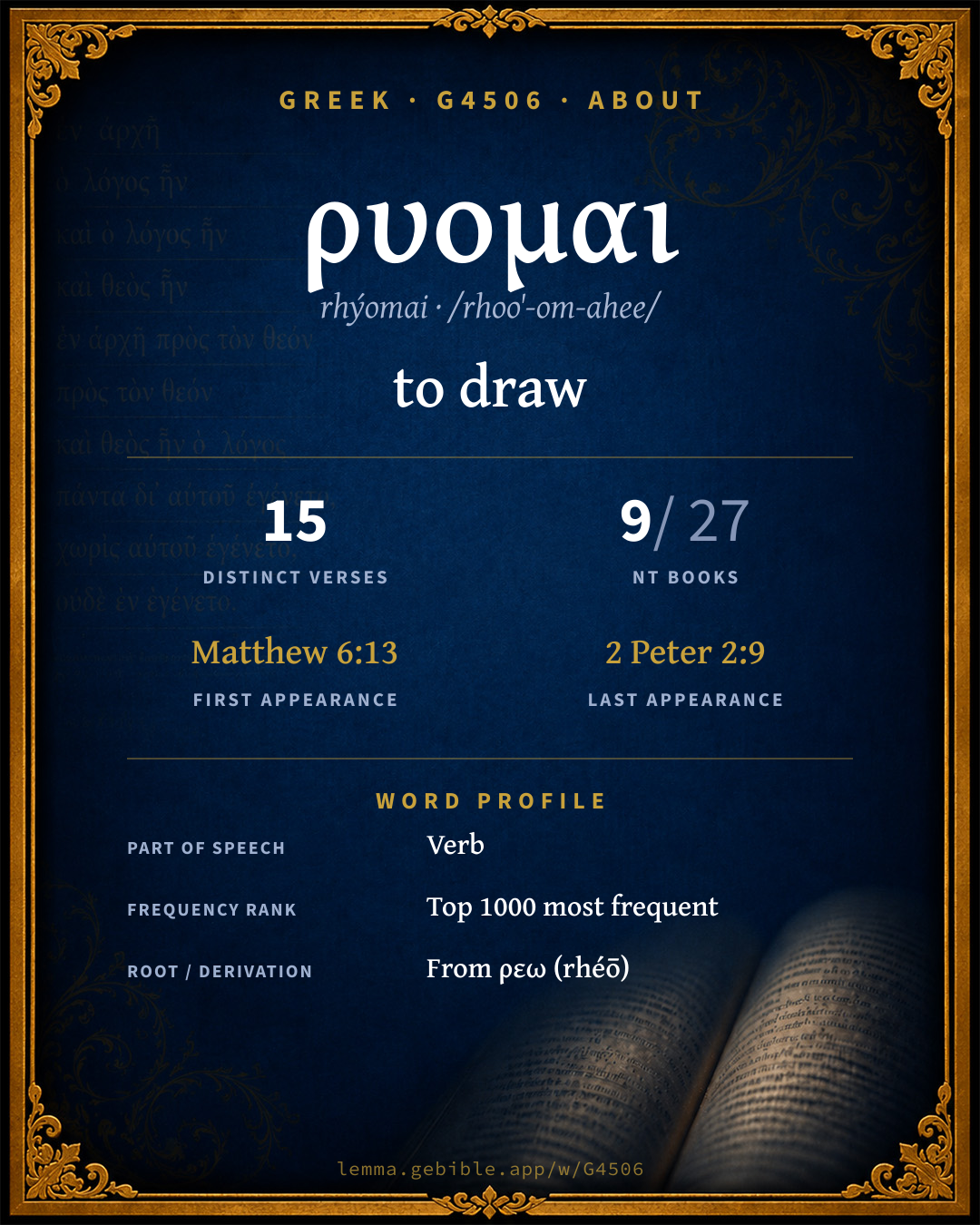
ῥύομαι
to draw
‘to draw’ is one of 2 main senses fuller range ↓
Full lexicon entry — Thayer's Greek Lexicon
From Thayer's Greek Lexicon
Where this word appears
See every Aorist-tense verb in the Greek New Testament →
Grammar key — what these labels mean
Part of speech
- Verb
- An action or state-of-being word.
Tense
- Aorist
- Action viewed as a simple whole, without regard to duration — often past (perfective aspect).
- Future
- Action expected in future time.
- Present
- Ongoing or general action in present time (imperfective aspect).
Voice
- Middle or Passive deponent
- Middle/passive in form but active in meaning.
- Middle deponent
- Middle in form but active in meaning.
- Passive
- The subject receives the action.
Mood
- Indicative
- States a fact or asks a factual question (the mood of reality).
- Imperative
- Expresses a command or request.
- Participle
- A verbal adjective (“writing,” “having written”).
- Subjunctive
- Expresses probability, purpose, or possibility (the mood of contingency).
- Infinitive
- A verbal noun (“to write”), unmarked for person or number.
Case
- Accusative
- The case of the direct object and of extent.
- Nominative
- The case of the subject (and the predicate nominative).
Person
- 3rd person
- The one spoken about (“he / she / it / they”).
- 2nd person
- The one addressed (“you”).
- 1st person
- The speaker (“I / we”).
Gender
- Masculine
- Grammatically masculine.
Number
- Singular
- One.
- Plural
- More than one.
Grammatical forms 11 distinct
- Verb, Aorist, Middle or Passive deponent, Indicative, 3rd person, Singular 4 times (24%)
- Verb, Future, Middle deponent, Indicative, 3rd person, Singular 4 times (24%)
- Verb, Aorist, Middle deponent, Imperative, 2nd person, Singular 1 time (6%)
- Verb, Aorist, Middle deponent, Imperative, 3rd person, Singular 1 time (6%)
- Verb, Aorist, Passive, Indicative, 1st person, Singular 1 time (6%)
- Verb, Aorist, Passive, Participle, Accusative, Plural, Masculine 1 time (6%)
- Verb, Aorist, Passive, Subjunctive, 1st person, Plural 1 time (6%)
- Verb, Aorist, Passive, Subjunctive, 1st person, Singular 1 time (6%)
+3 more forms (3 occurrences)
Parsed forms decoded from the imported morphology (Robinson–Tischendorf, public domain), counted across 17 parsed occurrences — not distinct verses.
Every verse where G4506 appears — 15 distinct verses across 9 books. Click any verse to open its interlinear word-by-word view. Verse text shown in the World English Bible for context — . Each verse’s Greek form is shown with its reference; the English is not keyword-highlighted, since the data carries no word-level English alignment. Use “Compare translations” on any verse to read it across multiple English versions. This concordance covers the Greek New Testament; Septuagint (Greek Old Testament) occurrences of this word are not indexed here.
Matthew 2 verses
- Matthew 6:13 ῥῦσαι aor mid.dep impv 2sg Bring us not into temptation, but deliver us from the evil one. For yours is the Kingdom, the power, and the glory forever. Amen.'
- Matthew 27:43 ῥυσάσθω aor mid.dep impv 3sg He trusts in God. Let God deliver him now, if he wants him; for he said, 'I am the Son of God.'"
Luke 1 verse
Romans 3 verses
- Romans 7:24 ῥύσεται fut mid.dep ind 3sg What a wretched man I am! Who will deliver me out of the body of this death?
- Romans 11:26 ῥυόμενος pres mid/pass.dep ptcp nom sg masc and so all Israel will be saved. Even as it is written, "There will come out of Zion the Deliverer, And he will turn away ungodliness from Jacob.
- Romans 15:31 ῥυσθῶ aor pass subj 1sg that I may be delivered from those who are disobedient in Judea, and that my service which I have for Jerusalem may be acceptable to the saints;
2 Corinthians 1 verse
Colossians 1 verse
1 Thessalonians 1 verse
2 Thessalonians 1 verse
2 Timothy 3 verses
- 2 Timothy 3:11 ἐρύσατο aor mid/pass.dep ind 3sg persecutions, and sufferings: those things that happened to me at Antioch, Iconium, and Lystra. I endured those persecutions. Out of them all the Lord delivered me.
- 2 Timothy 4:17 ἐρύσθην aor pass ind 1sg But the Lord stood by me, and strengthened me, that through me the message might be fully proclaimed, and that all the Gentiles might hear; and I was delivered out of the mouth of the lion.
- 2 Timothy 4:18 ῥύσεταί fut mid.dep ind 3sg And the Lord will deliver me from every evil work, and will preserve me for his heavenly Kingdom; to whom be the glory forever and ever. Amen.
2 Peter 2 verses
- 2 Peter 2:7 ἐρρύσατο aor mid/pass.dep ind 3sg and delivered righteous Lot, who was very distressed by the lustful life of the wicked
- 2 Peter 2:9 ῥύεσθαι pres mid/pass.dep inf the Lord knows how to deliver the godly out of temptation and to keep the unrighteous under punishment for the day of judgment;
About this entry
At a glance — auto-summarized from this page’s data, not written by a person. Every figure links to its source below. This summary describes the numbers; it doesn’t interpret them.
The Greek verb ρυομαι centers on the idea of “to draw.” First canonically at Matthew 6:13, it enters the text early. The Greek New Testament uses it across 15 verses — uncommon. Lexicons map it across 2 senses. Related forms include ρεω, ρυμη and ρυσις. For the data behind this summary, explore the sense tree and the renderings breakdown below.
Gloss history
Strong's 1890 vs modern scholarship

About this word
Strong's G4506 catalogs a Greek word from the Greek New Testament.
These counts are not copied from any lexicon or concordance. They are computed here, from the morphology-tagged Greek New Testament. What Lemma adds →
- 15
- distinct verses
- The word appears in 15 distinct verses.
- 9 / 27
- NT books
- The word appears in 9 of 27 New Testament books.
- #697
- by frequency
- Top 1000 most frequent Greek words (rank 697 of 5,347 Greek words by occurrence).
View all 15 occurrences in the concordance →
By section of the New Testament
By traditional corpus
Conventional, traditional groupings — biblical authorship is debated, so this is a traditional corpus grouping, not an authorship claim. Some books belong to more than one corpus (Luke is in both the Gospels and the Lukan corpus, and so on), so these shares overlap and need not total 100%. Each figure is a share of the word’s 15 distinct verses.
- Pauline corpus 10 verses · 67%
- Gospels 3 verses · 20%
- General (Catholic) Epistles 2 verses · 13%
- Lukan (Luke–Acts) 1 verse · 7%
How translations render this word
Counts come from each version’s own published word-to-Strong’s tagging or interlinear alignment — an approximate guide to how each version renders this word, not a word-level alignment the data otherwise carries. Because each total is that version’s own tagged count, the per-version totals vary from one another and need not match the appearance or distinct-verse counts above. These counts may also differ from a printed concordance because Lemma counts each distinctly tagged rendering and does not collapse phrase taggings into a single head-word total. This is a fixed set of word-tagged versions (KJV, ASV, BSB, ULT) and does not change with the reading translation you choose elsewhere. Each version’s license is shown beside its name below (and on Sources).
- King James Version: Delivered 4×, Deliver 3×, Shall deliver 2×
- American Standard Version: Delivered 4×, Deliver 2×, Will deliver 2×
- Berean Standard Bible: Deliverer 2×, Will rescue 2×
- unfoldingWord Literal Text: Rescued 3×, He will rescue 2×, Us 2×
King James Version Public Domain
Renders G4506 across 19 tagged occurrences — most commonly:
Plus 10 renderings that appear only once — usually multi-word phrases or single function words the recovered tagging swept in, not distinct renderings.
American Standard Version Public Domain
Renders G4506 across 18 tagged occurrences — most commonly:
Plus 10 renderings that appear only once — usually multi-word phrases or single function words the recovered tagging swept in, not distinct renderings.
Berean Standard Bible Public Domain
Renders G4506 across 17 tagged occurrences — most commonly:
Plus 13 renderings that appear only once — usually multi-word phrases or single function words the recovered tagging swept in, not distinct renderings.
unfoldingWord Literal Text CC BY-SA 4.0
Renders G4506 across 20 tagged occurrences — most commonly:
Plus 11 renderings that appear only once — usually multi-word phrases or single function words the recovered tagging swept in, not distinct renderings.
Senses in Thayer's
The 2 senses Thayer's distinguishes for this word, in lexicon order (not ranked by frequency or importance). The full entry — with sub-senses — is in the Lexicon Entry tab.
- to draw to one's self, to rescue, to deliver
- the deliverer
Word origin
Derived from ρεω (rhéō) (G4482) — to flow.
Forms in the corpus
The 13 distinct written forms G4506 takes in the Greek New Testament, most frequent first — each parse links to that tense’s occurrences in the concordance.
Same root — word family
Other Thayer's entries built from the same root as G4506, grouped by Strong’s listed origin. These share a root / origin per the lexicon — not necessarily a shared meaning. Each links to that word’s own entry.
Derives from
Derived from this word
- ρυμη rhýmē G4505 street
- ρυσις rhýsis G4511 hemorrhage
- ρυτις rhytís G4512 wrinkle
- ρωννυμι rhṓnnymi G4517 to strengthen
Compare all same-root words → Showing 4 of 6 — not the complete family. They share a root, not necessarily a meaning.
Septuagint usage
The same Greek word ρυομαι appears 145 times in the Greek Old Testament (Septuagint), across 140 verses in 16 books.
- 145
- LXX occurrences
- Tagged occurrences of this Greek word in the Septuagint.
- 140
- verses
- Distinct Septuagint verses containing this word.
- 16 / 39
- OT books
- The word appears in 16 of the 39 Old Testament books.
Sample Septuagint occurrences
- Genesis 48:16 ῥύομαι
- Exodus 2:17 ῥύομαι
- Joshua 22:22 ῥύομαι
- Judges 6:9 ῥύομαι
- 2 Samuel 12:7 ῥύομαι
- 2 Kings 18:32 ῥύομαι
- Ezra 8:31 ῥύομαι
- Esther 4:8 ῥύομαι
- Job 5:20 ῥύομαι
- Psalms 6:5 ῥύομαι
- Proverbs 2:12 ῥύομαι
- Isaiah 1:17 ῥύομαι
Septuagint occurrences (same lexeme)
Every verse where the same Strong’s number (G4506) appears in the Greek Septuagint — showing the first 50 of 140. Verse text shown in the World English Bible for context; the Greek form is the matched word — the English is not keyword-highlighted.
- Genesis 48:16 ῥύομαι the angel who has redeemed me from all evil, bless the lads, and let my name be named on them, and the name of my fathers Abraham and Isaac. Let them grow into a multitude in the midst of the earth."
- Exodus 2:17 ῥύομαι The shepherds came and drove them away; but Moses stood up and helped them, and watered their flock.
- Exodus 2:19 ῥύομαι They said, "An Egyptian delivered us out of the hand of the shepherds, and moreover he drew water for us, and watered the flock."
- Exodus 5:23 ῥύομαι For since I came to Pharaoh to speak in your name, he has brought trouble on this people; neither have you delivered your people at all."
- Exodus 6:6 ῥύομαι Therefore tell the children of Israel, 'I am Yahweh, and I will bring you out from under the burdens of the Egyptians, and I will rid you out of their bondage, and I will redeem you with an outstretched arm, and with great judgments:
- Exodus 12:27 ῥύομαι that you shall say, 'It is the sacrifice of Yahweh's Passover, who passed over the houses of the children of Israel in Egypt, when he struck the Egyptians, and spared our houses.'" The people bowed their heads and worshiped.
- Exodus 14:30 ῥύομαι Thus Yahweh saved Israel that day out of the hand of the Egyptians; and Israel saw the Egyptians dead on the seashore.
- Joshua 22:22 ῥύομαι The Mighty One, God, Yahweh, the Mighty One, God, Yahweh, he knows; and Israel he shall know: if it be in rebellion, or if in trespass against Yahweh (don't save us this day),
- Joshua 22:31 ῥύομαι Phinehas the son of Eleazar the priest said to the children of Reuben, and to the children of Gad, and to the children of Manasseh, This day we know that Yahweh is in the midst of us, because you have not committed this trespass against Yahweh: now have you delivered the children of Israel out of the hand of Yahweh.
- Judges 6:9 ῥύομαι and I delivered you out of the hand of the Egyptians, and out of the hand of all who oppressed you, and drove them out from before you, and gave you their land;
- Judges 8:34 ῥύομαι The children of Israel didn't remember Yahweh their God, who had delivered them out of the hand of all their enemies on every side;
- Judges 9:17 ῥύομαι (for my father fought for you, and adventured his life, and delivered you out of the hand of Midian:
- Judges 11:26 ῥύομαι While Israel lived in Heshbon and its towns, and in Aroer and its towns, and in all the cities that are along by the side of the Arnon, three hundred years; why didn't you recover them within that time?
- Judges 18:28 ῥύομαι There was no deliverer, because it was far from Sidon, and they had no dealings with any man; and it was in the valley that lies by Beth Rehob. They built the city, and lived therein.
- 2 Samuel 12:7 ῥύομαι Nathan said to David, "You are the man. This is what Yahweh, the God of Israel, says: 'I anointed you king over Israel, and I delivered you out of the hand of Saul.
- 2 Samuel 14:16 ῥύομαι For the king will hear, to deliver his servant out of the hand of the man who would destroy me and my son together out of the inheritance of God.
- 2 Samuel 19:10 ῥύομαι Absalom, whom we anointed over us, is dead in battle. Now therefore why don't you speak a word of bringing the king back?
- 2 Samuel 22:18 ῥύομαι He delivered me from my strong enemy, From those who hated me; for they were too mighty for me.
- 2 Samuel 22:44 ῥύομαι You also have delivered me from the strivings of my people; You have kept me to be the head of the nations: A people whom I have not known shall serve me.
- 2 Samuel 22:49 ῥύομαι Who brings me forth from my enemies: Yes, you lift me up above those who rise up against me; You deliver me from the violent man.
- 2 Kings 18:32 ῥύομαι Until I come and take you away to a land like your own land, a land of grain and new wine, a land of bread and vineyards, a land of olive trees and of honey, that you may live, and not die: and don't listen to Hezekiah, when he persuades you, saying, Yahweh will deliver us.
- 2 Kings 18:33 ῥύομαι Has any of the gods of the nations ever delivered his land out of the hand of the king of Assyria?
- 2 Kings 19:11 ῥύομαι Behold, you have heard what the kings of Assyria have done to all lands, by destroying them utterly: and shall you be delivered?
- 2 Kings 23:18 ῥύομαι He said, Let him be; let no man move his bones. So they let his bones alone, with the bones of the prophet who came out of Samaria.
- Ezra 8:31 ῥύομαι Then we departed from the river Ahava on the twelfth [day] of the first month, to go to Jerusalem: and the hand of our God was on us, and he delivered us from the hand of the enemy and the bandit by the way.
- Ezra 19:28 ῥύομαι
- Esther 4:8 ῥύομαι Also he gave him the copy of the writing of the decree that was given out in Shushan to destroy them, to show it to Esther, and to declare it to her, and to charge her that she should go in to the king, to make supplication to him, and to make request before him, for her people.
- Job 5:20 ῥύομαι In famine he will redeem you from death; In war, from the power of the sword.
- Job 6:23 ῥύομαι Or, 'Deliver me from the adversary's hand?' Or, 'Redeem me from the hand of the oppressors?'
- Job 22:30 ῥύομαι He will even deliver him who is not innocent; Yes, he shall be delivered through the cleanness of your hands."
- Job 33:17 ῥύομαι That he may withdraw man from his purpose, And hide pride from man.
- Job 33:30 ῥύομαι To bring back his soul from the pit, That he may be enlightened with the light of the living.
- Psalms 6:5 ῥύομαι For in death there is no memory of you. In Sheol, who shall give you thanks?
- Psalms 7:2 ῥύομαι Lest they tear apart my soul like a lion, Ripping it in pieces, while there is none to deliver.
- Psalms 16:13 ῥύομαι
- Psalms 17:1 ῥύομαι Hear, Yahweh, my righteous plea; Give ear to my prayer, that doesn't go out of deceitful lips.
- Psalms 17:18 ῥύομαι
- Psalms 17:20 ῥύομαι
- Psalms 17:30 ῥύομαι
- Psalms 17:44 ῥύομαι
- Psalms 17:49 ῥύομαι
- Psalms 21:5 ῥύομαι His glory is great in your salvation. You lay honor and majesty on him.
- Psalms 21:9 ῥύομαι You will make them as a fiery furnace in the time of your anger. Yahweh will swallow them up in his wrath. The fire shall devour them.
- Psalms 21:21 ῥύομαι
- Psalms 24:20 ῥύομαι
- Psalms 30:2 ῥύομαι Yahweh my God, I cried to you, And you have healed me.
- Psalms 30:16 ῥύομαι
- Psalms 32:19 ῥύομαι
- Psalms 33:5 ῥύομαι He loves righteousness and justice. The earth is full of the loving kindness of Yahweh.
- Psalms 33:8 ῥύομαι Let all the earth fear Yahweh. Let all the inhabitants of the world stand in awe of him.
These are occurrences of the same Greek lexeme (G4506) in the Septuagint — not a translation of any one Hebrew word. The store carries no word-level Hebrew↔Greek alignment, so no Hebrew original is asserted here. Counts come from the recovered LXX Strong's tagging — high-frequency vocabulary is well covered, while rare or late forms may be untagged — so they reflect tagged occurrences and may slightly undercount.