
Galatians 2:10

Greek (Tischendorf 8th ed.) Galatians 2:10 appears in the Greek New Testament. The text above is from the Tischendorf 8th edition. Each word links to its Strong’s number and a concise gloss. Click any word for its full Thayer’s Greek Lexicon entry.
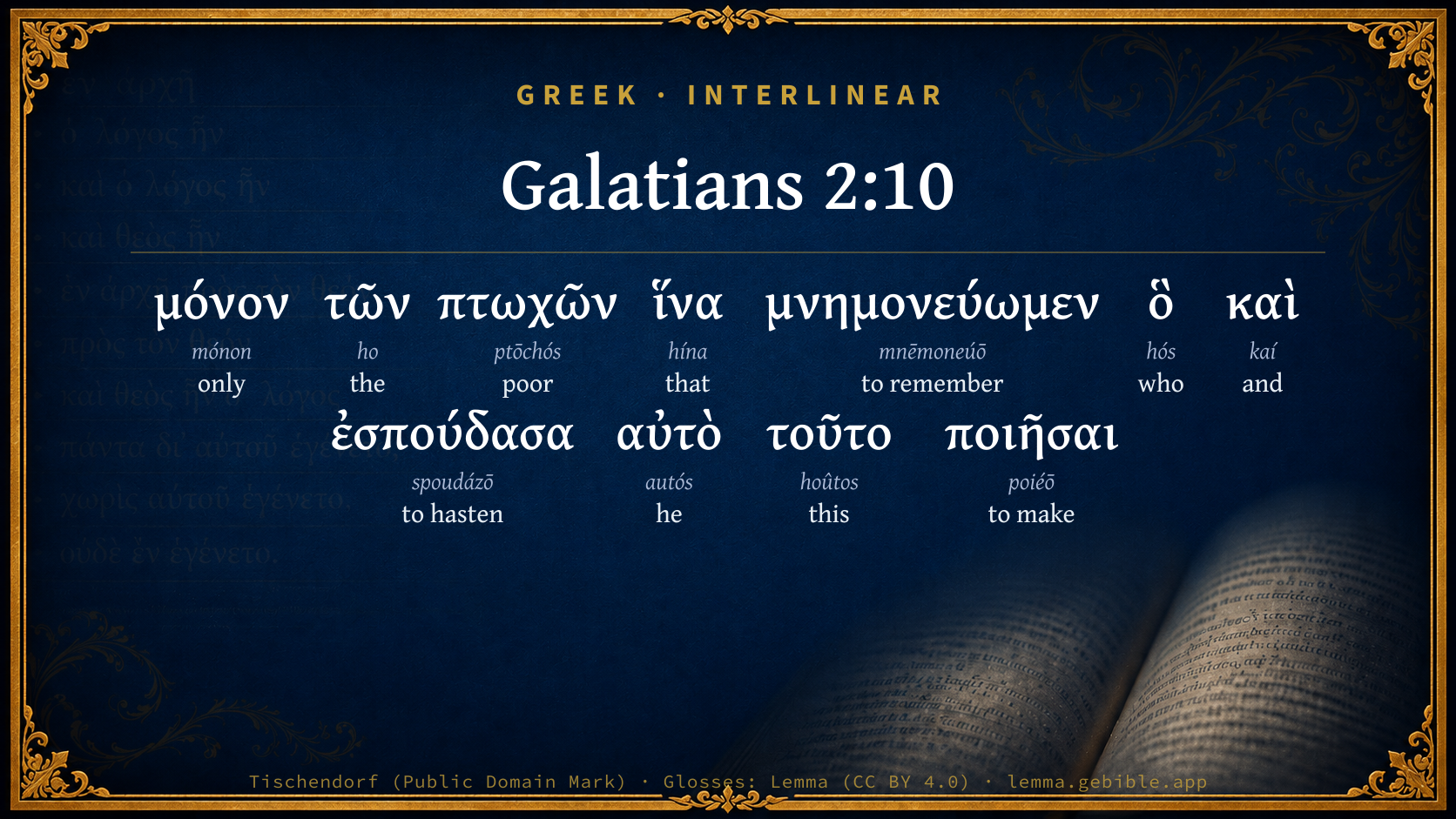
Download image
Cite this verse

Galatians 2:10 (World English Bible). Public Domain. Lemma interlinear Bible study tool, https://lemma.gebible.app/v/galatians/2/10.

Show BibTeX & RIS
BibTeX
RIS
English Translation
They only asked us to remember the poor--which very thing I was also zealous to do.
World English Bible · Public Domain
Highlights
  • 1 first appearance in the Greek New Testament
Full analysis ↓
Download a study sheet

One document with this verse’s original text, its word-by-word gloss line, the meaning frame, cross-references with their text, attributed commentary, and full source and license credits — printable, and it pastes into notes with its structure intact.

This verse Autodidact and up

Study sheet (.html) Plain text (.txt)

A passage Seminary Student

Up to 50 verses in one chapter. A passage sheet keeps up to 6 commentary sources and 12 cross-references per verse, in the order this page ranks them, and says so on the sheet whenever that leaves anything out. Ask for a single verse and you get the Autodidact verse sheet above.

Everything on this page stays free to read, with no account — the sheet is a download of what is already on screen, not access to it.

Want to remove ads? Support Godless Engineer
Compare translations 3

The same verse in 3 English versions, stacked beneath the original-language interlinear above. Click any original word for its lexicon entry.

Each is an independent rendering of the whole verse — the interlinear is not word-aligned to these translations.

Highlighted words mark where these versions differ — a whole-verse word diff, not a word-by-word alignment.

  • World English Bible Public Domain
    They only asked us to remember the poor--which very thing I was also zealous to do.
  • King James Version Public Domain
    Only they would that we should remember the poor; the same which I also was forward to do.
  • unfoldingWord Literal Text CC BY-SA 4.0
    only that we should continue to remember the poor, this same thing that I was also eager to do.

unfoldingWord Literal Text — © unfoldingWord, licensed CC BY-SA 4.0. Word-aligned USFM3 via Door43 (git.door43.org/unfoldingWord/en_ult).

Versions to compare (up to 4)

3 of 4 selected

Show all 19 translations

Every available English version of this verse, each an independent rendering of the whole verse.

  • World English Bible Public Domain
    They only asked us to remember the poor--which very thing I was also zealous to do.
  • Berean Standard Bible Public Domain
    They only asked us to remember the poor, the very thing I was eager to do.
  • Majority Standard Bible Public Domain
    They only asked us to remember the poor, the very thing I was eager to do.
  • King James Version Public Domain
    Only they would that we should remember the poor; the same which I also was forward to do.
  • American Standard Version (1901) Public Domain
    only `they would' that we should remember the poor; which very thing I was also zealous to do.
  • Revised Version (1885) Public Domain
    only they would that we should remember the poor; which very thing I was also zealous to do.
  • Geneva Bible (1599) Public Domain
    Warning onely that we should remember the poore: which thing also I was diligent to doe.
  • Douay-Rheims (1899) Public Domain
    Only that we should be mindful of the poor: which same thing also I was careful to do.
  • Young's Literal Translation Public Domain
    only, of the poor that we should be mindful, which also I was diligent -- this very thing -- to do.
  • Literal Standard Version CC BY-SA 4.0
    only, that we should be mindful of the poor, which I also was diligent—this very thing—to do.
  • Unlocked Literal Bible CC BY-SA 4.0
    They requested only that we remember the poor, the very thing that I was eager to do.
  • unfoldingWord Literal Text CC BY-SA 4.0
    only that we should continue to remember the poor, this same thing that I was also eager to do.
  • Darby Bible Public Domain
    only that we should remember the poor, which same thing also I was diligent to do.
  • World Messianic Bible Public Domain
    They only asked us to remember the poor—which very thing I was also zealous to do.
  • Webster's Bible Public Domain
    Only they would that we should remember the poor; the same which I also was forward to do.
  • Free Bible Version CC BY-SA 4.0
    We were to work for the foreigners, while they would work for the Jews. Their only instruction was to remember to look after the poor, something I was already very committed to.
  • Bible in Basic English Public Domain
    Only it was their desire that we would give thought to the poor; which very thing I had much in mind to do.
  • Text-Critical English NT CC BY 4.0
    They only asked us to remember the poor, the very thing I was eager to do.
  • Tyndale New Testament (1534) Public Domain
    warnynge only that we shulde remember the poore. Which thinge also I was diligent to do.

Literal Standard Version (2020), Covenant Press — licensed CC BY-SA 4.0. Text via the HelloAO Bible API (eBible.org). Unlocked Literal Bible (unfoldingWord) — licensed CC BY-SA 4.0. Text via the HelloAO Bible API (eBible.org). unfoldingWord Literal Text — © unfoldingWord, licensed CC BY-SA 4.0. Word-aligned USFM3 via Door43 (git.door43.org/unfoldingWord/en_ult). Free Bible Version, Dr. Jonathan Gallagher — licensed CC BY-SA 4.0. Text via the HelloAO Bible API (eBible.org).

Word by word

More ways to search: Search by grammar → Find every occurrence → Compare this word →

Practice this passage: Drill this verse → Learn its vocabulary →

About this verse

These counts appear in no published source. They are computed here, from the morphology-tagged text and Lemma’s own curated glosses. What Lemma adds →

11
words
11
distinct lemmas
Pauline Epistles
section

Notable vocabulary

The rarest word here is ἐσπούδασα to hasten G4704 — appearing just 11 times in the whole Greek New Testament.

First appearance in Scripture

This word makes its first canonical appearance in the Greek New Testament here:

  • ἐσπούδασα to hasten G4704

Shared distinctive vocabulary

ἐσπούδασα to hasten G4704 occurs in 11 verses of the Greek New Testament. Also found in:

Cross-references

8

Topical passages linked to Galatians 2:10 in the Treasury of Scripture Knowledge — connected by theme and wording, ordered by reader-vote popularity; previews shown in the World English Bible.

  • Acts 24:17 Now after some years, I came to bring gifts for the needy to my nation, and offerings;
  • Hebrews 13:16 But don't forget to be doing good and sharing, for with such sacrifices God is well pleased.
  • 1 John 3:17 But whoever has the world's goods, and sees his brother in need, and closes his heart of compassion against him, how does the love of God remain in him?
  • 2 Corinthians 8:1–9 Moreover, brothers, we make known to you the grace of God which has been given in the assemblies of Macedonia;
  • 1 Corinthians 16:1–2 Now concerning the collection for the saints, as I commanded the assemblies of Galatia, you do likewise.
  • Acts 11:29–30 As any of the disciples had plenty, each determined to send relief to the brothers who lived in Judea;
  • Romans 15:25–27 But now, I say, I am going to Jerusalem, serving the saints.
  • James 2:15–16 And if a brother or sister is naked and in lack of daily food,

Cross-references courtesy of OpenBible.info (CC BY 4.0).

Commentary

Notes on Galatians 2:10 from classic Christian and Jewish commentators (each source and its license shown beneath its notes). The classic Christian expositions comment on the surrounding passage and are grouped to its opening verse, so a note may address several verses; the Jewish commentaries on the Tanakh (Rashi and others) are per-verse, so they appear only where the commentator wrote on this verse.

Lemma curates 59 commentaries, every one of them public domain or Creative Commons licensed, each selected and text-cleaned for this edition rather than reprinted as found. About our sources →

The Biblical Illustrator

Joseph S. Exell

Gal_2:10

That we should remember the poor.

A plea for the poor

Good men do not always think alike. When they differ, it is commonly from ignorance and a want of mutual explanation; and therefore when their understandings are informed, as their hearts were right before, they are like so many drops of water on a table--when they touch they run into one. Besides, while differing in some things, they agree in others--and these by fro the most important: and after awhile are generally led to see and acknowledge this. Such the case here. A difference among the brethren in Jerusalem concerning the missions of Peter and Paul; but none about the duty of remembering the poor. On that all agree.

I. Who are to be remembered? The poor. Found in every age and land.

1. Distinguish between the vagrant poor and the resident poor. Vagrants are generally the least entitled to succour, being lazy, and not disposed to work when the opportunity is offered them. The resident poor have these claims;

(1) they are neighbours;

(2) their cases can be searched out, and impositions detected;

(3) regarding them your bounty is known, and it ought to be known--not to extol you, but to honour your religion, recommend the gospel, and glorify God.

2. Distinguish between Gods poor and the devils poor. In helping the latter while they continue what they are, you are aiding the beer-house, the gin-shop, licentiousness, and every evil. We should try to save them from their suffering by saving them first from their sin.

3. Distinguish between the strong and healthy poor, and the sick and disabled. The latter deserve sympathy and help.

II. Why should you remember the poor?

1. In doing so, you keep the best company, and conform to the noblest examples.

2. You are bound by Divine authority.

3. The poor are your brethren.

4. You ire under great obligations to the poor. You are more dependent on them, than they on you. They cultivate your lands, manage your capital, prepare your food, furnish you with fuel; they man your ships, fill your armies, fight your battles, etc., etc.

5. In remembering them you will remember yourselves. By Gods eternal law, doing good is the way to gain good; giving is the way to thrive (Psa_41:1-3).

III. How are we to remember the poor?

1. Compassion.

2. Readiness to relieve. All might do much by exercising self-denial, and influencing others.

IV. When should we remember the poor?

1. When you die.

2. When you prosper.

3. When you are unthankful. It will remind you of how many blessings you daily receive, and so stir up your heart to praise.

4. When you are peevish, fretful, discontented, and miserable. Go, then, and see real misery; and consider how much more others have to suffer than you; and then do your best to relieve that suffering. In the act of giving consolation, you shall receive it.

5. When you fast. Let your own abstinence for your souls health benefit the bodies of those whose life is a perpetual involuntary fast (Isa_58:6-8).

6. Every Lords Day (1Co_16:2).

7. Now. Give liberally to the charity work in aid of which your alms are to-day solicited. If the Saviour were here now as a Man, how would He give? He could not give much. He would then give--what many hero (and the best givers too, perhaps) will give--coppers; not from want of inclination, but from want of ability. He was a poor Man, had not where to lay His head. But suppose He was possessed of the fortunes some of you possess, what would He give then? Think of it, and go and do likewise. (William Jay.)

The duty of remembering the poor

Poverty no virtue; wealth no sin. Nor yet is wealth morally good, poverty morally evil. Virtue is a plant which depends not on the atmosphere surrounding it, but on the hand that waters and the grace that sustains it. Grace must be sustained by Divine power. Yet, as a fact, God has been pleased for the most part to plant His grace in the soil of poverty. A very large multitude of His family are destitute, afflicted, tormented, and are kept leaning day by day upon the daily provisions of God, and trusting Him from meal to meal, believing that He will supply their wants out of the riches of His fulness.

I. The fact, that the Lord has a poor people. A word from Him, and they might all be rich. Yet He does not speak that word. Why?

1. To teach us how grateful we should be for all the comforts He bestows on many of us.

2. To display His sovereignty in all He does.

3. To manifest the power of His comforting promises, and the supports of the gospel. The master.works of God are those that stand in the midst of difficulties--when all things oppose them, yet maintain their stand; these are His all-glorious works; and so His best children, those who honour Him most, are those who have grace to sustain them amidst the heaviest load of tribulations and trials.

4. To plague the devil, e.g., Job.

5. To give us some living glimpse of Christ. A poor saint is a better picture of Jesus than a rich one.

6. To give us opportunities of showing our love to Him. Take away the poor, and one channel wherein our love delights to flow is withdrawn at once.

II. The duty, that we should remember the poor.

1. In prayers.

2. In conversation.

3. In providing for their necessities.

IV. Why we should remember the poor.

1. They are the Lords brethren. This is surely reason enough. (C. H. Spurgeon.)

Remembrance of the poor recommended

I. Examine the nature of the assertion. No need to describe the poor; they describe themselves. You daily witness the scantiness and poverty of their apparel, their pale and emaciated forms; you hear their piteous plaints, and the tale of their complicated woes. But we should remember--

1. The work of the poor.

(1) It is irksome and laborious;

(2) often destructive to health;

(3) of more benefit to others than to themselves.

2. The deprivations of the poor.

(1) Scanty means of instruction;

(2) little opportunity of improving their minds;

(3) uncomfortable homes;

(4) degrading surroundings;

(5) insufficient clothing and food.

3. Our remembrance of the poor should be founded on personal observation.

4. It should be accompanied by relief. The best form of relief is employment.

II. State the obligations we are under to comply with it.

1. The dictates of humanity require it. The poor are our brethren.

2. The demands of duty require it. The laws of God have made this imperative upon us (Deu_15:7-9; Dan_4:27; Luk_6:36-38; Mat_7:12; 1Jn_3:17).

3. The rights of justice require it. To the poor we owe far more than to rich drones who merely live on the labours of others. Who erect our houses? Who make our clothes? Who procure our food? Do not the poor? therefore remember them.

4. The claims of interest require it. God remembers the poor; is it not our interest to imitate Him? (Psa_41:1-2; Pro_3:9; Pro_19:17; Isa_63:10-11).

III. Answer objections.

1. My circumstances are straitened, I have nothing to spare. What! Nothing? (1Ki_17:11-12; Luk_21:2-4).

2. Charity must begin at home. True; but it should not end there.

3. I have a right to do what I will with my own. But what is your own? Are you not a steward merely of Gods goods? Will He not call you to account?

4. The poor do not deserve to be remembered. God thinks they do; that is enough. What if He dealt with us according to our deserts? (Theological Sketch-book.)

Care of the poor

When Fox, the author of the Book of Martyrs, was once leaving the palace of Aylmer, the Bishop of London, a company of poor people begged him to relieve their wants with great importunity. Fox, having no money, returned to the bishop, and asked the loan of five pounds, which was readily granted. He immediately distributed it among the poor by whom he was surrounded. Some months after, Aylmer asked Fox for the money he had borrowed. I have laid it out for you, was the answer, and paid it where you owed it--to the poor people who lay at your gate. Far from being offended, Aylmer thanked Fox for thus being his steward.

A plea for the poor

Some one was expressing surprise to Eveillon, canon and archdeacon of Angers, that none of his rooms were carpeted. He answered: When I enter my house in the winter-time, the floors do not tell me that they are cold; but the poor, who are shivering at my gate, tell me they want clothes.

Pauls care for the poor

I. Paul, who had beggared the Church, is now ready to beg for it.

II. Paul sets us as example of care for the poor (Rom_15:25; Rom_15:28). He gave more than good words and wishes.

1. The charge was very great to maintain the altar in the Old Testament. In the New Testament the poor come in place of the altar.

2. Mercy to the poor is a condition of Divine mercy.

III. Paul being warned was diligent to do that of which he was warned. It is a common fault to hear much and do little. (W. Perkins.)

True beneficence: its thoughtfulness

How difficult it is to be wisely charitable; to do good without multiplying the sources of evil! To give alms is nothing unless you give thought also. It is written, not blessed is he that feedeth the poor, but blessed is he that considereth the poor. A little thought and a little kindness are often worth more than a deal of money. (Ruskin.)

Beneficence: its reward

During the retreat of Alfred the Great at Athelney, a beggar came to him and requested alms; when his queen informed him that they had only one small loaf left, which was insufficient for themselves and their friends who had gone abroad in quest of food, though with little hope of success, Give the poor Christian one-half of the loaf, said the king; He who could feed five thousand men with five loaves and two small fishes can certainly make that half of the loaf suffice for our necessities. The poor man was relieved accordingly, and this noble act of charity was soon recompensed by a providential store of fresh provisions, with which his people returned.

Remember the poor

I was very much pleased with the conduct of a brother who is here present. A short time ago there stood in the aisle near his pew, a gentleman and a poor fellow in a smock frock! thought to myself He will let one in, I know; I wonder which it will be? I did not wait long before out he came and in went the smock frock. He thought very rightly that the poor man was the most tired, for he had no doubt had a hard weeks work, and probably a long walk, for there are not many smock frocks near London. I say again, Remember the poor. (C. H. Spurgeon.)

Remember the orphans

Puddings and potatoes form important articles of diet, and I shall be glad if farmers will remember our orphans in seedtime and harvest. Much more help could be rendered in kind if doners would only think of it. We need not mention things which an orphanage cannot consume; it would take space to mention things we could not use, such as alcoholic liquors, rattlesnakes, gunpowder, dynamite, or books of modern theology. (C. H. Spurgeon.)

Christian forwardness

And now, when the standard of Christ is unfurled, have Christians become cowardly? Are there none among them who can step forward and say, Here am I: send me. I do not believe there is such a cowardly spirit among us. But there is what is generally called a retiring disposition. I am scarcely able to make nice distinctions. In the day of battle if the commanding officer found one of his men in the rear rank on account of his modest and retiring disposition, I think he would tingle it out of him with a few lashes on his back. (C. H. Spurgeon.)

The Biblical Illustrator, edited by Joseph S. Exell (c. 1880s–1900s) — public domain. Text from a community e-Sword module.

The Preacher's Complete Homiletical Commentary

Joseph S. Exell (gen. ed.)

CRITICAL AND EXPLANATORY NOTES

Gal_2:10. Remember the poor.—Of the Jewish Christians in Judea then distressed. Paul’s past care for their poor prompted this request. His subsequent zeal in the same cause was the answer to their appeal (Act_11:29-30; Rom_15:26-27; 1Co_16:3; 2Co_9:1; Act_24:17).

MAIN HOMILETICS OF THE PARAGRAPH.—Gal_2:10

Christianity and Poverty.

I. Christianity has ever been the friend of the poor.—

1. The poor who are made so by accepting Christianity. Accepting Christ often means the loss of friends, of status, of fortune. The discovery of this result among the first Christians might have much to do in the formation of a common fund. There are many Jews and heathen to-day who are convinced of the truth of Christianity, but hesitate to make a public avowal of their belief because of the apparent impossibility of gaining a livelihood and the certainty of social ostracism. Christian missionaries are not in a position to guarantee their support, nor do they wish to encourage, a system that might easily degenerate into wholesale bribery. There are converts who run all risks and deliberately accept Christ and poverty. All such the Christian Church, often at great sacrifice, does its best to befriend.

2. The poor who are made so by unavoidable calamity.—Judea was devastated by famine in the reign of Claudius Cæsar, and the apostles promptly organised relief for the sufferers in the Jewish Churches (Act_11:27-30). Christianity has ever been ready to help the distressed and unfortunate. The hospitals, almshouses, and other benevolent institutions that abound are substantial monuments of the practical benevolence of the Christian Church. Christianity is the best friend of the people.

II. Christianity inculcates a zealous and unselfish charity.—“Only they would that we should remember the poor; the same I also was forward [zealous] to do.” Paul had already rendered noble service in this direction, and was prompted by the spirit of the gospel to continue to do so. He was zealous in good works, though he stoutly denied any merit in them to justify the sinner. His first concern was to help the Jewish poor, though many of them impugned his apostolic authority and strove to ruin his influence. As champion of the Gentiles he employed the wealth of his converts in supplying the needs of his famishing Jewish brethren. Christian charity is superior to the jealousies of sects and parties, and even to personal insult and wrong. Behind the hand of the generous alms-giver is the heart of love.

III. Christianity elevates and enriches the poor.—It enjoins temperance, industry, honesty, and perseverance—the practice of which has raised many from poverty to wealth. The man who has prospered should never forget the claims of the poor. It is said that a certain man dreamed that the Saviour appeared to him and upbraided him with giving so little to His cause. The man replied, “I can’t afford it.” “Very well,” said the Saviour; “let it be so. But do you remember, that when that business panic happened, how you prayed to Me to keep you out of difficulties? And I heard your prayer and tided you over the trouble. And do you remember also, when your little child was sick, how you prayed that her life might be spared, and again I heard your prayer and restored her? But now let it be an understanding between us that henceforth when you are in trouble I do nothing for you, seeing you can’t afford to help Me.” The man’s conscience was touched, and he exclaimed, “Lord, take what I have; it is Thine.”

Lessons.—

1. Christianity is the source of the highest philanthropy.

2. Is the unfailing hope and comfort of the poor.

3. Has achieved its greatest triumphs among the poor.

GERM NOTES ON THE VERSES

Gal_2:10. Remember the Poor.

I. The Church of Jerusalem was in extreme poverty.—

1. Because the poorer sort received the gospel.

2. Because the richer were deprived of their riches for their profession of the name of Christ.

II. It is the office of pastors and teachers, not only to preach and dispense the word, but also to have care of the poor.

III. Satisfaction, recompense, and restitution are the way to life by the appointment of God.—

1. He must restore who is the cause of any wrong or loss to others and all that are accessory.

2. Restitution is to be made to him that is wronged and bears the loss if he be known and alive; if he be dead, to his heirs; if all be dead, to the poor.

3. The things to be restored are those which are of us unjustly received or detained, either known to us or unknown.

4. As to the order of restitution, things certain must first be restored, and things uncertain after.

IV. It is not enough for us to give good words and to wish well, but we must in our places and calling do our endeavour that relief may be sealed to our poor.—

1. The charge was great to maintain the altar of the Lord in the Old Testament; the poor come in the room of the altar.

2. The poor represent the person of Christ.

3. Compassion in us is a pledge or an impression of the mercy that is in God towards us, and by it we may know or feel in ourselves that mercy belongs unto us. The observing of the commandment of relief is the enriching of us all.—Perkins.

Christian Duty to the Poor.—

1. It is frequently the lot of those who are rich in grace to be poor in the things of the present life, and driven into such straits as to be forced to live upon some charitable supply from others, God seeing it convenient hereby to wean them from worldly contentments that heaven may be more longed after and more sweet when it comes.

2. Though those who are our own poor, within the bounds where we live, are chiefly to be relieved by us, yet in cases of extremity the poor who live remote from us are also to be supplied.

3. Ministers ought to press upon the people, not only duties which are easy and cost them nought, but also those that are burdensome and expensive, especially that they would willingly give of those things they enjoy for the supply of others who want.—Fergusson.

The Poor Representative of Christ.—One evening at supper, when one of the boys had said the grace, “Come, Lord Jesus, be our Guest, and bless what Thou hast provided,” a little fellow looked up and said, “Do tell me why the Lord Jesus never comes. We ask Him every day to sit with us, and He never comes!” “Dear child, only believe, and you may be sure He will come, for He does not despise our invitation.” “I shall set a seat,” said the little fellow, and just then there was a knock at the door. A poor frozen apprentice entered, begging a night’s lodging. He was made welcome, the chair stood empty for him, every child wanted him to have his plate, and one was lamenting that his bed was too small for the stranger, who was quite touched by such uncommon attentions. The little one had been thinking hard all the time. “Jesus could not come, and so He sent this poor man in His place: is that it?” “Yes, dear child; that is just it. Every piece of bread and every drink of water that we give to the poor, or the sick, or the prisoners for Jesus’ sake, we give to Him.”—Memoir of John Falk.

Remembrance of the Poor recommended.

I. The nature of the assertion.—

1. Remember the work of the poor.

2. The deprivations of the poor.

3. Our remembrance of the poor should be founded on a personal acquaintance with their circumstances. “Indeed, sir,” said a person of large property, “I am a very compassionate man; but to tell you the truth, I do not know any person in want.” He kept aloof from the poor.

II. Obligations to comply with the recommendation.—

1. The dictates of humanity require it.

2. The demands of duty.

3. The rights of justice.

4. The claims of interest.

III. Answer objections.—Such as:

1. My circumstances are impoverished and I have nothing to spare.

2. Charity must begin at home.

3. I have a right to do what I will with my own.

4. The poor do not deserve to be remembered.—Beta.

The Preacher's Complete Homiletical Commentary (gen. ed. Joseph S. Exell; Funk & Wagnalls, c. 1892) — public domain (pre-1929). A full-Bible homiletical/sermon-outline anthology covering 65 of 66 books (2 John is absent from the source module). Text from a community e-Sword module.

Tyndale Open Study Notes

Tyndale Open Resources

2:10 The mention of helping the poor connects this narrative with Acts 11:30; 12:25. The Christians in Judea suffered years of deep poverty, and Paul was eager to have the Gentile churches alleviate some of that difficulty and build unity with the Jewish church (see Rom 15:25-27; 1 Cor 16:1-4; 2 Cor 8:1–9:15).

Tyndale Open Study Notes — © Tyndale Open Resources, licensed CC BY-SA 4.0. Text via the HelloAO Bible API.

Bengel's Gnomon

Johann Albrecht Bengel

Gal 2:10. Τῶν πτωχῶν, the poor) From among the Jews.—μνημονεύωμεν, we should remember) The antecedent for the consequent; for Paul was forward, not only to remember, but to assist.—ἐσπούδασα, I was forward [anxious, zealous]) even among the Galatians, 1Co 16:1. Paul did not cast away his zeal for good works.[10]

[10] Though denying justification by them.—ED.

Bengel's Gnomon of the New Testament — English translation (T&T Clark, Edinburgh, 1860) — public domain. Text from a community e-Sword module.

Meyer's Critical & Exegetical Commentary

Heinrich August Wilhelm Meyer

Gal_2:10. After μόνον interpreters usually supply a verb such as αἰτοῦντες or παρακαλοῦντες, which in itself would be allowable (Buttmann, neut. Gr. p. 207 f.), but is nevertheless quite superfluous; for μόνον τῶν πτωχῶν ἵνα μνημ. appears dependent on δεξιὰς ἔδωκαν ἐμοὶ καὶ Βαρν. κοιν., so that it is parallel with the preceding ἵνα and limits it. Comp. Matthies, Fritzsche, Hofmann. They made with us a collegiate alliance, to the end that we should be apostles to the Gentiles; … only that we should not omit to remember the poor of the περιτομή (not merely of the mother-church) as to support. In that alliance nothing further, in respect to our relation to the περιτομή, was designed or settled. On μνημονεύειν in the sense of beneficent care, comp. Psa_9:12; Hom. Od. xviii. 267.

μόνον, which belongs to the whole clause, and τῶν πτωχῶν stand before ἵνα on account of the emphasis laid upon them. Comp. on Eph_3:18; 1Co_7:29; 2Co_2:4; 2Th_2:7, et al. The poverty of the Christians of Palestine, which was the principal motive for this proviso being added, finds its explanation in the persecutions which they underwent, in the community of goods which they had at first, and perhaps also in the expectation of the Parousia as near which they most of all cherished. Moreover, the μόνον κ.τ.λ. by no means excludes the ordinances of the apostolic council, for Paul here has in view nothing but his recognition as apostle on the part of the original apostles in the private discussions held with the latter. How Baur misuses μόνον κ.τ.λ., as contrasted with the supposed irreconcilable diversity subsisting in doctrine, may be seen in the theol. Jahrb. 1849, p. 470; Paulus, I. p. 142 ff. ed. 2; comp. also Holsten. In the face of real antagonism of doctrine, the older apostles certainly would not have tendered Paul their hands; and had they desired to do so, Paul would have refused them his.[82]

ὃ καὶ ἐσπούδασα αὐτὸ τοῦτο ποιῆσαι] The aorist, not used instead of the pluperfect, relates to the time from that apostolic alliance to the composition of the epistle. Paul, however, continues in the singular; for soon afterwards he separated himself from Barnabas (Act_15:39). So, correctly, Estius, Winer, Usteri, Schott. Those who identify our journey with that related in Acts 11, 12 must conclude, with Fritzsche, that Paul desired to report concerning himself, and hence only mentioned Barnabas (and Titus) as well, where it was necessary. Nevertheless this joint-mention, although not necessary, would have been very natural in our passage; for ἵνα μνημονεύωμεν had just been said, and then in a single stroke of the representation, with ὃ καὶ ἐσπούδασα κ.τ.λ., is given the conclusion of the matter so referred to.

αὐτὸ τοῦτο] is not superfluous (Piscator, Vorstius, Grotius, Morus), as neither αὐτό alone (Winer, p. 140) nor τοῦτο alone (see Matthiae, p. 1050; Kühner, II. p. 527) is used; it is the emphatic epexegesis of ὅ, hoc ipsum (see Bornemann, Schol. in Luc. p. LIII.), whereby Paul makes his readers feel the contrast between the Jewish Christian antagonism and his zeal of love thus shown. Studer and Usteri find in αὐτὸ τοῦτο the tacit antithesis, but nothing further which the apostles had imposed on me. Inappropriately, for the idea of any other matters imposed was already excluded by the previous account. Schott proposes to take ὅ as διʼ ὅ (see on Act_26:16), but the assumption of this poetical use cannot be justified except by a necessity such as is presented to us in the N.T. only at Act_26:16. Still more easily might αὐτὸ τοῦτο be explained (Poppo, ad Xen. Cyrop. iv. 1. 21; Matthiae, p. 1041; Stallbaum, ad Plat. Symp. p. 204 A) as on that very account (2Pe_1:5; Xen. Anab. i. 9. 21). But in that case ὅ would so naturally take up what preceded, that there would be no reason why Paul should have brought on that very account so prominently forward. It would rather have the appearance of suggesting that, if it had not been for the agreement in question, Paul would not have cared for the poor.

We have no historical vouchers for the truth of ὃ καὶ ἐσπούδασα κ.τ.λ.; for the conveyance of the contributions in Acts 11 took place earlier than our journey; and the collection mentioned 1 Corinthians 16., 2 Corinthians 8 f., Rom_15:27, comp. Act_21:17 f., Act_24:17, occurred after the composition of our epistle. But who would be inclined to doubt that assurance? Looking at the more or less fragmentary accounts in Acts and the Pauline epistles, who knows how often Paul may have sent pecuniary assistance to Palestine? as indeed he may have brought the like with him on occasion of his own journey, Act_18:20-22. It has, however, been wrongly asserted that, by means of this obligation in respect to the poor, a connection was intended to be maintained between the Gentile churches and the primitive church, and that at the bottom of it lay the wish to bring over the preliminarily converted Gentiles gradually more and more to the principles and the mode of life of the primitive church (Hilgenfeld, in his Zeitschr. 1860, p. 141). This is an insinuation derived from mere fancy.

[82] Tertullian (de praescr. 23) already gives the right view: inter se distributionem officii ordinaverant, non separationem evangelii, nec ut aliud alter, sed ut aliis alter praedicarent.

Meyer — Critical and Exegetical Commentary on the New Testament — English translation by Peter Christie, edited by Frederick Crombie (T&T Clark, 1880) — public domain. Text from a community e-Sword module.

Expositor's Greek Testament

ed. W. Robertson Nicoll

Gal 2:10 . μόνον … ἵνα . A verb must be supplied out of δεξιὰς ἔδωκαν expressive of the pledge that the other Apostles exacted from Barnabas and Paul. τῶν πτωχῶν . These words are displaced from their grammatical position after μνημονεύωμεν in order to lay stress upon the poor being the central object of the appeal. Judæa suffered often from famine in apostolic times, and Christians were probably the worst sufferers owing to religious ill-will and social persecution. This passage implies chronic poverty. So also does the history of the Pauline contribution, which was not an effort to meet a special emergency, for it took more than a year to collect, but a fund organised to meet a permanent demand for systematic help. ὃ . The addition of τοῦτο after αὐτό shows that ὅ is not the object of ποιῆσαι , but is used with adverbial force for a connecting particle, as in Gal 1:7 , as for which . καὶ ἐσπούδασα : not I also , for this would require καὶ ἐγώ in the Greek text. The force of καί is to intensify the following verb. I was not only willing, but was indeed zealous to do so .

The Expositor's Greek Testament, edited by W. Robertson Nicoll (1897–1910) — public domain. Text from a community e-Sword module.

Jamieson, Fausset & Brown

Robert Jamieson, A. R. Fausset & David Brown

remember the poor--of the Jewish Christians in Judea, then distressed. Paul and Barnabas had already done so (Act 11:23-30).

the same--the very thing.

I . . . was forward--or "zealous" (Act 24:17; Rom 15:25; Co1 16:1; 2Co. 8:1-9:15). Paul was zealous for good works, while denying justification by them.

Jamieson, Fausset & Brown — Commentary Critical and Explanatory on the Whole Bible (1871) — public domain (CC PDM 1.0). Text via the HelloAO Bible API.

Adam Clarke's Commentary

Verse 10. Only they would that we should remember the poor] They saw plainly that God had as expressly called Barnabas and me to go to the Gentiles as he had called them to preach to the Jews; and they did not attempt to give us any new injunctions, only wished us to remember the poor in Judea; but this was a thing to which we were previously disposed.

Adam Clarke's Commentary on the Bible (1810–1826) — public domain. Text from a community e-Sword/MySword module.

John Calvin's Commentaries

10. That we should remember the poor. It is evident that the brethren who were in Judea labored under extreme poverty: otherwise they would not have burdened other churches. That might arise both from the various calamities which befell the whole nation, and from the cruel rage of their own countrymen, by which they were every day stript of their possessions. It was proper that they should receive assistance from the Gentiles, who owed to them the inestimable benefit of the gospel. Paul says, that he was forward to do, that he faithfully performed, what the apostles had requested from him, and thus he takes away from his adversaries a pretext which they were desirous to seize.

John Calvin's Commentaries (1540-1563) — public domain. Text from the Calvin Translation Society English edition (1840s-50s) via the Christian Classics Ethereal Library (ccel.org). Calvin's coverage is partial (roughly two-thirds of the Bible); uncommented books and verses are honest gaps, never fabricated. The 19th-century editor's footnotes and remarks are omitted so the notes are faithfully Calvin's own voice.

Ellicott's Commentary for English Readers

(10) The poor—i.e., at Jerusalem and in Judaea. St. Paul had already been the means of bringing contributions from the wealthier churches of Antioch to Jerusalem (Act_11:29-30). This seems to have been gracefully received, not only as an act of charity, but as a recognition of the claims of the mother Church. The Apostles expressed a hope that the same good feeling might continue, to which St. Paul willingly assented. That he did not forget his promise appears from Act_24:17; Rom_15:26-27; 1Co_16:3; 2Co_8:1-2; 2Co_9:1 et sea. (See Notes on Rom_15:25-27.)

A Bible Commentary for English Readers, edited by Charles John Ellicott (1878–1897) — public domain. Text from a community e-Sword module.

The Cambridge Bible for Schools and Colleges

gen. ed. J. J. S. Perowne

10. One reservation was made which was in accordance with my own earnest desire.

the poor] In the department of almsgiving no distinction was to be made. On two recorded occasions, St Paul conveyed alms from the Gentiles to the poor saints in Jerusalem, Act_10:29-30; 1Co_16:3. He was not afraid of being charged with resorting to bribery for gaining converts—a justification, if any be needed, of the action of Missionary Societies in modern times. Our Lord Himself had set the example.

The Cambridge Bible for Schools and Colleges (gen. ed. J. J. S. Perowne; Cambridge University Press, 1878–1918) — public domain. Text from a community e-Sword module.

John Gill's Exposition

Only they would that we should remember the poor,.... Not in a spiritual sense, as some have thought, though these the apostle was greatly mindful of; but properly and literally the poor as to the things of this world; and may design the poor in general, everywhere, in the several churches where they should be called to minister, and particularly the poor saints at Jerusalem; who were become such, either through the frequent calamities of the nation, and a dearth or scarcity of provisions among them, and which affected the whole country; or rather through the persecutions of their countrymen, who plundered them of their goods for professing the name of Christ; or it may be through their having given up all their substance into one common stock and fund, as they did at first, and which was now exhausted, and that in a great measure by assisting out of it the preachers who first spread the Gospel among the Gentiles; so that it was but just that they should make some return unto them, and especially for the spiritual favours they received from them, as the Gospel, and the ministers of it, which first went out of Jerusalem: the "remembering" of them not only intends giving them actual assistance according to their abilities, which was very small, but mentioning their case to the several Gentile churches, and stirring them up to a liberal contribution:

the same which I also was forward to do; as abundantly appears from his epistles to the churches, and especially from his two epistles to the Corinthians. Now since the apostles at Jerusalem desired nothing else but this, and said not a word concerning the observance of the rites and ceremonies of the law, and neither found fault with, nor added to the Gospel the apostle communicated to them, it was a clear case that there was an entire agreement between them, in principle and practice, and that he did not receive his Gospel from them.

John Gill's Exposition of the Whole Bible (1746–1763) — public domain (CC PDM 1.0). Text via the HelloAO Bible API.

Albert Barnes' Notes on the Bible

Only they would that we should remember the poor - That is, as I suppose, the poor Christians in Judea. It can hardly be supposed that it would be necessary to make this an express stipulation in regard to the converts from among the Gentiles, and it would not have been very pertinent to the case before them to have done so. The object was, to bind together the Christians from among the pagan and from among the Jews, and to prevent alienation and unkind feeling. It might have been alleged that Paul was disposed to forget his own countrymen altogether; that he regarded himself as so entirely the apostle of the Gentiles that he would become wholly alienated from those who were his “kinsmen according to the flesh,” and thus it might be apprehended that unpleasant feelings would be engendered among those who had been converted from among the Jews. Now nothing could be better adapted to allay this than for him to pledge himself to feel a deep interest in the poor saints among the Jewish converts; to remember them in his prayers; and to endeavor to secure contributions for their needs.

Thus he would show that he was not alienated from his countrymen; and thus the whole church would be united in the closest bonds. It is probable that the Christians in Judea were at that time suffering the ills of poverty arising either from some public persecution, or from the fact that they were subject to the displeasure of their countrymen. All who know the special feelings of the Jews at that time in regard to Christians, must see at once that many of the followers of Jesus of Nazareth would be subjected to great inconveniences on account of their attachment to him. Many a wife might be disowned by her husband; many a child disinherited by a parent; many a man might be thrown out of employment by the fact that others would not countenance him; and hence, many of the Christians would be poor. It became, therefore, an object of special importance to provide for them; and hence, this is so often referred to in the New Testament. In addition to this, the church in Judea was afflicted with famine; compare Act 11:30; Rom 15:25-27; 1Co 16:1-2; 2Co 8:1-7.

The same which I also was forward to do - See the passages just referred to. Paul interested himself much in the collection for the poor saints at Jerusalem, and in this way he furnished the fullest evidence that he was not alienated from them, but that he felt the deepest interest in those who were his kindred. One of the proper ways of securing union in the church is to have the poor with them and depending on them for support; and hence, every church has some poor persons as one of the bonds of union. The best way to unite all Christians, and to prevent alienation, and jealousy, and strife, is to have a great common object of charity, in which all are interested and to which all may contribute. Such a common object for all Christians is a sinful world. All who bear the Christian name may unite in promoting its salvation, and nothing would promote union in the now divided and distracted church of Christ like a deep and common interest in the salvation of all mankind.

Albert Barnes' Notes on the Bible (1834–1885) — public domain. Text from a community e-Sword/MySword module.

Matthew Poole's English Annotations

These pillars and apostles, which have among you the greatest reputation, added no new doctrine to us, gave us nothing new in charge; they only desired us that we would be careful, wheresoever we went, to make collection for the poor Christians in Judea, who either by selling all they had to maintain the gospel in its first plantation, or by the sharp persecution which had wasted them, or by reason of the famine, were very low; nor was this any new thing, I had before done it, and was very forward to do it again, had they said nothing to us about it.

Matthew Poole's English Annotations on the Holy Bible (1683–1685) — public domain. Text from a community e-Sword/MySword module.

Whedon's Commentary on the Bible

Daniel D. Whedon

10. Remember the poor—In accordance with the custom of Jews in foreign lands who sent in contributions to the poor of Palestine. As the Hebrew Christians bore the brunt of Jewish persecution, so it was due from the Churches abroad, whose fountain head the Holy Land had been, to aid them in their distresses.

Forward to do—And did on a large scale.

Daniel D. Whedon (gen. ed.), Commentary on the Old and New Testaments (1874–1909) — public domain. Text from a community e-Sword module.

The Pulpit Commentary

Only they would that we should remember the poor (monon twn ptwcwn ina mnhmoneuwmen); only, that we should be mindful of the poor, or perhaps, their poor; for the clause must be understood subjectively, as referred to the standpoint of those who" gave us the right hands of fellowship." (For the order of the words in the Greek, (2Co_2:4; Joh_13:29) If there is the ellipsis of any participle at all which needs to be supplied, which many critics suppose, though Meyer not unplausibly thinks otherwise, perhaps "stipulating" presents itself more readily than either "willing" or "requesting;" for this ina depends as much upon the dexiav edwkan as the preceding ina does, and therefore seems to introduce something as much as that a part of the compact. What the apostle means is this: "In one respect only did this mutual compact of equal brotherly partnership leave us who were ministers of the Gentiles unfree in relation to the circumcision and their ministers; we consented to allow ourselves bound to be mindful of the duty of helping their poor. In all other respects, we were to still pursue the same plan of evangelization as we had been pursuing, with no modification of either our doctrine or Church practice; with no such modification, for example, as these false brethren were clamouring for." St. Paul"s methods of work thus received the full sanction of the "pillars," being recognized by them as standing on the same level of truth and heavenly guidance as their own. The same which I also was forward to do (o kaidasa aujto touto poihsai); the very thing this which I was even of myself zealous to do. The as; makes prominent the notion of intense earnestness, which St. Paul is wont to express in the use of spoudazw, as well as of spoudh and spoudaiov. He did not merely consent to bear in mind the poor of Judaea; apart from such stipulation, apart from regard to any request of James, Cephas, and John, it was a matter which of himself he regarded as one of very great importance, demanding his most earnest attention. The especial force of this verb ejspoudasa is evinced by Eph_4:3; 1Th_2:17; 2Ti_2:15; and especially by 2Co_8:16, 2Co_8:17, in which the frame of mind it expresses is distinguished, as here, from that of mere willingness to consent to another person"s request. The principal reason for making this matter so prominent lay, no doubt, in the great distress prevailing amongst the poor in Judaea, justifying the application of the principle stated in 2Co_8:14, 2Co_8:15. (see Stanley"s note on 1Co_16:1) But we can hardly err in supposing that, as a subsidiary motive, both the leaders of the Jewish Church and St. Paul himself were greatly influenced by the consideration that such practical manifestation of Christian sympathy would both evince, and help to cement, the unity with each other of the Jewish and Gentile Churches. It was this organic unity which constituted the obligation of rendering such assistance. (comp. Rom_15:27 with Rom_11:17, Rom_11:18) How perseveringly and how earnestly the apostle strove to aid the poor of the Jewish Churches both before and after the conference here spoken of, is seen in Act_11:29, Act_11:30; 1Co_16:1 (where reference is made to collections in Galatia) 2Co 8:, 2Co_8:9; Rom_15:25-27; Act_24:17. Since in this last cited passage it is only incidentally that St. Luke is led to mention the collection which St. Paul brought with him in that journey of his to Jerusalem recorded in Act_21:17, it is quite supposable that he brought collections with him also in that former visit merely glanced at in Act_18:23. We may surmise that St. Paul has a special purpose in mentioning to the Galatians this particular item of that important compact. In his First Epistle to the Corinthians, written at no long interval whether before or after the sending of this letter, he tells them (1Co_16:1) that he had given order to the Churches of Galatia respecting the manner in which they should collect for this object. It seems the more probable supposition that those directions were not given until this letter had had the happy effect of restoring better relations between himself and them than he was able at present to reckon upon. Meanwhile, however, this historical reference would serve to prepare them in some measure for the appeal, when he should think it prudent to make it (cf. Introduction, pp. 16-18.).

It is well to observe, in reference to this whole passage (vers. 6-10), the extent to which the apostle goes in identifying Barnabas"s position with his own. Barnabas had laboured with himself as evangelizing "apostle" sent forth with himself from the Antiochian Church, and both before and. after that missionary journey in the neighbourhood of Antioch itself. Accordingly he tells his readers that the "pillars" had without qualification recognized the work of them both and had fraternally greeted their further prosecution of it. But it is of himself alone that he speaks when he contrasts Cephas"s apostleship of the circumcision with his own apostleship (for this is implied) to the Gentiles. The reason for this is that Barnabas was not an apostle in that other higher sense of the term in which Cephas and himself were (see Introduction, Dissertation I). Again, when mentioning the stipulation which the "pillars" made, that we should be mindful of their poor, he does not add, "the very thing this which we were of ourselves resolved to do," but makes the observation with reference to himself only. This is explained by the unhappy rupture which St. Luke tells of as so soon after occurring between them which account of St. Luke"s finds thus here a latent confirmation. What we otherwise know of Barnabas"s character leaves no room to doubt but that he too zealously set himself to carry out the stipulation in that separate sphere of work among Gentiles which, after the rupture, he engaged in. But this is no longer St. Paul"s business, while relating facts falling under his own cognizance. And this consideration throws light upon the time of the action expressed by the aorist ejspoudasa: it does not mean, "I had already before been forward to do so;" for then he would not have left out Barnabas; but, "thenceforward in my whole subsequent career I zealously made it my business," the aorist embracing the whole in one view.

Further, our attention is arrested by the extreme importance and the pregnant significance of the incident here related. Here was one who, neither directly nor indirectly, owed to those who had been previously sent forth by Heaven as teachers of the gospel, either his conversion, or his knowledge of the Christian doctrine, or his mission to preach; but had nevertheless gone forth proclaiming what he affirmed to be Christ"s gospel communicated to him by Divine revelation, gathering disciples to be baptized into Christ, and combining such disciples into Churches. In what relation did this doctrine of Paul and the Church organizations which he was setting on foot in the Gentile world stand to the doctrine of the twelve and to the Church organizations framed by them in connection therewith at Jerusalem and in Judaea? These last were assumed to be from heaven; were those more recent phenomena, of doctrines taught and societies formed by Paul, in harmony with the previous ones? Unquestionably and glaringly there were important differences between the external religious life of the twelve and the Jewish believers, and the external religious life which Paul taught the Gentile Churches to adopt. The twelve and the Jewish Christians in general still practised in their daily life the usages of Mosaism, blending the use of such outward forms and ceremonies as appertained to Christian discipleship with those older habits of life preserved intact; in the Gentile Church as moulded by Paul the usages of Mosaism were altogether wanting. Was the seal of Heaven to be recognized as affixed to the Pauline doctrine and the Pauline Church life, as certainly as it was seen to be affixed to the doctrine of the twelve and the Judaeo-Christian Church life? Yes. The verdict of the great leaders of the Jewish Church decided for the full recognition of the Pauline doctrine and the Pauline Church life as in root and essence identical with their own, and as equally with their own derived from heaven. It was a decision come to in the teeth of intense and deeply ingrained prejudices prompting to the adoption of a different conclusion; and must have been due to overpowering evidence leaving them no alternative, seconded we may believe by the secret swaying of their souls by the Holy Ghost. We cannot help reflecting

(1) how disastrous the effects would have been of a decision of another kind;

(2) how remarkably is here illustrated the essential oneness of the Christian life amidst most extreme diversity in its outward manifestation; and

(3) what a strong attestation is afforded to the certain truth of the gospel, revealed to the world through two wholly distinct channels of communication, which yet concurred in delivering what was in reality one and the same message.

The claims of the poor saints in Jerusalem.

they asked us that we should remember the poor; which very thing I also was forward to do." While they gave us the right hand of fellowship that we should go to the Gentiles, there was an agreement that we should remember the poor of the circumcision.

I WHO WERE THE POOR? They were the poor saints in Judaea, not in Jerusalem merely. (1Co_16:1) Their poverty arose, probably, from "the spoiling of their goods," so familiar in persecuting periods, as well as, perhaps, from forfeiting business relations with their own countrymen.

II A COMMON AGREEMENT TO REMEMBER THEM.

1. It is agreeable to mark this unity of feeling in the midst of controversy.

2. There ought to be no division with regard to the poor. The dictates of humanity, the demands of duty, the claims of interest, alike enforce a due consideration of the poor, but especially of those who belong to the household of faith.

3. A common object of charity ought to have a uniting effect on peopleseparated by other interests or opinions.

III THE APOSTLE"S SPECIAL ANXIETY ON THEIR BEHALF.

1. He would naturally desire to conciliate the Jews and destroy their anti-Gentile prejudices.

2. Yet his liberality was no token of dependence upon Jerusalem.

3. The prospect of ingratitude,from the Jews would have no effect in repressing his charitable zeal on their behalf.

4. The apostle was more forward on their behalf than any other apostle. How he fulfilled the engagement is abundantly manifest (1Co_16:1 2Co 8; Rom_15:26)

The Pulpit Commentary (1880–1919), ed. H.D.M. Spence-Jones & Joseph S. Exell — public domain. Text from a community e-Sword module.

John Wesley's Explanatory Notes

Of the poor - The poor Christians in Judea, who had lost all they had for Christ's sake.

John Wesley, Explanatory Notes Upon the Whole Bible (1754–1765) — public domain. Text via the GEBible commentary corpus.

Luther on Galatians

Martin Luther

VERSE 10. Only they would that we should remember the poor; the same which I also was forward to do.

Next to the preaching of the Gospel, a true and faithful pastor will take care of the poor. Where the Church is, there must be the poor, for the world and the devil persecute the Church and impoverish many faithful Christians.

Speaking of money, nobody wants to contribute nowadays to the maintenance of the ministry, and the erection of schools. When it comes to establishing false worship and idolatry, no cost is spared. True religion is ever in need of money, while false religions are backed by wealth.

Martin Luther — Commentary on the Epistle to the Galatians (1535), English translation by Theodore Graebner (Zondervan, 1939) — public domain (U.S. copyright not renewed). Text from a community e-Sword module.

McGarvey & Pendleton's Commentaries

J. W. McGarvey

only they would that we should remember the poor; which very thing I was also zealous to do . [These men, as I say, in no way reproved or corrected me, but, on the contrary, when they saw, by the testimony of the Spirit, that I was sent to the Gentiles as Peter was sent to the Jews (for the Spirit, who gave Peter wisdom and knowledge and power when he worked among the Jews, gave me these same gifts for my work among the Gentiles), and when they also saw the manner in which the Spirit had fitted me for my work, they recognized that God had appointed to each of us a separate sphere of operations; so they agreed, these pillars, that I should preach to the Gentiles, and they should preach to the Jews, and our agreement was not a loose and tacit affair, but one to which we formally pledged ourselves by the giving of hands. The only requirement they made of me was that I should remember the poor in Judæa whenever persecution, etc., brought them into distress, and this I would have done without their request. James is mentioned before Peter because he was elder at Jerusalem, and because he appears to have acted as president of the council. (See Acts 15.) The Scripture knows nothing of the supremacy of Peter, as contended for by the Roman Catholics. As to this agreement formed between the apostles, we should note that it was not rigid. Paul, in his missionary journeys, invariably preached first to the Jews, and Peter did work at Antioch and elsewhere among the Gentiles, and was, according to the appointment of Christ, the first to open the door of the kingdom for the Gentiles ( Mat_16:19 ; Acts 10; Act_15:7 ). Moreover, we should note that while the greatest goodwill and cordiality and most perfect understanding existed between the leaders of these two great wings of the church, this concord did not extend to the wings themselves, for it was a part of Peter's grand division of the church which was causing Paul trouble in Galatia. As to collections for the poor, Paul had taken one such offering to Jerusalem even before the meeting of this council ( Act_11:28-30 ), and was even now taking another such collection on a large scale ( Rom_15:26-27 ; Act_24:16 ), of which facts the Galatians were not ignorant.]

J. W. McGarvey (with Philip Y. Pendleton), Commentaries on the New Testament (The Fourfold Gospel, 1914; Acts; and the epistles) — public domain. Text from a community e-Sword/MySword module.

The People's New Testament

B. W. Johnson

10. Only they would that we should remember the poor. Continue the collections in the Gentile churches for the poor at Jerusalem. We have seen Paul constantly active in this work (1 Cor. 16:1).

Note —In order to understand this epistle and parts of others, the reader must keep in mind the two great divisions of apostolic Christianity, the Jew and the Gentile. Of the Jewish, Peter, James and John were leaders; of the Gentile, Paul and Barnabas. These leaders were in full harmony, but the two sections of the church were not equally harmonious. The Jewish Christians, as a rule, still kept the Jewish law, and hoped for the conversion of the whole Jewish nation, until the destruction of Jerusalem; one extreme wing of them insisted that the Gentiles should keep the Jewish law, also. It is with this wing that Paul comes in conflict. Here in this chapter, and also in Acts 15, we have accounts of the conflict. After Jerusalem was destroyed, the temple in ruins, and the church removed elsewhere, the Jewish Christians gradually gave up the Jewish law, and the two divisions welded into one body in which there was neither Jew nor Gentile, but all one in Christ.

B. W. Johnson's The People's New Testament with Notes (1889–1891) — public domain. Electronic text from the Christian Classics Ethereal Library (CCEL) ThML edition.

Cambridge Greek Testament for Schools and Colleges

10. μόνον (Gal 1:23) τῶν πτωχῶν. Position for emphasis. The poor Jewish-Christians at Jerusalem for whom in fact St Paul carried alms at least twice, once earlier than this agreement (Act 11:29-30) and again on his last journey (1Co 16:3; 2Co 9:1 sqq.; Rom 15:26-27; Act 24:17) when he wrote this epistle. Perhaps the mention of the subject here is due to its occupying his mind at the time. See Introduction, p. xxi.

ἵνα. “An innovation in Hellenistic is ἵνα c. subj. in commands, which takes the place of the classical ὅπως c. fut. indic.” (Moulton, Proleg. 1906, p. 178). So Eph 5:33. Here the command is indirect (2Co 8:7), still representing the object of the implied compact, Gal 2:9. ἵνα follows μόνον also in Gal 6:12 (where however see note), and Ignatius ends his solemn enumeration of the torments that are coming on him μόνον ἵνα Ἰησοῦ Χριστοῦ ἐπιτύχω.

μνημονεύωμεν. On the one hand he and Barnabas were not to be so absorbed in Gentile work as to forget the needs of the poor believers of their own nation, and, on the other, mercy as twice blessed would foster the sense of unity in both Jewish receivers and Gentile givers.

ὃ … αὐτὸ τοῦτο ποιῆσαι. The pleonastic use of the pronoun after the relative is essentially a semitism (Mar 7:25), but the αὐτὸ τοῦτο is more than this, explaining and emphasizing the relative; cf. Blass, Gram. § 50. 4. For αὐτὸ τοῦτο see 2Pe 1:5.

καὶ ἐσπούδασα, “I was even anxious.”

The singular is employed probably because Barnabas had left him before he was able to carry it out. But the emphasis is not on “I” (as though ἐγὼ were expressed) but on the verb. The reason for his use of the aorist is not clear. Apparently it regards the whole of his life from his conversion to the present time as belonging to the past. Ramsay strangely limits it to the incidents of his visit to Jerusalem then (Gal. p. 300). It perhaps suggests some acquaintance on the part of the Galatians with his feelings on the subject, and so far illustrates 1Co 16:1, but throws no light on the relative dates of the two epistles.

Cambridge Greek Testament for Schools and Colleges (Cambridge University Press, 1896; 21 vols, various authors incl. Carr, Maclear, Plummer, Farrar, Lumby, Moule, M. R. James, Simcox) — public domain. Text from a community e-Sword module.

Alford’s Greek Testament

Henry Alford

10. μόν. τ. πτ. ἵνα μν.] The genitive is put before the conjunction for emphasis: see reff., and 2Th 2:7, and Joh 13:29, where remarkably enough it is the same word which precedes ἵνα, … τοῖς πτωχοῖς ἵνα τὶ δῷ. The construction is complete without supplying any participle (αἰτοῦντες or παρακαλοῦντες), depending upon ἔδωκαν.

ὃ καὶ ἐσπ. αὐτὸ τ. ποι.] which was the very thing that I also was anxious to do,—viz., then and always: it was my habit. So that ἐσπούδασα has not a pluperfect sense. He uses the singular, because the plural could not correctly be predicated of the whole time to which the verb refers: for he parted from Barnabas shortly after the council in Act_15. Meyer understands ἐσπούδ. of the time subsequent to the council only: but this does not seem necessary. The proofs of this σπουδή on his part may be found, Rom 15:25-27; 1Co 16:1-4; 2Co 8:9; Act 24:17: which, though they probably happened after the date of our Epistle, yet shewed the bent of his habitual wishes on this point.

αὐτὸ τοῦτο is not merely redundant, as in ἧς εἶχεν τὸ θυγάτριον αὐτῆς πνεῦμα ἀκάθαρτον, Mar 7:25,—but is an emphatic repetition of that to which ὅ refers, as in the version above. So that ὃ ἐσπ. αὐτὸ τοῦτο ποι. = καὶ ἐσπ. τὸ αὐτὸ τοῦτο ποι. Cf. Thuc. i. 10,—Ἀθηναίων δὲ τὸ αὐτὸ τοῦτο παθόντων. Cf. Ellicott’s note.

Henry Alford, The Greek Testament (1849–1861) — public domain. Text from a community e-Sword module.

International Critical Commentary

10. μόνον τῶν πτωχῶν ἵνα μνημονεύωμεν, “provided only that we should remember the poor.” ἐθέλησαν or some similar verb might be supplied before this clause. See GMT 332, Butt. p. 241. But it is better in the absence of a verb to make the clause co-ordinate in construction with the preceding ἵνα clause, ἵνα…περιτομήν, and dependent on the idea of agreement implied in δεξιὰς ἔδωκαν. On this understanding the clause is not a request added to the agreement, but a part of the agreement itself. μόνον limits the whole clause and indicates that it contains the only qualification of the agreement already stated in general terms. On the use of μόνον, introducing a qualification of a preceding statement or of its apparent implications, see 1:23, 5:13, and esp. 1Co 7:39. To the general agreement that the field be divided between them, each group maintaining entire independence in its own territory, there is added as the only qualification of this independence and separateness the specification that the apostles to the Gentiles shall continue to remember the poor, i. e., manifestly the poor among the Christians on the other side of the dividing line (cf. Sief. ad loc.). The tense of μνημονεύωμεν, denoting continued action (BMT 96), indicates either that the course of action referred to is one which having already been begun is to be continued, or that there is distinctly in mind a practice (not a single instance) of it in the future. The former as the more common implication of a present tense in the dependent moods is somewhat more probable.

ὃ καὶ ἐσπούδασα αὐτὸ τοῦτο ποιῆσαι. “which very thing I have also taken pains to do.” On the strengthening of ὅ by αὐτό, see Butt. p. 109. The verb σπουδάζω in N. T. signifies not simply “to be willing,” nor, on the other hand, “to do with eagerness,” but “to make diligent effort” to do a thing (1Th 2:17 of unsuccessful effort; everywhere else in exhortations); cf. Jth. 13:1, 12, “to make haste” to do a thing. Apparently, therefore, it can not refer simply to the apostle’s state of mind, but either to a previous or subsequent activity on his part. Against the supposition that the reference is to an effort in which Paul and Barnabas had jointly taken part (cf. Act 11:30) is the singular number of ἐσπούδασα. A reference to an effort on behalf of the poor at that very time in progress is impossible in view of the meaning and tense of ἐσπούδασα, to which also its singular number adds further force. This would have required an imperfect tense, and in all probability, since Barnabas was with Paul at the time, the plural number (notice the number of μνημονεύωμεν)—ἐσπουδάζομεν ποιεῖν or ἐποιοῦμεν. There is apparently a slight hint in the present tense of μνημονεύωμεν of a previous remembrance of the poor on the part of one or both of them (it would be overpressing the plural to say both of them), in ἐσπούδασα a reference to Paul’s subsequent diligence in fulfilling the stipulation then made.

Respecting the argument of the whole paragraph, it should be noticed that while the apostle’s objective point is precisely not to prove that he was in agreement with the Twelve, but independent of them, yet by the facts which he advances to prove his independence he at the same time excludes the interpretation which his judaistic opponents would have been glad to put upon his conduct, viz., that he was in disagreement with the Twelve, they right and he wrong, and shows that, though they at first disagreed with him as to what was expedient to do, in the end they cordially admitted that he was right.

f. Evidence of his independence of all human authority drawn from his conduct in resisting Peter at Antioch (2:11-14)

In this passage the apostle relates one of the most significant incidents of the whole series from the point of view of his independence of the apostles. Peter, coming down to Antioch evidently with no hostile intent or critical spirit, and probably arriving in Paul’s absence, is attracted by the spectacle of Jewish and Gentile Christians living together in harmony in one community, joins himself for the time to this community and, following the practice of the Jews of the church, eats with the Gentile members. Presently, however, there appeared at Antioch certain men who came from Jerusalem as the representatives of James. These men, doubtless contending that Peter’s conduct in eating with the Gentiles was not only not required by the Jerusalem agreement, but was in fact contrary to it, since it involved disregard of the law by Jewish Christians, brought such pressure to bear upon Peter that he gradually discontinued his social fellowship with the Gentile Christians. So influential was this change in Peter’s practice that all the Jewish members of the church ceased to eat with their Gentile fellow-Christians, and as a result of this even Barnabas, who at Jerusalem had with Paul championed the freedom of the Gentiles, also followed Peter’s example. Thus the church was divided, socially at least, into two, and by this fact pressure was brought upon the Gentiles to take up the observance of the Jewish law of foods, since so only could the unity of the church be restored. At this point Paul, perhaps returning from an absence from Antioch, for it is difficult to suppose that matters would have reached this pass while he was present, or possibly delaying action so long as the question pertained to the conduct of the Jews only, and interfering only when it became also a question of the subjection of the Gentiles to the Jewish law—at this point, at any rate, Paul boldly rebuked Peter, claiming that Peter’s own previous conduct showed that he recognised that the law was not binding even upon Jewish Christians, and that it was therefore unjustifiable and hypocritical for him, by refusing to eat with the Gentiles, in effect to endeavour to bring them under the law. By this incident a new phase of the question discussed at Jerusalem was brought to the front, viz.: whether the Jewish Christian was also released from the obligation to keep the law, as well as the Gentile; and, by the inclusion of foods as well as circumcision among the matters brought into controversy, the question of the obligation of statutes in general was raised. The essentially contradictory character of the compromise reached at Jerusalem having also in this way been brought to light, Paul, so far from recognising the authority of Peter as the representative of the Jerusalem apostles to dictate his course of action, resisted him openly, and following out the logic not of that to which he had consented at Jerusalem, viz., the continuance of legal practices by the Jewish Christians, but of that for which he had contended, viz., the freedom of the Gentiles from obligation to conform to the statutes of the law, boldly claimed that even Jewish Christians were not under law, and must not obey its statutes when such obedience involved compulsion of the Gentiles to do the same. In no way could he more effectively have affirmed his independence as a Christian apostle of all human authority.

11 And when Cephas came to Antioch I resisted him to the face, because he stood condemned. 12For before certain came from James he was eating with the Gentiles. But when they came he gradually drew back and separated himself, fearing the circumcised. 13And there joined him in the hypocrisy the rest of the Jews also, so that even Barnabas was carried along with their hypocrisy. 14But when I saw that they were not pursuing a straightforward course in relation to the truth of the gospel, I said to Cephas in the presence of everybody, If thou, though a Jew, livest after the manner of the Gentiles and not after that of the Jews, how is it that thou dost constrain the Gentiles to live after the Jewish manner?

11.Ὅτε δὲ ἦλθεν Κηφᾶς εἰς Ἀντιόχειαν, κατὰ πρόσωπον αὐτῷ ἀντέστην, ὅτι κατεγνωσμένος ἦν· “And when Cephas came to Antioch, I resisted him to the face, because he stood condemned.” The antithesis between the right hands of fellowship (v. 9) and Paul’s resistance of Peter at Antioch suggests the translation of δέ by “but.” But the paragraph is simply continuative of the argument begun in 1:11, and extending to and through this paragraph. By one more event in which he came into contact with the Jerusalem leaders he enforces his argument that he had never admitted their authority over him, but had acted with the consciousness of having independent guidance for his conduct.

The Antioch here referred to is unquestionably not the Pisidian Antioch, but the more famous Syrian city, which is regularly spoken of simply as Antioch, without further title to designate it. See Act 11:19 et freq. Cf. Act 13:14. This temporal clause evidently denotes the time of the fact about to be stated, only in a general way, not as if it occurred immediately upon Peter’s arrival; for the following verses show that in fact a considerable series of events must have elapsed before Paul took his stand against Peter. Concerning the time of the whole incident, see Introd. pp. 1 f.

The phrase κατὰ πρόσωπον conveys in itself no implication of hostility, but only of “face to face” encounter (Act 25:16, 2Co 10:1). ἀντέστην reflects the fact that to Paul Peter seemed to have made the initiative aggression. For while the verb is used both of passive resistance (lit. “to stand against”) and active counter opposition (cf. Act 13:8, 2Ti 3:8), yet it usually or invariably implies an initiative attack in some sense from the other side. This was furnished in the present instance by the conduct of Peter, which though not necessarily so in intention was in effect an attack on the position which Paul was maintaining at Antioch.

Of the various senses in which the verb καταγινώσκω is used by classical writers, two only can be considered here: (a) “to accuse,” (b) “to condemn.” Of these the latter is evidently much more appropriate in a clause in which Paul gives the reason for resisting Peter. The participle is predicative, and best taken as forming with ἦν a pluperfect of existing state (BMT 90, 91, 430; Gal 4:3, Mat 9:36, Mat 26:43, Mar 1:6, Luk 1:7). It comes to practically the same thing to take κατεγνωσμένος as having the force of an adjective meaning “guilty” (Sief. cites Herodian, 5, 15:1, ἐλέγχειν ἐπειρᾶτο εἰκότως κατεγνωσμένην, Luc. De salt. 952; Clem. Hom. 17:13; with which compare also, as illustrating the adjectival use of participles in N. T., Act 8:7, Gal 1:22, Eph 2:12, Eph 4:8, Col 1:21; BMT 429). A phrase of agency denoting by whom he had been condemned is not in any case necessary, nor is it necessary definitely to supply it in thought. Probably Paul’s thought is that Peter’s own action condemned him. Notice the following clause introduced by γάρ. The perfect is used with similar implication in Rom 14:23, Joh 3:18; Jos. Bell. 2.135 (8:6), cited by Ltft. To supply “by the Gentile Christians in Antioch” is to add to the text what is neither suggested by the context nor appropriate to it. For since the purpose of the apostle in narrating this event is still to show his own independence of the other apostles, a condemnation of Peter’s action by the Gentile Christians in Antioch is an irrelevant detail, and especially so as the reason for Paul’s action in rebuking Peter.

10. The reference of Paul to the recent incoming of the extreme legalistic element into the Jerusalem church, and the evidence of 1:24. (q. v.) also indicate that the Jerusalem church was at first disposed to be hospitable towards the acceptance of Gentiles as Christians, and that the question was not an acute one until it became so through the incoming of the legalistic element. When this occurred the Jerusalem apostles endeavoured to conciliate the legalists, but by conviction at first, and at length on the practical question also, sided with Paul so far as concerned the freedom of the Gentiles. Cf. pp. 77, 97.

International Critical Commentary — older volumes (1896–1929), various authors — public domain. Text from a community e-Sword module.

Vincent's Word Studies in the New Testament

Marvin R. Vincent

Only. With only this stipulation.

We should remember [μνημονευωμεν] . The only instance in N. T. of this verb in the sense of beneficent care. No instance in LXX In Psa 9:12, there is the thought but not the word.

The poor [των πτωχων] . The poor Christians of Palestine. Comp. Act 24:17; Rom 14:26, 27; 1Co 16:3; 2Co 9:1. For the word, see on Mt 5:3. In LXX ordinarily of those who are oppressors, or of those who are quiet in contrast with the lawless.

The same which [ο - αυτο τουτο] . Lit. which, this very thing. The expression is peculiarly emphatic, and brings out the contrast between Judaising hostility and Paul 's spirit of loving zeal. Rev. which very thing.

Marvin R. Vincent, Word Studies in the New Testament (1887–1900) — public domain. Text from a community e-Sword/MySword module.

Lesson kit

Teaching starters — assembled from the data on this page, not authored interpretation. Every prompt links to the verse data it draws on. Edit before teaching.

Galatians, in the Pauline Epistles, opens this verse with 11 words (11 distinct Greek lemmas). Its most distinctive word is spoudázō (“to hasten”). A historical commentator’s framing appears above. Read the whole chapter for the surrounding context.

Discussion questions

  1. What does “to hasten” (spoudázō) contribute to the verse as a whole?
  2. This is the first place “to hasten” appears in Scripture (first appears here). What does its debut here establish?
  3. How does Ephesians 4:3, which shares the word «to hasten», read alongside this verse?
  4. These translations render this verse differently; the difference is in the English rendering, not the original. What questions does that raise?
  5. Compare how The Biblical Illustrator and The Preacher's Complete Homiletical Commentary read this verse. Where do they agree or differ?

Things to notice

  • 1 word makes its first canonical appearance in Scripture here.
  • These translations choose different wording for 15 words in this verse.
  • 11 distinct Greek lemmas span 11 words in this verse.

Reading settings

Reading text

Shown beneath each verse's original-language words.

Old Testament
Old Testament edition

Read the OT as the Masoretic Hebrew (MT) or the Greek Septuagint (LXX).

English shown for the Greek Septuagint (in the Hebrew ↔ Greek comparison).

Comparing translations? Open the Compare panel on any verse page to stack up to four side by side.