1 Kings 1:36

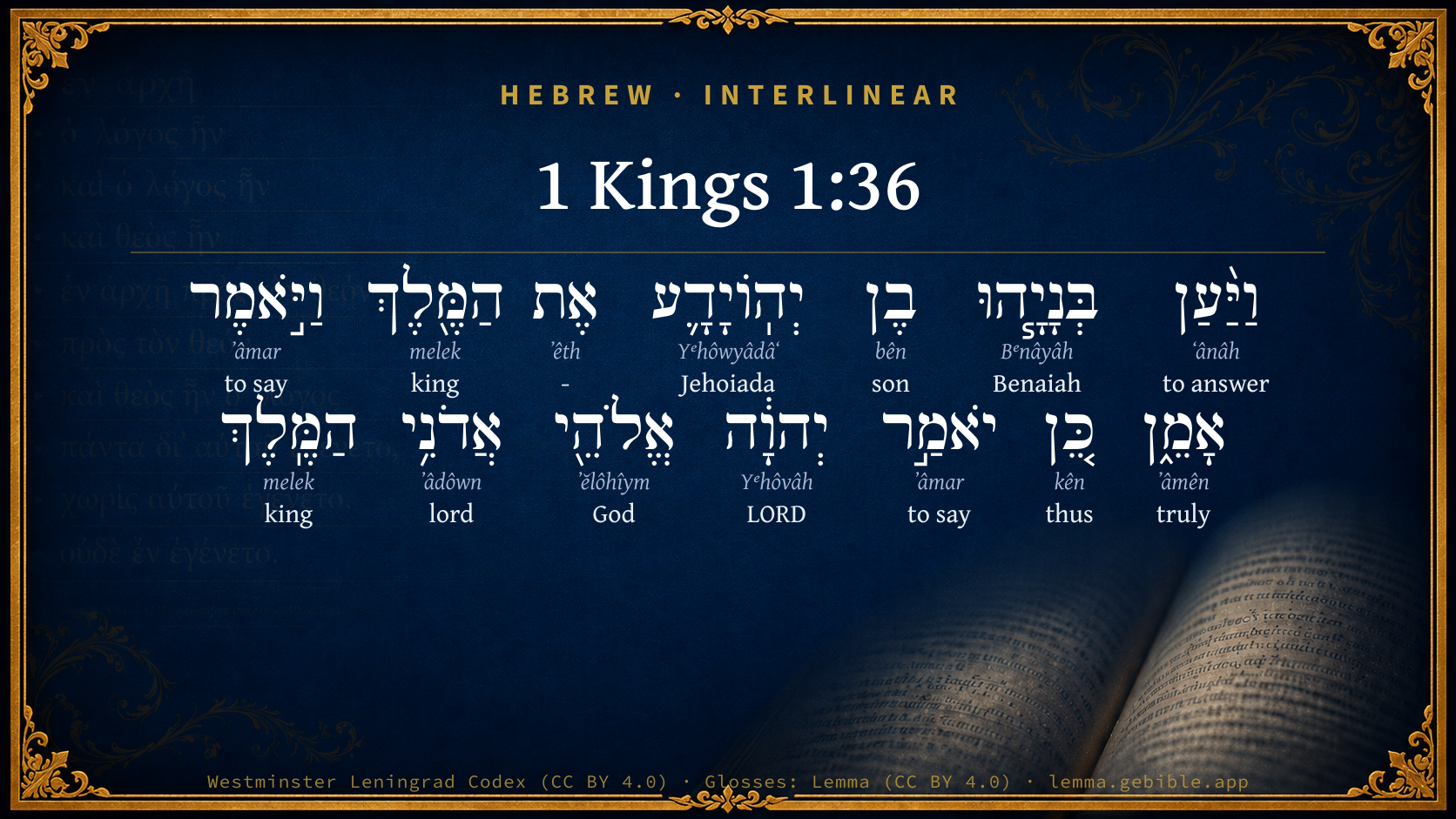
Hebrew (Westminster Leningrad Codex) 1 Kings 1:36 appears in the Hebrew Old Testament. The text above is from the Westminster Leningrad Codex. Each word links to its Strong’s number, a concise gloss, and parsing drawn from the Open Scriptures Hebrew Bible morphology. Click any word for its full Brown-Driver-Briggs (BDB) entry.
Download image
Cite this verse

1 Kings 1:36 (World English Bible). Public Domain. Lemma interlinear Bible study tool, https://lemma.gebible.app/v/1-kings/1/36.

Show BibTeX & RIS
BibTeX
RIS
English Translation
Benaiah the son of Jehoiada answered the king, and said, Amen: Yahweh, the God of my lord the king, say so [too].
World English Bible · Public Domain
Download a study sheet

One document with this verse’s original text, its word-by-word gloss line, the meaning frame, cross-references with their text, attributed commentary, and full source and license credits — printable, and it pastes into notes with its structure intact.

This verse Autodidact and up

Study sheet (.html) Plain text (.txt)

A passage Seminary Student

Up to 50 verses in one chapter. A passage sheet keeps up to 6 commentary sources and 12 cross-references per verse, in the order this page ranks them, and says so on the sheet whenever that leaves anything out. Ask for a single verse and you get the Autodidact verse sheet above.

Everything on this page stays free to read, with no account — the sheet is a download of what is already on screen, not access to it.

Want to remove ads? Support Godless Engineer
Compare translations 3

The same verse in 3 English versions, stacked beneath the original-language interlinear above. Click any original word for its lexicon entry.

Each is an independent rendering of the whole verse — the interlinear is not word-aligned to these translations.

Highlighted words mark where these versions differ — a whole-verse word diff, not a word-by-word alignment.

  • World English Bible Public Domain
    Benaiah the son of Jehoiada answered the king, and said, Amen: Yahweh, the God of my lord the king, say so [too].
  • King James Version Public Domain
    And Benaiah the son of Jehoiada answered the king, and said, Amen: the LORD God of my lord the king say so too.
  • unfoldingWord Literal Text CC BY-SA 4.0
    And Benaiah, the son of Jehoiada, answered the king and said, “Truly! May Yahweh, the God of my lord the king, say thus!

unfoldingWord Literal Text — © unfoldingWord, licensed CC BY-SA 4.0. Word-aligned USFM3 via Door43 (git.door43.org/unfoldingWord/en_ult).

Versions to compare (up to 4)

3 of 4 selected

Show all 18 translations

Every available English version of this verse, each an independent rendering of the whole verse.

  • World English Bible Public Domain
    Benaiah the son of Jehoiada answered the king, and said, Amen: Yahweh, the God of my lord the king, say so [too].
  • Berean Standard Bible Public Domain
    “Amen,” replied Benaiah son of Jehoiada. “May the LORD, the God of my lord the king, so declare it.
  • Majority Standard Bible Public Domain
    “Amen,” replied Benaiah son of Jehoiada. “May the LORD, the God of my lord the king, so declare it.
  • King James Version Public Domain
    And Benaiah the son of Jehoiada answered the king, and said, Amen: the LORD God of my lord the king say so too.
  • American Standard Version (1901) Public Domain
    And Benaiah the son of Jehoiada answered the king, and said, Amen: Jehovah, the God of my lord the king, say so `too'.
  • Revised Version (1885) Public Domain
    And Benaiah the son of Jehoiada answered the king, and said, Amen: the LORD, the God of my lord the king, say so too.
  • Geneva Bible (1599) Public Domain
    Then Benaiah the sonne of Iehoiada answered the King, and said, So be it, and the Lord God of my lord the King ratifie it.
  • Douay-Rheims (1899) Public Domain
    And Banaias the son of Joiada answered the king, saying: Amen: so say the Lord the God of my lord the king.
  • Young's Literal Translation Public Domain
    And Benaiah son of Jehoiada answereth the king, and saith, `Amen! so doth Jehovah, God of my lord the king, say;
  • Literal Standard Version CC BY-SA 4.0
    And Benaiah son of Jehoiada answers the king and says, “Amen! So does YHWH, God of my lord the king, say;
  • Unlocked Literal Bible CC BY-SA 4.0
    Benaiah son of Jehoiada answered the king, and said, “So let it be! May Yahweh, the God of my master the king, confirm it.
  • unfoldingWord Literal Text CC BY-SA 4.0
    And Benaiah, the son of Jehoiada, answered the king and said, “Truly! May Yahweh, the God of my lord the king, say thus!
  • Darby Bible Public Domain
    And Benaiah the son of Jehoiada answered the king and said, Amen: Jehovah, the God of my lord the king, say so too.
  • World Messianic Bible Public Domain
    Benaiah the son of Jehoiada answered the king, and said, “Amen. May the LORD, the God of my lord the king, say so.
  • Webster's Bible Public Domain
    And Benaiah the son of Jehoiada answered the king, and said, Amen: the LORD God of my lord the king say so too.
  • Free Bible Version CC BY-SA 4.0
    “Amen!” replied Benaiah, son of Jehoiada. “May the Lord, the God of my lord the king, confirm this!
  • Bible in Basic English Public Domain
    And Benaiah, the son of Jehoiada, answering the king, said, So be it: and may the Lord, the God of my lord the king, say so.
  • JPS Tanakh (1917) Public Domain
    And Benaiah the son of Jehoiada answered the king, and said: 'Amen; so say the LORD, the God of my lord the king.

Literal Standard Version (2020), Covenant Press — licensed CC BY-SA 4.0. Text via the HelloAO Bible API (eBible.org). Unlocked Literal Bible (unfoldingWord) — licensed CC BY-SA 4.0. Text via the HelloAO Bible API (eBible.org). unfoldingWord Literal Text — © unfoldingWord, licensed CC BY-SA 4.0. Word-aligned USFM3 via Door43 (git.door43.org/unfoldingWord/en_ult). Free Bible Version, Dr. Jonathan Gallagher — licensed CC BY-SA 4.0. Text via the HelloAO Bible API (eBible.org).

Word by word

More ways to search: Search by grammar → Find every occurrence → Compare this word →

Practice this passage: Drill this verse → Learn its vocabulary →

אָמֵ֑ן
ʼâmên
H543
“truly”
Adverb
Part of Speech
Adverb
Full BDB Definition

Origin: from H539

TWOT: 116b

verily, truly, amen, so be it
  1. וַיַּ֨עַן ʻânâh H6030 “and · to answer” Conjunction + Verb, Qal, Sequential Imperfect, 3rd Person, Masculine, Singular
  2. בְּנָיָ֧הוּ Bᵉnâyâh H1141 “Benaiah” Noun, Proper
  3. בֶן bên H1121 “son of” Noun, Common, Masculine, Singular, Construct
  4. יְהֽוֹיָדָ֛ע Yᵉhôwyâdâʻ H3077 “Jehoiada” Noun, Proper
  5. אֶת ʼêth H853 “-” Particle, Direct Object
  6. הַמֶּ֖לֶךְ melek H4428 “the · king” Particle, Definite Article + Noun, Common, Masculine, Singular, Absolute
  7. וַיֹּ֣אמֶר ʼâmar H559 “and · to say” Conjunction + Verb, Qal, Sequential Imperfect, 3rd Person, Masculine, Singular
  8. כֵּ֚ן kên H3651 “thus” Particle, Demonstrative
  9. יֹאמַ֣ר ʼâmar H559 “to say” Verb, Qal, Imperfect, 3rd Person, Masculine, Singular
  10. יְהוָ֔ה Yᵉhôvâh H3068 “LORD” Noun, Proper
  11. אֱלֹהֵ֖י ʼĕlôhîym H430 “God(s) of” Noun, Common, Masculine, Plural, Construct
  12. אֲדֹנִ֥י ʼâdôwn H113 “lord · my” Noun, Common, Masculine, Singular, Construct + Suffix, Personal, 1st Person, Common, Singular
  13. הַמֶּֽלֶךְ melek H4428 “the · king” Particle, Definite Article + Noun, Common, Masculine, Singular, Absolute

About this verse

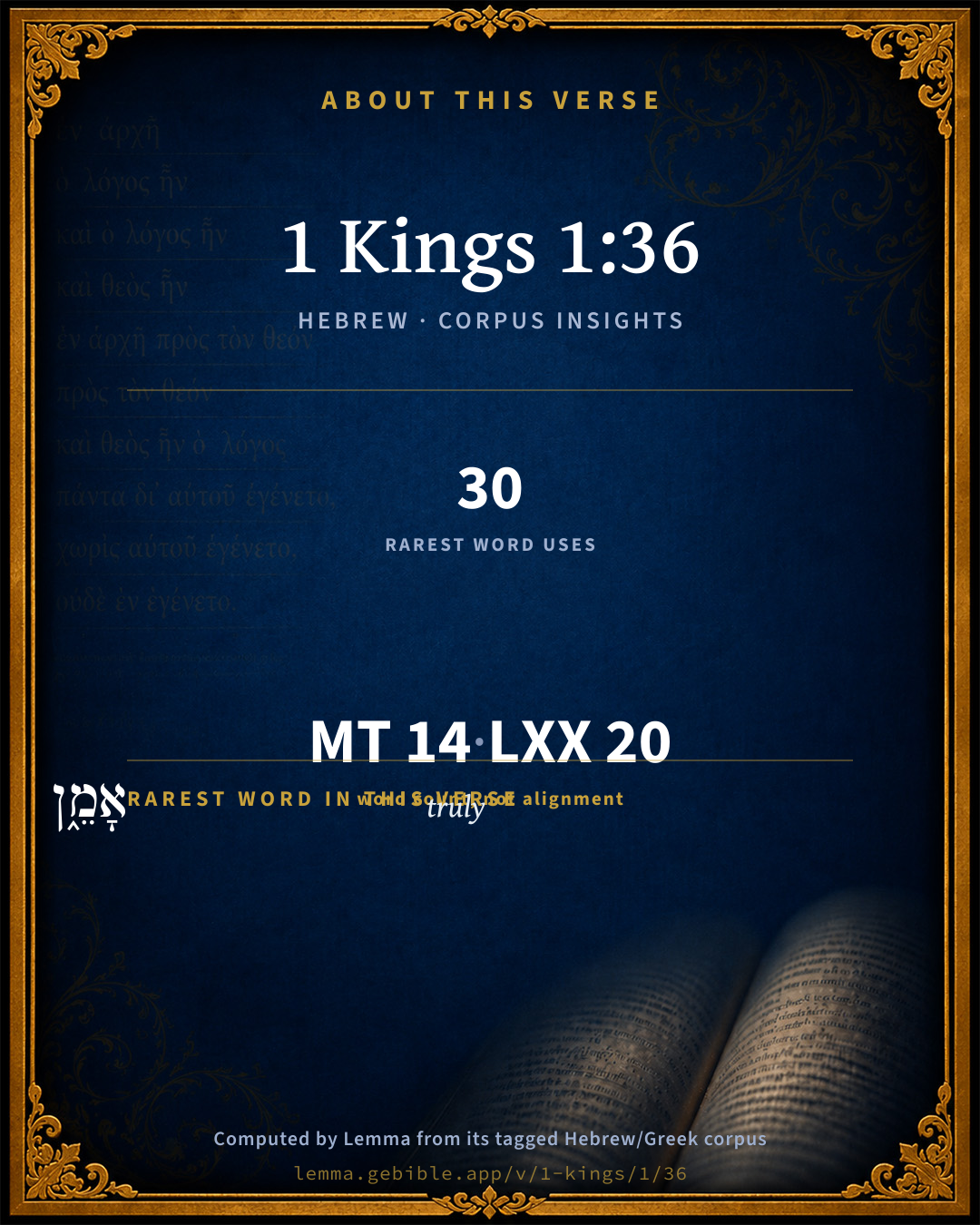
These counts appear in no published source. They are computed here, from the morphology-tagged text and Lemma’s own curated glosses. What Lemma adds →

14
words
12
distinct lemmas
Historical
section

Shared distinctive vocabulary

אָמֵ֑ן truly H543 occurs in 24 verses of the Hebrew Bible. Also found in:

Grammatical profile

  • 3 verbs
  • 8 nouns
  • 1 adverb
  • 2 particles

Verb forms

  • וַיַּ֨עַן Qal · Sequential Imperfect
  • וַיֹּ֣אמֶר Qal · Sequential Imperfect
  • יֹאמַ֣ר Qal · Imperfect

Repetition

Words recur within this verse — often emphatic in Hebrew:

  • הַמֶּ֖לֶךְ king H4428 ×2
  • וַיֹּ֣אמֶר to say H559 ×2

Hebrew & Septuagint length

In English translation the verse runs 22 words from the Hebrew and 26 from the Septuagint (LXX English) — closely comparable.

A rough comparison of the two English renderings, which tokenize alike — not a word-level alignment.

Word counts can differ between the Hebrew and the Greek without any difference in meaning — e.g. the Hebrew direct-object marker אֵת has no separate Greek word, and Greek often adds the article ὁ.

In the original languages it is 14 Hebrew tokens and 20 Greek tokens — but the two are counted differently (Hebrew bundles its prefixes and suffixes into one token; the Greek is in lemma form), so that isn’t a like-for-like length.

Cross-references

13

Topical passages linked to 1 Kings 1:36 in the Treasury of Scripture Knowledge — connected by theme and wording, ordered by reader-vote popularity; previews shown in the World English Bible.

  • Deuteronomy 27:15–26 Cursed be the man who makes an engraved or molten image, an abomination to Yahweh, the work of the hands of the craftsman, and sets it up in secret. All the people shall answer and say, Amen.
  • 1 Samuel 25:29 Though men be risen up to pursue you, and to seek your soul, yet the soul of my lord shall be bound in the bundle of life with Yahweh your God; and the souls of your enemies, them shall he sling out, as from the hollow of a sling.
  • 1 Chronicles 17:27 and now it has pleased you to bless the house of your servant, that it may continue forever before you: for you, Yahweh, have blessed, and it is blessed forever.
  • Psalms 18:2 Yahweh is my rock, my fortress, and my deliverer; My God, my rock, in whom I take refuge; My shield, and the horn of my salvation, my high tower.
  • Psalms 63:1 God, you are my God. I will earnestly seek you. My soul thirsts for you, My flesh longs for you, In a dry and weary land, where there is no water.
  • Psalms 72:19 Blessed be his glorious name forever! Let the whole earth be filled with his glory! Amen and amen.
  • Psalms 89:20 I have found David, my servant. I have anointed him with my holy oil,
  • Psalms 89:26 He will call to me, 'You are my Father, My God, and the rock of my salvation!'
  • Jeremiah 11:5 that I may establish the oath which I swore to your fathers, to give them a land flowing with milk and honey, as at this day. Then answered I, and said, Amen, Yahweh.
  • Jeremiah 28:6 even the prophet Jeremiah said, Amen: Yahweh do so; Yahweh perform your words which you have prophesied, to bring again the vessels of Yahweh's house, and all them of the captivity, from Babylon to this place.
  • Matthew 6:13 Bring us not into temptation, but deliver us from the evil one. For yours is the Kingdom, the power, and the glory forever. Amen.'
  • Matthew 28:20 teaching them to observe all things that I commanded you. Behold, I am with you always, even to the end of the age." Amen.
  • 1 Corinthians 14:16 Otherwise if you bless with the spirit, how will he who fills the place of the unlearned say the "Amen" at your giving of thanks, seeing he doesn't know what you say?

Cross-references courtesy of OpenBible.info (CC BY 4.0).

Hebrew and Greek witnesses Masoretic Hebrew ↔ Greek Septuagint

The same verse in the two great witnesses to the Old Testament, shown verse-for-verse.

These are two independent witnesses, not word-aligned to each other, and the Septuagint is shown in lemma (dictionary) form.

Hebrew 1 Kings 1:36 Masoretic · Westminster Leningrad Codex

וַיַּ֨עַן בְּנָיָ֧הוּ בֶן יְהֽוֹיָדָ֛ע אֶת הַמֶּ֖לֶךְ וַיֹּ֣אמֶר אָמֵ֑ן כֵּ֚ן יֹאמַ֣ר יְהוָ֔ה אֱלֹהֵ֖י אֲדֹנִ֥י הַמֶּֽלֶךְ

Benaiah the son of Jehoiada answered the king, and said, Amen: Yahweh, the God of my lord the king, say so [too].

World English Bible · Public Domain

Greek LXX 1 Kings 1:36 Septuagint · lemma form

καί ἀποκρίνω βαναιας υἱός ιωδαε ὁ βασιλεύς καί εἶπον γίγνομαι οὕτως πιστόω κύριος ὁ θεός ὁ κύριος ἐγώ ὁ βασιλεύς

And Banaeas the son of Jodae answered the king and said, So let it be: may the Lord God of my lord the king confirm it.

LXX2012 (modern English Septuagint) · Public Domain

Hebrew: Westminster Leningrad Codex (CC BY 4.0). Greek: Septuagint (public domain); English from LXX2012 (modern English Septuagint) (Public Domain). How the Septuagint differs from the Hebrew →

Targum (Aramaic paraphrase)

1

The Targum is the ancient Jewish Aramaic paraphrase of the Hebrew Scriptures — an interpretive translation, not the Hebrew text itself. Onkelos (literal) and Pseudo-Jonathan (expansive) render the Torah, and Jonathan the Prophets. Coverage is partial: where no permissively-licensed English translation exists for a verse, only the Aramaic is shown. This is verse-level text, not a word-by-word alignment to the Hebrew.

  1. Targum Jonathan Prophets (Joshua–Malachi)
    וַאֲתֵיב בְּנָיָהוּ בַר יְהוֹיָדָע יַת מַלְכָּא וַאֲמַר אָמֵן כֵּן תְּהֵי רַעֲוָא מִן קֳדָם יְיָ אֱלָהָא דְרִבּוֹנִי מַלְכָּא:

    (no public-domain English translation for this verse)

    Targum Jonathan — Aramaic: “Mikraot Gedolot” (public domain). English: “Sefaria Community Translation” (CC0 1.0 (public-domain dedication)); “London "Chaldee Paraphrase," 1871” (public domain). Text via Sefaria.

Commentary

Notes on 1 Kings 1:36 from classic Christian and Jewish commentators (each source and its license shown beneath its notes). The classic Christian expositions comment on the surrounding passage and are grouped to its opening verse, so a note may address several verses; the Jewish commentaries on the Tanakh (Rashi and others) are per-verse, so they appear only where the commentator wrote on this verse.

Lemma curates 59 commentaries, every one of them public domain or Creative Commons licensed, each selected and text-cleaned for this edition rather than reprinted as found. About our sources →

Trapp's Complete Commentary

John Trapp

1Ki 1:36 And Benaiah the son of Jehoiada answered the king, and said, Amen: the LORD God of my lord the king say so [too].

Ver. 36. Amen: the Lord … say so too.] Amen is, (1.) Assenting; (2.) Assevering; (3.) Assuring. It is as much as So be it; yea, So it shall be; It must be so, if, as here, the Lord our God say so too. Only we must stretch out our hearts after our Amen, say the Rabbis, and be swallowed up in God.

John Trapp, A Commentary or Exposition upon All the Books of the Old and New Testament (1647–1656) — public domain. Text from a community e-Sword module.

The Biblical Illustrator

Joseph S. Exell

1Ki_1:36

And Benaiah . . . said Amen.

The Amen of God and of man

Benaiah recognises the necessity that God shall ratify and effectuate mans desires and purposes. Mans Amen means May it be so. Jehovahs Amen alone means It shall be so. His words are the expression of--

I. Human helplessness. Mans plans only succeed when in the way of Gods Providence, and when carried out in His strength. The true, broad view of His Providence shows us a government of the worlds affairs, which takes in the life of the highest and humblest, their aims, their work, their wants, their very sins and opposition, and, as here, makes all contribute to the revelation of His Son and the setting up of His kingdom. At the same time He can fulfil Davids narrower plan, and secure Solomons elevation. He can secure my private wish and His own will; He can harmonise the course, and aims, and wants, of two lives, or twenty, or a hundred, even if not to converge for many years to come. If they harmonise, it is because He says so too. Men must strive in vain against Gods purposes; or for their own, without Jehovahs Amen. Men are, and are not, architects of their own fortune. Except the Lord build the house of David, or Benaiah, or any other, they labour in vain that build it. Babel-builders leave God out of their counsel; they must have Him in their work. Napoleons fall dates from his words at Berlin: I propose, and I dispose. Man proposes, God disposes.

II. Hope. Human effort is not to be paralysed: I cannot make my plan absolutely secure, or any plan, therefore I will do nothing. This is fatalism. There is a responsibility for effort lying on every man. David and Benaiah must propose. This done prayerfully and submissively, man may hope for a blessing on his effort, The godly man proposes, and may hope that God will say so too.

III. Humility. Not the sullen submission which bows, and bears, and yields, because there is no choice, if He does not say so too. But the reverent acknowledgment of a superior will to which a man loves to bow; the glad submission of every plan to the scrutiny and revision of a wise Father.

1. Let all our plans in life be conceived in this spirit. Write D.V. upon every record of purpose and desire.

2. All must be conceived and carried out in His strength. In our vows--

Thou art not only to perform Thy part,

Thou also mine: as when the league was made,

Thou didst at once Thyself indite

And hold my hand, while I did write.

--(Herbert.)

(H. J. Foster.)

The Biblical Illustrator, edited by Joseph S. Exell (c. 1880s–1900s) — public domain. Text from a community e-Sword module.

Geneva Bible (1599)

Geneva Bible translators

Hebrew, say so.

Geneva Bible (1599) marginal notes — public domain. Text via Bolls.life.

Adam Clarke's Commentary

Verse 36. Sit upon my throne] The matter of conducting a business of this kind seems to have been this:

1. The king elect was placed on the mule of his predecessor, and caused to ride abroad to one of the public wells, or to a river where there was the greatest concourse of people, that they might see who he was that was appointed. Solomon was here taken to the river Gihon, in order to be anointed; the continual stream or constantly running fountain, denoting the perpetuity of the kingdom.

2. The priest and the prophet anointed him in the name of the Lord; and thereby signified that he should be endued with all the kingly virtues; that he should reign by, under, and for the Lord.

3. The trumpet was then to be blown, and solemn proclamation made, that he was anointed king.

4. He was then brought and solemnly placed on the throne, to signify that he had now assumed the reins of government, and was about to administer justice and judgement to the people.

Adam Clarke's Commentary on the Bible (1810–1826) — public domain. Text from a community e-Sword/MySword module.

The Cambridge Bible for Schools and Colleges

gen. ed. J. J. S. Perowne

36. and said, Amen] Expressing as usual a prayer ‘So let it be’; but at the same time expressing concurrence with all the king had said and a determination to carry his orders into effect. Thus the word implies also ‘So it shall be.’ But there is immediately subjoined ‘the Lord God of my lord the king say so too,’ implying that though David might plan and his servants labour for this end it would not be brought about except with God’s will. The sentence may be compared with Jeremiah (Jer_28:6), where the words are ‘The prophet Jeremiah said, Amen: the Lord do so’; a reading which one or two MSS give here, but no doubt only as a gloss.

the Lord God of my lord] R.V. ‘the Lord, the God of my lord.’ See above on 1Ki_1:30.

The Cambridge Bible for Schools and Colleges (gen. ed. J. J. S. Perowne; Cambridge University Press, 1878–1918) — public domain. Text from a community e-Sword module.

John Gill's Exposition

And Benaiah the son of Jehoiada answered the king,.... In the name of the rest:

and said, Amen; they all assented to it, and expressed their satisfaction in it:

the Lord God of my lord the king say so too; let it appear, by the prosperity and success that shall by divine Providence attend the new king, that this is according to the will of God.

John Gill's Exposition of the Whole Bible (1746–1763) — public domain (CC PDM 1.0). Text via the HelloAO Bible API.

Haydock's Catholic Bible Commentary

King. May all have a prosperous issue, conformably to the wishes of your majesty and the decrees of God. (Calmet)

George Leo Haydock (1774–1849), Haydock's Catholic Family Bible and Commentary, 1859 edition — public domain. Excludes Psalms (Douay-Rheims chapter numbering differs from Protestant) and Deuterocanonical books (Catholic canon only).

Matthew Poole's English Annotations

Amen; which was both an approbation of the king’s fact, and a profession of his allegiance to the new king, and a petition to God to ratify and confirm it.

The Lord God of my lord the king say so too; the Lord stablish Solomon’s throne in spite of Adonijah, and all his other enemies.

Matthew Poole's English Annotations on the Holy Bible (1683–1685) — public domain. Text from a community e-Sword/MySword module.

The Pulpit Commentary

And Benaiah the son of Johoiada probably he spoke, not because the execution of the order depended upon him (Bahr); for both Zadok and Nathan had a much more important part to perform, but as a blunt soldier who was accustomed to speak his mind answered the king and said, Amen: the Lord God lit., "Jehovah, he God," etc. of my lord the king say so too.

The Pulpit Commentary (1880–1919), ed. H.D.M. Spence-Jones & Joseph S. Exell — public domain. Text from a community e-Sword module.

Keil & Delitzsch

C. F. Keil & F. Delitzsch

Benaiah responded to the utterance of the royal will with the confirmatory "Amen, thus saith Jehovah the God of my lord the king;" i.e., may the word of the king become a word of Jehovah his God, who fulfils what He promises (Psa 33:9); and added the pious wish, "May Jehovah be with Solomon, as He was with David, and glorify his throne above the throne of David," - a wish which was not merely "flattery of his paternal vanity" (Thenius), but which had in view the prosperity of the monarchy, and was also fulfilled by God (cf. Kg1 3:11.).

Keil & Delitzsch — Biblical Commentary on the Old Testament (1861–1891) — public domain (CC PDM 1.0). Text via the HelloAO Bible API. (Old Testament only.)

Rashi

Rabbi Shlomo Yitzchaki (Rashi)

Amein. [Long] live Shlomo.

Rashi on the Tanakh — English translations: “The Judaica Press complete Tanach with Rashi, translated by A. J. Rosenberg” (CC BY 4.0); “Pentateuch with Rashi's commentary by M. Rosenbaum and A.M. Silbermann, 1929-1934” (public domain); “The Metsudah Tanach series, Lakewood, N.J” (CC BY 4.0); and “The Book of Joshua, Metsudah Publications, 1997” (CC BY 4.0). Text via Sefaria.

Lesson kit

Teaching starters — assembled from the data on this page, not authored interpretation. Every prompt links to the verse data it draws on. Edit before teaching.

1 Kings, in the Historical, opens this verse with 14 words (12 distinct Hebrew lemmas). Its most distinctive word is ʼâmên (“truly”). A historical commentator’s framing appears above. Read the whole chapter for the surrounding context.

Discussion questions

  1. The word ʼâmên carries the sense “truly.” How does it shape the verse?
  2. How does Numbers 5:22, which shares the word «truly», read alongside this verse?
  3. What does the repetition of “king” (2× in this one verse) do in this verse?
  4. The translations on this page render this verse differently — a whole-verse word diff, not a word-by-word alignment. What might account for the different wordings?
  5. «וַיַּ֨עַן» is a Qal Sequential Imperfect verb. How does that grammatical form shape the action described?
  6. Compare how Trapp's Complete Commentary and The Biblical Illustrator read this verse. Where do they agree or differ?

Things to notice

Reading settings

Reading text

Shown beneath each verse's original-language words.

Old Testament
Old Testament edition

Read the OT as the Masoretic Hebrew (MT) or the Greek Septuagint (LXX).

English shown for the Greek Septuagint (in the Hebrew ↔ Greek comparison).

Comparing translations? Open the Compare panel on any verse page to stack up to four side by side.