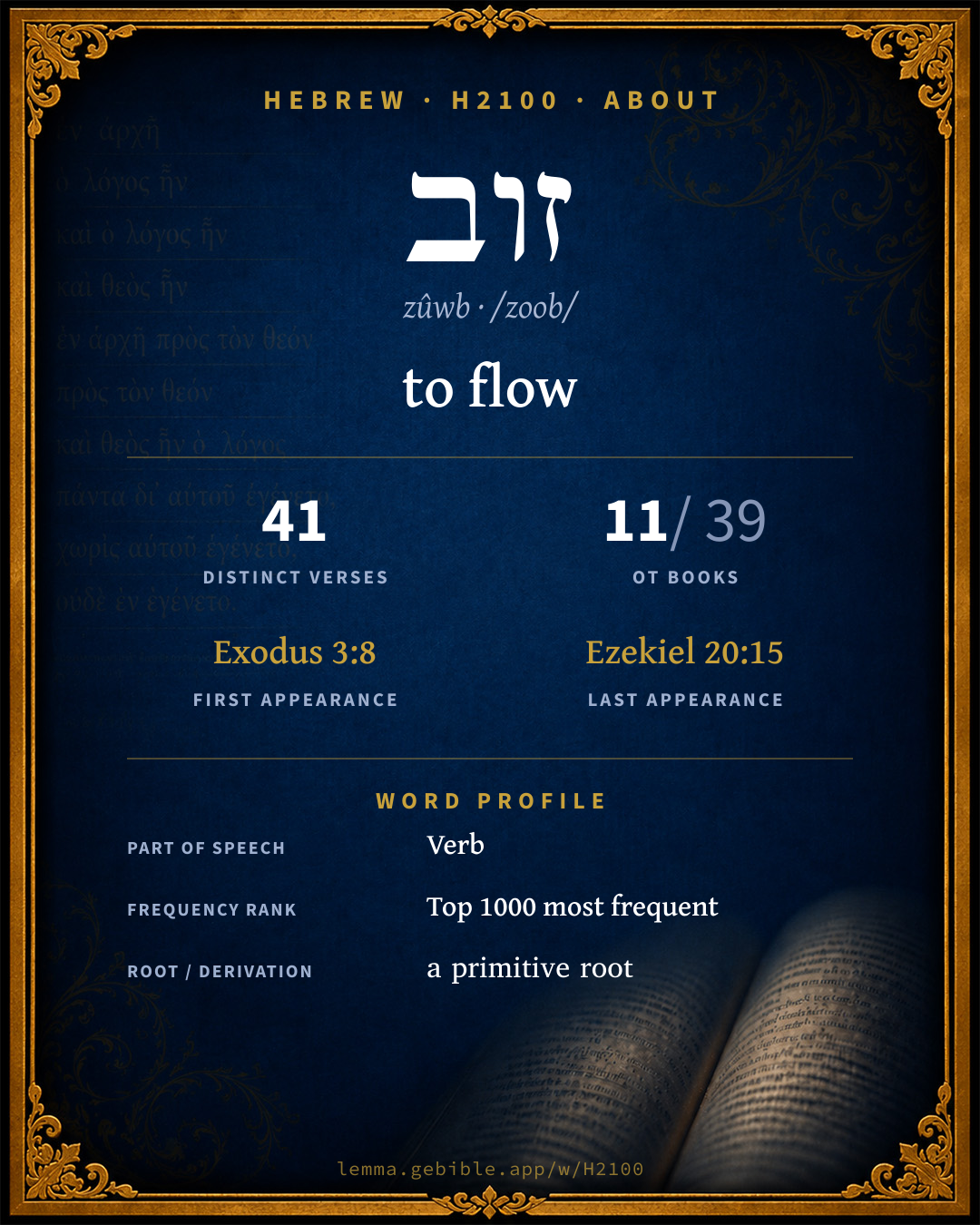
זוּב
to flow
also: gush, issue, discharge fuller range ↓
Full lexicon entry — Brown-Driver-Briggs (BDB)
From Brown-Driver-Briggs (BDB)
Where this word appears
Grammar key — what these labels mean
Part of speech
- Verb
- An action or state-of-being word.
- Noun
- A naming word — a person, place, thing, or idea.
Noun type
- Common
- A common noun — a general class of person, place, or thing (“king,” “city,” “water”), not a specific name.
Stem
- Qal
- The basic, simple active stem — the plain form of the verb (“he wrote”).
Form
- Participle Active
- A verbal adjective expressing ongoing or characteristic action (“writing / one who writes”).
- Sequential Imperfect
- An imperfect with prefixed waw — the standard past-narrative form (waw-consecutive imperfect).
- Imperfect
- An incomplete, ongoing, or future action (“he will / would write”).
State
- Construct
- A noun bound to a following noun in a possessive / “of” relationship (the construct chain).
- Absolute
- The independent form of a noun, not bound to a following word.
Person
- 3rd Person
- The one spoken about (“he / she / it / they”).
Gender
- Feminine
- Grammatically feminine.
- Masculine
- Grammatically masculine.
Number
- Singular
- One.
- Plural
- More than one (in Hebrew, generally three or more).
Grammatical forms
- Verb, Qal, Participle Active, Feminine, Singular, Construct 20 times (48%)
- Verb, Qal, Participle Active, Masculine, Singular, Absolute 15 times (36%)
- Verb, Qal, Sequential Imperfect, 3rd Person, Masculine, Plural 3 times (7%)
- Noun, Common, Masculine, Singular, Construct 1 time (2%)
- Verb, Qal, Imperfect, 3rd Person, Feminine, Singular 1 time (2%)
- Verb, Qal, Imperfect, 3rd Person, Masculine, Plural 1 time (2%)
- Verb, Qal, Imperfect, 3rd Person, Masculine, Singular 1 time (2%)
Parsed forms decoded from the imported morphology (morphhb / Westminster Leningrad Codex — WLC text public domain, morphhb tagging CC BY 4.0), counted across 42 parsed occurrences — not distinct verses.
Every verse where H2100 appears — 41 distinct verses across 11 books. Click any verse to open its interlinear word-by-word view. Verse text shown in the World English Bible for context — . Each verse’s Hebrew form is shown with its reference; the English is not keyword-highlighted, since the data carries no word-level English alignment. Use “Compare translations” on any verse to read it across multiple English versions. This concordance covers the Hebrew Bible; Septuagint (Greek Old Testament) occurrences are not indexed here.
Exodus 4 verses
- Exodus 3:8 זָבַ֥ת Qal ptcp.act fs cs I have come down to deliver them out of the hand of the Egyptians, and to bring them up out of that land to a good and large land, to a land flowing with milk and honey; to the place of the Canaanite, the Hittite, the Amorite, the Perizzite, the Hivite, and the Jebusite.
- Exodus 3:17 זָבַ֥ת Qal ptcp.act fs cs and I have said, I will bring you up out of the affliction of Egypt to the land of the Canaanite, the Hittite, the Amorite, the Perizzite, the Hivite, and the Jebusite, to a land flowing with milk and honey."'
- Exodus 13:5 זָבַ֥ת Qal ptcp.act fs cs It shall be, when Yahweh shall bring you into the land of the Canaanite, and the Hittite, and the Amorite, and the Hivite, and the Jebusite, which he swore to your fathers to give you, a land flowing with milk and honey, that you shall keep this service in this month.
- Exodus 33:3 זָבַ֥ת Qal ptcp.act fs cs to a land flowing with milk and honey: for I will not go up in the midst of you, for you are a stiff-necked people, lest I consume you in the way."
Leviticus 15 verses
- Leviticus 15:2 זָ֣ב Qal ptcp.act ms "Speak to the children of Israel, and tell them, 'When any man has a discharge from his body, because of his discharge he is unclean.
- Leviticus 15:4 הַ/זָּ֖ב ptcl def.art + Qal ptcp.act ms "'Every bed whereon he who has the discharge lies shall be unclean; and everything he sits on shall be unclean.
- Leviticus 15:6 הַ/זָּ֑ב ptcl def.art + Qal ptcp.act ms He who sits on anything whereon the man who has the discharge sat shall wash his clothes, and bathe himself in water, and be unclean until the evening.
- Leviticus 15:7 הַ/זָּ֑ב ptcl def.art + Qal ptcp.act ms "'He who touches the body of him who has the discharge shall wash his clothes, and bathe himself in water, and be unclean until the evening.
- Leviticus 15:8 הַ/זָּ֖ב ptcl def.art + Qal ptcp.act ms "'If he who has the discharge spits on him who is clean, then he shall wash his clothes, and bathe himself in water, and be unclean until the evening.
- Leviticus 15:9 הַ/זָּ֖ב ptcl def.art + Qal ptcp.act ms "'Whatever saddle he who has the discharge rides on shall be unclean.
- Leviticus 15:11 הַ/זָּ֔ב ptcl def.art + Qal ptcp.act ms "'Whoever he who has the discharge touches, without having rinsed his hands in water, he shall wash his clothes, and bathe himself in water, and be unclean until the evening.
- Leviticus 15:12 הַ/זָּ֖ב ptcl def.art + Qal ptcp.act ms "'The earthen vessel, which he who has the discharge touches, shall be broken; and every vessel of wood shall be rinsed in water.
- Leviticus 15:13 הַ/זָּב֙ ptcl def.art + Qal ptcp.act ms "'When he who has a discharge is cleansed of his discharge, then he shall count to himself seven days for his cleansing, and wash his clothes; and he shall bathe his flesh in running water, and shall be clean.
- Leviticus 15:19 זֹבָ֖/הּ n c ms cs + sfx pers 3fs "'If a woman has a discharge, and her discharge in her flesh is blood, she shall be in her impurity seven days: and whoever touches her shall be unclean until the evening.
- Leviticus 15:25 יָזוּב֩ תָז֖וּב Qal impf 3ms Qal impf 3fs "'If a woman has a discharge of her blood many days not in the time of her period, or if she has a discharge beyond the time of her period; all the days of the discharge of her uncleanness shall be as in the days of her period: she is unclean.
- Leviticus 15:32 הַ/זָּ֑ב ptcl def.art + Qal ptcp.act ms This is the law of him who has a discharge, and of him who has an emission of semen, so that he is unclean thereby;
- Leviticus 15:33 וְ/הַ/זָּב֙ conj + ptcl def.art + Qal ptcp.act ms and of her who has her period, and of a man or woman who has a discharge, and of him who lies with her who is unclean.
- Leviticus 20:24 זָבַ֥ת Qal ptcp.act fs cs But I have said to you, "You shall inherit their land, and I will give it to you to possess it, a land flowing with milk and honey." I am Yahweh your God, who has separated you from the peoples.
- Leviticus 22:4 זָ֔ב Qal ptcp.act ms "'Whoever of the seed of Aaron is a leper or has an issue; he shall not eat of the holy things, until he is clean. Whoever touches anything that is unclean by the dead, or a man whose seed goes from him;
Numbers 5 verses
- Numbers 5:2 זָ֑ב Qal ptcp.act ms "Command the children of Israel that they put out of the camp every leper, and everyone who has an issue, and whoever is unclean by the dead.
- Numbers 13:27 זָבַ֨ת Qal ptcp.act fs cs They told him, and said, We came to the land where you sent us; and surely it flows with milk and honey; and this is the fruit of it.
- Numbers 14:8 זָבַ֥ת Qal ptcp.act fs cs If Yahweh delight in us, then he will bring us into this land, and give it to us; a land which flows with milk and honey.
- Numbers 16:13 זָבַ֤ת Qal ptcp.act fs cs is it a small thing that you have brought us up out of a land flowing with milk and honey, to kill us in the wilderness, but you must needs make yourself also a prince over us?
- Numbers 16:14 זָבַ֨ת Qal ptcp.act fs cs Moreover you haven't brought us into a land flowing with milk and honey, nor given us inheritance of fields and vineyards: will you put out the eyes of these men? we won't come up.
Deuteronomy 6 verses
- Deuteronomy 6:3 זָבַ֥ת Qal ptcp.act fs cs Hear therefore, Israel, and observe to do it; that it may be well with you, and that you may increase mightily, as Yahweh, the God of your fathers, has promised to you, in a land flowing with milk and honey.
- Deuteronomy 11:9 זָבַ֥ת Qal ptcp.act fs cs and that you may prolong your days in the land, which Yahweh swore to your fathers to give to them and to their seed, a land flowing with milk and honey.
- Deuteronomy 26:9 זָבַ֥ת Qal ptcp.act fs cs and he has brought us into this place, and has given us this land, a land flowing with milk and honey.
- Deuteronomy 26:15 זָבַ֥ת Qal ptcp.act fs cs Look down from your holy habitation, from heaven, and bless your people Israel, and the ground which you have given us, as you swore to our fathers, a land flowing with milk and honey.
- Deuteronomy 27:3 זָבַ֤ת Qal ptcp.act fs cs and you shall write on them all the words of this law, when you are passed over; that you may go in to the land which Yahweh your God gives you, a land flowing with milk and honey, as Yahweh, the God of your fathers, has promised you.
- Deuteronomy 31:20 זָבַ֤ת Qal ptcp.act fs cs For when I shall have brought them into the land which I swore to their fathers, flowing with milk and honey, and they shall have eaten and filled themselves, and grown fat; then will they turn to other gods, and serve them, and despise me, and break my covenant.
Joshua 1 verse
2 Samuel 1 verse
Psalms 2 verses
- Psalms 78:20 וַ/יָּז֣וּבוּ conj + Qal wimpf 3mp Behold, he struck the rock, so that waters gushed out, Streams overflowed. Can he give bread also? Will he provide flesh for his people?"
- Psalms 105:41 וַ/יָּז֣וּבוּ conj + Qal wimpf 3mp He opened the rock, and waters gushed out. They ran as a river in the dry places.
Isaiah 1 verse
Jeremiah 3 verses
- Jeremiah 11:5 זָבַ֥ת Qal ptcp.act fs cs that I may establish the oath which I swore to your fathers, to give them a land flowing with milk and honey, as at this day. Then answered I, and said, Amen, Yahweh.
- Jeremiah 32:22 זָבַ֥ת Qal ptcp.act fs cs and gave them this land, which you did swear to their fathers to give them, a land flowing with milk and honey;
- Jeremiah 49:4 זָ֣ב Qal ptcp.act ms Why glory you in the valleys, your flowing valley, backsliding daughter? who trusted in her treasures, [saying], Who shall come to me?
Lamentations 1 verse
Ezekiel 2 verses
- Ezekiel 20:6 זָבַ֤ת Qal ptcp.act fs cs in that day I swore to them, to bring them forth out of the land of Egypt into a land that I had searched out for them, flowing with milk and honey, which is the glory of all lands.
- Ezekiel 20:15 זָבַ֤ת Qal ptcp.act fs cs Moreover also I swore to them in the wilderness, that I would not bring them into the land which I had given them, flowing with milk and honey, which is the glory of all lands;
About this entry
At a glance — auto-summarized from this page’s data, not written by a person. Every figure links to its source below. This summary describes the numbers; it doesn’t interpret them.
זוב — transliterated zûwb — is a Hebrew verb carrying the sense “to flow.” The lexical range runs to 5 senses — “to flow” plus “gush”, “issue”, and “discharge”. The Hebrew Bible uses it across 41 verses — moderately common. More than a third of its appearances fall in Leviticus. It first appears in Exodus 3:8. Each statement above links to its evidence; the full detail follows below.
Gloss history
Strong's 1890 vs modern scholarship
About this word
Strong's H2100 catalogs a Hebrew word from the Hebrew Old Testament.
These counts are not copied from any lexicon or concordance. They are computed here, from the morphology-tagged Hebrew Old Testament. What Lemma adds →
- 41
- distinct verses
- The word appears in 41 distinct verses.
- 11 / 39
- OT books
- The word appears in 11 of 39 Old Testament books.
- #864
- by frequency
- Top 1000 most frequent Hebrew words (rank 864 of 8,640 Hebrew words by occurrence).
View all 41 occurrences in the concordance →
Most concentrated in
- Leviticus 15 verses 37%
- Deuteronomy 6 verses 15%
- Numbers 5 verses 12%
By section of the Old Testament
By traditional corpus
Conventional, traditional groupings — biblical authorship is debated, so this is a traditional corpus grouping, not an authorship claim. Each share is this word’s portion of its verses in that division of the Hebrew canon. Each figure is a share of the word’s 41 distinct verses.
- Torah (Pentateuch) 30 verses · 73%
- Prophets (Nevi'im) 8 verses · 20%
- Writings (Ketuvim) 3 verses · 7%
How translations render this word
Counts come from each version’s own published word-to-Strong’s tagging or interlinear alignment — an approximate guide to how each version renders this word, not a word-level alignment the data otherwise carries. Because each total is that version’s own tagged count, the per-version totals vary from one another and need not match the appearance or distinct-verse counts above. These counts may also differ from a printed concordance because Lemma counts each distinctly tagged rendering and does not collapse phrase taggings into a single head-word total. This is a fixed set of word-tagged versions (KJV, ASV, BSB, ULT) and does not change with the reading translation you choose elsewhere. Each version’s license is shown beside its name below (and on Sources).
- King James Version: Floweth 11×, Flowing 9×, Hath the issue 6×
- American Standard Version: Flowing 11×, Land flowing 6×, Gushed out 2×
- Berean Standard Bible: Flowing 17×, Man with the discharge 6×, Discharge 3×
- unfoldingWord Literal Text: Flowing 13×, Flowing with 9×, One flowing 7×
King James Version Public Domain
Renders H2100 across 42 tagged occurrences — most commonly:
Plus 13 renderings that appear only once — usually multi-word phrases or single function words the recovered tagging swept in, not distinct renderings.
American Standard Version Public Domain
Renders H2100 across 42 tagged occurrences — most commonly:
Plus 15 renderings that appear only once — usually multi-word phrases or single function words the recovered tagging swept in, not distinct renderings.
Berean Standard Bible Public Domain
Renders H2100 across 42 tagged occurrences — most commonly:
Plus 8 renderings that appear only once — usually multi-word phrases or single function words the recovered tagging swept in, not distinct renderings.
unfoldingWord Literal Text CC BY-SA 4.0
Renders H2100 across 54 tagged occurrences — most commonly:
Plus 8 renderings that appear only once — usually multi-word phrases or single function words the recovered tagging swept in, not distinct renderings.
Senses in BDB
The 5 senses BDB distinguishes for this word, in lexicon order (not ranked by frequency or importance). The full entry — with sub-senses — is in the Lexicon Entry tab.
- to flow, gush, issue, discharge
(Qal)
- to flow, gush
- to die, pine away (figuratively)
- to flow (of issue from woman), have an issue, flux
- flowing (participle)
Word origin
[ זוּב ] vb. flow, gush
— Brown-Driver-Briggs (Oxford 1906, public domain), digitized via Sefaria, supplemented by the OpenScriptures HebrewLexicon (CC BY 4.0). See Sources.
Origin: a primitive root
Jastrow Dictionary
A second Hebrew/Aramaic lexicon for comparison, covering Aramaic and post-biblical (Talmudic, Targumic, Midrashic) usage that the biblical-Hebrew BDB does not. Matched by lemma rather than by Strong’s number, so a lemma may carry more than one Jastrow headword (shown separately below), and the entries cover usage well beyond the Bible.
זוּב
- to flow, drip. Bets. 3ᵃ, a. fr. משקין שזָבוּ juice of fruits which flowed out (on a Holy Day). Ḥull. 27ᵃ (play on וז̇ב̇ח̇ת̇, Deut. XII, 21) ממקום שזָֹב ח̇ת̇הו from where (the blood) will flow (the jugular veins), there break (its life), v. חָתַת; a. fr.—V. זָב. e.g. Deuteronomy 12:21
זוֹב
- preced.) flux, gonorrhea, prolonged menstruation. Nidd. 35ᵇ ז׳ דומה the flux (of the gonorrhea) resembles &c. Ib. יולדה בז׳ one giving birth while suffering with flux; a. fr.—Men. 64ᵇ שמא בז׳ סיכנה perhaps she was in danger from a severe hemorrhage, v. זִיבָה a. זֵיבָה.
זוֹב ²
- Sabb. 110ᵇ (in an incantation) קום מזוֹבִיךְ (Ms. M. a. some ed. מזָבִיךְ) rise (be cured) from thy flux.
A Dictionary of the Targumim, the Talmud Babli and Yerushalmi, and the Midrashic Literature (Marcus Jastrow; London, Luzac, 1903) — Public Domain. Digitized via Sefaria. Digitized via Sefaria. Full attribution on Sources.
Forms in the corpus
The 18 distinct written forms H2100 takes in the Hebrew Bible, most frequent first — each parse links to that stem’s occurrences in the concordance. Hebrew forms include their vowel points and cantillation, so a single lemma takes many written forms.
| Form | Parsing | Example | Uses |
|---|---|---|---|
| זָבַ֥ת | Verb, Qal, Participle Active, Feminine, Singular, Construct | Deuteronomy 6:3 | 13 |
| זָבַ֤ת | Verb, Qal, Participle Active, Feminine, Singular, Construct | Deuteronomy 27:3 | 5 |
| הַ/זָּ֖ב | Verb, Qal, Participle Active, Masculine, Singular, Absolute | Leviticus 15:4 | 4 |
| הַ/זָּ֑ב | Verb, Qal, Participle Active, Masculine, Singular, Absolute | Leviticus 15:6 | 3 |
| וַ/יָּז֣וּבוּ | Verb, Qal, Sequential Imperfect, 3rd Person, Masculine, Plural | Psalms 78:20 | 2 |
| זָ֣ב | Verb, Qal, Participle Active, Masculine, Singular, Absolute | Jeremiah 49:4 | 2 |
| זָבַ֨ת | Verb, Qal, Participle Active, Feminine, Singular, Construct | Numbers 13:27 | 2 |
| הַ/זָּ֔ב | Verb, Qal, Participle Active, Masculine, Singular, Absolute | Leviticus 15:11 | 1 |
| הַ/זָּב֙ | Verb, Qal, Participle Active, Masculine, Singular, Absolute | Leviticus 15:13 | 1 |
| וְ/הַ/זָּב֙ | Verb, Qal, Participle Active, Masculine, Singular, Absolute | Leviticus 15:33 | 1 |
| וַ/יָּזֻ֖בוּ | Verb, Qal, Sequential Imperfect, 3rd Person, Masculine, Plural | Isaiah 48:21 | 1 |
| זָ֑ב | Verb, Qal, Participle Active, Masculine, Singular, Absolute | Numbers 5:2 | 1 |
| זָ֔ב | Verb, Qal, Participle Active, Masculine, Singular, Absolute | Leviticus 22:4 | 1 |
| זָ֠ב | Verb, Qal, Participle Active, Masculine, Singular, Absolute | 2 Samuel 3:29 | 1 |
| זֹבָ֖/הּ | Noun, Common, Masculine, Singular, Construct | Leviticus 15:19 | 1 |
| יָז֨וּבוּ֙ | Verb, Qal, Imperfect, 3rd Person, Masculine, Plural | Lamentations 4:9 | 1 |
| יָזוּב֩ | Verb, Qal, Imperfect, 3rd Person, Masculine, Singular | Leviticus 15:25 | 1 |
| תָז֖וּב | Verb, Qal, Imperfect, 3rd Person, Feminine, Singular | Leviticus 15:25 | 1 |
Same root — word family
Other BDB entries built from the same root as H2100, grouped by Strong’s listed origin. These share a root / origin per the lexicon — not necessarily a shared meaning. Each links to that word’s own entry.
Derived from this word
Compare all same-root words → They share a root, not necessarily a meaning.
Septuagint verse parallels
This word appears in 40 verses that also exist in the Greek Old Testament (Septuagint), out of the 41 Hebrew verses it occurs in. You can read those verses in Greek by switching the Old Testament edition to the Septuagint.
Read these verses in the Septuagint
- Exodus 3:8
- Leviticus 15:2
- Numbers 5:2
- Deuteronomy 6:3
- Joshua 5:6
- 2 Samuel 3:29
- Psalms 105:41
- Isaiah 48:21
- Jeremiah 11:5
- Lamentations 4:9
- Ezekiel 20:6
This is a verse-level parallel only — the same verses exist in both the Hebrew and Greek Old Testaments. No word-level Hebrew↔Greek correspondence is claimed: the data carries no such alignment, so no Greek word is shown as this Hebrew word’s translation. Coverage is not total — the Septuagint omits the deuterocanon and renumbers the Psalms, so some Hebrew verses have no direct Greek parallel.