Jeremiah 32:22

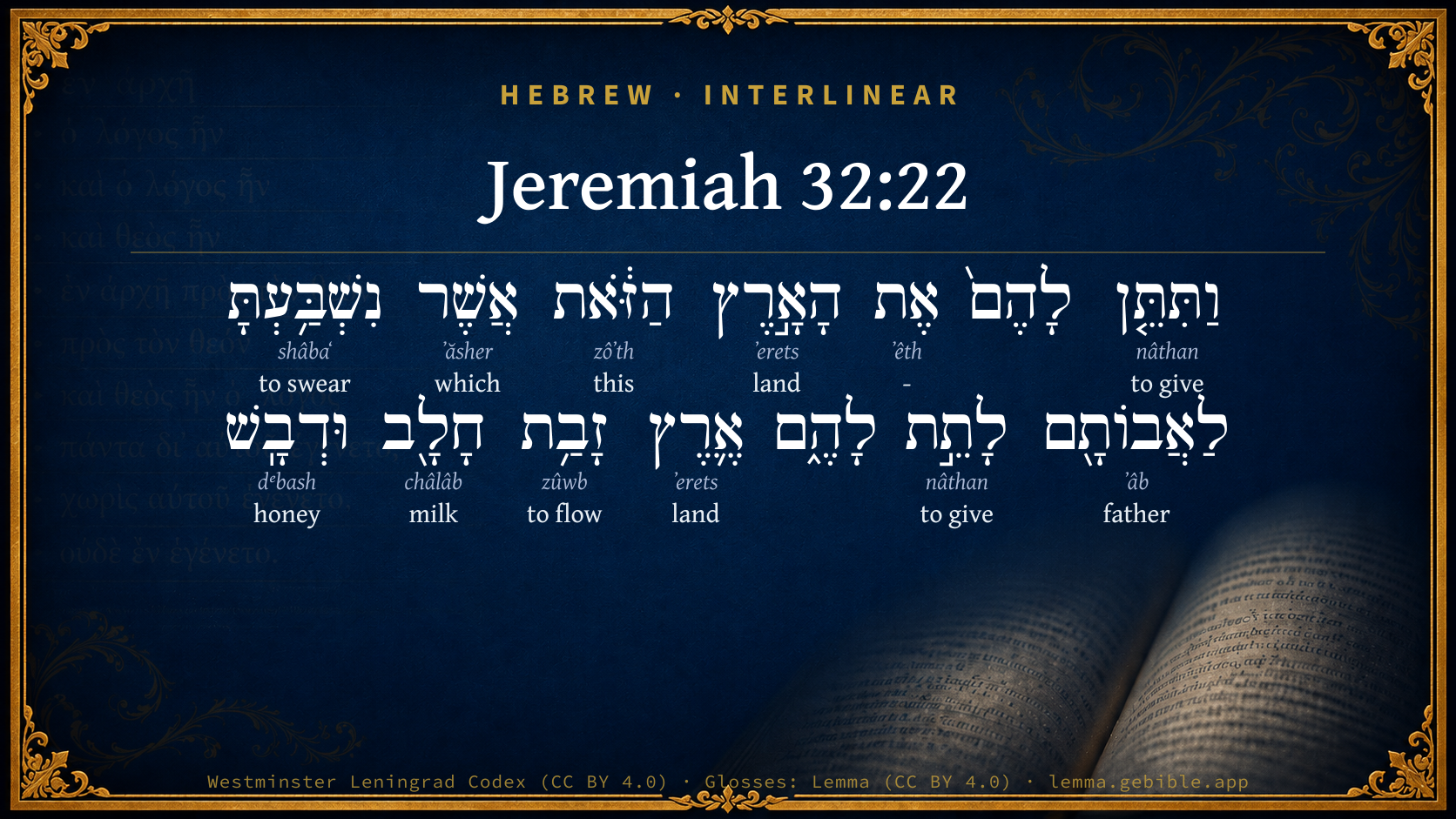
Hebrew (Westminster Leningrad Codex) Jeremiah 32:22 appears in the Hebrew Old Testament. The text above is from the Westminster Leningrad Codex. Each word links to its Strong’s number, a concise gloss, and parsing drawn from the Open Scriptures Hebrew Bible morphology. Click any word for its full Brown-Driver-Briggs (BDB) entry.
Download image
Cite this verse

Jeremiah 32:22 (World English Bible). Public Domain. Lemma interlinear Bible study tool, https://lemma.gebible.app/v/jeremiah/32/22.

Show BibTeX & RIS
BibTeX
RIS
English Translation
and gave them this land, which you did swear to their fathers to give them, a land flowing with milk and honey;
World English Bible · Public Domain
Download a study sheet

One document with this verse’s original text, its word-by-word gloss line, the meaning frame, cross-references with their text, attributed commentary, and full source and license credits — printable, and it pastes into notes with its structure intact.

This verse Autodidact and up

Study sheet (.html) Plain text (.txt)

A passage Seminary Student

Up to 50 verses in one chapter. A passage sheet keeps up to 6 commentary sources and 12 cross-references per verse, in the order this page ranks them, and says so on the sheet whenever that leaves anything out. Ask for a single verse and you get the Autodidact verse sheet above.

Everything on this page stays free to read, with no account — the sheet is a download of what is already on screen, not access to it.

Want to remove ads? Support Godless Engineer
Compare translations 3

The same verse in 3 English versions, stacked beneath the original-language interlinear above. Click any original word for its lexicon entry.

Each is an independent rendering of the whole verse — the interlinear is not word-aligned to these translations.

Highlighted words mark where these versions differ — a whole-verse word diff, not a word-by-word alignment.

  • World English Bible Public Domain
    and gave them this land, which you did swear to their fathers to give them, a land flowing with milk and honey;
  • King James Version Public Domain
    And hast given them this land, which thou didst swear to their fathers to give them, a land flowing with milk and honey;
  • unfoldingWord Literal Text CC BY-SA 4.0
    Then you gave them this land—which you had sworn to their ancestors to give to them—a land flowing with milk and honey.

unfoldingWord Literal Text — © unfoldingWord, licensed CC BY-SA 4.0. Word-aligned USFM3 via Door43 (git.door43.org/unfoldingWord/en_ult).

Versions to compare (up to 4)

3 of 4 selected

Show all 18 translations

Every available English version of this verse, each an independent rendering of the whole verse.

  • World English Bible Public Domain
    and gave them this land, which you did swear to their fathers to give them, a land flowing with milk and honey;
  • Berean Standard Bible Public Domain
    You gave them this land that You had sworn to give their fathers, a land flowing with milk and honey.
  • Majority Standard Bible Public Domain
    You gave them this land that You had sworn to give their fathers, a land flowing with milk and honey.
  • King James Version Public Domain
    And hast given them this land, which thou didst swear to their fathers to give them, a land flowing with milk and honey;
  • American Standard Version (1901) Public Domain
    and gavest them this land, which thou didst swear to their fathers to give them, a land flowing with milk and honey;
  • Revised Version (1885) Public Domain
    and gavest them this land, which thou didst swear to their fathers to give them, a land flowing milk and honey;
  • Geneva Bible (1599) Public Domain
    And hast giuen them this land, which thou diddest sweare to their fathers to giue them, euen a land, that floweth with milke and hony,
  • Douay-Rheims (1899) Public Domain
    And best given them this land which thou didst swear to their fathers, to give them a land flowing with milk and honey.
  • Young's Literal Translation Public Domain
    And thou givest to them this land that thou didst swear to their fathers to give to them, a land flowing with milk and honey,
  • Literal Standard Version CC BY-SA 4.0
    and you give to them this land that you swore to their fathers to give to them, a land flowing with milk and honey,
  • Unlocked Literal Bible CC BY-SA 4.0
    Then you gave them this land—which you had sworn to their ancestors to give to them—a land flowing with milk and honey.
  • unfoldingWord Literal Text CC BY-SA 4.0
    Then you gave them this land—which you had sworn to their ancestors to give to them—a land flowing with milk and honey.
  • Darby Bible Public Domain
    and didst give them this land, which thou hadst sworn unto their fathers to give them, a land flowing with milk and honey.
  • World Messianic Bible Public Domain
    and gave them this land, which you swore to their fathers to give them, a land flowing with milk and honey.
  • Webster's Bible Public Domain
    And hast given them this land, which thou didst swear to their fathers to give them, a land flowing with milk and honey;
  • Free Bible Version CC BY-SA 4.0
    You gave them this land that you had promised to give their forefathers, a land flowing with milk and honey.
  • Bible in Basic English Public Domain
    And have given them this land, which you gave your word to their fathers to give them, a land flowing with milk and honey;
  • JPS Tanakh (1917) Public Domain
    and gavest them this land, which Thou didst swear to their fathers to give them, a land flowing with milk and honey;

Literal Standard Version (2020), Covenant Press — licensed CC BY-SA 4.0. Text via the HelloAO Bible API (eBible.org). Unlocked Literal Bible (unfoldingWord) — licensed CC BY-SA 4.0. Text via the HelloAO Bible API (eBible.org). unfoldingWord Literal Text — © unfoldingWord, licensed CC BY-SA 4.0. Word-aligned USFM3 via Door43 (git.door43.org/unfoldingWord/en_ult). Free Bible Version, Dr. Jonathan Gallagher — licensed CC BY-SA 4.0. Text via the HelloAO Bible API (eBible.org).

Word by word

More ways to search: Search by grammar → Find every occurrence → Compare this word →

Practice this passage: Drill this verse → Learn its vocabulary →

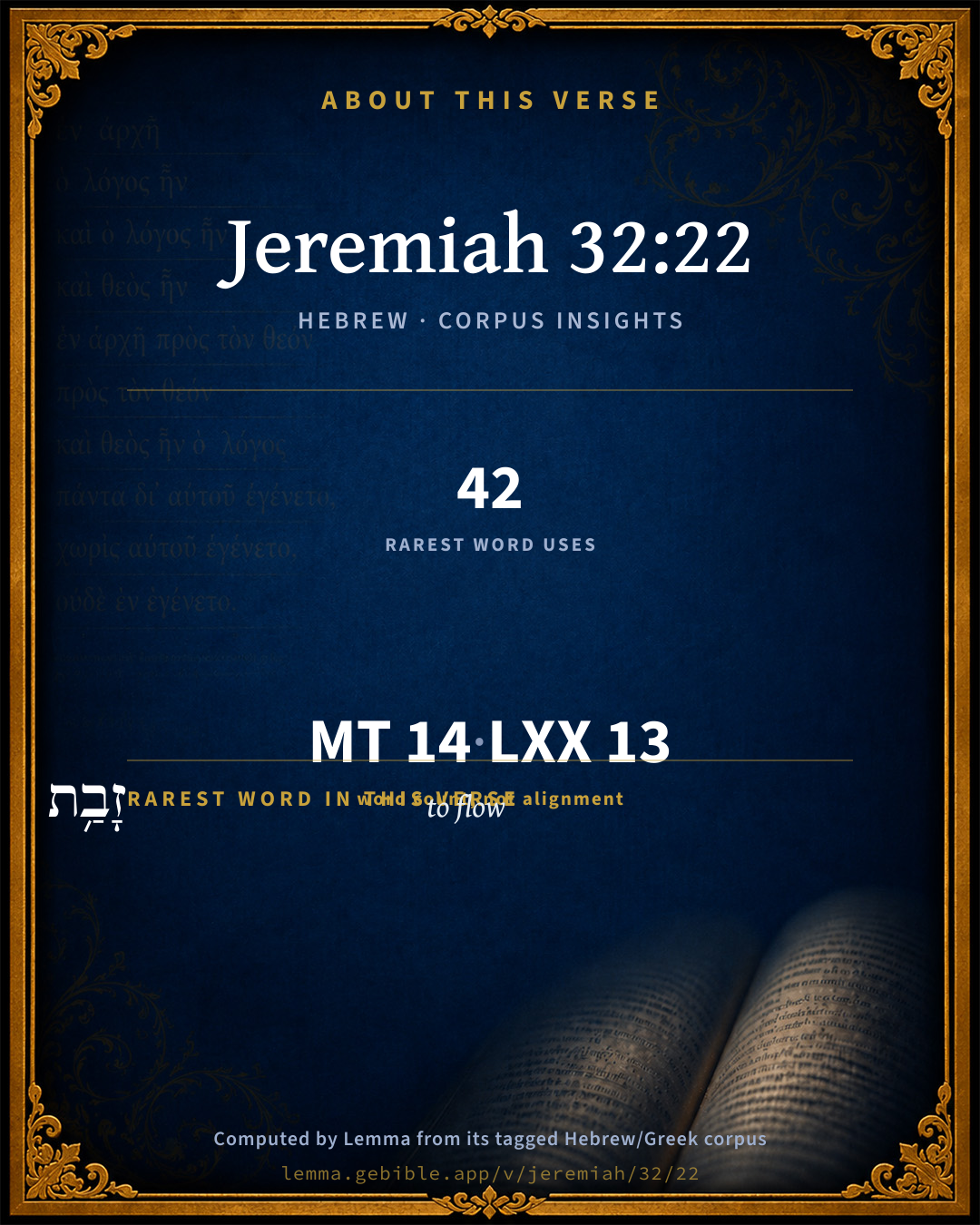
זָבַ֥ת
zûwb
H2100
“flowing”
Verb, Qal, Participle Active, Feminine, Singular, Construct
Part of Speech
Verb
Stem
Qal
Form
Participle Active
Gender
Feminine
Number
Singular
State
Construct
Full BDB Definition

Origin: a primitive root

TWOT: 534

to flow, gush, issue, discharge - (Qal) - to flow, gush - to die, pine away (figuratively) - to flow (of issue from woman), have an issue, flux - flowing (participle)
  1. וַתִּתֵּ֤ן nâthan H5414 “and · to give” Conjunction + Verb, Qal, Sequential Imperfect, 2nd Person, Masculine, Singular
  2. אֶת ʼêth H853 “-” Particle, Direct Object
  3. הָאָ֣רֶץ ʼerets H776 “the · land” Particle, Definite Article + Noun, Common, Both, Singular, Absolute
  4. הַזֹּ֔את zôʼth H2063 “the · this” Particle, Definite Article + Pronoun, Demonstrative, Feminine, Singular
  5. אֲשֶׁר ʼăsher H834 “which” Particle, Relative
  6. נִשְׁבַּ֥עְתָּ shâbaʻ H7650 “to swear” Verb, Niphal, Perfect, 2nd Person, Masculine, Singular
  7. לַאֲבוֹתָ֖ם ʼâb H1 “to/for · fathers · their” Preposition + Noun, Common, Masculine, Plural, Construct + Suffix, Personal, 3rd Person, Masculine, Plural
  8. לָתֵ֣ת nâthan H5414 “to give” Preposition + Verb, Qal, Infinitive Construct
  9. אֶ֛רֶץ ʼerets H776 “land” Noun, Common, Both, Singular, Absolute
  10. חָלָ֖ב châlâb H2461 “milk” Noun, Common, Masculine, Singular, Absolute
  11. וּדְבָֽשׁ dᵉbash H1706 “and · honey” Conjunction + Noun, Common, Masculine, Singular, Absolute

About this verse

These counts appear in no published source. They are computed here, from the morphology-tagged text and Lemma’s own curated glosses. What Lemma adds →

14
words
10
distinct lemmas
Prophets
section

Shared distinctive vocabulary

זָבַ֥ת to flow H2100 occurs in 41 verses of the Hebrew Bible. Also found in:

Grammatical profile

  • 4 verbs
  • 5 nouns
  • 1 pronoun
  • 2 prepositions
  • 2 particles

Verb forms

  • וַתִּתֵּ֤ן Qal · Sequential Imperfect
  • נִשְׁבַּ֥עְתָּ Niphal · Perfect
  • לָתֵ֣ת Qal · Infinitive Construct
  • זָבַ֥ת Qal · Participle Active

Repetition

Words recur within this verse — often emphatic in Hebrew:

  • וַתִּתֵּ֤ן to give H5414 ×2
  • הָאָ֣רֶץ land H776 ×2

Hebrew & Septuagint length

In the original languages it is 14 Hebrew tokens and 13 Greek tokens — but the two are counted differently (Hebrew bundles its prefixes and suffixes into one token; the Greek is in lemma form), so that isn’t a like-for-like length.

Cross-references

28

Topical passages linked to Jeremiah 32:22 in the Treasury of Scripture Knowledge — connected by theme and wording, ordered by reader-vote popularity; previews shown in the World English Bible.

  • Exodus 3:8 I have come down to deliver them out of the hand of the Egyptians, and to bring them up out of that land to a good and large land, to a land flowing with milk and honey; to the place of the Canaanite, the Hittite, the Amorite, the Perizzite, the Hivite, and the Jebusite.
  • Exodus 13:5 It shall be, when Yahweh shall bring you into the land of the Canaanite, and the Hittite, and the Amorite, and the Hivite, and the Jebusite, which he swore to your fathers to give you, a land flowing with milk and honey, that you shall keep this service in this month.
  • Jeremiah 11:5 that I may establish the oath which I swore to your fathers, to give them a land flowing with milk and honey, as at this day. Then answered I, and said, Amen, Yahweh.
  • Exodus 3:17 and I have said, I will bring you up out of the affliction of Egypt to the land of the Canaanite, the Hittite, the Amorite, the Perizzite, the Hivite, and the Jebusite, to a land flowing with milk and honey."'
  • Deuteronomy 1:8 Behold, I have set the land before you: go in and possess the land which Yahweh swore to your fathers, to Abraham, to Isaac, and to Jacob, to give to them and to their seed after them.
  • Psalms 105:9–11 The covenant which he made with Abraham, His oath to Isaac,
  • Genesis 13:15 for all the land which you see, I will give to you, and to your offspring forever.
  • Genesis 15:18–21 In that day Yahweh made a covenant with Abram, saying, "To your seed have I given this land, from the river of Egypt to the great river, the river Euphrates:
  • Genesis 17:7–8 I will establish my covenant between me and you and your seed after you throughout their generations for an everlasting covenant, to be a God to you and to your seed after you.
  • Genesis 24:7 Yahweh, the God of heaven, who took me from my father's house, and from the land of my birth, who spoke to me, and who swore to me, saying, 'I will give this land to your seed.' He will send his angel before you, and you shall take a wife for my son from there.
  • Genesis 28:13–15 Behold, Yahweh stood above it, and said, "I am Yahweh, the God of Abraham your father, and the God of Isaac. The land whereon you lie, to you will I give it, and to your seed.
  • Genesis 35:11–12 God said to him, "I am God Almighty. Be fruitful and multiply. A nation and a company of nations will be from you, and kings will come out of your loins.
  • Genesis 50:24 Joseph said to his brothers, "I am dying, but God will surely visit you, and bring you up out of this land to the land which he swore to Abraham, to Isaac, and to Jacob."
  • Exodus 33:1–3 Yahweh spoke to Moses, "Depart, go up from here, you and the people that you have brought up out of the land of Egypt, to the land of which I swore to Abraham, to Isaac, and to Jacob, saying, 'I will give it to your seed.'
  • Numbers 14:16 Because Yahweh was not able to bring this people into the land which he swore to them, therefore he has slain them in the wilderness.
  • Numbers 14:30 surely you shall not come into the land, concerning which I swore that I would make you dwell therein, save Caleb the son of Jephunneh, and Joshua the son of Nun.
  • Deuteronomy 1:35 Surely there shall not one of these men of this evil generation see the good land, which I swore to give to your fathers,
  • Deuteronomy 6:10 It shall be, when Yahweh your God shall bring you into the land which he swore to your fathers, to Abraham, to Isaac, and to Jacob, to give you, great and goodly cities, which you didn't build,
  • Deuteronomy 6:18 You shall do that which is right and good in the sight of Yahweh; that it may be well with you, and that you may go in and possess the good land which Yahweh swore to your fathers,
  • Deuteronomy 6:23 and he brought us out from there, that he might bring us in, to give us the land which he swore to our fathers.
  • Deuteronomy 7:13 and he will love you, and bless you, and multiply you; he will also bless the fruit of your body and the fruit of your ground, your grain and your new wine and your oil, the increase of your cattle and the young of your flock, in the land which he swore to your fathers to give you.
  • Deuteronomy 8:1 All the commandment which I command you this day shall you observe to do, that you may live, and multiply, and go in and possess the land which Yahweh swore to your fathers.
  • Deuteronomy 26:9–11 and he has brought us into this place, and has given us this land, a land flowing with milk and honey.
  • Joshua 1:6 Be strong and of good courage; for you shall cause this people to inherit the land which I swore to their fathers to give them.
  • Joshua 21:43 So Yahweh gave to Israel all the land which he swore to give to their fathers; and they possessed it, and lived therein.
  • Nehemiah 9:15 and gave them bread from the sky for their hunger, and brought forth water for them out of the rock for their thirst, and commanded those who they should go in to possess the land which you had sworn to give them.
  • Ezekiel 20:6 in that day I swore to them, to bring them forth out of the land of Egypt into a land that I had searched out for them, flowing with milk and honey, which is the glory of all lands.
  • Ezekiel 20:15 Moreover also I swore to them in the wilderness, that I would not bring them into the land which I had given them, flowing with milk and honey, which is the glory of all lands;

Cross-references courtesy of OpenBible.info (CC BY 4.0).

Hebrew and Greek witnesses Masoretic Hebrew ↔ Greek Septuagint

The same verse in the two great witnesses to the Old Testament, shown verse-for-verse.

These are two independent witnesses, not word-aligned to each other, and the Septuagint is shown in lemma (dictionary) form.

Hebrew Jeremiah 32:22 Masoretic · Westminster Leningrad Codex

וַתִּתֵּ֤ן לָהֶם֙ אֶת הָאָ֣רֶץ הַזֹּ֔את אֲשֶׁר נִשְׁבַּ֥עְתָּ לַאֲבוֹתָ֖ם לָתֵ֣ת לָהֶ֑ם אֶ֛רֶץ זָבַ֥ת חָלָ֖ב וּדְבָֽשׁ

and gave them this land, which you did swear to their fathers to give them, a land flowing with milk and honey;

World English Bible · Public Domain

Greek LXX Structure differs

In the Septuagint, Jeremiah is about an eighth shorter than the Hebrew and arranges its material differently — the Oracles Against the Nations (Hebrew chapters 46–51) appear in the middle of the Greek book, after 25:13. Because the chapter and verse boundaries do not line up, a verse-for-verse comparison with the Hebrew is not shown.

A verse-for-verse comparison isn’t shown here because the chapters and verses don’t line up. Switch to the LXX edition with the MT / LXX toggle above to read the Greek directly.

Hebrew: Westminster Leningrad Codex (CC BY 4.0). Greek: Septuagint (public domain); English from a public-domain English Septuagint. How the Septuagint differs from the Hebrew →

Targum (Aramaic paraphrase)

1

The Targum is the ancient Jewish Aramaic paraphrase of the Hebrew Scriptures — an interpretive translation, not the Hebrew text itself. Onkelos (literal) and Pseudo-Jonathan (expansive) render the Torah, and Jonathan the Prophets. Coverage is partial: where no permissively-licensed English translation exists for a verse, only the Aramaic is shown. This is verse-level text, not a word-by-word alignment to the Hebrew.

  1. Targum Jonathan Prophets (Joshua–Malachi)
    וִיהַבְתְּ לְהוֹן יַת אַרְעָא דְקַיֵמְתָּא לַאֲבָהַתְהוֹן לְמִתַּן לְהוֹן אַרְעָא עַבְדָא חֲלַב וּדְבָשׁ:

    (no public-domain English translation for this verse)

    Targum Jonathan — Aramaic: “Mikraot Gedolot” (public domain). English: “Sefaria Community Translation” (CC0 1.0 (public-domain dedication)); “London "Chaldee Paraphrase," 1871” (public domain). Text via Sefaria.

Commentary

Notes on Jeremiah 32:22 from classic Christian and Jewish commentators (each source and its license shown beneath its notes). The classic Christian expositions comment on the surrounding passage and are grouped to its opening verse, so a note may address several verses; the Jewish commentaries on the Tanakh (Rashi and others) are per-verse, so they appear only where the commentator wrote on this verse.

Lemma curates 59 commentaries, every one of them public domain or Creative Commons licensed, each selected and text-cleaned for this edition rather than reprinted as found. About our sources →

Trapp's Complete Commentary

John Trapp

Jer 32:22 And hast given them this land, which thou didst swear to their fathers to give them, a land flowing with milk and honey;

Ver. 22. {See Trapp on "Jer 32:21"}

John Trapp, A Commentary or Exposition upon All the Books of the Old and New Testament (1647–1656) — public domain. Text from a community e-Sword module.

Tyndale Open Study Notes

Tyndale Open Resources

32:22 God also gave the productive Promised Land to Israel.

Tyndale Open Study Notes — © Tyndale Open Resources, licensed CC BY-SA 4.0. Text via the HelloAO Bible API.

Jamieson, Fausset & Brown

Robert Jamieson, A. R. Fausset & David Brown

given . . . didst swear--God gave it by a gratuitous covenant, not for their deserts.

a land flowing with milk and honey--(See on Num 14:8).

Jamieson, Fausset & Brown — Commentary Critical and Explanatory on the Whole Bible (1871) — public domain (CC PDM 1.0). Text via the HelloAO Bible API.

John Calvin's Commentaries

Here the fruitfulness of the land is commended, so that the ingratitude of the people for their redemption might appear less excusable. God had already bound them, as it were, more than enough to himself, but when the wealth and fruitfulness of the land were added, the bounty of God was doubled, which, by a stronger and more sacred chain, bound the people to obedience. But when they buried, as it were, both their benefits, their impiety was extreme, and so much baser was their ingratitude. We hence see why the Prophet said that the land was given to the people.

He at the same time mentions the reason, even because it had been promised to their fathers. It is not, however, right to suppose that the fathers had any merits, as Jerome says, who ignorantly perverts this passage; for he says, that nothing was due to the people on the ground of merit; but that the fathers were yet worthy on account of their great virtues. But we know that God’s covenant was from the beginning gratuitous. The Prophet then means here, that the land was not given as a reward rendered to the people for their works, but that it was given them because it had been gratuitously promised. And he mentions the oath, because God, regarding the infirmity of Abraham and the fathers, confirmed by an oath his own promise. But as I have spoken elsewhere more at large on this subject, I touch on it but slightly now. However, whenever there is mention made of an oath, let us know that reproof is indirectly given to the inconstancy of men, who always vacillate, and can never recumb on God’s promise, except they are helped by this confirmation.

However this may be, the Prophet here reminds us that God confirmed the pledge which he had given to the fathers when the people entered into the land, because they could not have obtained it by their valor, or by any other means. In short, Jeremiah calls the attention of the people to God’s gratuitous covenant, that they might understand that they became possessors of the land by no other right than this, — that God of his own free will had promised to Abraham and his seed that he would give them that land. He speaks, as I have just said, of the fruitfulness of the land, because it was God’s design to allure the people in every way, that they might continue in his service. And when the people, thus bountifully dealt with, did not acknowledge God’s favor, their extreme and base stupidity was fully proved. What the Prophet then means is, that the land was most fruitful, in which the people had all abundance, and that yet they despised God the giver of so much bounty, according to what immediately follows —

John Calvin's Commentaries (1540-1563) — public domain. Text from the Calvin Translation Society English edition (1840s-50s) via the Christian Classics Ethereal Library (ccel.org). Calvin's coverage is partial (roughly two-thirds of the Bible); uncommented books and verses are honest gaps, never fabricated. The 19th-century editor's footnotes and remarks are omitted so the notes are faithfully Calvin's own voice.

The Cambridge Bible for Schools and Colleges

gen. ed. J. J. S. Perowne

22. a land flowing with milk and honey] See Jer_11:5, and for the whole v. cp. Neh_9:22-35.

The Cambridge Bible for Schools and Colleges (gen. ed. J. J. S. Perowne; Cambridge University Press, 1878–1918) — public domain. Text from a community e-Sword module.

John Gill's Exposition

And they came in and possessed it,.... After forty years travel in the wilderness; they entered into it with Joshua at the head of them, and the Lord with them; giving victory over the Canaanites, who were soon subdued; and the Israelites with little trouble settled in their land, which was divided to them by lot, and possessed as their inheritance:

but they obeyed not thy voice; though they promised at Sinai they would, and though they were so much obliged by the goodness of God to them; this shows great ingratitude in them:

neither walked in thy law; moral, ceremonial, and judicial, given at Harsh as the rule of their obedience; but they walked not according to it:

they have done nothing of all that thou commandedst them to do; they were not only deficient in some things, but in everything; they not only broke some of the laws of God, but all of them; there was not one law, one command, observed by them as it ought to have been; and yet these people were always prone to establish their own righteousness, and seek for justification by it:

therefore thou hast caused all this evil to come upon them; the Chaldean army, now besieging them; and the famine and pestilence among them; which, the prophet serves, were but the righteous judgments of God upon them for their sins.

John Gill's Exposition of the Whole Bible (1746–1763) — public domain (CC PDM 1.0). Text via the HelloAO Bible API.

Matthew Poole's English Annotations

God owneth this oath, Exo 6:8.

A land flowing with milk and honey; that is, abounding with all necessary things, and all pleasant things. Canaan is often thus described, Exo 3:8,17; 13:5; 33:3; Lev 20:24; Num 14:8; 16:13,14; Deu 6:3; 11:9, &c.

Matthew Poole's English Annotations on the Holy Bible (1683–1685) — public domain. Text from a community e-Sword/MySword module.

unfoldingWord translationNotes

Door43 World Missions Community

General Information:

Jeremiah continues praying to Yahweh. He ends the introduction to his lament ("Woe," Jeremiah 32:17) with the words "took possession of it" and begins the lament with "but they did not obey."

gave them

"gave the people of Israel"

land flowing with milk and honey

"land where milk and honey flow." God spoke of the land being good for animals and plants as if the milk and honey from those animals and plants were flowing through the land. See how you translated this in Jeremiah 11:5. AT: "land that is excellent for raising livestock and growing crops" (See: Metaphor and Metonymy)

But they did not obey your voice

The voice is a metonym for the message the speaker gives. AT: "But they did not obey what you said" (See: Metonymy)

translationWords

oath

honey

possess

obey

voice

life

law

command

unfoldingWord translationNotes — © Distant Shores Media and the Door43 World Missions Community, licensed CC BY-SA 4.0. Source: git.door43.org/Door43/en_tn.

Lesson kit

Teaching starters — assembled from the data on this page, not authored interpretation. Every prompt links to the verse data it draws on. Edit before teaching.

Jeremiah, in the Prophets, opens this verse with 14 words (10 distinct Hebrew lemmas). Its most distinctive word is zûwb (“to flow”). A historical commentator’s framing appears above. Read the whole chapter for the surrounding context.

Discussion questions

  1. The word zûwb carries the sense “to flow.” How does it shape the verse?
  2. Exodus 3:8 shares the word «to flow» with this verse. How do the two illuminate each other?
  3. “to give” occurs 2× in this one verse. What is the effect of the repetition?
  4. These translations render this verse differently. What is at stake in choosing one wording over another?
  5. The verb «וַתִּתֵּ֤ן» is Qal Sequential Imperfect. How does its form color the action?
  6. Reading how Trapp's Complete Commentary and Tyndale Open Study Notes read this verse, where do the two commentators agree and where do they part?

Things to notice

Reading settings

Reading text

Shown beneath each verse's original-language words.

Old Testament
Old Testament edition

Read the OT as the Masoretic Hebrew (MT) or the Greek Septuagint (LXX).

English shown for the Greek Septuagint (in the Hebrew ↔ Greek comparison).

Comparing translations? Open the Compare panel on any verse page to stack up to four side by side.