
Jeremiah 11:5

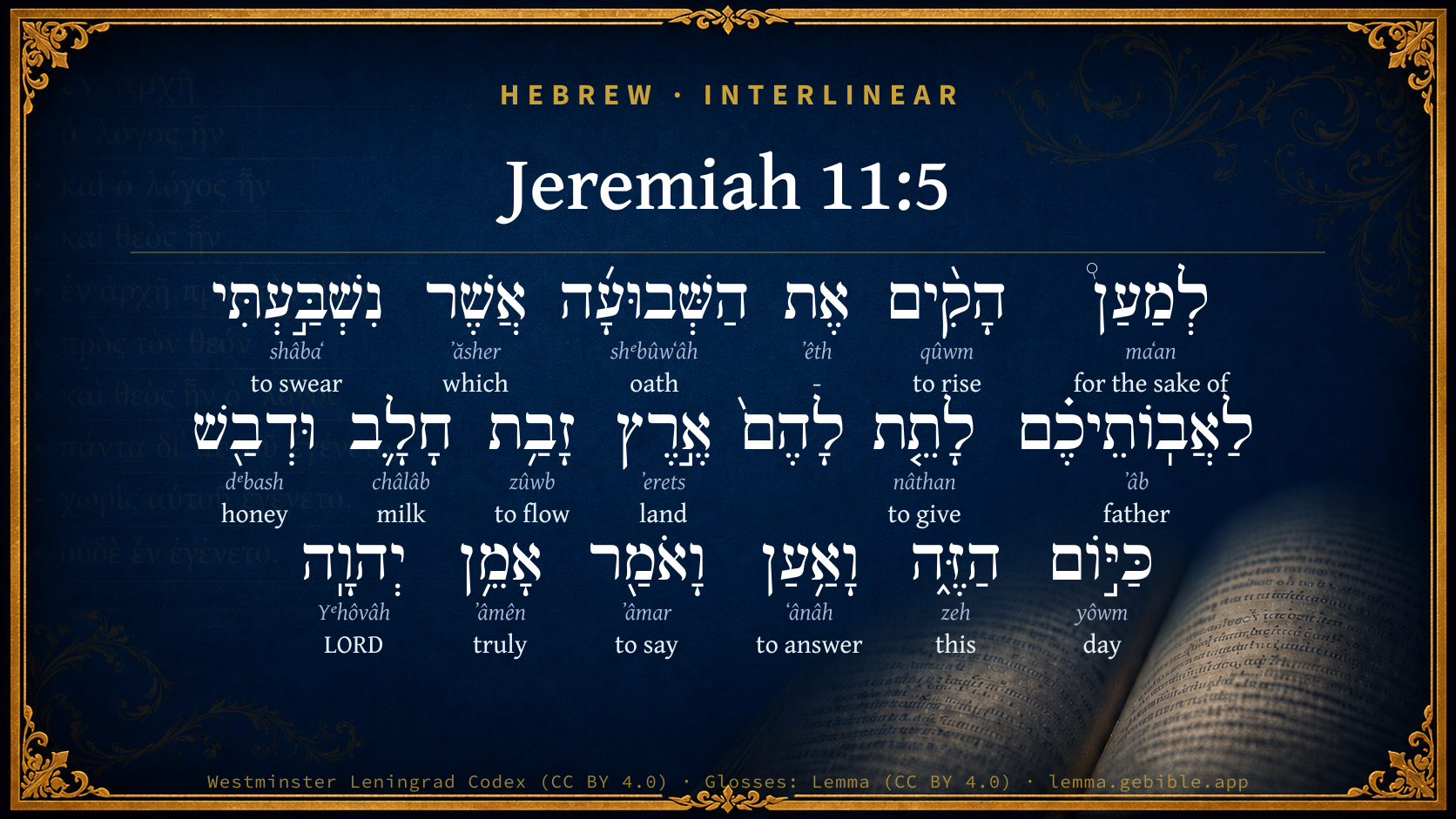
Hebrew (Westminster Leningrad Codex) Jeremiah 11:5 appears in the Hebrew Old Testament. The text above is from the Westminster Leningrad Codex. Each word links to its Strong’s number, a concise gloss, and parsing drawn from the Open Scriptures Hebrew Bible morphology. Click any word for its full Brown-Driver-Briggs (BDB) entry.
Download image
Cite this verse

Jeremiah 11:5 (World English Bible). Public Domain. Lemma interlinear Bible study tool, https://lemma.gebible.app/v/jeremiah/11/5.

Show BibTeX & RIS
BibTeX
RIS
English Translation
that I may establish the oath which I swore to your fathers, to give them a land flowing with milk and honey, as at this day. Then answered I, and said, Amen, Yahweh.
World English Bible · Public Domain
Download a study sheet

One document with this verse’s original text, its word-by-word gloss line, the meaning frame, cross-references with their text, attributed commentary, and full source and license credits — printable, and it pastes into notes with its structure intact.

This verse Autodidact and up

Study sheet (.html) Plain text (.txt)

A passage Seminary Student

Up to 50 verses in one chapter. A passage sheet keeps up to 6 commentary sources and 12 cross-references per verse, in the order this page ranks them, and says so on the sheet whenever that leaves anything out. Ask for a single verse and you get the Autodidact verse sheet above.

Everything on this page stays free to read, with no account — the sheet is a download of what is already on screen, not access to it.

Want to remove ads? Support Godless Engineer
Compare translations 3

The same verse in 3 English versions, stacked beneath the original-language interlinear above. Click any original word for its lexicon entry.

Each is an independent rendering of the whole verse — the interlinear is not word-aligned to these translations.

Highlighted words mark where these versions differ — a whole-verse word diff, not a word-by-word alignment.

  • World English Bible Public Domain
    that I may establish the oath which I swore to your fathers, to give them a land flowing with milk and honey, as at this day. Then answered I, and said, Amen, Yahweh.
  • King James Version Public Domain
    That I may perform the oath which I have sworn unto your fathers, to give them a land flowing with milk and honey, as it is this day. Then answered I, and said, So be it, O LORD.
  • unfoldingWord Literal Text CC BY-SA 4.0
    so that confirm the oath that I swore to your fathers, to give to them a land flowing of milk and honey, as this day.”’” Then I answered and said, “So be it, Yahweh!”

unfoldingWord Literal Text — © unfoldingWord, licensed CC BY-SA 4.0. Word-aligned USFM3 via Door43 (git.door43.org/unfoldingWord/en_ult).

Versions to compare (up to 4)

3 of 4 selected

Show all 18 translations

Every available English version of this verse, each an independent rendering of the whole verse.

  • World English Bible Public Domain
    that I may establish the oath which I swore to your fathers, to give them a land flowing with milk and honey, as at this day. Then answered I, and said, Amen, Yahweh.
  • Berean Standard Bible Public Domain
    This was in order to establish the oath I swore to your forefathers, to give them a land flowing with milk and honey, as it is to this day.” “Amen, LORD,” I answered.
  • Majority Standard Bible Public Domain
    This was in order to establish the oath I swore to your forefathers, to give them a land flowing with milk and honey, as it is to this day.” “Amen, LORD,” I answered.
  • King James Version Public Domain
    That I may perform the oath which I have sworn unto your fathers, to give them a land flowing with milk and honey, as it is this day. Then answered I, and said, So be it, O LORD.
  • American Standard Version (1901) Public Domain
    that I may establish the oath which I sware unto your fathers, to give them a land flowing with milk and honey, as at this day. Then answered I, and said, Amen, O Jehovah.
  • Revised Version (1885) Public Domain
    that I may establish the oath which I sware unto your fathers, to give them a land flowing with milk and honey, as at this day. Then answered I, and said, Amen, O LORD.
  • Geneva Bible (1599) Public Domain
    That I may confirme the othe, that I haue sworne vnto your fathers, to giue them a lande, which floweth with milke and hony, as appeareth this day. Then answered I and sayde, So be it, O Lord.
  • Douay-Rheims (1899) Public Domain
    That I may accomplish the oath which I swore to your fathers, to give them a land flowing with milk and honey, as it is this day. And I answered and said: Amen, O Lord.
  • Young's Literal Translation Public Domain
    In order to establish the oath that I have sworn to your fathers, To give to them a land flowing with milk and honey, as this day. And I answer and say, `Amen, O Jehovah.'
  • Literal Standard Version CC BY-SA 4.0
    In order to establish the oath that I have sworn to your fathers, || To give to them a land flowing with milk and honey, as this day.” And I answer and say, “Amen, O YHWH.”
  • Unlocked Literal Bible CC BY-SA 4.0
    Obey me so that I may confirm the oath that I swore to your ancestors, the oath that I would give them the land flowing with milk and honey, where you live today.'” Then I, Jeremiah, answered and said, “Yes, Yahweh!”
  • unfoldingWord Literal Text CC BY-SA 4.0
    so that confirm the oath that I swore to your fathers, to give to them a land flowing of milk and honey, as this day.”’” Then I answered and said, “So be it, Yahweh!”
  • Darby Bible Public Domain
    that I may perform the oath that I have sworn unto your fathers, to give them a land flowing with milk and honey, as it is this day. And I answered and said, Amen, Jehovah!
  • World Messianic Bible Public Domain
    that I may establish the oath which I swore to your fathers, to give them a land flowing with milk and honey,’ as it is today.” Then I answered, and said, “Amen, LORD.”
  • Webster's Bible Public Domain
    That I may perform the oath which I have sworn to your fathers, to give them a land flowing with milk and honey, as it is this day. Then answered I, and said, So be it, O LORD.
  • Free Bible Version CC BY-SA 4.0
    I did this to fulfill what I promised to your forefathers—to give them a land flowing with milk and honey, as it still is today. Amen, Lord, I answered.
  • Bible in Basic English Public Domain
    So that I may give effect to the oath which I made to your fathers, to give them a land flowing with milk and honey as at this day. And I said in answer, So be it, O Lord.
  • JPS Tanakh (1917) Public Domain
    that I may establish the oath which I swore unto your fathers, to give them a land flowing with milk and honey, as at this day.' Then answered I, and said: 'Amen, O LORD.'

Literal Standard Version (2020), Covenant Press — licensed CC BY-SA 4.0. Text via the HelloAO Bible API (eBible.org). Unlocked Literal Bible (unfoldingWord) — licensed CC BY-SA 4.0. Text via the HelloAO Bible API (eBible.org). unfoldingWord Literal Text — © unfoldingWord, licensed CC BY-SA 4.0. Word-aligned USFM3 via Door43 (git.door43.org/unfoldingWord/en_ult). Free Bible Version, Dr. Jonathan Gallagher — licensed CC BY-SA 4.0. Text via the HelloAO Bible API (eBible.org).

Word by word

More ways to search: Search by grammar → Find every occurrence → Compare this word →

Practice this passage: Drill this verse → Learn its vocabulary →

הַשְּׁבוּעָ֜ה
shᵉbûwʻâh
H7621
“the · oath”
Particle, Definite Article + Noun, Common, Feminine, Singular, Absolute
Part of Speech
Particle + Noun
Type
Common
Gender
Feminine
Number
Singular
State
Absolute
Full BDB Definition

Origin: pass part of H7650

TWOT: 2319a

oath, curse - oath - attesting of innocence - curse - oath (of Jehovah)
  1. לְמַעַן֩ maʻan H4616 “for the sake of” Preposition
  2. הָקִ֨ים qûwm H6965 “to rise” Verb, Hiphil, Infinitive Construct
  3. אֶת ʼêth H853 “-” Particle, Direct Object
  4. אֲשֶׁר ʼăsher H834 “which” Particle, Relative
  5. נִשְׁבַּ֣עְתִּי shâbaʻ H7650 “to swear” Verb, Niphal, Perfect, 1st Person, Common, Singular
  6. לַאֲבֽוֹתֵיכֶ֗ם ʼâb H1 “to/for · fathers · your” Preposition + Noun, Common, Masculine, Plural, Construct + Suffix, Personal, 2nd Person, Masculine, Plural
  7. לָתֵ֤ת nâthan H5414 “to give” Preposition + Verb, Qal, Infinitive Construct
  8. אֶ֣רֶץ ʼerets H776 “land” Noun, Common, Both, Singular, Absolute
  9. זָבַ֥ת zûwb H2100 “flowing” Verb, Qal, Participle Active, Feminine, Singular, Construct
  10. חָלָ֛ב châlâb H2461 “milk” Noun, Common, Masculine, Singular, Absolute
  11. וּדְבַ֖שׁ dᵉbash H1706 “and · honey” Conjunction + Noun, Common, Masculine, Singular, Absolute
  12. כַּיּ֣וֹם yôwm H3117 “like/as the · day” Preposition, Determined + Noun, Common, Masculine, Singular, Absolute
  13. הַזֶּ֑ה zeh H2088 “the · this” Particle, Definite Article + Pronoun, Demonstrative, Masculine, Singular
  14. וָאַ֥עַן ʻânâh H6030 “and · to answer” Conjunction + Verb, Qal, Sequential Imperfect, 1st Person, Common, Singular
  15. וָאֹמַ֖ר ʼâmar H559 “and · to say” Conjunction + Verb, Qal, Sequential Imperfect, 1st Person, Common, Singular
  16. אָמֵ֥ן ʼâmên H543 “truly” Adverb
  17. יְהוָֽה Yᵉhôvâh H3068 “LORD” Noun, Proper

About this verse

These counts appear in no published source. They are computed here, from the morphology-tagged text and Lemma’s own curated glosses. What Lemma adds →

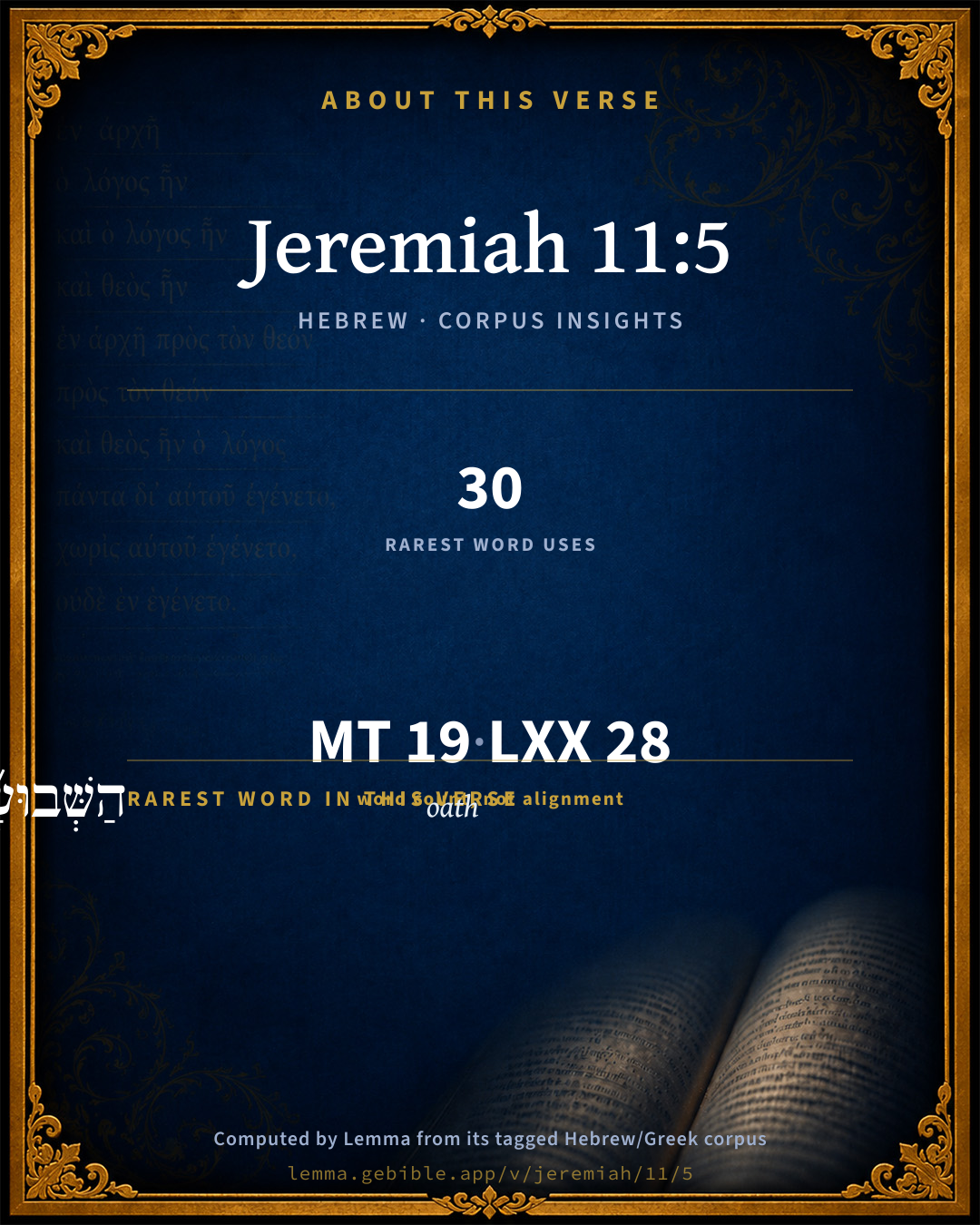
19
words
18
distinct lemmas
Prophets
section

Shared distinctive vocabulary

הַשְּׁבוּעָ֜ה oath H7621 occurs in 29 verses of the Hebrew Bible. Also found in:

Grammatical profile

  • 6 verbs
  • 7 nouns
  • 1 pronoun
  • 2 prepositions
  • 1 adverb
  • 2 particles

Verb forms

  • הָקִ֨ים Hiphil · Infinitive Construct
  • נִשְׁבַּ֣עְתִּי Niphal · Perfect
  • לָתֵ֤ת Qal · Infinitive Construct
  • זָבַ֥ת Qal · Participle Active
  • וָאַ֥עַן Qal · Sequential Imperfect
  • וָאֹמַ֖ר Qal · Sequential Imperfect

Hebrew & Septuagint length

In the original languages it is 19 Hebrew tokens and 28 Greek tokens — but the two are counted differently (Hebrew bundles its prefixes and suffixes into one token; the Greek is in lemma form), so that isn’t a like-for-like length.

Cross-references

12

Topical passages linked to Jeremiah 11:5 in the Treasury of Scripture Knowledge — connected by theme and wording, ordered by reader-vote popularity; previews shown in the World English Bible.

  • Deuteronomy 7:12–13 It shall happen, because you listen to these ordinances, and keep and do them, that Yahweh your God will keep with you the covenant and the loving kindness which he swore to your fathers:
  • Psalms 105:9–11 The covenant which he made with Abraham, His oath to Isaac,
  • Jeremiah 28:6 even the prophet Jeremiah said, Amen: Yahweh do so; Yahweh perform your words which you have prophesied, to bring again the vessels of Yahweh's house, and all them of the captivity, from Babylon to this place.
  • Genesis 22:16–18 and said, "I have sworn by myself, says Yahweh, because you have done this thing, and have not withheld your son, your only son,
  • Genesis 26:3–5 Sojourn in this land, and I will be with you, and will bless you. For to you, and to your seed, I will give all these lands, and I will establish the oath which I swore to Abraham your father.
  • Exodus 3:8–17 I have come down to deliver them out of the hand of the Egyptians, and to bring them up out of that land to a good and large land, to a land flowing with milk and honey; to the place of the Canaanite, the Hittite, the Amorite, the Perizzite, the Hivite, and the Jebusite.
  • Exodus 13:5 It shall be, when Yahweh shall bring you into the land of the Canaanite, and the Hittite, and the Amorite, and the Hivite, and the Jebusite, which he swore to your fathers to give you, a land flowing with milk and honey, that you shall keep this service in this month.
  • Leviticus 20:24 But I have said to you, "You shall inherit their land, and I will give it to you to possess it, a land flowing with milk and honey." I am Yahweh your God, who has separated you from the peoples.
  • Deuteronomy 6:3 Hear therefore, Israel, and observe to do it; that it may be well with you, and that you may increase mightily, as Yahweh, the God of your fathers, has promised to you, in a land flowing with milk and honey.
  • Deuteronomy 27:15–26 Cursed be the man who makes an engraved or molten image, an abomination to Yahweh, the work of the hands of the craftsman, and sets it up in secret. All the people shall answer and say, Amen.
  • Matthew 6:13 Bring us not into temptation, but deliver us from the evil one. For yours is the Kingdom, the power, and the glory forever. Amen.'
  • 1 Corinthians 14:16 Otherwise if you bless with the spirit, how will he who fills the place of the unlearned say the "Amen" at your giving of thanks, seeing he doesn't know what you say?

Cross-references courtesy of OpenBible.info (CC BY 4.0).

Hebrew and Greek witnesses Masoretic Hebrew ↔ Greek Septuagint

The same verse in the two great witnesses to the Old Testament, shown verse-for-verse.

These are two independent witnesses, not word-aligned to each other, and the Septuagint is shown in lemma (dictionary) form.

Hebrew Jeremiah 11:5 Masoretic · Westminster Leningrad Codex

לְמַעַן֩ הָקִ֨ים אֶת הַשְּׁבוּעָ֜ה אֲשֶׁר נִשְׁבַּ֣עְתִּי לַאֲבֽוֹתֵיכֶ֗ם לָתֵ֤ת לָהֶם֙ אֶ֣רֶץ זָבַ֥ת חָלָ֛ב וּדְבַ֖שׁ כַּיּ֣וֹם הַזֶּ֑ה וָאַ֥עַן וָאֹמַ֖ר אָמֵ֥ן יְהוָֽה

that I may establish the oath which I swore to your fathers, to give them a land flowing with milk and honey, as at this day. Then answered I, and said, Amen, Yahweh.

World English Bible · Public Domain

Greek LXX Structure differs

In the Septuagint, Jeremiah is about an eighth shorter than the Hebrew and arranges its material differently — the Oracles Against the Nations (Hebrew chapters 46–51) appear in the middle of the Greek book, after 25:13. Because the chapter and verse boundaries do not line up, a verse-for-verse comparison with the Hebrew is not shown.

A verse-for-verse comparison isn’t shown here because the chapters and verses don’t line up. Switch to the LXX edition with the MT / LXX toggle above to read the Greek directly.

On this verse, Haydock's Catholic Bible Commentary discusses the Septuagint’s reading. Read the note in Commentary ↓

Hebrew: Westminster Leningrad Codex (CC BY 4.0). Greek: Septuagint (public domain); English from a public-domain English Septuagint. How the Septuagint differs from the Hebrew →

Targum (Aramaic paraphrase)

1

The Targum is the ancient Jewish Aramaic paraphrase of the Hebrew Scriptures — an interpretive translation, not the Hebrew text itself. Onkelos (literal) and Pseudo-Jonathan (expansive) render the Torah, and Jonathan the Prophets. Coverage is partial: where no permissively-licensed English translation exists for a verse, only the Aramaic is shown. This is verse-level text, not a word-by-word alignment to the Hebrew.

  1. Targum Jonathan Prophets (Joshua–Malachi)
    בְּדִיל לְקַיָמָא יַת קְיָמָא דְקַיֵמִית לַאֲבָהַתְכוֹן לְמִתַּן לְהוֹן אַרְעָא עַבְדָא חֲלַב וּדְבַשׁ כְּיוֹמָא הָדֵין וַאֲתֵיבִית וַאֲמָרִית אָמֵן יְיָ:

    (no public-domain English translation for this verse)

    Targum Jonathan — Aramaic: “Mikraot Gedolot” (public domain). English: “Sefaria Community Translation” (CC0 1.0 (public-domain dedication)); “London "Chaldee Paraphrase," 1871” (public domain). Text via Sefaria.

Commentary

Notes on Jeremiah 11:5 from classic Christian and Jewish commentators (each source and its license shown beneath its notes). The classic Christian expositions comment on the surrounding passage and are grouped to its opening verse, so a note may address several verses; the Jewish commentaries on the Tanakh (Rashi and others) are per-verse, so they appear only where the commentator wrote on this verse.

Lemma curates 59 commentaries, every one of them public domain or Creative Commons licensed, each selected and text-cleaned for this edition rather than reprinted as found. About our sources →

Trapp's Complete Commentary

John Trapp

Jer 11:5 That I may perform the oath which I have sworn unto your fathers, to give them a land flowing with milk and honey, as [it is] this day. Then answered I, and said, So be it, O LORD.

Ver. 5. A land flowing with milk and honey.] With plenty of dainties. The city of Aleppo is so called by the Turks, of alep, milk; for if the via lactea milky way, it would be found there, saith one.

So be it, O Lord.] Amen, fiat, fiat. Oh that there were a heart in this people to obey thy voice! and oh that thou wouldst still continue them in this good land! &c. Our hearts should be stretched out after our amen, and we should be swallowed up in God, say the Rabbis.

John Trapp, A Commentary or Exposition upon All the Books of the Old and New Testament (1647–1656) — public domain. Text from a community e-Sword module.

The Biblical Illustrator

Joseph S. Exell

Jer_11:5

Then answered I, and said, So be it, O Lord.

The souls Amen

Jeremiah was naturally gentle, yielding, and pitiful for the sins and sorrows of his people. Nothing was further from his heart than to desire the evil day. Nothing would have given him greater pleasure than to have played the part of Isaiah in this decadent period of his peoples history. But what was possible to the great evangelic prophet in the days of Hezekiah was impossible now. In Isaiahs case the noblest traditions of the past, the patriotic pride of his people, and the promises of God all pointed in the same direction. But for Jeremiah there was an inevitable divorce between the trend of popular feeling led by the false prophets, and his clear conviction of the Word of God. It must, indeed, have been hard to prove that the prophets were wrong, and he was right; they simply reiterated what Isaiah had said a hundred times. And yet, as he utters the terrible curses and threatenings of Divine justice, and predicts the inevitable fate of his people, he is so possessed with the sense of the Divine rectitude that his soul rises up, and though he must pronounce the doom of Israel, he is forced to answer and say, Amen, O Lord!

I. The souls affirmation.

1. In Providence. It is not possible at first to say Amen in tones of triumph and ecstasy. Nay, the word is often choked with sobs that cannot be stifled, and soaked with tears that cannot be repressed. And as these words are read by those who lie year after year on beds of constant pain; or by those whose earthly life is tossed upon the sea of anxiety, over which billows of care and turmoil perpetually roll--it is not improbable that they will protest as to the possibility of saying Amen to Gods providential dealings. In reply, let all such remember that our blessed Lord in the garden was content to put His will upon the side of God. Dare to say Amen to Gods providential dealings. Say it, though heart and flesh fail; say it, amid a storm of tumultuous feeling, and a rain of tears. What thou knowest not now, thou shalt know hereafter.

2. In revelation there are mysteries which baffle the clearest thinkers. It must be so whilst God is God. There is no fathoming line long enough, no parallax fine enough, no standard of mensuration, though the universe itself be taken as our unit, by which to measure God. But though we cannot comprehend, we may affirm the thoughts of God. That we cannot understand is due to the immaturity of our faculties. But when He who has come straight from the realms of eternal day steadfastly affirms that which He knows, and bears witness to what He has seen, we receive His witness and say reverently, Amen, Lord!

3. In judgment. Gods judgments on the wicked are a great deep. Did we know more of sin, of holiness, of the love of God, of the yearning pleadings of His Spirit with men, we should probably understand better how Jeremiah was able to say, Amen, Lord!

II. The ground of the souls peace. Yea, Father! When face to face with the mysteries of the atonement, of substitution and sacrifice, of predestination and election, of the unequal distribution of Gospel light, be sure to turn to God as the Father of light, in whom is no darkness, no shadow of unkindness, no note inconsistent with the music of perfect benevolence.

III. The triumph of the affirming soul. Amen, Hallelujah! Mark the addition of Hallelujah to the Amen. Here the Amen, and not often the Hallelujah; there the two--the assent and the consent; the acquiescence and the acclaim; the submission to the win of God, and the triumphant outburst of praise and adoration (Rev_15:3, R.V.). (F. B. Meyer, B. A.)

The Biblical Illustrator, edited by Joseph S. Exell (c. 1880s–1900s) — public domain. Text from a community e-Sword module.

Tyndale Open Study Notes

Tyndale Open Resources

11:5 The Lord wanted to give Israel prosperity and blessing. Milk implies cattle, sheep, and goats. Honey, the product of bees, implies the presence of many different flowering and fruit-bearing plants. • The word Amen is a Hebrew word that can be translated may it be so. The NLT includes both the Hebrew word and its translation.

Tyndale Open Study Notes — © Tyndale Open Resources, licensed CC BY-SA 4.0. Text via the HelloAO Bible API.

Geneva Bible (1599)

Geneva Bible translators

Thus he speaketh in the person of the people, which agreed to the covenant.

Geneva Bible (1599) marginal notes — public domain. Text via Bolls.life.

Jamieson, Fausset & Brown

Robert Jamieson, A. R. Fausset & David Brown

oath-- (Psa 105:9-10).

a land flowing with milk and honey--(See on Num 14:8).

as it is this day--These are the concluding words of God to the Israelites when formerly brought out of Egypt, "Obey . . . that I may at this time make good the promise I made to your fathers, to give," &c. [MAURER]. English Version makes the words apply to Jeremiah's time, "As ye know at this time, that God's promise has been fulfilled," namely, in Israel's acquisition of Canaan.

So be it--Hebrew, Amen. Taken from Deu 27:15-26. Jeremiah hereby solemnly concurs in the justice of the curses pronounced there (see Jer 11:3).

Jamieson, Fausset & Brown — Commentary Critical and Explanatory on the Whole Bible (1871) — public domain (CC PDM 1.0). Text via the HelloAO Bible API.

Adam Clarke's Commentary

Verse 5. So be it, O Lord] Let thy promises be fulfilled; and let the incorrigible beware of thy threatenings!

Adam Clarke's Commentary on the Bible (1810–1826) — public domain. Text from a community e-Sword/MySword module.

John Calvin's Commentaries

He adds, That I may establish the oath which I have sworn to your fathers, to give them a land abounding in milk and honey, according to what it is at this day Here he does not refer to the chief part of their happiness; but only the land of Canaan is mentioned as the pledge or the earnest of God’s favor; for his promise had regard to something much higher than to the land of Canaan. God had indeed promised this as an inheritance to the Israelites: but when he says, that he would be their God and they his people, the promise of eternal life and of celestial glory is included, according to what is said elsewhere, that he is not the God of the dead but of the living. (Matthew 22:31) And we must ever bear in mind what is said by the Prophet Habakkuk,

“Thou art our God, we shall not die.” (Habakkuk 1:12)

God then promised to the Israelites something far greater than the possession of the land, when he said, that he would be their God But that land was a symbol, an earnest and a pledge of his paternal favor. All these things well agree together.

And to the same purpose is what the Prophet adds, that God had formerly sworn to their fathers, that he would give them that land by an hereditary right: and this promise had been fulfined to their posterity. Were any to lay hold on this only, — that God’s favor was seen in the land of Canaan, because they had obtained it through the expulsion of the heathens by God’s kindness, the view would be frigid, and the Prophet would diminish much from that promise which far exceeds all that man can conceive. Hence, as I have said, in speaking of the land of Canaan, he accommodates himself no doubt to the comprehension of a rude and ignorant people, and mentions the earnest and the pledge, that they alight see by their eyes, exhibited to them even in this world and in this frail life some evidence of that favor, which far surpasses all that can be desired in the world.

Now, when he says, That I may establish the oath which I have sworn to your fathers, God doubtless shews that though the Jews should obey him, they had not yet deserved by their obedience the inheritance promised before they were born. God then here proves that it was through his gratuitous kindness that; they became heirs of the land. How so? because they were not created when God sware to Abraham that he would give that land to him and to his posterity. As then the promise had been given long before, it follows that it could not be ascribed to the merits of the people, that they had at length in due time obtained the land. As to the oath, God by referring to it extols his favor; for he not only promised the land for an heritage to the children of Abraham, but he also added an oath, that the covenant might appear more sure. But the Prophet at the same time intimates, that they, if ungrateful to God, might justly be deprived of the promised inheritance; as though he had said, “There is no ground for you to expostulate with God, as though he defrauded you, were he to cast you out of the land; for God himself does not disinherit you, but your own wickedness; and ye are now unworthy, for God regards you not as his children.” While then the Prophet takes away every ground for boasting, that the Jews might not think that they possessed the land as a reward for their merits, he also reminds them that they might be justly deprived of their land, and that on account of their own fault, as they rendered not to God the service they owed to him. Hence he says, that I might establish the oath which I have sworn to your fathers

A land, he says, flowing with milk and honey: this mode of speaking was often adopted by Moses, (Exodus 3:8, Exodus 3:17; Exodus 13:5; Exodus 33:3; Leviticus 20:24) The land was no doubt from the beginning very fertile; but it is probable that it became more fruitful after the people entered into it, for it was in a manner renewed; and it was God’s design to shew in a visible manner how great; Was the efficacy of his covenant. It was not then to no purpose that Moses said so often that it was a land flowing with milk and honey.

He afterwards adds, According as it is at this day He produces witnesses; as though he had said, “God has dealt faithfully with you, for he has performed the faith pledged to your fathers, and has fulfined his oath: but now since ye have polluted this land, and the memory of God’s favor is as it were buried among you, and ye even tread under your feet his law — since then such great impiety averts his blessing from you, what remains for him to do, but to drive you away into exile?” We hence see that there is here to be understood an implied threatening, when he says that God had performed what he had promised to the fathers, and promised with this condition — that they were to obey his commands.

We have already spoken of the Prophet’s answer. When he answered, Amen, he did not wait for what the people would say; for the greater part no doubt made a clamor and sought to make shifts with God. So great was their effrontery, that they often rose up insolently against the Prophets. Then as he knew that they were so refractory, he subscribed to the curse in his own name. It follows —

John Calvin's Commentaries (1540-1563) — public domain. Text from the Calvin Translation Society English edition (1840s-50s) via the Christian Classics Ethereal Library (ccel.org). Calvin's coverage is partial (roughly two-thirds of the Bible); uncommented books and verses are honest gaps, never fabricated. The 19th-century editor's footnotes and remarks are omitted so the notes are faithfully Calvin's own voice.

Ellicott's Commentary for English Readers

(5) A land flowing with milk and honey.—The description appears for the first time in Exo_3:8; Exo_3:17. It rapidly became proverbial, and is prominent in Deu_6:3 and Jos_5:6. It points primarily, it may be noticed, to the plenty of a pastoral rather than an agricultural people (see Note on Isa_7:22), and so far to the earlier rather than the later stages of the life of Israel.

So be it, O Lord.—The Amen of the liturgies and litanies of Israel, brought probably into fresh prominence by Deu_27:15-26, and uttered by princes and people in the solemn ceremonial of 2Ki_23:3.

A Bible Commentary for English Readers, edited by Charles John Ellicott (1878–1897) — public domain. Text from a community e-Sword module.

The Cambridge Bible for Schools and Colleges

gen. ed. J. J. S. Perowne

5. your fathers] Abraham, Isaac, and Jacob, as ancestors of those who entered upon the enjoyment of the land.

flowing with milk and honey] For the expression cp. Jer_32:22; Exo_3:8; Exo_3:17, and elsewhere.

The Cambridge Bible for Schools and Colleges (gen. ed. J. J. S. Perowne; Cambridge University Press, 1878–1918) — public domain. Text from a community e-Sword module.

John Gill's Exposition

Then the Lord said unto me,.... Again; for this is a repetition of the above order:

proclaim all these words in the cities of Judah, and in the streets of Jerusalem: with a loud voice, and openly, that all may hear:

saying, hear ye the words of this covenant, and do them; which their forefathers promised, when the covenant was made with them, Exo 24:7, but did not perform; hearing without doing is of little avail; not the hearers, but the doers of the law are justified; wherefore men should not be content with hearing only, Rom 2:13.

John Gill's Exposition of the Whole Bible (1746–1763) — public domain (CC PDM 1.0). Text via the HelloAO Bible API.

Albert Barnes' Notes on the Bible

As it is this day - God had kept the terms of the covenant. Whether the promised land would permanently remain the property of the Jews would depend upon their observance of their part of the covenant.

So be it, O Lord - Or, “Amen, Yahweh.” The prophet was literally obeying the command given in Deu 27:14-26, and the same word should be kept in both places.

Albert Barnes' Notes on the Bible (1834–1885) — public domain. Text from a community e-Sword/MySword module.

Haydock's Catholic Bible Commentary

Amen. Septuagint, "So be it." (Haydock) --- Thou hast fulfilled thy engagements.

George Leo Haydock (1774–1849), Haydock's Catholic Family Bible and Commentary, 1859 edition — public domain. Excludes Psalms (Douay-Rheims chapter numbering differs from Protestant) and Deuterocanonical books (Catholic canon only).

Matthew Poole's English Annotations

I required their obedience for their own good; I had sworn to their fathers that I would give their posterity a land abounding with plenty of all good things, the best and choicest things, upon supposition of their obedience. I have performed that oath, I have brought them into such a land, and showed myself faithful to them. So be it, O Lord: God having ended his speech, the prophet saith, Amen, either asserting the truth of what God had said, or wishing that the people would do according to their covenant, or assenting to the curse according as God had commanded, Deu 27:26.

Matthew Poole's English Annotations on the Holy Bible (1683–1685) — public domain. Text from a community e-Sword/MySword module.

Whedon's Commentary on the Bible

Daniel D. Whedon

5. Land flowing with milk and honey — Who has not felt the difficulty of this description as applied to Palestine? Three considerations tend to relieve it: 1) Its contrast with Egypt, which the Israelites of that day would set up as a standard, it being the only land with which they were acquainted when this language was at first used. Now Egypt is literally the creation of the Nile. In the immediate vicinity of that river the country is exceedingly fertile, but elsewhere a sterile desert. Palestine, with its hills and valleys, its plains and its forests, its watercourses and its seacoasts, was indeed, especially to a pastoral people, a rich land in comparison. 2) Its contrast with the Sinaitic peninsula. Forty years of experience in Arabia Petrea would prepare the people fora very keen appreciation of such a land as Palestine, which was, as compared with this, almost as “the garden of the Lord.” 3) Its contrast with itself at the present time. Twenty centuries of neglect and abuse have doubtless materially changed the face of this land.

It is not doubtful that the Canaan of the Old Testament was a very different country from the Palestine of to-day. And putting with all the rest the character of Oriental speech, which delights in pictorial phrases, we shall not find it difficult to understand the expressions which seem to many so exaggerated.

Then answered I — As though the old scene so graphically described in Deu_27:14-26, was being re-enacted. The answer of the prophet is the same as the people then made, and should be translated, as there, Amen, Jehovah.

Daniel D. Whedon (gen. ed.), Commentary on the Old and New Testaments (1874–1909) — public domain. Text from a community e-Sword module.

The Pulpit Commentary

The oath which I have sworn. (so Deu_7:8; comp. Deu_8:18) As it is this day; a Deuteronomic formula, (see e.g. Deu_2:30 Deu_4:20) appealing to the test of experience. So be it, O Lord. The Hebrew has "Amen, Jehovah." "Amen" equivalent to "true, faithful, trustworthy;" or used in this way as a formula of asseveration, "may it be verified by facts" (the Septuagint has genoito ); comp. Jer_28:6.

HOMILIES BY A.F. MUIR Ver. 5. The response of the spiritual conscience to the words of God.

"And I said, Amen, Jehovah." This expression, uttered by Jeremiah with apparent originality, is really an echo of Deu_27:15. There it expresses the agreement of the whole congregation of Israel: here it is the word of one mouth. The adoption by the prophet, at this juncture, of words so solemnly significant is very impressive. One stands sponsor for many; a righteous and earnest man for a nation of callous transgressors. And is it not often so. What, indeed, would our poor, erring, depraved humanity do with itself were it not for these individual, mediatorial spirits, whom God raises up from time to time through the ages to interpret his will and to keep it in reverent obedience and spiritual trust for them who as yet are ignorant and alienated from his life? The service such men render is of vast importance and but imperfectly understood.

I ONLY THOSE WHO ARE IN COMMUNION WITH GOD CAN TRULY UNDERSTAND AND APPROVE HIS JUDGMENTS. The commandment is intelligently alluded to, and its penalty stated. The correspondence of Judah"s condition with that anticipated in the original passage is pregnantly suggested. All the more so that the transgressors did not feel or admit the correspondence. The prophet alone could say, "Amen;" but he said it emphatically and representatively. How many of God"s people find a similar difficulty in acquiescing in his dispensations? They do not examine themselves, or their conscience is not sufficiently awakened, and consequently they fail to recognize his judgments and to profit by them as was intended.

II GOD RAISES UP THOSE WHO SHALL RESPOND TO HIS VOICE AND MAINTAIN PROVISIONALLY HIS COVENANT RELATIONS WITH THE WORLD. The prophets were not only mouthpieces of Divine truth; they were saints whose consecration was essential to their spiritual discernment and the due exercise of their functions. The people were for the most part spiritually asleep or dead. In their spiritual and moral constitution a medium was provided sensitive enough for the perception and transmission of Divine communications. It was no exaggeration to speak of these messengers as "prepared, ordained, and sent." They were specially raised up for this duty of sustaining the conscious relations of God with his people. This was a dim foreshadowing of the Messiah-consciousness. In a certain sense the prophet repented, believed, obeyed, for the whole people, even as the high priest made solemn offering once a year for the sins of the whole people. Not that this spiritual condition of the inspired seer and saint could be effectual for individual salvation of others; but that it exercised a certain representative and general influence. The prophet held the truth as it were in trust for others, continually and energetically sought to mediate between Jehovah and Israel, and urged the people to acts of repentance and obedience. With each prophet it might be said that a new opportunity was given, a new day of grace afforded, for the return of the apostate nation to its primitive covenant relations with God. And in the succession of the prophets a guarantee was given of the enduring character of those relations, even when the covenant itself was flagrantly broken and practically set aside by those whom it chiefly concerned. The essential point was that there should be no age without some person or persons who should sustain a conscious spiritual connection with Jehovah for themselves and their race.

III THAT WHICH THE FEW HAVE UNDERSTOOD AND ACCEPTED SHALL BECOME THE COMMON INHERITANCE OF ALL. The prophet was for the most part a solitary and a lonely man. This isolation of his lot was his grief, but the persistence of the succession of the prophets proved the unswerving purpose of God ultimately to save, not only Israel, but the world. There might be from time to time but one or two who could say "Amen" to his judgments, but some day the people as a whole would themselves endorse and approve them. And soon in the "fullness of the time" Christ would come, who is the faithful and true Witness, the "Amen" of all the Divine Law and promise. In his world-wide reign as our Representative, Prophet, Priest, and King, through faith in him, the race will be constituted into a new Israel, to keep the word of God. In this transfer of influence the law is that the communication shall proceed from the higher consciousness and consecration to the lower; the travail for souls, etc., being but a detailed sponsorship, one day to be done away with, when "all should know him, from the least even to the greatest. M.

The Pulpit Commentary (1880–1919), ed. H.D.M. Spence-Jones & Joseph S. Exell — public domain. Text from a community e-Sword module.

John Wesley's Explanatory Notes

So be it - God having ended his speech, the prophet saith, Amen, either asserting the truth of which God had said, or wishing that the people would do according to their covenant.

John Wesley, Explanatory Notes Upon the Whole Bible (1754–1765) — public domain. Text via the GEBible commentary corpus.

Rashi

Rabbi Shlomo Yitzchaki (Rashi)

“Amen, O Lord” that he be cursed.

Rashi on the Tanakh — English translations: “The Judaica Press complete Tanach with Rashi, translated by A. J. Rosenberg” (CC BY 4.0); “Pentateuch with Rashi's commentary by M. Rosenbaum and A.M. Silbermann, 1929-1934” (public domain); “The Metsudah Tanach series, Lakewood, N.J” (CC BY 4.0); and “The Book of Joshua, Metsudah Publications, 1997” (CC BY 4.0). Text via Sefaria.

Lesson kit

Teaching starters — assembled from the data on this page, not authored interpretation. Every prompt links to the verse data it draws on. Edit before teaching.

Jeremiah, in the Prophets, opens this verse with 19 words (18 distinct Hebrew lemmas). Its most distinctive word is shᵉbûwʻâh (“oath”). A historical commentator’s framing appears above. Read the whole chapter for the surrounding context.

Discussion questions

  1. What does “oath” (shᵉbûwʻâh) contribute to the verse as a whole?
  2. Genesis 24:8 shares the word «oath» with this verse. How do the two illuminate each other?
  3. These translations render this verse differently. What is at stake in choosing one wording over another?
  4. The verb «הָקִ֨ים» is Hiphil Infinitive Construct. How does its form color the action?
  5. Reading how Trapp's Complete Commentary and The Biblical Illustrator read this verse, where do the two commentators agree and where do they part?

Things to notice

Reading settings

Reading text

Shown beneath each verse's original-language words.

Old Testament
Old Testament edition

Read the OT as the Masoretic Hebrew (MT) or the Greek Septuagint (LXX).

English shown for the Greek Septuagint (in the Hebrew ↔ Greek comparison).

Comparing translations? Open the Compare panel on any verse page to stack up to four side by side.