
Nehemiah 9:22

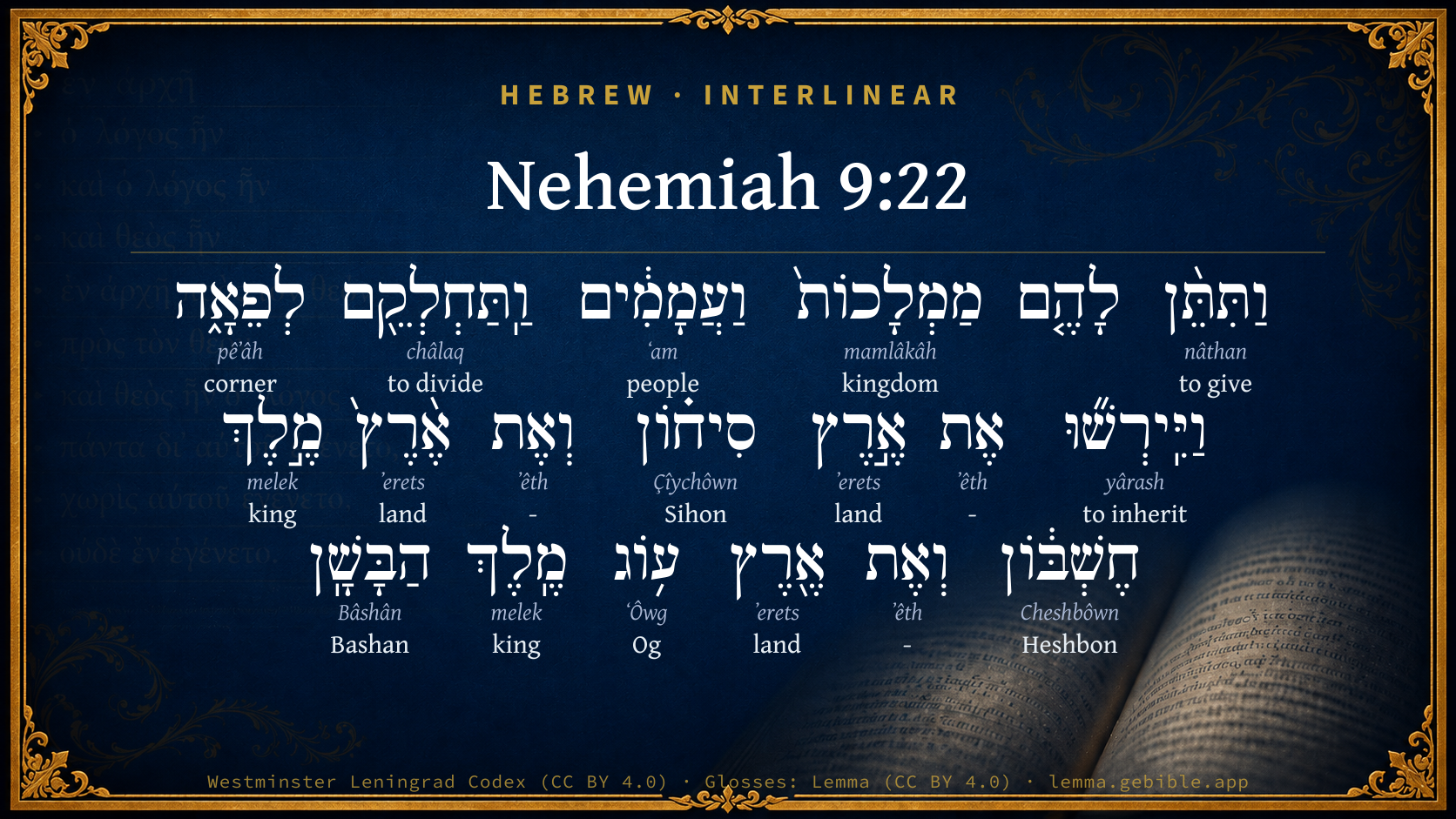
Hebrew (Westminster Leningrad Codex) Nehemiah 9:22 appears in the Hebrew Old Testament. The text above is from the Westminster Leningrad Codex. Each word links to its Strong’s number, a concise gloss, and parsing drawn from the Open Scriptures Hebrew Bible morphology. Click any word for its full Brown-Driver-Briggs (BDB) entry.
Download image
Cite this verse

Nehemiah 9:22 (World English Bible). Public Domain. Lemma interlinear Bible study tool, https://lemma.gebible.app/v/nehemiah/9/22.

Show BibTeX & RIS
BibTeX
RIS
English Translation
Moreover you gave them kingdoms and peoples, which you did allot after their portions: so they possessed the land of Sihon, even the land of the king of Heshbon, and the land of Og king of Bashan.
World English Bible · Public Domain
Download a study sheet

One document with this verse’s original text, its word-by-word gloss line, the meaning frame, cross-references with their text, attributed commentary, and full source and license credits — printable, and it pastes into notes with its structure intact.

This verse Autodidact and up

Study sheet (.html) Plain text (.txt)

A passage Seminary Student

Up to 50 verses in one chapter. A passage sheet keeps up to 6 commentary sources and 12 cross-references per verse, in the order this page ranks them, and says so on the sheet whenever that leaves anything out. Ask for a single verse and you get the Autodidact verse sheet above.

Everything on this page stays free to read, with no account — the sheet is a download of what is already on screen, not access to it.

Want to remove ads? Support Godless Engineer
Compare translations 3

The same verse in 3 English versions, stacked beneath the original-language interlinear above. Click any original word for its lexicon entry.

Each is an independent rendering of the whole verse — the interlinear is not word-aligned to these translations.

Highlighted words mark where these versions differ — a whole-verse word diff, not a word-by-word alignment.

  • World English Bible Public Domain
    Moreover you gave them kingdoms and peoples, which you did allot after their portions: so they possessed the land of Sihon, even the land of the king of Heshbon, and the land of Og king of Bashan.
  • King James Version Public Domain
    Moreover thou gavest them kingdoms and nations, and didst divide them into corners: so they possessed the land of Sihon, and the land of the king of Heshbon, and the land of Og king of Bashan.
  • unfoldingWord Literal Text CC BY-SA 4.0
    And you gave to them kingdoms and peoples, and you allocated to them as far as the corners. And they took possession of the land of Sihon, even the land of the king of Heshbon, and the land of Og, the king of Bashan.

unfoldingWord Literal Text — © unfoldingWord, licensed CC BY-SA 4.0. Word-aligned USFM3 via Door43 (git.door43.org/unfoldingWord/en_ult).

Versions to compare (up to 4)

3 of 4 selected

Show all 18 translations

Every available English version of this verse, each an independent rendering of the whole verse.

  • World English Bible Public Domain
    Moreover you gave them kingdoms and peoples, which you did allot after their portions: so they possessed the land of Sihon, even the land of the king of Heshbon, and the land of Og king of Bashan.
  • Berean Standard Bible Public Domain
    You gave them kingdoms and peoples and allotted to them every corner of the land. So they took the land of Sihon king of Heshbon and of Og king of Bashan.
  • Majority Standard Bible Public Domain
    You gave them kingdoms and peoples and allotted to them every corner of the land. So they took the land of Sihon king of Heshbon and of Og king of Bashan.
  • King James Version Public Domain
    Moreover thou gavest them kingdoms and nations, and didst divide them into corners: so they possessed the land of Sihon, and the land of the king of Heshbon, and the land of Og king of Bashan.
  • American Standard Version (1901) Public Domain
    Moreover thou gavest them kingdoms and peoples, which thou didst allot after their portions: so they possessed the land of Sihon, even the land of the king of Heshbon, and the land of Og king of Bashan.
  • Revised Version (1885) Public Domain
    Moreover thou gavest them kingdoms and peoples, which thou didst allot after their portions: so they possessed the land of Sihon, even the land of the king of Heshbon, and the land of Og king of Bashan.
  • Geneva Bible (1599) Public Domain
    And thou gauest them kingdomes and people, and scatteredst them into corners: so they possessed the land of Sihon and the land of ye King of Heshbon, and the land of Og King of Bashan.
  • Douay-Rheims (1899) Public Domain
    And thou gavest them kingdoms, and nations, and didst divide lots for them: and they possessed the land of Sehon, and the land of the king of Hesebon, and the land of Og king of Basan.
  • Young's Literal Translation Public Domain
    `And Thou givest to them kingdoms, and peoples, and dost apportion them to the corner, and they possess the land of Sihon, and the land of the king of Heshbon, and the land of Og king of Bashan.
  • Literal Standard Version CC BY-SA 4.0
    And You give to them kingdoms, and peoples, || And apportion them to the corner, || And they possess the land of Sihon, || And the land of the king of Heshbon, || And the land of Og king of Bashan.
  • Unlocked Literal Bible CC BY-SA 4.0
    You gave them kingdoms and peoples, assigning to them every corner of the land. Then they took possession of the land of Sihon king of Heshbon and the land of Og king of Bashan.
  • unfoldingWord Literal Text CC BY-SA 4.0
    And you gave to them kingdoms and peoples, and you allocated to them as far as the corners. And they took possession of the land of Sihon, even the land of the king of Heshbon, and the land of Og, the king of Bashan.
  • Darby Bible Public Domain
    And thou gavest them kingdoms and peoples, and didst divide them by countries; and they possessed the land of Sihon, as well the land of the king of Heshbon, as the land of Og king of Bashan.
  • World Messianic Bible Public Domain
    Moreover you gave them kingdoms and peoples, which you allotted according to their portions. So they possessed the land of Sihon, even the land of the king of Heshbon, and the land of Og king of Bashan.
  • Webster's Bible Public Domain
    Moreover, thou gavest them kingdoms and nations, and didst divide them into corners: so they possessed the land of Sihon, and the land of the king of Heshbon, and the land of Og king of Bashan.
  • Free Bible Version CC BY-SA 4.0
    You gave them kingdoms and nations; you assigned their borders. They took control of the land of Sihon, king of Heshbon, and of Og, king of Bashan.
  • Bible in Basic English Public Domain
    And you gave them kingdoms and peoples, making distribution to them in every part of the land: so they took for their heritage the land of Sihon, even the land of the king of Heshbon, and the land of Og, king of Bashan.
  • JPS Tanakh (1917) Public Domain
    Moreover Thou gavest them kingdoms and peoples, which Thou didst allot quarter by quarter; so they possessed the land of Sihon, even the land of the king of Heshbon, and the land of Og king of Bashan.

Literal Standard Version (2020), Covenant Press — licensed CC BY-SA 4.0. Text via the HelloAO Bible API (eBible.org). Unlocked Literal Bible (unfoldingWord) — licensed CC BY-SA 4.0. Text via the HelloAO Bible API (eBible.org). unfoldingWord Literal Text — © unfoldingWord, licensed CC BY-SA 4.0. Word-aligned USFM3 via Door43 (git.door43.org/unfoldingWord/en_ult). Free Bible Version, Dr. Jonathan Gallagher — licensed CC BY-SA 4.0. Text via the HelloAO Bible API (eBible.org).

Word by word

More ways to search: Search by grammar → Find every occurrence → Compare this word →

Practice this passage: Drill this verse → Learn its vocabulary →

ע֥וֹג
ʻÔwg
H5747
“Og”
Noun, Proper
Part of Speech
Noun
Type
Proper
Full BDB Definition

Origin: probably from H5746

TWOT: None

Og = "long-necked" - the Amorite king of Bashan and one of the last representatives of the giants of Rephaim
  1. וַתִּתֵּ֨ן nâthan H5414 “and · to give” Conjunction + Verb, Qal, Sequential Imperfect, 2nd Person, Masculine, Singular
  2. מַמְלָכוֹת֙ mamlâkâh H4467 “kingdoms” Noun, Common, Feminine, Plural, Absolute
  3. וַעֲמָמִ֔ים ʻam H5971 “and · peoples” Conjunction + Noun, Common, Masculine, Plural, Absolute
  4. וַֽתַּחְלְקֵ֖ם châlaq H2505 “and · to divide · them” Conjunction + Verb, Qal, Sequential Imperfect, 2nd Person, Masculine, Singular + Suffix, Personal, 3rd Person, Masculine, Plural
  5. לְפֵאָ֑ה pêʼâh H6285 “to/for · corner” Preposition + Noun, Common, Feminine, Singular, Absolute
  6. וַיִּֽירְשׁ֞וּ yârash H3423 “and · to inherit” Conjunction + Verb, Qal, Sequential Imperfect, 3rd Person, Masculine, Plural
  7. אֶת ʼêth H853 “-” Particle, Direct Object
  8. אֶ֣רֶץ ʼerets H776 “land of” Noun, Common, Both, Singular, Construct
  9. סִיח֗וֹן Çîychôwn H5511 “Sihon” Noun, Proper
  10. וְאֶת ʼêth H853 “and · -” Conjunction + Particle, Direct Object
  11. אֶ֨רֶץ֙ ʼerets H776 “land of” Noun, Common, Both, Singular, Construct
  12. מֶ֣לֶךְ melek H4428 “king of” Noun, Common, Masculine, Singular, Construct
  13. חֶשְׁבּ֔וֹן Cheshbôwn H2809 “Heshbon” Noun, Proper
  14. וְאֶת ʼêth H853 “and · -” Conjunction + Particle, Direct Object
  15. אֶ֖רֶץ ʼerets H776 “land of” Noun, Common, Both, Singular, Construct
  16. מֶֽלֶךְ melek H4428 “king of” Noun, Common, Masculine, Singular, Construct
  17. הַבָּשָֽׁן Bâshân H1316 “the · Bashan” Particle, Definite Article + Noun, Proper

About this verse

These counts appear in no published source. They are computed here, from the morphology-tagged text and Lemma’s own curated glosses. What Lemma adds →

19
words
13
distinct lemmas
Historical
section

Notable vocabulary

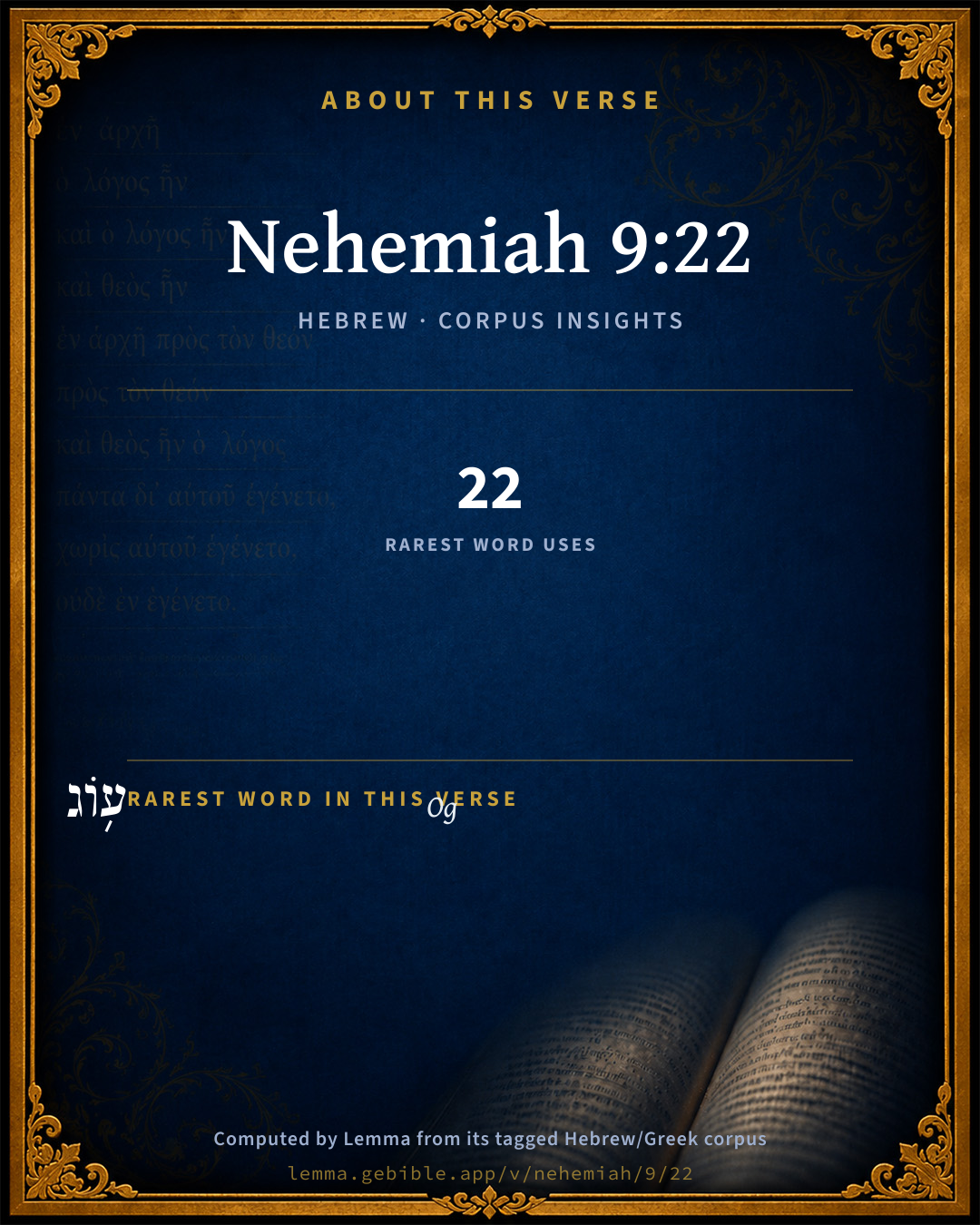
The rarest word here is ע֥וֹג Og H5747 — appearing just 22 times in the whole Hebrew Bible.

Shared distinctive vocabulary

ע֥וֹג Og H5747 occurs in 22 verses of the Hebrew Bible. Also found in:

Grammatical profile

  • 3 verbs
  • 12 nouns
  • 1 preposition
  • 3 particles

Verb forms

  • וַתִּתֵּ֨ן Qal · Sequential Imperfect
  • וַֽתַּחְלְקֵ֖ם Qal · Sequential Imperfect
  • וַיִּֽירְשׁ֞וּ Qal · Sequential Imperfect

Repetition

Words recur within this verse — often emphatic in Hebrew:

  • אֶ֣רֶץ land H776 ×3
  • מֶ֣לֶךְ king H4428 ×2

Cross-references

10

Topical passages linked to Nehemiah 9:22 in the Treasury of Scripture Knowledge — connected by theme and wording, ordered by reader-vote popularity; previews shown in the World English Bible.

  • Numbers 21:21–35 Israel sent messengers to Sihon king of the Amorites, saying,
  • Deuteronomy 2:26–36 I sent messengers out of the wilderness of Kedemoth to Sihon king of Heshbon with words of peace, saying,
  • Deuteronomy 3:1–17 Then we turned, and went up the way to Bashan: and Og the king of Bashan came out against us, he and all his people, to battle at Edrei.
  • Deuteronomy 32:26 I said, I would scatter them afar, I would make the memory of them to cease from among men;
  • Joshua 10:11 It happened, as they fled from before Israel, while they were at the descent of Beth Horon, that Yahweh cast down great stones from the sky on them to Azekah, and they died: they were more who died with the hailstones than they whom the children of Israel killed with the sword.
  • Joshua 11:23 So Joshua took the whole land, according to all that Yahweh spoke to Moses; and Joshua gave it for an inheritance to Israel according to their divisions by their tribes. The land had rest from war.
  • Psalms 78:65 Then the Lord awakened as one out of sleep, Like a mighty man who shouts by reason of wine.
  • Psalms 105:44 He gave them the lands of the nations. They took the labor of the peoples in possession,

Cross-references courtesy of OpenBible.info (CC BY 4.0).

Hebrew and Greek witnesses Masoretic Hebrew ↔ Greek Septuagint

The same verse in the two great witnesses to the Old Testament, shown verse-for-verse.

These are two independent witnesses, not word-aligned to each other, and the Septuagint is shown in lemma (dictionary) form.

Hebrew Nehemiah 9:22 Masoretic · Westminster Leningrad Codex

וַתִּתֵּ֨ן לָהֶ֤ם מַמְלָכוֹת֙ וַעֲמָמִ֔ים וַֽתַּחְלְקֵ֖ם לְפֵאָ֑ה וַיִּֽירְשׁ֞וּ אֶת אֶ֣רֶץ סִיח֗וֹן וְאֶת אֶ֨רֶץ֙ מֶ֣לֶךְ חֶשְׁבּ֔וֹן וְאֶת אֶ֖רֶץ ע֥וֹג מֶֽלֶךְ הַבָּשָֽׁן

Moreover you gave them kingdoms and peoples, which you did allot after their portions: so they possessed the land of Sihon, even the land of the king of Heshbon, and the land of Og king of Bashan.

World English Bible · Public Domain

Greek LXX Structure differs

The Septuagint has no separate book of Nehemiah. Its Greek text is the second half of Esdras B (2 Esdras), chapters 11–23; Ezra is the first half (1–10).

A verse-for-verse comparison isn’t shown here because the chapters and verses don’t line up. Switch to the LXX edition with the MT / LXX toggle above to read the Greek directly.

On this verse, Adam Clarke's Commentary discusses the Septuagint’s reading. Read the note in Commentary ↓

Hebrew: Westminster Leningrad Codex (CC BY 4.0). Greek: Septuagint (public domain); English from a public-domain English Septuagint. How the Septuagint differs from the Hebrew →

Commentary

Notes on Nehemiah 9:22 from classic Christian and Jewish commentators (each source and its license shown beneath its notes). The classic Christian expositions comment on the surrounding passage and are grouped to its opening verse, so a note may address several verses; the Jewish commentaries on the Tanakh (Rashi and others) are per-verse, so they appear only where the commentator wrote on this verse.

Lemma curates 59 commentaries, every one of them public domain or Creative Commons licensed, each selected and text-cleaned for this edition rather than reprinted as found. About our sources →

Trapp's Complete Commentary

John Trapp

Neh 9:22 Moreover thou gavest them kingdoms and nations, and didst divide them into corners: so they possessed the land of Sihon, and the land of the king of Heshbon, and the land of Og king of Bashan.

Ver. 22. Moreover thou gavest them kingdoms and nations] God gave them all; for he is the true proprietary, he pulleth down one, and setteth up another. This Nebuchadnezzar acknowledged (after he had been turned a grazing), and Charles V, emperor of Germany, who in twenty-eight battles in America, waged by Cortez and Pizarro, won twenty-eight kingdoms. And what a world of nations are swallowed up in the greatness of the Turkish empire! America hath the happiness to be out of their reach.

So they possessed the land of Sihon] God’s favours must not be mentioned in the lump only, and by wholesale; but particularly enumerated and celebrated.

John Trapp, A Commentary or Exposition upon All the Books of the Old and New Testament (1647–1656) — public domain. Text from a community e-Sword module.

Joseph Benson's Commentary

Neh 9:22. And didst divide them into corners — That is, the heathen nations, whom God in a great measure destroyed, and the remainders of them he dispersed into corners; that whereas, before the Israelites came, they had large habitations, now they were cooped up, some in one town, and some in another, in the several corners of their land, while the Israelites dwelt in a large place, and had the possession of their whole land, some few and small parcels excepted.

Joseph Benson's Commentary on the Old and New Testaments (1811–1818) — public domain. Text from a community e-Sword module.

Geneva Bible (1599)

Geneva Bible translators

Meaning, the heathen whom he drove out.

Geneva Bible (1599) marginal notes — public domain. Text via Bolls.life.

Jamieson, Fausset & Brown

Robert Jamieson, A. R. Fausset & David Brown

Moreover thou gavest them kingdoms and nations--that is, put them in possession of a rich country, of an extensive territory, which had been once occupied by a variety of princes and people.

and didst divide them into corners--that is, into tribes. The propriety of the expression arose from the various districts touching at points or angles on each other.

the land of Sihon, and the land of the king of Heshbon--Heshbon being the capital city, the passage should run thus: "the land of Sihon or the land of the king of Heshbon."

Jamieson, Fausset & Brown — Commentary Critical and Explanatory on the Whole Bible (1871) — public domain (CC PDM 1.0). Text via the HelloAO Bible API.

Adam Clarke's Commentary

Verse 22. The land of Og king of Bashan.] It is most evident that Sihon was king of Heshbon. How then can it be said that they possessed the land of Sihon, and the land of the king of Heshbon? The words the land of the king of Heshbon are wanting in two of De Rossi's MSS. In another MS. the words and the land of are wanting; so that the clause is read, They possessed the land of Sihon, king of Heshbon. The Septuagint has the same reading; the Arabic nearly the same, viz., the land of Sihon, the land of the king of Heshbon. The Syriac has, They possessed the land of Sihon, the land of the KINGS of Heshbon. The reading of the text is undoubtedly wrong; that supported by the MSS. and by the Septuagint is most likely to be the true one. Those of the Arabic and Syriac contain at least no contradictory sense. The and in the Hebrew and our version, distinguishes two lands and two kings; the land of Sihon and the land of the king of Heshbon: when it is most certain that only one land and one king can be meant: but the vau may be translated here as it often is, even: EVEN the land of the king of Heshbon.

Adam Clarke's Commentary on the Bible (1810–1826) — public domain. Text from a community e-Sword/MySword module.

Ellicott's Commentary for English Readers

(22) Divide them into corners.—Strict usage of the term would require: Thou didst divide unto them [these nations] in their boundaries.

And the land.—There is a double reference to Sihon, king of Heshbon. This and Bashan were taken as the earnest of the possession of Canaan.

A Bible Commentary for English Readers, edited by Charles John Ellicott (1878–1897) — public domain. Text from a community e-Sword module.

The Cambridge Bible for Schools and Colleges

gen. ed. J. J. S. Perowne

22–25. The Conquest of Palestine: Victory

22. The Conquest of the Transjordanic territory.

nations] R.V. peoples.

and didst divide them into corners] R.V. which thou didst allot after their portions. Marg. ‘Or, And didst distribute them into every corner’. The difficulty of rendering arises from the word ‘pêah’ = ‘a corner,’ or ‘edge,’ which the LXX. and Vulg. do not attempt to translate. Used of ‘a corner’ in such passages as Lev_19:9; Lev_19:27; Amo_3:12; it is found with a territorial signification, in Num_24:17 ‘the corners of Moab,’ Jos_15:5; Jos_18:14-15, ‘the north quarter,’ ‘the west quarter,’ ‘the south quarter,’ Jer_48:45 ‘the corner of Moab.’ It does not seem to occur anywhere in a technical sense for ‘a lot’ or ‘an appointed portion.’ ‘To allot according to corner,’ in the sense of ‘after their portions’ (as the R.V.), may give the meaning of the obscure phrase; but no satisfactory parallel to this use of ‘pêah’ occurs in the O. T. This being the case, it is probable that preference should be given to the R.V. marg. ‘into every corner,’ a translation which renders ‘pêah’ literally, and explains the Hebrew idiom by the insertion of the word ‘every.’

Sihon … Og] The victory over these kings at the battles of Jahaz and Edrei is described in Num_21:21-35. It made the children of Israel masters of the E. bank of the Jordan. Reference to the conquest of these two kings is frequent, e.g. Num_32:33; Deu_1:4; Deu_3:1, &c.; Jos_2:10; Psa_135:11; Psa_136:19-20. The territory of the two Amorite kings stretched from the river Jabbok in the S. to the Hauran Mts. in the N., and included the district of Argob. In later days it was divided into Iturea, Gaulanitis, Batanea, Trachonitis and Auranitis.

and the land of the king of Heshbon] R.V. even the land, &c. The ‘copula’ is used to define the previous words, cf. Neh_9:16 ‘they and our fathers.’ Neh_8:7. The LXX. omit ‘and the land’ (Σηὼν βασιλέως Ἐσεβών).

The Cambridge Bible for Schools and Colleges (gen. ed. J. J. S. Perowne; Cambridge University Press, 1878–1918) — public domain. Text from a community e-Sword module.

John Gill's Exposition

Moreover, thou gavest them kingdoms and nations,.... The two kingdoms of Sihon and Og, and the seven nations of Canaan:

and didst divide them into corners; or "corner"; into every corner of the land of Canaan, so that they possessed the whole of it, a few cities excepted; Jarchi interprets it of one corner, that they might not be mixed with the people of the land, but be all together in one place; but Aben Ezra understands it of the Canaanites, of their being divided and scattered into corners, when they fled from the Israelites; but the former sense seems best:

so they possessed the land of Sihon, and the land of the king of Heshbon; or "eren", or "namely" (z), "the land of the king of Heshbon"; for Sihon was king of Heshbon, and so the land the same:

and the land of Og king of Bashan; those lands both lay on the other side Jordan, and were possessed by the tribes of Reuben and Gad, and the half tribe of Manasseh.

(z) So Piscator, Patrick, Rambachius.

John Gill's Exposition of the Whole Bible (1746–1763) — public domain (CC PDM 1.0). Text via the HelloAO Bible API.

Albert Barnes' Notes on the Bible

Thou didst divide them into corners - i. e., parts of the holy land; or as some prefer “thou didst distribute them on all sides.”

Albert Barnes' Notes on the Bible (1834–1885) — public domain. Text from a community e-Sword/MySword module.

Haydock's Catholic Bible Commentary

Lots. Hebrew, "them (the Chanaanites, or as it is more commonly understood, the Israelites,) into corners." (Calmet) --- Septuagint, "by lot they possessed," &c. (Haydock) --- Sehon was king of Hesebon, Numbers xxi. 26. (Calmet)

George Leo Haydock (1774–1849), Haydock's Catholic Family Bible and Commentary, 1859 edition — public domain. Excludes Psalms (Douay-Rheims chapter numbering differs from Protestant) and Deuterocanonical books (Catholic canon only).

Matthew Poole's English Annotations

Into corners, or, into a corner. But the singular number is very commonly put for the plural. This is understood, either,

1. Of the Israelites, to whom God divided by lot the

kingdoms and nations last mentioned, and gave them all the corners, or sides, or quarters (for all these the word signifies) of their land. Or rather,

2. Of the heathen nations, whom God in a great measure destroyed, and the remainders of them he dispersed into corners; that whereas before the Israelites came they had large habitations and dominions, now they were cooped up into corners, some of them into one town or city, and some into another, in the several corners of their land, as indeed we find them afterward; whilst thee Israelites dwelt in a large place, and had the possession of their whole land, some few and small parcels excepted. Compare Deu 32:26, where the like phrase is used in the same sense.

Matthew Poole's English Annotations on the Holy Bible (1683–1685) — public domain. Text from a community e-Sword/MySword module.

Whedon's Commentary on the Bible

Daniel D. Whedon

22. Thou gavest them kingdoms and nations — Namely, the kingdoms and peoples of the land of Canaan.

Divide them into corners — Or, divide them according to borders. That is, thou didst divide those kingdoms (their territory) according to definite boundary lines. The conquered land was distributed among the Israelites according to their tribes, as is recorded in the Book of Joshua So Bertheau and Keil explain; but others, as Gesenius, refer the suffix to the Israelites, thus: thou didst distribute them (the Israelites) into various quarters.

Daniel D. Whedon (gen. ed.), Commentary on the Old and New Testaments (1874–1909) — public domain. Text from a community e-Sword module.

The Pulpit Commentary

Thou didst divide them into corners. i.e. "didst plant them in every corner of the Holy Land, them to possess the whole of it, ultimately, that is, not at first (see the comment on ver. 8). The land of Sihon, and the land of the king of Heshbon. The Levites must have known that Sihon was king of Heshbon, and (if the text is sound) must have expressed themselves as they did, by way of rhetorical amplification; perhaps, however, the van after "Sihon" is the mistake of a copyist.

Vers. 22-25. Canaan conquered and possessed.

Continuing the recital of the goodness of God to their nation, the people narrate how their fathers obtained possession of the promised land. All is ascribed to God.

I HE PRESERVED THE NATION to enter the land (ver. 23). Although those who left Egypt died, two excepted, in the desert, their children were multiplied "as the stars of heaven.

II HE CONQUERED THE COUNTRY, AND GAVE THEM POSSESSION OF IT. First, kingdoms east of the Jordan (ver. 22), then the rest of the land (ver. 24). Although the inhabitants were numerous and valiant, he subdued them; through his might they took even "strong cities" (ver. 25).

III THE LAND HE GAVE THEM WAS OF GREAT VALUE, AND AFFORDED THEM MUCH ENJOYMENT (ver. 25).

IV HE THUS FULFILLED HIS PROMISES (ver. 23).

Reflections:

1. The perpetuation of the nation of Israel reminds us of the perpetuity of the Church of Christ. Notwithstanding the death of successive generations of Christians, the ravages of error, worldliness, etc., its continuance is guaranteed by the promise, "The gates of Hades shall not prevail against it.

2. The fulfilment of the promise of Canaan, after so long a period, should assure us of the fulfilment of all the promises of God. "He is faithful that promised," and be is almighty to overcome all obstacles and opposition.

3. The possession of a good land should excite our gratitude and praise. Our land is superior to Canaan in many respects, supplied with all kinds of advantages which the labours of others have created for us; and, like later generations of Israelites, we inherit it without conquest, and with far less peril of invasion than they experienced. God is the Giver of all, and should ever be praised for all; and we should be concerned lest by godlessness and unrighteousness we forfeit our inheritance.

4. Christians are heirs of "a better country." Heaven is like Canaan, as the gift of God, according to his promises; as a "rest" after much wandering and unrest, and as abounding in whatever can minister to enjoyment, and cause its inhabitants to "delight themselves in God"s great goodness." But it is vastly superior, as a country never polluted by idolatry and wickedness; whose inhabitants are all holy; which no foe can invade, no sin, suffering, or death can enter; whose enjoyments are all pure, spiritual, and without peril; and from which is no expulsion. It is "an inheritance incorruptible, and undefiled, and which fadeth not away an eternal possession.

The Pulpit Commentary (1880–1919), ed. H.D.M. Spence-Jones & Joseph S. Exell — public domain. Text from a community e-Sword module.

John Wesley's Explanatory Notes

Divide - The Heathen nations, whom God in a great measure destroyed, and the remainders of them he dispersed into corners; that whereas before the Israelites came, they had large habitations, now they were cooped up, some in one town, and some in another, in the several corners of their land, while the Israelites dwelt in a large place, and had the possession of their whole land, some few and small parcels excepted.

John Wesley, Explanatory Notes Upon the Whole Bible (1754–1765) — public domain. Text via the GEBible commentary corpus.

unfoldingWord translationNotes

Door43 World Missions Community

Connecting Statement:

In these verses, the Levites continue to praise Yahweh in the presence of the people of Israel.

You gave them kingdoms

Yahweh gave the Israelites kingdoms.

gave them kingdoms and peoples

"enabled them to conquer kingdoms and peoples"

assigning to them every corner of the land

"enabling them to possess every part of the land"

Sihon ... Og

These are the names of kings. (See: How to Translate Names)

Heshbon ... Bashan

These are names of places. (See: How to Translate Names)

translationWords

kingdom

people group

possess

king

Bashan

unfoldingWord translationNotes — © Distant Shores Media and the Door43 World Missions Community, licensed CC BY-SA 4.0. Source: git.door43.org/Door43/en_tn.

Rashi

Rabbi Shlomo Yitzchaki (Rashi)

into a corner Heb. לְפֵאָה, like “to be to the side of one corner,” separate, not mingling with the nations of the lands.

Rashi on the Tanakh — English translations: “The Judaica Press complete Tanach with Rashi, translated by A. J. Rosenberg” (CC BY 4.0); “Pentateuch with Rashi's commentary by M. Rosenbaum and A.M. Silbermann, 1929-1934” (public domain); “The Metsudah Tanach series, Lakewood, N.J” (CC BY 4.0); and “The Book of Joshua, Metsudah Publications, 1997” (CC BY 4.0). Text via Sefaria.

Lesson kit

Teaching starters — assembled from the data on this page, not authored interpretation. Every prompt links to the verse data it draws on. Edit before teaching.

Nehemiah, in the Historical, opens this verse with 19 words (13 distinct Hebrew lemmas). Its most distinctive word is ʻÔwg (“Og”). A historical commentator’s framing appears above. Read the whole chapter for the surrounding context.

Discussion questions

  1. What does “Og” (ʻÔwg) contribute to the verse as a whole?
  2. Numbers 21:33 shares the word «Og» with this verse. How do the two illuminate each other?
  3. “land” occurs 3× in this one verse. What is the effect of the repetition?
  4. These translations render this verse differently; the difference is in the English rendering, not the original. What questions does that raise?
  5. The verb «וַתִּתֵּ֨ן» is Qal Sequential Imperfect. How does its form color the action?
  6. Reading how Trapp's Complete Commentary and Joseph Benson's Commentary read this verse, where do the two commentators agree and where do they part?

Things to notice

Reading settings

Reading text

Shown beneath each verse's original-language words.

Old Testament
Old Testament edition

Read the OT as the Masoretic Hebrew (MT) or the Greek Septuagint (LXX).

English shown for the Greek Septuagint (in the Hebrew ↔ Greek comparison).

Comparing translations? Open the Compare panel on any verse page to stack up to four side by side.