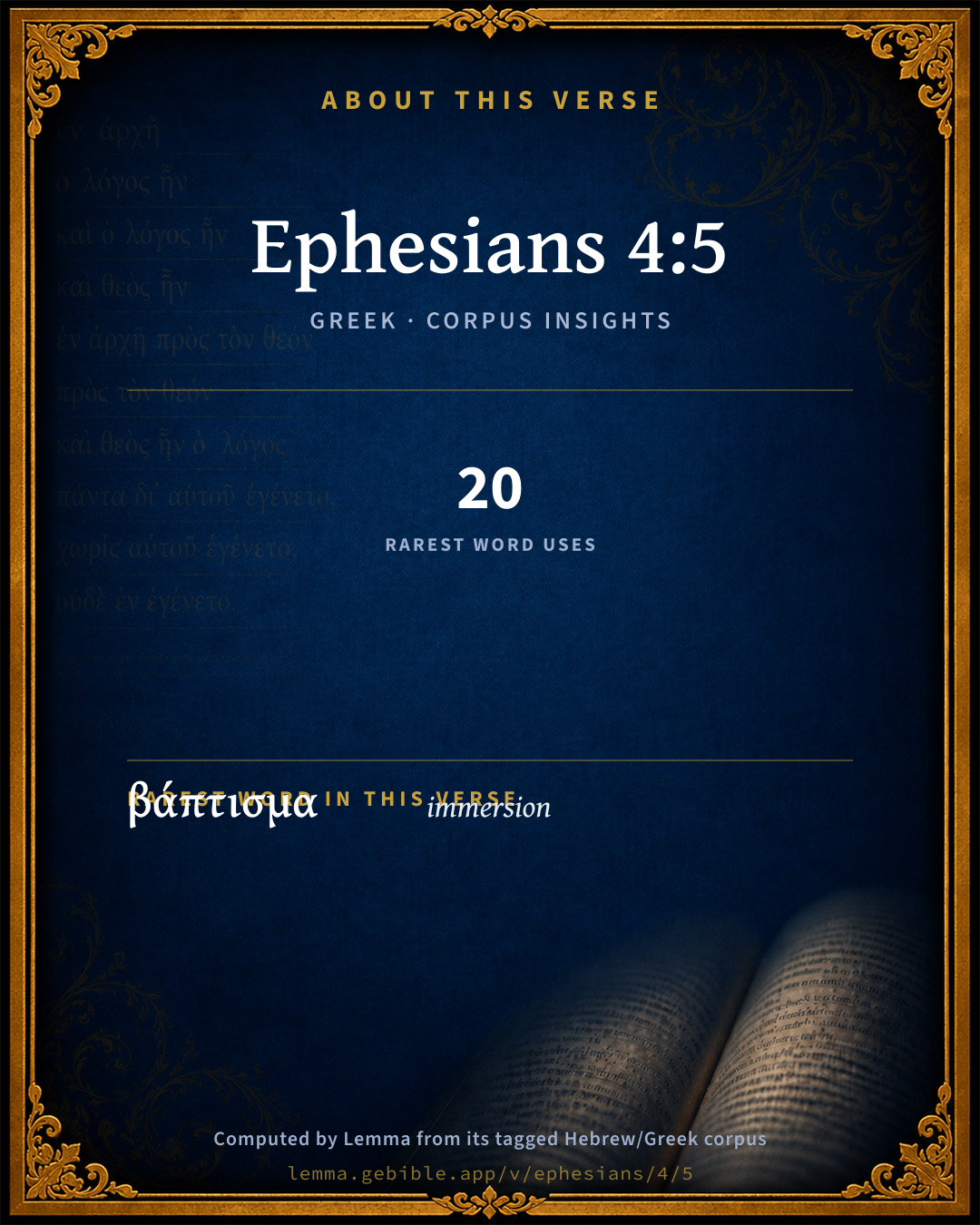
Ephesians 4:5

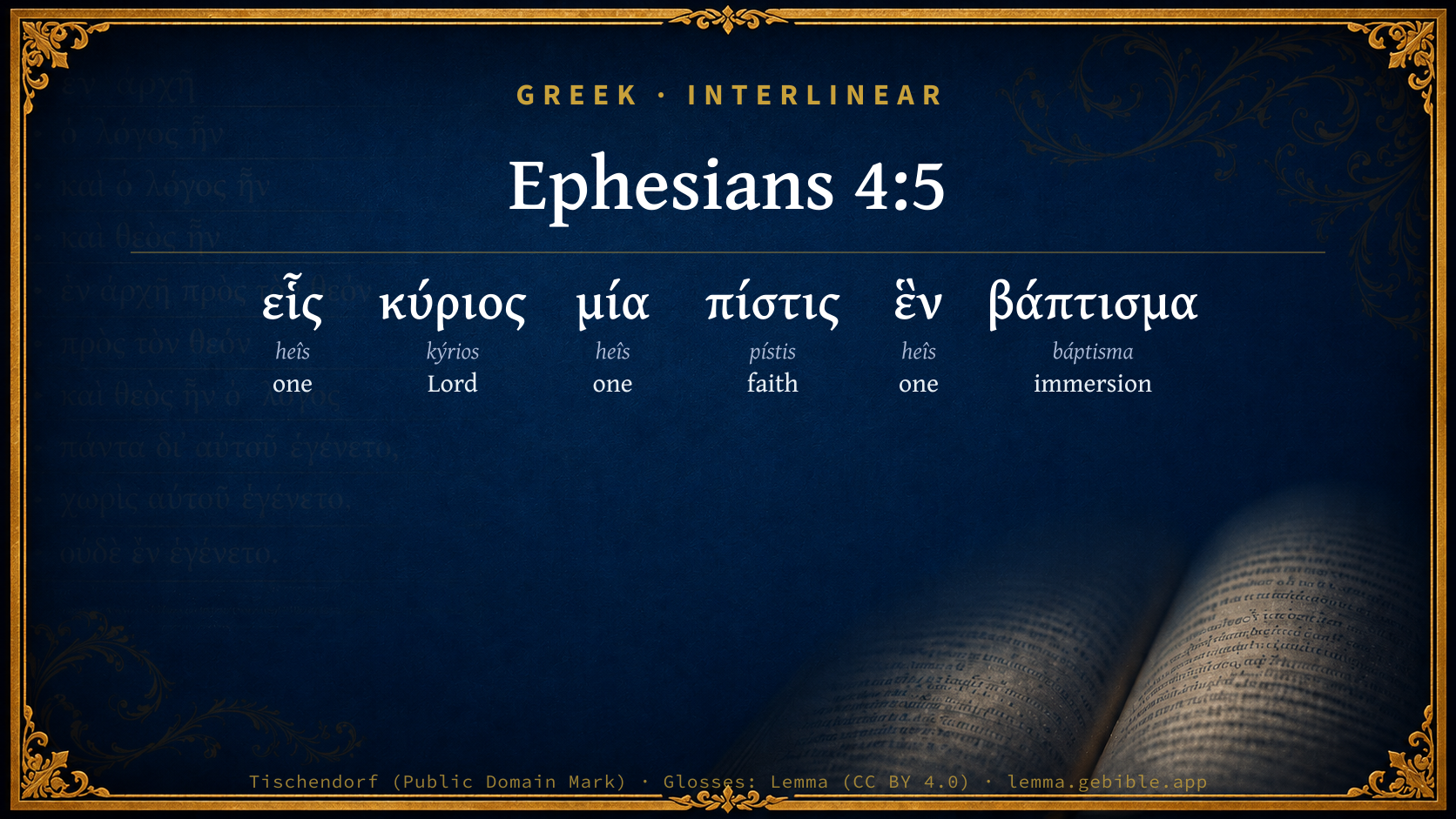
Greek (Tischendorf 8th ed.) Ephesians 4:5 appears in the Greek New Testament. The text above is from the Tischendorf 8th edition. Each word links to its Strong’s number and a concise gloss. Click any word for its full Thayer’s Greek Lexicon entry.
Download image
Cite this verse

Ephesians 4:5 (World English Bible). Public Domain. Lemma interlinear Bible study tool, https://lemma.gebible.app/v/ephesians/4/5.

Show BibTeX & RIS
BibTeX
RIS
English Translation
one Lord, one faith, one baptism,
World English Bible · Public Domain
Download a study sheet

One document with this verse’s original text, its word-by-word gloss line, the meaning frame, cross-references with their text, attributed commentary, and full source and license credits — printable, and it pastes into notes with its structure intact.

This verse Autodidact and up

Study sheet (.html) Plain text (.txt)

A passage Seminary Student

Up to 50 verses in one chapter. A passage sheet keeps up to 6 commentary sources and 12 cross-references per verse, in the order this page ranks them, and says so on the sheet whenever that leaves anything out. Ask for a single verse and you get the Autodidact verse sheet above.

Everything on this page stays free to read, with no account — the sheet is a download of what is already on screen, not access to it.

Want to remove ads? Support Godless Engineer
Compare translations 3

The same verse in 3 English versions, stacked beneath the original-language interlinear above. Click any original word for its lexicon entry.

Each is an independent rendering of the whole verse — the interlinear is not word-aligned to these translations.

Highlighted words mark where these versions differ — a whole-verse word diff, not a word-by-word alignment.

  • World English Bible Public Domain
    one Lord, one faith, one baptism,
  • King James Version Public Domain
    One Lord, one faith, one baptism,
  • unfoldingWord Literal Text CC BY-SA 4.0
    one Lord, one faith, one baptism,

unfoldingWord Literal Text — © unfoldingWord, licensed CC BY-SA 4.0. Word-aligned USFM3 via Door43 (git.door43.org/unfoldingWord/en_ult).

Versions to compare (up to 4)

3 of 4 selected

Show all 19 translations

Every available English version of this verse, each an independent rendering of the whole verse.

  • World English Bible Public Domain
    one Lord, one faith, one baptism,
  • Berean Standard Bible Public Domain
    one Lord, one faith, one baptism;
  • Majority Standard Bible Public Domain
    one Lord, one faith, one baptism;
  • King James Version Public Domain
    One Lord, one faith, one baptism,
  • American Standard Version (1901) Public Domain
    one Lord, one faith, one baptism,
  • Revised Version (1885) Public Domain
    one Lord, one faith, one baptism,
  • Geneva Bible (1599) Public Domain
    There is one Lord, one Faith, one Baptisme,
  • Douay-Rheims (1899) Public Domain
    One Lord, one faith, one baptism.
  • Young's Literal Translation Public Domain
    one Lord, one faith, one baptism,
  • Literal Standard Version CC BY-SA 4.0
    one Lord, one faith, one immersion,
  • Unlocked Literal Bible CC BY-SA 4.0
    And there is one Lord, one faith, one baptism,
  • unfoldingWord Literal Text CC BY-SA 4.0
    one Lord, one faith, one baptism,
  • Darby Bible Public Domain
    one Lord, one faith, one baptism;
  • World Messianic Bible Public Domain
    one Lord, one faith, one immersion,
  • Webster's Bible Public Domain
    One Lord, one faith, one baptism,
  • Free Bible Version CC BY-SA 4.0
    The Lord is one, our trust in him is one, and there's one baptism;
  • Bible in Basic English Public Domain
    One Lord, one faith, one baptism,
  • Text-Critical English NT CC BY 4.0
    one Lord, one faith, one baptism,
  • Tyndale New Testament (1534) Public Domain
    Let ther be but one lorde one fayth one baptism:

Literal Standard Version (2020), Covenant Press — licensed CC BY-SA 4.0. Text via the HelloAO Bible API (eBible.org). Unlocked Literal Bible (unfoldingWord) — licensed CC BY-SA 4.0. Text via the HelloAO Bible API (eBible.org). unfoldingWord Literal Text — © unfoldingWord, licensed CC BY-SA 4.0. Word-aligned USFM3 via Door43 (git.door43.org/unfoldingWord/en_ult). Free Bible Version, Dr. Jonathan Gallagher — licensed CC BY-SA 4.0. Text via the HelloAO Bible API (eBible.org).

Word by word

More ways to search: Search by grammar → Find every occurrence → Compare this word →

Practice this passage: Drill this verse → Learn its vocabulary →

βάπτισμα
báptisma
G908
“immersion”
Noun, Nominative, Singular, Neuter
Part of Speech
Noun
Case
Nominative
Number
Singular
Gender
Neuter
Full Thayer's Definition

Origin: from G907

TDNT: 10:05,9

1. immersion, submersion a. of calamities and afflictions with which one is quite overwhelmed b. of John's baptism, that purification rite by which men on confessing their sins were bound to spiritual reformation, obtained the pardon of their past sins and became qualified for the benefits of the Messiah's kingdom soon to be set up. This was valid Christian baptism, as this was the only baptism the apostles received and it is not recorded anywhere that they were ever rebaptised after Pentecost. c. of Christian baptism; a rite of immersion in water as commanded by Christ, by which one after confessing his sins and professing his faith in Christ, having been born again by the Holy Spirit unto a new life, identifies publicly with the fellowship of Christ and the church. In Rom. 6:3 Paul states we are "baptised unto death" meaning that weare not only dead to our former ways, but they are buried. To returnto them is as unthinkable for a Christian as for one to dig up a deadcorpse! In Moslem countries a new believer has little trouble withMoslems until he is publicly baptised. It is then, that the Moslems'know he means business, and then the persecution starts. See alsodiscussion of baptism under No. 907.
  1. εἷς heîs G1520 “one” Adjective, Nominative, Singular, Masculine
  2. κύριος kýrios G2962 “Lord” Noun, Nominative, Singular, Masculine
  3. μία heîs G1520 “one” Adjective, Nominative, Singular, Feminine
  4. πίστις pístis G4102 “faith” Noun, Nominative, Singular, Feminine
  5. ἓν heîs G1520 “one” Adjective, Nominative, Singular, Neuter

About this verse

These counts appear in no published source. They are computed here, from the morphology-tagged text and Lemma’s own curated glosses. What Lemma adds →

6
words
4
distinct lemmas
Pauline Epistles
section

Notable vocabulary

The rarest word here is βάπτισμα immersion G908 — appearing just 20 times in the whole Greek New Testament.

Shared distinctive vocabulary

βάπτισμα immersion G908 occurs in 20 verses of the Greek New Testament. Also found in:

Repetition

A word recurs within this verse:

Cross-references

27

Topical passages linked to Ephesians 4:5 in the Treasury of Scripture Knowledge — connected by theme and wording, ordered by reader-vote popularity; previews shown in the World English Bible.

  • 1 Corinthians 8:6 yet to us there is one God, the Father, of whom are all things, and we for him; and one Lord, Jesus Christ, through whom are all things, and we live through him.
  • 1 Corinthians 12:13 For in one Spirit we were all baptized into one body, whether Jews or Greeks, whether bond or free; and were all given to drink into one Spirit.
  • 1 Peter 3:21 This is a symbol of baptism, which now saves you-- not the putting away of the filth of the flesh, but the answer of a good conscience toward God, through the resurrection of Jesus Christ,
  • Romans 3:30 since indeed there is one God who will justify the circumcised by faith, and the uncircumcised through faith.
  • Galatians 3:26–28 For you are all children of God, through faith in Christ Jesus.
  • Matthew 28:19 Therefore go, and make disciples of all nations, baptizing them in the name of the Father and of the Son and of the Holy Spirit,
  • Zechariah 14:9 Yahweh will be King over all the earth. In that day Yahweh will be one, and his name one.
  • 1 Corinthians 1:13 Is Christ divided? Was Paul crucified for you? Or were you baptized into the name of Paul?
  • Jude 1:3 Beloved, while I was very eager to write to you about our common salvation, I was constrained to write to you exhorting you to contend earnestly for the faith which was once for all delivered to the saints.
  • 1 Corinthians 1:2 to the assembly of God which is at Corinth; those who are sanctified in Christ Jesus, called to be saints, with all who call on the name of our Lord Jesus Christ in every place, both theirs and ours:
  • 2 Corinthians 11:4 For if he who comes preaches another Jesus, whom we did not preach, or if you receive a different spirit, which you did not receive, or a different gospel, which you did not accept, you put up with that well enough.
  • Romans 14:8–9 For if we live, we live to the Lord. Or if we die, we die to the Lord. If therefore we live or die, we are the Lord's.
  • 1 Corinthians 12:5 There are various kinds of service, and the same Lord.
  • Galatians 5:6 For in Christ Jesus neither circumcision amounts to anything, nor uncircumcision, but faith working through love.
  • Ephesians 4:13 until we all attain to the unity of the faith, and of the knowledge of the Son of God, to a full grown man, to the measure of the stature of the fullness of Christ;
  • Philippians 2:11 and that every tongue should confess that Jesus Christ is Lord, to the glory of God the Father.
  • Acts 2:36 "Let all the house of Israel therefore know assuredly that God has made him both Lord and Christ, this Jesus whom you crucified."
  • Acts 10:36 The word which he sent to the children of Israel, preaching good news of peace by Jesus Christ--he is Lord of all--
  • Romans 6:3–4 Or don't you know that all we who were baptized into Christ Jesus were baptized into his death?
  • Galatians 1:6–7 I marvel that you are so quickly deserting him who called you in the grace of Christ to a different gospel;
  • Philippians 3:8 Yes most assuredly, and I count all things to be loss for the excellency of the knowledge of Christ Jesus, my Lord, for whom I suffered the loss of all things, and count them nothing but refuse, that I may gain Christ
  • Titus 1:1 Paul, a servant of God, and an apostle of Jesus Christ, according to the faith of God's chosen ones, and the knowledge of the truth which is according to godliness,
  • Titus 1:4 to Titus, my true child according to a common faith: Grace, mercy, and peace from God the Father and the Lord Jesus Christ our Savior.
  • Hebrews 6:6 and then fell away, it is impossible to renew them again to repentance; seeing they crucify the Son of God for themselves again, and put him to open shame.
  • Hebrews 13:7 Remember your leaders, men who spoke to you the word of God, and considering the results of their conduct, imitate their faith.
  • Jude 1:20 But you, beloved, keep building up yourselves on your most holy faith, praying in the Holy Spirit.
  • 2 Peter 1:1 Simon Peter, a servant and apostle of Jesus Christ, to those who have obtained a like precious faith with us in the righteousness of our God and Savior, Jesus Christ:

Cross-references courtesy of OpenBible.info (CC BY 4.0).

Commentary

Notes on Ephesians 4:5 from classic Christian and Jewish commentators (each source and its license shown beneath its notes). The classic Christian expositions comment on the surrounding passage and are grouped to its opening verse, so a note may address several verses; the Jewish commentaries on the Tanakh (Rashi and others) are per-verse, so they appear only where the commentator wrote on this verse.

Lemma curates 59 commentaries, every one of them public domain or Creative Commons licensed, each selected and text-cleaned for this edition rather than reprinted as found. About our sources →

Jamieson, Fausset & Brown

Robert Jamieson, A. R. Fausset & David Brown

Similarly "faith" and "baptism" (the sacramental seal of faith) are connected (Mar 16:16; Col 2:12). Compare Co1 12:13, "Faith" is not here that which we believe, but the act of believing, the mean by which we apprehend the "one Lord." "Baptism" is specified, being the sacrament whereby we are incorporated into the "one body." Not the Lord's Supper, which is an act of matured communion on the part of those already incorporate, "a symbol of union, not of unity" [ELLICOTT]. In Co1 10:17, where a breach of union was in question, it forms the rallying point [ALFORD]. There is not added, "One pope, one council, one form of government" [Cautions for Times]. The Church is one in unity of faith (Eph 4:5; Jde 1:3); unity of origination (Eph 2:19-21): unity of sacraments (Eph 4:5; Co1 10:17; Co1 12:13): unity of "hope" (Eph 4:4; Tit 1:2); unity of charity (Eph 4:3): unity (not uniformity) of discipline and government: for where there is no order, no ministry with Christ as the Head, there is no Church [PEARSON, Exposition of the Creed, Article IX].

Jamieson, Fausset & Brown — Commentary Critical and Explanatory on the Whole Bible (1871) — public domain (CC PDM 1.0). Text via the HelloAO Bible API.

The Biblical Illustrator

Joseph S. Exell

Eph_4:5

One Lord, one faith, one baptism.

The Lord of the Church

From the beginning, the Church is constituted of all who call upon the name of Jesus Christ our Lord.

I. How is the Lordship of Jesus constituted? Not by the suffrages of men; but by the will of God. And it is the reward of His servantship.

II. What does this Lordship comprise? Master, Teacher, Leader, Captain, Prince. In all things He is preeminent. In and over the Church He, and He only, has the right to reign.

III. How is this Lordship essential to the Church? The saints who form the one Body, and are actuated by the one Spirit, and are called in the hope of having one Lord, are companions in the kingdom of Jesus Christ. They are servants under one Master; disciples under one Teacher; soldiers under one Captain; subjects under one Lord. He is preeminent and paramount. And it is His Lordship that gives tone to their character, firmness to their testimony, steadfastness to their hues, and direction in all things.

IV. The practical uses of this doctrine.

1. It stirs gratitude.

2. It requires obedience.

3. It promotes equity and fair play among Christians.

4. It binds together Christians in unity.

There are differences of service and ministration rendered, but the same Lord is the rallying point of the whole kingdom. (J. Eadie, D. D.)

The five points of universal charity

I. One faith. This may be interpreted of the principle of faith as applied to revelation in general, and to Christ, the great object of that revelation, in particular. This faith is precious. It unites to a precious Saviour. It is precious, as the medium of deriving the greatest benefits.

II. One baptism. We prefer to consider this as the baptism of the Spirit; the sign being put for the thing signified.

III. One hope. This is termed, the one hope of their calling; namely, the one object to which they are all called, and which, therefore, they all have in hope, This is heaven, and is rather a state than a place, being two-fold, the one introductory, the other future and permanent.

IV. One Lord. This is Jesus Christ, viewed as a Saviour by faith and hope, and regarded as Lord by the principle of Christian submission and obedience. His supremacy, all true Christians joyfully acknowledge.

V. One God, and father of all. Here the apostle leads Christians up to the source of human redemption; and the ultimate object of all religious worship and homage. With God the Father, the plan of our salvation originated. Our Saviour perpetually refers His mediation to the will and appointment of His Father. I came not to do Mine own will, but the will of Him that sent Me. The work that My Father giveth Me to do, I do it. And even now, He carries on the process of human redemption in heaven, entirely in accordance with the will of the Father (Joh_5:19). Let us follow this epitome with some reflections on the agreement of Christians in these several particulars.

1. How great must be the work of their salvation! What great objects without are concerned in it; what great dispositions are wrought within them in relation to these objects to accomplish it! Here is God the Father intending it from eternity, Jesus Christ procuring it in time by His mediation, and a glorious heaven in future for its completion and enjoyment. Here is the Holy Spirit bringing their minds into contact with these objects, so as to be deeply influenced by them, through the medium of revealed truth, by the power of faith; which faith is expressly said to be of the operation of the Spirit of God, and the effect of the exceeding greatness of His power: and here is a supernatural principle of hope given them for the promotion of the same object.

2. What provision is made by these objects for the promotion of Christians in holiness? All the means and agencies requisite for that purpose are here at hand. The principle of faith with which they are endowed renders every part of the Bible that is favourable to holiness capable of being brought to bear on them. The principle of hope also is a great help and incentive to holiness. It saves us from being drawn to sin by the allurements of the world, presenting something infinitely more captivating before us; and it saves us from being driven to sin by its terrors, suggesting in such ease the affecting idea of the loss of its great object. Particularly does it influence to holiness by leading the mind to converse with holy objects, which must have a tendency to assimilate it to them.

3. What a foundation is laid, by the agreement of Christians in these particulars, for a mutual affection! The points of agreement among Christians, compared with those of disagreement, are much fewer in number but far greater in importance.

4. What a fearful thought is the fact of Christs lordship to the ungodly! They who neglect Him, little think of His present grandeur, and of His future glory. (J. Leifchild.)

The Church of the future

I believe in the Church of the future. I think that there will come a day, at no distant time, when from the watchtowers of Asia, once the land of many lords, there shall roll out the exultant chorus, One Lord! When from the watchtowers of Europe, distracted by divisions in the Faith, there shall roll up the great chorus, One Faith! When from the watchtowers of America, torn by controversies respecting the initiatory rite into the vestibule Church of our Lord Jesus Christ, there shall burst forth the inspiring chorus, One Baptism! When from the watchtowers of Africa, as though the God of all the human race were not her God, as if the Father of the entire family were not her Father--when from the watchtowers of neglected and despised Africa, there shall roll forth the chorus, One God and Father of us all! When the sacramental host, scattered all over the face of this lower creation, shall spring upon their feet, and, seizing the harp of thanksgiving, they shall join in the chorus that shall be responded to by the angels, One Lord, one Faith, one Baptism, one God and Father of us all, who is above all, and through all, and in you all; to whom be glory, dominion, and majesty, and blessing forever. (A. Cookman.)

The Biblical Illustrator, edited by Joseph S. Exell (c. 1880s–1900s) — public domain. Text from a community e-Sword module.

MacLaren's Expositions of Holy Scripture

Alexander MacLaren

EPHESIANS

THE THREEFOLD UNITY

Eph 4:5

The thought of the unity of the Church is very prominent in this epistle. It is difficult for us, amidst our present divisions, to realise how strange and wonderful it then was that a bond should have been found which drew together men of all nations, ranks, and characters. Pharisee and philosopher, high-born women and slaves, Roman patricians and gladiators, Asiatic Greeks and Syrian Jews forgot their feuds and sat together as one in Christ. It is no wonder that Paul in this letter dwells so long and earnestly on that strange fact. He is exhorting here to a unity of spirit corresponding to it, and he names a seven-fold oneness-one body and one spirit, one hope, one Lord, one faith, one baptism, one God and Father of all. The outward institution of the Church, as a manifest visible fact, comes first in the catalogue. One Father is last, and between these there lie the mention of the one Spirit and the one Lord. The ‘body’ is the Church. ‘Spirit, Lord, God,’ are the triune divine personality. Hope and faith are human acts by which men are joined to God; Baptism is the visible symbol of their incorporation into the one body. These three clauses of our text may be considered as substantially including all the members of the series. We deal with them quite simply now, and consider them in the order in which they stand here.

I. The one Lord.

The deep foundation of Christian unity is laid in the divine Christ. Here, as generally in the New Testament, the name ‘Lord’ designates Christ in His authority as ruler of men and in His divinity as Incarnation of God. It would not be going too far to suggest that we have in the name, standing as it does, for the most part, in majestic simplicity, a reference to the Old Testament name of Jehovah, which in the Greek translation familiar to Paul is generally rendered by this same word. Nor can we ignore the fact that in this great catalogue of the Christian unities the Lord stands in the centre of the three personalities named, and is regarded as being at once the source of the Spirit and the manifestation of the Father. The place which this name occupies in relation to the Faith which is next named suggests that the living personal Christ is the true uniting principle amongst men. The one body realises its oneness in its common relation to the one Lord. It is one, not because of identity in doctrine, not because of any of the bonds which hold men together in human associations, precious and sacred as many of these are, but ‘we being many are one bread, for we are all partakers of that one bread.’ The magnet draws all the particles to itself and holds them in a mysterious unity.

II. One faith.

The former clause set forth in one great name all the objective elements of the Church’s oneness; this clause sets forth, with equally all-comprehending simplicity, the subjective element which makes a Christian. The one Lord, in the fulness of His nature and the perfectness of His work, is the all-inclusive object of faith. He, in His own living person, and not any dogmas about Him, is regarded as the strong support round which the tendrils of faith cling and twine and grow. True, He is made known to us as possessing certain attributes and as doing certain things which, when stated in words, become doctrines, and a Christ without these will never be the object of faith. The antithesis which is so often drawn between Christ’s person and Christian doctrines is by no means sound, though the warning not to substitute the latter for the former is only too necessary at all times.

The subjective act which lays hold of Christ is faith, which in our text has its usual meaning of saving trust, and is entirely misconceived if it is taken, as it sometimes is, to mean the whole body of beliefs which make up the Christian creed. That which unites us to Jesus Christ is an infinitely deeper thing than the acceptance of any creed. A man may believe thirty-nine or thirty-nine hundred articles without having any real or vital connection with the one Lord. The faith which saves is the outgoing of the whole self towards Christ. In it the understanding, the emotions, and the will are all in action. The New Testament faith is absolutely identical with the Old Testament trust, and the prophet who exhorted Israel, ‘Trust ye in the Lord for ever, for in the Lord Jehovah is everlasting strength,’ was preaching the very same message as the Apostle who cried, ‘Believe on the Lord Jesus Christ and thou shalt be saved.’

That ‘saving faith’ is the same in all Christians, however different they may be in condition and character and general outlook and opinion upon many points of Christian knowledge. The things on which they differ are on the surface, and sometimes by reason of their divergencies Christians stand like frowning cliffs that look threateningly at one another across a narrow gorge, but deep below ground they are continuous and the rock is unbroken. In many and melancholy ways ‘the unity of faith and knowledge’ is contradicted in the existing organisations of the Church, and we are tempted to postpone its coming to the day of the new Jerusalem which is compact together; but the clarion note of this great text may encourage us to hope, and to labour in our measure for the fulfilment of the hope, that all, who by one faith have been joined to the one Lord, may yet know themselves to be one in Him, and present to the world the fair picture of one body animated by one spirit.

III. One baptism.

Obviously in Paul’s mind baptism here means, not the baptism with the Spirit, but the rite, one and the same for all, by which believers in Christ enter into the fellowship of the Church. It was then a perpetual rite administered as a matter of course to all who professed to have been joined to the one Lord by their one faith. The sequence in the three clauses of our text is perfectly clear. Baptism is the expression and consequence of the faith which precedes it. Surely there is here a most distinct implication that it is a declaration of personal faith. Without enlarging on the subject, I venture to think that the order of the Apostle’s thought negatives other conceptions of Christian baptism, such as, that it is a communication of Grace, or an expression of the feelings and desires of parents, or a declaration of some truth about redeemed humanity. Paul’s order is Christ’s when He said, ‘He that believeth and is baptized shall be saved.’

It is very remarkable and instructive that whilst thus our text shows that baptism was a matter of course and universally practised, the references to it in the epistles are so few. The inference is not that it was neglected, but that, as being a rite, it could not be as important as were Christian truths and Christian character. May we, in a word, suggest the contrast between the frequency and tone of the Apostolic references to baptism and those which we find in many quarters to-day?

It is remarkable that here the Lord’s Supper is not mentioned, and all the more so, that in Paul’s letter to the Corinthians, the passage which we have already quoted does put emphasis upon it as a token of Christian unity. The explanation of the omission may be found in the fact that, in these early days, the Lord’s Supper was not a separate rite, but was combined with ordinary meals, or perhaps more probably in the consideration that baptism was what the Lord’s Supper was not-an initial rite which incorporated the possessors of one faith into the one body.

Alexander MacLaren, Expositions of Holy Scripture (1904–1910) — public domain. Text from a community e-Sword module.

Bengel's Gnomon

Johann Albrecht Bengel

Eph 4:5. Μία πίστις, ἕν βάπτισμα, one faith, one baptism) into Christ, the Lord. Sometimes baptism, sometimes faith, is put first; Mar 16:16; Col 2:12.

Bengel's Gnomon of the New Testament — English translation (T&T Clark, Edinburgh, 1860) — public domain. Text from a community e-Sword module.

Meyer's Critical & Exegetical Commentary

Heinrich August Wilhelm Meyer

Eph_4:5. Continuation. There are not several Lords, but One, who is Lord of all believers, even Christ; not several kinds of faith, but one faith, inasmuch as all place their confidence upon the atoning death of Christ, on account of which they are justified and obtain salvation (Rom_3:23 ff.); not several kinds of baptism, but one baptism, namely, into Christ (Rom_6:3; Gal_3:27; Act_10:48; Act_19:5).

εἷς κύριος at the head; because μία πίστις and the ἓν βάπτισμα accomplished in the case of those who have become believers are consequentia of εἷς κύριος.

To make of πίστις the doctrine of the faith (Grotius, Zachariae, and others), is at variance with linguistic usage; comp. on Gal_1:23; Rom_1:5. The ἑνότης τῆς πίστεως is here represented as present, but in Eph_4:13 as future. Both with justice; inasmuch as here the Christian faith in the narrower sense is intended, the fides salvifica, which in all Christians was essentially the same, while at Eph_4:13 it is the Christian faith in the wider sense, within the compass of which there was diversity of convictions (as respects the validity of the law, the resurrection, veneration of angels, asceticism, partaking of flesh offered to idols, and other matters).

Of the Lords Supper, the unity of which might likewise appear as a suitable element in the connection (1Co_10:17), Paul does not make mention: according to Calovius, because it was comprehended uno baptismatis sacramento ex paritatis ratione; according to Harless, because Paul was mentioning only the fundamental conditions of the Christian fellowship, as they exist from the outset, at the first entrance upon it; according to Olshausen, because the specific act of the Supper, the partaking (rather, the communion, 1Co_10:16) of Christ, is included in εἷς κύριος, μία πίστις; according to de Wette, because it was less a something conditioning the unity, than something representing this unity itself.[201] But, in opposition to Calovius and Olshausen, it may be urged that, if Paul had adopted the synecdochic point of view in the selection, he would not have needed to mention πίστις, since baptism presupposes faith; in opposition to Harless, that the fundamental conditions of the Christian communion which Paul mentions are such, not specially for the beginning of it, but for its whole duration; in opposition to de Wette, finally, that the Lords Supper is, precisely as a representation of the unity, at the same time a powerful ethical incitement thereto, and hence would have been admirably appropriate in the series of points adduced. The ground of its not being mentioned is rather to be sought in the fact that the adducing of the Lords Supper would have disturbed the threefold triad of the elements adduced, and have broken through the whole rhythm of the passage. And the holy meal might the more easily remain unmentioned, because it was at that time not yet an observance subsisting by itself, but was combined with the common meals; hence, doubtless, in a context where the Lords Supper is spoken of, the εἷς ἄρτος (1Co_10:17) is brought forward as a symbol of the unity of Christians, but in another context the thought ἓν δεῖπνον κυρίου or μία τράπεζα κυρίουbecause the Supper was not something subsisting alone like baptism, which as the constituent element of Christian standing could not remain unmentioneddid not so necessarily suggest itself.

[201] Most mistakenly of all, Schenkel holds that Paul did not regard a uniform observance of the Supper as necessary, and would not stand in the way of the varied development of a rite. In that case, doubtless, Paul would have done well not to mention baptism either.

Meyer — Critical and Exegetical Commentary on the New Testament — English translation by Peter Christie, edited by Frederick Crombie (T&T Clark, 1880) — public domain. Text from a community e-Sword module.

Expositor's Greek Testament

ed. W. Robertson Nicoll

Eph 4:5 . εἷς Κύριος , μία πίστις , ἓν βάπτισμα : one Lord, one faith, one baptism . “One Lord,” that is Christ, He alone and He for all equally whether Gentile or Jew. “One faith,” i.e. , one belief having Him as its object; πίστις having here its usual subjective sense of saving trust , not = that which is believed, the Christian doctrine or creed (Grot.) a meaning which is at the best very rare in the NT and not quite certain even in most of the passages usually cited in support of it (Act 6:7 ; Gal 1:23 ; 1Ti 1:4 ; 1Ti 1:19 ; 1Ti 2:7 ; 1Ti 4:1 ; 1Ti 4:6 ; 1Ti 5:8 ; 1Ti 6:10 ; 1Ti 6:21 ), but most probable in Jdg 3:20 . “One baptism” the rite, one and the same for all, by which believers in Christ are admitted into the fellowship of His Church, and which is described as “into Christ” (Rom 6:3 ; Gal 3:27 ), into His name (Act 10:38 ; Act 10:48 ; Act 19:5 ), into the “name of the Father and of the Son and of the Holy Ghost” (Mat 28:19 ). No mention is made of the Lord’s Supper. This is the more remarkable in view of the fact that elsewhere it is referred to as a token of unity (1Co 10:17 ). Various explanations of the omission have been given e.g. , the desire to preserve the rhythmical form of the sentence, together with the fact that the Lord’s Supper did not as yet stand by itself, but was combined with ordinary Christian meals (Mey.); the fact that it was more a representation than a condition of unity (De Wette); the consideration that it is not like baptism an initial, fundamental rite, but one that comes to be observed after admission (Harl.). None of these reasons can be called satisfactory, nor have we the materials for an adequate explanation.

The Expositor's Greek Testament, edited by W. Robertson Nicoll (1897–1910) — public domain. Text from a community e-Sword module.

Hodge's Commentary on Romans, Ephesians & First Corinthians

Charles Hodge

Eph_4:4, Eph_4:5

Having urged the duty of preserving unity, the apostle proceeds to state both its nature and grounds. It is a unity which arises from the fact there is and can be but one body, one Spirit, one hope, one Lord, one faith, one baptism, and one God.

One body, ἓν σῶμα. This is not an exhortation, but a declaration. The meaning is not, Let us be united in one body, or in soul and body; but, as the context requires, it is a simple declaration. There is, one body, viz. one mystical body of Christ. All believers are in Christ; they are all his members; they constitute not many, much less conflicting bodies, but one. We, being many, are one body in Christ, and every one members one of another. Rom_12:5; 1Co_10:17; 1Co_12:27. In Eph_1:23, the church is said to be his body, the fullness of him that filleth all in all. As all true believers are members of this body, and as all are not included in any one external organization, it is obvious that the one body of which the apostle speaks, is not one outward visible society, but a spiritual body of which Christ is the head and all the renewed are members. The relation, therefore, in which believers stand to each other, is that which subsists between the several members of the human body. A want of sympathy is evidence of want of membership.

One spirit, ἓν πνεῦμα. This again does not mean one heart. It is not an exhortation to unanimity of feeling, or a declaration that such unanimity exists. Quasi diceret, nos penitus corpore et anima, non ex parte duntaxat, debere esse unitos. The context and the analogy of Scripture, as a comparison of parallel passages would evince, prove that by spirit is meant the Holy Spirit. As there is one body, so there is one Spirit, which is the life of that body and dwells in all its members. By one Spirit, says the apostle, are we all baptized into one body, whether we be Jews or Gentiles, whether we be bond or free; and have all been made to drink into one Spirit. 1Co_12:13. Of all believers, he says, The Spirit of God dwelleth in you. 1Co_3:16; 1Co_6:19; Rom_8:9, Rom_8:11. There is no doctrine of Scripture more plainly revealed than that the Spirit of God dwells in all believers, and that his presence is the ultimate ground of their unity as the body of Christ. As the human body is one because pervaded by one soul; so the body of Christ is one because it is pervaded by one and the same Spirit, who dwelling in all is a common principle of life. All sins against unity, are, therefore, sins against the Holy Ghost. They dissever that which he binds together. Our relation to Christ as members of his body; and our relation to the Holy Spirit who is our life, demands of us that we love our brethren and live at peace with them.

Even as ye are called in one hope of your calling, καθὼς καὶ ἐκλήθητε ἐν μιᾷ ἐλπίδι τῆς κλήσεως ὑμῶν. Inasmuch as. That is, believers are one body and have one spirit, because they have one hope. The fact that they all have the same high destiny, and are filled with the same expectations, proves that they are one. The unity of their hope is another evidence and element of the communion of saints. The Holy Ghost dwelling in them gives rise to the same aspirations, to the same anticipations of the same glorious inheritance, to a participation of which they had been called. The word hope is sometimes used for the things hoped for, as when the apostle speaks of the hope laid up in heaven. Col_1:5. See also Tit_2:13; Heb_6:18. Most frequently of course it has its subjective sense, viz. the expectation of future good. There is no reason for departing from that sense here, though the other is intimately allied with it, and is necessarily implied. It is because the object is the same, that the expectation is the same. Hope of your calling, is the hope which flows from your vocation. The inward, effectual call of the Holy Spirit gives rise to this hope for two reasons. First, because their call is to the inheritance of the saints in light. They naturally hope to obtain what they are invited to receive. They are invited to reconciliation and fellowship with God, and therefore they hope for his salvation; and in the second place, the nature of this call makes it productive of hope. It is at once an earnest and a foretaste of their future inheritance. See Eph_1:14, and 1Co_1:22. It assures the believer of his interest in the blessings of redemption, Rom_8:16; and as a drop of water makes the thirsty traveler long for the flowing stream, so the first fruits of the Spirit, his first sanctifying operations on the heart, cause it to thirst after God. Psa_42:1, Psa_42:2. Hope includes both expectation and desire, and therefore the inward work of the Spirit being of the nature both of an earnest and a foretaste, it necessarily produces hope.

Another ground of the unity of the church is, that all its members have one Lord. Lordship includes the ideas of possession and authority. A lord, in proper sense, is both owner and sovereign. When used in reference to God or Christ, the word expresses these ideas in the highest degree. Christ is The Lord, i.e. omnium rerum summus dominus et possessor. He is our Lord, i.e. our rightful owner and absolute sovereign. This proprietorship and sovereignty pertain to the soul and to the body. We are not our own, and should glorify him in our body and spirit which are his. Our reason is subject to his teaching, our conscience to his commands, our hearts and lives to his control. We are his slaves. And herein consists our liberty. It is the felix necessitas boni of which Augustine speaks. It is analogous to absolute subjection to truth and holiness, only it is to a person who is infinite in knowledge and in excellence. This lordship over us belongs to Christ not merely as God, or as the Logos, but as the Theanthropos. It is founded not simply on his divinity, but also and specially on the work of redemption. We are his because he has bought us with his own most precious blood. 1Co_6:20 : 1Pe_1:1. For this end he both died and rose again, that he might be Lord both of dead and of living. Rom_14:9. Such being the nature and the grounds of the sovereignty of Christ, it necessarily binds together his people. The slaves of one master and the subjects of the same sovereign are intimately united among themselves, although the ownership and authority are merely external. But when, as in our relation to Christ, the proprietorship and sovereignty are absolute, extending to the soul as well as to the body, the union is unspeakably more intimate. Loyalty to a common Lord and master animates with one spirit all the followers of Christ.

One faith. This is the fifth bond of union enumerated by the apostle. Many commentators deny that the word πίστις is ever used for the object of faith, or the things believed; they therefore deny that one faith here means one creed. But as this interpretation is in accordance with the general usage of language, and as there are so many cases in which the objective sense of the word is best suited to the context, there seems to be no sufficient reason for refusing to admit it. In Gal_1:23, Paul says, He preached the faith; in Act_6:7, men, it is said, were obedient to the faith. The apostle Jude speaks of the faith once delivered to the saints. In these and in many other instances the objective sense is the natural one. In many cases both senses of the word may be united. It may be said of speculative believers that they have one faith, so far as they profess the same creed, however they may differ in their real convictions. All the members of the Church of England have one faith, because they all profess to adopt the Thirty-Nine Articles, although the greatest diversity of doctrine prevails among them. But true believers have one faith, not only because they profess the same creed, but also because they really and inwardly embrace it. Their union, therefore, is not merely an external union, but inward and spiritual. They have the same faith objectively and subjectively. This unity of faith is not perfect. That, as the apostle tells us in a subsequent part of this chapter, is the goal towards which the church contends. Perfect unity in faith implies perfect knowledge and perfect holiness. It is only as to fundamental doctrines, those necessary to piety and therefore necessary to salvation, that this unity can be affirmed of the whole church as it now exists on earth. Within these limits all the true people of God are united. They all receive the Scriptures as the word of God, and acknowledge themselves subject to their teachings. They all recognize and worship the Lord Jesus as the Son of God. They all trust to his blood for redemption and to his Spirit for sanctification.

One baptism. Under the old dispensation when a Gentile became a Jew, he professed to accede to the covensant which God had made with his people, and he received the sign of circumcision not only as a badge of discipleship but as the seal of the covenant. All the circumcised therefore were foederati, men bound together by the bonds of a covenant which united them to the same God and to each other. So under the new dispensation the baptized are foederati; men bound together in covenant with Christ and with each other. There is but one baptism. All the baptized make the same profession, accept the same covenant, and are consecrated to the same Lord and Redeemer. They are, therefore, one body. For as many as have been baptized into Christ, have put on Christ. There is neither Jew nor Greek, there is neither bond nor free, there is neither male nor female, for ye are all one in Christ Jesus. Gal_3:27, Gal_3:28.

Charles Hodge — Commentary on Romans (1835), First Corinthians (1857), and Ephesians (1856) — public domain. Text from a community e-Sword module.

Adam Clarke's Commentary

Verse 5. One Lord] Jesus Christ, who is the governor of this Church.

One faith] One system of religion, proposing the same objects to the faith of all.

One baptism] Administered in the name of the holy Trinity; indicative of the influences, privileges, and effects of the Christian religion.

Adam Clarke's Commentary on the Bible (1810–1826) — public domain. Text from a community e-Sword/MySword module.

John Calvin's Commentaries

5. One Lord. In the first Epistle to the Corinthians, he employs the word Lord, to denote simply the government of God.

“There are differences of administration, but the same Lord.” (1 Corinthians 12:5)

In the present instance, as he shortly afterwards makes express mention of the Father, he gives this appellation strictly to Christ, who has been appointed by the Father to be our Lord, and to whose government we cannot be subject, unless we are of one mind. The frequent repetition of the word one is emphatic. Christ cannot be divided. Faith cannot be rent. There are not various baptisms, but one which is common to all. God cannot cease to be one, and unchangeable. It cannot but be our duty to cherish holy unity, which is bound by so many ties. Faith, and baptism, and God the Father, and Christ, ought to unite us, so as almost to become one man. All these arguments for unity deserve to be pondered, but cannot be fully explained. I reckon it enough to take a rapid glance at the apostle’s meaning, leaving the full illustration of it to the preachers of the gospel. The unity of faith, which is here mentioned, depends on the one, eternal truth of God, on which it is founded.

One baptism, This does not mean that Christian baptism is not to be administered more than once, but that one baptism is common to all; so that, by means of it, we begin to form one body and one soul. But if that argument has any force, a much stronger one will be founded on the truth, that the Father, and Son, and Spirit, are one God; for it is one baptism, which is celebrated in the name of the Three Persons. What reply will the Arians or Sabellians make to this argument? Baptism possesses such force as to make us one; and in baptism, the name of the Father, and of the Son, and of the Spirit, is invoked. Will they deny that one Godhead is the foundation of this holy and mysterious unity? We are compelled to acknowledge, that the ordinance of baptism proves the existence of Three Persons in one Divine essence.

John Calvin's Commentaries (1540-1563) — public domain. Text from the Calvin Translation Society English edition (1840s-50s) via the Christian Classics Ethereal Library (ccel.org). Calvin's coverage is partial (roughly two-thirds of the Bible); uncommented books and verses are honest gaps, never fabricated. The 19th-century editor's footnotes and remarks are omitted so the notes are faithfully Calvin's own voice.

Ellicott's Commentary for English Readers

(5) One Lord, one faith.—From the idea of “the calling,” the Apostle passes naturally to Him who calls—the “one Lord”—and to the method of His calling to Himself, first, by the “one faith,” and then by the “one baptism” at which profession of that one faith is made. It is on the indwelling of Christ in each heart by faith that the spiritual unity of all Christians—primarily with Him, secondarily with one another—depends; and that spiritual unity is “put on” in baptism (Gal_3:27), in which we are “buried with Him and risen again” (Col_2:12), growing into the likeness of His death and resurrection (Rom_6:3-5). Again we note that, with but few exceptions, all Christians, even in the divided condition of the Church, are still united in the “one baptism;” and if we look to such expressions of the one faith as are contained in the baptismal profession (e.g., of the Apostles’ Creed), it is clear that our divisions, great as they are, turn mainly on the fourth subsidiary Article on the “Holy Catholic Church,” and not on the three primary Articles of the Father, the Son, and the Holy Ghost. In these the mass of Christendom has still one faith.

A Bible Commentary for English Readers, edited by Charles John Ellicott (1878–1897) — public domain. Text from a community e-Sword module.

The Cambridge Bible for Schools and Colleges

gen. ed. J. J. S. Perowne

5. one Lord] Jesus Christ; Possessor and Prince of all His people equally.

one faith] Is “faith” here the “Christian creed,” or “trustful acceptance” of Christ, “saving faith”? Probably the latter, in view of the great rarity of the former meaning of the word in St Paul (Gal_1:23; Php_1:27; present perhaps the best cases, and even these are not quite clear). The words here thus mean, “one and the same way of access to and union with the One Lord.”

one baptism] The one Divine Seal upon the one God-given faith in the One Lord. This holy Seal is “one” in respect of the Unity of the Triune Name (Mat_28:19) “into” which, and which alone, all partakers of the covenant of Christ are baptized. The “one baptism for the remission of sins” is baptism into that Name, or into its equivalent (Act_2:38), the Name of the Son of the Father and the Giver of the Spirit.

The Cambridge Bible for Schools and Colleges (gen. ed. J. J. S. Perowne; Cambridge University Press, 1878–1918) — public domain. Text from a community e-Sword module.

John Gill's Exposition

One Lord,.... The Lord Jesus Christ, who, by right of creation, is Lord of all; and by right of marriage, and redemption, is the one and only Lord of his church and people; he has betrothed them to himself, and is their husband, and so their Lord, whom they are to worship and obey; he has redeemed them, he has bought them with the price of his blood, and therefore they are not their own, but his, and should glorify him both with their bodies and souls, which are his; he is the head of his body the church, the King of saints, and Father and master of the family named of him, and therefore they ought to agree among themselves, and not be many masters, and usurp a domination over one another. The Ethiopic version reads, "one God", but that is expressed in the following verse.

One faith; there is but one grace of faith; there are indeed different sorts of faith; there is the faith of miracles, and an historical, temporary faith, but there is but one true grace of faith; and which, though it is in different subjects, and its degrees and acts are various, yet as to its nature, it is like precious faith in all; and has the same author and object, Jesus Christ, and springs from the same cause, the free grace of God, and has equally in all everlasting salvation connected with it, and consequent upon it: and there is but one doctrine of faith; the Gospel is so called, because it consists of things to be believed, is the means of implanting faith, it proposes the object to be believed in, and requires the exercise of it upon it, and should be mixed with faith whenever heard. Now this is but one, and is all of a piece, and consistent with itself, and so should the professors of it be, and love one another in the faith.

One baptism, there were divers baptisms under the law, but there is but one baptism under the Gospel; for John's and Christ's are the same: there are, besides, figurative or metaphorical ones, which are so in an improper sense, as the baptism of the Spirit, and the baptism of blood, or of sufferings; but there is but one baptism, literally and properly so called, which is water baptism; and which is to be administered in one and the same way, by immersion in water; and on one and the same subjects, believers in Christ; and in one and the same name, the name of the Father, the Son, and the Holy Ghost; and to be performed but once, when rightly administered.

John Gill's Exposition of the Whole Bible (1746–1763) — public domain (CC PDM 1.0). Text via the HelloAO Bible API.

Trapp's Complete Commentary

John Trapp

5 One Lord, one faith, one baptism,

Ver. 5. One baptism] The author to the Hebrews speaketh of baptisms, Eph 6:2. But either he puts the plural for the singular; or else he meaneth it of the outward and inward washing, which the schools call baptismum fluminis et flaminis, the baptism of water and fire. {See Trapp on "Mat 3:11"}

John Trapp, A Commentary or Exposition upon All the Books of the Old and New Testament (1647–1656) — public domain. Text from a community e-Sword module.

Albert Barnes' Notes on the Bible

One Lord - This evidently refers to the Lord Jesus. The “Spirit” is mentioned in the previous verse; the Father in the verse following. On the application of the word “Lord” to the Saviour, see the notes on Act 1:24. The argument here is, that there ought to be unity among Christians, because they have one Lord and Saviour. They have not different Saviours adapted to different classes; not one for the Jew and another for the Greek; not one for the rich and another for the poor; not one for the bond and another for the free. There is but one. He belongs in common to all as their Saviour; and he has a right to rule over one as much as over another. There is no better way of promoting unity among Christians than by reminding them that they have the same Saviour. And when jealousies and heart-burnings arise; or when they are disposed to contend about trifles; when they magnify unimportant matters until they are in danger of rending the church asunder, let them feel that they have one Lord and Saviour, and they will lay aside their contentions and be one again. Let two men who have never seen each other before, meet in a distant land, and feel that they have the same Redeemer, and their hearts will mingle into one. They are not aliens, but friends. A cord of sympathy is struck more tender than that which binds them to country or home and though of different nations, complexions, or habits, they will feel that they are one. Why should contentions ever arise between those who have the same Redeemer?

One faith - The same belief. That is, either the belief of the same doctrines, or faith of the same nature in the heart. The word may be taken in either sense. I see no reason why it should not include “both” here, or be used in the widest sense, If so used it means that Christians should be united because they hold the same great doctrines; and also, because they have the same confidence in the Redeemer in their hearts, They hold the same system as distinguished from Judaism, Paganism, Mohammedanism, Deism; and they should, therefore, be one. They have the same trust in Christ, as a living, practical principle - and they should, therefore, be one. They may differ in other attachments; in temperament; in pursuit; in professions in life - but they have a common faith - and they should be one.

One baptism - This does not affirm that there is one mode of baptism, but it refers to “the thing itself.” They are all baptized in the name of the same Father, Saviour, Sanctifier. They have all in this manner been consecrated unto God, and devoted to his service. Whether by immersion, or by pouring, or by sprinkling, they have all been baptized with water; whether it is done in adult years, or in infancy, the same solemn act has been performed on all - the act of consecration to the Father, the Son, and the Holy Spirit. This passage cannot be adduced to prove that only one “mode” of baptism is lawful, unless it can be shown that the thing referred to here was the “mode” and not “the thing itself;” and unless it can be proved that Paul meant to build his argument for the “unity” of Christians on the fact that the same “form” was used in their baptism. But this is evidently not the point of his argument.

The argument is, that there was really but “one baptism” - not that there was but one “mode” of baptism. I could not use this argument in this form, “Christians should be one because they have been all baptized by ‘sprinkling;’” and yet the argument would be just as forcible as to use it in this form, “Christians should be one because they have all been baptized by ‘immersion.’” There is one baptism, not one “mode” of baptism; and no man has a right to “assume” that there can be but one mode, and then apply this passage to that. The “essential thing” in the argument before us is, that there has been a consecration to the Father, the Son, and the Holy Spirit, by the application of water. Thus, understood, the argument is one that will be “felt” by all who have been devoted to God by baptism. They have taken the same vows upon them. They have consecrated themselves to the same God. They have made the same solemn profession of religion. Water has been applied to one and all as the emblem of the purifying influences of the Holy Spirit; and having been thus initiated in a solemn manner into the same profession of religion, they should be one. (See Mat 3:6 note and Mat 3:16 note.)

Albert Barnes' Notes on the Bible (1834–1885) — public domain. Text from a community e-Sword/MySword module.

Haydock's Catholic Bible Commentary

This contains some more reasons why Christians should love one another. We are all servants of the same God, believe the same mysteries, and receive the same sacraments, whoever may be the dispenser of them. --- One faith. As rebellion is the bane of commonwealths and kingdoms, and peace and concord the preservation of the same; so is schism, and diversity of faith or fellowship in the service of God, the calamity of the Church: and peace, unity, and uniformity, the special blessing of God therein. St. Cyprian, in his book on the unity of the Church, writeth thus: "One Church, for one is my dove. This unity of the Church, he that holdeth not, doth he think he holdeth the faith? He that withstandeth or resisteth the Church, he that resisteth Peter’s chair, upon which the Church was built, doth he trust that he is in the Church?" And again, Ep. xl. "There is one God, and one Christ, and one Church, and one chair, by our Lord’s voice founded upon Peter. To set up another altar, or to constitute another priesthood, besides the one altar and the one priesthood, is impossible. Whosever gathereth elsewhere scattereth. It is adulterous, it is impious, it is sacrilegious, whatsoever is instituted by man to the breach of God’s disposition. Get ye far from such men: they are blind, and leaders of the blink." St. Hilary also applies this text against the Arians thus: "Perilous and miserable is it that there are now among them as many faiths as wills, and as many doctrines as manners; whilst modes of faith are written as men will, or as they will, so are understood. Whereas the one truth teaches there is but one God, one Lord, one baptism, and also one faith: hence whilst more faiths are made, they begin by falling from that which is the only faith, and end in having no faith at all." (St. Hilary, lib. ad Constantium Augustum.)

George Leo Haydock (1774–1849), Haydock's Catholic Family Bible and Commentary, 1859 edition — public domain. Excludes Psalms (Douay-Rheims chapter numbering differs from Protestant) and Deuterocanonical books (Catholic canon only).

Matthew Poole's English Annotations

One Lord; Christ, viz. as Redeemer, Head, and Husband of the church, to whom, by God’s appointment, she is immediately subject, 1Co 8:6; Joh 13:13; Act 2:36.

One faith; i.e. one object of the faith of all believers, viz. the doctrine of salvation, which is but one.

One baptism; both as to the outward symbol, and the thing signified by it.

Matthew Poole's English Annotations on the Holy Bible (1683–1685) — public domain. Text from a community e-Sword/MySword module.

Whedon's Commentary on the Bible

Daniel D. Whedon

5. One Lord—To whom, as centre, head, and author of our entire salvation one faith unites us, that faith expressed and confirmed by one baptism. Thus one faith supposes a creed. That is, it assumes that Christianity is not only a life but a doctrine. It has its central fundamental truths which must be embraced in this one faith. By these truths believed, and firmly held, men are led to, and united to, Christ as their Saviour. Besides these fundamental truths, by which Christianity is formed and a man becomes “a believer,” there are, doubtless, many truths and many beliefs held by many Christians not necessary to the very existence of the one faith. But we must not give ready heed to teachers who declaim against “doctrines” and “the creeds,” as if truth and sound doctrine were not vital to the reality of our Christianity.

One baptism—One affusion by the Spirit, symbolized by water, declaring to the world our living one faith in the one Lord.

Daniel D. Whedon (gen. ed.), Commentary on the Old and New Testaments (1874–1909) — public domain. Text from a community e-Sword module.

John Wesley's Explanatory Notes

One outward baptism.

John Wesley, Explanatory Notes Upon the Whole Bible (1754–1765) — public domain. Text via the GEBible commentary corpus.

The People's New Testament

B. W. Johnson

5. One Lord. Christ, the Head of the church (1 Cor. 1:13; Eph. 1:10). All saints have one Master. One faith. One Lord who is the object of faith, and whom both Jews and Gentiles lay hold upon by faith in him. One baptism. All have been baptized into the “one Lord” upon the profession of the “one faith” by one rite. It would be utterly inconsistent with the Apostle's argument, if there could be anything divisive about baptism, as three different ways of administering itself. He is showing that there is unity in each one of seven essential features of Christianity, and hence all should seek to “keep the unity of the Spirit in the bond of peace.”

B. W. Johnson's The People's New Testament with Notes (1889–1891) — public domain. Electronic text from the Christian Classics Ethereal Library (CCEL) ThML edition.

Cambridge Greek Testament for Schools and Colleges

5. The ‘subjective’ unity of the Spirit in love and hope has an ‘objective’ counterpart in the service of a common Lord, confessed by a common Creed sealed by a common Sacrament of incorporation.

εἶς κύριος. Cf. 1Co 8:6; 1Co 1:2 (where the confession of a common faith in Jesus Christ as Lord is recognized as a link between men ‘in every place’) and Rom 10:12 (where the distinction of Jew and Gentile is done away on the same ground).

μία πίστις. Cf. Tit 1:4 and 2Co 4:13. See also 2Pe 1:1. Here ‘faith,’ which is one as resting upon and directed towards a common object, is practically identical with ‘Creed.’ See Westcott’s note in loc.

ἔν βάπτισμα. Baptism is seen as a unifying power in 1Co 12:13, and indirectly, but none the less effectively, in the indignant disclaimer in connexion with the rise of party divisions in 1Co 1:13.

Cambridge Greek Testament for Schools and Colleges (Cambridge University Press, 1896; 21 vols, various authors incl. Carr, Maclear, Plummer, Farrar, Lumby, Moule, M. R. James, Simcox) — public domain. Text from a community e-Sword module.

Alford’s Greek Testament

Henry Alford

5.] one Lord (as the Head of the Church: in this verse he grounds the co-existence of the ἓν σῶμα κ. ἓν πνεῦμα in the three great facts on which it rests—the first objective,—εἷς κύριος—the second subjective,—μίαπίστις—the third compounded of the two,—ἓν βάπτισμα), one faith (in that one Lord: the subjective medium by which that one Lord is apprehended and appropriated: not ‘fides quæ creditur,’ but ‘fides quâ creditur:’ but it is necessarily understood, that this subjective faith has for its object the One Lord just mentioned) one baptism (the objective seal of the subjective faith, by which, as a badge, the members of Christ are outwardly and visibly stamped with His name. The other sacrament, being a matured act of subsequent participation, a function of the incorporate, not a seal of incorporation (a symbol of union, not of unity: so Ellicott), is not here adduced. In 1Co 10:17, where an act was in question which was a clear breach of union, it forms the rallying-point),

Henry Alford, The Greek Testament (1849–1861) — public domain. Text from a community e-Sword module.

International Critical Commentary

5. εἷς Κύριος, μία πίστις, ἓν βάπτισμα. “One Lord, one Faith, one Baptism.” One Lord, Christ; one faith, of which He is the object, one in its nature and essence; and one baptism, by which we are brought into the profession of this faith.

The question has been asked, Why is the other sacrament not mentioned? and various answers have been given, of which the one that is most to the point, perhaps, is that it is not a ground or antecedent condition of unity, but an expression of it. Yet it must be admitted that it would supply a strong motive for preserving unity, as in 1Co 10:17. Probably, as it was not essential to mention it, the omission is due in part to the rhythmical arrangement of three triads.

International Critical Commentary — older volumes (1896–1929), various authors — public domain. Text from a community e-Sword module.

Vincent's Word Studies in the New Testament

Marvin R. Vincent

Faith. The principle of faith; not that which is believed - the body of Christian doctrine, which does not promote unity. See on Act 6:7. Baptism. The external sign of faith, but of no significance without the Lord and the faith. Baptism is emphasized instead of the Eucharist, because the latter assumes and recognizes unity as an established fact; while faith and baptism precede that fact, and are essential to it. Baptism, moreover, is not administered to the Church as a body, but to individuals, and therefore emphasizes the exhortation to each member to be in vital union with the whole body.

Marvin R. Vincent, Word Studies in the New Testament (1887–1900) — public domain. Text from a community e-Sword/MySword module.

Lesson kit

Teaching starters — assembled from the data on this page, not authored interpretation. Every prompt links to the verse data it draws on. Edit before teaching.

Ephesians, in the Pauline Epistles, opens this verse with 6 words (4 distinct Greek lemmas). Its most distinctive word is báptisma (“immersion”). A historical commentator’s framing appears above. Read the whole chapter for the surrounding context.

Discussion questions

  1. What does “immersion” (báptisma) contribute to the verse as a whole?
  2. How does Matthew 3:7, which shares the word «immersion», read alongside this verse?
  3. What does the repetition of “one” (3× in this one verse) do in this verse?
  4. Compare how Jamieson, Fausset & Brown and The Biblical Illustrator read this verse. Where do they agree or differ?

Things to notice

Reading settings

Reading text

Shown beneath each verse's original-language words.

Old Testament
Old Testament edition

Read the OT as the Masoretic Hebrew (MT) or the Greek Septuagint (LXX).

English shown for the Greek Septuagint (in the Hebrew ↔ Greek comparison).

Comparing translations? Open the Compare panel on any verse page to stack up to four side by side.