Colossians 1:15

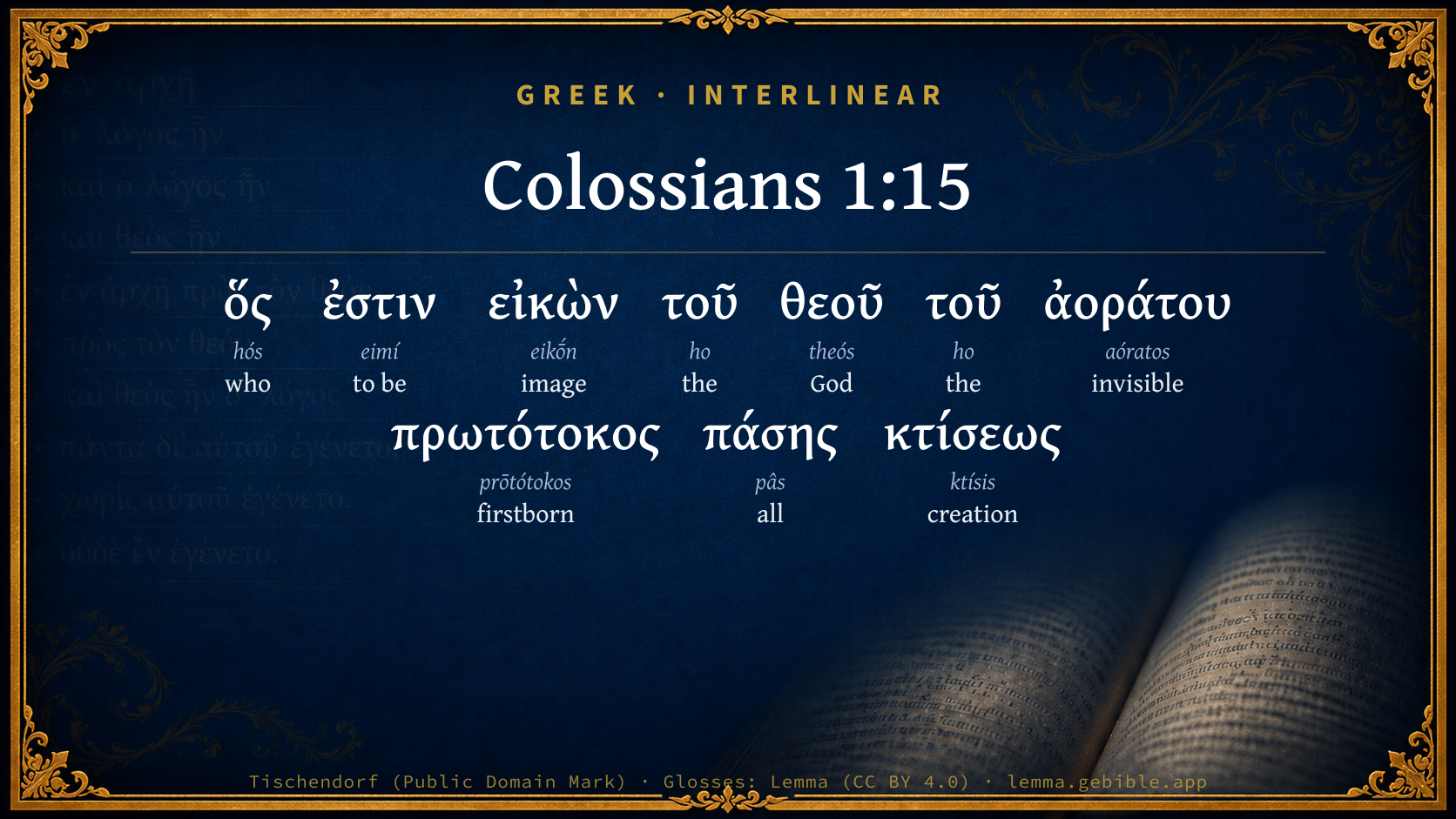
Greek (Tischendorf 8th ed.) Colossians 1:15 appears in the Greek New Testament. The text above is from the Tischendorf 8th edition. Each word links to its Strong’s number and a concise gloss. Click any word for its full Thayer’s Greek Lexicon entry.
Download image
Cite this verse

Colossians 1:15 (World English Bible). Public Domain. Lemma interlinear Bible study tool, https://lemma.gebible.app/v/colossians/1/15.

Show BibTeX & RIS
BibTeX
RIS
English Translation
who is the image of the invisible God, the firstborn of all creation.
World English Bible · Public Domain
Download a study sheet

One document with this verse’s original text, its word-by-word gloss line, the meaning frame, cross-references with their text, attributed commentary, and full source and license credits — printable, and it pastes into notes with its structure intact.

This verse Autodidact and up

Study sheet (.html) Plain text (.txt)

A passage Seminary Student

Up to 50 verses in one chapter. A passage sheet keeps up to 6 commentary sources and 12 cross-references per verse, in the order this page ranks them, and says so on the sheet whenever that leaves anything out. Ask for a single verse and you get the Autodidact verse sheet above.

Everything on this page stays free to read, with no account — the sheet is a download of what is already on screen, not access to it.

Want to remove ads? Support Godless Engineer
Compare translations 3

The same verse in 3 English versions, stacked beneath the original-language interlinear above. Click any original word for its lexicon entry.

Each is an independent rendering of the whole verse — the interlinear is not word-aligned to these translations.

Highlighted words mark where these versions differ — a whole-verse word diff, not a word-by-word alignment.

  • World English Bible Public Domain
    who is the image of the invisible God, the firstborn of all creation.
  • King James Version Public Domain
    Who is the image of the invisible God, the firstborn of every creature:
  • unfoldingWord Literal Text CC BY-SA 4.0
    He is the image of the invisible God, the firstborn of all creation.

unfoldingWord Literal Text — © unfoldingWord, licensed CC BY-SA 4.0. Word-aligned USFM3 via Door43 (git.door43.org/unfoldingWord/en_ult).

Versions to compare (up to 4)

3 of 4 selected

Show all 19 translations

Every available English version of this verse, each an independent rendering of the whole verse.

  • World English Bible Public Domain
    who is the image of the invisible God, the firstborn of all creation.
  • Berean Standard Bible Public Domain
    The Son is the image of the invisible God, the firstborn over all creation.
  • Majority Standard Bible Public Domain
    The Son is the image of the invisible God, the firstborn over all creation.
  • King James Version Public Domain
    Who is the image of the invisible God, the firstborn of every creature:
  • American Standard Version (1901) Public Domain
    who is the image of the invisible God, the firstborn of all creation;
  • Revised Version (1885) Public Domain
    who is the image of the invisible God, the firstborn of all creation;
  • Geneva Bible (1599) Public Domain
    Who is the image of the inuisible God, the first begotten of euery creature.
  • Douay-Rheims (1899) Public Domain
    Who is the image of the invisible God, the firstborn of every creature:
  • Young's Literal Translation Public Domain
    who is the image of the invisible God, first-born of all creation,
  • Literal Standard Version CC BY-SA 4.0
    who is the image of the invisible God, firstborn of all creation,
  • Unlocked Literal Bible CC BY-SA 4.0
    The Son is the image of the invisible God. He is the firstborn of all creation.
  • unfoldingWord Literal Text CC BY-SA 4.0
    He is the image of the invisible God, the firstborn of all creation.
  • Darby Bible Public Domain
    who is image of the invisible God, firstborn of all creation;
  • World Messianic Bible Public Domain
    He is the image of the invisible God, the firstborn of all creation.
  • Webster's Bible Public Domain
    Who is the image of the invisible God, the first-born of every creature:
  • Free Bible Version CC BY-SA 4.0
    The Son is the visible image of the invisible God. He was before all creation,
  • Bible in Basic English Public Domain
    Who is the image of the unseen God coming into existence before all living things;
  • Text-Critical English NT CC BY 4.0
    He is the image of the invisible God, the firstborn of all creation.
  • Tyndale New Testament (1534) Public Domain
    which is the ymage of the invisible god fyrst begotten of all creatures.

Literal Standard Version (2020), Covenant Press — licensed CC BY-SA 4.0. Text via the HelloAO Bible API (eBible.org). Unlocked Literal Bible (unfoldingWord) — licensed CC BY-SA 4.0. Text via the HelloAO Bible API (eBible.org). unfoldingWord Literal Text — © unfoldingWord, licensed CC BY-SA 4.0. Word-aligned USFM3 via Door43 (git.door43.org/unfoldingWord/en_ult). Free Bible Version, Dr. Jonathan Gallagher — licensed CC BY-SA 4.0. Text via the HelloAO Bible API (eBible.org).

Word by word

More ways to search: Search by grammar → Find every occurrence → Compare this word →

Practice this passage: Drill this verse → Learn its vocabulary →

About this verse

These counts appear in no published source. They are computed here, from the morphology-tagged text and Lemma’s own curated glosses. What Lemma adds →

10
words
9
distinct lemmas
Pauline Epistles
section

Notable vocabulary

The rarest word here is ἀοράτου invisible G517 — appearing just 5 times in the whole Greek New Testament.

Shared distinctive vocabulary

ἀοράτου invisible G517 occurs in 5 verses of the Greek New Testament. Also found in:

Repetition

A word recurs within this verse:

Cross-references

23

Topical passages linked to Colossians 1:15 in the Treasury of Scripture Knowledge — connected by theme and wording, ordered by reader-vote popularity; previews shown in the World English Bible.

  • Hebrews 1:3 His Son is the radiance of his glory, the very image of his substance, and upholding all things by the word of his power, when he had by himself made purification for our sins, sat down on the right hand of the Majesty on high;
  • John 14:9 Jesus said to him, "Have I been with you such a long time, and do you not know me, Philip? He who has seen me has seen the Father. How do you say, 'Show us the Father?'
  • John 1:1 In the beginning was the Word, and the Word was with God, and the Word was God.
  • 2 Corinthians 4:4 in whom the god of this world has blinded the minds of the unbelieving, that the light of the Gospel of the glory of Christ, who is the image of God, should not dawn on them.
  • John 1:18 No one has seen God at any time. The one and only Son, who is in the bosom of the Father, he has declared him.
  • John 1:14 The Word became flesh, and lived among us. We saw his glory, such glory as of the one and only Son of the Father, full of grace and truth.
  • Psalms 89:27 I will also appoint him my firstborn, The highest of the kings of the earth.
  • 2 Corinthians 4:6 seeing it is God who said, "Light will shine out of darkness," who has shone in our hearts, to give the light of the knowledge of the glory of God in the face of Jesus Christ.
  • Philippians 2:6 who, existing in the form of God, didn't consider it robbery to be equal with God,
  • 1 Timothy 1:17 Now to the King eternal, immortal, invisible, to God who alone is wise, be honor and glory forever and ever. Amen.
  • Romans 8:29 For whom he foreknew, he also predestined to be conformed to the image of his Son, that he might be the firstborn among many brothers.
  • John 3:16 For God so loved the world, that he gave his one and only Son, that whoever believes in him should not perish, but have eternal life.
  • Colossians 1:16–17 For by him were all things created, in the heavens and on the earth, things visible and things invisible, whether thrones or dominions or principalities or powers; all things have been created through him, and for him.
  • Hebrews 1:6 Again, when he brings in the firstborn into the world he says, "Let all the angels of God worship him."
  • Revelation 3:14 "To the angel of the assembly in Laodicea write: "The Amen, the Faithful and True Witness, the Head of God's creation, says these things:
  • Ezekiel 1:26–28 Above the expanse that was over their heads was the likeness of a throne, as the appearance of a sapphire stone; and on the likeness of the throne was a likeness as the appearance of a man on it above.
  • 1 Timothy 6:16 who alone has immortality, dwelling in unapproachable light; whom no man has seen, nor can see: to whom be honor and eternal power. Amen.
  • Proverbs 8:29–31 When he gave to the sea its boundary, That the waters should not violate his commandment, When he marked out the foundations of the earth;
  • Colossians 1:13 who delivered us out of the power of darkness, and translated us into the Kingdom of the Son of his love;
  • John 15:24 If I hadn't done among them the works which no one else did, they wouldn't have had sin. But now have they seen and also hated both me and my Father.
  • Exodus 24:10 They saw the God of Israel. Under his feet was like a paved work of sapphire stone, like the skies for clearness.
  • Numbers 12:8 with him will I speak mouth to mouth, even manifestly, and not in dark speeches; and the form of Yahweh shall he see: why then were you not afraid to speak against my servant, against Moses?
  • Hebrews 11:27 By faith, he left Egypt, not fearing the wrath of the king; for he endured, as seeing him who is invisible.

Cross-references courtesy of OpenBible.info (CC BY 4.0).

Commentary

Notes on Colossians 1:15 from classic Christian and Jewish commentators (each source and its license shown beneath its notes). The classic Christian expositions comment on the surrounding passage and are grouped to its opening verse, so a note may address several verses; the Jewish commentaries on the Tanakh (Rashi and others) are per-verse, so they appear only where the commentator wrote on this verse.

Lemma curates 59 commentaries, every one of them public domain or Creative Commons licensed, each selected and text-cleaned for this edition rather than reprinted as found. About our sources →

Jamieson, Fausset & Brown

Robert Jamieson, A. R. Fausset & David Brown

They who have experienced in themselves "redemption" (Col 1:14), know Christ in the glorious character here described, as above the highest angels to whom the false teachers (Col 2:18) taught worship was to be paid. Paul describes Him: (1) in relation to God and creation (Col 1:15-17); (2) in relation to the Church (Col 1:18-20). As the former regards Him as the Creator (Col 1:15-16) and the Sustainer (Col 1:17) of the natural world; so the latter, as the source and stay of the new moral creation.

image--exact likeness and perfect Representative. Adam was made "in the image of God" (Gen 1:27). But Christ, the second Adam, perfectly reflected visibly "the invisible God" (Ti1 1:17), whose glories the first Adam only in part represented. "Image" (eicon) involves "likeness" (homoiosis); but "likeness" does not involve "image." "Image" always supposes a prototype, which it not merely resembles, but from which it is drawn: the exact counterpart, as the reflection of the sun in the water: the child the living image of the parent. "Likeness" implies mere resemblance, not the exact counterpart and derivation as "image" expresses; hence it is nowhere applied to the Son, while "image" is here, compare Co1 11:7 [TRENCH]. (Joh 1:18; Joh 14:9; Co2 4:4; Ti1 3:16; Heb 1:3). Even before His incarnation He was the image of the invisible God, as the Word (Joh 1:1-3) by whom God created the worlds, and by whom God appeared to the patriarchs. Thus His essential character as always "the image of God," (1) before the incarnation, (2) in the days of His flesh, and (3) now in His glorified state, is, I think, contemplated here by the verb "is."

first-born of every creature-- (Heb 1:6), "the first-begotten": "begotten of His Father before all worlds" [Nicene Creed]. Priority and superlative dignity is implied (Psa 89:27). English Version might seem to favor Arianism, as if Christ were a creature. Translate, "Begotten (literally, 'born') before every creature," as the context shows, which gives the reason why He is so designated. "For," &c. (Col 1:16-17) [TRENCH]. This expression is understood by ORIGEN (so far is the Greek from favoring Socinian or Arian views) as declaring the Godhead of Christ, and is used by Him as a phrase to mark that Godhead, in contrast with His manhood [Book 2, sec. Against Celsus]. The Greek does not strictly admit ALFORD'S translation, "the first-born of all creation."

Jamieson, Fausset & Brown — Commentary Critical and Explanatory on the Whole Bible (1871) — public domain (CC PDM 1.0). Text via the HelloAO Bible API.

The Cambridge Bible for Schools and Colleges

gen. ed. J. J. S. Perowne

15–17. the thought continued: greatness of the redeemer as head of creation

15. who is] Here opens, in closest connexion with the preceding matter, a confession of truth and faith about the Person of the Redeeming Son of God, the King of the redeemed. He appears in His relation to (a) the Eternal Father, (b) the created Universe, especially the Universe of spirits, (c) the Church of redeemed men. Every clause is pregnant of Divine truth, and the whole teaches with majestic emphasis the great lesson that the Person is all-important to the Work, the true Christ to the true salvation.

the image] So 2Co_4:4. The Greek word (eicôn) occurs often in Biblical Greek, most frequently (in O.T.) as a translation of the Hebrew tselem. Usage shews that on the whole it connotes not only similarity but also “representation (as a derived likeness) and manifestation” (Grimm’s N. T. Lexicon, ed. Thayer; and see Lightfoot’s note, or rather essay, here). An instructive passage for study of the word is Heb_10:1, where it is opposed to “shadow,” and plainly means “the things themselves, as seen.” Thus the Lord Christ, the mystery of His Person and Natures, is not only a Being resembling God, but God Manifest. Cp. Joh_14:9, and Heb_1:3.

“Christian antiquity has ever regarded the expression ‘image of God’ as denoting the eternal Son’s perfect equality with the Father in respect of His substance, power, and eternity … The Son is the Father’s Image in all things save only in being the Father” (Ellicott; with reff. inter alia to Hilary de Synodis, § 73; Athan. contra Arian. i. 20, 21).

the invisible God] For the same word see 1Ti_1:17; Heb_11:27. And cp. Deu_4:12; Joh_1:18; Joh_5:37; 1Ti_6:16; 1Jn_4:20. This assertion of the Invisibility of the Father has regard to the manifesting function of the Image, the Son. See Lightfoot here. The Christian Fathers generally (not universally) took it otherwise, holding that the “Image” here refers wholly to the Son in His Godhead, which is as invisible as that of the Father, being indeed the same. But the word “Image” by usage tends to the thought of vision, in some sort; and the collocation of it here with “the Invisible” brings this out with a certain emphasis. Not that the reference of the “Image” here is directly or primarily to our Lord’s visible Body of the Incarnation, but to His being, in all ages and spheres of created existence, the Manifester of the Father to created intelligences. His being this was, so to speak, the basis and antecedent of His gracious coming in the flesh, to be “seen with the eyes” of men on earth (1Jn_1:1). In the words of St Basil (Epist. xxxviii. 8, quoted by Lightfoot) the creature “views the Unbegotten Beauty in the Begotten.”

the firstborn of every creature] Better perhaps, Firstborn of all creation (Lightfoot and R.V.), or, with a very slight paraphrase, Firstborn over all creation; standing to it in the relation of priority of existence and supremacy of inherited right. So, to borrow a most inadequate analogy, the heir of an hereditary throne might be described as “firstborn to, or over, all the realm.” The word “creature” (from the (late) Latin creatura) here probably, as certainly in Romans 8, means “creation” as a whole; a meaning to which the Greek word inclines in usage, rather than to that of “a creature” (which latter Ellicott and Alford however adopt). See Lightfoot’s note.

“Firstborn:”—cp. Psa_89:27; and the Palestinian Jewish application, thence derived, of the title “Firstborn” to the Messiah. A similar word was used of the mysterious “Logos” among the Alexandrian Jews, as shewn in the writings of St Paul’s contemporary, Philo. Studied in its usage, and in these connexions, the word thus denotes (a) Priority of existence, so that the Son appears as antecedent to the created Universe, and therefore as belonging to the eternal Order of being (see the following context); (b) Lordship over “all creation,” by this right of eternal primogeniture. See Psa_89:27, and cp. Heb_1:2.

“Of all creation:”—so lit. The force of the Greek genitive, in connexion with the word “first” (as here “firstborn”), may be either partitive, so that the Son would be described as first of created things, or so to speak comparative (see a case exactly in point, Joh_1:15, Greek), so that He would be described as first, or antecedent, in regard of created things. And the whole following context, as well as the previous clause, decides for this latter explanation of the grammar.

On the theological importance of the passage see further Appendix C.

The Cambridge Bible for Schools and Colleges (gen. ed. J. J. S. Perowne; Cambridge University Press, 1878–1918) — public domain. Text from a community e-Sword module.

Albert Barnes' Notes on the Bible

Who is the image of the invisible God - εἰκὼν τοῦ Θεοῦ τοῦ ἀοράτου eikōn tou Theou tou aoratou. The objects. here, as it is in the parallel place in Eph 1:20-23, is to give a just view of the exaltation of the Redeemer. It is probable that, in both cases, the design is to meet some erroneous opinion on this subject that prevailed in those churches, or among those that claimed to be teachers there. See the Introduction to this Epistle, and compare the notes at Eph 1:20-23. For the meaning of the phrase occurring here, “the image of the invisible God,” see the Heb 1:3, note, and 2Co 4:4, note. The meaning is, that he represents to mankind the perfections of God, as an image, figure, or drawing does the object which it is made to resemble. See the word “image” - εἰκὼν eikōn - explained in the notes at Heb 10:1. It properly denotes that which is a copy or delineation of a thing; which accurately and fully represents it, in contradistinction from a rough sketch, or outline; compare Rom 8:29; 1Co 11:7; 1Co 15:49.

The meaning here is, that the being and perfections of God are accurately and fully represented by Christ. In what respects particularly he was thus a representative of God, the apostle proceeds to state in the following verses, to wit, in his creative power, in his eternal existence, in his heirship over the universe, in the fulness that dwelt in him. This cannot refer to him merely as incarnate, for some of the things affirmed of him pertained to him before his incarnation; and the idea is, that in all things Christ fairly represents to us the divine nature and perfections. God is manifest to us through him; 1Ti 3:16. We see God in him as we see an object in that which is in all respects an exact copy of it. God is invisible. No eye has seen him, or can see him; but in what Christ is, and has done in the works of creation and redemption, we have a fair and full representation of what God is; see the notes at Joh 1:18; Joh 14:9, note.

The first-born of every creature - Among all the creatures of God, or over all his creation, occupying the rank and pro-eminence of the first-born. The first-born, or the oldest son, among the Hebrews as elsewhere, had special privileges. He was entitled to a double portion of the inheritance. It has been, also, and especially in oriental countries, a common thing for the oldest son to succeed to the estate and the title of his father. In early times, the first-born son was the officiating priest in the family, in the absence or on the death of the father. There can be no doubt that the apostle here has reference to the usual distinctions and honors conferred on the first-born, and means to say that, among all the creatures of God, Christ occupied a pre-eminence similar to that. He does not say that, in all respects, he resembled the first-born in a family; nor does he say that he himself was a creature, for the point of his comparison does not turn on these things, and what he proceeds to affirm respecting him is inconsistent with the idea of his being a created being himself.

He that “created all things that are in heaven and that are in earth,” was not himself created. That the apostle did not mean to represent him as a creature, is also manifest from the reason which he assigns why he is called the first-born. “He is the image of God, and the first-born of every creature, for - ὅτι hoti - by him were all things created.” That is, he sustains the elevated rank of the first-born, or a high eminence over the creation, because by him “all things were created in heaven and in earth.” The language used here, also, does not fairly imply that he was a creature, or that he was in nature and rank one of those in relation to whom it is said he was the first-born. It is true that the word “first-born” - πρωτότοκος prōtotokos - properly means the first-born child of a father or mother, Mat 1:25; Luk 2:7; or the first-born of animals. But two things are also to be remarked in regard to the use of the word:

(1) It does not necessarily imply that anyone is born afterward in the family, for it would be used of the first-born, though an only child; and,

(2) It is used to denote one who is chief, or who is highly distinguished and pre-eminent. Thus, it is employed in Rom 8:29, “That he might be the first-born among many brethren.” So, in Col 1:18, it is said that he was “the first-born from the dead;” not that he was literally the first that was raised from the dead, which was not the fact, but that he might be pre-eminent among those that are raised; compare Exo 4:22. The meaning, then, is, that Christ sustains the most exalted rank in the universe; he is pre-eminent above all others; he is at the head of all things. The expression does not mean that he was “begotten before all creatures,” as it is often explained, but refers to the simple fact that he sustains the highest rank over the creation. He is the Son of God. He is the heir of all things. All other creatures are also the “offspring of God;” but he is exalted as the Son of God above all.

(This clause has been variously explained. The most commonly received, and, as we think, best supported opinion, is that which renders πρωτοτοκος πασης κτισεως prōtotokos pasēs ktiseōs; “begotten before all creation.” This most natural and obvious sense would have been more readily admitted, had it not been supposed hostile to certain views on the sonship of Christ. Some explain πρωτότοκος prōtotokos actively, and render “first begetter or producer of all things,” which gives, at all events, a sense consistent with truth and with the context, which immediately assigns as the reason of Christ being styled πρωτότοκος prōtotokos, the clause beginning ὁτι εν αυτω εκτισθη hoti en autō ektisthē, “For by him were all things created.” Others, with the author explain the word figuratively, of pre-eminence or lordship. To this view however, there are serious objections.

It seems not supported by sufficient evidence. No argument can be drawn from Col 1:18 until it is proved that “firstborn from the dead,” does not mean the first that was raised to die no more, which Doddridge affirms to be “the easiest, surest, most natural sense, in which the best commentators are agreed.” Nor is the argument from Rom 8:29 satisfactory. “Πρωτότοκος Prōtotokos,” says Bloomfield, at the close of an admirable note on this verse, “is not well taken by Whitby and others, in a figurative sense, to denote ‘Lord of all things, since the word is never so used, except in reference to primogeniture. And although, in Rom 8:29, we have τον ρωτοτοκος εν πολλοις αδελφοις ton prōtotokos en pollois adelphois, yet there his followers are represented not as his creatures, but as his brethren. On which, and other accounts, the interpretation, according to which we have here a strong testimony to the eternal filiation of our Saviour is greatly preferable; and it is clear that Col 1:15, Col 1:18 are illustrative of the nature, as Col 1:16-17 are an evidence of the pre-existence and divinity of Christ.”)

Albert Barnes' Notes on the Bible (1834–1885) — public domain. Text from a community e-Sword/MySword module.

Matthew Poole's English Annotations

Having touched on the benefit of Christ’s sacrifice, which implies his human nature, he doth here rise higher, to set forth the dignity of his person, (which made it satisfactory), both with respect to his Father and the creature. As to the former, he styles him his image, which is not to be understood of an artificial, accidental, or imperfect image, as that of the king on his coin, or as man was the feeble image of God, Gen 9:6; 1Co 11:7; Col 3:10; for the apostle’s arguing Christ’s dignity to redeem, would have no force in it, if Christ were no more than a mere man; but of a natural, substantial, and perfect image: as Seth was the natural image of his father Adam, of the same substance with him, Gen 5:3; so Christ, the eternal Word, the only begotten Son of God by nature, Joh 1:1,18, (See Poole on "Phi 2:6"), very God of very God, Joh 17:3,5, doth exactly resemble, perfectly and adequately represent, his Father, of whose person he is the express character, or perfect image, Heb 1:3. Yet more distinctly Christ is the image of God, either:

1. As he is the Second Person in the blessed Trinity, from an intrinsical relation to the Father, in regard of the same essence with him by eternal generation before the world was made. He being eternally in the Father, and the Father in him, Joh 14:10; so he is in respect of his Father his essential image, and in regard to us as invisible as the Father himself; no creature could be the eternal image of the Creator, as that Son of the only true God, the living God, was, and is, Mat 16:16; Joh 6:69, in respect of his Father.

2. As he is God-man, in whom the fulness of the Godhead dwells bodily, Col 2:9, whereby he doth infinitely exceed and surpass angels and men at first, Heb 1:5,6; 2:5. The apostle in this place doth not say simply Christ the image of God, but of the invisible God, ( considered personally), i.e. the Father; because the Father cannot be known to us but in his Son, as in an image, in which he would represent or manifest himself to be seen or known, Joh 1:14,18; Joh 14:8,9; 2Co 4:4. And in this latter respect (which imports the manifestative, not essential image) is Christ the image of his invisible Father unto us; unto whom, in all his offices and works of mediation, the attributes, affections, and excellencies of God clearly shine forth, they being otherwise incomprehensible and invisible by a creature: but Christ is the complete image of them, in a transcendent way; for as they are in him, they are incommunicable to any mere creature, and therefore he is the image of the invisible God, in that he makes him visible unto us. God is a pure Spirit, without body, or bodily parts, but yet was clearly manifested in Christ tabernacling amongst us, Joh 1:14; 1Ti 3:16; he represents him to us in his understanding and wisdom, Pro 8:14,15; almightiness and eternity, Isa 9:6; Joh 1:1; 8:58, permanency and unchangeableness, Heb 1:11,12; 13:8, omnipresence and omnisciency, Joh 2:24,25; 13:18; Rev 2:13. Not (as the Lutherans strangely imagine) that Christ is omnipotent with the omnipotency of the Divine nature, or omniscient with that omnisciency, as if the manhood did instrumentally use the attributes of the Godhead; but such perfections are really inherent in and appertaining to the manhood, by virtue of its union with the Divine nature in the Second Person of the Trinity, that though they are vastly short of the attributes which are essential to the Godhead, yet they are the completest image of them, and such as no mere creature is capable of. Hence it is said, we beheld his glory, the glory of the only begotten Son of God, who did further represent and manifest his Father to us, in the works of creation and preservation which he did, Joh 1:3; 5:19; Heb 1:10. Hence the apostle in this verse considers the dignity of Christ, with respect to the creature, adding to the forementioned intrinsic, an extrinsic royalty, the first-born of every creature, which a learned man would render, begotten before all the creation, or born before every creature, which is a Hebrew phrase. The Greek scholiast and several of the Greek fathers go this way; not as if the ineffable generation of Christ had any beginning, as some falsely conceited Christ to be made in time, just in the beginning before the world, by whom as an instrument all the rest were created; but the apostle doth not say he was first made, or first created; but, Col 1:17, was, or did exist, before all things besides; (as John Baptist said, he was before me, Joh 1:15); and therefore none of the rank of all them, but of another, viz. equal with his Father, whose image he was, above all that was made or created: he was not created at all, though first-born, or first-begotten, yet not first-created, (being distinguished here from created, as the cause from the effect), as it refers to him that begets, so it may to only begotten, Christ being so begotten as no other was or could be, Pro 8:22; Mic 5:2; Heb 1:5,6, even from eternity. The word first may either respect what follows, and so notes order in the things spoken of, he who is first being one of them, 1Co 15:47; or things going before, in which sense it denies all order or series of things in the same kind: as God is first before whom none, Isa 41:4; 43:11; Rev 21:6; so Christ may be said to be first-born because the only begotten Son of his Father, Joh 1:14; so the apostle may consider him here in order to establish the consideration of him as Mediator and Head of his church, Col 1:18; he speaking before, Col 1:16, of those things more generally whose creation are assigned to him, in contradistinction to those of the church or new creation, Col 1:18. Agreeably to our translation, first-born of every creature, ( note, here is a difference in the Greek, between first-born of and for, Col 1:18), we may consider:

1. Negatively. It is not to be understood properly for the first in order, so as to be one of them, in reference to whom he is said to be the first-born. But:

2. Positively, yet figuratively in a borrowed speech: so primacy and primogeniture may be attributed to him in regard of the creatures:

a) By a metonymy of the antecedent for the consequent; he who hath the privileges of enjoying and disposing of his father’s goods and inheritance, is accounted the first-born, Gen 27:29; Gal 4:1; so is Christ, being Owner, Lord, and Prince of every creature, as he is God-man, or ordained to human nature, he hath the preeminence of the whole creation, and is the chief, Psa 2:7,8

Heb 1:2,6. The heir amongst the Hebrews was reckoned the prince of the family, and so amongst the Romans the heir was taken for the lord: so God said he would make David his first-born, Psa 89:27, compared with Job 18:13; Isa 14:30

Jer 31:9. This sovereign empire which Christ hath over all the creation, and the parts of it, is by his primogeniture, or that he is first-born, since there is left nothing that is not under him, Heb 2:8, (as Adam in this lower world, in regard of his dominion, the state of innocency, might be first-born of them created for him), for the apostle brings in the next verse as the fundamental reason of this assertion.

b) By a consideration of Christ in God’s eternal decree and purpose, as the common womb of him who is God-man, and all creatures; being fore-ordained before the foundation of the world, 1Pe 1:20, he may be looked upon as the first-born amongst those who are predestinated to be conformed to his image, Rom 8:29, with Eph 1:4,5; for upon this account he is the first-born of the first-born creatures or church, (but this, as hinted before, is considered more specially, Col 1:18), Heb 12:23, therefore the first-born of all others: and this may be one respect in which he is before them, Col 1:17, with Pro 8:22; yea, all of them of the old, as well as the new creation. The Socinians are so daringly bold as to restrain this extensive expression of

every creature, or all the creation, to the new creation of men or the faithtful only, by perverting some texts of Scripture to strain them that way; when it is plain by what follows, the Spirit of God means all created beings, either in the first or second world, Christ being the principal cause both of the one and the other; the apostle, by the general term every creature simply, without any additament, doth import all created things, viz. the heavens and the earth, with all that is made in them: neither angels, nor inanimate and irrational creatures, are excluded; as in the apostle’s reason immediately following this expression.

Matthew Poole's English Annotations on the Holy Bible (1683–1685) — public domain. Text from a community e-Sword/MySword module.

The Biblical Illustrator

Joseph S. Exell

Col_1:15

Christ the Image of the invisible God.

I. Christ is the image of God. Image signifies that which represents another, and as things are variously represented, so there is a great variety of images.

1. Some are imperfect, and express but some particular, and that defectively.

(1) Artificial images, whether drawn, sculptured, or embroidered, represent only the colour, figure, and lineaments, and have nothing of life and nature.

(2) Adam, who was called Gods image because the conditions of his nature had some resemblance to the properties of God--intellect, will, and lordship; but he had not Gods essence.

2. Some are perfect. We call a child the image of his father, inasmuch as he has not merely the colour or figure of his parent, but his nature and properties, soul, body, life, etc. So a prince has not only the appearance of his predecessors power, but its substance (Gen_5:3).

3. In which of these two senses is the figure true of Christ? Surely not in the sense that man is the image of God. For intending to exalt Christ and to show that His dignity is so great as to capacitate Him to save us, it would ill suit his design if the apostle attributed no more to Him than what holds good for any man. Read our Lords own testimony (Joh_14:9; Joh_12:45). Now where is the portrait of which it may be said that he who has seen it has seen him whom it represents? This can only be found in one which contains the nature of the original (Heb_1:3).

(1) Gods nature is perfectly represented in Christ. Hence He is called God over and over again.

(2) Christ represents the Father in His properties, eternity, immutability, wisdom, etc.

(3) In His works 1Jn_5:19; Heb_1:10; Joh_1:3, etc.).

4. Now no child perfectly represents is father; there are differences of manner, disposition, feature: but Christ represents the Father in everything.

5. This sacred truth overthrows two heresies--the Sabellian and the Arian. The former confounded the Son with the Father, the latter rent them asunder. Those took from the Son His person, these His nature. Paul demonstrates the Sabellian error here, for no one is the image of himself; and the Arian, for Christ could not be a perfect image unless He had the same nature as the Father.

II. God, whose image Jesus is, is invisible.

1. The Divine nature is spiritual, and hence invisible, inasmuch as the eye sees only corporeal objects. For this cause, Moses, in teaching that there is nothing material in the Divine essence that might be represented by pencil or chisel, remonstrates to them that when God manifested Himself they saw no similitude (Deu_4:12; Deu_4:15). Whence He infers they must make no graven image.

2. But the meaning here is also that God is incomprehensible. Seeing is often put for knowing. The Seraphim cover their faces to embody this truth (Isa_6:2). Through His grace indeed we may know something of His nature (Heb_1:1); but however clear it does not amount to a seeing, i.e., an apprehension which conceives the proper form of the subject.

3. Why is this quality mentioned here? To show us that God has manifested Himself to us by His Son. There is a secret opposition between image and invisible. God has a nature so impenetrable that without this His Image men would not have known Him.

(1) By Him He made, preserves, and governs the world. To Him we must refer the revelations of God under the Old Testament.

(2) But here the reference is to what took place in the fulness of time. In Christ we see all the wonders of the invisible Father--His justice, mercy, power, etc., in all their completeness, whereas creation only shows the edges. (J. Daille.)

The image of God

We believe in many things we never saw, on the evidence of other senses than sight. We believe in music, invisible odours, nay, in what we can neither hear, taste, smell, nor touch--our own life, our soul. Thus it were irrational to disbelieve in God because He is invisible. Still we are tempted to forget His existence, and as for the ungodly God is not in all their thoughts.

I. I would warn you against allowing God to be out of mind because He is out of sight.

1. This is a danger to which our very constitution exposes us. Hence the necessity of striving to walk by faith, not by sight. This is difficult because we are creatures of sense. The dead are out of sight and so often forgotten, the eternal world, the devil, and so God.

2. Why should the invisibility of God be turned into a temptation to sin? It should rather minister to holy care. How solemn the thought that an unseen Being is ever at our side! Were this realized, then bad thoughts would be banished, and unholy deeds crushed, and purity and heavenliness imparted to the life and conduct.

II. The visible revelations of the invisible in the old testament were most probably manifestations of the Son of God. To Jacob at Peniel, to Joshua at Jericho, to Manoah, to Isaiah (chap. 6.), and to others God appeared. How are we to reoncile this with No man hath seen God at any time? Only by regarding these appearances as manifestations of Him who is the image of the invisible God. This is in perfect harmony with other passages in the history of redemption. We know for certain that the fruits of the incarnation were anticipated, and the fruits of His death enjoyed before He died. Why not, then, the fact of the incarnation? Viewed in this light, these Old Testament stories acquire a deeper and more enduring interest. In the guide of Abrahams pilgrimage I see the guide of my own. Jacobs success in wrestling imparts vigour to my prayers.

III. The greatness of the worker corresponds with the greatness of the work. It is not always so. Sometimes God accomplishes mighty ends by feeble instruments in both nature and grace. But redemption is differentiated in greatness, grandeur, and difficulty from all the other works of God. It cost more love, labour, and wisdom than all yon starry universe. But great as is the work the Worker is greater--the visible Image of the invisible God.

IV. God as revealed visibly in Jesus meets and satisfies one of our strongest wants,

1. The second commandment runs more counter to our nature than any other.

(1) Look at the heathen world. For long ages the world was given up to idolatry with the exception of a single people. To fix the mind on an invisible Being seemed like attempting to anchor a vessel on a flowing tide. And as a climbing plant, for lack of a better stay, will throw its arms round a rotting tree; rather than want something palpable to which their thoughts might cling, men have worshipped the Divine Being through the most hideous forms.

(2) Look at the proneness to sensuous worship among the Jews.

(3) We find the evidence of this prosperity in the Christian Church. Fancy some old Roman rising from his grave on the banks of the Tiber, what could he suppose but that the Eternal City had changed her idols, and by some strange turn of fortune had given to one Jesus the old throne of Jupiter and assigned the crown which Juno wore in his days to another queen of heaven?

2. In what way are we to account for this universal tendency? It is not enough to call it folly; the feelings from which it springs are deeply rooted in our nature. You tell me that God is infinite, incomprehensible; but it is as difficult for me to make such a Being the object of my affections as to grasp a Sound or detain a shadow. This heart craves something more congenial to my nature, and seeks in God a palpable object for its affections to cling to.

3. Now see how this want is met in the Gospel by Him who knoweth our frame. In His incarnate Son the Infinite is brought within the limits of my understanding, the Invisible is revealed to my sight. In that eye bent upon me I see Divine love in a form I can feel. God addresses me in human tones, and stands before me in the fashion of a man; and when I fall at His feet with Thomas I am an image worshipper but no idolater, for I bend to the image of the invisible God.

V. In what sense is Christ the image of the invisible God?

1. It means much more than mere resemblance; it conveys the idea of shadow less than of substance. I have known an infant bear such a resemblance to his father that what his tongue could not tell his face did, and people struck by the likeness exclaimed, He is the very image of his father. Such was Adam in his state of innocence. Now it may be said that as our Lord, like the first Adam, was holy, he is therefore called the image of God; yet that does not exhaust the meaning, nor is it on that account that Paul calls Him the second Adam. Nor have they sounded the depths who say He was so called because He was endowed with power to do the works of God. For many others have been in that sense equally images of God. But where are they represented as God manifest in the flesh?

2. In Christs character and works we have a living, visible, perfect image of the invisible God.

(1) In Him we see the power of God, and notably at the grave of Lazarus. To make something out of nothing is a work more visibly stamped with divinity than to make one thing out of another--a living man out of lifeless dust, and then on that mountain side the bread multiplies.

(2) In Christ we have the image of a holy God.

(3) In Christ we have the image of a God willing and waiting to save. (T. Guthrie, D. D.)

The image of the invisible God

I draw out from my pocket a little miniature, and look upon it and tears drop from my eyes. What is it? A piece of ivory. What is on it? A face that some artist has painted there. It is a radiant face. My history is connected with it. When I look upon it tides of feeling swell in me. Some one comes to me, and says: What is that? I say, It is my mother. Your mother I should call it a piece of ivory with water-colours on it. To me it is my mother. When you come to scratch it, and analyze it, and scrutinize the elements of it, to be sure it is only a sign or dumb show, but it brings to me that which is no sign nor dumb show. According to the law of my mind, through it I have brought back, interpreted, refreshed, revived, made patent in me, all the sense of what a loving mother was. So I take my conception of Christ as He is painted in dead letters on dead paper, and to me is interpreted the glory, the sweetness, the patience, the love, the joy-inspiring nature of God; and I do not hesitate to say, Christ is my God, just as I would not hesitate to say of that picture, It is my mother. But, says a man, you do not mean that you really sucked at the breast of that picture? No. I did not; but I will not allow any one to drive me into any such minute analysis as that. Now I hold that the Lord Jesus Christ, as represented in the New Testament, brings to my mind all the effluence of brightness and beauty which I am capable of understanding. I can take in no more. He is said to be the express image of Gods glory. He reveals to us a God whose interest in man is inherent, and who through His mercy and goodness made sacrifices for it. God so loved the world that He gave His only begotten Son to die for it. What is the only begotten Son of God? Who knows? Who can know? That His only begotten Son is precious to Him we may know, judging from the experience of an earthly father; and we cannot doubt that when He gave Christ to come into life, and humble Himself to mans condition, and take upon Himself an ignominious death, He sacrificed that which was exceedingly dear to Him. And this act is a revelation of the feeling of God toward the human race. (H. W. Beecher.)

Christ the image of God

There is in Rome an elegant fresco by Guido--The Aurora. It covers a lofty ceiling. Looking up at it from the pavement your neck grows stiff, your head dizzy, and the figures indistinct. You soon tire and turn away. The owner of the palace has placed a broad mirror near the floor. You may now sit down before it as at a table, and at your leisure look into the mirror, and enjoy the fresco that is above you. There is no more weariness, nor indistinctness, nor dizziness. Like the Rosplglioso mirror beneath The Aurora, Christ reflects the glory of the Divine nature to the eye of man.

Christ is intended to be familiarly known

The whole value of the gospels to Erasmus lay in the vividness with which they brought home to their readers the personal impression of Christ Himself. Were we to have seen Him with our own eyes, we should not have so intimate a knowledge as they give us of Christ, speaking, healing, dying, rising again, as it were in our very presence … If the footprints of Christ are shown us in any place, we kneel down and adore them. Why do we not rather venerate the living and breathing picture of Him in these books?… It may be the safer course, he goes on, with characteristic irony, to conceal the state mysteries of kings, but Christ desires His mysteries to be spread abroad as openly as was possible. (Littles Historical Lights.)

The firstborn

The expression as it stands is somewhat ambiguous.

1. Does it imply that all creatures have been born, but that Jesus was born before them? Impossible. All human creatures have been born, all at least but the first; and even he was the son of God (Luk_3:38). We are all Gods offspring. But, except in poetry, we can scarcely speak of the birth of the earth, ocean, stars, etc. They have been created, not born; they are the creatures rather than the children of God.

2. Nor can the meaning be firstborn within the circle of all creation; for the higher nature of Jesus is not within that circle: it is far above it; before Abraham, and sun, moon, and stars, He was and is.

3. The apostles idea is that Jesus is the hereditary Lord of the whole creation. The representation is based on the prerogative that is still attached in many lands to primogeniture. That prerogative is great. In virtue of it the first-born of the Queen is Prince of Wales; of the Emperor of Germany, Crown Prince; of the late Emperor Napoleon, Prince Imperial. In ancient times and among the apostles people, in the days of their national grandeur, there was a corresponding privilege attached to the royal firstborn. And hence in the course of time the word came to be so employed that the ideas of birth and priority of birth got sometimes to be merged out of sight, while the ideas of special hereditary privilege, prerogative, and honour stood prominently forth. Hence God said to Pharaoh, Israel is My son, My firstborn, because they were in distinction from other peoples the recipients of the advantages which were the natural prerequisites of primogeniture. Again in Jer_31:9 the idea of priority in birth is entirely shaded off, for that priority could not be affirmed of Ephraim--the reference is to peculiarity of prerogative and honour. Take again Heb_12:22-23. Here Christians are called the firstborn, and not Christians in heaven, for they are distinguished from the spirits of just men made perfect, but Christians on earth. All such Christians, though scattered, and variously denominated, are the one general assembly and Church of the firstborn. This shows that the term may be and is used without priority of birth, and in the sense of being Gods very highly-favoured children. All the blessings of primogeniture are theirs because they are Christs, the Firstborn. As He is the Crown Prince of the universe, the Prince Imperial and hereditary Lord of the whole creation, they are constituted joint heirs with Him of the inheritance incorruptible, etc. Again, this interpretation is supported by Rom_8:29. Firstborn among many brethren is a notable expression. We cannot suppose that God desired to secure the Saviour a relation of chronological priority. Jesus was already before all. The idea is that it was the aim of God to remove from the peerless Son the condition of solitariness in the parental and heavenly home. This aim was accomplished by surrounding Him with a circle of multitudinous brethren, bearing the familiar family likeness, who might be sharers with Him in His inheritance of glory. (J. Morison, D. D.)

Christ is one of us

On the centenary of the birth of Robert Stephenson, there was a very large demonstration at Newcastle. The town was paraded by a vast procession who carried banners in honour of the distinguished engineer. In the procession there was a band of peasants, who carried a little banner of very ordinary appearance, but bearing the words, He was one of us. They were inhabitants of the small village in which Robert Stephenson had been born, and had come to do him honour. They had a right to a prominent position in that days proceedings, because he to whom so many thousands did honour was one of them. Even so, whatever praise the thrones, dominions, principalities, and powers can ascribe to Christ in that grand celebration when time shall be no more, we from earth can wave our banners with the words written on them, He was one of us.

Col_1:15-19

Who is the image of the invisible God.

This is the most exhaustive assertion of our Lords Godhead to be found in St. Pauls Writings. This magnificent dogmatic passage is introduced, after the apostles manner, with a strictly practical object. The Colossian Church was exposed to the attacks of a theosophic doctrine which degraded Christ to the rank of one of a long series of inferior beings supposed to range between man and the Supreme God. Against this assertion Paul asserts that Christ is:

I. The image of the invisible God. The expression supplements the title of the Son. As the Son, Christ is derived eternally from the Father, and of one substance with Him. As the image Christ is in that one substance, the exact likeness of the Father, in all things except being the Father. He is the image of the Father, not as the Father, but as God. The image is indeed originally Gods unbegun, unending reflection of Himself in Himself, but is also the organ whereby God, in His essence invisible, reveals Himself to His creatures. Thus the image is naturally, so to speak, the Creator, since creation is the first revelation God has made of Himself. Man is the highest point in the visible universe; in man, Gods attributes are most luminously exhibited; man is the image and glory of God (1Co_11:7). But Christ is the adequate image of God, Gods self-reflection in His own thought, eternally present with Himself.

II. As the image Christ is the first-born of all creation, i.e., not the first in rank among created beings, but begotten before any created beings. That this is the true sense of the expression is etymologically certain; but it is also the only sense which is in real harmony with the relation in which, according to the context, Christ stands to the universe. Of all things in heaven and earth, of things seen and unseen, of the various orders of the angelic hierarchy, it is said that they were created:

1. In Christ. There was no creative process external to and independent of Him; since the archetypal forms after which the creatures are modelled and the sources of their strength and consistency of being eternally reside in Him.

2. By Him. The force which has summoned the worlds out of nothingness into being, and which upholds them in being is His; He wields it; He is the one producer and sustainer of all created existence.

3. For Him. He is not as Arianism pretended, merely an inferior workman creating for the glory of a higher Master; He creates for HimSelf; He is the end of all things as well as their immediate source; and in living for Him every creature finds at once the explanation and law of its being. For He is before all things, and by Him all things consist.

III. After such a statement it follows naturally that the fulness, i.e., the entire cycle of the Divine attributes, considered as a series of forces, dwells in him; and this not in any ideal or transcendental manner, but with that actual reality which men attach to the presence of material bodies which they can feel and measure through the organs of sense (Col_2:9). Although throughout this Epistle the word Logos is never introduced, it is plain that the Image of St. Paul is equivalent in His rank and functions to the Logos of St. John. Each exists prior to creation; each is the one agent in creation; each is a Divine person; each is equal with God and shares His essential life; each is really none other than God. (Canon Liddon.)

The person of Christ

I. As related to God. Image. Some interpret this of the essential image; others as setting forth Christ as Gods messenger, or as perfect man, in allusion to Gen_1:26. But there is a great difference between man made in, after, or according to Gods image, and Christ the image itself.

1. An image

(1) differs widely from a shadow. The Old Testament discoveries of Christ are called shadows, and though a shadow presupposes substance, it is only a mere appearance (Heb_10:1).

(2) Is more than a similitude. One thing may be very similar to another in some things, and yet in others be very unlike. The sun is a similitude, but not an image of God.

(3) Corresponds entirely with that which it represents a perfect model and transcript. The cast is an exact sampler of the mould; the wax bears a correct impress of the seal, not merely in general figure, but in every line. The word therefore shows that Christ is the very form of God in whom are embodied all His perfections.

2. This suggests that

(1) the dignity of our Saviours person stamps infinite merit on His work.

(2) Since it is to the Divine image that believers have to be conformed, we have some idea of the privileges and dignity to which we shall be exalted.

(3) In Christs glorious person we may read our own defects.

II. As related to the universe.

1. He is Creator: from which it is clear that all things had a beginning, and that nothing exists that does not owe its existence to Christ; and therefore Christ is the lawful proprietor of all things. That there may be no cavil we have a particular enumeration of His works:

(1) In their universality, all things;

(2) their properties, visible and invisible;

(3) their grades in the scale of being, thrones, etc. Try to elevate your thoughts to the dignity of this subject. What an Almighty Saviour you have. He is above all human portraiture. His name is Wonderful.

2. But if Christ be all this, then

(1) here is an end of Atheism, Deism, Unitarianism.

(2) What a claim have Christs meanest creatures on our consideration.

(3) How desperate their condition who will not have Him to reign over them.

III. As belated to His Church. Head.

1. By Divine appointment; and as the natural head is the highest part of the body, so Christ has in all things the pre-eminence.

2. In respect of His wisdom. The head is the seat of mind. There are all the organs and mental phenomena: the eye to see, etc. In Him are hid all the treasures of wisdom and knowledge.

3. As regards spiritual sustenation and support. The head is where most of the vital functions are which impart energy through the system, and diffuse pleasure or pain, joy or sorrow. So Christ transmits whatever supplies are required for the Churchs welfare; through Him the whole body increases with the increase of God.

Lessons: We have a Saviour--

1. Almighty.

2. Sympathizing.

3. Everlasting. (T. Watson, B. A.)

The dignity of Christ

I. Christ in his pre-incarnate state. This dignity is represented by two brief clauses dealing with--

1. His relation to the God head, image. There is a distinction between image and likeness. Likeness represents superficial resemblance, as when two leaves from the same tree are said to be like each other; image indicates resemblance by participation in the same life by reproduction of essence. Likeness is that which is superficial and partial, image that which is essential and exhaustive. Our Lord is that representation of God which God could not but have. Whatever of glory dwells in the Eternal Father is eternally imaged in His Son.

2. His relation to the universe.

(1) In Him all things were made, i.e., the creative energy not only passed through Him, as the volume of a rivers waters passes through its rock-hewn channels, but the creative energy dwells in Him, belongs to Him, as the life of His life, essentially and eternally.

(2) In Him also all things consist, stand together; in Him the universe finds its unity and coherence. We talk about the laws of nature. If it were possible for us to trace the laws of nature and of history to their point of convergence, we should find that to be nothing less than the personal sovereignty of Jesus Christ.

(3) He is the universal Governor. For Him all things exist, to serve His purpose and to manifest His glory. Jesus Christ is the first, efficient, and final cause of all created existence.

3. Now these separate clauses are dove-tailed into the clause preceding them, the firstborn, for that expression does not mean that our Lord is the first creature, either in time or in rank. The emphasis must be put upon both adjectives, firstborn. The primacy of Jesus Christ in the creation is the primacy of birth. He alone is born, not made; all other things are made, not born; and there is a very marked distinction between these two. Our thoughts are born of our intelligence; our works are the product of our hands. The things that we make are outside of ourselves; they may perish, and our being be not affected; but the thoughts that are born within us and of us are a part of our being; when you touch them you touch yourself. Our Lords place in the universe is that of the firstborn; His own being is rooted in the very being of God, as inseparable from Him as thought is from being. Therefore He is called the Eternal Word of God. Thought always precedes achievement, just as a great cathedral is born in the mind of the architect before the click of a chisel is heard. Even so is Christ the first born of creation as holding in His living thought all the realms and ages. Thus far the essential majesty of the Divine Christ. This is a glory that blinds us, but does not kindle nor transfigure us.

II. The apostle passes to the glory of Him who tabernacled in human flesh. As creation finds in Him its head, unity, and coherence, so also does the kingdom of grace. These are not two systems, joining each other as two circles might have their contact at a single point, or overlapping, but are one, because the sovereignty of each and both is invested in Christ.

1. In His relation to redemption Christ is the beginning, the firstborn from among the dead, not the first who came forth from the grave in rank or time. His relation to the kingdom of grace as to that of nature is birth, i.e., in Him the resurrection finds its original and eternal home. It is net merely said that He is risen, but that He is the Resurrection and the Life.

2. As He is said to be the source of spiritual creative energy, so also is it declared that the authority of spiritual control is vested in Him. He is Head of the Church, to whom alone our prayers are to be addressed, and through whom alone the answer of God can come to us. Between us and God there are no hierarchies of principalities and powers, no army of saints and martyrs. The way is clear through Christ. There is but one Mediator. Just as the head interprets, gathers up, and responds to the multitudinous demands of the body that are telegraphed along the nervous filaments of sensation, so also does Christ, as the Head of His Church, interpret her needs and respond to her prayers. The heart does not always pray as do the lips, and our wishes are sometimes very different from our wants: but the great Head of the Church knows how to interpret, and always pierces to the deepest need. And so when the strength of our hands fails us, and our wisdom is staggered by the problems that front us, a larger wisdom and a mightier hope come pulsing into our feebleness.

3. Great prerogatives are these, but they are not a temporary investiture. They belong to Him by eternal right, for it pleased the Father that in Him all fulness should dwell. Grace has in Him its eternal dwelling place. And so long as the redeemed shall endure will He be their loving and loved Head. For in Him both God and man find their sufficient and eternal reconciliation.

4. This great reconciliation is not merely problematical and partial, it is positive and universal. The tenses are in the past. We are living to-day, not in the dispensation of the wrath of God, but in the dispensation of His redeeming grace. God is sending forth His ministers, bidding all to repent, assuring them that the feast is ready, and that it is only waiting for the guests. The age of demoralization passed away eighteen hundred years ago. The age of reconstruction began when on the cross our Lord said, It is finished! That was the burial of the old, as it was the birth of the new; and ever since, and until the end of time, in spite of opposition and apparent defeat, all things have been and shall be working together for good, and surely, though slowly, advancing the cause of Gods eternal righteousness.

III. Practical inferences.

1. We have been led by the apostle to the most exalted conceivable position whence we can look out on the works of God and upon the history of the world. We have been led through all the grades of being, from matter in its crudest form to mind in its loftiest manifestation, and we have seen that in Christ the whole universe of created existence finds its unity and coherence, while the awful struggle of right against wrong, truth against falsehood, find in Him its consummation and ending. This is something that neither science nor philosophy can give. In Him all contradictions are solved between the seen and the unseen, the created and the uncreated, the sin of man and the righteousness of God.

2. If it be true that both creation and redemption find in Christ their living centre, then it is also plain that only in proportion as we enter into the mind of Christ can we understand aright either the works of God, or the history of the race, or the revelation of His character and purposes in Scripture.

3. Here, too, is the only solution of the vexed question of Christian union. How shall that unity be brought about? Certainly not by creeds nor by forms. There is only one name, one sign, that can subdue us all, and that is the sign that must conquer the world, the flaming cross of Jesus Christ. When we bow before that, and all our faces are turned reverently toward the One on the throne, then shall enmity perish, and we shall be one, even as He and the Father are one.

4. The incomparable dignity of our Lord should awaken in us a three-fold attachment.

(1) It should awaken in us a feeling of reverence. As no one of us would think of standing before a throned king without becoming humility, it behoves us when we come into our Creators presence to bow with reverence at His feet.

(2) But incomparable as is His dignity, it is for ever joined with our common nature; and therefore, while it calls for reverence it also calls for trust. He is the Head of the Church, and therefore we ought to come not only reverently, but confidently and boldly. There ought to be joy as well as reverence in our worship and in our service.

(3) This incomparable dignity ought also to fill us with assurance and courage. (A. J. F. Behrends, D. D.)

The Divine pre-eminence of Christ

I. Christs pre-eminence.

1. His supremacy in relation to God. Image means

(1) The supreme likeness of God.

(2) The supreme representation of God.

(3) The supreme manifestation of God.

2. His supremacy in relation to nature. We have

(1) His dignity, firstborn, telling of His age, heirship, authority.

(2) His creative and sustaining agency. All is made by Him and consists in Him. In His miracles He was the Divine Ulysses whose use of his love proclaimed him lord.

(3) His consummating glory. Creation exists for Him as well as by Him. He is its end as well as its origin.

3. His supremacy in relation to His Church. He is

(1) Its sovereign, Head;

(2) Its force, Beginning.

(3) Life, Firstborn from the dead. His risen life is the life of the Church.

II. The explanation on His pre-eminence is his Divine plenitude. He is the Pleroma, the totality of Divine attributes and powers.

1. In Him are all the Divine resources. He is the fulness of wisdom, power, love.

2. In Him all those resources permanently dwell. Because He is thus full of God, He must in pre-eminence be fully God.

III. The work of Christ in His pre-eminence and plenitude is the work of reconciliation.

1. Reconcile what? All things.

2. How? By the blood of His cross. (U. R. Thomas.)

The glory of the Son

There are here three grand conceptions of Christs relations.

I. To God. Paul uses language which was familiar on the lips of his antagonists. Alexandrian Judaism had much to say about the Word, and spoke of it as the Image of God. Probably this teaching reached Colossae. An image is a likeness as of a kings head on a coin or a face in a mirror. Here it is that which makes the invisible visible.

1. God in Himself is inconceivable and unapproachable. No man hath seen, etc. He is beyond the sense and above understanding. There is in every human spirit a dim consciousness of His presence, but that is not knowledge. Creatural limitations and mans sin prevents it.

2. Christ is the perfect manifestation of God. Through Him we know all that we can know of God. He that hath seen Me, etc. The great fathomless, shoreless ocean of the Divine nature is like a closed sea. Christ is the broad river which brings its waters to men. Our souls cry for the living God; and never will that orphaned cry be answered but in the possession of Christ, in whom we possess the Father also.

II. To creation. Firstborn.

1. At first sight this seems to include Him in the great family of creatures as the eldest, but it is shown not to be the intention in the next verse, which alleges that Christ was before, and is the agent of, all creation. The true meaning is that He is firstborn in comparison with, or reference to, all creation.

2. The title implies priority in existence and supremacy. It applies to the Eternal Word and not to His incarnation.

3. The necessary clauses state more fully this relation and so confirm and explain the title.

(1) The whole universe is set in one class, and He alone over against it. Four times in one sentence we have all things repeated, and traced to Him as Creator and Lord.

(a) In the heavens and earth is quoted from Genesis, and is intended, as then, to be an exhaustive enumeration of the creation according to plan.

(b) Things visible and invisible includes the whole under another principle of division--there are visible things in heaven, and may be invisible on earth, but wherever they are He made them. () Whether thrones, etc., an enumeration alluding to dreamy speculations about an angelic hierarchy filling the space between God and men.

(2) The language employed brings into strong relief the manifold variety of relations which the Son sustains to the universe. The Greek means all things considered as a unity.

(a) In Him, regards Him as the creative centre or reservoir in which all creative force resided, and was in a definite act put forth. The error of the Gnostics was to put the act of creation and the thing created as far away as possible from God, and is here met.

(b) But the possible dangers of that profound truth are averted by the preposition through Him. That presupposes the clear demarcation between creature and creator, and extricates the person of the firstborn from all risk of being confounded with the creation, while it makes Him the medium of the Divine energy, and so shows His relation to the Divine nature. He is the image of the invisible God, and accordingly through Him have all things been created. The express image of His person by whom He made the worlds.

(c) For Him. All things sprung from His will, and return thither again. These relations are more than once declared of the Father. What theory of Christs person explains the fact?

3. His existence before the creation is repeated. He is emphatic, He Himself; is emphasises not only preexistence, but absolute existence. He was would not have said so much as He is before all things. Before Abraham was I am.

4. In Him all things hold together. He is the element in and by which is that continued creation which is the preservation of the universe. He links all creatures and forces into a co-operant whole, reconciling their antagonisms, and melting all their notes into music which God may hear, however discordant it may be to us.

III. To the Church. A parallel is plainly intended between Christs relation to the material creation and to the spiritual. As is the pre-incarnate word to the universe, so is the incarnate Christ to the Church.

1. Christ the Head and the Church His body. Popular physiology regards the head as the seat of life. So our Lord is the source of that spiritual life which flows from Him into His members, and is sight in the eye, strength in the arm, swiftness in the foot, colour in the cheek, richly various in its manifestations, but one in its nature and all His. That thought leads to Him as the centre of unity by whom the many members become one body. The head, too, is the symbol of authority.

2. Christ is the beginning of the Church. In nature He was before all, and the source of all. So the beginning does not mean the first member of a series, but the power which causes the series to begin. The root is the beginning of flowers, although we may say the first flower is.

3. He is head and beginning by means of His resurrection.

(1) He is firstborn from the dead, and His communication of spiritual life to His Church requires the historical fact of His resurrection, for a dead Christ could not be the source of life.

(2) He is the beginning through His resurrection, too, in regard to raising us from the dead. He is the firstfruits, and bears promise of a mighty harvest. Because He lives we shall live also.

4. So Paul concludes that in all things He is first, and all things are that He may be first. Whether in nature or grace the pre-eminence is supreme. (A. Maclaren, D. D.)

The Biblical Illustrator, edited by Joseph S. Exell (c. 1880s–1900s) — public domain. Text from a community e-Sword module.

Joseph Benson's Commentary

Col 1:15. Who — That is, the Son of God, in whose blood we have redemption; is the image of the invisible God — By the description here given of the glory of Christ, and his pre-eminence over the highest angels, the apostle lays a foundation for the reproof of all worshippers of angels. The Socinians contend that Christ is here styled the image of the invisible God, merely because he made known to men the will of God; and that in this sense only Christ said to Philip, (Joh 14:9,) He that hath seen me hath seen the Father. But it should be considered, that in other passages in Scripture, the word image denotes likeness, if not sameness of nature and properties, as 1Co 15:49 : As we have borne the image of the earthly, we shall also bear the image of the heavenly. Certainly, as Dr. Whitby observes, the more natural import of the phrase is, that Christ is therefore called the image of God, because he made him, who is invisible in his essence, conspicuous to us by the divine works he wrought, they being such as plainly showed that in him dwelt the fulness of the Godhead bodily; for the invisible God can only be seen by the effects of his power, wisdom, and goodness, and of his other attributes. He who, by the works both of the old and new creation, hath given such clear demonstrations of the divine power, wisdom, and goodness, is, upon this account, as much the image of God as it is possible any person or thing should be; and to this sense the expression seems here necessarily restrained by the connective particle οτι, for. He is the image of God, for by him all things were created. Moreover, this passage in exactly parallel to that in the beginning of the epistle to the Hebrews, as will evidently appear on a comparison of the two. Here he is said to be the image of God; there, the brightness (απαυγασμα, effulgence) of his Father’s glory, and the express image of his person, or substance, as υποστασεως more properly signifies: here he is called the firstborn, or Lord, of every creature; there, the heir of all things: here it is said that all things were created by him; there, that he made the worlds: here, that by him all things do consist; and there, that he upholdeth all things by the word of his power. Now, that he is there styled the image of God’s glory, and the express image or character of his person, or substance, by reason of that divine power, wisdom, and majesty, which shone forth in his actions, some Socinians are forced to confess. It is not, therefore, to be doubted that he is here styled the image of God in the same sense. And it is highly probable that he is called the image of the invisible God, as appearing to the patriarchs, and representing to them the Father, who dwells in light inaccessible; (1Ti 6:16;) according to what is frequently observed by the ante-Nicene fathers, that God the Father being invisible, and one whom no man hath seen or can see, appeared to the patriarchs by his Son. Add to this, that the Son is likewise called the image of God, because he manifested the divine perfections in the flesh visibly, by that fulness of grace and truth which shone in him during his abode on earth. This St. John’s words evidently imply: No man hath seen God at any time; the only-begotten Son, who is in the bosom of the Father, he hath declared him. See the notes on Joh 1:14; Joh 1:18. In which sense Christ’s words to Philip also (Joh 14:9) are to be understood: He that hath seen me hath seen the Father, as our Lord manifestly shows, when he adds, I am in the Father, and the Father in me: the Father that dwelleth in me, he doeth the works. And 2Co 4:4, he is plainly styled the image of God, for the like reason, because (Col 1:6) the light of the knowledge of the glory of God is reflected from his face, or person, as προσωπω signifies. See the notes there.

The firstborn — Or first-begotten, (πρωτοτοκος,) of every creature — Or rather, of the whole creation, as πασα κτισις is translated Rom 8:22, existing before it, and the heir and Lord of it. “According to the Arians, the firstborn of the whole creation is the first-made creature. But the reason advanced to prove the Son the firstborn of the whole creation overturns that sense of this passage; for surely the Son’s creating all things doth not prove him to be the first-made creature; unless his power of creating all things originated from his being the first-made creature; which no one will affirm. As little does the Son’s creating all things prove that he created himself. Yet these absurdities will be established by the apostle’s reasoning, if the firstborn of the whole creation signifies the first-made creature. But it is proper to observe, that πρωτοτοκος, the firstborn, or first-begotten, in this passage, may signify the heir, or Lord: of the whole creation. For, anciently, the firstborn was entitled to possess his father’s estate, 2Ch 21:3. The firstborn was likewise lord of his brethren, who were all his servants. This appears from what Isaac said to Esau, after he had bestowed the rights of primogeniture on Jacob, Gen 27:37. Hence, among the Hebrews and other nations, firstborn, heir, and lord, were synonymous terms. See Gal 4:1. According to this interpretation of the terms firstborn and heir, the apostle’s reasoning is perfectly just: for the creation of all things, (Col 1:16,) and the making of the world, (Heb 1:3,) through the Son, is a direct proof that he is the firstborn, heir, or Lord of the whole.” See Whitby and Macknight.

Joseph Benson's Commentary on the Old and New Testaments (1811–1818) — public domain. Text from a community e-Sword module.

Whedon's Commentary on the Bible

Daniel D. Whedon

I. THE GLORIOUS PERSON AND REDEMPTIVE WORK OF CHRIST, Col_1:15 to Col_2:7.

1. His exalted dignity, Col_1:15-18.

Against all possible systems of human salvation, and especially that one which at Colosse assumed a position of antagonism with the gospel, and through its mediatorship of angels with Christ, it is necessary to show his absolute and unapproachable pre-eminence in himself and as Mediator, together with the entire sufficiency of what he has done. The passage, though brief, is important as one of the principal four which describe the person of our Lord. Comp. Eph_1:20-23; Php_2:6-11; and Heb_1:2-3.

a. His relation to God, Col_1:15.

15. Who is—The subject is the Son of his love, in Col_1:13. The entire description takes in both his pre-incarnate, and his incarnate and now glorified state. The division is at the end of Col_1:17. Both before creation and after his ascension, from eternity to eternity, he is what is here asserted. The word is is the word of eternity.

Image—An image of what is invisible must itself be invisible. Image is more than resemblance or likeness: it is the exact counterpart of the being imaged, perfectly representing his attributes and essential nature, with, therefore, in the present case, the same substance, power, and eternity. As Ellicott observes, “The Son is the Father’s image in all things, save only in being the Father.” In his pre-existence, his incarnation, and his glorification, all the characteristics of God are in him. In his relations to the world he reveals and manifests God; but these are not in question here. They belong to his office, not to his nature and relation to God.

Firstborn of every creature—This phrase, standing alone, would confirm the Arian view, that the Son was the first created being; but the context, which ascribes to him the whole creation, with no exception, and also asserts his pre-existence, forbids that interpretation. No creature can create himself, or exist prior to any creation. He created the creation, and therefore existed before all creation. Moreover, first-created is not the word here used. Nor is the reference to our Lord’s birth of a human mother, as the for of the next verse shows; but rather to that mysterious emanation of the Son from the Father, in which he is said to be “begotten” or “born.” A correct rendering would read, the firstborn before every creature, that is, every kind of creature; and in Scripture, whatever is before any creation is from eternity. So the Nicene Creed expresses it, “begotten before all worlds,” that is, from eternity. In his eternal relation to the Father, the Son is the only begotten: in his relation to his creatures, he is before them all. Besides priority in time, he also has the priority in dignity and right which belong to the firstborn.

Daniel D. Whedon (gen. ed.), Commentary on the Old and New Testaments (1874–1909) — public domain. Text from a community e-Sword module.

The Preacher's Complete Homiletical Commentary

Joseph S. Exell (gen. ed.)

CRITICAL AND EXPLANATORY NOTES

Col_1:15. Who is the image of the invisible God.—In 2Co_4:4 St. Paul had so named Christ. “Beyond the very obvious notion of likeness, the word for image involves the idea of representation and manifestation” (Lightfoot). Man is said to be the image of God (1Co_11:7), and to have been created in the image of God, as an image on a coin may represent Cæsar, even though unrecognisable almost. Christ is “the very image” (Heb_1:3) of God, able to say, “He that hath seen Me hath seen the Father.” Firstborn of every creature.—“Not that He is included as part of the creation, but that the relation of the whole creation to Him is determined by the fact that He is the ‘firstborn of all creation’ (R.V.), so that without Him creation could not be” (Cremer). The main ideas involved in the word are

(1) priority to all creation;

(2) sovereignty over all creation (Lightfoot).

Col_1:16. Thrones, or dominions, or principalities, or powers.—That Paul believed in a heavenly hierarchy can scarcely be doubted; but this letter shows that in Colossæ it had become an elaborate superstition.

MAIN HOMILETICS OF THE PARAGRAPH.—Col_1:15-17

The Relation of Christ to God and to all Greated Things.

Having spoken of our redemption, the apostle, in terms of the highest significance and grandeur, dwells upon the dignity and absolute supremacy of the Redeemer.

I. The relation of Christ to God.—“Who is the image of the invisible God” (Col_1:15). God is an infinite and eternal Spirit, incomprehensible and invisible. “No man hath seen God at any time;” yet humanity yearns for some visible embodiment of Deity. Christ reflects and reveals the Father. “He is the brightness of His glory, and the express image of His person.” It is believed that the idea of the Logos underlies the whole of this passage, though the term is not mentioned. The heretical teachers at Colossæ had introduced a perverted view as to the nature of the mediation between God and creation, and the apostle aims to rectify it. The word λόγος, denoting both reason and speech, was a philosophical term adopted by Alexandrian Judaism to express the manifestation of the unseen God—the absolute Being—in the creation and government of the world. It included all modes by which God makes Himself known to man. As His reason, it denoted His purpose or design; as His speech, it implied His revelation. When Christian teachers adopted this term, they exalted and fixed its meaning by attaching to it two precise and definite ideas—that the Word is a divine person, and that the Word became incarnate in Jesus Christ (Lightfoot). Christ as the eternal Word is the perfect image, the visible representation, of the unseen God. In addition to the idea of similitude, which is capable of a wide and general use, the word “image” involves two others.

1. Representation.—It implies an archetype of which the image is a copy. Man is said to be in the image of God; but there is a difference between the image of God in man and the image of God in Christ. In Christ it is as Cæsar’s image in his son; in man it is as Cæsar’s image on his coin. In the God-man Christ Jesus we have a visible, living, perfect, and reliable representation of the invisible God.

2. Manifestation.—The general idea of the Logos is the manifestation of the hidden. “No man hath seen God at any time; the only begotten Son, which is in the bosom of the Father, He hath declared Him” (Joh_1:18, compared with Joh_14:9-10, Joh_6:46). The incarnate Word, in His nature, attributes, and actions, is the true epiphany of the unseen Deity, setting forth, like distinct rays of one and the same glorious light, His infinite wisdom, mercy, righteousness, and power. Our obligations to Christ for His wondrous revelations are unspeakably great.

II. The relation of Christ to all created things.—

1. Christ existed prior to the creation. He is “the firstborn of every creature” (Col_1:15). It is not said He was the first formed or first created of every creature, but the firstborn—the first begotten. It is plainly intimated that Christ, the Son of God’s love, was begotten before any created thing existed. There is therefore no ground in this passage for the Arians and Socinians to build up their theory of the creatureship of Christ. In relation to all created things, intelligent or unintelligent, terrene or celestial, Christ was the firstborn. In an ineffably mysterious sense He was begotten; they were created. The two ideas involved in the phrase are:

(1) Priority to all creation—the absolute pre-existence of the Son. The term “first begotten” was frequently used among the Jews as a term of precedence and dignity. As applied to the Son of God, it implies priority in rank in relation to all created things. Time is an accident of the creature. Therefore the origin of the Son of God precedes all time.

(2) Sovereignty over all creation. God’s firstborn is the natural Ruler, the acknowledged Head of God’s household. He is “Heir of all things.” He is creation’s supreme and absolute Lord. He brought all creatures out of nothing, and by His own will graduated the degree of being each should possess; and it is fitting He should have unlimited empire over all. As if to prevent the possibility of any misconception regarding the relation of Christ to the universe, and to show that He could not be a part of creation however exalted in degree, but was essentially distinct from it, the apostle sets forth the Son of God as the first cause, the active agent, and the grand end of all created things.

2. Christ is Himself the Creator of all things.—

(1) The conception of creation originated in Christ. “For by Him [or in Him] were all things created” (Col_1:16). He was the great first cause; the being, forms, limitations, energies of all things to be were bound up in Him. It rested with Himself to create or not to create. It is thought by some the Platonic idea is here shadowed forth: that the archetypes, the original patterns of all things, were in Christ before they were created outwardly. This is simply a philosophic speculation, and is readily suggested by the universal method of the mind first forming a mental conception within itself of any object it desires to body-forth to the outward eye. It is in Christ we trace the great work of creation in its beginning, progress, and end.

(2) The powers of creation were distributed by Christ. “All things that are in heaven, and that are in earth” (Col_1:16). He created the heavens also; but those things which are in the heavens are rather named because the inhabitants are more noble than their dwellings. “Visible,” things that are evident to the outward senses; and “invisible,” things that may be conceived by the understanding. “With a view to meet some peculiar doctrine of the false teachers at Colossæ, who seem to have alleged that Christ was but one of the heavenly powers, St. Paul breaks up the things invisible, and distributes them by the words “thrones,” “dominions,” “principalities,” or “powers.” It may be difficult, and indeed impossible, for us now fully to know what the terms severally convey in connection with the several hierarchies of heaven; they seem to point to gradations of being and to distinctions of official glory. Yet all these invisible beings, so illustrious as to be seated on thrones, so great as to be styled dominions, so elevated as to be considered principalities, so mighty as to merit the designation of powers, were created by the Son of God; and they all acknowledge His supremacy and glory. The highest position in creation is infinitely below Him, and there is neither majesty nor renown that equals His. All created beings occupying the loftiest thrones throughout the vastness of immensity and amidst the mystery of life do homage and service to Christ Jesus as the firstborn, the only begotten Son of God” (Spence).

(3) Christ is Himself the great end of creation. “All things were created for Him” (Col_1:16). As all creation emanated from Him, so does it all converge again towards Him. “The eternal Word is the goal of the universe, as He was the starting-point. It must end in unity, as it proceeded from unity; and the centre of this unity is Christ.” The most elaborate and majestic machinery of the universe and the most highly gifted intelligence alike exist only to serve the ultimate purpose of creation’s Lord. All created things gather their significance, dignity, and glory by their connection with Him. Christ must be more than a creature, as the loftiest creature could not be the end of all created things. It is a narrow philosophy that teaches that all things were made for man. The grand end of all our endeavours should ever be the glory of Christ.

3. The unchanging eternity of Christ.—“He is before all things” (Col_1:17). Not only is He before Moses and before Abraham, as He declared to the Jews (John 8), but He is before all things. The words refer not so much to His eminence in rank as to duration. The terms HE IS, in the Greek, are most emphatic, the one declaring His personality, the other that His pre-existence is absolute existence. Christ existed before any created thing—even before time itself; therefore, from eternity. Knowing the tendency of men to entertain inferior notions of the person of Christ, and of the redemption He has provided, the apostle multiplies conceptions to represent His divine worth and excellency. He should be preferred before all.

4. The continued existence of creation depends on Christ.—“And by [rather in] Him all things consist” (Col_1:17)—hold together, cohere. He is the principle of cohesion in the universe. He impresses upon creation that unity and solidarity which makes it a cosmos instead of a chaos. Thus, to take one instance, the action of gravitation, which keeps in their places things fixed and regulates the motion of things moving, is an expression of His mind (Lightfoot). The universe found its completion in Him, and is sustained and preserved every moment by the continuous exercise of His almighty power. All things hang on Christ; in Him they live and move and have their being. If He withdrew His upholding hand, everything would run into confusion and ruin. “Thou hidest Thy face, they are troubled: Thou takest away their breath, they die, and return to their dust.” In Him all things consist. He is the centre of life, force, motion, and rest; round Him all things revolve. He imposes their limits, gives to them their law, strikes the keynote of their harmonies, blends and controls their diverse operations. He is the All-perfect in the midst of imperfection, the Unchanged in the midst of change. He is the Author of human redemption; became incarnate, suffered, died, and rose again, and now reigns with the Father in glory everlasting. He is worthy of our loftiest adoration, our humblest submission, our strongest confidence, our most ardent love.

Lessons.—

1. The supremacy of the Creator and Preserver of all things is absolute and universal.—

2. Human redemption is grounded on the divinity of the Son of God.

3. Personal trust in the Redeemer brings the soul into direct personal relation to the Father.

GERM NOTES ON THE VERSES

Col_1:15. Christ a Revelation because He is the Equal of the Father—

I. In His nature.—The incarnation.

II. In His attributes.

III. In His will.—The character of Christ and His moral system.

IV. In His works.—His miracles, His death as a sacrifice for sin, His resurrection.

1. How ungrateful and unbelieving have we been!

2. How zealous and devoted should we be!—G. Brooks.

Col_1:16. Christ the Author and the End of Creation.

I. The Author.—

1. The extent. “All things.” The universe, natural and moral.

2. The variety.—“Visible and invisible.” The near and the distant, the vast and the minute, the material and the spiritual.

3. The orders.—“Whether they be.” Scale of being. Gradations in all classes.

II. The end.—

1. Heaven was created for Him. As the place of His special residence and as the home of His people.

2. Angels were created for Him.—Messengers of His mercy, executioners of His vengeance.

3. Hell was created for Him.—The prison of His justice.

4. The earth was created for Him.—The scene of His incarnation and atoning death. His mediatorial kingdom.

5. The human race was created for Him.—Man created, preserved, redeemed.

(1) How exalted should be our ideas of Christ!

(2) How carefully should we learn to view everything in connection with Christ!

3. What ground for confidence, gratitude, and fear!—Ibid.

The Preacher's Complete Homiletical Commentary (gen. ed. Joseph S. Exell; Funk & Wagnalls, c. 1892) — public domain (pre-1929). A full-Bible homiletical/sermon-outline anthology covering 65 of 66 books (2 John is absent from the source module). Text from a community e-Sword module.

The Expositor's Bible

Chapter 1 Part 5

THE GLORY OF THE SON IN HIS RELATION TO THE FATHER, THE UNIVERSE, AND THE CHURCH

Col_1:15-18 (R.V.)

As has already been remarked, the Colossian Church was troubled by teachers who had grafted on Jewish belief many of the strange speculations about matter and creation which have always had such a fascination for the Eastern mind. To us, they are apt to seem empty dreams, baseless and bewildering; but they had force enough to shake the early Church to its foundation, and in some forms they still live.

These teachers in Colossae seem to have held that all matter was evil and the seat of sin; that therefore the material creation could not have come directly from a good God, but was in a certain sense opposed to Him, or, at all events, was separated from Him by a great gulf. The void space was bridged by a chain of beings, half abstractions and half persons, gradually becoming more and more material. The lowest of them had created the material universe and now governed it, and all were to be propitiated by worship.

Some such opinions must be presupposed in order to give point and force to these great verses in which Paul opposes the solid truth to these dreams, and instead of a crowd of Powers and angelic Beings, in whom the effulgence of Deity was gradually darkened, and the spirit became more and more thickened into matter, lifts high and clear against that background of fable, the solitary figure of the one Christ. He fills all the space between God and man. There is no need for a crowd of shadowy beings to link heaven with earth. Jesus Christ lays His hand upon both. He is the head and source of creation; He is the head and fountain of life to His Church. Therefore He is first in all things, to be listened to, loved, and worshipped by men. As when the full moon rises, so when Christ appears, all the lesser stars with which Alexandrian and Eastern speculation had peopled the abysses of the sky are lost in the mellow radiance, and instead of a crowd of flickering ineffectual lights there is one perfect orb, "and heaven is overflowed." "We see no creature any more save Jesus only."

We have outgrown the special forms of error which afflicted the Church at Colossae, but the truths which are here set over against them are eternal, and are needed today in our conflicts of opinion as much as then. There are here three grand conceptions of Christs relations. We have Christ and God, Christ and Creation, Christ and the Church, and, built upon all these, the triumphant proclamation of His supremacy over all creatures in all respects.

I. We have the relation of Christ to God set forth in these grand words:

"the image of the invisible God."

Apparently Paul is here using for his own purposes language which was familiar on the lips of his antagonists. We know that Alexandrian Judaism had much to say about the "Word," and spoke of it as the Image of God: and probably some such teaching had found its way to Colossae. An "image" is a likeness or representation, as of a kings head on a coin, or of a face reflected in a mirror. Here it is that which makes the invisible visible. The God who dwells in the thick darkness, remote from sense and above thought, has come forth and made Himself known to man, even in a very real way has come within the reach of mans senses, in the manhood of Jesus Christ. Where then is there a place for the shadowy abstractions and emanations with which some would bind together God and man?

The first thought involved in this statement is, that the Divine Being in Himself is inconceivable and unapproachable. "No man hath seen God at any time nor can see Him." Not only is He beyond the reach of sense, but above the apprehension of the understanding. Direct and immediate knowledge of Him is impossible. There may be, there is, written on every human spirit a dim consciousness of His presence, but that is not knowledge. Creatural limitations prevent it, and mans sin prevents it. He is "the King invisible," because He is the "Father of Lights" dwelling in "a glorious privacy of light," which is to us darkness because there is in it "no darkness at all."

Then, the next truth included here is, that Christ is the perfect manifestation and image of God. In Him we have the invisible becoming visible. Through Him we know all that we know of God, as distinguished from what we guess or imagine or suspect of Him. On this high theme, it is not wise to deal much in the scholastic language of systems and creeds. Few words, and these mainly His own, are best, and he is least likely to speak wrongly who confines himself most to Scripture in his presentation of the truth. All the great streams of teaching in the New Testament concur in the truth which Paul here proclaims. The conception in Johns Gospel of the Word which is the utterance and making audible of the Divine mind, the conceptions in the Epistle to the Hebrews of the effulgence or forthshining of Gods glory, and the very image, or stamped impress of His substance, are but other modes of representing the same facts of full likeness and complete manifestation, which Paul here asserts by calling the man Christ Jesus, the image of the Invisible God. The same thoughts are involved in the name by which our Lord called Himself, the Son of God; and they cannot be separated from many words of His, such as "he that hath seen Me hath seen the Father." In Him the Divine nature comes near to us in a form that once could be grasped in part by mens senses, for it was "that of the Word of life" which they saw with their eyes and their hands handled, and which is today and forever a form that can be grasped by mind and heart and will. In Christ we have the revelation of a God who can be known, and loved, and trusted, with a knowledge which, though it be not complete, is real and valid, with a love which is solid enough to be the foundation of a life, with a trust which is conscious that it has touched rock and builds secure. Nor is that fact that He is the revealer of God, one that began with His incarnation, or ends with His earthly life. From the beginning and before the creatural beginning, as we shall see in considering another part of these great verses, the Word was the agent of all Divine activity, the "arm of the Lord," and the source of all Divine illumination, "the face of the Lord," or, as we have the thought put in the remarkable words of the Book of Proverbs, where the celestial and pure Wisdom is more than a personification, though not yet distinctly conceived as a person, "The Lord possessed me in the beginning of His way. I was by Him as one brought up- or as a master worker-with Him, and I was daily His delight and My delights were with the sons of men." And after the veils of flesh and sense are done away, and we see face to face, I believe that the face which we shall see, and seeing, shall have beauty born of the vision passing into our faces, will be the face of Jesus Christ, in which the light of the glory of God shall shine for the redeemed and perfected sons of God, even as it did for them when they groped amid the shows of earth. The law for time and for eternity is, "I have declared Thy name unto My brethren and will declare it." That great fathomless, shoreless ocean of the Divine nature is like a "closed sea"- Christ is the broad river which brings its waters to men, and "everything liveth whithersoever the river cometh."

In these brief words on so mighty a matter, I must run the risk of appearing to deal in unsupported statements. My business is not so much to try to prove Pauls words as to explain them, and then to press them. home. Therefore I would urge that thought, that we depend on Christ for all true knowledge of God. Guesses are not knowledge. Speculations are not knowledge. Peradventures, whether of hope or fear, are not knowledge. What we poor men need is a certitude of a God who loves us and cares for us, has an arm that can help us, and a heart that will. The God of "pure theism" is little better than a phantom, so unsubstantial that you can see the stars shining through the pale form, and when a man tries to lean on him for support, it is like leaning on a wreath of mist. There is nothing. There is no certitude firm enough for us to find sustaining power against lifes trials in resting upon it, but in Christ. There is no warmth of love enough for us to thaw our frozen limbs by, apart from Christ. In Him, and in Him alone, the far off, awful, doubtful God becomes a God very near, of Whom we are sure, and sure that He loves and is ready to help and cleanse and save.

And that is what we each need. "My soul crieth out for God, for the living God." And never will that orphaned cry be answered, but in the possession of Christ, in Whom we possess the Father also. No dead abstractions-no reign of law-still less the dreary proclamation, "Behold we know not anything," least of all, the pottage of material good, will hush that bitter wail that goes up unconsciously from many an Esaus heart-"My father, my father!" Men will find Him in Christ. They will find Him nowhere else. It seems to me that the only refuge for this generation from atheism-if it is still allowable to use that unfashionable word-is the acceptance of Christ as the revealer of God. On any other terms religion is rapidly becoming impossible for the cultivated class. The great word which Paul opposed to the cobwebs of Gnostic speculation is the word for our own time with all its perplexities-Christ is the Image of the Invisible God.

II. We have the relation of Christ to Creation set forth in that great name, "the firstborn of all creation," and further elucidated by a magnificent series of statements which proclaim. Him to be agent or medium, and aim or goal of creation, prior to it in time and dignity, and its present upholder and bond of unity.

"The firstborn of all creation." At first sight, this name seems to include Him in the great family of creatures as the eldest, and clearly to treat Him as one of them, just because He is declared to be in some sense the first of them. That meaning has been attached to the words; but it is shown not to be their intention by the language of the next verse, which is added to prove and explain the title. It distinctly alleges that Christ was "before" all creation, and that He is the agent of all creation. To insist that the words must be explained so as to include Him in "creation" would be to go right in the teeth of the Apostles own justification and explanation of them. So that the true meaning is that He is the firstborn, in comparison with, or in reference to, all creation. Such an understanding of the force of the expression is perfectly allowable grammatically, and is necessary unless this verse is to be put in violent contradiction to the next. The same construction is found in Miltons

"Adam, the goodliest man of men since born, His sons, the fairest of her daughters, Eve," where "of" distinctly means "in comparison with," and not "belonging to."

The title implies priority in existence, and supremacy. It substantially means the same thing as the other title of "the only begotten Son," only that the latter brings into prominence the relation of the Son to the Father, while the former lays stress on His relation to Creation. Further it must be noted, that this name applies to the Eternal Word and not to the incarnation of that Word, or to put it in another form, the divinity and not the humanity of the Lord Jesus is in the Apostles view. Such is the briefest outline of the meaning of this great name.

A series of clauses follow, stating more fully the relation of the firstborn Son to Creation, and so confirming and explaining the title.

The whole universe is, as it were, set in one class, and He alone over against it. No language could be more emphatically all comprehensive. Four times in one sentence we have "all things"- the whole universe-repeated, and traced to Him as Creator and Lord. "In the heavens and the earth" is quoted from Genesis, and is intended here, as there, to be an exhaustive enumeration of the creation according to place. "Things visible or invisible" again includes the whole under a new principle of division-there are visible things in heaven, as sun and stars, there may be invisible on earth, but whatever and of whatever sort they are. He made them. "Whether thrones or dominions, or principalities or powers," an enumeration evidently alluding to the dreamy speculations about an angelic hierarchy filling the space between the far off God, and men immersed in matter. There is a tone of contemptuous impatience in Pauls voice as he quotes the pompous list of sonorous titles which a busy fancy had coined. It is as if he had said, You are being told a great deal about these angel hierarchies, and know all about their ranks and gradations. I do not know anything about them; but this I know, that if, amid the unseen things in the heavens or the earth, there be any such, my Lord made them, and is their master. So he groups together the whole universe of created beings, actual or imaginary, and then high above it, separate from it, its Lord and Creator, its upholder and end, he points to the majestic person of the only begotten Son of God, His Firstborn, higher than all the rulers of the earth, whether human or superhuman.

The language employed brings into strong relief the manifold variety of relations which the Son sustains to the universe, by the variety of the prepositions used in the sentence. The whole sum. of created things (for the Greek means not only "all things," but "all things considered as a unity") was in the original act, created in Him, through Him, and unto Him. The first of these words, "in Him," regards Him as the creative centre, as it were, or element in which as in a storehouse or reservoir all creative force resided, and was in a definite act put forth. The thought may be parallel with that in the prologue to Johns Gospel, "In Him was life." The Word stands to the universe as the incarnate Christ does to the Church; and as all spiritual life is in Him, and union to Him is its condition, so all physical takes its origin within the depths of His Divine nature. The error of the Gnostics was to put the act of creation and the thing created as far away as possible from God, and it is met by this remarkable expression, which brings creation and the creatures in a very real sense within the confines of the Divine nature, as manifested in the Word, and asserts the truth of which pantheism so called is the exaggeration, that all things are in Him, like seeds in a seed vessel, while yet they are not identified with Him.

The possible dangers of that profound truth, which has always been more in harmony with Eastern than with Western modes of thought, are averted by the next preposition used, "all things have been created through Him." That presupposes the full, clear demarcation between creature and creator, and so on the one hand extricates the person of the Firstborn of all creation from all risk of being confounded with the universe, while on the other it emphasises the thought that He is the medium of the Divine energy, and so brings into clear relief His relation to the inconceivable Divine nature. He is the image of the invisible God, and accordingly, through Him have all things been created. The same connection of ideas is found in the parallel passage in the Epistle to the Hebrews, where the words, "through Whom also He made the worlds," stand in immediate connection with "being the effulgence of His glory."

But there remains yet another relation between Him and the act of creation. "For Him." they have been made. All things come from and tend towards Him. He is the Alpha and the Omega, the beginning and the ending. All things spring from His will, draw their being from that fountain, and return thither again. These relations which are here declared of the Son, are in more than one place declared of the Father. Do we face the question fairly - what theory of the person of Jesus Christ explains that fact?

But further, His existence before the whole creation is repeated, with a force in both the words, "He is," which can scarcely be given in English. The former is emphatic-He Himself-and the latter emphasises not only pre-existence, but absolute existence. "He was before all things" would not have said so much as "He is before all things." We are reminded of His own words, "Before Abraham was, I am."

"In Him all things consist" or hold together. He is the element in which takes place and by which is caused that continued creation which is the preservation of the universe, as He is the element in which the original creative act took place of old. All things came into being and form an ordered unity in Him. He links all creatures and forces into a cooperant whole, reconciling their antagonisms, drawing all their currents into one great tidal wave, melting all their notes into music which God can hear, however discordant it may sometimes sound to us. He is "the bond of perfectness," the keystone of the arch, the centre of the wheel.

Such, then, in merest outline is the Apostles teaching about the Eternal Word and the Universe. What sweetness and what reverential awe such thoughts should cast around the outer world and the providences of life! How near they should bring Jesus Christ to us! What a wonderful thought that is, that the whole course of human affairs and of natural processes is directed by Him who died upon the cross! The helm of the universe is held by the hands which were pierced for us. The Lord of Nature and the Mover of all things is that Saviour on whose love we may pillow our aching heads.

We need these lessons today, when many teachers are trying hard to drive all that is spiritual and Divine out of creation and history, and to set up a merciless law as the only God. Nature is terrible and stern sometimes, and the course of events can inflict crushing blows; but we have not the added horror of thinking both to be controlled by no will. Christ is King in either region, and with our elder brother for the ruler of the land, we shall not lack corn in our sacks, nor a Goshen to dwell in. We need not people the void, as these old heretics did, with imaginary forms, nor with impersonal forces and laws-nor need we, as so many are doing today, wander through its many mansions as through a deserted house, finding nowhere a Person who welcomes us; for everywhere we may behold our Saviour, and out of every storm and every solitude hear His voice across the darkness saying, "It is I; be not afraid."

III. The last of the relations set forth in this great section is that between Christ and His Church. "He is the head of the body, the Church; who is the beginning, the firstborn from the dead." A parallel is plainly intended to be drawn between Christs relation to the material creation and to the Church, the spiritual creation. As the Word of God before incarnation is to the universe, so is the incarnate Christ to the Church. As in the former, He is prior in time: and superior in dignity, so is He in the latter. As in the universe He is source and origin of all being, so in the Church He is the beginning, both as being first and as being origin of all spiritual life. As the glowing words which described His relation to creation began with the great title "the Firstborn," so those which describe His relation to the Church close with the same name in a different application. Thus the two halves of His work are as it were moulded into a golden circle, and the end of the description bends round towards the beginning.

Briefly, then, we have here first, Christ the head, and the Church His body. In the lower realm the Eternal Word was the power which held all things together, and similar but higher in fashion is the relation between Him and the whole multitude of believing souls. Popular physiology regards the head as the seat of life. So the fundamental idea in the familiar metaphor, when applied to our Lord, is that of the source of the mysterious spiritual life which flows from Him into all the members, and is sight in the eye, strength in the arm, swiftness in the foot, colour in the cheek, being richly various in its manifestations but one in its nature, and all His. The same mysterious derivation of life from Him is taught in His own metaphor of the Vine, in which every branch, however far away from the root, lives by the common life circulating through all, which clings in the tendrils, and reddens in the clusters, arm is not theirs though it be in them.

That thought of the source of life leads necessarily to the other, that He is the centre of unity, by Whom the "many members" become "one body," and the maze of branches one vine. The "head," too, naturally comes to be the symbol for authority-and these three ideas of seat of life, centre of unity, and emblem of absolute power, appear to be those principally meant here.

Christ is further the beginning to the Church. In the natural world He was before all, and source of all. The same double idea is contained in this name, "the Beginning." It does not merely mean the first member of a series who begins it, as the first link in a chain does, but it means the power which causes the series to begin. The root is the beginning of the flowers which blow in succession through the plants flowering time, though we may also call the first flower of the number the beginning. But Christ is root; not merely the first flower, though He is also that. He is head and beginning to His Church by means of His resurrection. He is the firstborn from the dead, and His communication of spiritual life to His Church requires the historical fact of His resurrection as its basis, for a dead Christ could not be the source of life; and that resurrection completes the manifestation of the incarnate Word, by our faith in which His spiritual life flows into our spirits. Unless He has risen from the dead, all His claims to be anything else than a wise teacher and fair character crumble into nothing, and to think of Him as a source of life is impossible.

He is the beginning through His resurrection, too, in regard of His raising us from the dead. He is the first fruits of them that slept, and bears the promise of a mighty harvest. He has risen from the dead, and therein we have not only the one demonstration for the world that there is a life after death, but the irrefragable assurance to the Church that because He lives it shall live also. A dead body and a living head cannot be. We are knit to Him too closely for the Fury "with the abhorred shears" to cut the thread. He has risen that He might be the firstborn among many brethren. So the Apostle concludes that in all things He is first-and all things are, that He may be first. Whether in nature or in grace, that preeminence is absolute and supreme. The end of all the majesty of creation and of all the wonders of grace is that His solitary figure may stand clearly out as centre and lord of the universe, and His name be lifted high over all.

So the question of questions for us all is, What think ye of Christ? Our thoughts now have necessarily been turned to subjects which may have seemed abstract and remote-but these truths which we have been trying to make clear, and to present in their connection, are not the mere terms or propositions of a half mystical theology far away from our daily life, but bear most gravely and directly on our deepest interests. I would fain press on every conscience the sharppointed appeal-What is this Christ to us? Is He anything to us but a name? Do our hearts leap up with a joyful Amen when we read these great words of this text. Are we ready to crown Him Lord of all? Is He our head, to fill us with vitality, to inspire and to command? Is He the goal and the end of our individual life? Can we each say-I live by Him, in Him, and for Him? Happy are we, if we give to Christ the preeminence, and if our hearts set "Him first, Him last, Him midst and without end."

William Robertson Nicoll, ed., The Expositor's Bible (London: Hodder & Stoughton, 1887–1910) — public domain. 65 of 66 books (1 Corinthians is not separately keyed, as that volume carries no machine-parseable verse references); section-level commentary keyed to the opening verse. Introductory and overview sections not keyed to a specific passage are excluded.

Tyndale Open Study Notes

Tyndale Open Resources

1:15-20 Paul presents Jesus as the supreme creator (1:15-17) and redeemer (1:18-20). The series of short statements, the exalted conceptions of Christ, and the parallelism in language and thought strongly suggest that these verses quote an early Christian hymn about Jesus that Paul applied to the situation of the Colossian Christians.

1:15 visible image: In the Greek translation of the Old Testament, eikōn (“image, representation”) is used to refer to human beings having been made in the image of God (Gen 1:26-27) and also to the wisdom figure in Jewish writings (see Wisdom of Solomon 7:25-26). The New Testament writers speak about Christ as God’s wisdom to help explain his significance (cp. 1 Cor 1:24, 30). • He existed before anything was created and is supreme over all creation (or He is the firstborn of all creation): This phrase figured prominently in early Christian debates about the nature of Christ. Firstborn does not mean he was created; it is a title, drawn from the Old Testament, indicating supremacy of rank and priority in time (see, e.g., Ps 89:27).

Tyndale Open Study Notes — © Tyndale Open Resources, licensed CC BY-SA 4.0. Text via the HelloAO Bible API.

Bengel's Gnomon

Johann Albrecht Bengel

Col 1:15. Ὅς ἐστιν, who is) He describes the glory and excellence of Christ as even above the highest angels, and hereby scatters those seeds by which he will prove, next in order, the folly of the worshippers of angels. [He teaches believers to make application to Christ Himself, as their Saviour, and at the same time the head of all.—V. g.] Those, in short, obtain this full knowledge concerning Christ, who have experienced the mystery of redemption.—εἰκὼν τοῦ Θεοῦ, the image of God) 2Co 4:4, note.—τοῦ ἀοράτου, of the invisible) A most glorious epithet of God, 1Ti 1:17. The only begotten Son alone represents the invisible God, and is Himself His image, invisible, according to the Divine nature; visible, according to the human nature [Joh 14:9], visible even before the incarnation, inasmuch as the invisible things of God [Rom 1:20] began to be seen from the creation, which was accomplished through Him [by Him as the instrument]. To this refer Col 1:16, things visible and invisible.—πρωτότοκος πάσης κτίσεως, the first-begotten of every creature) He was begotten; and that, too, before the creation of all things. The πρὸ, which is contained in πρωτότοκος, governs the genitive κτίσεως. Time is an accident of the creature. Therefore the origin of the Son of God precedes all time.

Bengel's Gnomon of the New Testament — English translation (T&T Clark, Edinburgh, 1860) — public domain. Text from a community e-Sword module.

Meyer's Critical & Exegetical Commentary

Heinrich August Wilhelm Meyer

Col_1:15. As to Col_1:15-20, see Schleiermacher in the Stud. u. Krit. 1832, p. 497 ff. (Werke z. Theol. II. p. 321 ff.), and, in opposition to his ethical interpretation (of Christ as the moral Reformer of the world), Holzhausen in the Tüb. Zeitschr. 1832, 4, p. 236 ff.; Osiander, ibid. 1833, 1, 2; Bähr, appendix to Komment. p. 321 ff.; Bleek on Heb_1:2. See generally also Hofmann, Schriftbew. I. p. 153 ff., II. 1, p. 357 ff.; Beyschlag in the Stud. u. Krit. 1860, p. 446 f.

After having stated, in Col_1:14, what we have in Christ (whose state of exaltation he has in view, see Col_1:13, τὴν βασιλείαν), Paul now, continuing his discourse by an epexegetical relative clause, depicts what Christ is, namely, as regards His divine dignityhaving in view the influences of the false teachers, who with Gnostic tendencies depreciated this dignity. The plan of the discourse is not tripartite (originator of the physical creation, Col_1:15 f.; maintainer of everything created, Col_1:17; relation to the new moral creation, Col_1:18 ff.,so Bähr, while others divide differently[23]), but bipartite, in such a way that Col_1:15-17 set forth the exalted metaphysical relation of Christ to God and the world, and then Col_1:18 ff., His historical relation of dignity to the church.[24] This division, which in itself is logically correct (whereas Col_1:17 is not suited, either as regards contents or form, to be a separate, co-ordinate part), is also externally indicated by the two confirmatory clauses ὅτι ἐν αὐτῷ κ.τ.λ. in Col_1:16 and Col_1:19, by which the two preceding[25] affirmations in Col_1:15 and Col_1:18 are shown to be the proper parts of the discourse. Others (see especially Bengel, Schleiermacher, Hofmann, comp. also Gess, Pers. Chr. p. 77) have looked upon the twice-expressed ὅς ἐστιν in Col_1:15 and Col_1:18 as marking the beginning of the two parts. But this would not be justifiable as respects the second Ὅς ἘΣΤΙΝ; for the main idea, which governs the whole effusion, Col_1:15-20, is the glory of the dominion of the Son of God, in the description of which Paul evidently begins the second part with the words καὶ αὐτός, Col_1:18, passing over from the general to the special, namely, to His government over the church to which He has attained by His resurrection. On the details, see below.

ὅς ἐστιν κ.τ.λ.] It is to be observed that Paul has in view Christ as regards His present existence, consequently as regards the presence and continuance of His state of exaltation (comp. on. Col_1:13-14); hence he affirms, not what Christ was, but what He is. On this ἐστίν, comp. Col_1:17-18, and 2Co_4:4. Therefore not only the reference to Christs temporal manifestation (Calvin, Grotius, Heinrichs, Baumgarten-Crusius, and others), but also the limitation to Christs divine nature or the Logos (Calovius, Estius, Wolf, and many others, including Bähr, Steiger, Olshausen, Huther) is incorrect. The only correct reference is to His whole person, which, in the divine-human state of its present heavenly existence, is continually that which its divine naturethis nature considered in and by itselfwas before the incarnation; so that, in virtue of the identity of His divine nature, the same predicates belong to the exalted Christ as to the Logos. See Php_2:6; Joh_17:5.

εἰκὼν τοῦ Θεοῦ τοῦ ἀοράτου] image of God the invisible. Comp. on 2Co_4:4. As, namely, Christ in His pre-existence[26] down to His incarnation already possessed the essential divine glory, so that He was as to nature ἴσα Θεῷ, and as to form of appearance ἘΝ ΜΟΡΦῇ ΘΕΟῦ ὙΠΆΡΧΩΝ (see on Php_2:6); so, after He had by means of the incarnation divested Himself, not indeed of His God-equal nature, but of His divine ΔΌΞΑ, and had humbled Himself, and had in obedience towards God died even the death of the cross, He has been exalted again by God to His original glory (Php_2:9; Joh_17:5), so that the divine ΔΌΞΑ now exists (comp. on Col_2:9) in His glorified corporeal manifestation (Php_3:21); and Hethe exalted Christin this His glory, which is that of His Father, represents and brings to view by exact image God, who is in Himself invisible. He is ἈΠΑΎΓΑΣΜΑ Τῆς ΔΌΞΗς ΚΑῚ ΧΑΡΑΚΤῊΡ Τῆς ὙΠΟΣΤΆΣΕΩς ΘΕΙῦ (Heb_1:3),[27] and, in this majesty, in which He is the exactly similar visible revelation of God, He will present Himself to all the world at the Parousia (Mat_16:27; Mat_25:31; Php_3:20; 2Th_1:7; 1Pe_4:13; Tit_2:13, et al.). The predicate τοῦ ἀοράτου, placed as it is in its characteristically significant attributive position (Bornemann, Schol. in Luc. p. xxxvi.; Bernhardy, p. 322 f.) behind the emphatic τοῦ Θεοῦ, posits for the conception of the exact image visibility (Heb_12:14; 2Co_3:18; Act_22:11); but the assumption that Paul had thus in view the Alexandrian doctrine of the Logos, the doctrine of the hidden and manifest God (see Usteri, Lehrbegr. p. 308; comp. Bähr, Olshausen, Steiger, Huther), the less admits of proof, because he is not speaking here of the pre-existence, but of the exalted Christ, including, therefore, His human nature; hence, also, the comparison with the angel Metatron of Jewish theology (comp. Hengstenberg, Christol. III. 2, p. 67) is irrelevant. The Fathers, moreover, have, in opposition to the Arians, rightly laid stress upon the fact (see Suicer, Thes. I. p. 415) that, according to the entire context, εἰκὼν τοῦ Θεοῦ is meant in the eminent sense, namely of the adequate, and consequently consubstantial, image of God (μόνος … καὶ ἀπαραλλάκτως εἰκών, Theophylact), and not as man (Gen_1:26; comp. also 1Co_11:7; Col_3:10) or the creation (Rom_1:20) is Gods image. In that case, however, the invisibility of the εἰκών is not at all to be considered as presupposed (Chrysostom, Calovius, and others); this, on the contrary, pertains to the Godhead in itself (1Ti_1:17; Heb_11:27), so far as it does not present itself in its εἰκών; whereas the notion of ΕἸΚΏΝ necessarily involves perceptibility (see above); Dei inaspecti aspectabilis imago, Grotius. This visibilityand that not merely mental (Rom_1:20)had been experienced by Paul himself at his conversion, and at Christs Parousia will be fully experienced by all the world. Different from this is the (discursive) cognoscibility of God, which Christ has brought about by His appearance and working. Joh_1:18; Joh_14:9. This applies against the view of Calvin, Clericus, and many others, including de Wette: in His person, appearance, and operation … God has made Himself as it were visible; comp. Grotius: Adam imago Dei fuit, sed valde tenuis; in Christo perfectissime apparuit, quam Deus esset sapiens, potens, bonus; Baumgarten-Crusius: the affinity to God (which is held to consist in the destination of ruling over the spirit-world) as Christ showed it upon earth. Thus the substantiality of the exact image is more or less turned into a quasi or quodammodo, and the text is thus laid open to every kind of rationalizing caprice. We may add that Christ was already, as λόγος ἄσαρκος, necessarily the image of God, but ἘΝ ΜΟΡΦῇ ΘΕΟῦ, in purely divine glory; not, as after His exaltation, in divine-human δόξα; consequently, the doctrine of an eternal humanity of Christ (Beyschlag) is not to be based on ΕἸΚῺΝ ΤΟῦ ΘΕΟῦ. Comp. Wis_7:26, and Grimm, Handb. p. 161 f. The idea, also, of the prototype of humanity, which is held by Beyschlag here to underlie that of the image of God (comp. his Christol. p. 227), is foreign to the context. Certainly God has in eternity thought of the humanity which in the fulness of time was to be assumed by His Son (Act_15:18); but this is simply an ideal pre-existence (comp. Delitzsch, Psychol. p. 41 ff.), such as belongs to the entire history of salvation, very different from the real antemundane existence of the personal Logos.

πρωτότοκος πάσης κτίσεως] After the relation of Christ to God now follows His relation to what is created, in an apologetic interest of opposition to the Gnostic false teachers; βούλεται δεῖξαι, ὅτι πρὸ πάσης τῆς κτίσεώς ἐστιν ὁ υἱός· πῶς ὤν; διὰ γενήσεως· οὐκοῦν καὶ τῶν ἀγγέλων πρότερος, καὶ οὕτως ὥστε καὶ αὐτὸς ἔκτισεν αὐτούς, Theophylact. The false teachers denied to Christ the supreme unique rank in the order of spirits. But he is first-born of every creature, that is, born before every creaturehaving come to personal existence,[28] entered upon subsistent being, ere yet anything created was extant (Rom_1:25; Rom_8:39; Heb_4:13). Analogous, but not equivalent, is Pro_8:22 f. It is to be observed that this predicate also belongs to the entire Christ, inasmuch as by His exaltation His entire person is raised to that state in which He, as to His divine nature, had already existed before the creation of the world, corresponding to the Johannine expression ἐν ἀρχῇ ἦν ὁ λόγος, which in substance, although not in form, is also Pauline; comp. Php_2:6. Philos term πρωτόγονος, used of the Logos, denotes the same relation; but it is not necessary to suppose that Paul appropriated from him this expression, which is also current among classical authors, or that the apostle was at all dependent on the Alexandrian philosophic view. The mode in which he conceived of the personal pre-existence of Christ before the world as regards (timeless) origin, is not defined by the figurative πρωτότοκος more precisely than as procession from the divine nature (Philo illustrates the relation of the origin of the Logos, by saying that the Father ἀνέτειλεν Him), whereby the premundane Christ became subsistent ἐν μορφῇ Θεοῦ and ἴσα Θεῷ (Php_2:6). The genitive πάσης κτίσεως, moreover, is not the partitive genitive (although de Wette still, with Usteri, Reuss, and Baur, holds this to be indubitable), because the anarthrous πᾶσα κτίσις does not mean the whole creation, or everything which is created (Hofmann), and consequently cannot affirm the category or collective whole[29] to which Christ belongs as its first-born individual (it means: every creature; comp. on πᾶσα οἰκοδομή, Eph_2:21[30]); but it is the genitive of comparison, corresponding to the superlative expression: the first-born in comparison with every creature (see Bernhardy, p. 139), that is, born earlier than every creature. Comp. Bähr and Bleek, Ernesti, Urspr. d. Sünde, I. p. 241; Weiss, Bibl. Theol. p. 424; Philippi, Glaubensl. II. p. 214, ed. 2. In Rev_1:5, πρωτότοκ. τῶν νεκρῶν, the relation is different, τ. νεκρῶν pointing out the category; comp. πρωτότοκ. ἐν πολλοῖς ἀδ., Rom_8:29. The genitive here is to be taken quite as the comparative genitive with πρῶτος; see on Joh_1:15, and generally, Kühner, II. 1, p. 335 f. The element of comparison is the relation of time (πρὸ τοῦ τὸν κόσμον εἶναι, Joh_17:5), and that in respect of origin. But because the latter in the case of every ΚΤΊΣΙς is different from what it is in the case of Christ, neither πρωτόκτιστος nor πρωτόπλαστος is made use of,[31]terms which would indicate for Christ, who is withal Son of God, a similar mode of origin as for the creaturebut the term πρωτότοκος is chosen, which, in the comparison as to time of origin, points to the peculiar nature of the origination in the case of Christ, namely, that He was not created by God, like the other beings in whom this is implied in the designation κτίσις, but born, having come forth homogeneous from the nature of God. And by this is expressed, not a relation homogeneous with the κτίσις (Holtzmann), a relation kindred to the world (Beyschlag, Christol. p. 227), but that which is absolutely exalted above the world and unique. Theodoret justly observes: οὐχ ὡς ἀδελφὴν ἔχων τὴν κτίσιν, ἀλλʼ ὡς πρὸ πᾶσης κτίσεως γεννηθείς. At variance with the words, therefore, is the Arian interpretation, that Christ is designated as the first creature; so also Usteri, p. 315, Schwegler, Baur, Reuss. With this view the sequel also conflicts, which describes Christ as the accomplisher and aim of creation; hence in His case a mode of origin higher and different from the being created must be presupposed, which is, in fact, characteristically indicated in the purposely-chosen word πρωτότοκος. The Socinian interpretation is also incorrect[32] (Grotius, Wetstein, Nösselt, Heinrichs, and others), that κτίσις denotes the new ethical creation, along with which there is, for the most part, associated the reference of πρωτότοκ. to the highest dignity (Pelagius, Melanchthon, Cameron, Hammond, Zachariae, and others, including Storr and Flatt; comp. de Wette), which is assumed also by many who understand it of the physical creation. It is decisive against this interpretation, that κτίσις would necessarily require for the moral notion a more precise definition, either by a predicate (καινή, 2Co_5:17; comp. Barnabas, ep. c. xvi.: λαβόντες τὴν ἄφεσιν τῶν ἁμαρτιῶν καὶ ἐλπίσαντες ἐπὶ τῷ ὀνόματι τοῦ κυρίου, ἐγενόμεθα καινοὶ, πάλιν ἐξ ἀρχῆς κτιζόμενοι), or at least by a context which admitted of no doubt; also, that πρωτότοκος never means the most excellent, and can only have this sense ex adjuncto (as at Psa_89:28; Rom_8:29), which in this passage is not by any means the case, as the context (see Col_1:16, and πρὸ πάντων in Col_1:17; comp. also πρωτότοκος ἐκ τῶν νεκρῶν in Col_1:18) brings prominently forward the relation of time. Chrysostom justly says: οὐχὶ ἀξίας κ. τιμῆς, ἀλλὰ χρόνου μόνον ἐστὶ σημαντικόν, and already Theophilus, ad Autol. ii. 31, p. 172: ὅποτε δὲ ἠθέλησεν ὁ Θεὸς ποιῆσαι ὅσα ἐβουλεύσατο, τοῦτον τὸν λόγον ἐγέννησε προφορικόν, πρωτότοκον πάσης κτίσεως. This πρωτότοκον εἶναι belongs to the high dignity of Christ (comp. Rev_3:14 : ἡ ἀρχὴ τῆς κτίσεως τοῦ Θεοῦ), but it does not signify it. Comp. Justin, c. Tr. 100: πρωτότοκον μὲν τοῦ Θεοῦ κ. πρὸ πάντων τῶν κτισμάτων. The ethical[33] interpretation of the passage appears all the more mistaken, since according to it, even if πρωτότοκ. is understood temporally (Baumgarten-Crusius: ΚΤΊΣΙς is that which is remodelled, and πρωτότοκος, He who has come first under this category, has first received this higher spiritual dignity), Christ is made to be included under the κτίσις, which is at variance both with the context in Col_1:16 f., and with the whole N. T. Christology, especially the sinlessness of Christ. If, however, in order to obviate this ground of objection, ΠΡΩΤΌΤΟΚΟς is combined as an adjective with ΕἸΚΏΝ, we not only get a complicated construction, since both words have their genitival definition, but ΠΡΩΤΌΤΟΚΟς (instead of ΠΡΩΤΌΤΥΠΟς) would be an inappropriate predicate for εἰκών. This applies against Schleiermacher, who, taking ΚΤΊΣΙς as disposition and arrangement of human things, educes the rationalizing interpretation, that Christ is in the whole compass of the spiritual world of man the first-born image, the original copy of God; that all believers ought to be formed in the image of Christ, and thence the image of God would likewise necessarily arise in theman image of the second order. In the interest of opposition to heresy, some, following Isidore of Pelusium, Ep. iii. 31, p. 237, and Basil the Great, c. Eunom. iv. p. 104, have made the first-born even into the first-bringer-forth (πρωτοτόκος, as paroxytone, according to the classical usage, Hom. Il. xvii. 5; Plat. Theaet. p. 161 A, 151C; Valckenaer, Schol. II. p. 389), as, with Erasmus in his Annot. (but only permissively) Erasmus Schmid and Michaelis did, although πρωτοτόκος in an active sense occurs only of the female sex, and the very ΠΡΩΤΌΤΟΚΟς ἘΚ Τ. ΝΕΚΡ. of Col_1:18 ought to have dissuaded from such an idea, to say nothing of the unfitness and want of delicacy of the figure[34] as relating to Christs agency in the creation of the world, and of the want of reference in the πρῶτον to the idea of a δεύτερονan idea which, with the usual interpretation, is implied in κτίσεως.

Col_1:15 f. is, moreover, strikingly opposed to that assumption of a world without beginning (Schleiermacher, Rothe).

[23] e.g. Calovius: Redemptoris descriptio a Deitale: ab opere creationis, and quod caput ecclesiae sit. Comp. Schmid, Bibl. Theol. II. p. 299 f.

[24] Olshausen brings the two divisions under the exegetically erroneous point of view that, in vv. 1517, Christ is described without reference to the incarnation, and in vv. 1820, with reference to the same.

[25] In conformity with the confirmatory function of the ὅτι, according to which not the clause introduced by ὅτι, but the clause which it is to confirm, contains the leading thought, to which ὅτι κ.τ.λ. is logically subordinated. Hence the two parts are not to be begun with the two clauses ὅτι ἐν αὐτῷ themselves (so Rich. Schmidt, Paulin. Christol. p. 182), in which case, moreover, ver. 15 is supposed to be quite aloof from this connectiona supposition at variance with its even verbally evident association with ver. 16.

[26] Sabatier, p. 290, without reason represents the apostle as in a state of indistinct suspense in regard to his conception of this pre-existence. And Pfleiderer (in Hilgenfelds Zeitschr. 1871, p. 533) sees in the pre-existence a subjective product, the consequence, namely, of the fact that Christ is the ideal of the destiny of the human mind, hypostasized in a single person, to which is transferred the eternity and unchanged self-equality of the idea.

[27] This is the chief point of agreement between our Epistle and the Epistle to the Hebrews; and it is explained by the Pauline basis and footing, on which the author of the latter stood. The subsequent πρωτότοκος πασ. κτίσ., however, has nothing to do with πρωτότοκος, Heb_1:6, where the absolute word is rather to be explained in accordance with Rom_8:29. We make this remark in opposition to Holtzmann, according to whom the autor ad Ephesios as to his Christology walks in the track opened by the Epistle to the Hebrews. Other apparent resemblances to this letter are immaterial, and similar ones can be gathered from all the Pauline letters.

[28] According to Hofmann (Schriftbew.), the expression is also intended to imply that the existence of all created things was brought about through Him. But this is only stated in what follows, and is not yet contained in πρωτότοκος by itself, which only posits the origin of Christ (as λόγος προφορικός) in His temporal relation to the creature; and this point is the more purely to he adhered to, seeing that Christ Himself does not belong to the category of the κτίσις Calvin also has understood it as Hofmann does; comp. also Gess, v. d. Pers. Chr. p. 79, and Beyschlag, p. 446, according to whom Christ is at the same time to be designated as the principle of the creature, whose origin bears in itself that of the latter.

[29] Comp. Stallb. ad Plat. Rep. p. 608 C. The article would necessarily be added, as πᾶσα ἡ κτίσις, Jdt_16:14, or ἡ πᾶσα κτίσις, 3Ma_6:2, or ἡκτίσις πᾶσα. Comp. also ὅλη ἡ κτίσις, Wis_19:6.

[30] Hofmann, Schriftbew. I. p. 156: In relation to all that is created, Christ occupies the position which a first-born has towards the household of his father. Essentially similar is his view in his Heil. Schr. N. T., p. 16, where π. κτίσ. is held to mean all creation, and to signify all that is created in its unity, which is also the opinion of Rich. Schmidt, Paul. Christol. p. 211. The interpretation of Hofmann (comp. Gess, Pers. Chr. p. 79) is incorrect, because there would thereby be necessarily affirmed a homogeneous relation of origin for Christ and all the κτίσις The κτίσις would stand to Christ in the relation of the μετατεχθείς, to the πρωτότεκις, of the ἐπίγονος to the πρωτόγονος. Hofmann indeed (Heil. Schr. in loc.) opines that πάσης κτίσεως is simply genitive of the definition of relation. But this, in fact, explains nothing, because the question remains, What relation is meant to be defined by the genitive? The πρωτότοκος πάσης κτίσεως is not at all to be got over so easily as it is by Hofmann, namely, with a grammatically erroneous explanation of the anarthrous πᾶσα κτίσις, and with appeal to Psa_89:28 (where, in fact, πρωτότοκος stands without genitive, and בְּכו̇ר in the sense of the first rank).

[31] How much, however, the designations πρωτόκτιστος, κτίσμα, κτίζειν κ.τ.λ., as applied to the origin of the Son, were in use among the Alexandrians (following Pro_8:22, where Wisdom says: κύριος ἔκτισέ με, comp. Sir_1:4; Sir_24:8 f.), may be seen in Gieseler, Kirchengesch. I. 1, p. 327, ed. 4.

[32] The Socinian doctrine argues thus: primogenitum unum ex eorum numero, quorum primogenitus est, esse necesse est; but Christ could not be unus e rebus conditis creationis veteris,an assumption which would be Arian; He must consequently belong to the new creation, from which it follows, at the same time, that He does not possess a divine nature. See Catech. Racov. 167, p. 318, ed. Oeder.

[33] Both errors of the Socinians, etc., are already present in Theodore of Mop-suestia, namely, that πρωτότοκος πάτ. κτίτ does not stand ἐτὶ χρόνου, but ἐπὶ προτιμήσεως and signifies ἐτὶ χρόνου; and that the following ἐν αὐτῷ κ.τ.λ. does not denote τὴν πρώτην, but τὴν ἐν αὐτῷ γενομένην ἀνάκτισιν. Comp. also Photius, Amphil. 192.

[34] πρῶτον αὐτὸν τετοκέναι, τοῦτʼ ἐστι πιποιηκέναι τὴν κτίσιν, Isidore, l.c.

Meyer — Critical and Exegetical Commentary on the New Testament — English translation by Peter Christie, edited by Frederick Crombie (T&T Clark, 1880) — public domain. Text from a community e-Sword module.

Expositor's Greek Testament

ed. W. Robertson Nicoll

Col 1:15-21 . THIS SON IN WHOM WE HAVE OUR DELIVERANCE IS THE MANIFESTATION OF GOD, THE LORD OF THE UNIVERSE, THE CREATOR OF ALL THINGS IN HEAVEN AND EARTH, INCLUDING THE ANGELIC POWERS, AND HE IS THE GOAL FOR WHICH THEY HAVE BEEN CREATED. AND AS HE IS THE FIRST IN THE UNIVERSE, SO ALSO HE IS HEAD OF THE CHURCH, WHO HAS PASSED TO HIS DOMINION FROM THE REALM OF THE DEAD, THAT HE MIGHT BECOME FIRST IN ALL THINGS. FOR THE FATHER WILLED THAT IN HIM ALL THE FULNESS OF DIVINE GRACE SHOULD DWELL, AND THUS THAT HE SHOULD RECONCILE TO HIM THROUGH HIS BLOOD ALL THINGS NOT ON EARTH ONLY BUT ALSO IN THE HEAVENS, IN WHICH RECONCILIATION THE COLOSSIANS HAVE THEIR PART.

Col 1:15 . With this verse the great Christological passage of the Epistle begins. Its aim is to refute the false doctrine, according to which angelic mediators usurped the place and functions of the Son in nature and grace. He, and He alone, is the Creator, Redeemer and Sovereign of all beings in the universe, including these angelic powers. The passage does not deal with the eternal relations of the Son to the Father, but with the Son’s relations to the universe and the Church. It is not of the pre-existent Son that Paul begins to speak, but of the Son who now possesses the kingdom, and in whom we have our deliverance ( ὅς refers back to τ . υἱοῦ ἐν ᾧ ἔχομεν τ . ἀπολύτρωσιν ). The work of the Son in His pre-existent state is referred to, that the true position of the exalted Christ may be rightly understood. As in other great theological passages in the Pauline Epistles, the metaphysical element is introduced for the sake of the practical. But it would be absurd to infer from this that it had little importance for the Apostle himself. He assumes the pre-existence of the Son as common ground, and is thus applying a fundamental Christian truth, which would form part of the elementary instruction in his Churches, to a new form of false teaching. ὅς ἐστιν . It is the exalted Christ of whom Paul is speaking, as is suggested, though not necessarily implied by the present, but more forcibly by the previous relative clause. We could not feel confident in arguing back from the function of the exalted Son to be εἰκὼν τοῦ Θεοῦ to that of the pre-incarnate Son, but what would be a plausible inference from this passage is asserted in Phi 2:5 . εἰκὼν τοῦ Θεοῦ τοῦ ἀοράτου .As image of God the Son possesses such likeness to God as fits Him to be the manifestation of God to us. God is invisible, which does not merely mean that He cannot be seen by our bodily eye, but that He is unknowable. In the exalted Christ the unknowable God becomes known. We behold “with unveiled face the glory of the Lord,” and so “are changed into the same image” (2Co 3:18 ), God has “shined in our hearts to give the light of the knowledge of the glory of God in the face of Jesus Christ” (Col 4:6 ), and it is the unbelieving on whom “the light of the Gospel of the glory of Christ, who is the image of God,” does not shine (Col 4:4 ). These passages illustrate Paul’s language here, and show that it is not, as Oltramare argues, of physical visibility or invisibility that he is speaking. Christ is the image of God for Christians. This, it is true, is only part of His wider functions. The Son is the Mediator between God and the universe. His work in grace has its basis in His place and work in nature. But it is the aspect of His work of which Paul is here speaking. The view of some of the Fathers that the Son, as image of the invisible God, must be Himself invisible is precisely the opposite of that intended by Paul. πρωτότοκος πάσης κτίσεως . πρωτότοκος in its primary sense expresses temporal priority, and then, on account of the privileges of the firstborn, it gains the further sense of dominion. Many commentators think both ideas are present here. Soden and Abbott, on the other hand, deny that the word expresses anything more than priority to and distinction from all creation, while Haupt again thinks that all the stress is on the idea of dominion, the Son is ruler of all creation (similarly Ol. and Weiss, who says that no temporal prius lies in the expression). It is undeniable that the word in the O.T. had in some cases lost its temporal significance, e.g. , Exo 4:22 , Psa 89:28 . Schoettgen instances the fact that R. Bechai spoke of God as “the firstborn of the world,” though, probably, as Bleek says in his note on Heb 1:6 , this is to be regarded “nur als eine Singularität”. The course of the argument seems to require that the stress should lie on the lordship of the Son rather than on His priority to creation. For what Paul is concerned to prove is the superiority of Christ to the angels, and for this the idea of priority is not relevant, but that of dominion is. Whether the word retains anything of its original meaning here is doubtful. If so, it might seem most natural to argue with the Arians that the Son is regarded as a creature. Grammatically it is possible to make πάσης κτίσεως a partitive genitive. But this is excluded by the context, which sharply distinguishes between the Son and τά πάντα , and for this idea Paul would probably have used πρωτόκτιστος . The genitive is therefore commonly explained as a genitive of comparison. Oltramare says that such a genitive after a substantive is a pure invention, but it is explained to be after the προ or πρωτο in πρωτότοκος ( cf. Joh 1:15 , ὅτι πρῶτός μου ἦν ). This, as Lightfoot says, “unduly strains the grammar,” and on this account it seems best to exclude the temporal element altogether. The pre-existence is sufficiently asserted in what follows. There seems to be no real affinity with Philo’s doctrine of the Logos as πρωτόγονος . πάσης κτίσεως may be taken either as a collective, “all creation” (Lightf., R.V.), or distributively, “every creature” (Mey., Ell., Haupt, Abb.). Lightfoot urges in favour of the former that πρωτότ . “seems to require either a collective noun or a plural”. But if πρωτότ . be taken in the sense of ruler, this is not so; and Haupt points out that πᾶσα κτίσις elsewhere is used of every created thing, and that Paul uses κτίσις without the article in the sense of creature. It is accordingly best to take it so here, “firstborn of every creature”. A further question is raised as to what the term includes. Haupt thinks its sense is limited to spiritual beings, since (1) Paul is proving the superiority of Christ to the angels, (2) he defines by τὰ ἐν τοῖς οὐρανοῖς καὶ ἑπὶ τῆς γῆς not including heaven and earth themselves, (3) εἰς αὐτὸν shows that animate creatures must be referred to. At the same time he is careful to point out that, according to Jewish ideas, shared, no doubt, by the false teachers, the heavenly bodies were regarded as possessed of souls and as standing in the closest relation to the spirit world. This, combined with the fact that all material things were supposed similarly to have guardian spirits, rather tells against his limitation. For Paul really was concerned to show not only that Christ was superior to the angels, but that He and not the angels was Lord of the material creation. The phrase should therefore be taken in its full sense, though probably it is the spiritual side of the universe that he has chiefly in mind. The interpretation of creation as the new creation, adopted by many Fathers to meet the Arian inference that the Son was a creature, scarcely needs refutation. It would have no point against the false teaching at Colossæ, nor can it be carried through the passage, Col 1:16 being decisive against it. Paul would probably have said firstborn of the Church or of the new creation if he had meant this.

The Expositor's Greek Testament, edited by W. Robertson Nicoll (1897–1910) — public domain. Text from a community e-Sword module.

Cambridge Greek Testament for Schools and Colleges

15–23. The nature, office, and work of Him into whose sovereignty they have been removed (Col 1:15-20), together with a further statement of the meaning and aim of their emancipation (Col 1:21-23)

St Paul wishes the Colossians to appreciate Christ as He now is, the risen and ascended Lord in glory, and to give Him His due. Attempts were being made to lead them astray, and to persuade them to find in created beings more help than Christ could give. St Paul, therefore, draws out at length His complete supremacy and power.

He does this by telling them His present relation to God (Col 1:15 a), and to all creation (Col 1:15 b–17), and to the Church (Col 1:18 a), laying stress on the position gained for Him by His resurrection (Col 1:18 b), and on the universal extent of the effect of His death (Col 1:19-20). St Paul then passes on to remind them once more of what Christ has already done for them (Col 1:21-22 a), and His desire to present them faultless if they will but stand firm (Col 1:22 b, 23).

(Col 1:15) He is the complete and visible expression of the invisible God, prior to all that has come into being from God; (Col 1:16) Because in Him was the creative centre of all things, namely in the various heavens and on earth, both those visible to our natural eyes and those invisible, including super-terrestrial beings of every grade; of the creation of them all He was the instrument and He is the final aim. (Col 1:17) He (and no other) is (eternally) before all things (in time), and in Him (who ever remains the same) they all have their permanence. (Col 1:18) And it is He who is “the centre of the unity and the seat of the life” of the Church, for He is the Chief and Beginning of it, who was once among the dead, but was the first to rise from them, in order that He should take the first place among all things; (Col 1:19) For this was God’s good pleasure (to use the Gospel phrase); namely that in Him from all eternity the complete sum of the Father’s attributes should permanently dwell, (Col 1:20) and therefore that He (the Son) should be the means by which the Father should reconcile all things unto Him (the Son), making peace by His death on the Cross—by Him and no other, whether the things be on earth or in the heavens, (Col 1:21) This reconciliation includes you—you who once were in a state of alienation and enmity in your thought, showing itself in your worthless deeds; yet, as facts really are, He reconciled you (Col 1:22) in the incarnate Saviour by His death, that He might present you before Him at the judgment-day completely holy and without any blemish and unimpeachable, (Col 1:23) if only you stay on in your faith (cf. Col 1:4), set on the sure Foundation, and firm in character, and resisting all attempts to move you from the hope brought by the Gospel which you yourselves heard, the same which was proclaimed in every district, and of the power of which I myself am a living witness.

15. πρωτότοκος, etc. to end of Col 1:16 omitted by Marcion on, as it seems, purely theological grounds. See Tertull. c. Marc. Col 1:19.

15. The student should not neglect the exposition of Col 1:15-17 given by Bp Pearson, Creed, pp. 114–116.

ὅς. Probably not so much giving a reason for the preceding statement (P. Ewald) as expanding the meaning of it, showing Who and What He is into whose Kingdom we have been brought.

ἐστιν. The repetition of ἐστιν in Col 1:17-18 bis suggests that this is more than the mere copula, and has at least some connotation of present time. St Paul is not speaking only of the pre-incarnate Son, but of Him as He is, including necessarily all that He ever was.

εἰκὼν. The omission of the article identifies the predicate more completely with the subject. The English idiom does not allow of this, but requires “who is the image.” So also with the following πρωτότοκος. Contrast Col 1:18 a.

On the meaning of εἰκών here much has been written. The more important points to notice are perhaps the following. In the N.T. it means

(1) The effigies on a coin, Mat 22:20 || Mar 12:16 and Luk 20:24.

(2) A statue or other representation; so of the Beast in the Apocalypse, esp. Rev 13:15 ter; cf. Rev 13:14, Rev 14:9; Rev 14:11, Rev 15:2, Rev 16:2, Rev 19:20, Rev 20:4. So often in the LXX. it=idol. Thus too probably Rom 1:23.

Similarly also in the metaphor of the solid reality of a statue in contrast to the shadow that it throws, Heb 10:1 (see Westcott).

(3) From this material sense of εἰκών, the essential part of which is that εἰκών means no accidental similarity but true representation, and representation of that which is, at least for a time, absent from sight, the transition to higher meanings is easy.

(a) Thus it is used of the likeness, primarily, but not wholly, physical, of men to Adam, and of glorified men to Christ, 1Co 15:49, and of a man being in some sense a visible representation of God, 1Co 11:7, ἀνήρ … εἰκὼν κ. δόξα θεοῦ ὑπάρχων. Compare of men Gen 1:26; Gen 5:3; Sir 17:3, and especially Wis 2:23. So too it is used of the representation of God in the new creation, Col 3:10.

(b) But if a man, as embodying Divine principles, and as being the outcome of the Divine character in a degree that is not predicated of lower stages of creation, can be said to be εἰκὼν θεοῦ, much more may εἰκὼν be used of Christ in relation to God. So 2Co 4:4, and our present passage.

(4) Thus the thought here is that Christ is the external expression, if the phrase may be allowed, of God. In this connexion, therefore, εἰκὼν is a metaphor closely akin to λόγος, save that the Word appeals to the mind through the ear, the Image through the eye. In either case Christ is regarded as being

(a) the outcome of the Father’s nature, and hence related to Him in a wholly unique way; and especially

(b) the means by which the Father manifests Himself to all that is without. Compare the title given in the Midrash to the Logos, “the light of the raiment of the Holy One” (quoted in J. Liechtenstein’s Hebrew Commentary on our passage, Leipzig, 1901). Such revelation began at the first moment when things external to God came into being, and will continue for ever, though the Incarnation as such centred it in human nature and focussed it there for the human eye.

τοῦ θεοῦ τοῦ ἀοράτου. The slightly emphatic position of ἀοράτου draws attention to the meaning of εἰκών here as the representation of God to created beings. God is invisible. His εἰκών may be seen. Observe that of course “the epithet must not be confined to the apprehension of the bodily senses, but will include the cognisance of the inward eye also” (Lightfoot).

From another point of view creation itself is the means by which τὰ ἀόρατα θεοῦ are seen, Rom 1:20. For ἀόρατος of God cf. 1Ti 1:17; Heb 11:27. In our Col 1:16 it is used generally, in contrast to ὁρατά, of things invisible to men.

πρωτότοκος πάσης κτίσεως, “the Firstborn of all creation.” On the absence of the article before πρωτ. see note on εἰκων.

The unique relation in which the Son stands to all created beings has been already hinted at in εἰκών, but is now clearly brought out, first generally in this phrase, and secondly in that all individual things had their creation in and by and unto Him, and maintain their existence and coherence only in Him. How, hen, St Paul implies, can you put them into rivalry with Him?

πρωτότοκος. (1) Two meanings are possible.

(a) The primary meaning of the word, according to which the Son is here regarded as preceding πᾶσα κτἰσις in point of time. Cf. “Adam was the Firstborn of the world,” אדם הראשון בכורו של עולם, Num. R. § 4. 6.

(b) The secondary meaning of the higher position and privileges attached to a firstborn. So perhaps Exo 4:22, σὺ δὲ ἐρεῖς τῷ Φαραώ Τάδε λέγει Κύριος Υἱὸς πρωτότοκός μου Ἰσραήλ, for Israel was by no means the eldest of the nations, though first in honour. Yet in that passage the phrase may merely mean that Israel is as the eldest son, i.e. in point of time, with very indirect reference to the privileges belonging to such.

A clearer instance is Psalms 88(89):28 of David, and thus of Messiah, κἀγὼ πρωτότοκον θήσομαι αὐτόν, ὑψηλὸν παρὰ τοῖς βασιλεῦσιν τῆς γῆς, where the reference is to the position He shall hold; He is to be as the eldest son enjoying his privileges, as is brought out by the parallelism of the second clause. Sir 36:17 (14), Ἰσραὴλ ὅν πρωτοτόκῳ (אca πρωτογόνῳ B) ὡμοίωσας, is only a reference to Exo 4:22 as is evident from its original Hebrew, ישראל בכור כיניתה, “Israel whom Thou didst surname Firstborn.” Compare Jeremiah 38(31):9 of N. Israel, Ἐφράιμ πρωτότοκός μού ἐστιν.

If this be adopted the chief thought of our passage is that the Son surpasses πᾶσα κτίσις in honour.

It will be observed that in none of the above passages is active sovereignty either stated or even implied. At the very most it is to be deduced frem primacy in honour.

(2) But the following words ὅτι ἐν αὐρῷ κ.τ.λ. suggest that the primary, temporal, meaning of the word is that which was chiefly in St Paul’s mind here.

And indeed this seems to be the thought in every passage of the N.T. where πρωτότοκος is used of Christ. If arranged in the order of their historical reference they are (a) our passage, at the commencement of creation, (b) Luk 2:7 at His birth, (c) Col 1:18, Rev 1:5 at the Resurrection, (d) Rom 8:29, “among many brethren,” apparently in heavenly glory (cf. probably Heb 1:6).

(3) A further and very important question is whether πρωτότοκος necessarily implies that the one of whom it is used belongs to the same category as those with whom he is compared. Does it, that is to say, necessarily mean here that the πρωτότοκος Himself comes under the category of κτίσις?

(a) The question is not to be solved peremptorily by reading, as did Isidore of Pelusium, πρωτοτόκος in the active, “the First-bearer” (Ep. III. 31). For such a meaning is never found in the Greek Bible, nor indeed exactly anywhere else, and further in our passage it would be inadmissible in view of the fact that δευτεροτόκος would be impossible with reference to πᾶσα κτίσις (cf. Abbott).

(b) Assuming then that we must undoubtedly read πρωτότοκος in the passive, “the Firstborn,” it may be conceded that ordinarily the πρωτότοκος is in the category of those with whom He is compared. Yet it must be observed (α) that πρωτότοκος does not of itself imply that others are born afterwards (for the firstborn is at once consecrated to God, without waiting to see whether others are born); (β) that in the present case the various parts of creation are set (Col 1:16-17) in a position so utterly subordinate to Him that He cannot be a creature in the sense in which they are creatures; and (γ) that this suggests that the apostle did not intend to represent Him as in any sense κτίσις, but as prior to, and therefore superior to, πᾶσα κτίσις.

A curious, but very late, illustration of this use of the Hebrew word for “firstborn,” בְּכוֹר, is found in the commentary on the Pentateuch by R. Baḥya (Bechai), died 1340 A.D. (fol. 124. 4, Schoettgen on Heb 1:6), who says of God, “He is the Firstborn of the world,” שהוא בכור של עולם, and again (fol. 74. 4, Schoettgen, loc. cit.) says that God calls Himself Firstborn, adding in explanation of Exo 13:2, “sanctify to me every firstborn,” as though it were Sanctify me with all the firstborn[98].

[98] Schechter, J. Q. R., Ap. 1894, p. 420, referring the first quotation from Baḥya to Exo 34:20, says that the title “is not to be found in the older Rabbinic literature, and seems to be only a later Cabbalistic term.”

After this we cannot be surprised that Jews could call Jacob (probably = Israel) the Firstborn of the LORD בכורו של הקב׳ה (Exod. R. § 19, about the middle), or that they applied midrashically Psa 89:28 directly to Messiah; see Exod. R. (same §, near the end) on Exo 13:2, “R. Nathan says, The Holy One, blessed be He, saith to Moses, As I made Jacob the Firstborn, for it is said (Exo 4:22) ‘my son, my firstborn Israel,’ so do I make King Messiah Firstborn, for it is said (Psa 89:28) I too will set him as Firstborn.”

But that πρωτότοκος was a recognised title of Messiah among the Jews, especially among those of St Paul’s time, there is no sufficient evidence to prove. Heb 1:6 is in itself far from enough.

πάσης κτίσεως. κτίσις in the N.T.═ (1) act of creation, Rom 1:20; (2) creation as the aggregate of created things, Mar 13:19; Rom 8:22; (3) a single part of creation regarded as space, Col 1:23; institution, 1Pe 2:13 (where see Hort); animate or inanimate beings, Rom 8:39; Heb 4:13.

The first is evidently out of the question here, but it is very difficult to decide between the second and the third. In favour of the third is urged the absence of the article, cf. Blass, Gram. § 47. 9, Vulg. primogenitus omnis creaturae. Yet κτίσις may be here used anarthrously like κόσμος, γῆ, οὐρανός, and “πρωτότοκος seems to require either a collective noun, or a plural πάσων τῶν κτίσεων” (Lightfoot).

We therefore translate here “of all creation.” Cf. Jdt 9:12 (17) and Rev 3:14.

Cambridge Greek Testament for Schools and Colleges (Cambridge University Press, 1896; 21 vols, various authors incl. Carr, Maclear, Plummer, Farrar, Lumby, Moule, M. R. James, Simcox) — public domain. Text from a community e-Sword module.

International Critical Commentary

15-17. The pre-eminence of Christ. In His essential nature He is above all created things, being the image of the invisible God; and more than that, all things have been created through Him and held together by Him

15. ὅς ἐστιν, κ.τ.λ.. On this verse Lightfoot has a valuable excursus. The arrangement of the passage 15-20 is twofold. We have, first, the relation of Christ to God and the world, 15-17; and, secondly, His relation to the Church, 18 ff. This division is indicated in the construction of the passage by the repeated ὅτι ἐν αὐτῷ, 16, 19, introducing in each case the reason of the preceding statement. The relation to the Church begins with καὶ αὐτός, ver. 18.

Some commentators regard 15-17 as descriptive of the Word before the Incarnation, the Λόγος ἄσαρκος; and 18-20, of the Incarnate Word, Λόγος ἔνσαρκος. But this is inconsistent with ἔστιν, “is,” which shows that St. Paul is speaking of Christ in His present glorified state. Compare 2Co 4:4, τὸν φωτισμὸν τοῦ εὐαγγελίου τῆς δόξης τοῦ Χριστοῦ, ὅς ἐστιν εἰκὼν τοῦ Θεοῦ. The exalted Christ is now and continues to be what He was in His own nature as the Word before He became incarnate, Joh 17:5.

εἰκών is primarily an image (so in Rev. often, comp. Mat 22:20). It differs from ὁμοίωμα, which expresses mere resemblance, whereas εἰκών implies representation of an archetype. αὔτη γάρ εἰκόνος φύσις μίμημα εἶναι τοῦ ἀρχετύπου (Greg. Naz. Orat. 30). It may be used, therefore, to express resemblance in some essential character. So in Heb 10:1, εἰκών is contrasted with σκιά. Compare 1Co 15:49, τὴν εἰκόνα τοῦ χοϊκοῦ … τὴν εἰκ. τοῦ ἐπουρανίου: Rom 8:29, συμμόρφους τῆς εἰκόνος τοῦ υἱοῦ αὐτοῦ, an idea expressed again 2Co 3:18, τὴν αὐτὴν εἰκόνα μεταμορφούμεθα: and Col 3:10, τὸν ἀνακαινούμενον κατʼ εἰκόνα τοῦ κτίσαντος αὐτόν. An allusion to Gen 1:26, Gen 1:28. With the same allusion in 1Co 11:7 the apostle calls the man εἰκὼν καὶ δόξα θεοῦ. This last passage, in particular, forbids our adopting the view of some commentators, that the expression denotes “the eternal Son’s perfect equality with the Father in respect of His substance, nature, and eternity” (Ellicott, quoting Hil. De Syn. § 73: “perfectae aequalitatis significantiam habet similitudo.”). As Lightfoot remarks: “The idea of perfection does not lie in the word itself, but must be sought from the context, e.g. πᾶν τὸ πλήρωμα, ver. 19.”

The expression is frequently used by Philo in reference to the Logos, e.g. τὸν ἀόρατον καὶ νοητὸν θεῖον λόγον εἰκόνα λέγει θεοῦ (De Mund. Op. 8, Opp. I. p. 6); λόγος δέ ἐστιν εἰκὼν Θεοῦ διʼ οὗ σύμπας ὁ κόσμος ἐδημιουργεῖτο (De Monarch. ii. 5, II. p. 225); and notably De Somniis, I. p. 656, καθάπερ τὴν ἀνθήλιον αὐγὴν ὡς ἣλιον οἱ μὴ δυνάμενοι τὸν ἤλιον αὐτὸν ἰδεῖν ὁρῶσι … οὓτως καὶ τὴν τοῦ Θεοῦ εἰκόνα, τὸν ἄγγελον αὐτοῦ λόγον, ὡς αὐτὸν κατανοοῦσι. Compare with this Joh 14:9, ὁ ἑωρακὼς ἐμὲ ἑώρακεν τὸν πατέρα.

Closely allied to εἰκών is χαρακτήρ, similarly applied to Christ in Heb 1:3, ὢν ἀπαύγασμα τῆς δόξης καὶ χαρακτὴρ τῆς ὑποστάσεως αὐτοῦ.

τοῦ ἀοράτου. This word, which by its position also is emphatic, makes prominent the contrast with the εἰκών, the visibility of which is therefore implied. Compare Rom 1:20, τὰ ἀόρατα αὐτοῦ … τοῖς ποιήμασι νοούμενα καθορᾶται. Here Christ is the visible manifestation of the invisible. Chrysostom, indeed, and the Nicene and post-Nicene Fathers, argued that, as the archetype is invisible, so must the image be, ἡ τοῦ ἀοράτου εἰκὼν καὶ αὐτὴ ἀόρατος καὶ ὁμοίως ἀόρατος. But, as Lightfoot says, “the underlying idea of the εἰκών, and, indeed, of the λόγος generally, is the manifestation of the hidden.” Compare Joh 1:18, Θεὸν οὐδεὶς ἐώρακε πώποτε· ὁ μονογενὴς ἐξηγήσατο, and 14:9, quoted above.

πρωτότοκος πάσης κτίσεως. πρωτότοκος seems to have been a recognised title of the Messiah (see Heb 1:6), perhaps derived from Psa 89:28, ἐγὼ πρωτότοκον θήσομαι αὐτόν, which is interpreted of the Messiah by R. Nathan in Shemoth Rabba, 19, fol. 118. 4. Israel is called God’s firstborn (Exo 4:22; Jer 31:9), and hence the term was readily transferred to the Messiah, as the ideal representative of the race.

The genitive here is not partitive, as the following context clearly shows, for ἐν αὐτῷ ἐκτίσθη τὰ πάντα. Setting this aside, commentators are not agreed as to the interpretation of πρωτότοκος. Eadie, Hofmann, al., understand it of sovereignty. Alford and Lightfoot, while giving the first place to the idea of priority to all creation, admit sovereignty over all creation as part of the connotation. So Theodore of Mops., οὐκ ἐπὶ χρόνον λέγεται μόνον· ἀλλὰ γὰρ καὶ ἐπὶ προτιμήσεως (but he interprets κτίσεως of the new creation). In defence of this interpretation of the word Ps. 88:28 is quoted, where after πρωτότοκον θήσομαι αὐτόν the explanation is added, ὑψηλὸν παρὰ τοῖς βασιλεῦσι τῆς γῆς: also what appears as a paraphrase of this, ἔθηκεν κληρόνομον πάντων, Heb 1:2: also Exo 4:22; Rom 8:29, εἰς τὸ εἶναι αὐτὸν πρωτότοκον ἐν πολλοῖς ἀδελφοῖς. Job 18:13, “the firstborn of death,” for “a fatal malady”; and Isa 14:30, “the firstborn of the poor,” for “the very poor,” are also referred to. Lightfoot quotes R. Bechai, who calls God Himself the firstborn of the world, and he concludes that the words signify “He stands in the relation of πρ. to all creation,” i.e. “He is the Firstborn, and as the Firstborn the absolute Heir and Sovereign Lord of all creation.”

The passages cited do not justify this interpretation. In Exo 4:22 the word does not at all mean “sovereign,” which would be quite out of place even apart from the prefixed “my,” but “object of favour.” In Ps. 88:28, again, the added words, if taken as an explanation of πρωτ. simply, would go too far; but it is the πρωτότοκος of God, who is said to be “higher than the kings of the earth.” θήσομαι αὐτὸν πρ. is, “I will put him in the position of a firstborn,” and the following words are not an explanation of πρ., but state the result of God’s regarding him as such. Compare the English phrase, “making one an eldest son by will.” By no means would the words of the psalm justify such an expression as πρωτότοκος τῶν βασιλέων, unless it were intended to include the πρ amongst the βασιλεῖς. As the context forbids our including the πρωτότοκος here amongst the κτίσις, the interpretation leaves the genitive inexplicable. It is called “the genitive of reference”; but this is too vague to explain anything, as will appear by substituting either κόσμου for κτίσεως, or μέγας for πρωτ. Thus πρωτότοκος τοῦ κόσμον for “sovereign in relation to the world,” and μέγας πάσης κτίσεως are equally impossible. If by “genitive of reference” is meant “genitive of comparison,” then we come back to the relation of priority in πρῶτος. In fact, the genitive after πρ. must be 1st, genitive of possession, as “my firstborn,” 2nd, partitive, “firstborn” of the class, or 3rd, of comparison, as in Joh 1:15, πρῶτός μου ἦν. A moment’s reflection will show that Isa 14:30 is not parallel, for there “the firstborn of the poor”. is included in the class. In Job 18:13 (which, moreover, is poetical) the genitive is possessive, “death’s chief instrument.” Rom 8:29, there is no genitive, but πρ is included ἐν πολλοῖς ἀδελφοῖς.

Rabbi Bechai’s designation of God as “firstborn of the world” is a fanciful interpretation of Exo 13:2. R. Bechai probably meant by the expression “priority,” not “supremacy.” The firstborn were to be consecrated to God because He was the First of all. But it must be remembered that the Hebrew word is not etymologically parallel to πρωτότοκος.

Hence the only tenable interpretation of the words before us is “begotten before πᾶσα κτίσις, ” the genitive being like that in Joh 1:15, πρωτότοκον τοῦ Θεοῦ καὶ πρὸ πάντων τῶν κτισμάτων, Justin M. Dial. § 100. The only ideas involved are priority in time and distinction from the genus κτίσις. οὐχ ὡς ἀδελφὴν ἔχων τὴν κτίσιν, ἀλλʼ ὡς πρὸ πάσης κτίσεως γεννηθείς, Theodoret; and so Chrysostom: οὑχὶ ἁξίας κ. τιμῆς ἀλλὰ χρόνου μόνον ἐστι σημαντικόν. Compare Rev 3:14, ἡ ἀρχὴ τῆς κτίσεως τοῦ Θεοῦ. πρωτόκτιστος or πρωτόπλαστος would have implied that Christ was created like πᾶσα κτίσις.

Isidore of Pelusium, in the interests of orthodoxy, assigns an active meaning to πρωτοτόκος (to be in that case thus accented), not, however, a meaning corresponding to the signification of πρωτοτόκος in classical writers, which is “primipara,” and could yield no tolerable sense, but as “primus auctor.” His words are: οὐ πρῶτον τῆς κτίσεως … ἀλλὰ πρῶτον αὐτὸν τετοκὲναι τοῦτʼ ἐστι πεποιηκέναι τὴν κτίσιν ἵνα ᾖ τρίτης συλλαβῆς ὀξυμένης, ὡς πρωτοκτίστος (EP. iii. 31). Basil seems to adopt the same view, for, comparing ver. 19, he says: εἰ δὲ πρωτότοκος νεκρῶν εἴρηται, διὰ τὸ αἴτιος εἶναι τῆς ἐν νεκρῶν ἀναστάσεως, οὔτω καὶ πρωτότοκος κτίσεως, διὰ τὸ αἴτιος εἶναι τοῦ ἐξ οὐκ ὄντων εἰς τὸ εἶναι παραγαγεῖν τὴν κτίσιν (Contra Eunom. lib. iv. p. 292 D). (The true reading in ver. 19 is πρ. ἐκ τῶν νεκρῶν, but πρ. τῶν ν. is in Rev 1:5.)

This interpretation is followed by Michaelis and some others. In addition, however, to the unsuitableness of τίκτειν in this connexion, πρῶτος is unsuitable, since there would be no possibility of a δευτεροτόκος.

πάσης κτίσεως. κτίσις in N.T. has three meanings: 1st, the act of creation (the primary meaning of κτίσις as of “creation”) Rom 1:20, ἀπὸ κτίσεως κόσμου: 2nd, “creation” as the universe of created things, Rom 8:22, πᾶσα ἡ κτίσις συστενάζει: 3rd, “a creation,” a single created thing, Rom 8:39, οὔτε τις κτίσις ἑτέρα. Here it may be questioned whether πάσης κτίσεως means “all creation” (RV., Alford, Lightfoot, al.) or “every creature” (AV., Meyer, Ellicott, al.). In favour of the latter rendering is the absence of the article, which we should expect after πᾶς in the former sense. It may be replied that κτίσις belongs to the class of nouns which from their meaning may sometimes dispense with the article, such as γῆ (Luk 2:14; Heb 8:4), οὐρανός (Act 3:21, al.), κόσμος (Rom 5:13, Rom 5:11:12, Rom 5:15, al.). Yet it is very rarely, and only in particular combinations, that these words are without the article. As an instance of κτίσις = the aggregate of created things being without the article, is cited Mar 13:19, ἀπὸ ἀρχῆς κτίσεως, the parallel in Mat 24:21 having ἀπʼ ἀρχῆς κόσμου. So also Mat 10:6; 2Pe 3:4.

But granting that κτίσις here = κόσμος (which might be questioned) the point to be noted is the anarthrous use, not of κτίσις, but of the compound term ἀρχὴ κτίσεως, like ἀρχὴ κόσμου; and this is precisely parallel to the similar use of καταβολὴ κόσμου, which we have several times with ἀπό and πρό, always without the article. So we have frequently ἀπʼ ἀρχῆς, ἐν ἀρχῇ ἐξ ἀρχῆς. Similarly, εἰς τέλος, ἕως τέλους, μέχρι τέλους. ἀπʼ ἀρχῆς being regularly used without the article, it is in accordance with rule that in ἀπὸ ἀρχῆς κτίσεως the latter word should also be anarthrous. Moreover, even κόσμος and γῆ, which are cited as examples of words occasionally anarthrous, do not dispense with the article when πᾶς precedes, probably because of the possible ambiguity which would result. There appears, therefore, no sufficient justification for departing from the natural rendering, “every created thing.” This furnishes an additional reason against the interpretation which would include the πρωτότοκος in πᾶσα κτίσις.

This exposition of the unique and supreme position of Christ is plainly directed against the errors of the false teachers, who denied this supremacy.

The history of the ancient interpretation of the expression πρωτότοκος τ. κτ., is interesting and instructive. The Fathers of the second and third centuries understand it correctly of the Eternal Word (Justin, Clem. Alex., Tert., Origen, etc.). But when the Arians made use of the expression to prove that the Son was a created being, many of the orthodox were led to adopt the view that the words relate to the Incarnate Christ, understanding, therefore, κτίσις and κτίζεσθαι of the new spiritual creation, the καινὴ κτίσις. (Athanasius, Greg. Nyss., Cyril, Theodore Mops.) As Lightfoot observes, this interpretation “shatters the context,” for, as a logical consequence, we must understand ἐν αὐτῷ ἐκτίσθη τὰ πάντα ἐν τοῖς οὐρανοῖς καὶ ἐπὶ τῆς γῆς and ver. 17 of the work of the Incarnation; and to do this is “to strain language in a way which would reduce all theological exegesis to chaos.” In addition to this, the interpretation disregards the history of the terms, and “takes no account of the cosmogomy and angelology of the false teachers against which the apostle’s exposition here is directed.” Basil prefers the interpretation which refers the expression to the Eternal Word, and so Theodoret and Severianus, and the later Greek writers generally (Theoph., Oecumenius, etc.). Chrysostom’s view is not clear.

International Critical Commentary — older volumes (1896–1929), various authors — public domain. Text from a community e-Sword module.

Geneva Bible (1599)

Geneva Bible translators

Begotten before anything was made: and therefore the everlasting Son of the everlasting Father.

A lively description of the person of Christ, whereby we understand that in him only, God showeth himself to be seen: who was begotten of the Father before anything was made, that is, from everlasting, by whom also all things that are made, were made without any exception, by whom also they do consist, and whose glory they serve.

Geneva Bible (1599) marginal notes — public domain. Text via Bolls.life.

Adam Clarke's Commentary

Verse 15. Who is the image of the invisible God] The counterpart of God Almighty, and if the image of the invisible God, consequently nothing that appeared in him could be that image; for if it could be visible in the Son, it could also be visible in the Father; but if the Father be invisible, consequently his image in the Son must be invisible also. This is that form of God of which he divested himself; the ineffable glory in which he not only did not appear, as to its splendour and accompaniments, but concealed also its essential nature; that inaccessible light which no man, no created being, can possibly see. This was that Divine nature, the fulness of the Godhead bodily, which dwelt in him.

The first-born of every creature] I suppose this phrase to mean the same as that, Php 2:9: God hath given him a name which is above every name; he is as man at the head of all the creation of God; nor can he with any propriety be considered as a creature, having himself created all things, and existed before any thing was made. If it be said that God created him first, and that he, by a delegated power from God, created all things, this is most flatly contradicted by the apostle's reasoning in the 16th and 17th verses. Col 1:16; Col 1:17 As the Jews term Jehovah בכורו של עולם becoro shel olam, the first-born of all the world, or of all the creation, to signify his having created or produced all things; (see Wolfius in loc.) so Christ is here termed, and the words which follow in the 16th and 17th Col 1:16; Col 1:17 verses are the proof of this. The phraseology is Jewish; and as they apply it to the supreme Being merely to denote his eternal pre-existence, and to point him out as the cause of all things; it is most evident that St. Paul uses it in the same way, and illustrates his meaning in the following words, which would be absolutely absurd if we could suppose that by the former he intended to convey any idea of the inferiority of Jesus Christ.

Adam Clarke's Commentary on the Bible (1810–1826) — public domain. Text from a community e-Sword/MySword module.

John Calvin's Commentaries

15. Who is the image of the invisible God. He mounts up higher in discoursing as to the glory of Christ. He calls him the image of the invisible God, meaning by this, that it is in him alone that God, who is otherwise invisible, is manifested to us, in accordance with what is said in John 1:18,

— No man hath ever seen God: the only begotten Son, who is in the bosom of the Father, hath himself manifested him to us.

I am well aware in what manner the ancients were accustomed to explain this; for having a contest to maintain with Arians, they insist upon the equality of the Son with the Father, and his (ὁμοουσίαν) identity of essence, while in the mean time they make no mention of what is the chief point — in what manner the Father makes himself known to us in Christ. As to Chrysostom’s laying the whole stress of his defense on the term image, by contending that the creature cannot be said to be the image of the Creator, it is excessively weak; nay more, it is set aside by Paul in 1 Corinthians 11:7, whose words are — The man is the IMAGE and glory of God

That, therefore, we may not receive anything but what is solid, let us take notice, that the term image is not made use of in reference to essence, but has a reference to us; for Christ is called the image of God on this ground — that he makes God in a manner visible to us. At the same time, we gather also from this his (ὁμοουσία) identity of essence, for Christ would not truly represent God, if he were not the essential Word of God, inasmuch as the question here is not as to those things which by communication are suitable also to creatures, but the question is as to the perfect wisdom, goodness, righteousness, and power of God, for the representing of which no creature were competent. We shall have, therefore, in this term, a powerful weapon in opposition to the Arians, but, notwithstanding, we must begin with that reference that I have mentioned; we must not insist upon the essence alone. The sum is this — that God in himself, that is, in his naked majesty, is invisible, and that not to the eyes of the body merely, but also to the understandings of men, and that he is revealed to us in Christ alone, that we may behold him as in a mirror. For in Christ he shews us his righteousness, goodness, wisdom, power, in short, his entire self. We must, therefore, beware of seeking him elsewhere, for everything that would set itself off as a representation of God, apart from Christ, will be an idol.

The first-born of every creature. The reason of this appellation is immediately added — For in him all things are created, as he is, three verses afterwards, called the first-begotten from the dead, because by him we all rise again. Hence, he is not called the first-born, simply on the ground of his having preceded all creatures in point of time, but because he was begotten by the Father, that they might be created by him, and that he might be, as it were, the substance or foundation of all things. It was then a foolish part that the Arians acted, who argued from this that he was, consequently, a creature. For what is here treated of is, not what he is in himself, but what he accomplishes in others.

John Calvin's Commentaries (1540-1563) — public domain. Text from the Calvin Translation Society English edition (1840s-50s) via the Christian Classics Ethereal Library (ccel.org). Calvin's coverage is partial (roughly two-thirds of the Bible); uncommented books and verses are honest gaps, never fabricated. The 19th-century editor's footnotes and remarks are omitted so the notes are faithfully Calvin's own voice.

Ellicott's Commentary for English Readers

(15) The image of the invisible God.—This all important clause needs the most careful examination. We note accordingly (1) that the word “image” (like the word “form,” Php_2:6-7) is used in the New Testament for real and essential embodiment, as distinguished from mere likeness. Thus in Heb_10:1 we read, “The law, having a shadow of good things to come, and not the very image of the things;” we note also in Rom_1:23 the distinction between the mere outward “likeness” and the “image” which it represented; we find in 1Co_15:49 that the “image of the earthy” and “the image of the heavenly” Adam denote actual identity of nature with both; and in 2Co_3:18 the actual work of the Spirit in the heart is described as “changing us from glory to glory” into “the image” of the glorified Christ. (2) Next we observe that although, speaking popularly, St. Paul in 1Co_11:7 calls man “the image and glory of God,” yet the allusion is to Gen_1:26; Gen_1:28, where man is said, with stricter accuracy, to be made “after the image of God” (as in Eph_4:24, “created after God”), and this more accurate expression is used in Col_3:10 of this Epistle, “renewed after the image of Him that created him.” Who then, or what, is the “image of God,” after which man is created? St. Paul here emphatically (as in 2Co_4:4 parenthetically) answers “Christ,” as the Son of God, “first-born before all creation.” The same truth is conveyed in a different form, clearer (if possible) even than this, in Heb_1:3, where “the Son” is said to be not only “the brightness of the glory of the Father,” but “the express image of His Person.” For the word “express image” is character in the original, used here (as when we speak of the alphabetical “characters”) to signify the visible drawn image, and the word “Person” is substance or essence. (3) It is not to be forgotten that at this time in the Platonising Judaism of Philo, “the Word” was called the eternal “image of God.” (See passages quoted in Dr. Light-foot’s note on this passage.) This expression was not peculiar to him; it was but a working out of that personification of the “wisdom of God,” of which we have a magnificent example in Pro_8:22-30, and of which we trace the effect in the Alexandrine Book of “Wisdom” (Wis_7:25-26). “Wisdom is the breath of the power of God, and a pure stream from the glory of the Most High—the brightness of the everlasting light, the unspotted mirror of the power of God, and the image of His goodness.” It seems to have represented in the Jewish schools the idea complementary to the ordinary idea of the Messiah in the Jewish world. Just as St. John took up the vague idea of “the Word,” and gave it a clear divine personality in Christ, so St. Paul seems to act here in relation to the other phrase, used as a description of the Word. In Christ he fixes in solid reality the floating vision of the “image of God.” (4) There is an emphasis on the words “of the invisible God.” Now, since the whole context shows that the reference is to the eternal pre-existence of Christ, ancient interpreters (of whom Chrysostom may be taken as the type) argued that the image of the invisible must be also invisible. But this seems opposed to the whole idea of the word “image,” and to its use in the New Testament and elsewhere. The true key to this passage is in our Lord’s own words in Joh_1:8, “No man hath seen God at any time, the only begotten Son” (here is the remarkable reading, “the only begotten God”), “who is in the bosom of the Father, He hath revealed Him.” In anticipation of the future revelation of Godhead, Christ, even as pre-existent, is called “The image of the invisible God.”

The firstborn of every creature (of all creation).—(1) As to the sense of this clause. The grammatical construction here will bear either the rendering of our version, or the rendering “begotten before all creation,” whence comes the “begotten before all worlds “of the Nicene creed. But the whole context shows that the latter is unquestionably the true rendering. For, as has been remarked from ancient times, He is said to be “begotten” and not “created;” next, he is emphatically spoken of below as He “by whom all things were created,” who is “before all things,” and in whom all things consist.” (2) As to the order of idea. In Himself He is “the image of God” from all eternity. From this essential conception, by a natural contrast, the thought immediately passes on to distinction from, and priority to, all created being. Exactly in this same order of idea, we have in Heb_1:2-3, “By whom also He made the worlds . . . upholding all things by the word of His power;” and in Joh_1:3, “All things were made by Him, and without Him was not anything made which was made. Here St. Paul indicates this idea in the words “firstborn before all creation,” and works it out in the verses following. (3) As to the name “firstborn” itself. It is used of the Messiah as an almost technical name (derived from Psa_2:7; Psa_89:28), as is shown in Heb_1:6, “when He bringeth the first begotten into the world.” In tracing the Messianic line of promise we notice that; while the Messiah is always true man, “the seed of Abraham,” “the son of David,” yet on him are accumulated attributes too high for any created being (as in Isa_9:6). He is declared to be an “Emmanuel” God with us; and His kingdom a visible manifestation of God. Hence the idea contained in the word “firstborn” is not only sovereignty “above all the kings of the earth” (Psa_89:28; comp. Dan_8:13-14), but also likeness to God and priority to all created being. (4) As to the union of the two clauses. In the first we have the declaration of His eternal unity with God—all that was completely embodied in the declaration of the “Word who is God,” up to which all the higher Jewish speculations had led; in the second we trace the distinctness of His Person, as the “begotten of the Father,” the true Messiah of Jewish hopes, and the subordination of the co-eternal Son to the Father. The union of the two marks the assertion of Christian mystery, as against rationalising systems, of the type of Arianism on one side, of Sabellianism on the other.

A Bible Commentary for English Readers, edited by Charles John Ellicott (1878–1897) — public domain. Text from a community e-Sword module.

John Gill's Exposition

Who is the image of the invisible God,.... Not of deity, though the fulness of it dwells in him; nor of himself, though he is the true God, and eternal life; nor of the Spirit, who also is God, and the Spirit of the Son; but the Father, called "God", not to the exclusion of the Son or Spirit, who are with him the one God: "and he is invisible"; not to the Son who lay in his bosom, and had perfect and infinite knowledge of him; nor, in some sense, to angels, who always behold his face, but to men: no man hath seen him corporeally with the eyes of his body, though intellectually with the eyes of the understanding, when enlightened; not in his essence and nature, which is infinite and incomprehensible, but in his works of creation, providence, and grace; nor immediately, but mediately, in and through Christ, in whom he gives the light of the knowledge of the glory of his person and perfections; and this not perfectly now, but in the other state, when the saints shall see him face to face. But chiefly the Father is said to be invisible, because he did not appear to Old Testament saints; as his voice was never heard, so his shape was never seen; he never assumed any visible form; but whenever any voice was heard, or shape seen, it was the second person that appeared, the Son of God, who is here said to be his "image", and that, as he is the Son of God; in which sense he is the natural, essential, and eternal image of his Father, an eternal one, perfect and complete, and in which he takes infinite complacency and delight: this designs more than a shadow and representation, or than bare similitude and likeness; it includes sameness of nature and perfections; ascertains the personality of the Son, his distinction from the Father, whose image he is; and yet implies no inferiority, as the following verses clearly show, since all that the Father hath are his. Philo, the Jew (f), often speaks of the or Word of God, as the image of God. Also, this may be understood of him as Mediator, in whom, as such, is a most glorious display of the love, grace, and mercy of God, of his holiness and righteousness, of his truth and faithfulness, and of his power and wisdom:

the firstborn of every creature; not the first of the creation, or the first creature God made; for all things in Col 1:16 are said to be created by him, and therefore he himself can never be a creature; nor is he the first in the new creation, for the apostle in the context is speaking of the old creation, and not the new: but the sense either is, that he was begotten of the Father in a manner inconceivable and inexpressible by men, before any creatures were in being; or that he is the "first Parent", or bringer forth of every creature into being, as the word will bear to be rendered, if instead of we read which is no more than changing the place of the accent, and may be very easily ventured upon, as is done by an ancient writer (g), who observes, that the word is used in this sense by Homer, and is the same as "first Parent", and "first Creator"; and the rather this may be done, seeing the accents were all added since the apostle's days, and especially seeing it makes his reasoning, in the following verses, appear with much more beauty, strength, and force: he is the first Parent of every creature, "for by him were all things created", &c. Col 1:16, or it may be understood of Christ, as the King, Lord, and Governor of all creatures; being God's firstborn, he is heir of all things, the right of government belongs to him; he is higher than the kings of the earth, or the angels in heaven, the highest rank of creatures, being the Creator and upholder of all, as the following words show; so the Jews make the word "firstborn" to be synonymous with the word "king", and explain it by , "a great one", and "a prince" (h); see Psa 89:27.

(f) De Mund. Opific. p. 6. de Plant. Noe, p. 216, 217. de Coufus. Ling. p. 341. de Somniis, p. 600. de Monarch. p. 823. (g) Isidior. Pelusiot. l. 3. Ep. 31. (h) R. Sol. Urbin. Ohel Moed, fol. 50. 1.

John Gill's Exposition of the Whole Bible (1746–1763) — public domain (CC PDM 1.0). Text via the HelloAO Bible API.

Trapp's Complete Commentary

John Trapp

15 Who is the image of the invisible God, the firstborn of every creature:

Ver. 15. Who is the image] The express image of his person, Heb 1:2. Milk is not so like milk as this Son is like the Father. By whom also God (otherwise invisible) is manifested to us. And here, he that would see God must set the eyes of faith upon the manhood of Christ; for he "that seeth the Son, seeth the Father." When a man looketh into a crystal glass, it casteth no reflex to him; but put steel upon the back of it, it will cast a reflex. So put the humanity (as a back of steel) to the glass of the Godhead, and it casteth a comfortable reflex to us. As without this, if we look upon God, we see indeed some small sparks of his glory to terrify and amaze us; but in Christ (God and man) we behold the lively and express face of God; not any more as a fearful and terrible Judge, but a most gracious and loving Father to comfort and refresh us.

The firstborn of every creature] As being begotten of the substance of the Father, after a wonderful manner, before all beginnings, and as being the heir of all his Father’s goods. And so this text is parallel to that Heb 1:2.

John Trapp, A Commentary or Exposition upon All the Books of the Old and New Testament (1647–1656) — public domain. Text from a community e-Sword module.

Haydock's Catholic Bible Commentary

The first [2] born of every creature. St. John Chrysostom takes notice against the Arians, that the apostle calls Christ the first-begotten, or first-born, not the first created, because he was not created at all. And the sense is, that he was before all creatures, proceeding from all eternity from the Father; though some expound the words of Christ as man, and that he was greater in dignity. See Romans viii. 29. (Witham)

===============================

[BIBLIOGRAPHY]

Primogenitus omnis creaturæ; Greek: prototokos pases ktiseos. St. John Chrysostom, Greek: log. g. p. 103. Greek: ou protoktistos, alla prototokos....oukoun ektistai.

George Leo Haydock (1774–1849), Haydock's Catholic Family Bible and Commentary, 1859 edition — public domain. Excludes Psalms (Douay-Rheims chapter numbering differs from Protestant) and Deuterocanonical books (Catholic canon only).

The Pulpit Commentary

Vers. 15-23. SECTION II THE REDEEMING SON AND HIS KINGDOM. We now approach the real subject of the apostle"s letter, and that which is its distinction and glory amongst the Epistles, in the great theological deliverance of vers. 15-20 concerning the Person of Christ. This passage occupies a place in the Christology of St. Paul corresponding to that which belongs to Rom_3:19-26 in regard to his Soteriology. Here he treats directly and expressly of the sovereignty of Christ and the nature of his Person subjects which elsewhere in his writings are for the most part matter of assumption or mere incidental reference. But the paragraph is no detached or interpolated piece of abstract theology. It depends grammatically and practically on the previous verses (12-14). It sets forth who he is and what place he fills in the universe that Son of God"s love in whom we have redemption, and in whose kingdom the Father has placed us; and what cause, therefore, there is for the Colossians to give thanks as having such a Person for their redeeming King. The passage fails into two parts, closely corresponding both in form and sense, and governed, like other of the apostle"s more fervid and elevated utterances, by a Hebraistic antithetical rhythm of expression, which should aid us in the difficulties of its interpretation. A twofold headship is ascribed to the Lord Christnatural (vers. 15-17) and redemptional (vers. 1820): the first the source and ground of the second; the second the issue and consequence of the first, its reassertion and consummation. This symmetrical structure we may attempt to exhibit in the following way:

I Ver. 15. (a) Who is Image of God the invisible, Firstborn of all creation:

Ver. 16. (b) For in Him were created all things,

(c) In the heavens and on the earth, the things visible and the things invisible whether thrones, whether lordships, whether principalities, whether dominions

Ver. 17. (d) All things through Him and unto Him have been created;

(e) And He is before all things, and in Him all things consist.

II Ver. 18. (e) And He is the Head of the body, the Church;

(a) Who is (the) Beginning, Firstborn out of the dead, that in all things He might become pre-eminent:

Ver. 19. (b) For in Him he was pleased that all the fulness should dwell;

Ver. 20. (d) And through Him to reconcile all things unto Him, having made peace through the blood of his cross, through Him,

(c) Whether the things on the earth, or the things in the heavens.

I

(a) In virtue of his relation to God, Christ is at once

(b) ground of creation,

(c) both in heaven and on earth, and at the same time

(d) its means and its end; he is, therefore,

(e) supreme over the universe, preconditioning its existence, constituting its unity.

II In a similar sense he is

(e) Head of the Church,

(a) in virtue of his new relation to man, which makes him

(b) ground,

(d) means, and end of reconciliation also,

(c) whether on earth or in heaven.

Who is Image of God the invisible. (Col_2:9; Php_2:6; 2Co_4:4; Heb_1:1-3 Heb_11:27; Joh_1:1-3, 18 5:37, 38; 1Ti_1:17; Exo_33:20; Job_23:8, Job_23:9) On "image" (Elsie), see Lightfoot"s full discussion; and Trench"s "Synonyms." The word is well defined by Philo ("On Dreams," 1. "The image no imitation, but the very archetypal representation itself (aujto totupon ei=dov)." This title the apostle had before conferred on Christ in 2Co_4:4. There it is in the moral and redemptional attributes of the Godhead, manifest in "the illumination of the gospel," that Jesus Christ (ver. 6), the incarnate Redeemer, appears as "the Image of God:" hero the title is put upon him as representing the invisible God in all that pertains to nature and creation. The Colossian error rested on a philosophical dualism. It assumed an absolute separation between the infinite God and the finite, material world, which was viewed as the work of lower and more or less evil powers. To counteract it, therefore, the apostle"s argument must go down to the foundation of things, and seeks for a true conception of the universe on which to ground itself. Accordingly, in this and the following verses, he bases the redeeming work of "the Word made flesh who dwelt among us," set forth in his previous Epistles, upon that of "the Word who was with God in the beginning, who was God, and through whom all things were made." He avoids, however, the term Loges, which must have been perfectly familiar to him in this connection possibly to prevent misunderstanding (see Introduction, 7). Firstborn of all creation (Rom_8:29; Heb_1:2, Heb_1:6; Joh_1:18; Psa_89:27) (On "firstborn," see again Lightfoot"s invaluable note.) Primogeniture in early ages carried with it the rights of full heirship, involving representation of the father both in his religious and civil capacity, and in his sovereignty within the house (Gen_25:31 Gen_27:29 Gen_49:3; Deu_21:17; 1Ch_5:1) But natural precedence, as in the ease of Esau and Jacob, may yield to Divine election, which gives a unique sacredness and separateness to the position and title of the firstborn. So Israel is Jehovah"s firstborn among the nations (Exo_4:22, Exo_4:23; Jer_31:9) What belonged to the chosen people under this title is, in the language of Psa_89:27, concentrated on the person of the Messianic King, the elect Son of David; and firstborn became a standing designation of the Messiah. The apostle has already applied it to Christ in his relation to the Church Rom_8:29; see below, ver. 18), as being not the eldest simply, but one intrinsically superior to and sovereign over those whom he claims for his brethren. (Rom_14:9) Here the historical birthright and actual sovereignty of the Lord Jesus Christ within the Church are affirmed to rest upon an original primacy over the universe itself. He is not the Church"s only, but "all creation"s Firstborn". (comp. Heb_3:3-6, "Son over his own house the house of him "who built all things The phrase is synonymous with the "Heir of all things" of Heb_1:2, and the "Only-begotten" of Joh_1:18. So far were the titles Firstborn and Only-begotten from excluding each other in Jewish thought that Israel is designated "God"s firstborn, only-begotten," in the apocryphal Psalms of Solomon (18:4; also 4 Est 6:58); and so entirely had the former become a title of sovereignty that God himself is called "Firstborn of the world" (Rabbi Bechai: see Lightfoot). Philo uses the equivalent prwtogonov of the Divine Word as the seat of the archetypal ideas after which creation was framed. This phrase has been a famous battle-ground of controversy. It was a chief stronghold of the Arians, who read "of (out of) all creation" as partitive genitive. This interpretation, while grammatically allowable, is exegetically and historically impossible. For vers. 16 and 17 expressly and emphatically distinguish between "him" and "the all things" of creation. The idea of the Son of God being part of creation was foreign to St. Paul"s (Col_2:9; 1Co_8:6; Php_2:6-8) and to the thought of his day. Had such a misunderstanding occurred to him as possible, he would, perhaps, have expressed himself differently. Some of the early opponents of Arius gave to prwtotokov, against all usage, an active sense of all creation." Athanasius, with ether Greek Fathers of the fourth century, in the stress of the same controversy, were led to propose whatsubsequently became the standard Socinian interpretation, understanding "creation" to mean "the new (moral) creation" (so also Schleiermacher) against the whole scope of the context, and cutting the very nerve of the apostle"s argument. The Jewish theosophy of the day distributed the offices of representing God, and of mediating between him and the creatures, amongst a variable and nebulous crowd of agencies angels, words, powers neither human nor strictly Divine. The apostle gathers all these mediatorial and administrative functions into one, and places them in the hands of "the Son of his love." Looking up to God, he is his Image: looking down on creation, he is its primal Head and Lord. "Creation," standing collectively without the article in antithesis to "Firstborn," is used qualitatively, or (as the logicians would say) intensively (see Alford; and comp. ver. 23 and. (Eph_2:21, Revised Text) This is better than making ktisiv a quasi-proper noun (Winer, Lightfoot), or rendering distributively, "every creature" (Meyer, Ellicott). (On this occasional collective use of pav without article, see Kruger"s "Griech. Sprachlehre," 1:50. 11.9.)

Vers. 15-23. Sect. 2.

The redeeming Son and his kingdom.

I CHRIST THE LORD OF UNIVERSAL NATURE. (Vers. 15-17.) Colossian error was undermining the Christian system by introducing into it a false, dualistic theory of nature, then widely prevalent in other quarters.

And the leaders of Christian thought can never afford to be indifferent to the current philosophic views of their day. Indeed, in the contact of Christian teaching with philosophy, and in the reflection of thoughtful men at all times, the question was sure to arise and must constantly recur in new forms, "What is the relation of Christ to the universe? At what point does he enter the scheme of things? He who died on Calvary, who claims to save the souls of men, what has he to do with nature and the common world?" If this question could not be answered, or if any inferior and limited position in the world of being must be assigned to him, then, as the Colossian heresy shows, his spiritual authority and the efficacy of his redemption become, in the same degree, limited and uncertain. Hence the teaching of the Epistles of this group (Colossians, Ephesians, Philippians) respecting the Person of Christ is the logical and theological sequel of that of the second (Galatians, Romans, I and 2 Corinthians), respecting our salvation through him. We gather from the apostle"s teaching hero:

1. That in Christ God becomes visible, and nature becomes intelligible.

To earnest philosophic thought, as to sound religious instinct, it has always been evident that "what is seen hath not been made out of things which do appear". (Heb_11:3) An "everlasting power and divinity are clearly seen from the creation of the world but as "invisible things". (Rom_1:20) Our latest Agnosticism is but a despairing echo of the cry of Job: "I go towards the east, but he is not there; and westward, but I cannot perceive him; toward the north, where he is working, but I cannot see him; where he veileth himself in the south, but I cannot find him". (Job_28:8, Job_28:9) God effectually hides himself behind his works. All visible point to invisible causes, all finite things lead up to the Infinite, all phenomena to the noumenal; but whither they point we cannot follow. Some of the most profound and minute of modern scientific inquirers testify most strongly to this ( e.g. M. Dumas and M. Pasteur, in their addresses at the French Academy, 1880, 1882). From that invisible. Christ comes forth to testify of him whom "no man hath seen nor can see". (Joh_1:14, 18 14:9) We know now what the Maker of the universe is like. The world is no longer orphaned. The unknown God proves to be its Father, and his Son its older Brother. Human thought has a visible centre around which to move, a sun which sheds light and warmth over all its speculations. The incarnation and resurrection of Christ, with the whole course of his miracles (his signs), assure us that natural law is, and must prove itself ultimately to be, subservient to spiritual law, the lower to the higher order, the material world to the moral being of man. His miracles and parables and his general teaching furnish many fruitful hints, some that lie on the surface, others that await our deeper searching or future need, respecting the meaning and use of the natural world. He is, after all, its chief Interpreter, the Master of poets and philosophers of nature who often owe most to him when they are least aware of it, as well as of religious thinkers and social reformers. While we hold fast this faith in the "Image of God the invisible," the "Firstborn of all creation," we may witness science and philosophy pursuing their inquiries without misgiving, and we may follow them, warily indeed, but without mistrust; for they can discover no truth which will not in the end support the "truth as it is in Jesus," and they labour, though they know it not, only to add their own to the "many crowns" that are preparing for the head of our Immanuel.

2. All the relations which nature holds to God centre in Christ.

(1) If the world rests on God, is grounded in him, refers secretly and everywhere to God as the immanent, perpetual Cause of its being and its energy; if in him "we live and move and are; then we are to understand all this of Christ. "In him were created, in him consist all things" (vers. 16, 17). "God was in Christ" creating the heavens and the earth; is "in Christ" sustaining, coordinating, directing the march of the circling worlds, the evolution of their teeming, endlessly varied forms of life. The "winds and the sea" that "obeyed him," disease and death and the mighty spirits of darkness that fled at his word, knew something of this secret, if men do not.

(2) If through God the universe came to be; (Rom_11:36) if he supplied the agencies of creation, the matter and the force (unless matter is really force) out of which it was generated, the laws which shaped its form and governed its development; then it appears that all this was done through Christ.

(3) If the world moves towards God, (Rom_11:36) in spite of all divergence and confusion; and if throughout the unmeasured cycles of its duration past and to come it advances towards the fulfilment of its destiny, "that God may be all in all"; (1Co_15:28) then its course is directed also unto Christ. The will of God respecting the kingdom of his Son was the secret of creation. (Eph_3:9, Eph_3:10) Man"s sin did not give birth to that purpose. It called for its vindication in new forms of superabounding grace; but from the beginning it was "the Father"s will that all should honour the Son as they honour the Father". (Joh_5:23) He is "the Heir of all things", (Heb_1:2) and it is "the glory of God the Father" "that every knee should bow, of things in heaven, and things on earth, and things under the earth, and that every tongue should confess that Jesus Christ is Lord". (Php_2:9-11) So far, therefore, as we can trace any Divine working in the course of nature or history, we may refer it to Christ as truly as the forgiveness of sins or the resurrection of the dead. Nature and grace, body and spirit, history and revelation, the secular and sacred, are essentially one, are parts of the same scheme, each being the complement of the other (instance the inseparable connection of Christ"s miracles of healing with his spiritual work), and are working under the same management, (Mat_28:18) towards the same issue, that "purpose of the ages which God purposed in Christ Jesus our Lord, to sum up all things in Christ". (Eph_1:10 Eph_3:9-11)

II CHRIST THE HEAD OF THE CHURCH. (Vers. 18-23.)

1. Into the world created to be "the kingdom of the Son of God"s love," "sin entered, and death through sin;" and death became king, sin in death, (Rom_5:12, Rom_5:13, Rom_5:21) instead of "the Prince of life." Hatred was planted in the human breast, and with it came a darkness that "apprehended not the light of life" (vers. 13, 21; Joh_1:4, Joh_1:5; 1Jn_3:8, 1Jn_3:11, 1Jn_3:12) and men fell under "the dominion of Satan" (Act_26:18; Eph_2:2, Eph_2:3; Luk_4:6; 1Jn_5:19) the "murderer," the "father of lies;" till it came to pass that, though Christ ever "was in the world, the world knew him not". (Joh_1:10) Men were everywhere "cut off from Christ," "alienated," "children of wrath" (ver. 21; Eph_2:3, Eph_2:12) how rebellious against him, his advent proved. Then, in their "wicked works," they not only denied the Son his preeminence, but even said, "Come, let us kill him" (Mat_21:38; Luk_19:14 Ps 2)

2. And he submits to die, that he may "put away sin by the sacrifice of himself." The Firstborn of all creation becomes Firstborn out of the dead. So high he was in his Divine, eternal birth, so low he steeped to the Virgin"s womb, to "a servant"s form," and "unto death, yea, the death of the cross" (vers. 18, 20; Php_2:7, 8; Rom_1:3 Rom_9:5; 2Co_8:9; Gal_4:4; Heb_2:5-18) to restore his human brethren, to recover his alienated kingdom, "to reconcile all things unto himself" (vers. 18, 20; Rom_14:9; Php_2:10; Rev_1:5, Rev_1:6, Revised Text)

3. So dying, he lives again that he may give its life; (Rom_6:4-11) descending, in turn he ascends and lifts us with him (Eph_4:8-10 Eph_2:5, Eph_2:6; Joh_12:32) emptying himself, he gains a new sovereign fulness (ver. 19; Php_2:8; Eph_4:10 Eph_1:20-23) of all that the dark, exiled, broken, miserable world needs to restore it and build it up again (Col_2:9, Col_2:10; Php_4:19)

4. Round himself as the living Centre, he gathers a new humanity and forms a new world, which is his body, the Church (vers. 18, 24; Col_2:19; Eph_4:16 Eph_5:23; Joh_15:1-8) a body wider, and yet narrower, than the visible (Mat_13:24-30; Joh_10:16) "a spiritual house," built of those united as "living stones" to the "living Stone", (1Pe_2:4, 1Pe_2:5) which "groweth unto a holy temple in the Lord". (Eph_2:21) So he is the Beginning (ver. 18) of an agelong, world wide process of resurrection and reconstruction. The life that is in him is an organic, formative, spiritual enemy, with a "mighty working" in it that is "able to subdue all things unto itself" (Php_3:21; Rom_8:2-11) a leaven destined to leaven the whole lump. (Mat_13:31-33) "The kingdom of this world" must "become the kingdom of our Lord and his Christ" (Rev_11:15; 1Co_15:25; Dan_2:34, 35 7:13, 14) "the law of the Spirit of life in Christ Jesus" must penetrate, transform, and dominate every sphere of human thought and activity; "the works of the devil" everywhere, and in every form and shape, must be "destroyed". (1Jn_3:8) Then only will he have "reconciled all things on the earth to himself.

5. For ourselves, as individuals, the design of Christ"s reconciliation is the perfection of our personal character as approved by himself at the day of judgment (vers. 22, 28). This is true also of the Church collectively. (Eph_5:27) He is Judge as well as Saviour; and his justice is as inflexible as his mercy is compassionate. "The King," for as King he will then appear, desires to be able to say to each of us, "Come, ye blessed of my Father, inherit the kingdom prepared for you;" "sit with me in my throne" (Mat_25:34; Rev_3:21) but he will only say it to those who are worthy. (Rev_3:4, Rev_3:5) To this end he redeemed us by his blood, bestowed on us Ms Spirit, brought us into his kingdom, subjects us to its discipline, employs us in its service, instructs us in its wisdom, enriches us with all its spiritual blessings present us (on that day) holy and without blemish and unreprovable before him" (Jud_1:24, 25; 1Th_3:12, 13 5:23, 24)

6. How far the influence of this reconciliation extends beyond the things upon the earth; and, if it does so extend, in what direction; whether or how it touches "the principalities and powers in heavenly places, we cannot tell, and dare not attempt to guess. Origen, on the warrant of this passage (ver. 20), fondly thought that even Satan himself would be ultimately reconciled to God. At any rate, when he "through whom and unto whom all things have been created" is the sacrifice, and when the evil of this world is but a part of the realm of evil above and around us, we may not deny the possibility of others sharing with us, somehow, in the atoning virtue of his death.

7. But all this is so far stated from the Divine side, as matter of God"s general purpose and plain in Christ (Eph_1:10; 2Ti_1:9; Act_3:21) and this plan will certainly be carried out; "all things," as a whole, will certainly be reconciled. But there is nothing here to contradict the possibility of a self-exclusion of individuals, belonging to this world or to other worlds, from the benefits of the Divine amnesty, and of their expulsion from a reconciled universe (2Th_1:9; Mat_25:41; Luk_13:25; Rev_22:15) Ver. 23 intimates as much as this. "All this is yours," the,apostle virtually says, "if ye continue in the faith, not being moved away from the hope of the gospel;" but if not, what then? Contrast 2Co_5:19 and 20; Joh_10:10 and 5:40. Still the distressing question, "Lord, are there few that be saved?" presses on us, and our Lord"s reply speaks in the same tones of stern and solemn warning. (Luk_13:23-30) For us to whom the message of reconciliation is now addressed, it is clear that now is the day of salvation". (2Co_6:2) To be a minister of this reconciliation, and so a minister of the Church, a builder of the house of God, the Body of Christ, how high and responsible the office! (vers. 23-26; 1Co_4:1, 1Co_4:2; 2Co_5:11-21; 2Co_6:1-10)

Vers. 15-17.

Christ"s headship over nature.

The Gnostic errorists at Colossae taught that the gulf between the infinite God and finite man was bridged across by subordinate angelic agencies. The apostle teaches that the gulf is bridged by Jesus Christ, who, being both God and Man, touches both and is the Reconciler of God and man. He shows that Christ has a double sovereignty, a twofold mediatorial function in relation to the universe and in relation to the Church. Thus we have a most pregnant statement concerning the doctrine of the person of Christ with the view of showing that there is a real mediation between God and creation.

I HIS RELATION TO THE INVISIBLE FATHER. "Who is the Image of the invisible God." Christ is likewise called "the Brightness of the Father"s glory, the express Image of his person". (Heb_1:3)

1. The meaning of this image.

(1) Christ is not a mere likeness of the Father, like the head of a sovereign stamped on a coin, or as a son hears the features of his father.

(2) But he is an essential manifestation and embodiment of the Father. Thus the invisible God becomes visible to man, according to our Lord"s own words, "No man hath seen God at any time; the only begotten Son, who is in the bosom of the Father, he hath revealed him". (Joh_1:18) "He that hath seen me hath seen the Father". (Joh_14:9)

(3) It implies his perfect equality with the Father in respect to substance, nature, and eternity. The Son is the Father"s Image except in respect that he is not the Father.

2. Lessons to be drawn from this representation of Christ"s glory.

(1) If we would know the Father, we must get into Christ by faith. (2Co_4:4)

(2) As it is Christ"s glory to be God"s Image, be it our honour to be Christ"s image, in knowledge, (Col_3:10) in holiness, in righteousness. (Eph_4:21) We are "predestinated to be conformed to the image of his Son". (Rom_8:29)

(3) How great a sin it is to turn the glory of the incorruptible God into the image of corruptible creatures"! (Rom_1:23)

II CHRIST"S RELATION TO THE UNIVERSE. He is "the Firstborn of all creation." As his being God"s Image implies his eternal unity with God, so his being the only begotten Son of God implies the distinctness of his Person. The apostle thus guards the truth on one side against Arianism, on the other side against Sabellianism. There are two ideas involved in this statement.

1. Christ has a priority to all creation. Arians refer to the passage as implying that he is only one, though the very first, of created beings. But

(1) he is said here to be begotten, not created.

(2) He is declared in the context to be "before all things," and therefore he is no part of them.

(3) "All things" are declared to be "made by him," but he is himself necessarily excepted from the number of the things he created.

(4) The Scriptures elsewhere declare his eternal preexistence and Godhead.

2. Christ is sovereign Lord of creation by right of primogeniture. The word "Firstborn" is used of the Messiah almost as his technical designation, (Psa_2:7) as we see by Heb_1:6, "When he bringeth the First-begotten into the world." As such he is "Heir of all things" (Heb_1:2; Rom_4:14) There is thus implied a mediatorial function in the world as well as in the Church.

3. Christ is the actual Creator of all things. "For in him were all things created, in the heavens and upon the earth, things visible and invisible, whether thrones, or dominions, or principalities, or powers." These words justify the title of "Firstborn of all creation." They were all created "in him," not merely "by him as if the germ of all creative power and wisdom lay in his infinite mind, as the sphere of their operation. The words impliedly exclude the Gnostic idea that Christ was an inferior agent of the infinite God. He was the creative centre of the universe. Mark:

(1) The extent of creation in the heavens and things upon the earth." This includes all creation as described by locality.

(2) The variety of the creation things visible or invisible." This division would include the sun, moon, stars, the earth with all its visible glories, in one class; the angels and the souls of men in the other class.

(3) The orders of creation, "whether thrones, or dominions, or principalities, or powers." As Gnosticism placed Christ among the higher intelligences, the apostle places him far above all angelic intelligences of every order. It is not possible to say whether these names represent various grades of a celestial hierarchy, but it is probable that they do; "thrones and dominions" belonging to the first order, "principalities and powers" standing next, as including spirits both good and evil. Christ made the angels.

4. Christ is himself the End or final Cause of creation. "All things have been created through him and for him." All things were created by him as well as for him for the manifestation of his glory. "He that was the first Cause must be the last End." The final destination of the universe is referred to the Son, just as it is elsewhere ascribed to the Father. (Rom_11:36) The Son is the Centre of the world"s final unity.

5. Christ is the Sustainer of the universe. "And by him all things consist." The continued existence, as well as the creation, of all things, depends upon him. "My Father worketh hitherto, and I work". (Joh_5:17) He "upholds all things by the word of his power". (Heb_1:3) The sustaining unity of the creation is in him

(1) because he maintains its order, appointing all things to their respective ends;

(2) because he sustains the operation of all things, correlating means with ends;

(3) because he secures the cooperation of all things, so that all things work together for his glory;

(4) because he maintains the perpetuity of all things. Thus Christ maintains the cohesion of the universe.

III LESSONS TO BE DRAWN FROM CHRIST"S RELATION TO HIS FATHER AND TO THE UNIVERSE.

1. We delight in the doctrine of Christ"s divinity, which is the doctrine of Christendom.

2. If he made angels and men, they may well worship him.

3. His relation to creation encourages us to hope that he will overrule all the power of nature for the growth of his Church. Even wicked men will have no power to destroy his Church. The creation proves his power, and his love proves his good will.

4. The knowledge of his glory ought to deter from all creature worship.

5. We should ever pray that he would direct the work of our hands continually. (Psa_90:7)

6. We ought not to fret at Divine providence. (Psa_37:2, Psa_37:3) The creative and administrative work of Christ, in the natural order of things, is the comfort of all believers. T. C.

Vers. 15-20.

The glories of King Jesus.

The apostle, having in his prayer pleaded for the Colossians that they may be worthy members of the kingdom of Christ, proceeds to speak of the glories which belong to their King. His purpose, like that of every true preacher, is to make Christ pre-eminent. The central thought of the passage is that God is invisible, but Christ is the visible Manifestation of the Father"s perfections. In him as the perfect "Image" we may "see God.

I JESUS AS THE GLORIOUS CREATOR REVEALED THE MIND OF GOD. (Vers. 15, 16.) We are apt to think of Christ"s revelation of the Godhead solely in his incarnation. Doubtless it was the climax of the "exegesis of the invisible God (cf.sato). (Joh_1:18) ejxhgh But there were previous revelations, and this is Paul"s idea here that creation is a revelation of God through the power of. Christ. Now, one thing is certain about the creation, that it addresses itself to mind. If men imagined it was thoughtless, they would not spend two minutes more in its investigation. All science proceeds on the postulate of creation being thinkable, intelligible, an appeal to mind. If creation, then, embodies thought, we have further to notice that it is thought of the same order as human thought. After all the weary investigation, therefore, which tries to blink the fact of creation being a revelation of God, we are reduced in the last analysis exactly to this idea. Of course, we have not succeeded in interpreting the revelation in nature with either accuracy or fulness; but every year"s honest work carries us on towards the fuller understanding of the Divine Thinker who speaks to his creatures in all the work of his hands. The fascination of science lies in the fact that a deeper Thinker than any of the investigators is behind the work, and is calling for interpreters. The wonderful creation is from end to end, in heaven above and in earth beneath, Christ"s exposition of the mind of God.

II HISTORY IS ALSO AN EXPOSITION BY CHRIST OF THE DIVINE MIND. (Ver. 17.) For not only did Christ as Creator give the system a start, but as the Upholder of the system he makes it a continuous revelation. The philosophy of history lies in the assurance of the great procession of facts being under the constant control and direction of Divinity. Of course, as in the former case of the interpretation of nature, we may be and are very far from a full grasp of the significance of history. Yet undoubtedly a reverential study of the course of events brings us daily nearer the understanding of the whole. It adds to our interest to take with us this assurance that Jesus Christ is at the back of all being, upholding it, sustaining the system, and reducing it to an orderly exposition of the Divine thought. Amid the apparently chaotic course of events, in consequence of the freedom and frailty of the creature, there is the really orderly procession of the whole towards that "one Divine event to which the whole creation moves.

III CHRIST"S ECCLESIASTICAL HEADSHIP IS A FURTHER REVELATION OF GOD. (Ver. 18.) For not only has Christ been Creator, not only has he been and is the Preserver of the system, but he has also been constituted Head of a special class of beings, united in what is called "the Church. Many of his creatures do not recognize either him or his relations to the universe. They act as if he were not, and his control of them is without their leave and in spite oftentimes of their opposition. But others happily have come to recognize him as Lord of all, and consequently of themselves as well. Believers in him, adorers of him, they have learned to look on life as simply a longer or shorter opportunity of doing his will or of suffering" his good pleasure." And as Christ comes lute tenderer and closer relations to the believers of the world than he can come into towards the unbelievers, he is as closely bound to his believing people as the ruling and sovereign "head" is to the subject and obedient "members "of the one body. And this headship of Christ is a revelation unto men of the mind of God. Of course, in this case, as in the previous cases, there is only an approximation to the understanding of God"s mind and will as thus revealed. But we are progressing steadily towards the ideal of perfect light and perfect submission. The Churches may but imperfectly grasp what God in Christ means; they may be very wayward and arbitrary in many of their interpretations; but the desire to know and obey Christ brings them along the line of privilege and duty with increasing appreciation and success.

IV IS CHRIST"S RECONCILIATION OF ALL THINGS UNTO GOD HE FURTHER REVEALS TO THE UNIVERSE THE MIND OF GOD. (Vers. 18-20.) Now, just as philosophy is the reduction of the multiform in fact to the uniform in idea, so is there in the system administered by Christ provision made for the reconciliation of all things to the Supreme, that the unity of all things may be the last thought of God. This is the meaning of the cross and the blood shed upon it, and all the redemptive system which centres around it. This is the purpose of Christ"s resurrection to immortal life the first, that, as the pre-eminent One, he might gather in his embrace a reconciled universe and lay it at the Father"s feet. Of course, the prerogative of creaturely freedom is such as to refuse the reconciliation and to crystallize into hostility in some sad cases. It would be contrary to the Divine plan to force the will and ride rough shod over the determinations of the creature. Some consequently, it would seem, are to be allowed to take their own course and remain incorrigible; yet in the unifying idea of God their discord, as in the music of the great masters, will be made to contribute to and to emphasize the general harmony. Meanwhile, how grand the idea is of the unity of all things! Surely we should not allow ourselves to conflict consciously with it in our dealings with men. We should back it up as the goal and far off Divine event to which all things are made to move. The blood of the cross cries really for the reconciliation of the universe to God. R.M.E.

Vers. 15-29.

Christ all in all.

The truth taught in our text is that Christ is all and in all, the one absolute Mediator between God and man, the only Reconciler of heaven and earth. We notice

I THE DIVINE PRE-EMINENCE OF CHRIST. This includes:

1. His supremacy in relation to God. He is his Image, Likeness, Representation. Heathen idolatries utter the longing of the soul for him. To the prayer, "Show us the Father," Christ answers, "He that hath seen me hath seen the Father.

2. His supremacy in relation to nature. He is "the Firstborn." To all creation he stands as Heir. We notice:

(1) His creative agency. Christ is the Wisdom of God; Christ is the Word of God; Christ is the Arm of God.

(2) His sustaining energy. He binds all things together.

(3) His consummating glory. He is the End of creation, the Alpha and the Omega. As the bow of Ulysses could only be bent by its master, so creation only fully responds to the touch of Christ.

1. His supremacy in relation to the Church. He is the Head. This implies sovereignty and sympathy vital union. We say that "the blood of the martyrs.is the seed of the Church." In an infinitely higher sense the blood of Christ is the seed of the Church.

2. His supremacy in relation to the Resurrection. He is "the Firstborn from the dead." The risen Christ is the life of the Church.

II THE EXPLANATION OF THIS DIVINE PRE-EMINENCE IS THE DIVINE PLENITUDE, Christ is as supreme as the apostle has been describing because he is so lull of God. He is the Pleroma. This, as Archdeacon Farrar shows, is the keynote of the Epistle. When we say this, we mean that in Jesus is found "the "totality of Divine attributes and powers." For in him there is:

1. Fulness of might. He is manifested in his miracles and in his own resurrection as the Lord of nature. Its forces are subject to him.

2. Fulness of wisdom. He claims, and as far as can be these claims are verified, to reveal God and to know what is in man. He did not misinterpret the Divine nor misunderstand the human.

3. Fulness of love. God is love. But could there be an amplitude of love beyond that which is manifested in Jesus Christ? Where is the love of God and where the God of love, if not in Jesus?

III THE WORK OF CHRIST IN HIS PRE-EMINENCE AND PLENITUDE IS THE WORK OF RECONCILIATION. Our Lord is thus set forth as in his supremacy and fulness the great Reconciler. This is God"s purpose; nay, God"s passion. But all words are faint in describing any emotion in the infinite heart. The clear teaching here is, not that God loves because Christ died, but that Christ died because God loves. Reconciliation is the Father"s desire, the Father"s work. Much is left in necessary mystery, but Paul"s words here answer for us two great questions.

1. What is God reconciling to himself through Christ? We must not be afraid of the assertion things." By that I read all things

(1) in this world"s activities and institutions;

(2) in human hearts and minds. The whole universe of being is to find its lapsed harmony in Jesus Christ; to be set again in its right relation to the righteous Father.

2. How is God reconciling all things to himself through Jesus Christ? Such a work involves even Divine effort; such a work is worth accomplishing at a tremendous cost. Hence "the blood of the cross," i.e. life poured out in a sacrifice of utmost pain and darkest shame. The highest can only serve through suffering; the mightiest can only save by sacrifice. Three practical questions.

(1) Has Christ pre-eminence in all things with us? Do all our sheaves make obeisance to his in the great field of life and love?

(2) Is Christ the Plenitude of all things to us? Kepler felt, in studying the laws of nature, that he was thinking over again the thoughts of God. Is it so with us in duty, thought, and love? Is Christ all in all?

(3) Has Christ reconciled us to God? Are we

(a) forgiven;

(b) resigned; and

(c) most difficult of all, ceaselessly obedient to God? U. R.T.

Vers. 15-17.

The glory of the Son.

The blessings which flow to us from the love of the Father (vers. 12-14) are only enjoyed by union with "the Son of his love," "in whom" we are, (1Co_1:30) and "in whom we have our redemption" and all its allied blessings. Who is this Son of God? In answering this question the apostle unfolds the true doctrine of the Christ, and meets one of the errors that was seeking a home in the Colossian Church. The error of the heretical teachers was twofold had a false conception in theology and a false basis of morals. These two were closely connected together and had their root in the same fundamental error the idea of matter as the abode of evil and thus antagonistic to God. As the two elements of the heretical doctrine were derived from the same source, so the reply to both was sought by the apostle in the same idea the conception of the person of Christ as the one absolute Mediator between God and man, the true and only Reconciler of heaven and earth." The practical error is dealt with in the second chapter; the doctrinal heresy is refuted here. The false teachers seem to have believed in a variety of angelic or superhuman mediators who had some place in the works of creation and redemption. Paul teaches that both in the universe and in the Church, in creation and redemption, Christ is the one and all-sufficient Mediator. He alone could fill the void between God and man; he alone could be the great Reconciler; and to him alone was due the homage which these false teachers were diverting to angels or other beings standing in the place which God claims for "the Son of his love." The apostle"s teaching is "that in all things he might have the preeminence in relation to God; to the universe, the natural creation; and to the Church, the moral creation (vers. 15-18).

I THE GLORY OF THE SON IN RELATION TO GOD. "Who is the Image of the. invisible God." The two chief ideas seem to be representation and revelation. Elsewhere the Son is called "the Effulgence of his glory revelation, and the very Image of his substance representation". (Heb_1:3) We may find an important application of this truth in the life and character of the Incarnate Word. Christ"s words, "He that hath seen me hath seen the Father," seem to require this. The Father"s perfections were represented and reflected in the sinless character of the Man Christ Jesus, as the brightness of the midday sun, on which we cannot gaze, may be reflected in a lake or mirror, and under certain limitations its rays may be examined and analyzed. Through the words and conduct of Jesus we may learn much concerning the truthfulness, the unselfishness, the indignation, and the love of God. But while this truth may have been a thought in Paul"s mind, the truth he teaches here is part of the revelation which Scripture gives respecting the nature of the Triune Jehovah. That the term "Image" refers to the pro-incarnate Christ, we infer from

(1) the creation being ascribed to him; and

(2) the term "Firstborn," etc., being coupled with it a term which includes both priority and supremacy. Notice:

1. There is that in the Divine nature which is both invisible and incomprehensible. (Exo_33:20; Joh_1:18; 1Ti_6:15, 1Ti_6:16) As we cannot see "the Father of our Lord Jesus Christ" with mortal eyes, neither can we fully comprehend a Divine Being who is absolute, infinite, without beginning and without end.

2. Yet God hath been seen by mortal eyes. (Gen_18:22-33 Gen_32:28; Exo_24:10, 11 33:23; Jos_5:13-15 Jos_6:2, etc.) And men have learned to see God by the eye of faith, to know him as their own God. The doctrine of the Word of God, who is "the Image of God", (2Co_4:4) "the Life" and" the Light of men" (Joh_1:4; 1Jn_1:2) is the reconciling truth. There is a glory in God which no creature can behold; but the Divine Word is a ray of that glory. There is a Divine personality which is invisible; but the Word is the express image of that Person. There is a Divine silence respecting mysteries we cannot comprehend; but there is also a Divine" Word" which breaks the silence and reveals to us something of the infinite and incomprehensible. (Joh_1:1, Joh_1:14, Joh_1:18) Every manifestation in time has been through him who is "the Image of the invisible God." But "who by searching can find out God" etc.? (Job_11:7-9)

Thought, repress thy weak endeavour! Here must reason prostrate fall; Oh, the ineffable for ever, And the eternal all in all!

II THE GLORY OF THE SON IN RELATION TO THE CREATION. This is unfolded by four truths respecting him.

1. He is "the Firstborn of all creation. In the New Testament the term "Firstborn" is applied five times to Christ (vers. 15 and 18; Heb_1:6; Rev_1:5) Its use here figuratively reminds us of the place which the firstborn occupied in a Hebrew family. Having priority, he had also a certain supremacy over the other members and a double portion of the inheritance. Our Lord Christ has priority; " before Abraham," before all creation; (Joh_1:1, Joh_1:2) absolute preexistence, "before all things" (ver. 17). He has supremacy. If Paul here alludes to Psa_89:27, we are reminded that the Messiah is "higher than the kings of the earth, King of kings," "Lord of all," etc. And he enjoys more than the firstborn"s double portion. (Joh_3:34, 35 5:22, 23, 26, 27)

2. He is the means of all creation. The sixteenth verse confutes the notion of the Son of God being himself a creature, though the highest. He is the Creator, not of "the rest" of the universe, but of "all things." Who can adequately interpret that mysterious term "in him," etc.? We can only venture to suggest such truths as these: Apart from Christ there would have been no creation at all. He was the reason for it. He was the First Cause and the Final Cause, the Alpha and the Omega of creation. The term "in him" includes both the following truths "by him" and "for him," "through him and unto him." The same preposition (ejn), which the apostle so often uses to describe the relations between the Saviour and his people, he here employs to teach us the relations between Christ the Creator and the universe. But these are but guesses towards an interpretation. (Luk_10:21) We are at any rate expressly taught that all things were created "through him" or "by him"; (Joh_1:3) "in the heavens" (revelations of the telescope, Isa_40:26) "and upon the earth" (revelations of the microscope, making "things invisible" become visible), all were created by Christ. From the world of matter we turn to theworld of spirits, to things strictly "invisible." The false teachers may have indulged speculations as to the ranks and power and authority of angels. Without discussing the subject, Paul teaches that, whoever they may be and whatsoever their authority, they are all created by and subordinated to Christ, the "Firstborn of all creation.

3. He is the object of all creation. We need not dissociate the human nature of our Lord in his present glory from the Divine nature when we reflect on the truth that all things were created "for him," "unto him." It is a sublime thought that everything in creation and in history was planned for the glory of our blessed Redeemer. This world with its mountains and lakes and cataracts, its flowers and fruits and birds, was made so beautiful because it was Christ"s world. Other worlds, peopled by the heavenly hosts, were created that his glory might be revealed to them and through them. Man was created and the ages of history were all arranged for him. Sin was permitted for him (like a dark cloud showing more clearly the glory of the rainbow). The eternal purposes of redemption and their fulfilment in time were all for him. What a proof of the Deity of Christ is supplied by comparing ver. 16 with Rom_11:36!

4. He is the upholder of all creation. (Ver. 17.) Being "before all things" from the moment of creation down to the present time, he had upheld all things by the word of his power, and "in him all things consist," i.e. hold together. He is the Corner-stone of the universe no less than of the Church. Behind the laws of nature we see the mind of Christ. If he were to cease to uphold things they could not "hold together;" their harmony, nay more, their very existence, would cease; for in him all things live and move and have their being. But "My Father worketh even until now, and I work". (Joh_5:17, 19 10:30) All these truths respecting the glory of Christ remind us of the supreme claims over each one of us of that Divine Son who created us for his own glory and redeemed us by his own precious blood, that he might reign over us for our salvation E.S.P. (Act_5:31; Rom_14:7-9)

Christ in his relations to God and to the world.

This Epistle to the Colossians is conspicuous among the writings of St. Paul for its enthusiastic assertion of the supreme glory and divinity of Jesus Christ. In opposition to an incipient Gnosticism which would lose the solitary rank of the Son of God in a crowded hierarchy of angels, it exalts that rank with an elevation and a distinctness not to be met with in any previously written portion of the New Testament. It is impossible to read the words of the apostle impartially without seeing that he taught the full divinity and pre-existence of Jesus Christ. The old unitarianism that appealed to scriptural authority for confirmation was simply blind with prejudice. Modern unitarianism is more consistent when it rejects the inspiration of the book which plainly contains the doctrine it repudiates. It is true that the ideas of St. Paul are expressed in accordance with the notions of his times, especially in relation to the "Loges" doctrine of Alexandrian philosophy, and therefore that if we interpret them into the language that fits our modern conception of things, they may appear to change their form. But however expressed, the truths taught by the great apostle concerning the Divine, pre-existent, and supreme Christ are essential to the gospel of the New Testament.

I CHRIST IN HIS RELATION TO GOD. He "is the Image of the invisible God." This implies two facts.

1. Resemblance. The likeness is not external and accidental, "as one egg is like another the "homoiousion" of the semi-Arians. The image is produced by the prototype as the seal by the die; it is "the impress of his substance," as the writer of the Epistle to the Hebrews describes it. (Heb_1:3) The language of the apostle refers to the Divine nature of Christ. But it remains true after the Word has been made flesh. Thus we may see that, as at the creation man was made in the image of God, so in the Incarnation the perfection of humanity is identical with the exact likeness of God. Christ became no less human because he was the Image of God, but, on the contrary, just perfectly human. Our highest conception of divinity is our ideal of manhood.

2. Expression. Christ is the Image of the invisible God. "No man hath seen God at any time," etc.. (Joh_1:18) God is invisible because he is pure spirit. No change of place and no change of state will ever enable us to see God with our physical eyes. The light which suffuses the air is invisible except where it shines on some object and is reflected to us. God"s universally diffused presence requires such reflection for us to see it. We have this in some degree in the works of nature star, sea, and flower reflecting God"s glory. But it is only in Christ the perfect Image that we can have the perfect manifestation of God. He only can say, "He that hath seen me hath seen the Father". (Joh_14:9)

II CHRIST IN HIS RELATION TO THE WORLD. He is "the Firstborn of all creation." That this expression refers, not to the Incarnation, but to the Divine pre-existence of Christ, is plain if only from the language of the following verse (ver. 16). It expresses two facts.

1. Pre-existence. We have no reason for thinking that the human soul of Christ existed before the Incarnation. But it is plainly taught by St. Paul that that which is Divine in him did so exist. Our Lord said the same of himself. (Joh_8:58) Without attempting to understand the mystery of the nature of God, we may gather this important lesson that all those Divine characteristics which are so beautifully revealed in Jesus of Nazareth were not produced for the first time in the New Testament days. Though less known, they were as really existing in the age of Moses and even at the first creation of the world. Therefore the very scheme of nature and the whole government of the world must be in accordance with what we know of Christ. As Christ will finally judge the world, and all that we know of his Spirit will lead us to be thankful that such a one is the Judge, so we may rejoice that the same Spirit of love and gentleness has been from the first eternally pervading all things.

2. Pre-eminence. The firstborn has the chief honour. Christ"s rank is not only above that of the highest archangels; it is distinctive in kind. He is not the first creature of many creatures, but the first born of all creation, in the deepest sense the only begotten Son of the Father.

(1) Thus he who is most pure and good is most noble.

(2) He who humbled himself and sacrificed himself the most was the most highly exalted.

(3) All who trust in Christ may have the assurance that they could have no greater security for their confidence.

(4) Christ is worthy of worship. W.F.A.

The Pulpit Commentary (1880–1919), ed. H.D.M. Spence-Jones & Joseph S. Exell — public domain. Text from a community e-Sword module.

John Wesley's Explanatory Notes

Who is - By describing the glory of Christ, and his preeminence over the highest angels, the apostle here lays a foundation for the reproof of all worshippers of angels. The image of the invisible God - Whom none can represent, but his only begotten Son; in his divine nature the invisible image, in his human the visible image, of the Father. The first begotten of every creature - That is, begotten before every creature; subsisting before all worlds, before all time, from all eternity.

John Wesley, Explanatory Notes Upon the Whole Bible (1754–1765) — public domain. Text via the GEBible commentary corpus.

Kretzmann's Popular Commentary

Paul E. Kretzmann

The Work of the exalted Christ through the Medium of the Ministry.

Jesus Christ all in all:

v. 15. Who is the image of the invisible God, the First-born of every creature;

v. 16. for by Him were all things created that are in heaven and that are in earth, visible and invisible, whether they be thrones, or dominions, or principalities, or powers; all things were created by Him and for Him.

v. 17. And He is before all things, and by Him all things consist.

v. 18. And he is the Head of the body, the Church; who is the Beginning, the First-born from the dead; that in all things he might have the preeminence.

v. 19. For it pleased the father that in Him should all fullness dwell;

v. 20. and, having made peace through the blood of His cross, by Him to reconcile all things unto Himself; by Him, I say, whether they be things in earth or things in heaven.

This passage is one of the most wonderful and comprehensive in the entire New Testament, for the apostle has crowded into these few sentences almost the entire doctrine of Christ’s person and office. Of Jesus Christ, whose work of redemption he has just described in its chief parts, the apostle says: Who is the image of the invisible God, the First-born of the entire creation. God’s essence is such as to place Him beyond the senses of man; no man has seen nor can see Him, 1Ti 6:16; 1Jn 4:12; Joh 1:18. But God had resolved to reveal Himself to mankind in Jesus Christ, His Son, as His image, in and through whom we can see the Father, Joh 14:7-10; 1Jn 1:1-3. In Jesus Christ the invisible, the unknowable God is both seen and known to us, in Him God has shined in our hearts to give the light of the knowledge of the glory of God in the face of Jesus Christ, 2Co 4:6. in Him, who is the eternal and living and personal image of the Father, of the same essence with the Father, the eternal love, the gracious and merciful essence of the Father, has been manifested to men. Jesus is incidentally the Firstborn of all creation; He is before them and above them in time as well as in rank, He is superior to all creatures, Heb 1:6. Luther is right in stating that to be called the first-born in this connection is to be termed true God.

Just how much is included in these words the apostle shows in the following: For in Him was created everything in the heavens and upon the earth, the visible and the invisible, whether thrones or dominions or principalities or powers; everything through Him and for Him is created, and Himself is before all, and in Him all things subsist. The entire creation rested in the creative power of the Son of God from eternity; the entire counsel of God with regard to the creation of the world was put into execution by Him. Everything, the whole universe with all that it contains, was brought into being by His creative power, the creatures in the heavens, the angels, as well as those on earth, both the organic and inorganic creatures, with man as their glory and crown. Or, to classify these creatures according to their essence and manner of being: to Christ’s creative sphere belong the invisible creatures as well as the visible. The apostle enumerates some of the invisible creatures, the spirits: thrones and lordships and principalities and powers, both the good and the fallen angels being included. See Eph 1:21; Eph 3:10. Whether special ranks or orders of angels must be distinguished, cannot be determined from this passage; the apostle seems rather to have the object to bring out the great power of the spirits, which yet is not to be compared with the almighty, creative power of the Son of God. Therefore He summarizes once more that all things, with not a single exception, through Him, through His omnipotence, and for Him, dependent upon Him, for His glory, are created. He is also said to be the possessor of eternity: He is before all things, He was in existence before a single creature had life and being. He is Providence: all things, the entire universe, exist in Him, hold together through His providential power. He keeps all creatures in their proper place and in the right relation toward one another: He sustains the world in all its parts. Christ is thus the Creator of the world, the Preserver of the world, true God with the Father from eternity.

The apostle now describes the relation of the Mediator to the Church: And He is the Head of the body, of the Church, who is the Beginning, the First-born from the dead, in order that He Himself might become preeminent among all. Since Christ has brought about the cleansing of our sins through Himself, since the Father has rescued us from the rule of darkness and transferred us into the kingdom of His dear Son, since we have in Him the redemption through His blood, we now belong to His Church, the kingdom of Christ. The Church is the body of Christ, who is the Head. See Eph 1:23; 1Co 12:27; Eph 5:23. By their fellowship with Christ, by their union in Christ, all the believers, as members together of the body of which He is the Head, are partakers of all the blessings and glories which pertain to Him in His capacity as the eternal Son of God. He is the Beginning: without Him the Church could not exist, could not have come into being. He is the First-born out of the dead, from among the dead. Both according to time and in rank He is the first in the resurrection of the dead: He is the cause of the resurrection of the dead; through His righteousness justification of life is come upon all men, Rom 5:18; He is the First-born among many brethren, Rom 8:29; 1Co 15:20. Among all men, among all creatures, He is preeminent, supreme; that is the result of His resurrection from the dead, of His exaltation on high.

The apostle rises to ever greater heights of sustained eloquence: Because in Him it was the good pleasure that all fullness should dwell. This is the climax of the thought. Christ is the first before all creatures; Christ is the first in the redeemed congregation; Christ is the first in the resurrection and in the subsequent glory. He is the Ruler in the Kingdom of Power; He is the Ruler in the Kingdom of Grace; He is the Ruler in the Kingdom of Glory. So Christ is the vessel in which is contained, in which dwells, the fullness of all the divine counsels for creation and humanity; through Him the fullness of all divine thoughts should be expressed, so that His superiority, His preeminence, might be unquestioned in time and eternity. The thought is almost the same as in chap. 2:9.

Not only, however, is the supremacy of Christ emphasized, but also the dependence of the believers upon His work: And that through Him (Christ) everything be reconciled to Him (God the Father), He having made peace through the blood of His cross; through Him, whether things on earth or things in the heavens. This was also God’s good pleasure. The apostle evidently does not refer only to the reconciliation which was made through the death of Christ, by which fallen mankind was brought back into the right relation with God. The statement is too broad for that. The culmination of Christ’s work, in His state of exaltation, will be to remove the estrangement which exists ever since the evil angels first revolted against the government of God, to effect the reconciliation by which the sum total of all created things shall be restored to its primal harmony with the Creator. See Rom 8:21. The connection of thought, therefore, is this: By the fact that God reconciled us to Himself through the blood of Christ He brought about an adjustment of the relations which were thrown out of alignment by the first revolt, and this will finally result in bringing about harmony and unity between heaven and earth. Not only all those that confess the exalted Christ have entered into this state of proper relation with God, but all creatures that are now groaning under the effects of sin will finally, through the power of the exalted Christ, be delivered from their bondage, thus bringing about the union of heaven and earth, while hell with its occupants will be shut out forever from this glorious reconciliation. All this has resulted and will result from the fact that God has made peace through the blood of His Son’s cross. When Christ was nailed to the accursed tree of the cross, it was in punishment for the sins of the world. But at the same time the shedding of His holy, innocent blood atoned for our transgressions, turned the heart of the Father back to us through our Substitute, and changed the state of warfare existing between the holy, righteous God and the sinful world to one of perfect peace. As a consequence of this sacrifice of atonement the union between God and the believers will be perfect and happy throughout all eternity.

Paul E. Kretzmann, Popular Commentary of the Bible (1921–1924) — public domain. Text from a community e-Sword module.

Burkitt's Expository Notes on the New Testament

William Burkitt

The apostle having mentioned our redemption in the former verse, describes the person of our Redeemer in this and the following verses, in such lofty characters, as evidently bespeak him to be a divine person, truly and really God, and consequently the fittest person to undertake so great and glorious a work, as the redemption and salvation of a lost and perishing world.

Note here, 1. The Redeemer described by his eternal relation to God, he is the image of the invisible God, that is, his natural and essential image; thus he is, in respect of his eternal generation as God; as a child whom we call the express image of the father, is of the same nature with his father, so is Christ of the same essence and nature with God; his nature is the same, his attributes are the same, his works the same, the worship given him the same; faith and affiance in him the same: Ye believe in God, believe also in me Joh 14:1.

Again, Christ is the image of the invisible God, as God-man; by him, as a lively image, did God the Father set forth unto us his glorious attributes of wisdom, mercy, righteousness, and power. The first person in the God-head is called invisible to the patriarchs; but the Son frequently apperared, as a preludium to his incarnation, in which he appeared visibly to all.

Note, 2. Christ is here described, as by his eternal relation to God, so by his eternal relation to the creatures; He is the first born of every creature; that is,

1. He was before every creature, and therefore he himself cannot be a creature: The apostle says expressly, That he is before all things, Col 1:17 that is, Christ had a being before there was any created; he was before all creature, both in point of dignity, and in point of duration.

Thus, Chirst calls himself the beginning of the creation of God, Rev 3:14 that is, the principal and efficient cause of the creation, and so could not be a creature himself, but consequently must of necessity have been God from all eternity with the Father:

Or else, 2. By the first-born of every creature, may be understood, that he was the Lord and heir of all the creatures; in allusion to the first born among the Jews of old, who were Lords over their brethren, Behold I have made him thy Lord Gen 27:37; the first-born is natural heir, and heir did anciently signify Lord.

Now Christ is said in to be Lord of all Act 10:36, and He is called heir of all things Rom 4:14 : Now, how well may Christ be said to be the Lord and heir of all things, when all things were made by him, and without him was not anything made that was made!

Learn hence, That the Socinians have no ground from this text to reckon Christ amongst the number of creatures, he having a being antecedent to all creatures; yea, being Lord of the whole creation; and accordingly the apostle styling him here the first born of every creature, never designed to insinuate, that the Son of God is a creature, as most evidently appears by the next verses.

William Burkitt's Expository Notes on the New Testament (1700–1703) — public domain. Text from a community e-Sword module.

The People's New Testament

B. W. Johnson

15–17. Who is the image of the invisible God. He came in order to reveal the Father in his own person. See John 14:10, and Heb. 1:3. The love of God is revealed in Christ. He was the visible representative of the invisible God. The first-born of every creature. The thought is that he existed before creation began; born of God instead of being created by the divine fiat; born before any creature was called into existence. The passage does not say that he was the first created, but the first-born. He was before creation. See John 1:1, 2.

B. W. Johnson's The People's New Testament with Notes (1889–1891) — public domain. Electronic text from the Christian Classics Ethereal Library (CCEL) ThML edition.

unfoldingWord translationNotes

Door43 World Missions Community

The Son is the image of the invisible God

Here "image" does not mean a representation of something that is visible. Instead, "image" here means that by knowing the Son, we learn what God the Father is like. (See: Metaphor)

Son

This is an important title for Jesus, the Son of God. (See: Translating Son and Father)

He is the firstborn

"The Son is the firstborn." The expression "firstborn Son" does not refer to Jesus' birth in Bethlehem. Instead, it refers to the Son's position as the eternal Son of God the Father. In this sense, "firstborn" is a metaphor meaning "most important." Jesus is the most important and the unique "Son" of God. He is God. The word "Son" shows Jesus' intimate relationship with the Father. That relationship cannot be understood until and unless you use your language's words for "son" and "father." (See: Metaphor)

For by him all things were created

This can be stated in active form. AT: "For by him God created all things" or "God caused the Son to create all things" (See: Active or Passive)

all things were created by him and for him

This can be stated in active form. God caused the Son to create all things for the Son's glory. AT: "For by him and for him God created all things" or "God caused him to create all things for himself" (See: Active or Passive)

He himself is before all things

"It is he who existed before all things"

in him all things hold together

Paul is speaking here of the Son controlling all things as if he were physically holding them together. "he holds everything together" (See: Active or Passive and Metaphor)

translationWords

Son of God

image of God

God

firstborn

create

heaven

throne

dominion

authority

unfoldingWord translationNotes — © Distant Shores Media and the Door43 World Missions Community, licensed CC BY-SA 4.0. Source: git.door43.org/Door43/en_tn.

Alford’s Greek Testament

Henry Alford

15.] (The last verse has been a sort of introduction, through our own part in Him, to the Person of the Redeemer, which is now directly treated of, as against the teachers of error at Colossæ. He is described, in His relation 1) to God and His Creation (vv. 15-17): 2) to the Church (18-20). This arrangement, which is Meyer’s, is far more exact than the triple division of Bähr,—‘Source of creation (15, 16): upholder of creation (17): relation to the new moral creation 18-20)’), who is (now—in His glorified state—essentially and permanently: therefore not to be understood, as De W. after Erasm., Calv., Beza, Grot., Beng., al., of the historical Christ, God manifested in our flesh on earth: nor again with Olsh., Bleek on Heb_1 al., of the eternal Word: but of Christ’s present glorified state, in which He is exalted in our humanity, but exalted to that glory which He had with the Father before the world was. So that the following description applies to Christ’s whole Person in its essential glory,—now however, by His assumption of humanity, necessarily otherwise conditioned than before that assumption. See for the whole, notes on Php 2:6, and Heb 1:2 ff.; and Usteri, Paulinisches Lehrbegriff, ii. § 4, p. 286 ff.) image (= the image) of the invisible God (the adjunct τοῦ ἀοράτου is of the utmost weight to the understanding of the expression. The same fact being the foundation of the whole as in Php 2:6 ff., that the Son ἐν μορφῇ θεοῦ ὑπῆρχεν, that side of the fact is brought out here, which points to His being the visible manifestation of that in God which is invisible: the λόγος of the eternal silence, the ἀπαύγασμα of the δόξα which no creature can bear, the χαρακτήρ of that ὑπόστασις which is incommunicably God’s: in one word the ἐξηγητής of the Father whom none hath seen. So that while ἀόρατος includes in it not only the invisibility, but the incommunicability of God, εἰκών also must not be restricted to Christ corporeally visible in the Incarnation, but understood of Him as the manifestation of God in His whole Person and work—præ-existent and incarnate. It is obvious, that in this expression, the Apostle approaches very near to the Alexandrian doctrine of the λόγος: how near, may be seen from the extracts from Philo in Usteri: e.g. de somniis, 41, vol. i. p. 656, καθάπερ τὴν ἀνθήλιον αὐγὴν ὡς ἥλιον οἱ μὴ δυνάμενοι τὸν ἥλιον αὐτὸν ἰδεῖν ὁρῶσι, κ. τὰς περὶ τὴν σελήνην ἀλλοιώσεις ὡς αὐτὴν ἐκείνην· οὕτως καὶ τὴν τοῦ θεοῦ εἰκόνα, τὸν ἄγγελον αὐτοῦ λόγον, ὡς αὐτὸν κατανοοῦσι: and de Monarch. ii. 5, vol. ii. p. 225, λόγος δέ ἐστιν εἰκὼν θεοῦ, διʼ οὗ σύμπας ὁ κόσμος ἐδημιουργεῖτο. See other passages in Bleek on Heb 1:2. He is, in fact, as St. John afterwards did, adopting the language of that lore as far as it represented divine truth, and rescuing it from being used in the service of error. (This last sentence might have prevented the misunderstanding of this part of my note by Ellic. in loc.: shewing, as it does, that the inspiration of St. Paul and the non-inspiration of Philo, are as fully recognized by me as by himself)), the first-born of all creation (such, and not ‘every creature,’ is the meaning (so I still hold against Ellic. But see his whole note on this passage, as well worth study): nor can the strict usage of the article be alleged as an objection: cf. below, ver. 23, and Eph 2:21 note: the solution being, that κτίσις, as our word ‘creation,’ may be used anarthrous, in its collective sense.

Christ is ὁ πρωτότοκος, the first-born, Heb 1:6. The idea was well known in the Alexandrian terminology: τοῦτον μὲν γάρ,—viz. τὸν ἀσώματον ἐκεῖνον, θείας ἀδιαφοροῦντα εἰκόνος—πρεσβύτατον υἱὸν ὁ τῶν ὄντων ἀνέτειλε πατήρ, ὃν ἑτέρωθι πρωτόγονον ὠνόμασε, καὶ ὁ γεννηθεὶς μέντοι μιμούμενος τὰς τοῦ πατρὸς ὁδούς, πρὸς παραδείγματα ἀρχέτυπα ἐκείνου βλέπων, ἐμόρφου εἴδη. Philo, de Confus. Ling. 14, vol. i. p. 414. That the word is used as one whose meaning and reference was already known to the readers, is shewn by its being predicated of Christ as compared with two classes so different, the creatures, and the dead (ver.18).

The first and simplest meaning is that of priority of birth. But this, if insisted on, in its limited temporal sense, must apply to our Lord’s birth from his human mother, and could have reference only to those brothers and sisters who were born of her afterwards; a reference clearly excluded here. But a secondary and derived meaning of πρωτότοκος, as a designation of dignity and precedence, implied by priority, cannot be denied. Cf. Ps. 88:27, κἀγὼ πρωτότοκον θήσομαι αὐτόν, ὑψηλὸν παρὰ τοῖς βασιλεῦσι τῆς γῆς:—Exo 4:22, υἱὸς πρωτότοκός μου Ἰσραήλ:—Rom 8:29, and Heb 12:23, ἐκκλησίᾳ πρωτοτόκων ἀπογεγραμμένων ἐν οὐρανοῖς, where see Bleek’s note. Similarly πρωτόγονος is used in Soph. Phil. 180, οὗτος πρωτογόνων ἴσως οἴκων οὐδενὸς ὕστερος. It would be obviously wrong here to limit the sense entirely to this reference, as the very expression below, αὐτὸς ἐστὶν πρὸ πάντων, shews, in which his priority is distinctly predicated. The safe method of interpretation therefore will be, to take into account the two ideas manifestly included in the word, and here distinctly referred to—priority, and dignity, and to regard the technical term πρωτότοκος as used rather with reference to both these, than in strict construction where it stands. “First-born of every creature” will then imply, that Christ was not only first-born of His mother in the world, but first-begotten of His Father, before the worlds,—and that He holds the rank, as compared with every created thing, of first-born in dignity: for, &c., ver. 16, where this assertion is justified. Cf. below on ver. 18.

It may be well to notice other interpretations: 1) Meyer, after Tert., Chr., Thdrt., al., Bengel, al., would restrict the term to its temporal sense: ‘primogenitus, ut ante omnia genitus:’ on this, sec above. 2) The Arians maintained that Christ is thus Himself declared to be a κτίσις of God. It might have been enough to guard them from this, that as Chr. remarks, not πρωτόκτιστος, but πρωτότοκος is advisedly used by the Apostle. 3) The Socinians (also Grot., Wetst., Schleierm., al., after Theod. Mops.) holding the mistaken view of the necessity of the strict interpretation of πρωτότοκος—maintain, that Christ must be one of those among whom He is πρωτότοκος—and that consequently κτίσις must be the new spiritual creation—which it certainly cannot mean without a qualifying adjective to indicate such meaning—and least of all here, where the physical κτίσις is so specifically broken up into its parts in the next verse.

4) Worst of all is the rendering proposed by Isidore of Pelusium and adopted by Erasm. and Er.-Schmidt, ‘first bringer forth’ (πρωτοτόκος, but used only of a mother). See on the whole, De W.: and a long note in Bleek on the Hebrews, vol. i. pp. 43-48):

Henry Alford, The Greek Testament (1849–1861) — public domain. Text from a community e-Sword module.

Vincent's Word Studies in the New Testament

Marvin R. Vincent

The image [εικων] . See on Rev 13:14. For the Logos (Word) underlying the passage, see on Joh 1:1. Image is more than likeness which may be superficial and incidental. It implies a prototype, and embodies the essential verity of its prototype. Compare in the form of God, Phi 2:6 (note), and the effulgence of the Father 's glory, Heb 1:3. Also 1Jo 1:1.

Of the invisible God [του θεου του αορατου] . Lit., of the God, the invisible. Thus is brought out the idea of manifestation which lies in image. See on Rev 13:14.

The first born of every creature [πρωτοτοκος πασης κτισεως] . Rev., the first - born of all creation. For first - born, see on Rev 1:5; for creation, on 2Co 5:17. As image points to revelation, so first - born points to eternal preexistence. Even the Rev. is a little ambiguous, for we must carefully avoid any suggestion that Christ was the first of created things, which is contradicted by the following words : in Him were all things created. The true sense is, born before the creation. Compare before all things, ver. 17. This fact of priority implies sovereignty. He is exalted above all thrones, etc., and all things are unto [εις] Him, as they are elsewhere declared to be unto God. Compare Psa 89:27; Heb 1:2.

Marvin R. Vincent, Word Studies in the New Testament (1887–1900) — public domain. Text from a community e-Sword/MySword module.

Lightfoot's Colossians and Philemon

J. B. Lightfoot

15 sq. In the passage which follows St Paul defines the Person of Christ, claiming for Him the absolute supremacy,

(1) In relation to the Universe, the Natural Creation (vv. 15–17);

(2) In relation to the Church, the new Moral Creation (ver. 18);

and he then combines the two, ἵνα γένηται ἐν πᾶσιν αὐτὸς πρωτεύων, explaining this twofold sovereignty by the absolute indwelling of the pleroma in Christ, and showing how, as a consequence, the reconciliation and harmony of all things must be effected in Him (vv. 19, 20).

As the idea of the Logos underlies the whole of this passage, though the term itself does not appear, a few words explanatory of this term will be necessary by way of preface. The word λόγος then, denoting both ‘reason’ and ‘speech,’ was a philosophical term adopted by Alexandrian Judaism before St Paul wrote, to express the manifestation of the Unseen God, the Absolute Being, in the creation and government of the World. It included all modes by which God makes himself known to man. As His reason, it denoted His purpose or design; as His speech, it implied His revelation. Whether this λόγος was conceived merely as the divine energy personified, or whether the conception took a more concrete form, I need not stop now to enquire. A fuller account of the matter will be found in the dissertation at the end of this volume. It is sufficient for the understanding of what follows to say that Christian teachers, when they adopted this term, exalted and fixed its meaning by attaching to it two precise and definite ideas: (1) ‘The Word is a Divine Person,’ ὁ λόγος ἦν πρὸς τὸν Θεόν καὶ Θεὸς ἦν ὁ λόγος; and (2) ‘The Word became incarnate in Jesus Christ,’ ὁ λόγος σὰρξ ἐγένετο. It is obvious that these two propositions must have altered materially the significance of all the subordinate terms connected with the idea of the λόγος; and that therefore their use in Alexandrian writers, such as Philo, cannot be taken to define, though it may be brought to illustrate, their meaning in St Paul and St John. With these cautions the Alexandrian phraseology, as a providential preparation for the teaching of the Gospel, will afford important aid in the understanding of the Apostolic writings.

15–17. ‘He is the perfect image, the visible representation, of the unseen God. He is the Firstborn, the absolute Heir of the Father, begotten before the ages; the Lord of the Universe by virtue of primogeniture, and by virtue also of creative agency. For in and through Him the whole world was created, things in heaven and things on earth, things visible to the outward eye and things cognisable by the inward perception. His supremacy is absolute and universal. All powers in heaven and earth are subject to Him. This subjection extends even to the most exalted and most potent of angelic beings, whether they be called Thrones or Dominations or Princedoms or Powers, or whatever title of dignity men may confer upon them. Yes: He is first and He is last. Through Him, as the mediatorial Word, the universe has been created; and unto Him, as the final goal, it is tending. In Him is no before or after. He is pre-existent and self-existent before all the worlds. And in Him, as the binding and sustaining power, universal nature coheres and consists.’

15. ὅς ἐστιν κ.τ.λ.] The Person of Christ is described first in relation more especially to Deity, as εἰκὼν τοῦ Θεοῦ τοῦ ἀοράτου, and secondly in relation more especially to created things, as πρωτότοκος πάσης κτίσεως. The fundamental conception of the Logos involves the idea of mediation between God and creation. A perverted view respecting the nature of the mediation between the two lay, as we have seen, at the root of the heretical teaching at Colossæ (p. 34, p. 101 sq., p. 181 sq.), and required to be met by the true doctrine of Christ as the Eternal Logos.

εἰκών] ‘the image.’ This expression is used repeatedly by Philo, as a description of the Logos; de Mund. Op. 8 (I. p. 6) τὸν ἀόρατον καὶ νοητὸν θεῖον λόγον εἰκόνα λέγει Θεοῦ, de Confus. ling. 20 (I. p. 419) τὴν εἰκόνα αὐτοῦ, τὸν ἱερώτατον λόγον, ib. § 28 (I. p. 427) τῆς ἀϊδίου εἰκόνος αὐτοῦ λόγου τοῦ ἱερωτάτου κ.τ.λ., de Profug. 19 (I. p. 561) ὁ ὑπεράνω τούτων λόγος θεῖος ... αὐτὸς εἰκὼν ὑπάρχων Θεοῦ, de Monarch. ii. 5 (II. p. 225) λόγος δέ ἐστιν εἰκὼν Θεοῦ δι’ ὁῦ σύμπας ὁ κόσμος ἐδημιουργεῖτο, de Somn. i. 41 (I. p. 656), etc. For the use which Philo made of the text Gen. i. 26, 27, κατ’ εἰκόνα ἡμετέραν, κατ’ εἰκόνα Θεοῦ, see the note on iii. 10. Still earlier than Philo, before the idea of the λόγος had assumed such a definite form, the term was used of the Divine σοφία personified in Wisd. vii. 26 ἀπαύγασμα γάρ ἐστι φωτὸς ἀϊδίου ... καὶ εἰκὼν τῆς ἀγαθότητος αὐτοῦ. St Paul himself applies the term to our Lord in an earlier epistle, 2 Cor. iv. 4 τῆς δόξης τοῦ Χριστοῦ ὅς ἐστιν εἰκὼν τοῦ Θεοῦ (comp. iii. 18 τὴν αὐτὴνεἰκόνα μεταμορφούμεθα). Closely allied to εὶκὼν also is χαρακτήρ, which appears in the same connexion in Heb. i. 3 ὢν ἀπαύγασμα τῆς δόξης καὶ χαρακτὴρ τῆς ὑποστάσεως αὐτοῦ, a passage illustrated by Philo de Plant. 5 (I. p. 332) σφραγῖδι Θεοῦ ἧς ὁ χαρακτήρ ἐστιν ἀΐδιος λόγος. See also Phil. ii. 6 ἐν μορφῇ Θεοῦ ὑπάρχων.

Beyond the very obvious notion of likeness, the word εἰκών involves two other ideas;

(1) Representation. In this respect it is allied to χαρακτήρ, and differs from (ομοίωμα. In ὁμοίωμα the resemblance may be accidental, as one egg is like another; but εἱκών implies an archetype of which it is a copy, as Greg. Naz. Orat. 30 (I. p. 554) says ἅυτη γὰρ εἰκόνος φύσις μίμημα εἶναι τοῦ ἀρχετύπου . So too Io. Damasc. de Imag. i. 9 (I. p. 311) εἰκών ἐστιν ὁμοίωμα χαρακτηρίζον τὸ πρωτότυπον ; comp. Philo de Mund. Op. 23 (I. p. 16). On this difference see Trench N. T. Synon. § xv. p. 47. The εἰκὼν might be the result of direct imitation (μιμητική) like the head of a sovereign on a coin, or it might be due to natural causes (φυσική) like the parental features in the child, but in any case it was derived from its prototype: see Basil. de Spir. Sanct. 18 § 45 (III. p. 38). The word itself however does not necessarily imply perfect representation. Thus man is said to be the image of God; 1 Cor. xi. 7 εἰκὼν καὶ δόξα Θεοῦ ὑπάρχων, Clem. Rom. 33 ἄνθρωπον ... τῆς ἑαυτοῦ εἰκόνος χαρακτῆρα. Thus again an early Judæo-Christian writer so designates the duly appointed bishop, as the representative of the divine authority; Clem. Hom. iii. 62 ὡς εἰκόνα Θεοῦ προτιμῶντας. The idea of perfection does not lie in the word itself, but must be sought from the context (e.g. πᾶν τὸ πλήρωμα ver. 19). The use which was made of this expression, and especially of this passage, in the Christological controversies of the fourth and fifth centuries may be seen from the patristic quotations in Petav. Theol. Dogm. de Trin. ii. 11. 9 sq., vi. 5. 6.

(2) Manifestation. This idea comes from the implied contrast to τοῦ ἀοράτου Θεοῦ. St Chrysostom indeed maintains the direct opposite, arguing that, as the archetype is invisible, so the image must be invisible also, ἡ τοῦ ἀοράτου εἰκὼν καὶ αὐτὴ ἀόρατος καὶ ὁμοίως ἀόρατος. So too Hilary c. Const. Imp. 21 (II. p. 378) ‘ut imago invisibilis Dei, etiam per id quod ipse invisibilis est, invisibilis Dei imago esset.’ And this was the view of the Nicene and post-Nicene fathers generally. But the underlying idea of the εἰκών, and indeed of the λόγος generally, is the manifestation of the hidden: comp. Philo de Vit. Moys. ii. 12 (II. p. 144) εἰκὼν τῆς ἀοράτου φύσεως ἐμφανής. And adopted into Christian theology, the doctrine of the λόγος expresses this conception still more prominently by reason of the Incarnation; comp. Tertull. adv. Marc. v. 19 ‘Scientes filium semper retro visum, si quibus visus est in Dei nomine, ut imaginem ipsius,’ Hippol. c. Noet. 7 διὰ γὰρ τῆς εἰκόνος ὁμοίας τυγχανούσης εὔγνωστος ὁ πατὴρ γίνεται, ib. § 12, 13, Orig. in Ioann. vi. § 2 (IV. p. 104). Among the post-Nicene fathers too St Basil has caught the right idea, Epist. xxxviii. 8 (III. p. 121) ὁ τῆς εἰκόνος κατανοήσας κάλλος ἐν περινοίᾳ τοῦ ἀρχετύπου γίνεται ... βλέπειν διὰ τούτου ἐκεῖνον ... τὸ ἀγέννητον κάλλος ἐν τῷ γεννητῷ κατοπτεύσας. The Word, whether pre-incarnate or incarnate, is the revelation of the unseen Father: comp. John i. 18 Θεὸν οὐδεὶς ἑώρακεν πώποτε· μονογενὴς Θεός, ὁ ὢν εἰς τὸν κόλπον τοῦ πατρός, ἐκεῖνος ἐξηγήσατο , xiv. 9, 10 ὁ ἑωράκως ἐμὲ ἑώρακέν τὸν πατέρα · πῶς σὺ λέγεις, Δεῖξον ἡμῖν τὸν πατέρα; (compared with vi. 46 οὐχ ὅτι τὸν πατέρα ἑώρακέν τις κ.τ.λ.). The epithet ἀοράτου however must not be confined to the apprehension of the bodily senses, but will include the cognisance of the inward eye also.

πρωτότοκος πάσης κτίσεως] ‘the First-born of all creation.’ The word πρωτότοκος has a twofold parentage:

(1) Like εἰκών it is closely connected with and taken from the Alexandrian vocabulary of the Logos. The word however which Philo applies to the λόγος is not πρωτότοκος but πρωτόγονος: de Agric. 12 (I. p. 308) προστησάμενος τὸν ὀρθὸν αὐτοῦ λόγον πρωτόγονον ὑίον, de Somn. i. 37 (I. p. 653) ὁ πρωτόγονος αὐτοῦ θεῖος λόγος, de Confus. ling. i. 28 (I. p. 427) σπουδαζέτω κοσμεῖσθαι κατὰ τὸν πρωτόγονον αὐτοῦ λόγον: comp. ib. i. 14 (I. p. 414) τοῦτον πρεσβύτατον υἱὸν ὁ τῶν ὄντων ἀνέτειλε πατήρ, ὃν ἑτέρωθι πρωτόγονον ὠνόμασε: and this designation πρεσβύτατος υἱὸς is several times applied to the λόγος. Again in Quis rer. div. her. § 24 (I. p. 489) the language of Exod. xiii. 2 ἁγίασόν μοι πᾶν πρωτότοκον πρωτογενές κ.τ.λ. is so interpreted as to apply to the Divine Word. These appellations, ‘the first-begotten, the eldest son,’ are given to the Logos by Philo, because in his philosophy it includes the original conception, the archetypal idea, of creation, which was afterwards realised in the material world. Among the early Christian fathers Justin Martyr again and again recognises the application of the term πρωτότοκος to the Word; Apol. i. 23 (p. 68) λόγος αὐτοῦ ὑπάρχων καὶ πρωτότοκος καὶ δύναμις, ib. § 46 (p. 83) τὸν Χριστὸν πρωτότοκον τοῦ Θεοῦ εἶναι ... λόγον ὄντα οὗ πᾶν γένος ἀνθρώπων μετέσχε, ib. § 33 (p. 75 C) τὸν λόγον ὃς καὶ πρωτότοκος τῷ Θεῷ ἐστι. So too Theophilus ad Antol. ii. 22 τοῦτον τὸν λόγον ἐγέννησεν προφορικόν, πρωτότοκον πάσης κτίσεως.

(2) The word πρωτότοκος had also another not less important link of connexion with the past. The Messianic reference of Ps. lxxxix. 28, ἐγὼ πρωτότοκον θήσομαι αὐτὸν κ.τ.λ., seems to have been generally allowed. So at least it is interpreted by R. Nathan in Shemoth Rabba 19, fol. 118. 4, ‘God said, As I made Jacob a first-born (Exod. iv. 22), so also will I make king Messiah a first-born (Ps. lxxxix. 28).’ Hence ‘the first-born’ ὁ πρωτότοκος (בכור), used absolutely, became a recognised title of Messiah. The way had been paved for this Messianic reference of πρωτότοκος by its prior application to the Israelites, as the prerogative race, Exod. iv. 22 ‘Israel is my son, my first-born’: comp. Psalm. Salom. xviii. 4 ἡ παιδεία σου ἐφ’ ἡμᾶς ὡς υἱὸν πρωτότοκον μονογενῆ, 4 Esdr. vi. 58 ‘nos populus tuus, quem vocasti primogenitum, unigenitum,’ where the combination of the two titles applied in the New Testament to the Son is striking. Here, as elsewhere (see the note on Gal. iii. 16 καὶ τοῖς σπέρμασιν κ.τ.λ.), the terms are transferred from the race to the Messiah, as the representative, the embodiment, of the race.

As the Person of Christ was the Divine response alike to the philosophical questionings of the Alexandrian Jew and to the patriotic hopes of the Palestinian, these two currents of thought meet in the term πρωτότοκος as applied to our Lord, who is both the true Logos and the true Messiah. For this reason, we may suppose, as well as for others, the Christian Apostles preferred πρωτότοκος to πρωτόγονος, which (as we may infer from Philo) was the favourite term with the Alexandrians, because the former alone would include the Messianic reference as well.

The main ideas then which the word involves are twofold; the one more directly connected with the Alexandrian conception of the Logos, the other more nearly allied to the Palestinian conception of the Messiah.

(1) Priority to all creation. In other words it declares the absolute pre-existence of the Son. At first sight it might seem that Christ is here regarded as one, though the earliest, of created things. This interpretation however is not required by the expression itself. The fathers of the fourth century rightly called attention to the fact that the Apostle writes not πρωτόκτιστος, but πρωτότοκος; e.g. Basil, c. Eunom. iv (p. I. p. 292). Much earlier, in Clem. Alex. Exc. Theod. 10 (p. 970), though without any direct reference to this passage, the μονογενὴς καὶ πρωτότοκος is contrasted with the πρωτόκτιστοι, the highest order of angelic beings; and the word πρωτόκτιστος occurs more than once elsewhere in his writings (e.g. Strom. v. 14, p. 699). Nor again does the genitive case necessarily imply that the πρωτότοκος Himself belonged to the κτίσις, as will be shown presently. And if this sense is not required by the words themselves, it is directly excluded by the context. It is inconsistent alike with the universal agency in creation which is ascribed to Him in the words following, ἐν αὐτῷ ἐκτίσθη τὰ πάντα, and with the absolute pre-existence and self-existence which is claimed for Him just below, αὐτὸς ἔστιν πρὸ πάντων. We may add also that it is irreconcileable with other passages in the Apostolic writings, while it contradicts the fundamental idea of the Christian consciousness. More especially the description πρωτότοκος πάσης κτίσεως must be interpreted in such a way that it is not inconsistent with His other title of μονογενής, unicus, alone of His kind and therefore distinct from created things. The two words express the same eternal fact; but while μονογενής states it in itself, πρωτότοκος places it in relation to the Universe. The correct interpretation is supplied by Justin Martyr, Dial. § 100 (p. 326 D) πρωτότοκον τοῦ Θεοῦ καὶ πρὸ πάντων τῶν κτισμάτων. He does not indeed mention this passage, but it was doubtless in his mind, for he elsewhere uses the very expression πρωτότοκος πάσης κτίσεως, Dial. § 85 (p. 311 B), § 138 (p. 367 D); comp. also § 84 (p. 310 B), where the words πρωτότοκος τῶν πάντων ποιημάτων occur.

(2) Sovereignty over all creation. God’s ‘first-born’ is the natural ruler, the acknowledged head, of God’s household. The right of primogeniture appertains to Messiah over all created things. Thus in Ps. lxxxix. 28 after πρωτότοκον θήσομαι αὐτὸν the explanation is added, ὑψηλὸν παρὰ τοῖς βασιλεῦσιν τῆς γῆς, i.e. (as the original implies) ‘above all the kings of the earth.’ In its Messianic reference this secondary idea of sovereignty predominated in the word πρωτότοκος, so that from this point of view πρωτότοκος πάσης κτίσεως would mean ‘Sovereign Lord over all creation by virtue of primogeniture.’ The ἔθηκεν κληρόνομον πάντων of the Apostolic writer (Heb. i. 2) exactly corresponds to the θήσομαι πρωτότοκον of the Psalmist (lxxxix. 28), and doubtless was tacitly intended as a paraphrase and application of this Messianic passage. So again in Heb. xii. 23, ἐκκλησίᾳ πρωτοτόκων, the most probable explanation of the word is that which makes it equivalent to ‘heirs of the kingdom,’ all faithful Christians being ipso facto πρωτότοκοι, because all are kings. Nay, so completely might this idea of dominion by virtue of priority eclipse the primary sense of the term ‘first-born’ in some of its uses, that it is given as a title to God Himself by R. Bechai on the Pentateuch, fol. 124. 4, ‘Who is primogenitus mundi,’ שהוא בכורי של עולם, i.e. ὅς ἐστιν πρωτότοκος τοῦ κόσμου, as it would be rendered in Greek. In this same work again, fol. 74. 4, Exod. xiii. 2 is falsely interpreted so that God is represented as calling Himself ‘primogenitus’: see Schöttgen p. 922. For other instances of secondary uses of בכור in the Old Testament, where the idea of ‘priority of birth’ is over-shadowed by and lost in the idea of ‘pre-eminence,’ see Job xviii. 13 ‘the first-born of death,’ Is. xiv. 30 ‘the first-born of the poor’.

πάσης κτίσεως ‘of all creation,’ rather than ‘of every created thing.’ The three senses of κτίσις in the New Testament; are (1) creation, as the act of creating, e.g. Rom. i. 20 ἀπὸ κτίσεως κόσμου: (2) creation, as the aggregate of created things, Mark xiii. 19 ἀπ’ ἀρχῆς κτίσεως ἣν ἔκτισεν ὁ Θεός (where the parallel passage, Matt. xxiv. 21, has ἀπ’ ἀρχῆς κόσμου), Rom. viii. 22 πᾶσα ἡ κτίσις συστενάζει: (3) a creation, a single created thing, a creature, e.g. Rom. viii. 39 οὔτε τις κτίσις ἑτέρα, Heb. iv. 13 οὐκ ἔστιν κτίσις ἀφανής. As κτίσις without the definite article is sometimes used of the created world generally (e.g. Mark xiii. 19), and indeed belongs to the category of anarthrous nouns like κόσμος, γῆ, οὐρανός, etc. (see Winer § xix. p. 149 sq.), it is best taken so here. Indeed πάσης κτίσεως, in the sense of πάντος κτίσματος, would be awkward in this connexion; for πρωτότοκος seems to require either a collective noun, or a plural πασῶν τῶν κτίσεων. In ver. 23 the case is different (see the note there). The anarthrous πᾶσα κτίσις is found in Judith ix. 12 βασιλεῦ πασῆς κτίσεώς σου, while πᾶσα ἡ κτίσις occurs in Judith xvi. 14, Mark xvi. 15, Rom. viii. 22, Clem. Rom. 19, Mart. Polyc. 14. For πᾶς, signifying ‘all,’ and not ‘every,’ when attached to this class of nouns, see Winer § xviii. p. 137.

The genitive case must be interpreted so as to include the full meaning of πρωτότοκος, as already explained. It will therefore signify: ‘He stands in the relation of πρωτότοκος to all creation,’ i.e. ‘He is the Firstborn, and, as the Firstborn, the absolute Heir and sovereign Lord, of all creation.’ The connexion is the same as in the passage of R. Bechai already quoted, where God is called primogenitus mundi. Another explanation which would connect the genitive with the first part of the compound alone (πρωτό-), comparing Joh. i. 15, 30, πρῶτός μου ἦν, unduly strains the grammar, while it excludes the idea of ‘heirship, sovereignty.’

The history of the patristic exegesis of this expression is not without a painful interest. All the fathers of the second and third centuries without exception, so far as I have noticed, correctly refer it to the Eternal Word and not to the Incarnate Christ, to the Deity and not to the humanity of our Lord. So Justin l.c., Theophilus l.c., Clement of Alexandria Exc. Theod. 7, 8, 19 (pp. 967, 973), Tertullian adv. Prax. 7, adv. Marc. v. 19, Hippolytus Hær. x. 33, Origen c. Cels. vi. 47, 63, 64, in Ioann. i. § 22 (IV. p. 21), xix. § 5 (p. 305), xxviii. § 14 (p. 392), Cyprian Test. ii. 1, Novatian de Trin. 16, and the Synod of Antioch (Routh’s Rel. Sacr. III. pp. 290, 293). The Arian controversy however gave a different turn to the exegesis of the passage. The Arians fastened upon the expression πρωτότοκος πάσης κτίσεως, and drew from it the inference that the Son was a created being. The great use which they made of the text appears from the document in Hilary, Fragm. Hist. Op. II. p. 644. The right answer to this false interpretation we have already seen. Many orthodox fathers however, not satisfied with this, transferred the expression into a new sphere, and maintained that πρωτότοκος πάσης κτίσεως describes the Incarnate Christ. By so doing they thought to cut up the Arian argument by the roots. As a consequence of this interpretation, they were obliged to understand the κτίσις and the κτίζεσθαι in the context of the new spiritual creation, the καινὴ κτίσις of 2 Cor. v. 17, Gal. vi. 15. Thus interpreted, πρωτότοκος πάσης κτίσεως here becomes nearly equivalent to πρωτότοκος ἐν πολλοῖς ἀδελφοῖς in Rom. viii. 29. The arguments alleged in favour of this interpretation are mainly twofold: (1) That, if applied to the Divine nature, πρωτότοκος would contradict μονογενὴς which elsewhere describes the nature of the Eternal Son. But those who maintained, and rightly maintained, that πρωτότοκος (Luke ii. 7) did not necessarily imply that the Lord’s mother had other sons, ought not to have been led away by this fallacy. (2) That πρωτότοκος in other passages (e.g. Rom. viii. 29, Rev. i. 5, and just below, ver. 18) is applied to the humanity of Christ. But elsewhere, in Heb. i. 6 ὅταν δὲ πάλιν εἰσαγάγῃ τὸν πρωτότοκον κ.τ.λ., the term must almost necessarily refer to the pre-existence of the Son; and moreover the very point of the Apostle’s language in the text (as will be seen presently) is the parallelism in the two relations of our Lord—His relation to the natural creation, as the Eternal Word, and His relation to the spiritual creation, as the Head of the Church—so that the same word (πρωτότοκος πάσης κτίσεως ver. 15, πρωτότοκος ἐκ τῶν νεκρῶν ver. 18) is studiously used of both. A false exegesis is sure to bring a nemesis on itself. Logical consistency required that this interpretation should be carried farther; and Marcellus, who was never deterred by any considerations of prudence, took this bold step. He extended the principle to the whole context, including even εὶκὼν τοῦ ἀοράτου Θεοῦ, which likewise he interpreted of our Lord’s humanity. In this way a most important Christological passage was transferred into an alien sphere; and the strongest argument against Arianism melted away in the attempt to combat Arianism on false grounds. The criticisms of Eusebius on Marcellus are perfectly just: Eccl. Theol. i. 20 (p. 96) ταῦτα περὶ τῆς θεότητος τοῦ υἱοῦ τοῦ Θεοῦ, κἂν μὴ Μαρκέλλῳ δοκῇ, εἴρηται· οὐ γὰρ ἂν περὶ τῆς σαρκὸς ἂν εἶπεν τοσαῦτα ὁ θεῖος ἀπόστολος κ.τ.λ.; comp. ib. ii. 9 (p. 67), iii. 6 sq. (p. 175), c. Marcell. i. 1 (p. 6), i. 2 (p. 12), ii. 3 (pp. 43, 46 sq., 48). The objections to this interpretation are threefold: (1) It disregards the history of the terms in their connexion with the pre-Christian speculations of Alexandrian Judaism. These however, though directly or indirectly they were present to the minds of the earlier fathers and kept them in the right exegetical path, might very easily have escaped a writer in the fourth century. (2) It shatters the context. To suppose that such expressions as ἐν αὐτῷ ἐκτίσθη τὰ πάντα [τὰ] ἐν τοῖς οὐρανοῖς καὶ [[τὰ] ἐπὶ τῆς γῆς, or τὰ πάντα δι’ αὐτοῦ ... ἔκτισται, or τὰ πάντα ἐν αὐτῷ συνέστηκεν, refer to the work of the Incarnation, is to strain language in a way which would reduce all theological exegesis to chaos; and yet this, as Marcellus truly saw, is a strictly logical consequence of the interpretation which refers πρωτότοκος πάσης κτίσεως to Christ’s humanity. (3) It takes no account of the cosmogony and angelology of the false teachers against which the Apostle’s exposition here is directed (see above, pp. 101 sq., 110 sq., 181 sq.). This interpretation is given by St Athanasius c. Arian. ii. 62 sq. (I. p. 419 sq.) and appears again in Greg. Nyss. c. Eunom. ii (II. pp. 451–453, 492), ib. iii (II. p. 540–545), de Perf. (III. p. 290 sq.), Cyril Alex. Thes. 25, p. 236 sq., de Trin. Dial. iv. p. 517 sq., vi. p. 625 sq., Anon. Chrysost. Op. VIII. p. 223, appx. (quoted as Chrysostom by Photius Bibl. 277). So too Cyril expresses himself at the Council of Ephesus, Labb. Conc. III. p. 652 (ed. Colet.). St Athanasius indeed does not confine the expression to the condescension (συγκατάβασις) of the Word in the Incarnation, but includes also a prior condescension in the Creation of the world (see Bull Def. Fid. Nic. iii. 9. § 1, with the remarks of Newman Select Treatises of S. Athanasius I. pp. 278, 368 sq.). This double reference however only confuses the exegesis of the passage still further, while theologically it might lead to very serious difficulties. In another work, Expos. Fid. 3 (I. p. 80), he seems to take a truer view of its meaning. St Basil, who to an equally clear appreciation of doctrine generally unites a sounder exegesis than St Athanasius, while mentioning the interpretation which refers the expression to Christ’s human nature, himself prefers explaining it of the Eternal Word; c. Eunom. iv (I. p. 292). Of the Greek commentators on this passage, Chrysostom’s view is not clear; Severianus (Cram. Cat. p. 303) and Theodoret understand it rightly of the Eternal Word; while Theodore of Mopsuestia (Cram. Cat. pp. 306, 308, 309, Rab. Maur. Op. VI. p. 511 sq. ed. Migne) expresses himself very strongly on the opposite side. Like Marcellus, he carries the interpretation consistently into the whole context, explaining ἐν αὐτῷ to refer not to the original creation (κτίσις) but to the moral re-creation (ἀνάκτισις), and referring εἰκών to the Incarnation in the same way. At a later date, when the pressure of an immediate controversy has passed away, the Greek writers generally concur in the earlier and truer interpretation of the expression. Thus John Damascene (de Orthod. Fid. iv. 8, I. p. 258 sq.), Theophylact (ad loc.), and Œcumenius (ad loc.), all explain it of Christ’s Divine Nature. Among Latin writers, there is more diversity of interpretation. While Marius Victorinus (adv. Arium i. 24, p. 1058, ed. Migne), Hilary of Poictiers (Tract. in ii Ps. § 28 sq. I. p. 47 sq. de Trin. viii. 50, II. p. 248 sq.), and Hilary the commentator (ad loc.), take it of the Divine Nature, Augustine (Expos. ad Rom. 56, III. p. 914) and Pelagius (ad loc.) understand it of the Incarnate Christ. This sketch of the history of the interpretation of the expression would not be complete without a reference to another very different explanation. Isidore of Pelusium, Epist. iii. 31 (p. 268), would strike out a new path of interpretation altogether (εἰ καὶ δόξαιμί τισι καινοτέραν ἑρμηνίας ἀνατέμνειν ὁδόν), and for the passive πρωτότοκος suggests reading the active πρωτοτόκος, alluding to the use of this latter word in Homer (Il. xvii. 5 μήτηρ πρωτοτόκος ... οὐ πρὶν εἰδυῖα τόκοιο: comp. Plat. Theæt. 151 C ὥσπερ αἱ πρωτοτόκοι). Thus St Paul is made to say that Christ πρῶτον τετοκέναι, τουτέστι, πεποιηκέναι τὴν κτίσιν.

J. B. Lightfoot, St Paul's Epistles to the Colossians and Philemon: a revised text with introductions, notes and dissertations (London: Macmillan, 1875) — public domain. Electronic text from Project Gutenberg (ebook #50857). Covers Colossians and Philemon only (the verse-by-verse notes; introductions and dissertations are omitted); Lightfoot's companion Galatians and Philippians volumes are not included, as the available public-domain scans carry garbled Greek that cannot be faithfully reproduced.

Lesson kit

Teaching starters — assembled from the data on this page, not authored interpretation. Every prompt links to the verse data it draws on. Edit before teaching.

Colossians, in the Pauline Epistles, opens this verse with 10 words (9 distinct Greek lemmas). Its most distinctive word is aóratos (“invisible”). A historical commentator’s framing appears above. Read the whole chapter for the surrounding context.

Discussion questions

  1. What does “invisible” (aóratos) contribute to the verse as a whole?
  2. How does Romans 1:20, which shares the word «invisible», read alongside this verse?
  3. What does the repetition of “the” (2× in this one verse) do in this verse?
  4. These translations render this verse differently. What is at stake in choosing one wording over another?
  5. Compare how Jamieson, Fausset & Brown and The Cambridge Bible for Schools and Colleges read this verse. Where do they agree or differ?

Things to notice

  • These translations choose different wording for 5 words in this verse.
  • “the” occurs 2× in this single verse.
  • 9 distinct Greek lemmas span 10 words in this verse.

Reading settings

Reading text

Shown beneath each verse's original-language words.

Old Testament
Old Testament edition

Read the OT as the Masoretic Hebrew (MT) or the Greek Septuagint (LXX).

English shown for the Greek Septuagint (in the Hebrew ↔ Greek comparison).

Comparing translations? Open the Compare panel on any verse page to stack up to four side by side.