Luke 9:6

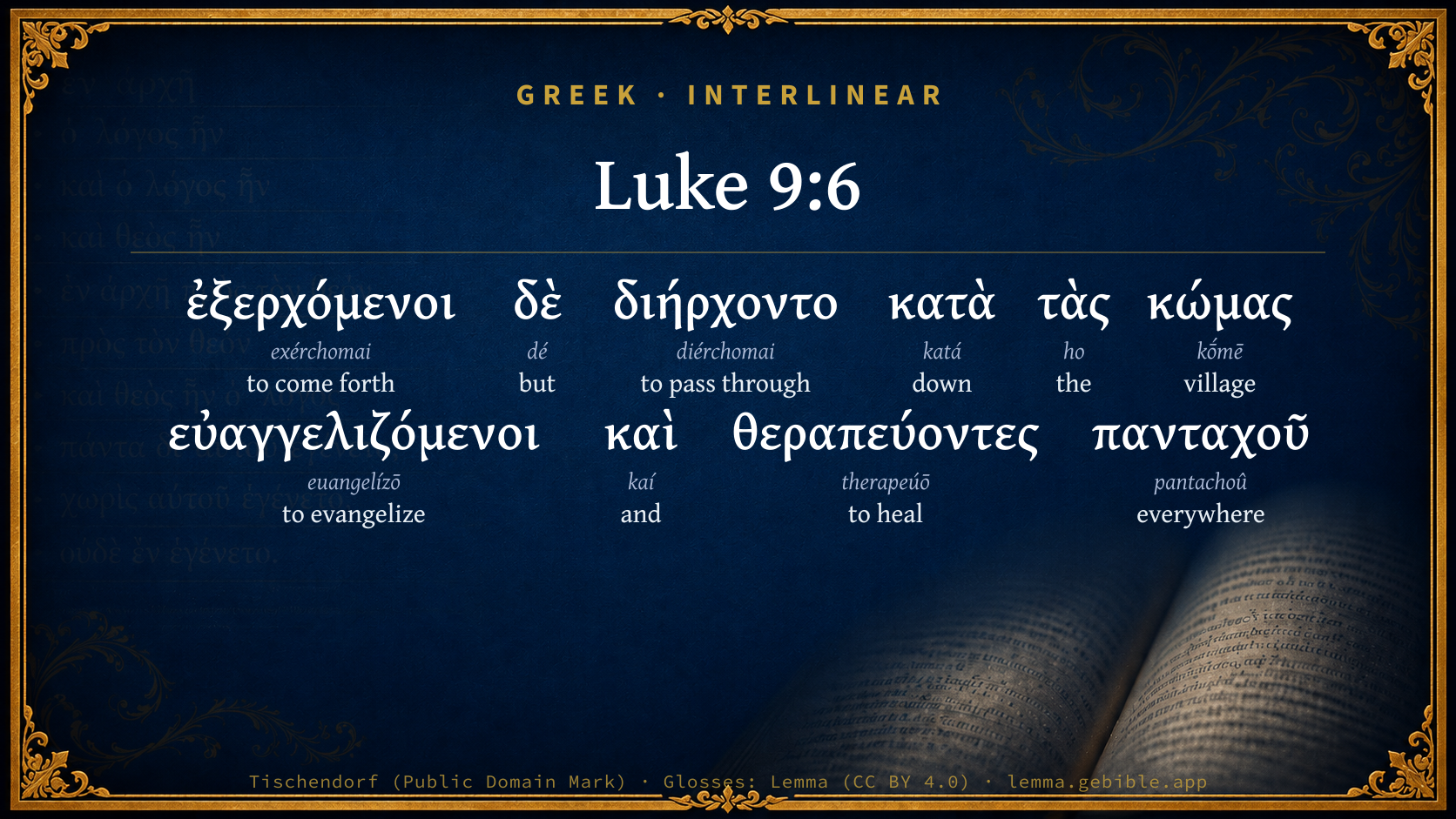
Greek (Tischendorf 8th ed.) Luke 9:6 appears in the Greek New Testament. The text above is from the Tischendorf 8th edition. Each word links to its Strong’s number and a concise gloss. Click any word for its full Thayer’s Greek Lexicon entry.
Download image
Cite this verse

Luke 9:6 (World English Bible). Public Domain. Lemma interlinear Bible study tool, https://lemma.gebible.app/v/luke/9/6.

Show BibTeX & RIS
BibTeX
RIS
English Translation
They departed, and went throughout the villages, preaching the Gospel, and healing everywhere.
World English Bible · Public Domain
Download a study sheet

One document with this verse’s original text, its word-by-word gloss line, the meaning frame, cross-references with their text, attributed commentary, and full source and license credits — printable, and it pastes into notes with its structure intact.

This verse Autodidact and up

Study sheet (.html) Plain text (.txt)

A passage Seminary Student

Up to 50 verses in one chapter. A passage sheet keeps up to 6 commentary sources and 12 cross-references per verse, in the order this page ranks them, and says so on the sheet whenever that leaves anything out. Ask for a single verse and you get the Autodidact verse sheet above.

Everything on this page stays free to read, with no account — the sheet is a download of what is already on screen, not access to it.

Want to remove ads? Support Godless Engineer
Compare translations 3

The same verse in 3 English versions, stacked beneath the original-language interlinear above. Click any original word for its lexicon entry.

Each is an independent rendering of the whole verse — the interlinear is not word-aligned to these translations.

Highlighted words mark where these versions differ — a whole-verse word diff, not a word-by-word alignment.

  • World English Bible Public Domain
    They departed, and went throughout the villages, preaching the Gospel, and healing everywhere.
  • King James Version Public Domain
    And they departed, and went through the towns, preaching the gospel, and healing every where.
  • unfoldingWord Literal Text CC BY-SA 4.0
    Then they went out were going through the villages, proclaiming the gospel and healing everywhere.

unfoldingWord Literal Text — © unfoldingWord, licensed CC BY-SA 4.0. Word-aligned USFM3 via Door43 (git.door43.org/unfoldingWord/en_ult).

Versions to compare (up to 4)

3 of 4 selected

Show all 19 translations

Every available English version of this verse, each an independent rendering of the whole verse.

  • World English Bible Public Domain
    They departed, and went throughout the villages, preaching the Gospel, and healing everywhere.
  • Berean Standard Bible Public Domain
    So they set out and went from village to village, preaching the gospel and healing people everywhere.
  • Majority Standard Bible Public Domain
    So they set out and went from village to village, preaching the gospel and healing people everywhere.
  • King James Version Public Domain
    And they departed, and went through the towns, preaching the gospel, and healing every where.
  • American Standard Version (1901) Public Domain
    And they departed, and went throughout the villages, preaching the gospel, and healing everywhere.
  • Revised Version (1885) Public Domain
    And they departed, and went throughout the villages, preaching the gospel, and healing everywhere.
  • Geneva Bible (1599) Public Domain
    And they went out, and went through euery towne preaching the Gospel, and healing euery where.
  • Douay-Rheims (1899) Public Domain
    And going out, they went about through the towns, preaching the gospel, and healing every where.
  • Young's Literal Translation Public Domain
    And going forth they were going through the several villages, proclaiming good news, and healing everywhere.
  • Literal Standard Version CC BY-SA 4.0
    And going forth they were going through the several villages, proclaiming good news, and healing everywhere.
  • Unlocked Literal Bible CC BY-SA 4.0
    Then they departed and went through the villages, proclaiming the good news and healing everywhere.
  • unfoldingWord Literal Text CC BY-SA 4.0
    Then they went out were going through the villages, proclaiming the gospel and healing everywhere.
  • Darby Bible Public Domain
    And going forth they passed through the villages, announcing the glad tidings and healing everywhere.
  • World Messianic Bible Public Domain
    They departed and went throughout the villages, proclaiming the Good News and healing everywhere.
  • Webster's Bible Public Domain
    And they departed, and went through the towns, preaching the gospel, and healing every where.
  • Free Bible Version CC BY-SA 4.0
    They left and went around the villages, announcing the good news and healing everywhere they went.
  • Bible in Basic English Public Domain
    And they went away, journeying through all the towns, preaching the good news and making people free from diseases in all places.
  • Text-Critical English NT CC BY 4.0
    So they set out and went throughout the villages, preaching the gospel and healing people everywhere.
  • Tyndale New Testament (1534) Public Domain
    And they went out and went thorow the tounes preachinge the gospell and healynge every wheare.

Literal Standard Version (2020), Covenant Press — licensed CC BY-SA 4.0. Text via the HelloAO Bible API (eBible.org). Unlocked Literal Bible (unfoldingWord) — licensed CC BY-SA 4.0. Text via the HelloAO Bible API (eBible.org). unfoldingWord Literal Text — © unfoldingWord, licensed CC BY-SA 4.0. Word-aligned USFM3 via Door43 (git.door43.org/unfoldingWord/en_ult). Free Bible Version, Dr. Jonathan Gallagher — licensed CC BY-SA 4.0. Text via the HelloAO Bible API (eBible.org).

Word by word

More ways to search: Search by grammar → Find every occurrence → Compare this word →

Practice this passage: Drill this verse → Learn its vocabulary →

About this verse

These counts appear in no published source. They are computed here, from the morphology-tagged text and Lemma’s own curated glosses. What Lemma adds →

10
words
10
distinct lemmas
Gospels
section

Notable vocabulary

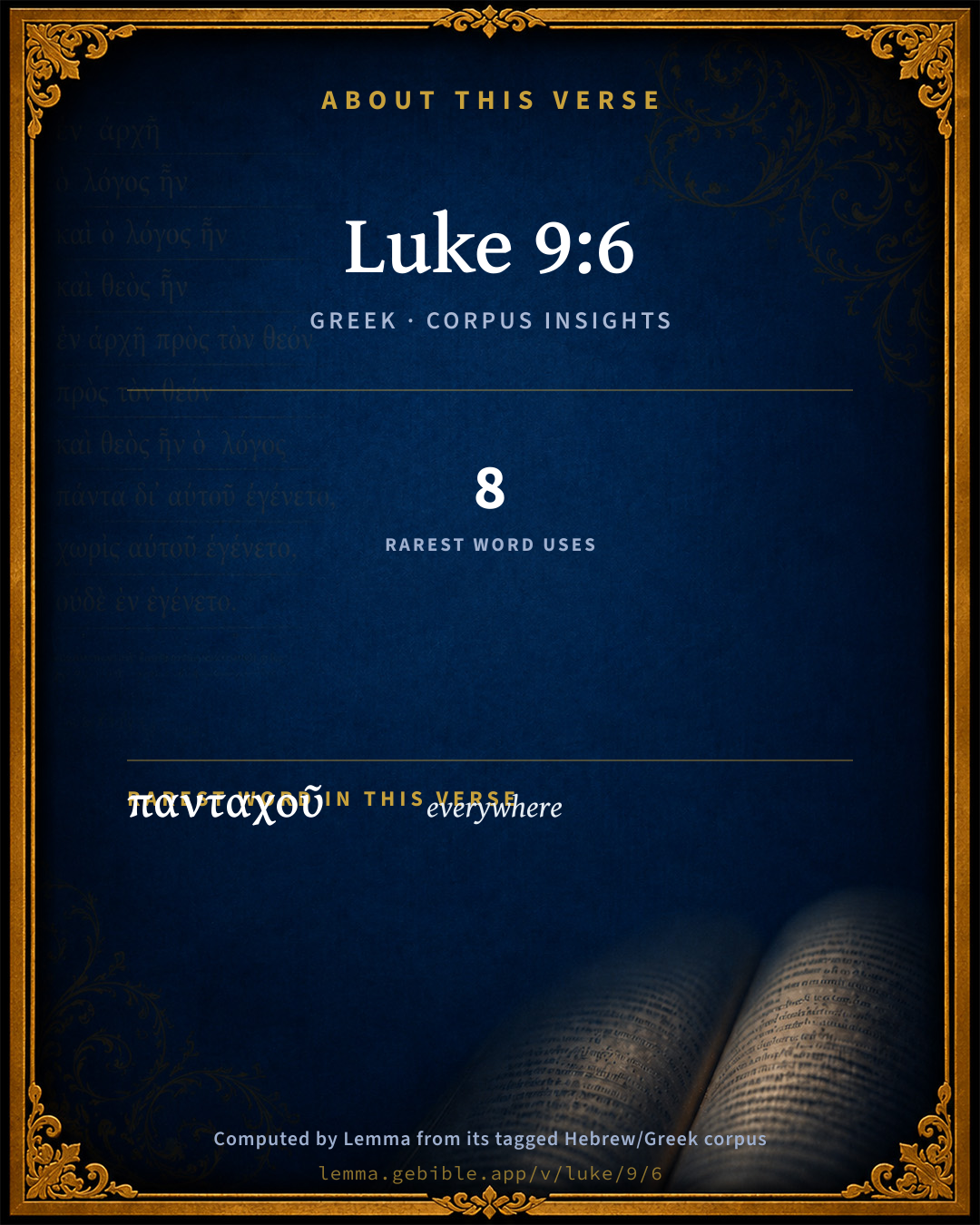
The rarest word here is πανταχοῦ everywhere G3837 — appearing just 8 times in the whole Greek New Testament.

Shared distinctive vocabulary

πανταχοῦ everywhere G3837 occurs in 8 verses of the Greek New Testament. Also found in:

Cross-references

5

Topical passages linked to Luke 9:6 in the Treasury of Scripture Knowledge — connected by theme and wording, ordered by reader-vote popularity; previews shown in the World English Bible.

  • Mark 6:12–13 They went out and preached that people should repent.
  • Mark 16:20 They went out, and preached everywhere, the Lord working with them, and confirming the word by the signs that followed. Amen.
  • Acts 4:30 while you stretch out your hand to heal; and that signs and wonders may be done through the name of your holy Servant Jesus."
  • Acts 5:15 They even carried out the sick into the streets, and laid them on cots and mattresses, so that as Peter came by, at the least his shadow might overshadow some of them.
  • Luke 9:1–2 He called the twelve together, and gave them power and authority over all demons, and to cure diseases.

Cross-references courtesy of OpenBible.info (CC BY 4.0).

Commentary

Notes on Luke 9:6 from classic Christian and Jewish commentators (each source and its license shown beneath its notes). The classic Christian expositions comment on the surrounding passage and are grouped to its opening verse, so a note may address several verses; the Jewish commentaries on the Tanakh (Rashi and others) are per-verse, so they appear only where the commentator wrote on this verse.

Lemma curates 59 commentaries, every one of them public domain or Creative Commons licensed, each selected and text-cleaned for this edition rather than reprinted as found. About our sources →

Whedon's Commentary on the Bible

Daniel D. Whedon

§ 59.—THE TWELVE PREACH AND WORK MIRACLES, Luk_9:6. Mar_6:12-13.

See closing paragraph of note on Mat_10:42.

Daniel D. Whedon (gen. ed.), Commentary on the Old and New Testaments (1874–1909) — public domain. Text from a community e-Sword module.

Godbey's Commentary on the New Testament

William B. Godbey

CHAPTER 31

THE MINISTRY OF THE TWELVE

Mar 6:12-13. “And having gone out, they continued to preach that they must repent; they continued to cast out many demons; they continued to anoint many sick people with oil, and heal them.” Luk 9:6 : “And going forth, they continued to go throughout the villages, everywhere preaching the gospel and healing” (the sick). This is all we have on record appertaining to the ministry of the Twelve, while separate from Jesus, pursuant to the above commission; and this, you observe, is given by Mark and Luke, who were not apostles at that time. We hear nothing of Mark till Paul’s first evangelistic tour, about nine years subsequently to this transaction, when he went out as a helper of Paul and Barnabas, doubtless quite young and inexperienced, as his heart failed him in Pamphylia, so that, much to the disgust of Paul and doubtless the grief of his uncle Barnabas, he left the work and returned to Jerusalem; Barnabas, loath to give up his nephew, endeavoring to restore him to the evangelistic work and take him out on their second tour; but Paul positively refusing, they separated, thus organizing two evangelistic forces, Barnabas taking Mark, and Paul taking Silas, Luke, and Timothy. If Mark was present at the time of this commission, he was quite a youth, not coming into history till about nine years later. As Luke was a citizen of Antioch, when we first hear of him as a convert under the ministry of Paul and Barnabas, about ten years subsequently, it is hardly probable that he was present; yet he might have been, as the Jews were coming from all Gentile countries, magnetized by the preaching and miracles of Jesus. Why do not Matthew and John give us an account of this ministry? In their histories they are simply writing up the life and ministry of Jesus. They were both members of the apostleship at that time, and went out under this commission to preach the gospel to the Jews. From the chronological data we can pick up, the presumption is that they were gone about three months. Six parties of them, moving with great expedition over a region of country about the size of New England, would make great progress in a dozen weeks.

Here is a vacuum in the history of our Lord’s life and ministry. Matthew and John were absent; Luke and Mark had not yet become disciples, so far as our knowledge extends; the latter yet in his home in Jerusalem, and the former, off in Antioch, studying medicine. Luke, about A.D. 42, became the evangelistic helper and amanuensis of Paul, writing for him to the end of his life. Though the Gospel of Luke was dictated by Paul, we must remember that he never came to Palestine during the ministry of Jesus; having been educated at Jerusalem, but returned to Tarsus before the ministry of John the Baptist. It is believed that Mark wrote his Gospel at Rome, about thirty years after the ascension of our Lord, as dictated by Peter, who speaks of him very kindly, calling him his son. (1Pe 5:13.) We find from the above Scriptures that the Twelve, during their absence from Jesus, were true and faithful, giving the trumpet no uncertain sound, but laying a constant, burning emphasis on repentance, which is fundamental in the gracious economy, not only laying the bottom rock of the experimental edifice, but gilding the topmost pinnacle; as metanoia, “repentance,” is from meta, “change,” and nous, “the mind.” Hence it means a change of minds; i.e., get rid of the carnal mind, and receive the whole mind of Christ, which really comprehends the entire plan of salvation. The trouble with dead Churches is the absence of evangelical repentance. We find these Twelve were constantly casting out demons — i.e., getting people converted — and healing the sick, not forgetting the anointing with olive-oil, which everywhere abounds in that country, and is a constant symbol of the Holy Ghost.

Mat 14:1-12; Mar 6:14-29; and Luk 9:7-9

MARTYRDOM OF JOHN THE BAPTIST

Mat 14:1-12; Mar 6:14-29; and Luk 9:7-9. While the biography of Jesus is intimated by these inspired historians during the period of their absence, we find three of them favoring us with the record of the melancholy and apparently premature death of John the Baptist. As the Jews had poured out in multitudes, and hung spell-bound upon his eloquent lips, the six months of his brilliant and wonderful ministry, his name was everywhere a household word. Hence his cruel and untimely martyrdom fell on the nation with the shock of an earthquake. Mark:

“And King Herod said, John the Baptist is risen from the dead, and therefore mighty works are wrought through him. Others said, That he is Elijah. And others said, That he is one of the prophets. But Herod, hearing, said, This is John, whom I beheaded; he is risen from the dead. It being a high day when Herod, on his birthday, made a feast for his magnates, chiliarchs, and the first men of Galilee, and the daughter of Herodias having come in, and danced and pleased Herod, and those sitting along with him at the table, the king said to the damsel, Ask of me whatsoever you may wish, and I will give it to you. And he swore unto her, Whatsoever you may ask me, I will give you, even unto the half of my kingdom. And she, having gone out, said to her mother, What shall I ask? And she said, The head of John the Baptist. And having come in unto the king with haste, unhesitatingly she asked him, saying, I wish that you may give me here the head of John the Baptist in a charger. The king being much grieved, on account of his oaths and those who were sitting at the table with him, did not receive his consent to reject her. The king immediately sending forth an executioner, commanded that his head should be brought. He having departed, beheaded him in prison; and he brought his head in a charger, and gave it to the damsel; and the damsel gave it to her mother. His disciples, hearing, came and took his body and buried it in a tomb.”

a. This was Herod Antipas, the son of Herod the Great, the last king of the Jews, who was on the throne when our Savior was born, and died at Jericho while He was in Egypt, a fugitive from the infantile slaughter at Bethlehem. He had married the daughter of Aretas, king of Arabia, whom he discarded in order to take Herodias, his niece, the wife of his half- brother Philip (not Philip the tetrarch, of Iturea and Trachonitis — Luk 3:1), having employed a bondman in the home of his brother to seduce her away from her husband, and get her thus unlawfully to become his wife. His enraged father-in-law eventually invaded his country with an army, to avenge the maltreatment of his daughter. I saw the battle-field, off the southeast coast of the Galilean Sea, where Aretas met Herod, and signally defeated him, thus beginning his fatal downfall, which culminated in his ruin, the Roman emperor not only dethroning him, taking his kingdom from him and giving it to Herod Agrippa, but actually banishing him and Herodias to Lugdunum (Lyons), in the wilds of Gaul, and afterward exiling them in Spain, where they died in dreary solitude and misery, their temporal misfortunes the ominous prelude of the awful fate awaiting them.

b. We have in John the Baptist a beautiful and brilliant example of that stern and uncompromising ministerial fidelity which alone will qualify the Lord’s heralds for the judgment fires. John knew no fear. Bold as an archangel, he looked the king and queen in the face, and publicly exposed their sins, making the queen so awfully mad, as it was wholesale murder to her pride, that she would have slain him quickly through a hired assassin, if her husband had not defeated her purposes by shutting him up in prison. The implacable woman never relented, but studied every conceivable device to take his life. Eighteen months have whiled away since this greatest of prophets has become the inmate of a gloomy, subterranean dungeon in the Tower of Machierus, east of the Dead Sea, in the Land of Moab. During all this time, Herod frequently heard him preach, being powerfully wrought upon and deeply convicted, so that he actually obeyed the preacher in many respects. “For Herod feared John, knowing him to be a righteous and holy man; and he continued to hold him in prison, and hearing him, he continued to do many things, and hear him delightfully.” (Mar 6:20.) Herod was a member of the Jewish Church, loved to go to meeting, and as John was the best preacher he had ever heard, was delighted with him, making great reformation under his ministry, still retaining him in prison, to keep his enraged wife from killing him. Little did he anticipate his awful, impending fate. Now conceive the situation.

c. Pursuant to the custom of Oriental monarchs, he makes a great feast, to which he invites his official subordinates, and the rich and mighty men from all parts of his kingdom, to participate his bounty and contemplate his royal magnificence. In the midst of the festivities and jollifications, while all are merry with wine, pretty, little Salome comes in, and dances a pantomime for their edification, her wonderful agility literally capturing the princely audience thronging the royal palace. Amid a thousand compliments by the magnates, the king, now drunk enough to act the fool, obligates himself, by a solemn oath, in the presence of the royalty and nobility, to grant her petition, even though she ask the queenship of half his dominions a custom from time immemorial peculiar to Oriental monarchs.

d. The little girl darts away, and counsels her mother, whose constant study the last two years has been the destruction of that impudent preacher, who had the atidacity, in his public preaching, to assault her character and ruin her reputation. O how she seizes the auspicious moment, and sends the girl back, with the bloody petition dropping in livid horror from her lips, “Give me here in this charger the head of John the Baptist!”

e. The king expected her to ask some great present, perhaps a kingdom, that she might rule over it when she arrived at womanhood. Her demand strikes him like a thunderbolt from a cloudless sky. He is flooded with grief, and would give a world to rescind the whole matter. But what can he do? If he goes back on his oath, he will so unman himself in the estimation of the royalty and the nobility that they will rebel against him on the spot, take the crown from his head, and either take his head off, or banish him from his kingdom. Satan helps him. He rallies his courage; dispatches the bloody executioner at once to the prison, with the charger sent in by blood-thirsty Herodias to receive the gory head of the greatest prophet the world has seen. f. The sad fate of King Herod should be a profitable warning to all the people who have not settled the problem of personal salvation by entire sanctification; lest, like poor Herod, in an evil hour, the enemy slip in like a weasel and suck away your life-blood, blighting your hope, and sealing your doom in the gloom of rayless night.

g. In the present age of conjugal infidelity, illegal marriages, and all sorts of domestic entanglements, withering and blighting the beautiful flowers wont to bloom amid the gardens of holy wedlock, and disseminating social pestilence, like the withering sirocco that sweeps its pestilential gales over Lybia’s burning sands, thus turning home into a pandemonium, O how we need the lightning, steel, fire, thunder, and earthquake type of preaching which characterized the fearless prophet of the wilderness, when he publicly scandalized the king and queen in their own presence, heroically preaching the truth, though it cost him imprisonment and martyrdom!

h. Should not that great preacher have been more cautious, and thus perpetuated his liberties, and prolonged his life many years to preach the gospel? I trow not. God makes no mistakes. Though John’s active ministry in the open air lasted but about six months, till overtaken by the dark eclipse of imprisonment and death, doubtless he did more good than if he had preached a compromised gospel six hundred years.

William B. Godbey, Commentary on the New Testament (1896–1900) — public domain. Text from a community e-Sword module.

Bengel's Gnomon

Johann Albrecht Bengel

Luk 9:6. Κώμας, the villages [towns]) The cities are not excluded, but much rather are taken for granted: Luk 9:5.

Bengel's Gnomon of the New Testament — English translation (T&T Clark, Edinburgh, 1860) — public domain. Text from a community e-Sword module.

Expositor's Greek Testament

ed. W. Robertson Nicoll

Luk 9:6 . Brief statement, as in Mk., as to the execution of the mission, but wanting his reference to the use of oil in healing.

Hahn states that this mission was purely pedagogic, for the benefit of the Twelve, not of the people. This is a mere unfounded assertion. The training of the Twelve by no means appears a prominent aim of Jesus in the pages of Lk.; much less so than in Mt. and Mk.

The Expositor's Greek Testament, edited by W. Robertson Nicoll (1897–1910) — public domain. Text from a community e-Sword module.

Godet's Commentaries

Frédéric Louis Godet

3 d. Luk 9:6. The Result.—Διά, in διήρχοντο (they went through), has for its complement the country in general, and denotes the extent of their mission. Κατά, which is distributive, expresses the accomplishment of it in detail: “staying in every little town.”

Only Mark makes mention here of the use of oil in healing the sick,—a remarkable circumstance, with which the precept, Jas 5:14, is probably connected. In Matthew, the discourse absorbs the attention of the historian to such a degree, that he does not say a word, at the end of chap. 10, about the execution of their mission.

This short address, giving the Twelve their instructions, is only the preamble in Matthew (chap. 10) to a much more extended discourse, in which Jesus addresses the apostles respecting their future ministry in general. Under the influence of his fixed idea, Baur maintains that Luke purposely abridged the discourse in Matthew, in order to diminish the importance of the mission of the Twelve, and bring out in bolder relief that of the seventy disciples (Luke 10) “We see,” he says, “that every word here, so to speak, is too much for the evangelist” (Evangel. p. 435). But, 1. If Luke had been animated by the jealous feeling which this criticism imputes to him, and so had allowed himself to tamper with the history, would he have put the election of the Twelve (chap. 6), as distinct from their first mission, into such prominence, when Matthew appears to confound these two events (Luk 10:1-4)? Would he mention so expressly the success of their mission, as he does, Luk 9:6, while Matthew himself preserves complete silence upon this point? It is fortunate for Luke that their respective parts were not changed, as they might have been, and very innocently, so far as he is concerned. He would have had to pay smartly for his omission in the hands of such critics! 2. Mark (Mar 6:8-10) gives this discourse in exactly the same form as Luke, and not at all after Matthew’s manner; he, however, is not suspected of any antipathy to the Twelve. It follows from this, that Mark and Luke have simply given the discourse as they found it, either in a common document (the primitive Mark, according to Holtzmann), or in documents of a very similar character, to which they had access. There is sufficient proof, from a comparison of Luk 9:6 in Luke with Luk 9:13 in Mark, that of these two suppositions the latter must be preferred. 3. We may add, lastly, that in the discourse on the apostolate (Matthew 10) it is easy to recognise the same characteristics already observed in the Sermon on the Mount. It is a composition of a didactic nature on a definite subject, in which fragments of very different discourses, speaking chronologically, are collected into a single discourse. “The instructions it contains,” Holtzmann rightly observes (p. 183), “go far beyond the actual situation, and imply a much more advanced state of things....” Bleek, Ewald, and Hilgenfeld also recognise the more evident indications of anticipation. We find the true place for the greater part of the passages grouped together in Matthew, under the heading, general instructions on the apostolate, in Luke 12, 21.

For all these reasons, we regard the accusation brought against Luke respecting this discourse as scientifically untenable.

Frédéric Louis Godet — Commentaries on Luke, John, Romans, and 1 Corinthians — English translation (T&T Clark, Edinburgh, 1870s–1890s) — public domain. Text from a community e-Sword module.

Ellicott's Commentary for English Readers

(6) Went through the towns.—Better, villages, as more consistent with the rendering of the word in Mat_14:15.

A Bible Commentary for English Readers, edited by Charles John Ellicott (1878–1897) — public domain. Text from a community e-Sword module.

The Cambridge Bible for Schools and Colleges

gen. ed. J. J. S. Perowne

6. preaching the gospel] The word here used is “evangelizing,” in Luk_9:2 it is “to herald.”

healing] In the other Evangelists exorcisms are prominent. Mar_6:13. The special object of the mission of the Twelve is plain from St Matthew. Our Lord had now been preaching for nearly a year in Galilee, and multitudes still thronged to Him. He knew that He would soon be compelled to retire, and He sent the Twelve to give one last opportunity to those who had heard Him.

The Cambridge Bible for Schools and Colleges (gen. ed. J. J. S. Perowne; Cambridge University Press, 1878–1918) — public domain. Text from a community e-Sword module.

John Gill's Exposition

And they departed,.... That is, the apostles, as the Syriac and Persic versions express it: they went from Christ, and the place where he was, from Capernaum, at least from some place in Galilee:

and went through the towns; the Syriac, Persic, and Ethiopic versions add, "and cities"; that is, of Judea, as well as Galilee, even the whole land of Israel:

preaching the Gospel; which explains what is meant by the kingdom of God, Luk 9:2 and healing everywhere; all sorts of bodily diseases, wherever they came.

John Gill's Exposition of the Whole Bible (1746–1763) — public domain (CC PDM 1.0). Text via the HelloAO Bible API.

Trapp's Complete Commentary

John Trapp

6 And they departed, and went through the towns, preaching the gospel, and healing every where.

Ver. 6. And healing everywhere] Those miracles of healing ascribed to Vespasian by heathen historians (Dio et alii), but falsely, do belong properly and alone to Christ’s disciples.

John Trapp, A Commentary or Exposition upon All the Books of the Old and New Testament (1647–1656) — public domain. Text from a community e-Sword module.

Cambridge Greek Testament for Schools and Colleges

6. διήρχοντο κατά. ‘They went in all directions, from village to village.’ The κατὰ is (like ἀνά) distributive.

εὐαγγελιζόμενοι. In Luk 9:2 we have κηρύσσειν, ‘to herald.’

θεραπεύοντες. In the other Evangelists exorcisms are prominent. Mar 6:13. The special object of the mission of the Twelve is plain from St Matthew. Our Lord had now been preaching for nearly a year in Galilee, and multitudes still thronged to Him. He knew that He would soon be compelled to retire, and He sent the Twelve to give one last opportunity to those who had heard Him.

Cambridge Greek Testament for Schools and Colleges (Cambridge University Press, 1896; 21 vols, various authors incl. Carr, Maclear, Plummer, Farrar, Lumby, Moule, M. R. James, Simcox) — public domain. Text from a community e-Sword module.

International Critical Commentary

6. εὐαγγελιζόμενοι καὶ θεραπεύοντες. Comp, ver. 2. Union of care for men’s bodies with care for their souls is characteristic of Christ and of Christian missions. The miraculous cures of the apostolic age have given place to the propagation of medical and sanitary knowledge, which is pursued most earnestly under Christian influences. For διήρχοντο see on 2:15, and for εὐαγγελιζόμενοι see on 2:10. Excepting Mar 1:28, Mar 1:16:20, 1Co 4:17 πανταχοῦ occurs only here and three or four times in Acts: here it goes with both participles.

International Critical Commentary — older volumes (1896–1929), various authors — public domain. Text from a community e-Sword module.

Vincent's Word Studies in the New Testament

Marvin R. Vincent

Throughout the towns [κατα τας κωμας] . Rev., rightly, villages. The preposition is distributive, village by village.

7 - 9. Compare Mt 14:1 - 2; 6 - 12. Mr 6:14 - 16, 21 - 29.

Marvin R. Vincent, Word Studies in the New Testament (1887–1900) — public domain. Text from a community e-Sword/MySword module.

Lesson kit

Teaching starters — assembled from the data on this page, not authored interpretation. Every prompt links to the verse data it draws on. Edit before teaching.

Luke, in the Gospels, opens this verse with 10 words (10 distinct Greek lemmas). Its most distinctive word is pantachoû (“everywhere”). A historical commentator’s framing appears above. Read the whole chapter for the surrounding context.

Discussion questions

  1. The word pantachoû carries the sense “everywhere.” How does it shape the verse?
  2. Mark 1:28 shares the word «everywhere» with this verse. How do the two illuminate each other?
  3. These translations render this verse differently. What is at stake in choosing one wording over another?
  4. Reading how Whedon's Commentary on the Bible and Godbey's Commentary on the New Testament read this verse, where do the two commentators agree and where do they part?

Things to notice

Reading settings

Reading text

Shown beneath each verse's original-language words.

Old Testament
Old Testament edition

Read the OT as the Masoretic Hebrew (MT) or the Greek Septuagint (LXX).

English shown for the Greek Septuagint (in the Hebrew ↔ Greek comparison).

Comparing translations? Open the Compare panel on any verse page to stack up to four side by side.