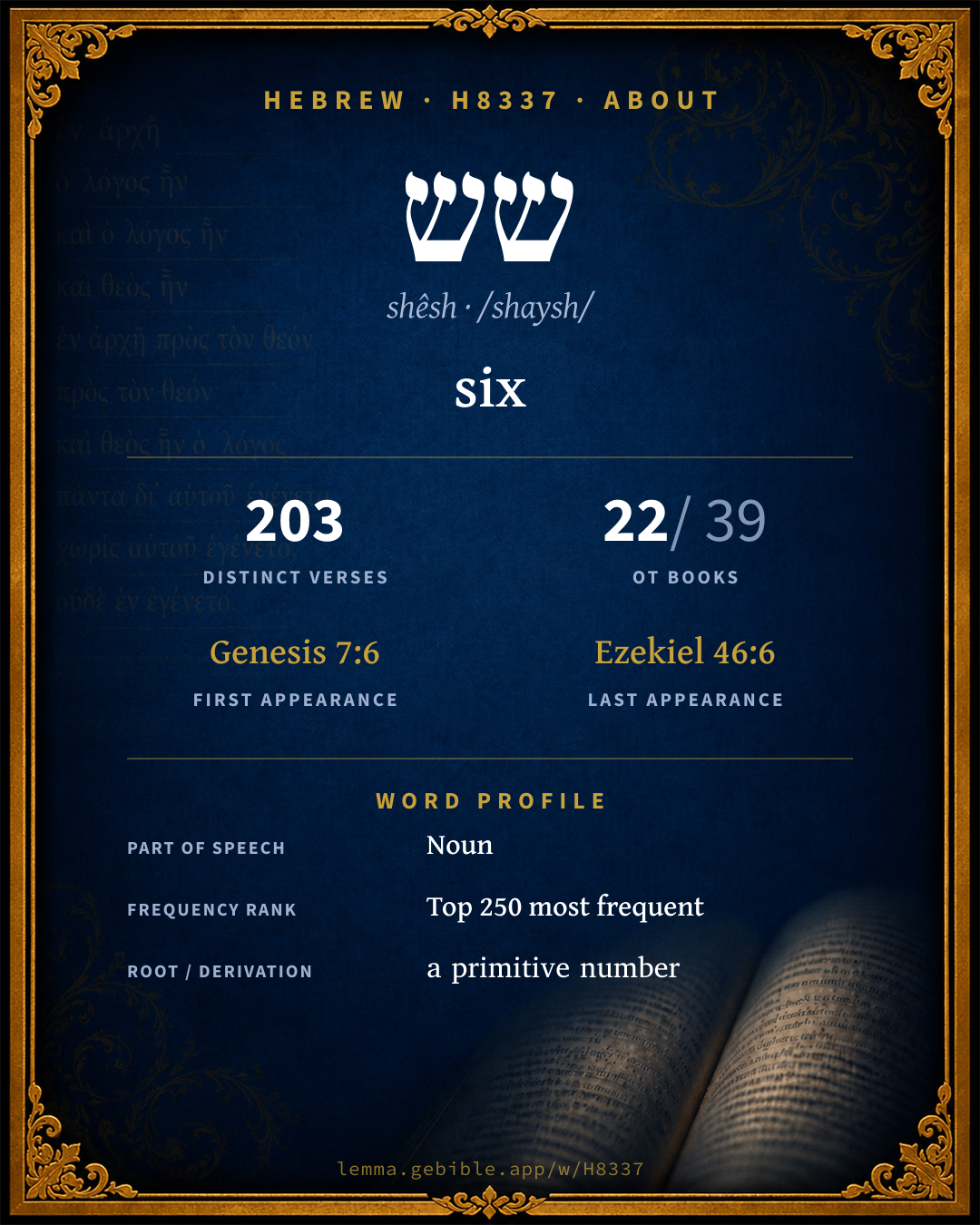
שֵׁשׁ
six
‘six’ is one of 4 main senses fuller range ↓
Full lexicon entry — Brown-Driver-Briggs (BDB)
From Brown-Driver-Briggs (BDB)
Where this word appears
Grammar key — what these labels mean
Part of speech
- Adjective
- A word that describes or qualifies a noun.
State
- Absolute
- The independent form of a noun, not bound to a following word.
- Construct
- A noun bound to a following noun in a possessive / “of” relationship (the construct chain).
Gender
- Feminine
- Grammatically feminine.
- Masculine
- Grammatically masculine.
Number
- Singular
- One.
Every verse where H8337 appears in the Book of Jeremiah — 3 distinct verses. Click any verse to open its interlinear word-by-word view. Verse text shown in the World English Bible for context — . Each verse’s Hebrew form is shown with its reference; the English is not keyword-highlighted, since the data carries no word-level English alignment. Use “Compare translations” on any verse to read it across multiple English versions. This concordance covers the Hebrew Bible; Septuagint (Greek Old Testament) occurrences are not indexed here.
Jeremiah
- Jeremiah 34:14 שֵׁ֣שׁ adj Cardinal number fs At the end of seven years you shall let go every man his brother who is a Hebrew, who has been sold to you, and has served you six years, you shall let him go free from you: but your fathers didn't listen to me, neither inclined their ear.
- Jeremiah 52:23 וְ/שִׁשָּׁ֖ה conj + Adjective Cardinal number ms There were ninety-six pomegranates on the sides; all the pomegranates were one hundred on the network round about.
- Jeremiah 52:30 וְ/שֵׁ֥שׁ conj + Adjective Cardinal number fs in the three and twentieth year of Nebuchadrezzar Nebuzaradan the captain of the guard carried away captive of the Jews seven hundred forty-five persons: all the persons were four thousand and six hundred.
About this entry
At a glance — auto-summarized from this page’s data, not written by a person. Every figure links to its source below. This summary describes the numbers; it doesn’t interpret them.
שש (shêsh) is a Hebrew noun most often rendered “six.” Not a single-sense word: explore its full sense range. It turns up in 203 verses across 22 books, a common footprint. Scripture first uses it in Genesis 7:6. It clusters with ששה, ששי and ששים under a shared root. For the data behind this summary, explore the sense tree and the renderings breakdown below.
Gloss history
Strong's 1890 vs modern scholarship
About this word
Strong's H8337 catalogs a Hebrew word from the Hebrew Old Testament.
These counts are not copied from any lexicon or concordance. They are computed here, from the morphology-tagged Hebrew Old Testament. What Lemma adds →
- 203
- distinct verses
- The word appears in 203 distinct verses.
- 22 / 39
- OT books
- The word appears in 22 of 39 Old Testament books.
- #220
- by frequency
- Top 250 most frequent Hebrew words (rank 220 of 8,640 Hebrew words by occurrence).
View all 203 occurrences in the concordance →
Most concentrated in
- Numbers 28 verses 14%
- Exodus 27 verses 13%
- 1 Chronicles 21 verses 10%
By section of the Old Testament
By traditional corpus
Conventional, traditional groupings — biblical authorship is debated, so this is a traditional corpus grouping, not an authorship claim. Each share is this word’s portion of its verses in that division of the Hebrew canon. Each figure is a share of the word’s 203 distinct verses.
- Writings (Ketuvim) 72 verses · 35%
- Torah (Pentateuch) 71 verses · 35%
- Prophets (Nevi'im) 60 verses · 30%
How translations render this word
Counts come from each version’s own published word-to-Strong’s tagging or interlinear alignment — an approximate guide to how each version renders this word, not a word-level alignment the data otherwise carries. Because each total is that version’s own tagged count, the per-version totals vary from one another and need not match the appearance or distinct-verse counts above. These counts may also differ from a printed concordance because Lemma counts each distinctly tagged rendering and does not collapse phrase taggings into a single head-word total. This is a fixed set of word-tagged versions (KJV, ASV, BSB, ULT) and does not change with the reading translation you choose elsewhere. Each version’s license is shown beside its name below (and on Sources).
BDB lists this Strong’s number as 4 distinct words (homographs). Each count above pools all of them and is not split by sense — see the Senses section below. A low-frequency rendering may belong to a different one of those words, not the primary meaning.
- King James Version†: Six 140×, Sixteen 12×, Were six 8×
- American Standard Version†: Six 134×, Sixteen 13×, Were six 9×
- Berean Standard Bible†: Six 91×, Sixteen 15×, And 5×
- unfoldingWord Literal Text†: Six 78×, Were 26×, And 12×
King James Version Public Domain
Renders H8337 across 213† tagged occurrences — most commonly:
Plus other, less common renderings. Plus 18 renderings that appear only once — usually multi-word phrases or single function words the recovered tagging swept in, not distinct renderings. Not rendered by a distinct English word in 2 further occurrences.
American Standard Version Public Domain
Renders H8337 across 213† tagged occurrences — most commonly:
Plus 31 renderings that appear only once — usually multi-word phrases or single function words the recovered tagging swept in, not distinct renderings.
Berean Standard Bible Public Domain
Renders H8337 across 145† tagged occurrences — most commonly:
Plus 20 renderings that appear only once — usually multi-word phrases or single function words the recovered tagging swept in, not distinct renderings. Not rendered by a distinct English word in 70 further occurrences.
unfoldingWord Literal Text CC BY-SA 4.0
Renders H8337 across 161† tagged occurrences — most commonly:
Plus other, less common renderings. Plus 11 renderings that appear only once — usually multi-word phrases or single function words the recovered tagging swept in, not distinct renderings. Not rendered by a distinct English word in 57 further occurrences.
7 senses and sub-senses in the full BDB
What do BDB’s symbols mean?
BDB uses these scholarly abbreviations:
| Symbol | Meaning |
|---|---|
| 𝔊 | the Septuagint (the ancient Greek translation, LXX) |
| 𝔙 | the Vulgate (the Latin translation) |
| 𝔖 | the Syriac version (the Peshitta) |
| 𝔗 | the Targum (the Aramaic translation) |
| ψ | the Psalms |
| √ | root (the underlying root or stem) |
| ‖ | parallel passage (a synonymous or contrasted parallel) |
| † | the dagger: every passage where the word occurs is cited |
The 7 senses and sub-senses the full Brown-Driver-Briggs lexicon distinguishes for this word, in lexicon order (not ranked by frequency), with BDB’s own verbatim wording and sub-sense lettering. Shown in Hebrew script with BDB’s own scholarly abbreviations. The condensed entry is in the Lexicon Entry tab. See also the Forms in the corpus table below.
שש I f.six
- 1. no other num.:
- a. bef. n.pl. 75 times: e.g. שֵׁשׁ שָׁנִים Ex 21:2 (E) + 11 times, שֵׁשׁ אַמּוֹת 1 S 17:4 + 8 times; שֵׁשׁ בָּאַמָּה †1 K 6:6; שִׁשָּׁה בָּנִים Gn 30:20 (E) + 2 times; שֵׁשֶׁת יָמִים Ex 23:12 (E) + 14 times; after n. (late) †Ex 28:2 Jos 15:59, 62 (all P), 1 Ch 4:27; 26:17; Ne 5:18; rarely n. om. Lv 24:6 (P) + (distrib. 2 S 21:20 = 1 Ch 20:6). e.g. Exodus 21:2
- b. = ordin. שְׁנַת שֵׁשׁ לְחִזְק׳ 2 K 18:10 (Ges§ 134 o). e.g. 2 Kings 18:10
- 2. 16, c. n.f.: שֵׁשׁ עֶשְׂרֵה, bef. נָ֑פֶשׁ Gn 46:18 (P), שָׁנָה 2 K 13:10 + 9 times, בָּנוֹת 2 Ch 13:21; after עָרִים Jos 15:41; 19:22 (P); c. n.m. שִׁשָׁה עָשָׂר, bef. אֲדָנִים Ex 26:25; 36:30 (P), also אֶלֶף, 1000, Nu 31:40 + (P); after בָּנִים 1 Ch 4:27, etc.; = ordin. 16th 1 Ch 24:14; 25:23 +, יוֹם שׁ׳ ע׳ 2 Ch 29:17. e.g. Genesis 46:18
- 3. 600 = שֵׁשׁ מֵאוֹת, Gn 7:6 (P) + 63 times; 6000 = שֵׁשֶׁת אֲלָפִים Nu 3:34 (P) + 8 times; שׁ׳ אֶלֶף Ju 20:15 + 2 times e.g. Genesis 7:6
- 4. c. tens, שׁ׳ foll. Gn 46:26 + 13 times, precedes Nu 31:44 (P). e.g. Genesis 46:26
- 5. שׁ׳ as round no., חָמֵשׁ אוֹ־שׁ׳ 2 K 13:19, cf. Jb 5:19 Pr 6:16. e.g. 2 Kings 13:19
שש II six, v. שׁדשׁ.
Senses from the full Brown-Driver-Briggs lexicon (Brown, Driver, Briggs; Oxford 1906 — public domain), digitized via Sefaria, supplemented by the OpenScriptures HebrewLexicon (CC BY 4.0). Full attribution on Sources.
Word origin
I. n.m. et f.six;—m. שֵׁשׁ (c. n.f.) Gn 31:41 + 120 times; f. שִׁשָּׁה (c. n.m.) 30:20 + 39 times; cstr. שֵׁ֫שֶׁת Ex 23:12 + 30 times (6 + 10 = 16 are additional);—six (Hex chiefly P):
II. n.m. id.;—עַמּוּדֵי שׁ׳ Ct 5:15 (in fig.), Est 1:6 a, material of pavement v 6 b (v. בַּ֫הַט).—I. שֵׁשׁ, v. שׁדשׁ.
V. n.m. Ex 26:1 byssus (loan-wd. prob. from Egyptian šen-suten Reinischap. DHM VOJ viii (1894), 7 Copt. šens, cf. Copt. šent, weave; v. MʿLeanEncy. Bib. linen; on spinning, weaving, and wearing of linen in Egypt ErmanAegypten 594 ff.; Eng. Trans. 448 f.);—always abs. שׁ׳ (שׁשׁי Ez 16:13 is error):—byssus, fine Egyptian linen (בּוּץ, q.v., is later synon.), i.e. the linen thread (spun by women Ex 35:25), and the material woven from it: used for garments Gn 41:42 (E), Ez 16:10, 13 (שׁשׁי, read שׁשׁ), Pr 31:22; for sail (in fig. of Tyre as ship) Ez 27:7 (brought from Egypt); elsewhere P, of priestly vestments Ex 28:5, 39(×2); 39:3, 27, 28(×2); also שׁ׳ מָשְׁזָר twisted linen 28:6, 8, 15; 39:2, 5, 8, 28, 29 + v 24 (read וְשֵׁשׁ מ׳ Sam. 𝔊 Bae); שׁ׳ of hangings, etc., in tabern. 25:4; 35:6, 23, 25, 35; 38:23, and so שׁ׳ מָשְׁזָר 26:1, 31, 36; 27:9, 16, 18; 36:8, 35, 37; 38:9, 16, 18.
— Brown-Driver-Briggs (Oxford 1906, public domain), digitized via Sefaria, supplemented by the OpenScriptures HebrewLexicon (CC BY 4.0). See Sources.
Origin: a primitive number
Jastrow Dictionary
A second Hebrew/Aramaic lexicon for comparison, covering Aramaic and post-biblical (Talmudic, Targumic, Midrashic) usage that the biblical-Hebrew BDB does not. Matched by lemma rather than by Strong’s number, so a lemma may carry more than one Jastrow headword (shown separately below), and the entries cover usage well beyond the Bible.
שֵׁשׁ I
- (b. h.) marble, v. שַׁיִשׁ.
שֵׁשׁ II
- (b. h.) white linen. Yoma 71ᵇ דברים שנאמר בהן שש … ששה וכ׳ those things concerning which shesh is used are woven of a sixfold thread, where moshzar is added, of an eightfold thread. Ib. מאי משמע דהאי שש כיתנא הוא what evidence is there that that shesh (Ex. XXXIX, 27) means flax? Y. Kil. IX, beg. 31ᵈ (ref. to Ex. XXXIX, 28; 29, a. Ez. XLIV, 18) את דרש שש משש שש מפארי ופארי מפארי you learn the meaning of shesh (in האבנט שש משזר) from shesh (in פארי מגבעות שש), and the meaning of this shesh from פארי (in ופארי פשתים Ez. l. c.), and the meaning of this paăré from paăré (in פארי מגבעות, Ex. l. c.). Midr. Prov. to ch. XXXI, 22 זו … שהיה מרוקם בשש וארגמן that is Bathsheba of whom came Solomon who was clad in embroidered garments of white linen and purple; Yalk. ib. 964. Cant. R. to IV, 12 (ref. to Ez. XVI, 10) תחת שש ועזים as a reward for the offering of white linen and goats’ hair (Ex. XXV, 4); a. e. e.g. Exodus 39:27
שֵׁשׁ
- six. Pes. V, 1 (58ᵃ) בששה ומחצה (Y. a. Bab. ed. בשש) at six hours and a half (from sunrise). Y. ib. IV, beg. 30ᶜ משש שעות ולמעלן after six hours (noon); משש שעות ולמען before noon. Yoma 21ᵇ שש אשות הן there are six kinds of fire. Pes. 49ᵇ ש׳ דברים נאמרו וכ׳ six things have been said concerning ignorant people; a. v. fr.—Constr. m. שֵׁשֶׁת. Snh. 97ᵃ; Ab. Zar. 9ᵃ; v. שָׁנָה II; a. fr.—Pl. שִׁשִּׁים sixty. B. Kam. 58ᵇ סאה בש׳ סאין the damage to a field of one S’ah is assessed by calculation from a field of sixty S’ahs (so as to arrive at a fair estimate). Ib. בש׳ taking as a basis for calculation sixty times the quantity under dispute; ib. 59ᵃ; a. e.—Ḥull. 97ᵇ בש׳ (sub. בטל) is neutralized in a quantity sixty times as large. Ex. R. s. 1 ש׳ בכרס אחד sixty at one birth. Y. Taan. IV, 68ᶜ top ש׳ רבוא sixty myriads. Succ. 51ᵇ; a. fr.
A Dictionary of the Targumim, the Talmud Babli and Yerushalmi, and the Midrashic Literature (Marcus Jastrow; London, Luzac, 1903) — Public Domain. Digitized via Sefaria. Digitized via Sefaria. Full attribution on Sources.
Forms in the corpus
The 54 distinct written forms H8337 takes in the Hebrew Bible, most frequent first — each parse links to that state’s occurrences in the concordance. Hebrew forms include their vowel points and cantillation, so a single lemma takes many written forms.
Same root — word family
Other BDB entries built from the same root as H8337, grouped by Strong’s listed origin. These share a root / origin per the lexicon — not necessarily a shared meaning. Each links to that word’s own entry.
Derived from this word
- ששה shâshâh H8341 to give sixth part
- ששי shishshîy H8345 sixth
- ששים shishshîym H8346 sixty
- שת shêth H8353 six
Compare all same-root words → Showing 4 of 5 — not the complete family. They share a root, not necessarily a meaning.
Septuagint verse parallels
This word appears in 191 verses that also exist in the Greek Old Testament (Septuagint), out of the 203 Hebrew verses it occurs in. You can read those verses in Greek by switching the Old Testament edition to the Septuagint.
Read these verses in the Septuagint
- Genesis 7:6
- Exodus 12:37
- Leviticus 12:5
- Numbers 1:21
- Deuteronomy 5:13
- Joshua 6:3
- Judges 3:31
- Ruth 3:15
- 1 Samuel 13:5
- 2 Samuel 2:11
- 1 Kings 6:6
- 2 Kings 5:5
This is a verse-level parallel only — the same verses exist in both the Hebrew and Greek Old Testaments. No word-level Hebrew↔Greek correspondence is claimed: the data carries no such alignment, so no Greek word is shown as this Hebrew word’s translation. Coverage is not total — the Septuagint omits the deuterocanon and renumbers the Psalms, so some Hebrew verses have no direct Greek parallel.