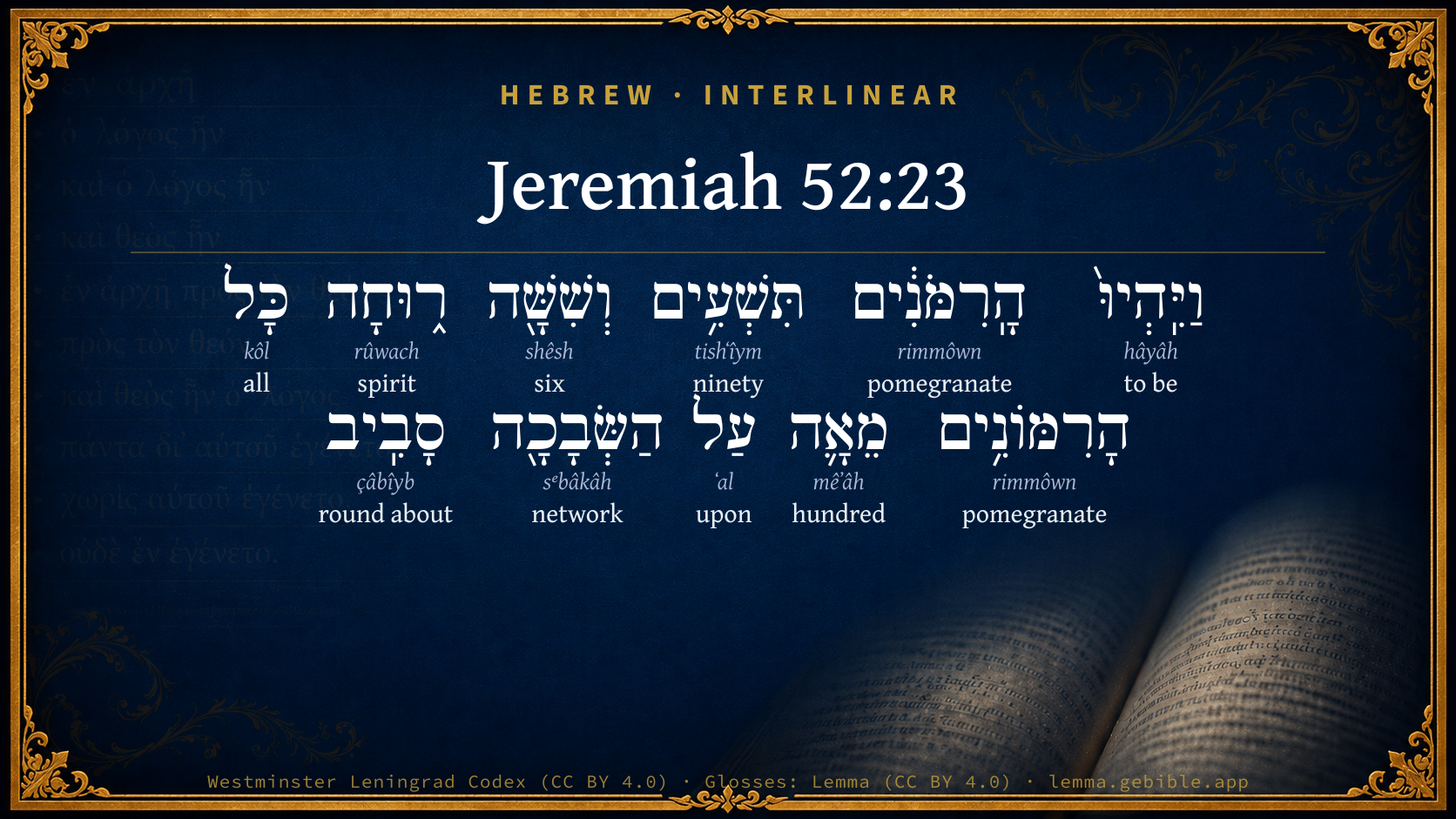
Jeremiah 52:23

Hebrew (Westminster Leningrad Codex) Jeremiah 52:23 appears in the Hebrew Old Testament. The text above is from the Westminster Leningrad Codex. Each word links to its Strong’s number, a concise gloss, and parsing drawn from the Open Scriptures Hebrew Bible morphology. Click any word for its full Brown-Driver-Briggs (BDB) entry.
Download image
Cite this verse

Jeremiah 52:23 (World English Bible). Public Domain. Lemma interlinear Bible study tool, https://lemma.gebible.app/v/jeremiah/52/23.

Show BibTeX & RIS
BibTeX
RIS
English Translation
There were ninety-six pomegranates on the sides; all the pomegranates were one hundred on the network round about.
World English Bible · Public Domain
Download a study sheet

One document with this verse’s original text, its word-by-word gloss line, the meaning frame, cross-references with their text, attributed commentary, and full source and license credits — printable, and it pastes into notes with its structure intact.

This verse Autodidact and up

Study sheet (.html) Plain text (.txt)

A passage Seminary Student

Up to 50 verses in one chapter. A passage sheet keeps up to 6 commentary sources and 12 cross-references per verse, in the order this page ranks them, and says so on the sheet whenever that leaves anything out. Ask for a single verse and you get the Autodidact verse sheet above.

Everything on this page stays free to read, with no account — the sheet is a download of what is already on screen, not access to it.

Want to remove ads? Support Godless Engineer
Compare translations 3

The same verse in 3 English versions, stacked beneath the original-language interlinear above. Click any original word for its lexicon entry.

Each is an independent rendering of the whole verse — the interlinear is not word-aligned to these translations.

Highlighted words mark where these versions differ — a whole-verse word diff, not a word-by-word alignment.

  • World English Bible Public Domain
    There were ninety-six pomegranates on the sides; all the pomegranates were one hundred on the network round about.
  • King James Version Public Domain
    And there were ninety and six pomegranates on a side; and all the pomegranates upon the network were an hundred round about.
  • unfoldingWord Literal Text CC BY-SA 4.0
    So there were ninety-six pomegranates on the capital’s sides, and one hundred pomegranates above the surrounding latticework.

unfoldingWord Literal Text — © unfoldingWord, licensed CC BY-SA 4.0. Word-aligned USFM3 via Door43 (git.door43.org/unfoldingWord/en_ult).

Versions to compare (up to 4)

3 of 4 selected

Show all 18 translations

Every available English version of this verse, each an independent rendering of the whole verse.

  • World English Bible Public Domain
    There were ninety-six pomegranates on the sides; all the pomegranates were one hundred on the network round about.
  • Berean Standard Bible Public Domain
    Each capital had ninety-six pomegranates on the sides, and a total of a hundred pomegranates were above the surrounding network.
  • Majority Standard Bible Public Domain
    Each capital had ninety-six pomegranates on the sides, and a total of a hundred pomegranates were above the surrounding network.
  • King James Version Public Domain
    And there were ninety and six pomegranates on a side; and all the pomegranates upon the network were an hundred round about.
  • American Standard Version (1901) Public Domain
    And there were ninety and six pomegranates on the sides; all the pomegranates were a hundred upon the network round about.
  • Revised Version (1885) Public Domain
    And there were ninety and six pomegranates on the sides; all the pomegranates were an hundred upon the network round about.
  • Geneva Bible (1599) Public Domain
    And there were ninetie and sixe pomegranates on a side: and all the pomegranates vpon the net worke were an hundreth round about.
  • Douay-Rheims (1899) Public Domain
    And there were ninety-six pomegranates hanging down: and the pomegranates being a hundred in all, were compassed with network.
  • Young's Literal Translation Public Domain
    And the pomegranates are ninety and six on a side, all the pomegranates `are' a hundred on the net-work round about.
  • Literal Standard Version CC BY-SA 4.0
    And the pomegranates are ninety-six on a side, all the pomegranates [are] one hundred on the network all around.
  • Unlocked Literal Bible CC BY-SA 4.0
    So there were ninety-six pomegranates on the capital's sides, and one hundred pomegranates above the surrounding latticework.
  • unfoldingWord Literal Text CC BY-SA 4.0
    So there were ninety-six pomegranates on the capital’s sides, and one hundred pomegranates above the surrounding latticework.
  • Darby Bible Public Domain
    And there were ninety-six pomegranates on the [four] sides; all the pomegranates upon the network were a hundred round about.
  • World Messianic Bible Public Domain
    There were ninety-six pomegranates on the sides; all the pomegranates were one hundred on the network all around.
  • Webster's Bible Public Domain
    And there were ninety and six pomegranates on a side; and all the pomegranates upon the net-work were a hundred on all sides.
  • Free Bible Version CC BY-SA 4.0
    There were ninety-six bronze pomegranates around each column. Above the network were a total of one hundred pomegranates.
  • Bible in Basic English Public Domain
    There were ninety-six apples on the outside; the number of apples all round the network was a hundred.
  • JPS Tanakh (1917) Public Domain
    And there were ninety and six pomegranates on the outside; all the pomegranates were a hundred upon the network round about.

Literal Standard Version (2020), Covenant Press — licensed CC BY-SA 4.0. Text via the HelloAO Bible API (eBible.org). Unlocked Literal Bible (unfoldingWord) — licensed CC BY-SA 4.0. Text via the HelloAO Bible API (eBible.org). unfoldingWord Literal Text — © unfoldingWord, licensed CC BY-SA 4.0. Word-aligned USFM3 via Door43 (git.door43.org/unfoldingWord/en_ult). Free Bible Version, Dr. Jonathan Gallagher — licensed CC BY-SA 4.0. Text via the HelloAO Bible API (eBible.org).

Word by word

More ways to search: Search by grammar → Find every occurrence → Compare this word →

Practice this passage: Drill this verse → Learn its vocabulary →

הַשְּׂבָכָ֖ה
sᵉbâkâh
H7639
“the · network”
Particle, Definite Article + Noun, Common, Feminine, Singular, Absolute
Part of Speech
Particle + Noun
Type
Common
Gender
Feminine
Number
Singular
State
Absolute
Full BDB Definition

Origin: from H7638

TWOT: 2230b

network, lattice-work, net, netting - lattice - net-ornament (on pillars) - network, toils (for catching animals)
  1. וַיִּֽהְיוּ֙ hâyâh H1961 “and · to be” Conjunction + Verb, Qal, Sequential Imperfect, 3rd Person, Masculine, Plural
  2. הָֽרִמֹּנִ֔ים rimmôwn H7416 “the · pomegranates” Particle, Definite Article + Noun, Common, Masculine, Plural, Absolute
  3. תִּשְׁעִ֥ים tishʻîym H8673 “ninety” Adjective, Cardinal number, Both, Plural, Absolute
  4. וְשִׁשָּׁ֖ה shêsh H8337 “and · six” Conjunction + Adjective, Cardinal number, Masculine, Singular, Absolute
  5. ר֑וּחָה rûwach H7307 “spirit · toward” Noun, Common, Both, Singular, Absolute + Suffix, Demonstrative
  6. כָּל kôl H3605 “all of” Noun, Common, Masculine, Singular, Construct
  7. הָרִמּוֹנִ֥ים rimmôwn H7416 “the · pomegranates” Particle, Definite Article + Noun, Common, Masculine, Plural, Absolute
  8. מֵאָ֛ה mêʼâh H3967 “hundred” Adjective, Cardinal number, Both, Singular, Absolute
  9. עַל ʻal H5921 “upon” Preposition
  10. סָבִֽיב çâbîyb H5439 “round about” Noun, Common, Both, Singular, Absolute

About this verse

These counts appear in no published source. They are computed here, from the morphology-tagged text and Lemma’s own curated glosses. What Lemma adds →

11
words
10
distinct lemmas
Prophets
section

Notable vocabulary

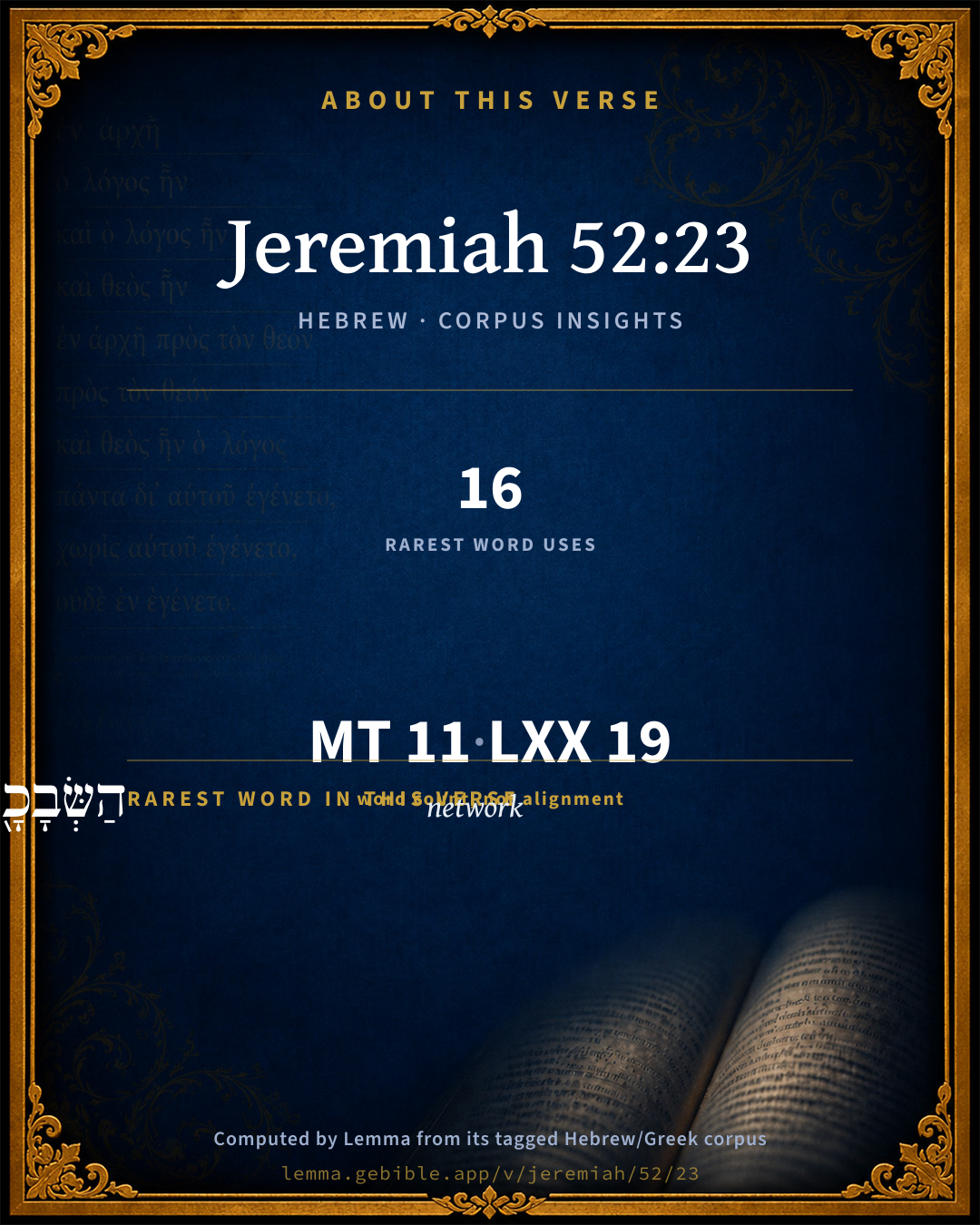
The rarest word here is הַשְּׂבָכָ֖ה network H7639 — appearing just 16 times in the whole Hebrew Bible.

Shared distinctive vocabulary

הַשְּׂבָכָ֖ה network H7639 occurs in 12 verses of the Hebrew Bible. Also found in:

Grammatical profile

  • 1 verb
  • 6 nouns
  • 3 adjectives
  • 1 preposition

Verb forms

  • וַיִּֽהְיוּ֙ Qal · Sequential Imperfect

Repetition

A word recurs within this verse — often emphatic in Hebrew:

  • הָֽרִמֹּנִ֔ים pomegranate H7416 ×2

Hebrew & Septuagint length

In the original languages it is 11 Hebrew tokens and 19 Greek tokens — but the two are counted differently (Hebrew bundles its prefixes and suffixes into one token; the Greek is in lemma form), so that isn’t a like-for-like length.

Cross-references

1

Topical passages linked to Jeremiah 52:23 in the Treasury of Scripture Knowledge — connected by theme and wording, ordered by reader-vote popularity; previews shown in the World English Bible.

  • 1 Kings 7:20 There were capitals above also on the two pillars, close by the belly which was beside the network: and the pomegranates were two hundred, in rows round about on the other capital.

Cross-references courtesy of OpenBible.info (CC BY 4.0).

Hebrew and Greek witnesses Masoretic Hebrew ↔ Greek Septuagint

The same verse in the two great witnesses to the Old Testament, shown verse-for-verse.

These are two independent witnesses, not word-aligned to each other, and the Septuagint is shown in lemma (dictionary) form.

Hebrew Jeremiah 52:23 Masoretic · Westminster Leningrad Codex

וַיִּֽהְיוּ֙ הָֽרִמֹּנִ֔ים תִּשְׁעִ֥ים וְשִׁשָּׁ֖ה ר֑וּחָה כָּל הָרִמּוֹנִ֥ים מֵאָ֛ה עַל הַשְּׂבָכָ֖ה סָבִֽיב

There were ninety-six pomegranates on the sides; all the pomegranates were one hundred on the network round about.

World English Bible · Public Domain

Greek LXX Structure differs

In the Septuagint, Jeremiah is about an eighth shorter than the Hebrew and arranges its material differently — the Oracles Against the Nations (Hebrew chapters 46–51) appear in the middle of the Greek book, after 25:13. Because the chapter and verse boundaries do not line up, a verse-for-verse comparison with the Hebrew is not shown.

A verse-for-verse comparison isn’t shown here because the chapters and verses don’t line up. Switch to the LXX edition with the MT / LXX toggle above to read the Greek directly.

Hebrew: Westminster Leningrad Codex (CC BY 4.0). Greek: Septuagint (public domain); English from a public-domain English Septuagint. How the Septuagint differs from the Hebrew →

Targum (Aramaic paraphrase)

1

The Targum is the ancient Jewish Aramaic paraphrase of the Hebrew Scriptures — an interpretive translation, not the Hebrew text itself. Onkelos (literal) and Pseudo-Jonathan (expansive) render the Torah, and Jonathan the Prophets. Coverage is partial: where no permissively-licensed English translation exists for a verse, only the Aramaic is shown. This is verse-level text, not a word-by-word alignment to the Hebrew.

  1. Targum Jonathan Prophets (Joshua–Malachi)
    וַהֲווֹ רִמוֹנַיָא תִּשְׁעִין וְשִׁתָּא בְעֶבְרָתָא כָּל רִמוֹנַיָא מְאָה עַל סְרִיגְתָּא סְחוֹר סְחוֹר:

    (no public-domain English translation for this verse)

    Targum Jonathan — Aramaic: “Mikraot Gedolot” (public domain). English: “Sefaria Community Translation” (CC0 1.0 (public-domain dedication)); “London "Chaldee Paraphrase," 1871” (public domain). Text via Sefaria.

Commentary

Notes on Jeremiah 52:23 from classic Christian and Jewish commentators (each source and its license shown beneath its notes). The classic Christian expositions comment on the surrounding passage and are grouped to its opening verse, so a note may address several verses; the Jewish commentaries on the Tanakh (Rashi and others) are per-verse, so they appear only where the commentator wrote on this verse.

Lemma curates 59 commentaries, every one of them public domain or Creative Commons licensed, each selected and text-cleaned for this edition rather than reprinted as found. About our sources →

Tyndale Open Study Notes

Tyndale Open Resources

52:23 Jeremiah added this verse, which is not in 2 Kgs 25 (see study note on 52:1-34).

Tyndale Open Study Notes — © Tyndale Open Resources, licensed CC BY-SA 4.0. Text via the HelloAO Bible API.

Geneva Bible (1599)

Geneva Bible translators

But because of the roundness, no more could be seen but ninety and six.

Geneva Bible (1599) marginal notes — public domain. Text via Bolls.life.

Jamieson, Fausset & Brown

Robert Jamieson, A. R. Fausset & David Brown

on a side--literally, (on the side) towards the air or wind, that is, the outside of the capitals of the pillars conspicuous to the eye, opposed to the four remaining pomegranates which were not seen from the outside. The pomegranates here are ninety-six; but in Kg1 7:20 they are two hundred on each chapiter, and four hundred on the two (Ch2 4:13). It seems there were two rows of them, one above the other, and in each row a hundred. They are here said to be ninety-six, but immediately following one hundred, and so in Kg1 7:20. Four seem to have been unseen to one looking from one point; and the ninety-six are only those that could be seen [VATABLUS]; or, the four omitted here are those separating the four sides, one pomegranate at each point of separation (or at the four corners) between the four sides [GROTIUS].

Jamieson, Fausset & Brown — Commentary Critical and Explanatory on the Whole Bible (1871) — public domain (CC PDM 1.0). Text via the HelloAO Bible API.

Adam Clarke's Commentary

Verse 23. See Clarke on Jer 52:18.

Adam Clarke's Commentary on the Bible (1810–1826) — public domain. Text from a community e-Sword/MySword module.

The Cambridge Bible for Schools and Colleges

gen. ed. J. J. S. Perowne

23. In 1Ki_7:20; 1Ki_7:42 each pillar is said to have had two rows of pomegranates, a hundred in each, the one above and the other below the ornamental network of the chapiters. It is possible that the account here may not be inconsistent with the existence of such a double row upon each chapiter, though it certainly does not suggest it, or again, one of the rows may have been removed before this period, leaving one hundred on each chapiter.

on the sides] The other renderings in mg. shew that the meaning of the expression is obscure. Suggestions are (a) visible outwards, i.e. four of the hundred in each row were hidden owing to the nearness of the pillar to the wall of the porch, or (b) hanging loosely, i.e. four of the pomegranates were fixed to the network on the capitals, while the rest hung in festoons between them.

The Cambridge Bible for Schools and Colleges (gen. ed. J. J. S. Perowne; Cambridge University Press, 1878–1918) — public domain. Text from a community e-Sword module.

John Gill's Exposition

And the captain of the guard took Seraiah the chief priest,.... That is, out of the temple, where he was ministering, or fled for safety; this is supposed to be the father of Ezra, Ch1 6:14;

and Zephaniah the second priest: or deputy priest: the "sagan" of the priests, as the Targum calls him, who was deputed to minister for the high priest, in case anything happened which hindered him from officiating; such an one there always was in later times on the day of atonement, as appears from the Misna (f); this man is thought to be the same with Zephaniah the son of Maaseiah the priest, Jer 21:1;

and the three keepers of the door; that is, of the temple. The Targum calls them three "amarcalin"; who had, as Jarchi says, the keys of the court committed to them. The number seems better to agree with the "gizbarim" or treasurers; of whom, it is said, they never appoint less than three treasurers, and seven "amarcalin" (g).

(f) Yoma, c. 1. sect. 1. (g) Misn. Shekalim, c. 5. sect. 2.

John Gill's Exposition of the Whole Bible (1746–1763) — public domain (CC PDM 1.0). Text via the HelloAO Bible API.

Albert Barnes' Notes on the Bible

On a side - The 96 were toward the four winds, 24 toward the north, 24 toward the east, and so on. Add one at each corner, and the whole 100 is made up.

Albert Barnes' Notes on the Bible (1834–1885) — public domain. Text from a community e-Sword/MySword module.

Haydock's Catholic Bible Commentary

Hundred; four next the wall were not seen, or were fixed to the chaptrels.

George Leo Haydock (1774–1849), Haydock's Catholic Family Bible and Commentary, 1859 edition — public domain. Excludes Psalms (Douay-Rheims chapter numbering differs from Protestant) and Deuterocanonical books (Catholic canon only).

Matthew Poole's English Annotations

There are some differences as to the measure of these chapiters betwixt 2Ki 25:17 and this text; here the height of them is made to be five cubits, there it is said to be three cubits: that which is said to resolve this difficulty is, that there were three parts in the chapiter, the square, the belly, and the crown, and that this text gives an account of the whole; but that text, 2Ki 25:17, gives an account only of the belly and the crown, which were no more than three cubits. The like difference there is betwixt this text and 1Ki 7:20, and 2Ch 4:13, about the number of the pomegranates. In the Book of Kings it is said the pomegranates were in number two hundred; 2Ch 4:13, they are said to have been four hundred. The meaning is, there were a hundred in a row, in the two rows two hundred, in the four rows (two upon each pillar) four hundred. Some other difference also there is about the particular number of pomegranates on a side, which are here said to be but ninety-six, which make on the two sides but one hundred and ninety-two, on the four sides but three hundred and eighty-four, and comes up neither to the two hundred mentioned in the Book of Kings, nor to the number of four hundred mentioned in the Book of Chronicles. See the English Annotations, where the learned author hath observed that in the Hebrew, what we translate of a side, is word for word windward, that is, toward the four winds, so as the table was square, and there were twenty-four on each side, which made ninety-six in all, to which four being added. one at each corner, this made a hundred. But these are niceties, a satisfaction in which is of no great concernment to us, unless to satisfy such as would make use of these little things to question the authority of the Scriptures because of these seeming contradictions, of how little concernment soever they be as to our faith and holiness.

Matthew Poole's English Annotations on the Holy Bible (1683–1685) — public domain. Text from a community e-Sword/MySword module.

Whedon's Commentary on the Bible

Daniel D. Whedon

23. Ninety and six pomegranates on a side; all… were a hundred — The Hebrew for “on a side” is windwards, and it cannot mean that there were “ninety-six pomegranates” on each side, for then, as the capitals were square, the whole number would have been three hundred and eighty-four. The expression must mean that “ninety-six” were toward the four winds, twenty-four facing each quarter; and one at each corner, which would be each toward two winds, as north-east, north-west, etc: this would make “a hundred” all told.

Daniel D. Whedon (gen. ed.), Commentary on the Old and New Testaments (1874–1909) — public domain. Text from a community e-Sword module.

The Pulpit Commentary

On a side; rather, towards the outside.

The Pulpit Commentary (1880–1919), ed. H.D.M. Spence-Jones & Joseph S. Exell — public domain. Text from a community e-Sword module.

Lesson kit

Teaching starters — assembled from the data on this page, not authored interpretation. Every prompt links to the verse data it draws on. Edit before teaching.

Jeremiah, in the Prophets, opens this verse with 11 words (10 distinct Hebrew lemmas). Its most distinctive word is sᵉbâkâh (“network”). A historical commentator’s framing appears above. Read the whole chapter for the surrounding context.

Discussion questions

  1. How does “network” (sᵉbâkâh) shape what this verse is saying?
  2. How does 1 Kings 7:17, which shares the word «network», read alongside this verse?
  3. What does the repetition of “pomegranate” (2× in this one verse) do in this verse?
  4. These translations render this verse differently. What is at stake in choosing one wording over another?
  5. «וַיִּֽהְיוּ֙» is a Qal Sequential Imperfect verb. How does that grammatical form shape the action described?
  6. Compare how Tyndale Open Study Notes and Geneva Bible (1599) read this verse. Where do they agree or differ?

Things to notice

Reading settings

Reading text

Shown beneath each verse's original-language words.

Old Testament
Old Testament edition

Read the OT as the Masoretic Hebrew (MT) or the Greek Septuagint (LXX).

English shown for the Greek Septuagint (in the Hebrew ↔ Greek comparison).

Comparing translations? Open the Compare panel on any verse page to stack up to four side by side.