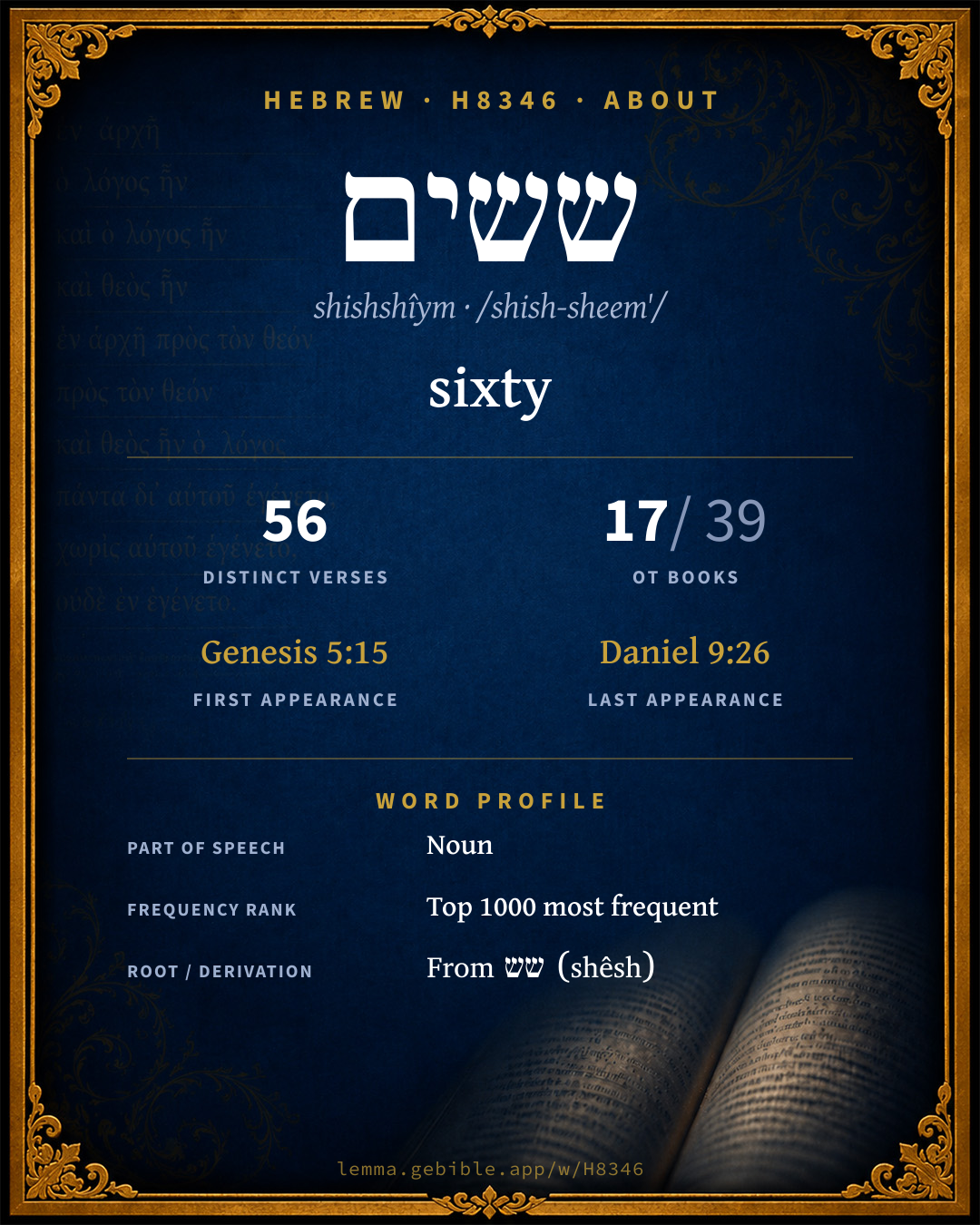
שִׁשִּׁים
sixty
Full lexicon entry — Brown-Driver-Briggs (BDB)
From Brown-Driver-Briggs (BDB)
Where this word appears
Grammar key — what these labels mean
Part of speech
- Adjective
- A word that describes or qualifies a noun.
State
- Absolute
- The independent form of a noun, not bound to a following word.
Gender
- Both
- Attested as both masculine and feminine.
Number
- Plural
- More than one (in Hebrew, generally three or more).
Every verse where H8346 appears — 56 distinct verses across 17 books. Click any verse to open its interlinear word-by-word view. Verse text shown in the World English Bible for context — . Each verse’s Hebrew form is shown with its reference; the English is not keyword-highlighted, since the data carries no word-level English alignment. Use “Compare translations” on any verse to read it across multiple English versions. This concordance covers the Hebrew Bible; Septuagint (Greek Old Testament) occurrences are not indexed here.
Genesis 8 verses
- Genesis 5:15 וְ/שִׁשִּׁ֣ים conj + Adjective Cardinal number bp Mahalalel lived sixty-five years, and became the father of Jared.
- Genesis 5:18 וְ/שִׁשִּׁ֛ים conj + Adjective Cardinal number bp Jared lived one hundred sixty-two years, and became the father of Enoch.
- Genesis 5:20 וְ/שִׁשִּׁים֙ conj + Adjective Cardinal number bp All the days of Jared were nine hundred sixty-two years, then he died.
- Genesis 5:21 וְ/שִׁשִּׁ֖ים conj + Adjective Cardinal number bp Enoch lived sixty-five years, and became the father of Methuselah.
- Genesis 5:23 וְ/שִׁשִּׁים֙ conj + Adjective Cardinal number bp all the days of Enoch were three hundred sixty-five years.
- Genesis 5:27 וְ/שִׁשִּׁים֙ conj + Adjective Cardinal number bp All the days of Methuselah were nine hundred sixty-nine years, then he died.
- Genesis 25:26 שִׁשִּׁ֥ים adj Cardinal number bp After that, his brother came out, and his hand had hold on Esau's heel. He was named Jacob. Isaac was sixty years old when she bore them.
- Genesis 46:26 שִׁשִּׁ֥ים adj Cardinal number bp All the souls who came with Jacob into Egypt, who were his direct descendants, besides Jacob's sons' wives, all the souls were sixty-six.
Leviticus 3 verses
- Leviticus 12:5 וְ/שִׁשִּׁ֥ים conj + Adjective Cardinal number bp But if she bears a female child, then she shall be unclean two weeks, as in her period; and she shall continue in the blood of purification sixty-six days.
- Leviticus 27:3 שִׁשִּׁ֣ים adj Cardinal number bp Your valuation shall be of a male from twenty years old even to sixty years old, even your valuation shall be fifty shekels of silver, after the shekel of the sanctuary.
- Leviticus 27:7 שִׁשִּׁ֨ים adj Cardinal number bp If the person is from sixty years old and upward; if it is a male, then your valuation shall be fifteen shekels, and for a female ten shekels.
Numbers 9 verses
- Numbers 1:39 וְ/שִׁשִּׁ֛ים conj + Adjective Cardinal number bp those who were numbered of them, of the tribe of Dan, were sixty-two thousand seven hundred.
- Numbers 2:26 וְ/שִׁשִּׁ֛ים conj + Adjective Cardinal number bp His division, and those who were numbered of them, were sixty-two thousand seven hundred.
- Numbers 3:50 וְ/שִׁשִּׁ֜ים conj + Adjective Cardinal number bp from the firstborn of the children of Israel he took the money, one thousand three hundred sixty-five shekels, after the shekel of the sanctuary:
- Numbers 7:88 שִׁשִּׁים֙ שִׁשִּׁ֔ים שִׁשִּׁ֑ים adj Cardinal number bp adj Cardinal number bp adj Cardinal number bp and all the oxen for the sacrifice of peace offerings twenty-four bulls, the rams sixty, the male goats sixty, the male lambs a year old sixty. This was the dedication of the altar, after it was anointed.
- Numbers 26:25 וְ/שִׁשִּׁ֛ים conj + Adjective Cardinal number bp These are the families of Issachar according to those who were numbered of them, sixty-four thousand three hundred.
- Numbers 26:27 שִׁשִּׁ֥ים adj Cardinal number bp These are the families of the Zebulunites according to those who were numbered of them, sixty thousand five hundred.
- Numbers 26:43 וְ/שִׁשִּׁ֛ים conj + Adjective Cardinal number bp All the families of the Shuhamites, according to those who were numbered of them, were sixty-four thousand four hundred.
- Numbers 31:34 וְ/שִׁשִּׁ֖ים conj + Adjective Cardinal number bp and seventy-one thousand donkeys,
- Numbers 31:39 וְ/שִׁשִּֽׁים conj + Adjective Cardinal number bp The donkeys were thirty thousand five hundred; of which Yahweh's tribute was sixty-one.
Deuteronomy 1 verse
Joshua 1 verse
2 Samuel 1 verse
1 Kings 4 verses
- 1 Kings 4:13 שִׁשִּׁים֙ adj Cardinal number bp Ben Geber, in Ramoth-gilead (to him [pertained] the towns of Jair the son of Manasseh, which are in Gilead; [even] to him [pertained] the region of Argob, which is in Bashan, sixty great cities with walls and brazen bars);
- 1 Kings 4:22 וְ/שִׁשִּׁ֥ים conj + Adjective Cardinal number bp Solomon's provision for one day was thirty measures of fine flour, and sixty measures of meal,
- 1 Kings 6:2 שִׁשִּֽׁים adj Cardinal number bp The house which king Solomon built for Yahweh, the length of it was sixty cubits, and the breadth of it twenty [cubits], and the height of it thirty cubits.
- 1 Kings 10:14 שִׁשִּׁ֥ים adj Cardinal number bp Now the weight of gold that came to Solomon in one year was six hundred sixty-six talents of gold,
2 Kings 1 verse
1 Chronicles 6 verses
- 1 Chronicles 2:21 שִׁשִּׁ֣ים adj Cardinal number bp Afterward Hezron went in to the daughter of Machir the father of Gilead, whom he took [as wife] when he was sixty years old; and she bore him Segub.
- 1 Chronicles 2:23 שִׁשִּׁ֣ים adj Cardinal number bp Geshur and Aram took the towns of Jair from them, with Kenath, and the villages of it, even sixty cities. All these were the sons of Machir the father of Gilead.
- 1 Chronicles 5:18 וְ/שִׁשִּׁ֖ים conj + Adjective Cardinal number bp The sons of Reuben, and the Gadites, and the half-tribe of Manasseh, of valiant men, men able to bear buckler and sword, and to shoot with bow, and skillful in war, were forty-four thousand seven hundred and sixty, that were able to go forth to war.
- 1 Chronicles 9:13 וְ/שִׁשִּׁ֑ים conj + Adjective Cardinal number bp and their brothers, heads of their fathers' houses, one thousand seven hundred sixty; very able men for the work of the service of the house of God.
- 1 Chronicles 16:38 שִׁשִּׁ֣ים adj Cardinal number bp and Obed-edom with their brothers, sixty-eight; Obed-edom also the son of Jeduthun and Hosah to be doorkeepers;
- 1 Chronicles 26:8 שִׁשִּׁ֥ים adj Cardinal number bp All these were of the sons of Obed-edom: they and their sons and their brothers, able men in strength for the service; sixty-two of Obed-edom.
2 Chronicles 4 verses
- 2 Chronicles 3:3 שִׁשִּׁ֔ים adj Cardinal number bp Now these are the foundations which Solomon laid for the building of the house of God. The length by cubits after the first measure was sixty cubits, and the breadth twenty cubits.
- 2 Chronicles 9:13 וְ/שִׁשִּׁ֥ים conj + Adjective Cardinal number bp Now the weight of gold that came to Solomon in one year was six hundred and sixty-six talents of gold,
- 2 Chronicles 11:21 שִׁשִּׁ֑ים וְ/שִׁשִּׁ֥ים adj Cardinal number bp conj + Adjective Cardinal number bp Rehoboam loved Maacah the daughter of Absalom above all his wives and his concubines: (for he took eighteen wives, and sixty concubines, and became the father of twenty-eight sons and sixty daughters.)
- 2 Chronicles 12:3 וּ/בְ/שִׁשִּׁ֥ים conj + prep + Adjective Cardinal number bp with twelve hundred chariots, and sixty thousand horsemen. The people were without number who came with him out of Egypt: the Lubim, the Sukkiim, and the Ethiopians.
Ezra 5 verses
- Ezra 2:9 וְ/שִׁשִּֽׁים conj + Adjective Cardinal number bp The children of Zaccai, seven hundred sixty.
- Ezra 2:13 שִׁשִּׁ֥ים adj Cardinal number bp The children of Adonikam, six hundred sixty-six.
- Ezra 2:64 שִׁשִּֽׁים adj Cardinal number bp The whole assembly together was forty-two thousand three hundred sixty,
- Ezra 8:10 וְ/שִׁשִּׁ֖ים conj + Adjective Cardinal number bp Of the sons of Shelomith, the son of Josiphiah; and with him one hundred sixty males.
- Ezra 8:13 שִׁשִּׁ֥ים adj Cardinal number bp Of the sons of Adonikam, [who were] the last; and these are their names: Eliphelet, Jeuel, and Shemaiah; and with them sixty males.
Nehemiah 6 verses
- Nehemiah 7:14 וְ/שִׁשִּֽׁים conj + Adjective Cardinal number bp The children of Zaccai, seven hundred sixty.
- Nehemiah 7:18 שִׁשִּׁ֥ים adj Cardinal number bp The children of Adonikam, six hundred sixty-seven.
- Nehemiah 7:19 שִׁשִּׁ֥ים adj Cardinal number bp The children of Bigvai, two thousand sixty-seven.
- Nehemiah 7:66 וְ/שִׁשִּֽׁים conj + Adjective Cardinal number bp The whole assembly together was forty-two thousand three hundred sixty,
- Nehemiah 7:72 שִׁשִּׁ֥ים adj Cardinal number bp That which the rest of the people gave was twenty thousand darics of gold, and two thousand minas of silver, and sixty-seven priests' garments.
- Nehemiah 11:6 שִׁשִּׁ֥ים adj Cardinal number bp All the sons of Perez who lived in Jerusalem were four hundred sixty-eight valiant men.
Song of Solomon 2 verses
Isaiah 1 verse
Jeremiah 1 verse
Ezekiel 1 verse
Daniel 2 verses
- Daniel 9:25 שִׁשִּׁ֣ים adj Cardinal number bp Know therefore and discern, that from the going forth of the commandment to restore and to build Jerusalem to the Anointed One, the prince, shall be seven weeks, and sixty-two weeks: it shall be built again, with street and moat, even in troubled times.
- Daniel 9:26 שִׁשִּׁ֣ים adj Cardinal number bp After the sixty-two weeks the Anointed One shall be cut off, and shall have nothing: and the people of the prince who shall come shall destroy the city and the sanctuary; and the end of it shall be with a flood, and even to the end shall be war; desolations are determined.
About this entry
At a glance — auto-summarized from this page’s data, not written by a person. Every figure links to its source below. This summary describes the numbers; it doesn’t interpret them.
The Hebrew noun ששים centers on the idea of “sixty.” The King James Version usually renders it “threescore,” while modern versions prefer “were” (unfoldingWord Literal Text) — see the renderings breakdown. Spanning 56 verses in 17 books, it ranks among the moderately common words of the Hebrew Bible. Debuting at Genesis 5:15, it then recurs through the corpus. Sharing its root, it stands alongside שש, ששה and ששי. Dig into 56-verse concordance and the renderings breakdown below.
Gloss history
Strong's 1890 vs modern scholarship
About this word
Strong's H8346 catalogs a Hebrew word from the Hebrew Old Testament.
These counts are not copied from any lexicon or concordance. They are computed here, from the morphology-tagged Hebrew Old Testament. What Lemma adds →
- 56
- distinct verses
- The word appears in 56 distinct verses.
- 17 / 39
- OT books
- The word appears in 17 of 39 Old Testament books.
- #647
- by frequency
- Top 1000 most frequent Hebrew words (rank 647 of 8,640 Hebrew words by occurrence).
View all 56 occurrences in the concordance →
Most concentrated in
- Numbers 9 verses 16%
- Genesis 8 verses 14%
- 1 Chronicles 6 verses 11%
By section of the Old Testament
By traditional corpus
Conventional, traditional groupings — biblical authorship is debated, so this is a traditional corpus grouping, not an authorship claim. Each share is this word’s portion of its verses in that division of the Hebrew canon. Each figure is a share of the word’s 56 distinct verses.
- Writings (Ketuvim) 25 verses · 45%
- Torah (Pentateuch) 21 verses · 38%
- Prophets (Nevi'im) 10 verses · 18%
How translations render this word
Counts come from each version’s own published word-to-Strong’s tagging or interlinear alignment — an approximate guide to how each version renders this word, not a word-level alignment the data otherwise carries. Because each total is that version’s own tagged count, the per-version totals vary from one another and need not match the appearance or distinct-verse counts above. These counts may also differ from a printed concordance because Lemma counts each distinctly tagged rendering and does not collapse phrase taggings into a single head-word total. This is a fixed set of word-tagged versions (KJV, ASV, BSB, ULT) and does not change with the reading translation you choose elsewhere. Each version’s license is shown beside its name below (and on Sources).
BDB lists this Strong’s number as 2 distinct words (homographs). Each count above pools all of them and is not split by sense — see the Senses section below. A low-frequency rendering may belong to a different one of those words, not the primary meaning.
- King James Version†: Threescore 34×, Sixty 11×, Were threescore 5×
- American Standard Version†: Threescore 32×, Sixty 10×, Them 5×
- Berean Standard Bible†: Sixty 18×, Sixty-six 2×, Sixty-two 2×
- unfoldingWord Literal Text†: Were 9×, Sixty 6×, And 4×
King James Version Public Domain
Renders H8346 across 59† tagged occurrences — most commonly:
Plus 6 renderings that appear only once — usually multi-word phrases or single function words the recovered tagging swept in, not distinct renderings.
American Standard Version Public Domain
Renders H8346 across 59† tagged occurrences — most commonly:
Plus 7 renderings that appear only once — usually multi-word phrases or single function words the recovered tagging swept in, not distinct renderings.
Berean Standard Bible Public Domain
Renders H8346 across 28† tagged occurrences — most commonly:
Plus 4 renderings that appear only once — usually multi-word phrases or single function words the recovered tagging swept in, not distinct renderings. Not rendered by a distinct English word in 31 further occurrences.
unfoldingWord Literal Text CC BY-SA 4.0
Renders H8346 across 30† tagged occurrences — most commonly:
Plus 1 rendering that appears only once — usually multi-word phrases or single function words the recovered tagging swept in, not distinct renderings. Not rendered by a distinct English word in 29 further occurrences.
Senses in BDB
The 1 sense BDB distinguishes for this word, in lexicon order (not ranked by frequency or importance). The full entry — with sub-senses — is in the Lexicon Entry tab.
- sixty, three score
Word origin
n. indecl. sixty;—bef. n. sg.: city Dt 3:4 + 4 times, cubit 1 K 6:2 Ez 40:14, man 2 K 25:19 = Je 52:25, day Lv 12:5, etc.; n.pl. בָּנוֹת 2 Ch 11:21, cf. Ct 3:7; after n.pl. Nu 7:88(×3) 2 Ch 3:3; 11:21 +; שִׁשִּׁים אֶלֶף 2 Ch 12:3 +; שׁ׳ foll. units Gn 5:15 + 12 times; שׁ׳ precedes unit Is 7:8 + 12 times; שׁ׳ foll. 100 (1000) Ezr 8:10 + 11 times; precedes Gn 5:18 + 8 times
— Brown-Driver-Briggs (Oxford 1906, public domain), digitized via Sefaria, supplemented by the OpenScriptures HebrewLexicon (CC BY 4.0). See Sources.
Derived from שש (shêsh) (H8337) — six.
Jastrow Dictionary
A second Hebrew/Aramaic lexicon for comparison, covering Aramaic and post-biblical (Talmudic, Targumic, Midrashic) usage that the biblical-Hebrew BDB does not. Matched by lemma rather than by Strong’s number, so a lemma may carry more than one Jastrow headword (shown separately below), and the entries cover usage well beyond the Bible.
שֵׁשׁ
- six. Pes. V, 1 (58ᵃ) בששה ומחצה (Y. a. Bab. ed. בשש) at six hours and a half (from sunrise). Y. ib. IV, beg. 30ᶜ משש שעות ולמעלן after six hours (noon); משש שעות ולמען before noon. Yoma 21ᵇ שש אשות הן there are six kinds of fire. Pes. 49ᵇ ש׳ דברים נאמרו וכ׳ six things have been said concerning ignorant people; a. v. fr.—Constr. m. שֵׁשֶׁת. Snh. 97ᵃ; Ab. Zar. 9ᵃ; v. שָׁנָה II; a. fr.—Pl. שִׁשִּׁים sixty. B. Kam. 58ᵇ סאה בש׳ סאין the damage to a field of one S’ah is assessed by calculation from a field of sixty S’ahs (so as to arrive at a fair estimate). Ib. בש׳ taking as a basis for calculation sixty times the quantity under dispute; ib. 59ᵃ; a. e.—Ḥull. 97ᵇ בש׳ (sub. בטל) is neutralized in a quantity sixty times as large. Ex. R. s. 1 ש׳ בכרס אחד sixty at one birth. Y. Taan. IV, 68ᶜ top ש׳ רבוא sixty myriads. Succ. 51ᵇ; a. fr.
שִׁשִּׁים
- , v. שֵׁשׁ III
A Dictionary of the Targumim, the Talmud Babli and Yerushalmi, and the Midrashic Literature (Marcus Jastrow; London, Luzac, 1903) — Public Domain. Digitized via Sefaria. Digitized via Sefaria. Full attribution on Sources.
Forms in the corpus
The 17 distinct written forms H8346 takes in the Hebrew Bible, most frequent first — each parse links to that state’s occurrences in the concordance. Hebrew forms include their vowel points and cantillation, so a single lemma takes many written forms.
| Form | Parsing | Example | Uses |
|---|---|---|---|
| שִׁשִּׁ֥ים | Adjective, Cardinal number, Both, Plural, Absolute | Deuteronomy 3:4 | 15 |
| שִׁשִּׁ֣ים | Adjective, Cardinal number, Both, Plural, Absolute | Daniel 9:25 | 7 |
| וְ/שִׁשִּׁ֛ים | Adjective, Cardinal number, Both, Plural, Absolute | Genesis 5:18 | 6 |
| וְ/שִׁשִּׁ֥ים | Adjective, Cardinal number, Both, Plural, Absolute | 1 Kings 4:22 | 6 |
| וְ/שִׁשִּׁ֖ים | Adjective, Cardinal number, Both, Plural, Absolute | Ezra 8:10 | 4 |
| וְ/שִׁשִּֽׁים | Adjective, Cardinal number, Both, Plural, Absolute | Ezra 2:9 | 4 |
| וְ/שִׁשִּׁים֙ | Adjective, Cardinal number, Both, Plural, Absolute | Genesis 5:20 | 3 |
| שִׁשִּׁ֑ים | Adjective, Cardinal number, Both, Plural, Absolute | 2 Chronicles 11:21 | 2 |
| שִׁשִּׁ֔ים | Adjective, Cardinal number, Both, Plural, Absolute | 2 Chronicles 3:3 | 2 |
| שִׁשִּֽׁים | Adjective, Cardinal number, Both, Plural, Absolute | Ezra 2:64 | 2 |
| שִׁשִּׁים֙ | Adjective, Cardinal number, Both, Plural, Absolute | 1 Kings 4:13 | 2 |
| וְ/שִׁשִּׁ֑ים | Adjective, Cardinal number, Both, Plural, Absolute | 1 Chronicles 9:13 | 1 |
| וְ/שִׁשִּׁ֜ים | Adjective, Cardinal number, Both, Plural, Absolute | Numbers 3:50 | 1 |
| וְ/שִׁשִּׁ֣ים | Adjective, Cardinal number, Both, Plural, Absolute | Genesis 5:15 | 1 |
| וּ/בְ/שִׁשִּׁ֥ים | Adjective, Cardinal number, Both, Plural, Absolute | 2 Chronicles 12:3 | 1 |
| שִׁשִּׁ֤ים | Adjective, Cardinal number, Both, Plural, Absolute | Isaiah 7:8 | 1 |
| שִׁשִּׁ֨ים | Adjective, Cardinal number, Both, Plural, Absolute | Leviticus 27:7 | 1 |
Same root — word family
Other BDB entries built from the same root as H8346, grouped by Strong’s listed origin. These share a root / origin per the lexicon — not necessarily a shared meaning. Each links to that word’s own entry.
Derives from
Shares the same root
Derived from this word
Compare all same-root words → Showing 4 of 6 — not the complete family. They share a root, not necessarily a meaning.
Septuagint verse parallels
This word appears in 49 verses that also exist in the Greek Old Testament (Septuagint), out of the 56 Hebrew verses it occurs in. You can read those verses in Greek by switching the Old Testament edition to the Septuagint.
Read these verses in the Septuagint
- Genesis 5:15
- Leviticus 12:5
- Numbers 1:39
- Deuteronomy 3:4
- Joshua 13:30
- 2 Samuel 2:31
- 1 Kings 4:13
- 2 Kings 25:19
- 1 Chronicles 2:21
- 2 Chronicles 3:3
- Ezra 2:9
- Song of Solomon 3:7
This is a verse-level parallel only — the same verses exist in both the Hebrew and Greek Old Testaments. No word-level Hebrew↔Greek correspondence is claimed: the data carries no such alignment, so no Greek word is shown as this Hebrew word’s translation. Coverage is not total — the Septuagint omits the deuterocanon and renumbers the Psalms, so some Hebrew verses have no direct Greek parallel.