
1 Chronicles 20:6

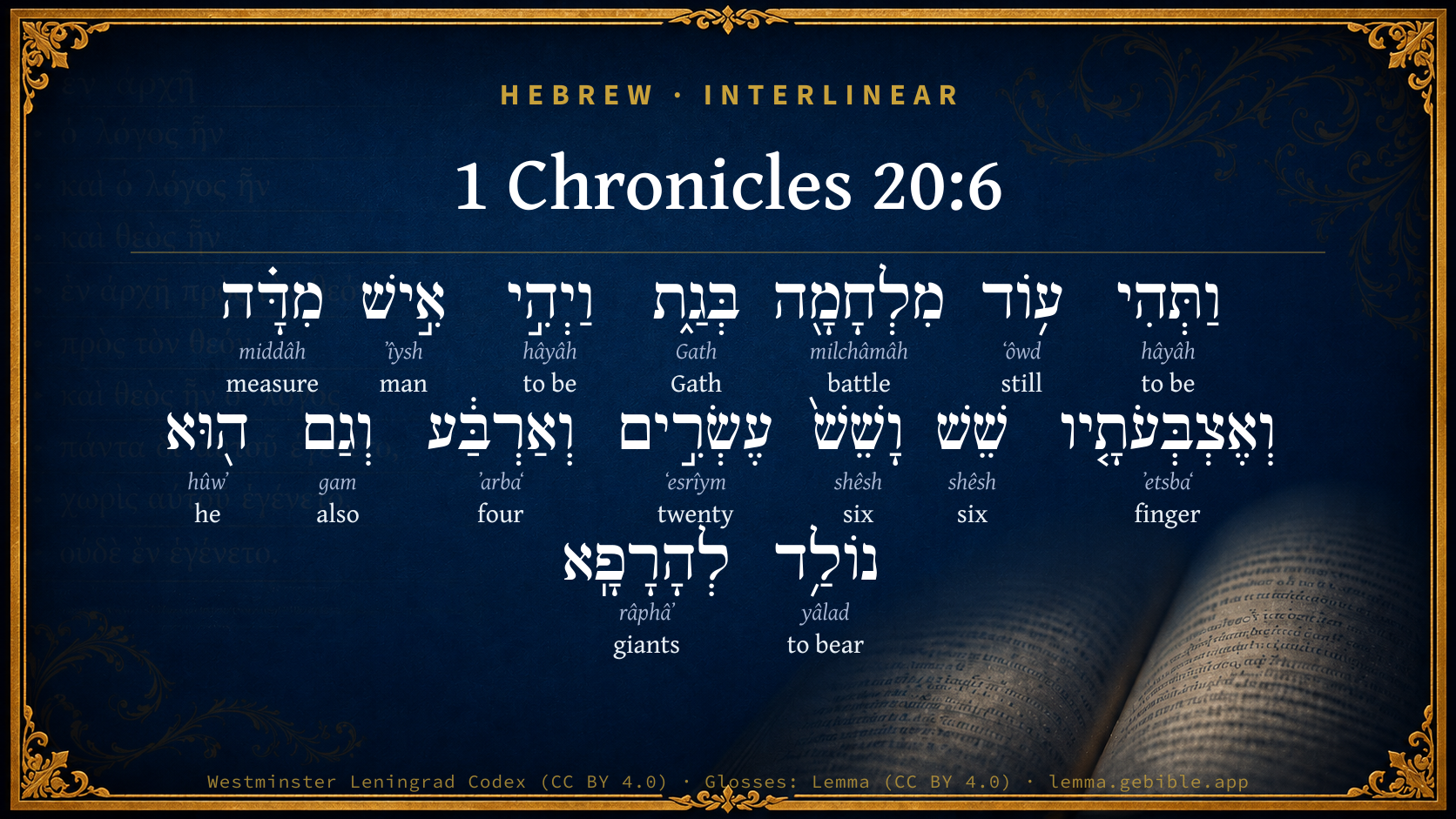
Hebrew (Westminster Leningrad Codex) 1 Chronicles 20:6 appears in the Hebrew Old Testament. The text above is from the Westminster Leningrad Codex. Each word links to its Strong’s number, a concise gloss, and parsing drawn from the Open Scriptures Hebrew Bible morphology. Click any word for its full Brown-Driver-Briggs (BDB) entry.
Download image
Cite this verse

1 Chronicles 20:6 (World English Bible). Public Domain. Lemma interlinear Bible study tool, https://lemma.gebible.app/v/1-chronicles/20/6.

Show BibTeX & RIS
BibTeX
RIS
English Translation
There was again war at Gath, where was a man of great stature, whose fingers and toes were twenty-four, six [on each hand], and six [on each foot]; and he also was born to the giant.
World English Bible · Public Domain
Download a study sheet

One document with this verse’s original text, its word-by-word gloss line, the meaning frame, cross-references with their text, attributed commentary, and full source and license credits — printable, and it pastes into notes with its structure intact.

This verse Autodidact and up

Study sheet (.html) Plain text (.txt)

A passage Seminary Student

Up to 50 verses in one chapter. A passage sheet keeps up to 6 commentary sources and 12 cross-references per verse, in the order this page ranks them, and says so on the sheet whenever that leaves anything out. Ask for a single verse and you get the Autodidact verse sheet above.

Everything on this page stays free to read, with no account — the sheet is a download of what is already on screen, not access to it.

Want to remove ads? Support Godless Engineer
Compare translations 3

The same verse in 3 English versions, stacked beneath the original-language interlinear above. Click any original word for its lexicon entry.

Each is an independent rendering of the whole verse — the interlinear is not word-aligned to these translations.

Highlighted words mark where these versions differ — a whole-verse word diff, not a word-by-word alignment.

  • World English Bible Public Domain
    There was again war at Gath, where was a man of great stature, whose fingers and toes were twenty-four, six [on each hand], and six [on each foot]; and he also was born to the giant.
  • King James Version Public Domain
    And yet again there was war at Gath, where was a man of great stature, whose fingers and toes were four and twenty, six on each hand, and six on each foot and he also was the son of the giant.
  • unfoldingWord Literal Text CC BY-SA 4.0
    And there was battle again at Gath, and there was a man of stature, and his digits were six and six, 24. And he also was born to Rapha.

unfoldingWord Literal Text — © unfoldingWord, licensed CC BY-SA 4.0. Word-aligned USFM3 via Door43 (git.door43.org/unfoldingWord/en_ult).

Versions to compare (up to 4)

3 of 4 selected

Show all 18 translations

Every available English version of this verse, each an independent rendering of the whole verse.

  • World English Bible Public Domain
    There was again war at Gath, where was a man of great stature, whose fingers and toes were twenty-four, six [on each hand], and six [on each foot]; and he also was born to the giant.
  • Berean Standard Bible Public Domain
    And there was still another battle at Gath, where there was a man of great stature with six fingers on each hand and six toes on each foot—twenty-four in all. He too was descended from Rapha,
  • Majority Standard Bible Public Domain
    And there was also a battle at Gath, where there was a man of great stature with six fingers on each hand and six toes on each foot—twenty-four in all. He too was descended from Rapha,
  • King James Version Public Domain
    And yet again there was war at Gath, where was a man of great stature, whose fingers and toes were four and twenty, six on each hand, and six on each foot and he also was the son of the giant.
  • American Standard Version (1901) Public Domain
    And there was again war at Gath, where was a man of great stature, whose fingers and toes were four and twenty, six `on each hand', and six `on each foot'; and he also was born unto the giant.
  • Revised Version (1885) Public Domain
    And there was again war at Gath, where was a man of great stature, whose fingers and toes were four and twenty, six on each hand, and six on each foot; and he also was born unto the giant.
  • Geneva Bible (1599) Public Domain
    And yet againe there was a battel at Gath, where was a man of a great stature, and his fingers were by sixes, euen foure and twentie, and was also the sonne of Haraphah.
  • Douay-Rheims (1899) Public Domain
    There was another battle also in Geth, in which there was a man of great stature, whose fingers and toes were four and twenty, six on each hand and foot: who also was born of the stock of Rapha.
  • Young's Literal Translation Public Domain
    And there is again war in Gath, and there is a man of measure, and his fingers and his toes `are' six and six, twenty and four, and also, he hath been born to the giant.
  • Literal Standard Version CC BY-SA 4.0
    And there is war in Gath again, and there is a man of [great] measure, and his fingers and his toes [are] six and six—twenty-four [total], and he has also been born to the giant.
  • Unlocked Literal Bible CC BY-SA 4.0
    It came about in another battle at Gath that there was a man of great height who had six fingers on each hand and six toes on each foot. He also was descended from the Rephaim.
  • unfoldingWord Literal Text CC BY-SA 4.0
    And there was battle again at Gath, and there was a man of stature, and his digits were six and six, 24. And he also was born to Rapha.
  • Darby Bible Public Domain
    And there was again a battle, at Gath; and there was a man [there] of great stature, whose fingers [and toes] were four and twenty, six [on each hand], and six [on each foot]; and he also was born to Rapha.
  • World Messianic Bible Public Domain
    There was again war at Gath, where there was a man of great stature, who had twenty-four fingers and toes, six on each hand and six on each foot; and he also was born to the giant.
  • Webster's Bible Public Domain
    And yet again there was war at Gath, where was a man of great stature, whose fingers and toes were four and twenty, six on each hand, and six on each foot: and he also was the son of the giant.
  • Free Bible Version CC BY-SA 4.0
    In yet another battle at Gath, there was a gigantic man, who had six fingers on each hand and six toes on each foot, making twenty-four all. He too was descended from the giants.
  • Bible in Basic English Public Domain
    And again there was war at Gath, where there was a very tall man, who had twenty-four fingers and toes, six fingers on his hands and six toes on his feet; he was one of the offspring of the Rephaim.
  • JPS Tanakh (1917) Public Domain
    And there was again war at Gath, where was a man of great stature, whose fingers and toes were four and twenty, six on each hand, and six on each foot; and he also was born unto the giant.

Literal Standard Version (2020), Covenant Press — licensed CC BY-SA 4.0. Text via the HelloAO Bible API (eBible.org). Unlocked Literal Bible (unfoldingWord) — licensed CC BY-SA 4.0. Text via the HelloAO Bible API (eBible.org). unfoldingWord Literal Text — © unfoldingWord, licensed CC BY-SA 4.0. Word-aligned USFM3 via Door43 (git.door43.org/unfoldingWord/en_ult). Free Bible Version, Dr. Jonathan Gallagher — licensed CC BY-SA 4.0. Text via the HelloAO Bible API (eBible.org).

Word by word

More ways to search: Search by grammar → Find every occurrence → Compare this word →

Practice this passage: Drill this verse → Learn its vocabulary →

לְהָרָפָֽא
râphâʼ
H7497
“to/for · the · giants”
Preposition + Particle, Definite Article + Noun, Gentilic, Masculine, Singular, Absolute
Part of Speech
Preposition + Particle + Noun
Type
Gentilic
Gender
Masculine
Number
Singular
State
Absolute
Full BDB Definition

Origin: from H7495 in the sense of invigorating

TWOT: 2198d

giants, Rephaim - old tribe of giants
  1. וַתְּהִי hâyâh H1961 “and · to be” Conjunction + Verb, Qal, Sequential Imperfect, 3rd Person, Feminine, Singular
  2. ע֥וֹד ʻôwd H5750 “still” Adverb
  3. מִלְחָמָ֖ה milchâmâh H4421 “battle” Noun, Common, Feminine, Singular, Absolute
  4. בְּגַ֑ת Gath H1661 “in/at · Gath” Preposition + Noun, Proper
  5. וַיְהִ֣י hâyâh H1961 “and · to be” Conjunction + Verb, Qal, Sequential Imperfect, 3rd Person, Masculine, Singular
  6. אִ֣ישׁ ʼîysh H376 “man of” Noun, Common, Masculine, Singular, Construct
  7. מִדָּ֗ה middâh H4060 “measure” Noun, Common, Feminine, Singular, Absolute
  8. וְאֶצְבְּעֹתָ֤יו ʼetsbaʻ H676 “and · fingers · his” Conjunction + Noun, Common, Feminine, Plural, Construct + Suffix, Personal, 3rd Person, Masculine, Singular
  9. שֵׁשׁ shêsh H8337 “six” Adjective, Cardinal number, Feminine, Singular, Absolute
  10. וָשֵׁשׁ֙ shêsh H8337 “and · six” Conjunction + Adjective, Cardinal number, Feminine, Singular, Absolute
  11. עֶשְׂרִ֣ים ʻesrîym H6242 “twenty” Adjective, Cardinal number, Both, Plural, Absolute
  12. וְאַרְבַּ֔ע ʼarbaʻ H702 “and · four” Conjunction + Adjective, Cardinal number, Feminine, Singular, Absolute
  13. וְגַם gam H1571 “and · also” Conjunction + Particle, Accusative
  14. ה֖וּא hûwʼ H1931 “he” Pronoun, Personal, 3rd Person, Masculine, Singular
  15. נוֹלַ֥ד yâlad H3205 “to bear” Verb, Niphal, Perfect, 3rd Person, Masculine, Singular

About this verse

These counts appear in no published source. They are computed here, from the morphology-tagged text and Lemma’s own curated glosses. What Lemma adds →

16
words
14
distinct lemmas
Historical
section

Notable vocabulary

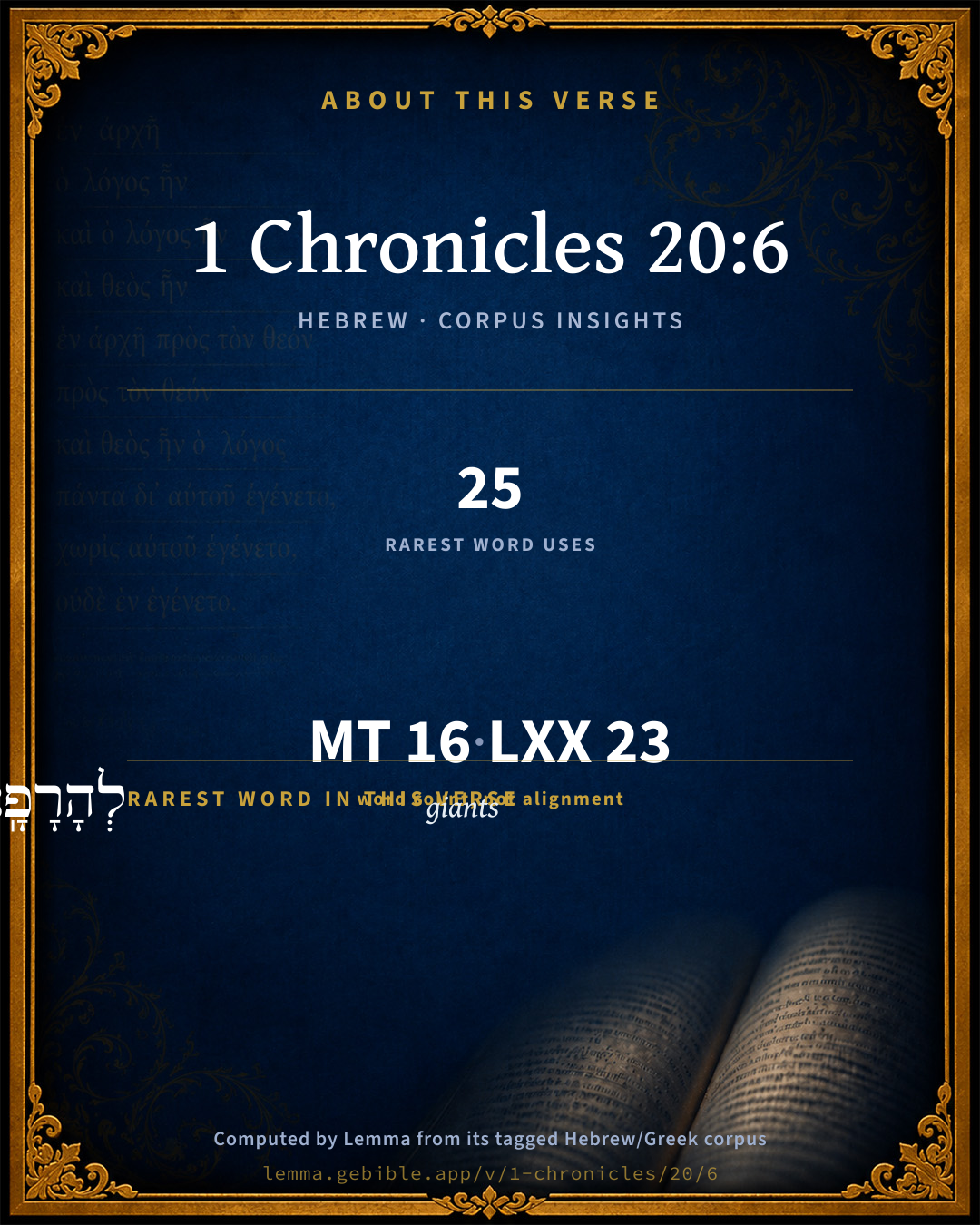
The rarest word here is לְהָרָפָֽא giants H7497 — appearing just 25 times in the whole Hebrew Bible.

Shared distinctive vocabulary

לְהָרָפָֽא giants H7497 occurs in 24 verses of the Hebrew Bible. Also found in:

Grammatical profile

  • 3 verbs
  • 6 nouns
  • 4 adjectives
  • 1 pronoun
  • 1 adverb
  • 1 particle

Verb forms

  • וַתְּהִי Qal · Sequential Imperfect
  • וַיְהִ֣י Qal · Sequential Imperfect
  • נוֹלַ֥ד Niphal · Perfect

Repetition

Words recur within this verse — often emphatic in Hebrew:

  • וַתְּהִי to be H1961 ×2
  • שֵׁשׁ six H8337 ×2

Hebrew & Septuagint length

In English translation the verse runs 36 words from the Hebrew and 37 from the Septuagint (LXX English) — closely comparable.

A rough comparison of the two English renderings, which tokenize alike — not a word-level alignment.

Word counts can differ between the Hebrew and the Greek without any difference in meaning — e.g. the Hebrew direct-object marker אֵת has no separate Greek word, and Greek often adds the article ὁ.

In the original languages it is 16 Hebrew tokens and 23 Greek tokens — but the two are counted differently (Hebrew bundles its prefixes and suffixes into one token; the Greek is in lemma form), so that isn’t a like-for-like length.

Cross-references

1

Topical passages linked to 1 Chronicles 20:6 in the Treasury of Scripture Knowledge — connected by theme and wording, ordered by reader-vote popularity; previews shown in the World English Bible.

  • 2 Samuel 21:20 There was again war at Gath, where was a man of great stature, who had on every hand six fingers, and on every foot six toes, four and twenty in number; and he also was born to the giant.

Cross-references courtesy of OpenBible.info (CC BY 4.0).

Hebrew and Greek witnesses Masoretic Hebrew ↔ Greek Septuagint

The same verse in the two great witnesses to the Old Testament, shown verse-for-verse.

These are two independent witnesses, not word-aligned to each other, and the Septuagint is shown in lemma (dictionary) form.

Hebrew 1 Chronicles 20:6 Masoretic · Westminster Leningrad Codex

וַתְּהִי ע֥וֹד מִלְחָמָ֖ה בְּגַ֑ת וַיְהִ֣י אִ֣ישׁ מִדָּ֗ה וְאֶצְבְּעֹתָ֤יו שֵׁשׁ וָשֵׁשׁ֙ עֶשְׂרִ֣ים וְאַרְבַּ֔ע וְגַם ה֖וּא נוֹלַ֥ד לְהָרָפָֽא

There was again war at Gath, where was a man of great stature, whose fingers and toes were twenty-four, six [on each hand], and six [on each foot]; and he also was born to the giant.

World English Bible · Public Domain

Greek LXX 1 Chronicles 20:6 Septuagint · lemma form

καί γίγνομαι ἔτι πόλεμος ἐν γεθ καί εἰμί ἀνήρ ὑπερμεγέθης καί δάκτυλος αὐτός ἕξ καί ἕξ εἴκοσι τέσσαρες καί οὗτος εἰμί ἀπόγονος γίγας

And there was again war in Geth, and there was a man of extraordinary size, and his fingers and toes were six on each hand and foot, four and twenty; and he was descended from the giants.

LXX2012 (modern English Septuagint) · Public Domain

Hebrew: Westminster Leningrad Codex (CC BY 4.0). Greek: Septuagint (public domain); English from LXX2012 (modern English Septuagint) (Public Domain). How the Septuagint differs from the Hebrew →

Commentary

Notes on 1 Chronicles 20:6 from classic Christian and Jewish commentators (each source and its license shown beneath its notes). The classic Christian expositions comment on the surrounding passage and are grouped to its opening verse, so a note may address several verses; the Jewish commentaries on the Tanakh (Rashi and others) are per-verse, so they appear only where the commentator wrote on this verse.

Lemma curates 59 commentaries, every one of them public domain or Creative Commons licensed, each selected and text-cleaned for this edition rather than reprinted as found. About our sources →

The Biblical Illustrator

Joseph S. Exell

1Ch_20:6

Where was a man of great stature, whose fingers and toes were four and twenty?

Great giants and small

A giant, the son of a giant, children of the giant, a man of great stature. There were giants in those days; there are giants in our day. There is nothing in all history so great as the history of the present; there is no moment of time so pregnant with the meaning of eternity as the moment of our present breathing. You tremble when you read the names of these giants. There is no need to tremble; a deadlier giant is aiming at your heart to-day. The heroics have changed as to apparatus and nomenclature and environment, and all that sort of vanishing vapour; the great fight goes on, the tremendous rush of armies, Philistine and Israelite still meet face to face. And they can make no peace; they represent different worlds, different ideas, atmospheres, purposes, and they never can compromise. June cannot compromise with December. What giants have you been fighting? You have got through the first crude lot. I know it; so have we all. But it was a mere mob of blackguards; the hostility itself was vulgar, coarse, contemptible. The mischief is, lest having got through that mob of scoundrelism and villainy detestable and palpable, we think that therefore the fighting is done. The fighting never ends until the body is in the grave or is laid out on its last bed. You have killed the giant of Falsehood, you would not for the world be thought to be a liar. Long ago you killed the giant Untruth, the black-faced giant Lies. But it does not therefore follow that you are now a true man, that you have escaped the lap and the shame of another falsehood, deeper, subtler, deadlier. Take care! Thou shalt not steal. What is stealing? What is a thief? In the old time the robber despised the thief. A great distinction is drawn in the New Testament between thieves and robbers. Thieves were little, contemptible, mean apers of gigantic, majestic robbery. There is another set of giants to be encountered. What about the giant of Unbelief? But we are rather proud of fighting with the giant Unbelief, and showing thus how extremely intellectual we are. That we have even known the very existence of the word unbelief may show what marvellous giants of might we are. Not until we distinguish between crime and sin can we make any real progress in gospel studies. Have you fought down and conquered the giant of Ingratitude? Who thinks about the spiritual sins? Who is not horrified by crime and draws its garments round it in attestation of its shocked refinement? There may be more sin in ingratitude than in some murders. The murder may have been done in hot blood, in haste to be repented of evermore, through ages eternal to be regretted and deplored as a lasting bruise of the soul. Ingratitude is slow, mean, deliberate, calculating, cruel. The giant of Ingratitude takes a great deal of fighting. Have you overthrown the giant of your Ambition? that sordid, calculating ambition that always wishes to shoulder out some other man and get a foremost place in the race of life? The danger does not lie always along what may be called the line of giants. There are more difficult forces to contend with than the visibly and measurably gigantic. There is not a giant to fight every one of us, but there is a foe that every soul must know and confront and be thrown by or must overthrow. You could shoot an evil beast, but an army could not overtake the Colorado beetle. There would be plenty of people who at other peoples expense would go to distant countries to shoot big game. Poor fools! If they would pay their own waybill I would think a little less harshly of them. So many people are prepared for giants who are not prepared for beetles and bacilli and the germs that sow the air with death. Many people would do heroic things who are only called upon to do little, simple, daily, domestic things. Are you fully aware that there are many assailants and enemies who are not giants by name, but are giants in influence, in obstinacy of purpose, in a cruel determination to ruin your soul? Have you calculated the force of little things? Read me the plagues of Egypt. Lions, tigers, elephants--is that how the story runs? Not a word of it. What were the plagues? Hardly anything bigger than a frog; the lice, the flies, the little things, these excited the alarms of Egypt, and brought Egypt to her knees. You and I are not called upon to fight the giant of Gath, or his son, or the monster referred to in the text, but we are called upon to fight many insects, bacilli, germs of poison, things that require a microscope to discover, so minute as to be to the naked eye actually invisible, and vet on the tip of your finger you may have as many of them as would people any city in Europe as to mere number. To that fight we are called--the fight of spirit with spirit, soul with influence. A tremendous battle is ours! Do you suppose that an eagle fears any foes? Think of those pinions of steel, those eyes of fire, that beak of brass. And yet the eagle is maddened to death by a humming-bird no bigger than the joint of a finger. We have often told of the insect in certain countries that eats away all the woodwork of the door and leaves nothing but a coat of paint, so that going to the door and endeavouring to open it, it falls to pieces under the slightest pressure. That is translated into the life of to-day and into the life of every day. The paint is right, the externalism is beyond criticism, all seems to be well; but take care, for the white ant has eaten up all the interior character, and nothing is left but some flake of paint. We have to fight these things in various forms, but principally I think to-day in the forms of books and tracts and publications. (J. Wolfendale.)

Hindering superfluities

The anxieties and annoyances of those whose estates have become plethoric can only be told by those who possess them. It will be a good thing when, through your industry and prosperity, you can own the house in which you live. But suppose you own fifty houses, and you have all those rents to collect, and all those tenants to please. Suppose you have branched out in business successes until in almost every direction you have investments. The fire-bell rings at night, you rush upstairs to look out of the window, to see if it is any of your mills. Epidemic of crime comes, and there are embezzlements and abscondings in all directions, and you wonder whether any of your bookkeepers will prove recreant. A panic strikes the financial world, and you are like a hen under a sky full of hawks, and trying with anxious cluck to get your overgrown chicken safely under wing. After a certain stage of success has been reached, you have to trust so many important things to others that you are apt to become the prey of others, and you are swindled and defrauded, and the anxiety you had on your brow when you were earning your first thousand dollars is not equal to the anxiety on your brow now that you have won your three hundred thousand. The trouble with such a one is, he is spread out like the unfortunate one in my text. You have more fingers and toes than you know what to do with. Twenty were useful, twenty-four is a hindering superfluity. Disraeli says that a king of Poland abdicated his throne and joined the people, and became a porter to carry burdens. And some one asked him why he did so, and he replied: Upon my honour, gentlemen, the load which I cast off was by far heavier than the one you see me carry. The weightiest is but a straw when compared to that weight under which I laboured. I have slept more in four nights than I have during all my reign. I begin to live and to be a king myself. Elect whom you choose. As for me, I am so well it would be madness to return to court. I am anxious that all who have only ordinary equipment be thankful for what they have and rightly employ it. I think you all have figuratively, as well as literally, fingers enough. Do not long for hindering superfluities. (T. De Witt Talmage.)

The hand

Sir Charles Bell was so impressed with the wondrous construction of the human hand that when the Earl of Bridgewater gave forty thousand dollars for essays on the wisdom and goodness of God, and eight books were written, Sir Charles Bell wrote his entire book on the wisdom and goodness of God as displayed in the human hand. The twenty-seven bones in the hand and wrist with cartilages and ligaments and phalanges of the fingers all made just ready to knit, to sew, to build up, to pull down, to weave, to write, to plough, to pound, to wheel, to battle, to give friendly salutation. The tips of its fingers are so many telegraph offices by reason of their sensitiveness of touch. The bridges, the tunnels, the cities of the whole earth are the victories of the hand. The hands are not dumb, but often speak as distinctly as the lips. With our hands we invite, we repel, we invoke, we entreat, we wring them in grief, or clap them in joy, or spread them abroad in benediction. The malformation of the giants hand in the text glorifies the usual hand. Fashioned of God more exquisitely and wondrously than any human mechanism that was ever contrived, I charge you use it for God and the lifting of the world out of its moral predicament. Employ it in the sublime work of gospel handshaking. (T. De Witt Talmage.)

The foot

Yea; the malformation of this fallen giants foot glorifies the ordinary foot, for which I fear you have never once thanked God. The twenty-six bones of the foot are the admiration of the anatomist. The arch of the foot fashioned with a grace and a poise that Trajans arch, or Constantines arch, or any other arch could not equal. Those arches stand where they were planted, but this arch of the foot is an adjustable arch, a yielding arch, a flying arch, and ready for movements innumerable. The human foot so fashioned as to enable man to stand upright as no other creature, and leave the hand that would otherwise have to help in balancing the body free for anything it chooses. The foot of the camel fashioned for the sand, the foot of the bird fashioned for the tree-branch, the foot of the hind fashioned for the slippery rock, the foot of the lion fashioned to rend its prey, the foot of the horse fashioned for the solid earth, but the foot of man made to cross the desert, or climb the tree, or scale the cliff, or walk the earth, or go anywhere he needs to go. With that Divine triumph of anatomy in your possession where do you walk? In what path of righteousness or what path of sin have you set it down? Where have you left the mark of your footsteps? Amid the petrifactions in the rocks have been found the mark of the feet of birds and beasts of thousands of years ago. And God can trace out all the footsteps of your lifetime, and those you made fifty years ago are as plain as those made in the last soft weather, all of them petrified for the Judgment Day. Oh, the foot! Give me the autobiography of your foot from the time you stepped out of the cradle until to.day, and I will tell your exact character now and what are your prospects for the world to come. (T. De Witt Talmage.)

The folly of underestimating our enemies

An easy accommodation of the text and an allowable one, will permit us to see several practical lessons here. Do not under-estimate the powers that are opposed to you; count their fingers, count their toes, measure their stature, take their weight, calculate them to a nicety as to what they can possibly do. He is a fool who calls a giant a dwarf. The powers of this world are not to be sneered at. Your adversary the devil goeth about--like a cripple? like I. weakling? like a thing that may be despised? No--like a roaring lion; and no man has ever sneered at a lion. (J. Parker, D. D.)

The Biblical Illustrator, edited by Joseph S. Exell (c. 1880s–1900s) — public domain. Text from a community e-Sword module.

Geneva Bible (1599)

Geneva Bible translators

Meaning, that he had six apiece on hands and feet.

Geneva Bible (1599) marginal notes — public domain. Text via Bolls.life.

Adam Clarke's Commentary

Verse 6. Fingers and toes were four and twenty] 2Sa 21:20.

Adam Clarke's Commentary on the Bible (1810–1826) — public domain. Text from a community e-Sword/MySword module.

Ellicott's Commentary for English Readers

(6) Man of great stature.—See Margin. Samuel has a slightly different form.

Whose fingers . . .—The Authorised Version here agrees with the Hebrew text of Samuel. The Hebrew text of Chronicles is abridged: “And his digits six and six—twenty and four.”

Was the son of the giant.—Was born to the Rephaite: i.e., the clan so named.

A Bible Commentary for English Readers, edited by Charles John Ellicott (1878–1897) — public domain. Text from a community e-Sword module.

The Cambridge Bible for Schools and Colleges

gen. ed. J. J. S. Perowne

6. a man of great stature] In 2Sa_21:20 (Heb.) a man of contention, i.e. a challenger or champion.

giant] See 1Ch_20:4, note.

The Cambridge Bible for Schools and Colleges (gen. ed. J. J. S. Perowne; Cambridge University Press, 1878–1918) — public domain. Text from a community e-Sword module.

The Pulpit Commentary

A man of stature. The Hebrew text is hD; mi, as also in 1Ch_11:28; and (in the plural) in Num_13:32. An eccentric and probably corrupt form appears in the parallel place. Pliny ("Nat. Hist.," 2:43) speaks of the Sedigiti, and places them in the family of Forli, among the Himyarites.

Vers. 6, 7.

Strong in body, and strong in God.

Here are introduced to us "a man of great stature," and of abnormal development; a striking instance of mere bodily power: and a man who could overcome this giant, by virtue of his loyalty to God and reliance on his strength. It seems to be a fact that hugeness of body is usually associated with dulness of mind. The quick-witted David is always more than a match for the ponderous Goliath. It seems to be the fact at least under our present human conditions that the culture of the mind tends to ensure the frailty of the body. It seems to be now very difficult, if it may not be called impossible, to gain and to keep the mens sana in corpore sano. Yet we should feel that both the body and the soul are sacred trusts, and that we are responsible to God for the full and wise and harmonious culture of them both. The "body is to be for the Lord," and we are to "prosper even as our souls prosper." There are two principles by which our life should be toned. We should seek to be

I STRONG IN BODY; that is, in the bodily powers and resources. Applications may be made to health, vigour offrame, due control of passions, and proper training of mental faculties. But it should be shown that there are limitations to the success which we may reach in these matters limitations from constitutional peculiarities, from hereditary tendencies, and from disabilities of circumstance. In this each of us can but reach his best possible.

II STRONG IN GOD; that is, in the higher moral capacities and forces. In the culture of these there need be no qualifications or limitations. Due training of these will ensure complete dominion over the bodily powers and relations, so that all the lower faculties take their due place of ministry or service. And this is the high ideal after which we all should strive the true man, who is like the Man Christ Jesus, strong in God, and therefore strong in body. R.T.

The Pulpit Commentary (1880–1919), ed. H.D.M. Spence-Jones & Joseph S. Exell — public domain. Text from a community e-Sword module.

unfoldingWord translationNotes

Door43 World Missions Community

It came about

This phrase is used here to mark the beginning of a new part of the story. If your language has a way for doing this, you could consider using it here.

Rephaim

This is the name given to a race of people who were very tall and strong. (See: How to Translate Names)

Jehonadab ... Shimea

These are the names of men.

These were descendants of the Rephaim of Gath

Here "these" refer to Sippai in 1 Chronicles 20:4, Lahmi in 1 Chronicles 20:5, and the giant in verse 6.

they were killed by the hand of David and by the hand of his soldiers

David and his soldiers are referred to by the part of their bodies used to hold a sword. This can be stated in active form. AT: "David and his soldiers killed the descendants of the Rephaim" (See: Synecdoche and Active or Passive)

translationWords

Gath

descend

David

brother

hand

unfoldingWord translationNotes — © Distant Shores Media and the Door43 World Missions Community, licensed CC BY-SA 4.0. Source: git.door43.org/Door43/en_tn.

Rashi

Rabbi Shlomo Yitzchaki (Rashi)

and there was a man of great stature. This is similar to (Num. 13:32): “big in stature,” and since he was so tall that he had to be measured, he calls him a man of measure.

and his fingers were six and six Twelve on his hands and twelve on his feet, and in Samuel (II 21:20) it says: “twenty-four in number,” i.e., one beside the other, so that one can count them, and this also was his strength, for he was able to grasp the sword with the great strength of his hand. And in Tractate Bechoroth (45b) it is explained why it is written: “six and six, totaling twenty-four.” It is necessary, because if it were written, “six and six,” we would say six on one hand and six on one foot. Therefore, it says, “twenty- four.” And if it would say, “twenty-four,” I would say seven on one and five on the other. Therefore, it says, “six and six, totaling twenty-four.”

Rashi on the Tanakh — English translations: “The Judaica Press complete Tanach with Rashi, translated by A. J. Rosenberg” (CC BY 4.0); “Pentateuch with Rashi's commentary by M. Rosenbaum and A.M. Silbermann, 1929-1934” (public domain); “The Metsudah Tanach series, Lakewood, N.J” (CC BY 4.0); and “The Book of Joshua, Metsudah Publications, 1997” (CC BY 4.0). Text via Sefaria.

Lesson kit

Teaching starters — assembled from the data on this page, not authored interpretation. Every prompt links to the verse data it draws on. Edit before teaching.

1 Chronicles, in the Historical, opens this verse with 16 words (14 distinct Hebrew lemmas). Its most distinctive word is râphâʼ (“giants”). A historical commentator’s framing appears above. Read the whole chapter for the surrounding context.

Discussion questions

  1. What does “giants” (râphâʼ) contribute to the verse as a whole?
  2. How does Genesis 14:5, which shares the word «giants», read alongside this verse?
  3. What does the repetition of “to be” (2× in this one verse) do in this verse?
  4. The translations on this page render this verse differently — a whole-verse word diff, not a word-by-word alignment. What might account for the different wordings?
  5. «וַתְּהִי» is a Qal Sequential Imperfect verb. How does that grammatical form shape the action described?
  6. Compare how The Biblical Illustrator and Geneva Bible (1599) read this verse. Where do they agree or differ?

Things to notice

Reading settings

Reading text

Shown beneath each verse's original-language words.

Old Testament
Old Testament edition

Read the OT as the Masoretic Hebrew (MT) or the Greek Septuagint (LXX).

English shown for the Greek Septuagint (in the Hebrew ↔ Greek comparison).

Comparing translations? Open the Compare panel on any verse page to stack up to four side by side.