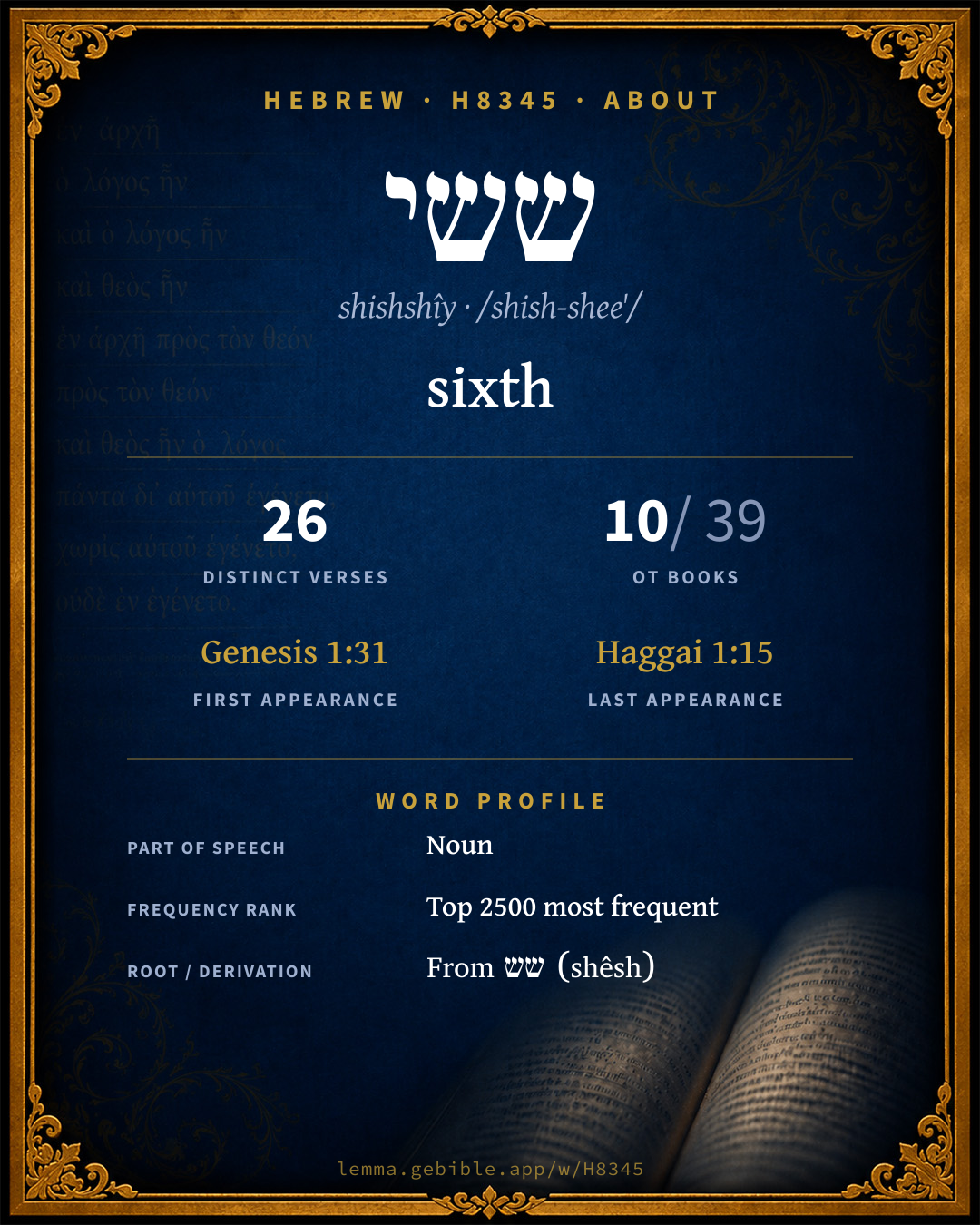
שִׁשִּׁי
sixth
‘sixth’ is one of 3 main senses fuller range ↓
Full lexicon entry — Brown-Driver-Briggs (BDB)
From Brown-Driver-Briggs (BDB)
Where this word appears
See every Absolute-state word in the Hebrew Bible →
Grammar key — what these labels mean
Part of speech
- Adjective
- A word that describes or qualifies a noun.
State
- Absolute
- The independent form of a noun, not bound to a following word.
- Construct
- A noun bound to a following noun in a possessive / “of” relationship (the construct chain).
Gender
- Masculine
- Grammatically masculine.
- Feminine
- Grammatically feminine.
Number
- Singular
- One.
Grammatical forms
- Adjective, Ordinal number, Masculine, Singular, Absolute 22 times (79%)
- Adjective, Ordinal number, Feminine, Singular, Absolute 4 times (14%)
- Adjective, Ordinal number, Feminine, Singular, Construct 2 times (7%)
Parsed forms decoded from the imported morphology (morphhb / Westminster Leningrad Codex — WLC text public domain, morphhb tagging CC BY 4.0), counted across 28 parsed occurrences — not distinct verses.
Every verse where H8345 appears — 26 distinct verses across 10 books. Click any verse to open its interlinear word-by-word view. Verse text shown in the World English Bible for context — . Each verse’s Hebrew form is shown with its reference; the English is not keyword-highlighted, since the data carries no word-level English alignment. Use “Compare translations” on any verse to read it across multiple English versions. This concordance covers the Hebrew Bible; Septuagint (Greek Old Testament) occurrences are not indexed here.
Genesis 2 verses
Exodus 4 verses
- Exodus 16:5 הַ/שִּׁשִּׁ֔י ptcl def.art + Adjective Ordinal number ms It shall come to pass on the sixth day, that they shall prepare that which they bring in, and it shall be twice as much as they gather daily."
- Exodus 16:22 הַ/שִּׁשִּׁ֗י ptcl def.art + Adjective Ordinal number ms It happened that on the sixth day they gathered twice as much bread, two omers for each one, and all the rulers of the congregation came and told Moses.
- Exodus 16:29 הַ/שִּׁשִּׁ֖י ptcl def.art + Adjective Ordinal number ms Behold, because Yahweh has given you the Sabbath, therefore he gives you on the sixth day the bread of two days. Everyone stay in his place. Let no one go out of his place on the seventh day."
- Exodus 26:9 הַ/שִּׁשִּׁ֔ית ptcl def.art + Adjective Ordinal number fs You shall couple five curtains by themselves, and six curtains by themselves, and shall double over the sixth curtain in the forefront of the tent.
Leviticus 1 verse
Numbers 2 verses
- Numbers 7:42 הַ/שִּׁשִּׁ֔י ptcl def.art + Adjective Ordinal number ms On the sixth day, Eliasaph the son of Deuel, prince of the children of Gad
- Numbers 29:29 הַ/שִּׁשִּׁ֛י ptcl def.art + Adjective Ordinal number ms On the sixth day eight bulls, two rams, fourteen he-lambs a year old without blemish;
Joshua 1 verse
2 Samuel 1 verse
1 Chronicles 8 verses
- 1 Chronicles 2:15 הַ/שִּׁשִּׁ֔י ptcl def.art + Adjective Ordinal number ms Ozem the sixth, David the seventh;
- 1 Chronicles 3:3 הַ/שִּׁשִּׁ֥י ptcl def.art + Adjective Ordinal number ms the fifth, Shephatiah of Abital; the sixth, Ithream by Eglah his wife:
- 1 Chronicles 12:11 הַ/שִּׁשִּׁ֔י ptcl def.art + Adjective Ordinal number ms Attai the sixth, Eliel the seventh,
- 1 Chronicles 24:9 הַ/שִּׁשִּֽׁי ptcl def.art + Adjective Ordinal number ms the fifth to Malchijah, the sixth to Mijamin,
- 1 Chronicles 25:13 הַ/שִּׁשִּׁ֣י ptcl def.art + Adjective Ordinal number ms the sixth to Bukkiah, his sons and his brothers, twelve:
- 1 Chronicles 26:3 הַ/שִּׁשִּׁ֔י ptcl def.art + Adjective Ordinal number ms Elam the fifth, Jehohanan the sixth, Eliehoenai the seventh.
- 1 Chronicles 26:5 הַ/שִּׁשִּׁי֙ ptcl def.art + Adjective Ordinal number ms Ammiel the sixth, Issachar the seventh, Peullethai the eighth; for God blessed him.
- 1 Chronicles 27:9 הַ/שִּׁשִּׁי֙ הַ/שִּׁשִּׁ֔י ptcl def.art + Adjective Ordinal number ms ptcl def.art + Adjective Ordinal number ms The sixth [captain] for the sixth month was Ira the son of Ikkesh the Tekoite: and in his division were twenty-four thousand.
Nehemiah 1 verse
Ezekiel 4 verses
- Ezekiel 4:11 שִׁשִּׁ֣ית adj Ordinal number fs You shall drink water by measure, the sixth part of a hin: from time to time shall you drink.
- Ezekiel 8:1 הַ/שִּׁשִּׁ֗ית בַּ/שִּׁשִּׁי֙ ptcl def.art + Adjective Ordinal number fs prep det + Adjective Ordinal number ms It happened in the sixth year, in the sixth [month], in the fifth [day] of the month, as I sat in my house, and the elders of Judah sat before me, that the hand of the Lord Yahweh fell there on me.
- Ezekiel 45:13 שִׁשִּׁ֤ית adj Ordinal number fs cs This is the offering that you shall offer: the sixth part of an ephah from a homer of wheat; and you shall give the sixth part of an ephah from a homer of barley;
- Ezekiel 46:14 שִׁשִּׁ֣ית adj Ordinal number fs cs You shall prepare a meal-offering with it morning by morning, the sixth part of an ephah, and the third part of a hin of oil, to moisten the fine flour; a meal-offering to Yahweh continually by a perpetual ordinance.
Haggai 2 verses
- Haggai 1:1 הַ/שִּׁשִּׁ֔י ptcl def.art + Adjective Ordinal number ms In the second year of Darius the king, in the sixth month, in the first day of the month, the Word of Yahweh came by Haggai, the prophet, to Zerubbabel, the son of Shealtiel, governor of Judah, and to Joshua, the son of Jehozadak, the high priest, saying,
- Haggai 1:15 בַּ/שִּׁשִּׁ֑י prep det + Adjective Ordinal number ms in the twenty-fourth day of the month, in the sixth month, in the second year of Darius the king.
About this entry
At a glance — auto-summarized from this page’s data, not written by a person. Every figure links to its source below. This summary describes the numbers; it doesn’t interpret them.
ששי (shishshîy) is a Hebrew noun most often rendered “sixth.” Debuting at Genesis 1:31, it then recurs through the corpus. With 26 verses in 10 books, it is a moderately common word in the Hebrew Bible. It concentrates in 1 Chronicles, which alone accounts for 31% of its uses. Its lexical range runs to 3 senses. See the sense tree, 26-verse concordance, and the renderings breakdown below.
Gloss history
Strong's 1890 vs modern scholarship
About this word
Strong's H8345 catalogs a Hebrew word from the Hebrew Old Testament.
These counts are not copied from any lexicon or concordance. They are computed here, from the morphology-tagged Hebrew Old Testament. What Lemma adds →
- 26
- distinct verses
- The word appears in 26 distinct verses.
- 10 / 39
- OT books
- The word appears in 10 of 39 Old Testament books.
- #1,190
- by frequency
- Top 2500 most frequent Hebrew words (rank 1,190 of 8,640 Hebrew words by occurrence).
View all 26 occurrences in the concordance →
Most concentrated in
- 1 Chronicles 8 verses 31%
- Exodus 4 verses 15%
- Ezekiel 4 verses 15%
By section of the Old Testament
By traditional corpus
Conventional, traditional groupings — biblical authorship is debated, so this is a traditional corpus grouping, not an authorship claim. Each share is this word’s portion of its verses in that division of the Hebrew canon. Each figure is a share of the word’s 26 distinct verses.
- Torah (Pentateuch) 9 verses · 35%
- Writings (Ketuvim) 9 verses · 35%
- Prophets (Nevi'im) 8 verses · 31%
How translations render this word
Counts come from each version’s own published word-to-Strong’s tagging or interlinear alignment — an approximate guide to how each version renders this word, not a word-level alignment the data otherwise carries. Because each total is that version’s own tagged count, the per-version totals vary from one another and need not match the appearance or distinct-verse counts above. These counts may also differ from a printed concordance because Lemma counts each distinctly tagged rendering and does not collapse phrase taggings into a single head-word total. This is a fixed set of word-tagged versions (KJV, ASV, BSB, ULT) and does not change with the reading translation you choose elsewhere. Each version’s license is shown beside its name below (and on Sources).
BDB lists this Strong’s number as 2 distinct words (homographs). Each count above pools all of them and is not split by sense — see the Senses section below. A low-frequency rendering may belong to a different one of those words, not the primary meaning.
- King James Version†: Sixth 18×, Sixth part 3×
- American Standard Version†: Sixth 16×, Sixth part 3×
- Berean Standard Bible†: Sixth 26×
- unfoldingWord Literal Text†: Sixth 28×
King James Version Public Domain
Renders H8345 across 28† tagged occurrences — most commonly:
Plus 7 renderings that appear only once — usually multi-word phrases or single function words the recovered tagging swept in, not distinct renderings.
American Standard Version Public Domain
Renders H8345 across 28† tagged occurrences — most commonly:
Plus 9 renderings that appear only once — usually multi-word phrases or single function words the recovered tagging swept in, not distinct renderings.
Berean Standard Bible Public Domain
Renders H8345 across 28† tagged occurrences — most commonly:
Plus 2 renderings that appear only once — usually multi-word phrases or single function words the recovered tagging swept in, not distinct renderings.
unfoldingWord Literal Text CC BY-SA 4.0
Renders H8345 across 29† tagged occurrences — most commonly:
Plus 1 rendering that appears only once — usually multi-word phrases or single function words the recovered tagging swept in, not distinct renderings.
Senses in BDB
The 3 senses BDB distinguishes for this word, in lexicon order (not ranked by frequency or importance). The full entry — with sub-senses — is in the Lexicon Entry tab.
- sixth
- sixth (ordinal number)
- sixth (as fraction)
Word origin
m.22 שִׁשִׁית f.6 adj.num. ordin. sixth;—(הַ)יוֹם הַשִּׁשִּׁי Gn 1:31 + 5 times, etc.; בַּשָּׁנָה הַשִּׁשִּׁית Lv 25:21 Ez 8:1, etc.; cstr. שִׁשִּׁית הַהִין Ez 4:11 6th part of the hin, cf. 45:13; 46:14; read שׁ׳ also 45:13b (v. [שִׁשָּׁה] infra).
— Brown-Driver-Briggs (Oxford 1906, public domain), digitized via Sefaria, supplemented by the OpenScriptures HebrewLexicon (CC BY 4.0). See Sources.
Derived from שש (shêsh) (H8337) — six.
Jastrow Dictionary
A second Hebrew/Aramaic lexicon for comparison, covering Aramaic and post-biblical (Talmudic, Targumic, Midrashic) usage that the biblical-Hebrew BDB does not. Matched by lemma rather than by Strong’s number, so a lemma may carry more than one Jastrow headword (shown separately below), and the entries cover usage well beyond the Bible.
שִׁשִּׁי
- preced.) sixth. Gen. R. s. 11 בש׳ נברא וכ׳ on the sixth day man and beast were created. Gen. R. s. 12. Taan. IV, 3; a. fr.
A Dictionary of the Targumim, the Talmud Babli and Yerushalmi, and the Midrashic Literature (Marcus Jastrow; London, Luzac, 1903) — Public Domain. Digitized via Sefaria. Digitized via Sefaria. Full attribution on Sources.
Forms in the corpus
The 18 distinct written forms H8345 takes in the Hebrew Bible, most frequent first — each parse links to that state’s occurrences in the concordance. Hebrew forms include their vowel points and cantillation, so a single lemma takes many written forms.
Same root — word family
Other BDB entries built from the same root as H8345, grouped by Strong’s listed origin. These share a root / origin per the lexicon — not necessarily a shared meaning. Each links to that word’s own entry.
Derives from
Shares the same root
Compare all same-root words → Showing 4 of 5 — not the complete family. They share a root, not necessarily a meaning.
Septuagint verse parallels
This word appears in 25 verses that also exist in the Greek Old Testament (Septuagint), out of the 26 Hebrew verses it occurs in. You can read those verses in Greek by switching the Old Testament edition to the Septuagint.
Read these verses in the Septuagint
- Genesis 1:31
- Exodus 16:5
- Leviticus 25:21
- Numbers 7:42
- Joshua 19:32
- 2 Samuel 3:5
- 1 Chronicles 2:15
- Ezekiel 4:11
- Haggai 1:1
This is a verse-level parallel only — the same verses exist in both the Hebrew and Greek Old Testaments. No word-level Hebrew↔Greek correspondence is claimed: the data carries no such alignment, so no Greek word is shown as this Hebrew word’s translation. Coverage is not total — the Septuagint omits the deuterocanon and renumbers the Psalms, so some Hebrew verses have no direct Greek parallel.