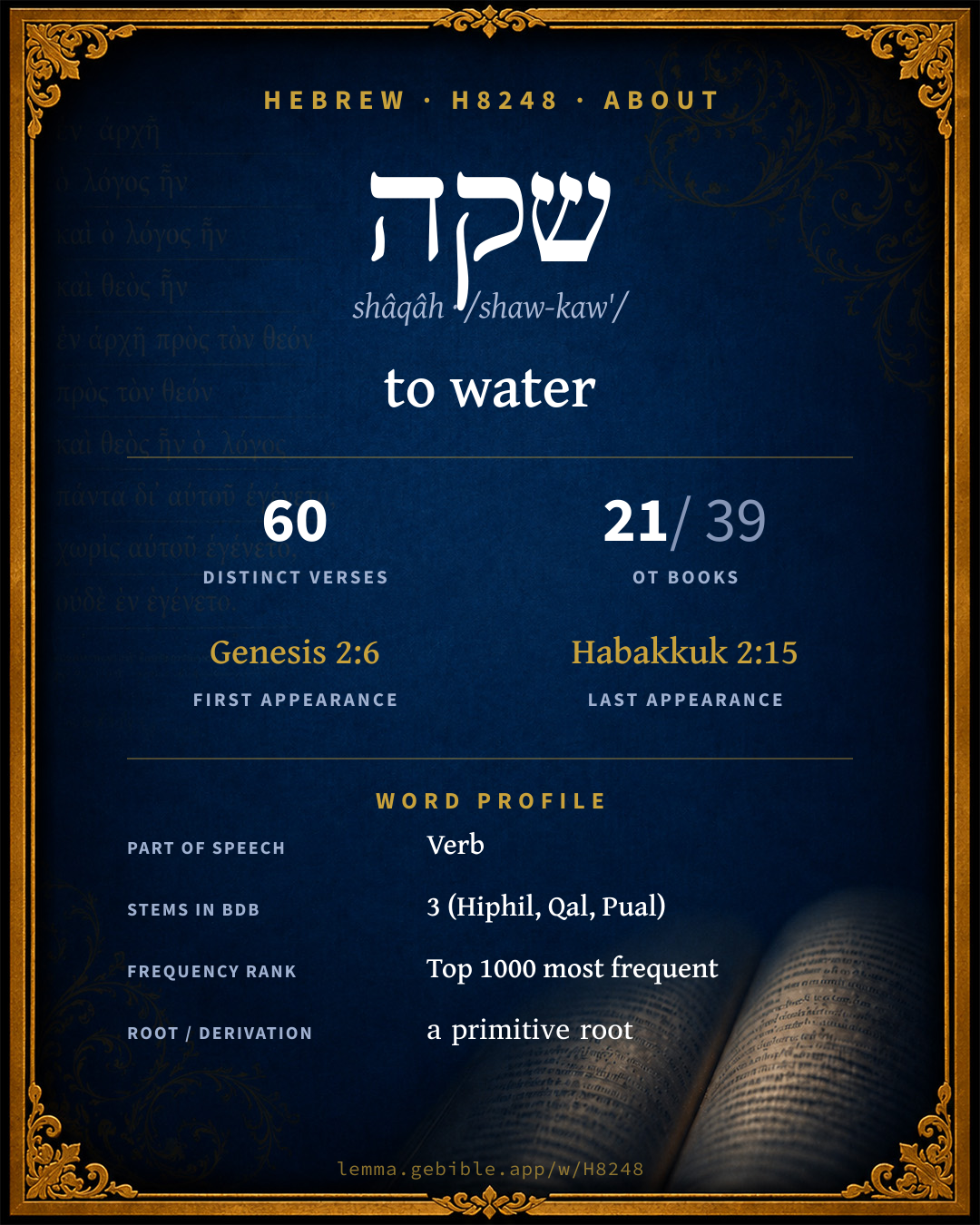
שָׁקָה
to water
‘to water’ is one of 3 main senses fuller range ↓
Full lexicon entry — Brown-Driver-Briggs (BDB)
From Brown-Driver-Briggs (BDB)
Where this word appears
See every Hiphil verb in the Hebrew Bible →
Grammar key — what these labels mean
Part of speech
- Verb
- An action or state-of-being word.
Stem
- Hiphil
- The causative active stem (“he caused / brought about”). Here: ‘cause to drink water’
- Niphal
- Usually the simple passive or reflexive of the Qal (“he was written”).
- Pual
- The passive counterpart of the Piel.
Form
- Sequential Imperfect
- An imperfect with prefixed waw — the standard past-narrative form (waw-consecutive imperfect).
- Infinitive Construct
- A bound verbal noun, frequently with prepositions (“to write / in writing”).
- Sequential Perfect
- A perfect with prefixed waw continuing a preceding imperfect or command (waw-consecutive perfect).
- Imperfect
- An incomplete, ongoing, or future action (“he will / would write”).
- Imperative
- A direct command (“write!”).
- Perfect
- A completed action or state — Hebrew marks aspect (completeness) more than strict tense (“he wrote”).
- Cohortative
- A first-person volitional form expressing wish or resolve (“let me / let us write”).
- Participle Active
- A verbal adjective expressing ongoing or characteristic action (“writing / one who writes”).
State
- Absolute
- The independent form of a noun, not bound to a following word.
- Construct
- A noun bound to a following noun in a possessive / “of” relationship (the construct chain).
Person
- 3rd Person
- The one spoken about (“he / she / it / they”).
- 2nd Person
- The one addressed (“you”).
- 1st Person
- The speaker (“I / we”).
Gender
- Masculine
- Grammatically masculine.
- Feminine
- Grammatically feminine.
- Common
- Either gender — not distinguished for this form.
Number
- Singular
- One.
- Plural
- More than one (in Hebrew, generally three or more).
Grammatical forms 28 distinct
- Verb, Hiphil, Infinitive Construct 7 times (11%)
- Verb, Hiphil, Sequential Imperfect, 3rd Person, Masculine, Singular 6 times (10%)
- Verb, Hiphil, Sequential Perfect, 2nd Person, Masculine, Singular 4 times (6%)
- Verb, Hiphil, Sequential Perfect, 3rd Person, Masculine, Singular 4 times (6%)
- Verb, Hiphil, Imperfect, 3rd Person, Masculine, Plural 4 times (6%)
- Verb, Hiphil, Imperfect, 1st Person, Common, Singular 4 times (6%)
- Verb, Hiphil, Imperative, 2nd Person, Feminine, Singular 3 times (5%)
- Verb, Hiphil, Sequential Perfect, 1st Person, Common, Singular 3 times (5%)
+20 more forms (27 occurrences)
Parsed forms decoded from the imported morphology (morphhb / Westminster Leningrad Codex — WLC text public domain, morphhb tagging CC BY 4.0), counted across 62 parsed occurrences — not distinct verses.
Every verse where H8248 appears — 60 distinct verses across 21 books. Click any verse to open its interlinear word-by-word view. Verse text shown in the World English Bible for context — . Each verse’s Hebrew form is shown with its reference; the English is not keyword-highlighted, since the data carries no word-level English alignment. Use “Compare translations” on any verse to read it across multiple English versions. This concordance covers the Hebrew Bible; Septuagint (Greek Old Testament) occurrences are not indexed here.
Genesis 18 verses
- Genesis 2:6 וְ/הִשְׁקָ֖ה conj + Hiphil wpf 3ms but a mist went up from the earth, and watered the whole surface of the ground.
- Genesis 2:10 לְ/הַשְׁק֖וֹת prep + Hiphil inf.cs A river went out of Eden to water the garden; and from there it was parted, and became four heads.
- Genesis 19:32 נַשְׁקֶ֧ה Hiphil impf 1cp Come, let's make our father drink wine, and we will lie with him, that we may preserve our father's seed."
- Genesis 19:33 וַ/תַּשְׁקֶ֧יןָ conj + Hiphil wimpf 3fp They made their father drink wine that night: and the firstborn went in, and lay with her father. He didn't know when she lay down, nor when she arose.
- Genesis 19:34 נַשְׁקֶ֨/נּוּ Hiphil coh 1cp + sfx pers 3ms It came to pass on the next day, that the firstborn said to the younger, "Behold, I lay last night with my father. Let us make him drink wine again, tonight. You go in, and lie with him, that we may preserve our father's seed."
- Genesis 19:35 וַ/תַּשְׁקֶ֜יןָ conj + Hiphil wimpf 3fp They made their father drink wine that night also. The younger arose, and lay with him. He didn't know when she lay down, nor when she arose.
- Genesis 21:19 וַ/תַּ֖שְׁקְ conj + Hiphil wimpf 3fs God opened her eyes, and she saw a well of water. She went, filled the bottle with water, and gave the boy drink.
- Genesis 24:14 אַשְׁקֶ֑ה Hiphil impf 1cs Let it happen, that the young lady to whom I will say, 'Please let down your pitcher, that I may drink.' She will say, 'Drink, and I will also give your camels a drink.' Let the same be she who you have appointed for your servant Isaac. Thereby will I know that you have shown kindness to my master."
- Genesis 24:18 וַ/תַּשְׁקֵֽ/הוּ conj + Hiphil wimpf 3fs + sfx pers 3ms She said, "Drink, my lord." She hurried, and let down her pitcher on her hand, and gave him drink.
- Genesis 24:19 לְ/הַשְׁקֹת֑/וֹ prep + Hiphil inf.cs + sfx pers 3ms When she had done giving him drink, she said, "I will also draw for your camels, until they have done drinking."
- Genesis 24:43 הַשְׁקִֽי/נִי Hiphil impv 2fs + sfx pers 1cs Behold, I am standing by the spring of water. Let it happen, that the maiden who comes forth to draw, to whom I will say, Give me, I pray you, a little water from your pitcher to drink.
- Genesis 24:45 הַשְׁקִ֥י/נִי Hiphil impv 2fs + sfx pers 1cs Before I had done speaking in my heart, behold, Rebekah came forth with her pitcher on her shoulder. She went down to the spring, and drew. I said to her, 'Please let me drink.'
- Genesis 24:46 אַשְׁקֶ֑ה הִשְׁקָֽתָה Hiphil impf 1cs Hiphil pf 3fs She hurried and let down her pitcher from her shoulder, and said, 'Drink, and I will also give your camels a drink.' So I drank, and she made the camels drink also.
- Genesis 29:2 יַשְׁק֖וּ Hiphil impf 3mp He looked, and behold, a well in the field, and, behold, three flocks of sheep lying there by it. For out of that well they watered the flocks. The stone on the well's mouth was great.
- Genesis 29:3 וְ/הִשְׁק֖וּ conj + Hiphil pf 3cp There all the flocks were gathered. They rolled the stone from the well's mouth, and watered the sheep, and put the stone again on the well's mouth in its place.
- Genesis 29:7 הַשְׁק֥וּ Hiphil impv 2mp He said, "Behold, it is still the middle of the day, not time to gather the cattle together. Water the sheep, and go and feed them."
- Genesis 29:8 וְ/הִשְׁקִ֖ינוּ conj + Hiphil wpf 1cp They said, "We can't, until all the flocks are gathered together, and they roll the stone from the well's mouth. Then we water the sheep."
- Genesis 29:10 וַ/יַּ֕שְׁקְ conj + Hiphil wimpf 3ms It happened, when Jacob saw Rachel the daughter of Laban, his mother's brother, and the sheep of Laban, his mother's brother, that Jacob went near, and rolled the stone from the well's mouth, and watered the flock of Laban his mother's brother.
Exodus 4 verses
- Exodus 2:16 לְ/הַשְׁק֖וֹת prep + Hiphil inf.cs Now the priest of Midian had seven daughters. They came and drew water, and filled the troughs to water their father's flock.
- Exodus 2:17 וַ/יַּ֖שְׁקְ conj + Hiphil wimpf 3ms The shepherds came and drove them away; but Moses stood up and helped them, and watered their flock.
- Exodus 2:19 וַ/יַּ֖שְׁקְ conj + Hiphil wimpf 3ms They said, "An Egyptian delivered us out of the hand of the shepherds, and moreover he drew water for us, and watered the flock."
- Exodus 32:20 וַ/יַּ֖שְׁקְ conj + Hiphil wimpf 3ms He took the calf which they had made, and burnt it with fire, ground it to powder, and scattered it on the water, and made the children of Israel drink of it.
Numbers 4 verses
- Numbers 5:24 וְ/הִשְׁקָה֙ conj + Hiphil wpf 3ms He shall make the woman drink the water of bitterness that causes the curse; and the water that causes the curse shall enter into her and become bitter.
- Numbers 5:26 יַשְׁקֶ֥ה Hiphil impf 3ms The priest shall take a handful of the meal offering, as the memorial of it, and burn it on the altar, and afterward shall make the woman drink the water.
- Numbers 5:27 וְ/הִשְׁקָ֣/הּ conj + Hiphil wpf 3ms + sfx pers 3fs When he has made her drink the water, then it shall happen, if she is defiled, and has committed a trespass against her husband, that the water that causes the curse will enter into her and become bitter, and her body will swell, and her thigh will fall away: and the woman will be a curse among her people.
- Numbers 20:8 וְ/הִשְׁקִיתָ֥ conj + Hiphil wpf 2ms Take the rod, and assemble the congregation, you, and Aaron your brother, and speak you to the rock before their eyes, that it give forth its water; and you shall bring forth to them water out of the rock; so you shall give the congregation and their cattle drink.
Deuteronomy 1 verse
Judges 1 verse
1 Samuel 1 verse
2 Samuel 1 verse
1 Chronicles 1 verse
2 Chronicles 1 verse
Esther 1 verse
Job 2 verses
Psalms 7 verses
- Psalms 36:8 תַשְׁקֵֽ/ם Hiphil impf 2ms + sfx pers 3mp They shall be abundantly satisfied with the abundance of your house. You will make them drink of the river of your pleasures.
- Psalms 60:3 הִ֝שְׁקִיתָ֗/נוּ Hiphil pf 2ms + sfx pers 1cp You have shown your people hard things. You have made us drink the wine that makes us stagger.
- Psalms 69:21 יַשְׁק֥וּ/נִי Hiphil impf 3mp + sfx pers 1cs They also gave me gall for my food. In my thirst, they gave me vinegar to drink.
- Psalms 78:15 וַ֝/יַּ֗שְׁקְ conj + Hiphil wimpf 3ms He split rocks in the wilderness, And gave them drink abundantly as out of the depths.
- Psalms 80:5 וַ֝/תַּשְׁקֵ֗/מוֹ conj + Hiphil wimpf 2ms + sfx pers 3mp You have fed them with the bread of tears, And given them tears to drink in large measure.
- Psalms 104:11 יַ֭שְׁקוּ Hiphil impf 3mp They give drink to every animal of the field. The wild donkeys quench their thirst.
- Psalms 104:13 מַשְׁקֶ֣ה Hiphil ptcp.act ms He waters the mountains from his chambers. The earth is filled with the fruit of your works.
Proverbs 1 verse
Ecclesiastes 1 verse
Song of Solomon 1 verse
Isaiah 2 verses
- Isaiah 27:3 אַשְׁקֶ֑/נָּה Hiphil impf 1cs + sfx pers 3fs I Yahweh am its keeper; I will water it every moment: lest any hurt it, I will keep it night and day.
- Isaiah 43:20 לְ/הַשְׁק֖וֹת prep + Hiphil inf.cs The animals of the field shall honor me, the jackals and the ostriches; because I give waters in the wilderness, and rivers in the desert, to give drink to my people, my chosen,
Jeremiah 7 verses
- Jeremiah 8:14 וַ/יַּשְׁקֵ֣/נוּ conj + Hiphil wimpf 3ms + sfx pers 1cp Why do we sit still? assemble yourselves, and let us enter into the fortified cities, and let us be silent there; for Yahweh our God has put us to silence, and given us water of gall to drink, because we have sinned against Yahweh.
- Jeremiah 9:15 וְ/הִשְׁקִיתִ֖י/ם conj + Hiphil wpf 1cs + sfx pers 3mp therefore thus says Yahweh of Hosts, the God of Israel, Behold, I will feed them, even this people, with wormwood, and give them water of gall to drink.
- Jeremiah 16:7 יַשְׁק֤וּ Hiphil impf 3mp neither shall men break [bread] for them in mourning, to comfort them for the dead; neither shall men give them the cup of consolation to drink for their father or for their mother.
- Jeremiah 23:15 וְ/הִשְׁקִתִ֖י/ם conj + Hiphil wpf 1cs + sfx pers 3mp Therefore thus says Yahweh of Hosts concerning the prophets: Behold, I will feed them with wormwood, and make them drink the water of gall; for from the prophets of Jerusalem is ungodliness gone forth into all the land.
- Jeremiah 25:15 וְ/הִשְׁקִיתָ֤ה conj + Hiphil wpf 2ms For thus says Yahweh, the God of Israel, to me: take this cup of the wine of wrath at my hand, and cause all the nations, to whom I send you, to drink it.
- Jeremiah 25:17 וָֽ/אַשְׁקֶה֙ conj + Hiphil wimpf 1cs Then took I the cup at Yahweh's hand, and made all the nations to drink, to whom Yahweh had sent me:
- Jeremiah 35:2 וְ/הִשְׁקִיתָ֥ conj + Hiphil wpf 2ms Go to the house of the Rechabites, and speak to them, and bring them into the house of Yahweh, into one of the chambers, and give them wine to drink.
Ezekiel 2 verses
- Ezekiel 17:7 לְ/הַשְׁק֣וֹת prep + Hiphil inf.cs There was also another great eagle with great wings and many feathers: and, behold, this vine did bend its roots toward him, and shot forth its branches toward him, from the beds of its plantation, that he might water it.
- Ezekiel 32:6 וְ/הִשְׁקֵיתִ֨י conj + Hiphil wpf 1cs I will also water with your blood the land in which you swim, even to the mountains; and the watercourses shall be full of you.
Joel 1 verse
Amos 2 verses
- Amos 2:12 וַ/תַּשְׁק֥וּ conj + Hiphil wimpf 2mp "But you gave the Nazirites wine to drink, And commanded the prophets, saying, 'Don't prophesy!'
- Amos 8:8 ו/נשקה conj + Niphal wpf 3fs Won't the land tremble for this, And everyone mourn who dwells in it? Yes, it will rise up wholly like the River; And it will be stirred up and sink again, like the River of Egypt.
Habakkuk 1 verse
About this entry
At a glance — auto-summarized from this page’s data, not written by a person. Every figure links to its source below. This summary describes the numbers; it doesn’t interpret them.
The Hebrew verb שקה centers on the idea of “to water.” Its earliest occurrence is Genesis 2:6. It turns up in 60 verses across 21 books, a moderately common footprint. The word gravitates to Genesis (30%), then Psalms and Jeremiah. The verb spans 3 stems, from Hiphil to Qal. Dig into 60-verse concordance and the renderings breakdown below.
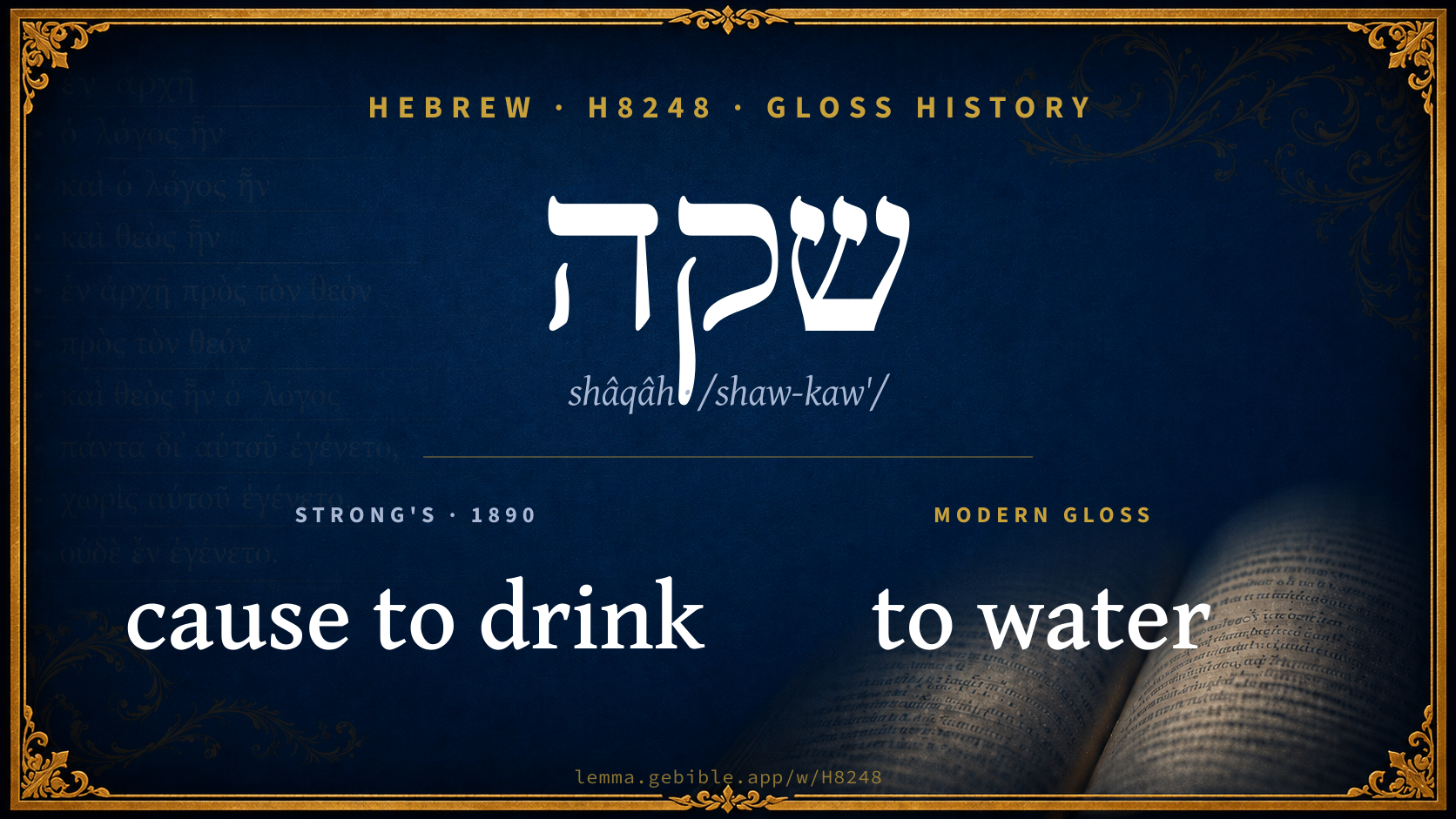
Gloss history
Strong's 1890 vs modern scholarship
About this word
Strong's H8248 catalogs a Hebrew word from the Hebrew Old Testament.
These counts are not copied from any lexicon or concordance. They are computed here, from the morphology-tagged Hebrew Old Testament. What Lemma adds →
- 60
- distinct verses
- The word appears in 60 distinct verses.
- 21 / 39
- OT books
- The word appears in 21 of 39 Old Testament books.
- #623
- by frequency
- Top 1000 most frequent Hebrew words (rank 623 of 8,640 Hebrew words by occurrence).
View all 60 occurrences in the concordance →
By section of the Old Testament
By traditional corpus
Conventional, traditional groupings — biblical authorship is debated, so this is a traditional corpus grouping, not an authorship claim. Each share is this word’s portion of its verses in that division of the Hebrew canon. Each figure is a share of the word’s 60 distinct verses.
- Torah (Pentateuch) 27 verses · 45%
- Prophets (Nevi'im) 18 verses · 30%
- Writings (Ketuvim) 15 verses · 25%
How translations render this word
Counts come from each version’s own published word-to-Strong’s tagging or interlinear alignment — an approximate guide to how each version renders this word, not a word-level alignment the data otherwise carries. Because each total is that version’s own tagged count, the per-version totals vary from one another and need not match the appearance or distinct-verse counts above. These counts may also differ from a printed concordance because Lemma counts each distinctly tagged rendering and does not collapse phrase taggings into a single head-word total. This is a fixed set of word-tagged versions (KJV, ASV, BSB, ULT) and does not change with the reading translation you choose elsewhere. Each version’s license is shown beside its name below (and on Sources).
- King James Version: Drink 25×, Butler 7×, Watered 5×
- American Standard Version: Drink 24×, Butler 7×, Water 4×
- Berean Standard Bible: Drink 15×, Water 6×, Watered 5×
- unfoldingWord Literal Text: Drink 16×, Water 6×, Watered 5×
King James Version Public Domain
Renders H8248 across 82 tagged occurrences — most commonly:
Plus 31 renderings that appear only once — usually multi-word phrases or single function words the recovered tagging swept in, not distinct renderings. Not rendered by a distinct English word in 1 further occurrence.
American Standard Version Public Domain
Renders H8248 across 82 tagged occurrences — most commonly:
Plus 36 renderings that appear only once — usually multi-word phrases or single function words the recovered tagging swept in, not distinct renderings.
Berean Standard Bible Public Domain
Renders H8248 across 62 tagged occurrences — most commonly:
Plus 27 renderings that appear only once — usually multi-word phrases or single function words the recovered tagging swept in, not distinct renderings.
unfoldingWord Literal Text CC BY-SA 4.0
Renders H8248 across 87 tagged occurrences — most commonly:
Plus 42 renderings that appear only once — usually multi-word phrases or single function words the recovered tagging swept in, not distinct renderings.
Senses in the full BDB
Hebrew verbs can shift meaning by stem (binyan): Qal is the basic action, Niphal is often passive or reflexive, Piel often intensifies or makes it factitive, and Hiphil is typically causative. The senses below are grouped under the stem BDB assigns to each. This entry also uses Pual (the passive of Piel).
What do BDB’s symbols mean?
BDB uses these scholarly abbreviations:
| Symbol | Meaning |
|---|---|
| 𝔊 | the Septuagint (the ancient Greek translation, LXX) |
| 𝔙 | the Vulgate (the Latin translation) |
| 𝔖 | the Syriac version (the Peshitta) |
| 𝔗 | the Targum (the Aramaic translation) |
| ψ | the Psalms |
| √ | root (the underlying root or stem) |
| ‖ | parallel passage (a synonymous or contrasted parallel) |
| † | the dagger: every passage where the word occurs is cited |
The 5 senses and sub-senses the full Brown-Driver-Briggs lexicon distinguishes for this word, in lexicon order (not ranked by frequency), with BDB’s own verbatim wording and sub-sense lettering. Shown in Hebrew script with BDB’s own scholarly abbreviations. The condensed entry is in the Lexicon Entry tab. See also the Forms in the corpus table below.
Hiphil
- cause to drink water, give to drink (NH Hiph. id.; Arabic سَقَى i. give to drink; Sab. סקי be irrigated Fell ZMG liv (1900), 246, מסקי drinks Hom Chr 124, מסתקין id. DHM Hofmus., No. 1, 1.7; Ethiopic ሰቀየ: water, irrigate; Assyrian šaḳû i. = Heb. Hiph., Aramaic שְׁקָא, ܫܩܳܐ Aph.);—for
Qal
- v. I. שָׁתָה;—Pf. 3 ms. consec. וְהִשְׁקָה Gn 2:6 +, sf. וְהִשְׁקָהּ Nu 5:27; 2 ms. consec. וְהִשְׁקִיתָ Nu 20:8 +; 1 s. consec. וְהִשְׁקֵיתִי Ez 32:6, etc.; Impf. 3 ms. יַשְׁקֶה Nu 5:26, וַיַּשְׁקְ Gn 29:10 +, etc.; Imv. ms. sf. הַשְׁקֵ֫הוּ Pr 25:21; fs. sf. הַשְׁקִ֫ינִי Gn 24:43 +; Inf. cstr. הַשְׁקוֹת Gn 2:10 +, sf. הַשְׁקֹתוֹ 24:19; Pt. מַשְׁקֶה ψ 104:13, cstr. Hb 2:15 (v. also i., ii. מַשְׁקֶה);— e.g. Genesis 2:6
- 1. irrigate, ground: subj. man Dt 11:10, mist Gn 2:6, river v 10 (both J), spring Jo 4:18; subj. י׳ Is 27:3 (כֶּרֶם), Ez 17:7 (גֶּפֶן), both in fig., fig. also 32:6 water land מִדָּם; lit. c. מִן of source ψ 104:13 (הָרִים) and (subj. man) Ec 2:6 (יַעַר). e.g. Deuteronomy 11:10
- 2. water, give drink to, usually human subj., acc. of beast, Gn 24:14, 46(×2); 29:2 (מִן of source), v 3, 7, 8, 10 Ex 2:16, 17, 19 (all J), ψ 104:11 (subj. springs); acc. pers. Gn 21:19 (E), 24:18, 19, 45 (J), Hb 2:15 (fig.), Is 43:20 (י׳ subj.), ψ 78:15 (id.), 2 Ch 28:15, c. ב of vessel Est 1:7; c. acc. pers. et animal. Nu 20:8 (P); give one something to drink, acc. pers. + rei (water, wine, etc.), Am 2:12; Gn 19:32, 33, 34, 35; 24:43; Nu 5:24, 26; Ju 4:19 1 S 30:11; 2 S 23:15 = 1 Ch 11:15; Jb 22:7, cf. Ct 8:2 (מִיַּיִן); fig. Je 8:14; 9:14; 16:7; 23:15; 25:15 ψ 69:22, cf. וְנַחַל עֲדָנֶיךָ תַשְׁקֵם 36:9, and וַתַּשְׁקֵ֫מוֹ בִּדְמָעוֹת 80:6; acc. rei om., lit. Ju 4:19; Ex 32:20 (E), fig. Je 25:17.—Vid. also i. מַשְׁקֶה infra. e.g. Genesis 24:14
Pual
- Impf. 3 ms. וּמֹחַ עַצְמוֹתָיו יְשֻׁקֶּה Jb 21:24 the marrow of his bones is watered, (refreshed, invigorated).—נשׁקה Am 8:8 v. שׁקע. e.g. Job 21:24
Senses from the full Brown-Driver-Briggs lexicon (Brown, Driver, Briggs; Oxford 1906 — public domain), digitized via Sefaria, supplemented by the OpenScriptures HebrewLexicon (CC BY 4.0). Full attribution on Sources.
Word origin
Origin: a primitive root
Jastrow Dictionary
A second Hebrew/Aramaic lexicon for comparison, covering Aramaic and post-biblical (Talmudic, Targumic, Midrashic) usage that the biblical-Hebrew BDB does not. Matched by lemma rather than by Strong’s number, so a lemma may carry more than one Jastrow headword (shown separately below), and the entries cover usage well beyond the Bible.
שָׁקָה
- , v. שקי
שקי
- [(cmp. שקע) to settle.]
- cmp. שָׁתָה) to give drink; to water. M. Kat. I, 1 מַשְׁקִין בית וכ׳ you may water a field that depends on irrigation during the festive week &c. Keth. 111ᵇ ממַשְׁקֵהוּ חלב, v. שֵׁן. Cant. R. to I, 12; Num. R. s. 113 ומשה מַשְׁקֶה and Moses gave drink (to those who were being circumcised). Eduy. V, 6 אין משקין וכ׳ we do not give the testing waters to a proselyte (v. סוֹטָה). Ib. דוגמא הִשְׁקוּהָ, v. דּוּגְמָא; Ber. 19ᵃ; a. fr.
A Dictionary of the Targumim, the Talmud Babli and Yerushalmi, and the Midrashic Literature (Marcus Jastrow; London, Luzac, 1903) — Public Domain. Digitized via Sefaria. Digitized via Sefaria. Full attribution on Sources.
Forms in the corpus
The 53 distinct written forms H8248 takes in the Hebrew Bible, most frequent first — each parse links to that stem’s occurrences in the concordance. Hebrew forms include their vowel points and cantillation, so a single lemma takes many written forms.
Same root — word family
Other BDB entries built from the same root as H8248, grouped by Strong’s listed origin. These share a root / origin per the lexicon — not necessarily a shared meaning. Each links to that word’s own entry.
Derived from this word
- משקה mashqeh H4945 drink
- שקו shiqquv H8249 drink
- שקוי shiqqûwy H8250 drink
- שקת shôqeth H8268 watering trough
Compare all same-root words → Showing 4 of 5 — not the complete family. They share a root, not necessarily a meaning.
Septuagint verse parallels
This word appears in 57 verses that also exist in the Greek Old Testament (Septuagint), out of the 60 Hebrew verses it occurs in. You can read those verses in Greek by switching the Old Testament edition to the Septuagint.
Read these verses in the Septuagint
- Genesis 2:6
- Exodus 2:16
- Numbers 5:24
- Deuteronomy 11:10
- Judges 4:19
- 1 Samuel 30:11
- 2 Samuel 23:15
- 1 Chronicles 11:17
- 2 Chronicles 28:15
- Esther 1:7
- Job 21:24
- Psalms 36:8
This is a verse-level parallel only — the same verses exist in both the Hebrew and Greek Old Testaments. No word-level Hebrew↔Greek correspondence is claimed: the data carries no such alignment, so no Greek word is shown as this Hebrew word’s translation. Coverage is not total — the Septuagint omits the deuterocanon and renumbers the Psalms, so some Hebrew verses have no direct Greek parallel.