Jeremiah 25:17

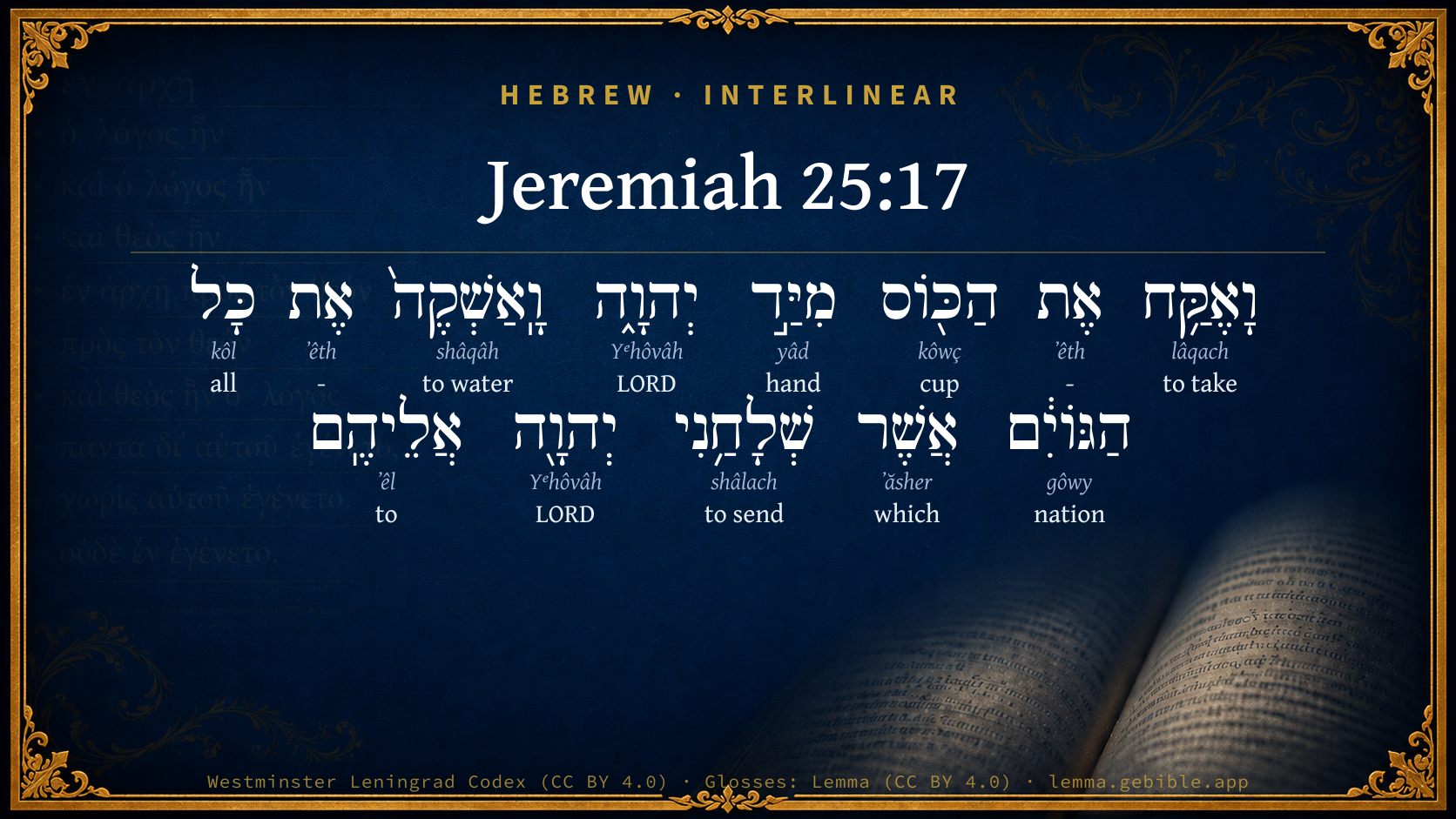
Hebrew (Westminster Leningrad Codex) Jeremiah 25:17 appears in the Hebrew Old Testament. The text above is from the Westminster Leningrad Codex. Each word links to its Strong’s number, a concise gloss, and parsing drawn from the Open Scriptures Hebrew Bible morphology. Click any word for its full Brown-Driver-Briggs (BDB) entry.
Download image
Cite this verse

Jeremiah 25:17 (World English Bible). Public Domain. Lemma interlinear Bible study tool, https://lemma.gebible.app/v/jeremiah/25/17.

Show BibTeX & RIS
BibTeX
RIS
English Translation
Then took I the cup at Yahweh's hand, and made all the nations to drink, to whom Yahweh had sent me:
World English Bible · Public Domain
Download a study sheet

One document with this verse’s original text, its word-by-word gloss line, the meaning frame, cross-references with their text, attributed commentary, and full source and license credits — printable, and it pastes into notes with its structure intact.

This verse Autodidact and up

Study sheet (.html) Plain text (.txt)

A passage Seminary Student

Up to 50 verses in one chapter. A passage sheet keeps up to 6 commentary sources and 12 cross-references per verse, in the order this page ranks them, and says so on the sheet whenever that leaves anything out. Ask for a single verse and you get the Autodidact verse sheet above.

Everything on this page stays free to read, with no account — the sheet is a download of what is already on screen, not access to it.

Want to remove ads? Support Godless Engineer
Compare translations 3

The same verse in 3 English versions, stacked beneath the original-language interlinear above. Click any original word for its lexicon entry.

Each is an independent rendering of the whole verse — the interlinear is not word-aligned to these translations.

Highlighted words mark where these versions differ — a whole-verse word diff, not a word-by-word alignment.

  • World English Bible Public Domain
    Then took I the cup at Yahweh's hand, and made all the nations to drink, to whom Yahweh had sent me:
  • King James Version Public Domain
    Then took I the cup at the LORD's hand, and made all the nations to drink, unto whom the LORD had sent me:
  • unfoldingWord Literal Text CC BY-SA 4.0
    And I took the cup from the hand of Yahweh, and I made all of the nations drink, to which Yahweh had sent me:

unfoldingWord Literal Text — © unfoldingWord, licensed CC BY-SA 4.0. Word-aligned USFM3 via Door43 (git.door43.org/unfoldingWord/en_ult).

Versions to compare (up to 4)

3 of 4 selected

Show all 18 translations

Every available English version of this verse, each an independent rendering of the whole verse.

  • World English Bible Public Domain
    Then took I the cup at Yahweh's hand, and made all the nations to drink, to whom Yahweh had sent me:
  • Berean Standard Bible Public Domain
    So I took the cup from the LORD’s hand and made all the nations drink from it, each one to whom the LORD had sent me,
  • Majority Standard Bible Public Domain
    So I took the cup from the LORD’s hand and made all the nations drink from it, each one to whom the LORD had sent me,
  • King James Version Public Domain
    Then took I the cup at the LORD's hand, and made all the nations to drink, unto whom the LORD had sent me:
  • American Standard Version (1901) Public Domain
    Then took I the cup at Jehovah's hand, and made all the nations to drink, unto whom Jehovah had sent me:
  • Revised Version (1885) Public Domain
    Then took I the cup at the LORD’S hand, and made all the nations to drink, unto whom the LORD had sent me:
  • Geneva Bible (1599) Public Domain
    Then tooke I the cup at the Lordes hand, and made all people to drinke, vnto whome the Lord had sent me:
  • Douay-Rheims (1899) Public Domain
    And I took the cup at the hand of the Lord, and I presented it to all the nations to drink of it, to which the Lord sent me:
  • Young's Literal Translation Public Domain
    `And I take the cup out of the hand of Jehovah, and cause all the nations to drink unto whom Jehovah sent me:
  • Literal Standard Version CC BY-SA 4.0
    And I take the cup out of the hand of YHWH, and cause all the nations to drink to whom YHWH sent me:
  • Unlocked Literal Bible CC BY-SA 4.0
    So I took the cup from Yahweh's hand, and I made all the nations to which Yahweh had sent me drink it:
  • unfoldingWord Literal Text CC BY-SA 4.0
    And I took the cup from the hand of Yahweh, and I made all of the nations drink, to which Yahweh had sent me:
  • Darby Bible Public Domain
    And I took the cup at Jehovah's hand, and made all the nations to drink, to whom Jehovah had sent me:
  • World Messianic Bible Public Domain
    Then I took the cup at the LORD’s hand, and made all the nations to drink, to whom the LORD had sent me:
  • Webster's Bible Public Domain
    Then I took the cup at the LORD'S hand, and made all the nations to drink, to whom the LORD had sent me:
  • Free Bible Version CC BY-SA 4.0
    I took the cup the Lord handed to me and made all the nations drink from it that he sent me to:
  • Bible in Basic English Public Domain
    Then I took the cup from the Lord's hand, and gave a drink from it to all the nations to whom the Lord sent me;
  • JPS Tanakh (1917) Public Domain
    Then took I the cup of the LORD'S hand, and made all the nations to drink, unto whom the LORD had sent me:

Literal Standard Version (2020), Covenant Press — licensed CC BY-SA 4.0. Text via the HelloAO Bible API (eBible.org). Unlocked Literal Bible (unfoldingWord) — licensed CC BY-SA 4.0. Text via the HelloAO Bible API (eBible.org). unfoldingWord Literal Text — © unfoldingWord, licensed CC BY-SA 4.0. Word-aligned USFM3 via Door43 (git.door43.org/unfoldingWord/en_ult). Free Bible Version, Dr. Jonathan Gallagher — licensed CC BY-SA 4.0. Text via the HelloAO Bible API (eBible.org).

Word by word

More ways to search: Search by grammar → Find every occurrence → Compare this word →

Practice this passage: Drill this verse → Learn its vocabulary →

הַכּ֖וֹס
kôwç
H3563
“the · cup”
Particle, Definite Article + Noun, Common, Feminine, Singular, Absolute
Part of Speech
Particle + Noun
Type
Common
Gender
Feminine
Number
Singular
State
Absolute
Full BDB Definition

Origin: from an unused root meaning to hold together

TWOT: 965 , 966

cup (noun feminine) - a kind of owl (an unclean bird) (noun masculine)
  1. וָאֶקַּ֥ח lâqach H3947 “and · to take” Conjunction + Verb, Qal, Sequential Imperfect, 1st Person, Common, Singular
  2. אֶת ʼêth H853 “-” Particle, Direct Object
  3. מִיַּ֣ד yâd H3027 “from · hand of” Preposition + Noun, Common, Both, Singular, Construct
  4. יְהוָ֑ה Yᵉhôvâh H3068 “LORD” Noun, Proper
  5. וָֽאַשְׁקֶה֙ shâqâh H8248 “and · to water” Conjunction + Verb, Hiphil, Sequential Imperfect, 1st Person, Common, Singular
  6. אֶת ʼêth H853 “-” Particle, Direct Object
  7. כָּל kôl H3605 “all of” Noun, Common, Masculine, Singular, Construct
  8. הַגּוֹיִ֔ם gôwy H1471 “the · nations” Particle, Definite Article + Noun, Common, Masculine, Plural, Absolute
  9. אֲשֶׁר ʼăsher H834 “which” Particle, Relative
  10. שְׁלָחַ֥נִי shâlach H7971 “to send · me” Verb, Qal, Perfect, 3rd Person, Masculine, Singular + Suffix, Personal, 1st Person, Common, Singular
  11. יְהוָ֖ה Yᵉhôvâh H3068 “LORD” Noun, Proper
  12. אֲלֵיהֶֽם ʼêl H413 “to · them” Preposition + Suffix, Personal, 3rd Person, Masculine, Plural

About this verse

These counts appear in no published source. They are computed here, from the morphology-tagged text and Lemma’s own curated glosses. What Lemma adds →

13
words
11
distinct lemmas
Prophets
section

Shared distinctive vocabulary

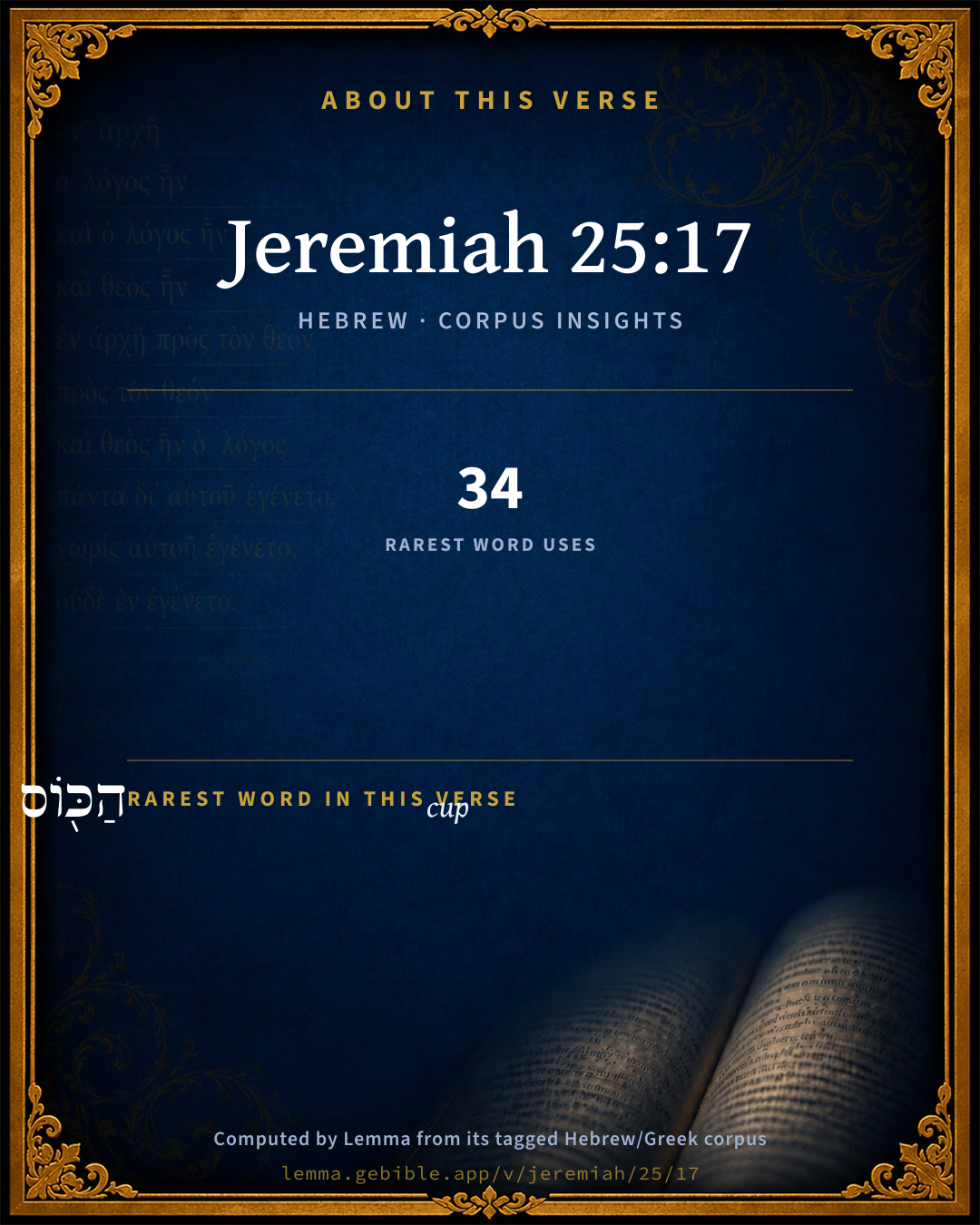
הַכּ֖וֹס cup H3563 occurs in 29 verses of the Hebrew Bible. Also found in:

Grammatical profile

  • 3 verbs
  • 6 nouns
  • 1 preposition
  • 3 particles

Verb forms

  • וָאֶקַּ֥ח Qal · Sequential Imperfect
  • וָֽאַשְׁקֶה֙ Hiphil · Sequential Imperfect
  • שְׁלָחַ֥נִי Qal · Perfect

Repetition

A word recurs within this verse — often emphatic in Hebrew:

  • יְהוָ֑ה LORD H3068 ×2

Cross-references

5

Topical passages linked to Jeremiah 25:17 in the Treasury of Scripture Knowledge — connected by theme and wording, ordered by reader-vote popularity; previews shown in the World English Bible.

  • Jeremiah 1:10 behold, I have this day set you over the nations and over the kingdoms, to pluck up and to break down and to destroy and to overthrow, to build and to plant.
  • Jeremiah 25:28 It shall be, if they refuse to take the cup at your hand to drink, then shall you tell them, Thus says Yahweh of Hosts: You shall surely drink.
  • Jeremiah 27:3 and send them to the king of Edom, and to the king of Moab, and to the king of the children of Ammon, and to the king of Tyre, and to the king of Sidon, by the hand of the messengers who come to Jerusalem to Zedekiah king of Judah;
  • Jeremiah 46:1–28 The word of Yahweh which came to Jeremiah the prophet concerning the nations.
  • Ezekiel 43:3 It was according to the appearance of the vision which I saw, even according to the vision that I saw when I came to destroy the city; and the visions were like the vision that I saw by the river Chebar; and I fell on my face.

Cross-references courtesy of OpenBible.info (CC BY 4.0).

Hebrew and Greek witnesses Masoretic Hebrew ↔ Greek Septuagint

The same verse in the two great witnesses to the Old Testament, shown verse-for-verse.

These are two independent witnesses, not word-aligned to each other, and the Septuagint is shown in lemma (dictionary) form.

Hebrew Jeremiah 25:17 Masoretic · Westminster Leningrad Codex

וָאֶקַּ֥ח אֶת הַכּ֖וֹס מִיַּ֣ד יְהוָ֑ה וָֽאַשְׁקֶה֙ אֶת כָּל הַגּוֹיִ֔ם אֲשֶׁר שְׁלָחַ֥נִי יְהוָ֖ה אֲלֵיהֶֽם

Then took I the cup at Yahweh's hand, and made all the nations to drink, to whom Yahweh had sent me:

World English Bible · Public Domain

Greek LXX Structure differs

In the Septuagint, Jeremiah is about an eighth shorter than the Hebrew and arranges its material differently — the Oracles Against the Nations (Hebrew chapters 46–51) appear in the middle of the Greek book, after 25:13. Because the chapter and verse boundaries do not line up, a verse-for-verse comparison with the Hebrew is not shown.

A verse-for-verse comparison isn’t shown here because the chapters and verses don’t line up. Switch to the LXX edition with the MT / LXX toggle above to read the Greek directly.

Hebrew: Westminster Leningrad Codex (CC BY 4.0). Greek: Septuagint (public domain); English from a public-domain English Septuagint. How the Septuagint differs from the Hebrew →

Targum (Aramaic paraphrase)

1

The Targum is the ancient Jewish Aramaic paraphrase of the Hebrew Scriptures — an interpretive translation, not the Hebrew text itself. Onkelos (literal) and Pseudo-Jonathan (expansive) render the Torah, and Jonathan the Prophets. Coverage is partial: where no permissively-licensed English translation exists for a verse, only the Aramaic is shown. This is verse-level text, not a word-by-word alignment to the Hebrew.

  1. Targum Jonathan Prophets (Joshua–Malachi)
    וְקַבְּלֵית יַת כַּסָא מִן קֳדָם יְיָ וְאַשְׁקֵיתִי יַת כָּל עַמְמַיָא דְשַׁלְחַנִי יְיָ לְוַתְהוֹן:

    (no public-domain English translation for this verse)

    Targum Jonathan — Aramaic: “Mikraot Gedolot” (public domain). English: “Sefaria Community Translation” (CC0 1.0 (public-domain dedication)); “London "Chaldee Paraphrase," 1871” (public domain). Text via Sefaria.

Commentary

Notes on Jeremiah 25:17 from classic Christian and Jewish commentators (each source and its license shown beneath its notes). The classic Christian expositions comment on the surrounding passage and are grouped to its opening verse, so a note may address several verses; the Jewish commentaries on the Tanakh (Rashi and others) are per-verse, so they appear only where the commentator wrote on this verse.

Lemma curates 59 commentaries, every one of them public domain or Creative Commons licensed, each selected and text-cleaned for this edition rather than reprinted as found. About our sources →

Trapp's Complete Commentary

John Trapp

Jer 25:17 Then took I the cup at the LORD’S hand, and made all the nations to drink, unto whom the LORD had sent me:

Ver. 17. And made all drink,] viz., In vision, and by denunciation.

John Trapp, A Commentary or Exposition upon All the Books of the Old and New Testament (1647–1656) — public domain. Text from a community e-Sword module.

Joseph Benson's Commentary

Jer 25:17. Then took I the cup — It is not to be imagined that Jeremiah went round in person to all the nations and kings here enumerated, with a cup of wine in his hand, but, doubtless, what is here related passed in a vision, in which it was represented to his view. This, either by writing, or by some special messenger, he communicated to the several kings and nations to which God ordered him to publish it. Or, he himself actually did what is figuratively designed, that is, he publicly announced the judgments of God severally against them, as we find in the chapters mentioned in the note on Jer 25:13.

Joseph Benson's Commentary on the Old and New Testaments (1811–1818) — public domain. Text from a community e-Sword module.

Tyndale Open Study Notes

Tyndale Open Resources

25:17 So I . . . made all the nations drink from it: Jeremiah accomplished this by announcing God’s judgment.

Tyndale Open Study Notes — © Tyndale Open Resources, licensed CC BY-SA 4.0. Text via the HelloAO Bible API.

Adam Clarke's Commentary

Verse 17. Then took I the cup - and made all the nations to drink] This cup of God's wrath is merely symbolical, and simply means that the prophet should declare to all these people that they shall fall under the Chaldean yoke, and that this is a punishment inflicted on them by God for their iniquities. "Then I took the cup;" I declared publicly the tribulation that God was about to bring on Jerusalem, the cities of Judah, and all the nations.

Adam Clarke's Commentary on the Bible (1810–1826) — public domain. Text from a community e-Sword/MySword module.

John Calvin's Commentaries

The Prophet now adds that he obeyed God’s command; for he had before often testified that he was constrained to perform his office, which he would have willingly not have done, if he was at liberty. But as he was bound to obey the divine call, it was evident that it was not his fault, and that he was unjustly charged by the people as the author of the evils denounced. We indeed know that the prophets incurred much ill-will and reproach from the refractory and the despisers of God, as though all their calamities were to be imputed to them. Jeremiah then says, that he took the cup and gave it to drink to all the nations: he intimates that he had no desire to do this, but that necessity was laid on him to perform his office. He then shews who these nations were, —

John Calvin's Commentaries (1540-1563) — public domain. Text from the Calvin Translation Society English edition (1840s-50s) via the Christian Classics Ethereal Library (ccel.org). Calvin's coverage is partial (roughly two-thirds of the Bible); uncommented books and verses are honest gaps, never fabricated. The 19th-century editor's footnotes and remarks are omitted so the notes are faithfully Calvin's own voice.

Ellicott's Commentary for English Readers

(17) Then took I the cup . . .—The words describe the act of the prophet as in the ecstasy of vision. One by one the nations are made to drink of that cup of the wrath of Jehovah of which His own country was to have the first and fullest draught. It is a strange example of the literalism of minds incapable of entering into the poetry of a prophet’s work, that one commentator (Michaelis) has supposed that the prophet offered an actual goblet of wine to the ambassadors of the states named, who were then, as he imagines, assembled at Jerusalem, as in Jer_27:3.

A Bible Commentary for English Readers, edited by Charles John Ellicott (1878–1897) — public domain. Text from a community e-Sword module.

The Cambridge Bible for Schools and Colleges

gen. ed. J. J. S. Perowne

17. Then took I the cup] not in any literal sense, but in vision; yet “not a mere allegory, but a psychic experience, in which Jeremiah really seems to himself to be forcing the goblet on the nations which he enumerates.” Pe.

The Cambridge Bible for Schools and Colleges (gen. ed. J. J. S. Perowne; Cambridge University Press, 1878–1918) — public domain. Text from a community e-Sword module.

John Gill's Exposition

Then took I the cup at the Lord's hand,.... In a visionary way, and did as he commanded, and prophesied as he directed him. The prophet was obedient to the heavenly vision, as became him:

and made all the nations to drink, unto whom, the Lord had sent me; not that he travelled through each of the nations with a cup in his hand, as an emblem of what wrath would come upon them, and they should drink deep of; but this was done in vision, and also in prophecy; the prophet publishing the will of God, denouncing his judgments upon the nations, and declaring to them what would befall them.

John Gill's Exposition of the Whole Bible (1746–1763) — public domain (CC PDM 1.0). Text via the HelloAO Bible API.

Albert Barnes' Notes on the Bible

Then took I the cup - Not actually offering the wine-cup - Holy Scripture has suffered much from this materialistic way of explaining it: but publicly proclaiming this prophecy in Jerusalem, as the central spot of God’s dealings with men, and leaving it to find its way to the neighboring states.

Albert Barnes' Notes on the Bible (1834–1885) — public domain. Text from a community e-Sword/MySword module.

Matthew Poole's English Annotations

That is, in the vision; for it cannot be thought that the Lord made the prophet to travel up and down to all the nations afterward named with a cup of wine in his hand.

Matthew Poole's English Annotations on the Holy Bible (1683–1685) — public domain. Text from a community e-Sword/MySword module.

The Pulpit Commentary

Then took I the cup... and made all the nations to drink. It is too pro-sale to suppose either that Jeremiah made a journey to "all the nations," or that he actually went through the form of presenting the cup to the ambassadors who (it is conjectured, comp. Jer_27:3) had come to Jerusalem to take measures against the common foe (so J. D. Michaelis). But the supposition arises (as Keil has well observed) out of an imperfect comprehension of the figure. It is not a cup with wine which the prophet receives from Jehovah, but a wine-cup filled with the wine of God"s fury, which wine (one may add) is no more a literal wine than the "sword of Jehovah" is a literal sword. The "making all the nations to drink" is simply a way of expressing the prophet"s firm faith that the word of Jehovah will not "return unto him void that a prophecy once uttered must fulfill itself; and "sent me," in the last clause, merely means "entrusted me with a message". (comp. Pro_26:6) For the fulfillment of this detailed prediction, see on Jeremiah 46-51.

The Pulpit Commentary (1880–1919), ed. H.D.M. Spence-Jones & Joseph S. Exell — public domain. Text from a community e-Sword module.

Keil & Delitzsch

C. F. Keil & F. Delitzsch

This duty imposed by the Lord Jeremiah performs; he takes the cup and makes all peoples drink it. Here the question has been suggested, how Jeremiah performed this commission: whether he made journeys to the various kings and peoples, or, as J. D. Mich. thought, gave the cup to ambassadors, who were perhaps then in Jerusalem. This question is the result of an imperfect understanding of the case. The prophet does not receive from god a flagon filled with wine which he is to give, as a symbol of divine wrath, to the kings and peoples; he receives a cup filled with the wrath of God, which is to intoxicate those that drink of it. As the wrath of God is no essence that may be drunk by the bodily act, so manifestly the cup is no material cup, and the drinking of it no act of the outer, physical reality. The whole action is accordingly only emblematical of a real work of God wrought on kings and peoples, and is performed by Jeremiah when he announces what he is commanded. And the announcement he accomplished not by travelling to each of the nations named, but by declaring to the king and his princes in Jerusalem the divine decree of judgment.

The enumeration begins with Judah, Jer 25:18, on which first judgment is to come. Along with it are named Jerusalem, the capital, and the other cities, and then the kings and princes; whereas in what follows, for the most part only the kings, or, alternating with them, the peoples, are mentioned, to show that kings and peoples alike must fall before the coming judgment. The plural "kings of Judah" is used as in Jer 19:3. The consequence of the judgment: to make them a desolation, etc., runs as in Jer 25:9, Jer 25:11, Jer 19:8; Jer 24:9. כּיּום הזּה has here the force: as is now about to happen.

Keil & Delitzsch — Biblical Commentary on the Old Testament (1861–1891) — public domain (CC PDM 1.0). Text via the HelloAO Bible API. (Old Testament only.)

unfoldingWord translationNotes

Door43 World Missions Community

Connecting Statement:

This passage continues the metaphor of Yahweh's extreme anger as wine that he causes the people of the nations to drink from a cup. (See: Metaphor)

I made all the nations ... drink it

The word "nations" represents the people of the nations. AT: "I made all the people of the nations ... drink the wine from the cup" (See: Metonymy)

something terrifying

The adjective "terrifying" can be translated with a verbal phrase. AT: "something that terrifies people"

an object for hissing and cursing

The word "hissing" refers to a sound that shows strong disapproval. Both "hissing" and "cursing" can be translated with a verbal phrase. AT: "an object at which people hiss and which they curse"

they are at this present day

Possible meanings are that this phrase 1) refers to the time when the book of Jeremiah was written and some time after Jeremiah had proclaimed this prophecy or 2) means that the things about which Jeremiah prophesies here have already started to happen.

translationWords

Jerusalem

kingdom of Judah

king

ruin

curse

unfoldingWord translationNotes — © Distant Shores Media and the Door43 World Missions Community, licensed CC BY-SA 4.0. Source: git.door43.org/Door43/en_tn.

Lesson kit

Teaching starters — assembled from the data on this page, not authored interpretation. Every prompt links to the verse data it draws on. Edit before teaching.

Jeremiah, in the Prophets, opens this verse with 13 words (11 distinct Hebrew lemmas). Its most distinctive word is kôwç (“cup”). A historical commentator’s framing appears above. Read the whole chapter for the surrounding context.

Discussion questions

  1. How does “cup” (kôwç) shape what this verse is saying?
  2. Genesis 40:11 shares the word «cup» with this verse. How do the two illuminate each other?
  3. “LORD” occurs 2× in this one verse. What is the effect of the repetition?
  4. These translations render this verse differently; the difference is in the English rendering, not the original. What questions does that raise?
  5. The verb «וָאֶקַּ֥ח» is Qal Sequential Imperfect. How does its form color the action?
  6. Reading how Trapp's Complete Commentary and Joseph Benson's Commentary read this verse, where do the two commentators agree and where do they part?

Things to notice

Reading settings

Reading text

Shown beneath each verse's original-language words.

Old Testament
Old Testament edition

Read the OT as the Masoretic Hebrew (MT) or the Greek Septuagint (LXX).

English shown for the Greek Septuagint (in the Hebrew ↔ Greek comparison).

Comparing translations? Open the Compare panel on any verse page to stack up to four side by side.