
Job 21:24

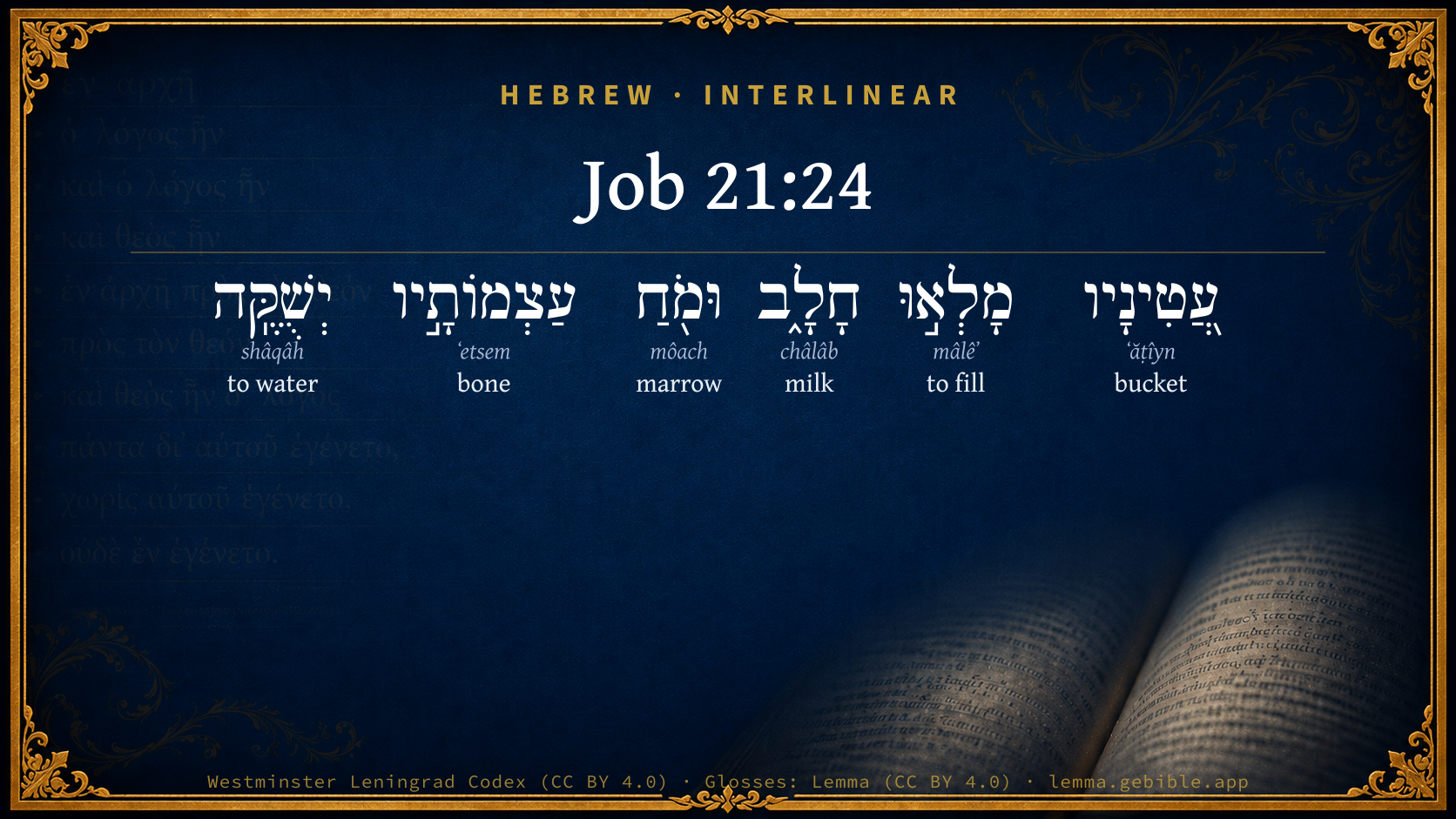
Hebrew (Westminster Leningrad Codex) Job 21:24 appears in the Hebrew Old Testament. The text above is from the Westminster Leningrad Codex. Each word links to its Strong’s number, a concise gloss, and parsing drawn from the Open Scriptures Hebrew Bible morphology. Click any word for its full Brown-Driver-Briggs (BDB) entry.
Download image
Cite this verse

Job 21:24 (World English Bible). Public Domain. Lemma interlinear Bible study tool, https://lemma.gebible.app/v/job/21/24.

Show BibTeX & RIS
BibTeX
RIS
English Translation
His pails are full of milk. The marrow of his bones is moistened.
World English Bible · Public Domain
Highlights
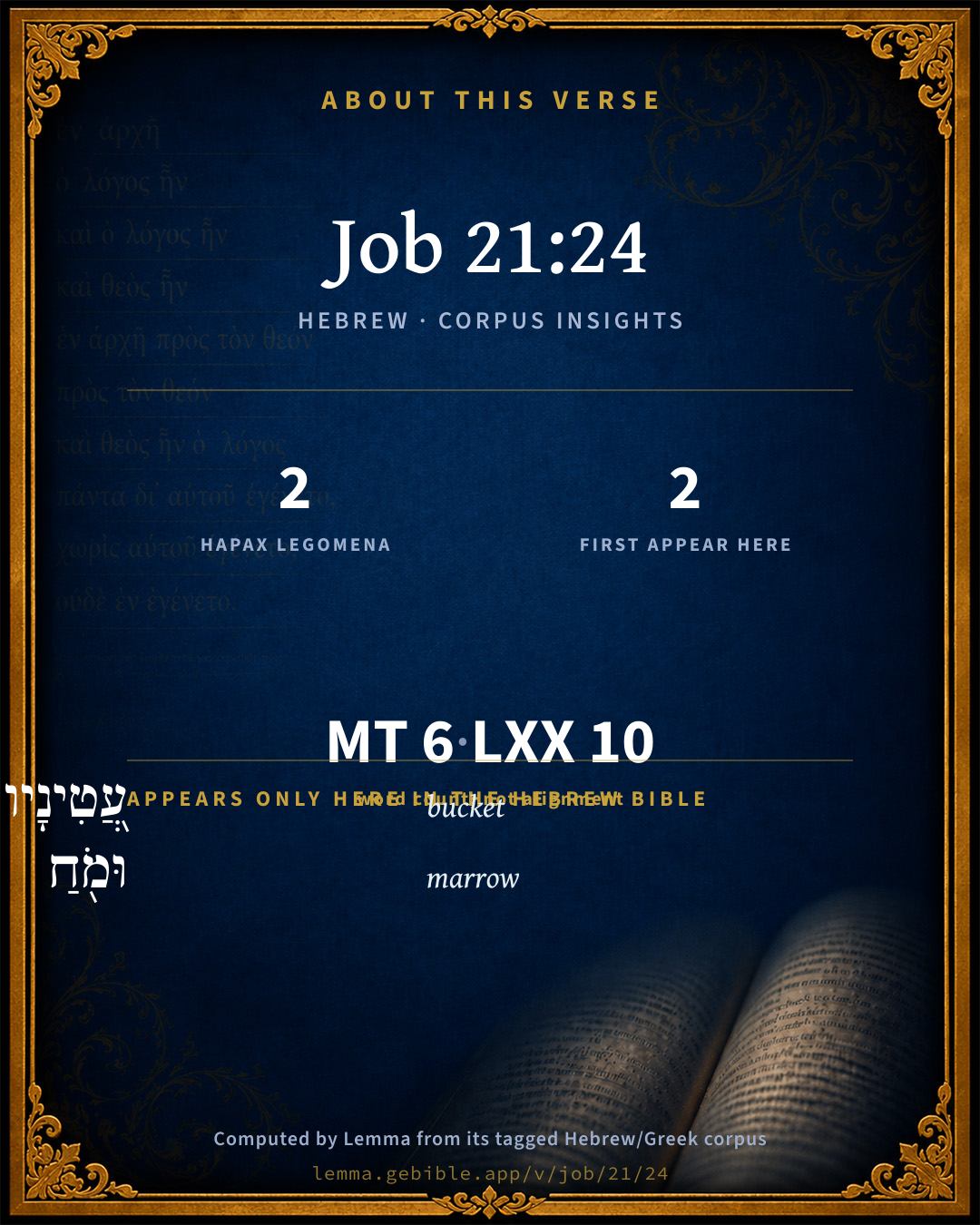
  • 2 hapax legomena — only here in the Hebrew Bible
  • 2 first appearances in the Hebrew Bible
Full analysis ↓
Download a study sheet

One document with this verse’s original text, its word-by-word gloss line, the meaning frame, cross-references with their text, attributed commentary, and full source and license credits — printable, and it pastes into notes with its structure intact.

This verse Autodidact and up

Study sheet (.html) Plain text (.txt)

A passage Seminary Student

Up to 50 verses in one chapter. A passage sheet keeps up to 6 commentary sources and 12 cross-references per verse, in the order this page ranks them, and says so on the sheet whenever that leaves anything out. Ask for a single verse and you get the Autodidact verse sheet above.

Everything on this page stays free to read, with no account — the sheet is a download of what is already on screen, not access to it.

Want to remove ads? Support Godless Engineer
Compare translations 3

The same verse in 3 English versions, stacked beneath the original-language interlinear above. Click any original word for its lexicon entry.

Each is an independent rendering of the whole verse — the interlinear is not word-aligned to these translations.

Highlighted words mark where these versions differ — a whole-verse word diff, not a word-by-word alignment.

  • World English Bible Public Domain
    His pails are full of milk. The marrow of his bones is moistened.
  • King James Version Public Domain
    His breasts are full of milk, and his bones are moistened with marrow.
  • unfoldingWord Literal Text CC BY-SA 4.0
    His pails are full of milk, and the marrow of his bones is moistened.

unfoldingWord Literal Text — © unfoldingWord, licensed CC BY-SA 4.0. Word-aligned USFM3 via Door43 (git.door43.org/unfoldingWord/en_ult).

Versions to compare (up to 4)

3 of 4 selected

Show all 18 translations

Every available English version of this verse, each an independent rendering of the whole verse.

  • World English Bible Public Domain
    His pails are full of milk. The marrow of his bones is moistened.
  • Berean Standard Bible Public Domain
    His body is well nourished, and his bones are rich with marrow.
  • Majority Standard Bible Public Domain
    His body is well nourished, and his bones are rich with marrow.
  • King James Version Public Domain
    His breasts are full of milk, and his bones are moistened with marrow.
  • American Standard Version (1901) Public Domain
    His pails are full of milk, And the marrow of his bones is moistened.
  • Revised Version (1885) Public Domain
    His breasts are full of milk, and the marrow of his bones is moistened.
  • Geneva Bible (1599) Public Domain
    His breasts are full of milke, and his bones runne full of marowe.
  • Douay-Rheims (1899) Public Domain
    His bowels are full of fat, and his bones are moistened with marrow.
  • Young's Literal Translation Public Domain
    His breasts have been full of milk, And marrow his bones doth moisten.
  • Literal Standard Version CC BY-SA 4.0
    His breasts have been full of milk, || And marrow moistens his bones.
  • Unlocked Literal Bible CC BY-SA 4.0
    His body is full of milk, and the marrow of his bones is moist.
  • unfoldingWord Literal Text CC BY-SA 4.0
    His pails are full of milk, and the marrow of his bones is moistened.
  • Darby Bible Public Domain
    His sides are full of fat, and the marrow of his bones is moistened;
  • World Messianic Bible Public Domain
    His pails are full of milk. The marrow of his bones is moistened.
  • Webster's Bible Public Domain
    His breasts are full of milk, and his bones are moistened with marrow.
  • Free Bible Version CC BY-SA 4.0
    Their body is fat from eating well; their bones still strong.
  • Bible in Basic English Public Domain
    His buckets are full of milk, and there is no loss of strength in his bones.
  • JPS Tanakh (1917) Public Domain
    His pails are full of milk, and the marrow of his bones is moistened.

Literal Standard Version (2020), Covenant Press — licensed CC BY-SA 4.0. Text via the HelloAO Bible API (eBible.org). Unlocked Literal Bible (unfoldingWord) — licensed CC BY-SA 4.0. Text via the HelloAO Bible API (eBible.org). unfoldingWord Literal Text — © unfoldingWord, licensed CC BY-SA 4.0. Word-aligned USFM3 via Door43 (git.door43.org/unfoldingWord/en_ult). Free Bible Version, Dr. Jonathan Gallagher — licensed CC BY-SA 4.0. Text via the HelloAO Bible API (eBible.org).

Word by word

More ways to search: Search by grammar → Find every occurrence → Compare this word →

Practice this passage: Drill this verse → Learn its vocabulary →

About this verse

These counts appear in no published source. They are computed here, from the morphology-tagged text and Lemma’s own curated glosses. What Lemma adds →

6
words
6
distinct lemmas
Wisdom
section

Notable vocabulary

2 hapax legomena — words that appear only here in the entire Hebrew Bible:

  • עֲ֭טִינָיו bucket H5845
  • וּמֹ֖חַ marrow H4221

First appearance in Scripture

These words make their first canonical appearance in the Hebrew Bible here:

  • עֲ֭טִינָיו bucket H5845
  • וּמֹ֖חַ marrow H4221

Shared distinctive vocabulary

חָלָ֑ב milk H2461 occurs in 44 verses of the Hebrew Bible. Also found in:

Grammatical profile

  • 2 verbs
  • 4 nouns

Verb forms

  • מָלְא֣וּ Qal · Perfect
  • יְשֻׁקֶּֽה Pual · Imperfect

Hebrew & Septuagint length

In English translation the verse runs 13 words from the Hebrew and 14 from the Septuagint (LXX English) — closely comparable.

A rough comparison of the two English renderings, which tokenize alike — not a word-level alignment.

Word counts can differ between the Hebrew and the Greek without any difference in meaning — e.g. the Hebrew direct-object marker אֵת has no separate Greek word, and Greek often adds the article ὁ.

In the original languages it is 6 Hebrew tokens and 10 Greek tokens — but the two are counted differently (Hebrew bundles its prefixes and suffixes into one token; the Greek is in lemma form), so that isn’t a like-for-like length.

Cross-references

3

Topical passages linked to Job 21:24 in the Treasury of Scripture Knowledge — connected by theme and wording, ordered by reader-vote popularity; previews shown in the World English Bible.

  • Proverbs 3:8 It will be health to your body, And nourishment to your bones.
  • Job 15:27 Because he has covered his face with his fatness, And gathered fat on his loins.
  • Psalms 17:10 They close up their callous hearts. With their mouth they speak proudly.

Cross-references courtesy of OpenBible.info (CC BY 4.0).

Hebrew and Greek witnesses Masoretic Hebrew ↔ Greek Septuagint

The same verse in the two great witnesses to the Old Testament, shown verse-for-verse.

These are two independent witnesses, not word-aligned to each other, and the Septuagint is shown in lemma (dictionary) form.

Hebrew Job 21:24 Masoretic · Westminster Leningrad Codex

עֲ֭טִינָיו מָלְא֣וּ חָלָ֑ב וּמֹ֖חַ עַצְמוֹתָ֣יו יְשֻׁקֶּֽה

His pails are full of milk. The marrow of his bones is moistened.

World English Bible · Public Domain

Greek LXX Job 21:24 Septuagint · lemma form

ὁ δέ ἔγκατα αὐτός πλήρης στέαρ μυελός δέ αὐτός διαχέω

and his inwards are full of fat, and his marrow is diffused throughout him.

LXX2012 (modern English Septuagint) · Public Domain

On this verse, Adam Clarke's Commentary discusses the Septuagint’s reading. Read the note in Commentary ↓

Hebrew: Westminster Leningrad Codex (CC BY 4.0). Greek: Septuagint (public domain); English from LXX2012 (modern English Septuagint) (Public Domain). How the Septuagint differs from the Hebrew →

Commentary

Notes on Job 21:24 from classic Christian and Jewish commentators (each source and its license shown beneath its notes). The classic Christian expositions comment on the surrounding passage and are grouped to its opening verse, so a note may address several verses; the Jewish commentaries on the Tanakh (Rashi and others) are per-verse, so they appear only where the commentator wrote on this verse.

Lemma curates 59 commentaries, every one of them public domain or Creative Commons licensed, each selected and text-cleaned for this edition rather than reprinted as found. About our sources →

Adam Clarke's Commentary

Verse 24. His breasts are full of milk] The word עטיניו atinaiv, which occurs nowhere else in the Hebrew Bible, is most likely an Arabic term, but probably so provincial as to be now lost. [Arabic] atana signifies to macerate hides so as to take off the hair: hence Mr. Good thinks it means here, that sleekness of skin which is the effect of fatness both in man and beast. But as the radical idea signifies to stink, as leather does which is thus macerated, I cannot see how this meaning can apply here. Under the root עטן atan, Mr. Parkhurst gives the following definitions:" עטן occurs, not as a verb, but as a noun masculine plural, in construction, עטיני atiney, the bowels, intestines; once Job 21:24, עטיניו atinaiv, his bowels or intestines, are full of, or abound with, חלב chalab, fat. So the LXX.: Τα δε εγκατα αυτου πληρη στεατος. The VULGATE: Viscera, ejus plena sent adipe, 'his intestines are full of fat.' May not עטינים atinim be a noun masculine plural from עטה atah, to involve, formed as גליונים gailyonim, mirrors, from גלה galah, to reveal? And may nor the intestines, including those fatty parts, the mesentery and omentum, be so called on account of their wonderful involutions?" I think this conjecture to be as likely as any that has yet been formed.

Adam Clarke's Commentary on the Bible (1810–1826) — public domain. Text from a community e-Sword/MySword module.

Trapp's Complete Commentary

John Trapp

Job 21:24 His breasts are full of milk, and his bones are moistened with marrow.

Ver. 24. His breasts are full of milk, and his bones, &c.] He is well lined within, as we say, having abundance of good blood and fresh spirits in his body; fat and plump, and well liking. He is enclosed in his own fat, Psa 17:10. His back is well larded, and his bones are moistened with marrow; which, Plato saith, is not only the source and seminary of generation, but the very seat of life (Plat. in Timaeo). Now such a state of body as is here described is no defence at all against death, saith Job; nay, it is a presage and a forerunner of it many times. For ultimus sanitaria gradus est morbo proximus, say physicians; the highest degree of health is nearest to sickness; we many times chop into the earth before we are aware; like a man, walking in a field covered with snow, who falleth into a pit suddenly.

John Trapp, A Commentary or Exposition upon All the Books of the Old and New Testament (1647–1656) — public domain. Text from a community e-Sword module.

Tyndale Open Study Notes

Tyndale Open Resources

21:24 vigorous and fit (literally the marrow of his bones [is] moist): Bones were thought to be the seat of health.

Tyndale Open Study Notes — © Tyndale Open Resources, licensed CC BY-SA 4.0. Text via the HelloAO Bible API.

Jamieson, Fausset & Brown

Robert Jamieson, A. R. Fausset & David Brown

breasts--rather, "skins," or "vessels" for fluids [LEE]. But [UMBREIT] "stations or resting-places of his herds near water"; in opposition to Zophar (Job 20:17); the first clause refers to his abundant substance, the second to his vigorous health.

moistened--comparing man's body to a well-watered field (Pro 3:8; Isa 58:11).

Jamieson, Fausset & Brown — Commentary Critical and Explanatory on the Whole Bible (1871) — public domain (CC PDM 1.0). Text via the HelloAO Bible API.

Ellicott's Commentary for English Readers

(24) His breasts.—This is an uncertain word, occurring only here. Some understand it literally of milk-pails, others of the lacteals of the human body, which certainly suits the parallelism better.

A Bible Commentary for English Readers, edited by Charles John Ellicott (1878–1897) — public domain. Text from a community e-Sword module.

The Cambridge Bible for Schools and Colleges

gen. ed. J. J. S. Perowne

24. His breasts are full of milk] Perhaps, his vessels are full of milk; but the meaning is uncertain, the word rendered “breasts” not occurring again. The word however has analogies in the cognate languages, and may mean vessels, or troughs, marg. milk-pails, the reference being to the plenty and richness of the man’s herds and possessions, though this is a figure for plenty in general. By a slight alteration in spelling the word “milk” means fat, and the ancient versions so read, translating, his inwards, or sides, are full of fat.

his bones are moistened with marrow] Rather, and the marrow of his bones is moistened, lit. watered, i. e. made fresh and strong. If the first clause be translated with the ancient Versions this clause is parallel in sense; otherwise, it describes the effect of his plenty on the man himself.

The Cambridge Bible for Schools and Colleges (gen. ed. J. J. S. Perowne; Cambridge University Press, 1878–1918) — public domain. Text from a community e-Sword module.

John Gill's Exposition

And another dieth in the bitterness of his soul,.... Either another wicked man; for there is a difference among wicked men; some are outwardly happy in life, and in the circumstances of their death, as before described; and others are very unhappy in both; their life is a scene of afflictions which embitter life, and make death eligible; and in the midst of which they die, as well as oftentimes in bitter pains, and terrible agonies of body, as well as in great distress and horror of mind, and black despair, as Judas and others:

and never eateth with pleasure, or "of any good", or "any good thing" (y); either he has it not to eat, or what he has is not good, but like husks which swine eat, of which the prodigal would fain have filled his belly, when in extreme poverty, such as those words may describe; or else having what is good, has not an heart to eat of it; and so they describe a miser, living and dying such; see Ecc 6:2; or rather the case of a man, who, through distempers and diseases of body, has lost his appetite, and cannot with any pleasure taste of the richest dainties; see Job 33:20. Some (z) interpret this verse and Job 21:23 as what should be the case according to the sentiments of Job's friends, who objected, that God punished the iniquities of wicked men, not in their own persons, but in their children; according to which, a wicked man then should die in the perfection of happiness, without weakness or want, in all quietness, ease, peace, and prosperity; and not in poverty and distress: but as Job 21:23 respect a wicked man, and his case and circumstances at death, agreeably to the whole context; so this relates to those of a good man, whom the Lord often deals bitterly with in life, as he did with Naomi, and was now the case of Job; see Rut 1:20; and who die in very poor and distressed circumstances; so that nothing is to be concluded from such appearances, with respect to the characters of men, as good or bad, and especially since both are brought into a like condition by death, as follows.

(y) "bonum", Pagninus, Mercerus; so Junius & Tremellius, Piscator & Bar Tzemach; "de bono", Cocceius, Michaelis, Schultens. (z) Bar Tzemach.

John Gill's Exposition of the Whole Bible (1746–1763) — public domain (CC PDM 1.0). Text via the HelloAO Bible API.

Albert Barnes' Notes on the Bible

His breasts - Margin, “milk pails.” The marginal translation is much the most correct, and it is difficult to understand why so improbable a statement has been introduced into our common version. But there has been great variety in the translation. The Vulgate renders it, Viscera ejus plena sunt adipe - “his viscera are full of fat.” So the Septuagint, τὰ ἔγκατα ἀυτοῦ πλήρη στέατος ta engkata autou plērē steatos. The Syraic, “his sides;” Prof. Lee, “his bottles;” Noyes, “his sides;” Luther, “sein milkfass” - “his milk-pail;” Wemyss, “the stations of his cattle;” Good, “his sleek skin.” In this variety of rendering, what hope is there of ascertaining the meaning of the word? It is not easy to account for this variety, though it is clear that Jerome and the Septuagint followed a different reading from the present, and instead of עטיניו ‛ăṭı̂ynāyv, they read בטיניו baṭı̂ynāyv - from בטן beṭen - “the belly;” and that instead of the word חלב châlâb as at present pointed, meaning “milk,” they understood it as if it were pointed חלב cheleb - meaning “fat” - the same letters, but different vowels.

The word which is rendered “breast” (עטין ‛ăṭı̂yn) occurs nowhere else in the Hebrew Scriptures. It has become necessary, therefore, to seek its meaning in the ancient versions, and in the cognate languages. For a full examination of the word, the reader may consult Bochart, Hieroz. P. 1, Lib. ii. c. xliv., pp. 455, 458; or Rosenmuller, where the remarks of Bochart are abridged; or Lee on Job, “in loc.” The Chaldee renders it ביזיו, “his breasts.” So Junius et Tre. Piscator, and others. Among the rabbis, Moses Bar Nackman, Levi, and others, render it as denoting the breasts, or “mulctralia” - “milk-vessels,” denoting, as some have supposed, “the lacteals.” This idea would admirably suit the connection, but it is doubtful whether it can be maintained; and the presumption is, that it would be in advance of the knowledge of physiology in the times of Job. Aben Ezra explains it of the places where camels lie down to drink - an idea which is found in the Arabic, and which will well suit the connection.

According to this, the sense would be, that those places abounded with milk - that is, that he was prospered and happy. The Hebrew word עטין ‛ăṭı̂yn, as has been observed, occurs nowhere else. It is supposed to be derived from an obsolete root, the same as the Arabic “atana, to lie down around water, as cattle do;” and then the derivative denotes a place where cattle and flocks lie down around water; and then the passage would mean, “the resting places of his herds are full, or abound with milk.” Yet the primary idea, according to Castell, Golius, and Lee, is that of saturating with water; softening, “scil.” a skin with water, or dressing a skin, for the purpose of using it as a bottle. Perhaps the word was used with reference to the place where camels came to drink, because it was a place that was “saturated” with water, or that abounded with water. The Arabic verb, also, according to Castell, is used in the sense of freeing a skin from wool and hairs - a lana pilisve levari pellem - so that it might be dressed for use.

From this reference to a “skin” thus dressed, Prof. Lee supposes that the word here means “a bottle,” arid that the sense is, that his bottles were full of milk; that is, that he had great prosperity and abundance. But it is very doubtful whether the word will bear this meaning, and whether it is ever used in this sense. In the instances adduced by Castell, Schultens, and even of Prof. Lee, of the use of the word, I find no one where it means “a skin,” or denotes a bottle made of a skin. The application of the “verb” to a skin is only in the sense of saturating and dressing it. The leading idea in all the forms of the word, and its common use in Arabic, is “that of a place where cattle kneel down for the purpose of drinking,” and then a place well watered, where a man might lead his camels and flocks to water. The noun would then come to mean a watering place - a place that would be of great value, and which a man who had large flocks and herds would greatly prize. The thought here is, therefore, that the places of this kind, in the possession of the man referred to, would abound with milk - that is, he would have abundance.

Are full of milk - Milk, butter and honey, are, in the Scriptures, the emblems of plenty and prosperity. Many of the versions, however, here render this “fat.” The change is only in the pointing of the Hebrew word. But, if the interpretation above given be correct, then the word here means “milk.”

And his bones are moistened with marrow - From the belief, that bones full of marrow are an indication of health and vigor.

Albert Barnes' Notes on the Bible (1834–1885) — public domain. Text from a community e-Sword/MySword module.

Haydock's Catholic Bible Commentary

Bowels. Protestants, "breasts" (Marginal note, "milk-pails") are full of milk. But the Septuagint, Bochart, &c., agree with the Vulgate. Job describes a corpulent man (Calmet) living in luxury, like the glutton. (Haydock)

George Leo Haydock (1774–1849), Haydock's Catholic Family Bible and Commentary, 1859 edition — public domain. Excludes Psalms (Douay-Rheims chapter numbering differs from Protestant) and Deuterocanonical books (Catholic canon only).

Matthew Poole's English Annotations

His breasts: the Hebrew word is not elsewhere used, and therefore it is diversely translated; either,

1. Breasts. But that seems very improper here, because men’s breasts do not use to be filled with milk. Or,

2. Milk-pails. But their fulness is common, and no sign of eminent plenty, which is here designed. Besides, the following branch, which in Job and elsewhere frequently explains the former, implies that it signifies some part of man’s body, as all the ancient interpreters render it; either the sides, as some of them have it; or the bowels, as others. But for the following milk they read fat; the Hebrew letters being exactly the same in both words; and the Hebrews by the name of milk do oft understand fat.

His bones are moistened with marrow; which is opposed to the dryness of the bones, Job 30:30 Psa 102:3, which is caused by old age, or grievous distempers or calamities.

Matthew Poole's English Annotations on the Holy Bible (1683–1685) — public domain. Text from a community e-Sword/MySword module.

Whedon's Commentary on the Bible

Daniel D. Whedon

24. His breasts — The Vulgate followed the Septuagint in rendering this troublesome word, עשׂין, thus: “His inwards are full of fat.” Furst and Rodwell, among others, conceive that the parallelism of the text demands some part of the human body: the former of them consequently rendering ‘hatin “veins;” the latter, “loins.” Schlottmann, on the other hand, observes that, “In contrast to the well-watered marrow, one expects a reference to a rich, nutritious drink.” The Hebrew word occurs nowhere else in the Scriptures, and is apparently of foreign origin, perhaps kindred with the Arabic hatan, “resting places,” (for herds,) an idea which Hitzig accepts. Delitzsch, Dillmann, and Zockler read, “his troughs are full of milk.” Our Authorized Version adopts the version of the Targum, than which Tayler Lewis thinks there is nothing better.

Moistened with marrow — And the marrow of his bones is well watered. The human body is likened to the soil of the field, which is not suffered to dry, but is plentifully watered and made fruitful. (Umbreit.) Comp. Isa_58:11.

Daniel D. Whedon (gen. ed.), Commentary on the Old and New Testaments (1874–1909) — public domain. Text from a community e-Sword module.

The Pulpit Commentary

His breasts are full of milk; rather, his milk-pails, as in the margin. The main wealth of the time being cattle, the man whose milk-pails are always full is the prosperous man. And his bones are moistened with marrow. Being thus wealthy and prosperous, his body is fat and well nourished.

The Pulpit Commentary (1880–1919), ed. H.D.M. Spence-Jones & Joseph S. Exell — public domain. Text from a community e-Sword module.

Rashi

Rabbi Shlomo Yitzchaki (Rashi)

His pails are full of milk Heb. עטיניו. This is the language of the Mishnah (Menahoth 86a): “He packs it (עוטנו) in the olive press.” They gather the olives together, and their oil forms globules and gathers in its midst in order to be ready when he presses it in the press, and that vessel in which they gather it in order for its oil to gather within it is called “ma’atan.” Here too, his milk and his moisture and fat are called “atinav.”

Rashi on the Tanakh — English translations: “The Judaica Press complete Tanach with Rashi, translated by A. J. Rosenberg” (CC BY 4.0); “Pentateuch with Rashi's commentary by M. Rosenbaum and A.M. Silbermann, 1929-1934” (public domain); “The Metsudah Tanach series, Lakewood, N.J” (CC BY 4.0); and “The Book of Joshua, Metsudah Publications, 1997” (CC BY 4.0). Text via Sefaria.

Lesson kit

Teaching starters — assembled from the data on this page, not authored interpretation. Every prompt links to the verse data it draws on. Edit before teaching.

Job, in the Wisdom, opens this verse with 6 words (6 distinct Hebrew lemmas). Its most distinctive word is ʻăṭîyn (“bucket”). A historical commentator’s framing appears above. Read the whole chapter for the surrounding context.

Discussion questions

  1. How does “bucket” (ʻăṭîyn) shape what this verse is saying?
  2. This verse holds 2 words here found nowhere else in the Hebrew Bible. What might the rare words draw attention to?
  3. 2 words here appear for the first time in Scripture. What is being introduced at this debut?
  4. Genesis 18:8 shares the word «milk» with this verse. How do the two illuminate each other?
  5. These translations render this verse differently. What is at stake in choosing one wording over another?
  6. The verb «מָלְא֣וּ» is Qal Perfect. How does its form color the action?
  7. Reading how Adam Clarke's Commentary and Trapp's Complete Commentary read this verse, where do the two commentators agree and where do they part?

Things to notice

Reading settings

Reading text

Shown beneath each verse's original-language words.

Old Testament
Old Testament edition

Read the OT as the Masoretic Hebrew (MT) or the Greek Septuagint (LXX).

English shown for the Greek Septuagint (in the Hebrew ↔ Greek comparison).

Comparing translations? Open the Compare panel on any verse page to stack up to four side by side.