Jeremiah 35:2

Hebrew (Westminster Leningrad Codex) Jeremiah 35:2 appears in the Hebrew Old Testament. The text above is from the Westminster Leningrad Codex. Each word links to its Strong’s number, a concise gloss, and parsing drawn from the Open Scriptures Hebrew Bible morphology. Click any word for its full Brown-Driver-Briggs (BDB) entry.
Download image
Cite this verse

Jeremiah 35:2 (World English Bible). Public Domain. Lemma interlinear Bible study tool, https://lemma.gebible.app/v/jeremiah/35/2.

Show BibTeX & RIS
BibTeX
RIS
English Translation
Go to the house of the Rechabites, and speak to them, and bring them into the house of Yahweh, into one of the chambers, and give them wine to drink.
World English Bible · Public Domain
Download a study sheet

One document with this verse’s original text, its word-by-word gloss line, the meaning frame, cross-references with their text, attributed commentary, and full source and license credits — printable, and it pastes into notes with its structure intact.

This verse Autodidact and up

Study sheet (.html) Plain text (.txt)

A passage Seminary Student

Up to 50 verses in one chapter. A passage sheet keeps up to 6 commentary sources and 12 cross-references per verse, in the order this page ranks them, and says so on the sheet whenever that leaves anything out. Ask for a single verse and you get the Autodidact verse sheet above.

Everything on this page stays free to read, with no account — the sheet is a download of what is already on screen, not access to it.

Want to remove ads? Support Godless Engineer
Compare translations 3

The same verse in 3 English versions, stacked beneath the original-language interlinear above. Click any original word for its lexicon entry.

Each is an independent rendering of the whole verse — the interlinear is not word-aligned to these translations.

Highlighted words mark where these versions differ — a whole-verse word diff, not a word-by-word alignment.

  • World English Bible Public Domain
    Go to the house of the Rechabites, and speak to them, and bring them into the house of Yahweh, into one of the chambers, and give them wine to drink.
  • King James Version Public Domain
    Go unto the house of the Rechabites, and speak unto them, and bring them into the house of the LORD, into one of the chambers, and give them wine to drink.
  • unfoldingWord Literal Text CC BY-SA 4.0
    “Go to the family of the Rekabites and speak with them. Then bring them to my house, into one of the rooms there, and give them wine to drink.”

unfoldingWord Literal Text — © unfoldingWord, licensed CC BY-SA 4.0. Word-aligned USFM3 via Door43 (git.door43.org/unfoldingWord/en_ult).

Versions to compare (up to 4)

3 of 4 selected

Show all 18 translations

Every available English version of this verse, each an independent rendering of the whole verse.

  • World English Bible Public Domain
    Go to the house of the Rechabites, and speak to them, and bring them into the house of Yahweh, into one of the chambers, and give them wine to drink.
  • Berean Standard Bible Public Domain
    “Go to the house of the Rechabites, speak to them, and bring them to one of the chambers of the house of the LORD to offer them a drink of wine.”
  • Majority Standard Bible Public Domain
    “Go to the house of the Rechabites, speak to them, and bring them to one of the chambers of the house of the LORD to offer them a drink of wine.”
  • King James Version Public Domain
    Go unto the house of the Rechabites, and speak unto them, and bring them into the house of the LORD, into one of the chambers, and give them wine to drink.
  • American Standard Version (1901) Public Domain
    Go unto the house of the Rechabites, and speak unto them, and bring them into the house of Jehovah, into one of the chambers, and give them wine to drink.
  • Revised Version (1885) Public Domain
    Go unto the house of the Rechabites, and speak unto them, and bring them into the house of the LORD, into one of the chambers, and give them wine to drink.
  • Geneva Bible (1599) Public Domain
    Go vnto the house of the Rechabites, and speake vnto them, and bring them into the house of the Lord into one of the chambers, and giue them wine to drinke.
  • Douay-Rheims (1899) Public Domain
    Go to the house of the Rechabites: and speak to them, and bring them into the house of the Lord, into one of the chambers of the treasures, and thou shalt give them wine to drink.
  • Young's Literal Translation Public Domain
    `Go unto the house of the Rechabites, and thou hast spoken with them, and brought them into the house of Jehovah, unto one of the chambers, and caused them to drink wine.'
  • Literal Standard Version CC BY-SA 4.0
    “Go to the house of the Rechabites, and you have spoken with them, and brought them into the house of YHWH, to one of the chambers, and caused them to drink wine.”
  • Unlocked Literal Bible CC BY-SA 4.0
    “Go to the family of the Rekabites and speak with them. Then bring them to my house, into one of the rooms there, and give them wine to drink.”
  • unfoldingWord Literal Text CC BY-SA 4.0
    “Go to the family of the Rekabites and speak with them. Then bring them to my house, into one of the rooms there, and give them wine to drink.”
  • Darby Bible Public Domain
    Go to the house of the Rechabites, and speak with them, and bring them into the house of Jehovah, into one of the chambers, and give them wine to drink.
  • World Messianic Bible Public Domain
    “Go to the house of the Rechabites, and speak to them, and bring them into the LORD’s house, into one of the rooms, and give them wine to drink.”
  • Webster's Bible Public Domain
    Go to the house of the Rechabites, and speak to them, and bring them into the house of the LORD, into one of the chambers, and give them wine to drink.
  • Free Bible Version CC BY-SA 4.0
    Go to where the Rechabites live. Invite them to come with you to one of the rooms in the Lord's Temple and offer them wine to drink.
  • Bible in Basic English Public Domain
    Go into the house of the Rechabites, and have talk with them, and take them into the house of the Lord, into one of the rooms, and give them wine.
  • JPS Tanakh (1917) Public Domain
    'Go unto the house of the Rechabites, and speak unto them, and bring them into the house of the LORD, into one of the chambers, and give them wine to drink.'

Literal Standard Version (2020), Covenant Press — licensed CC BY-SA 4.0. Text via the HelloAO Bible API (eBible.org). Unlocked Literal Bible (unfoldingWord) — licensed CC BY-SA 4.0. Text via the HelloAO Bible API (eBible.org). unfoldingWord Literal Text — © unfoldingWord, licensed CC BY-SA 4.0. Word-aligned USFM3 via Door43 (git.door43.org/unfoldingWord/en_ult). Free Bible Version, Dr. Jonathan Gallagher — licensed CC BY-SA 4.0. Text via the HelloAO Bible API (eBible.org).

Word by word

More ways to search: Search by grammar → Find every occurrence → Compare this word →

Practice this passage: Drill this verse → Learn its vocabulary →

הָרֵכָבִים֒
Rêkâh
H7397
“the · Rechah”
Particle, Definite Article + Noun, Gentilic, Masculine, Plural, Absolute
Part of Speech
Particle + Noun
Type
Gentilic
Gender
Masculine
Number
Plural
State
Absolute
Full BDB Definition

Origin: probably fem. from H7401

TWOT: None

Rechah = "uttermost part" - a place in Judah - perhaps the village of 'Rashiah' 3 miles (5 kilometers) south of Jerusalem
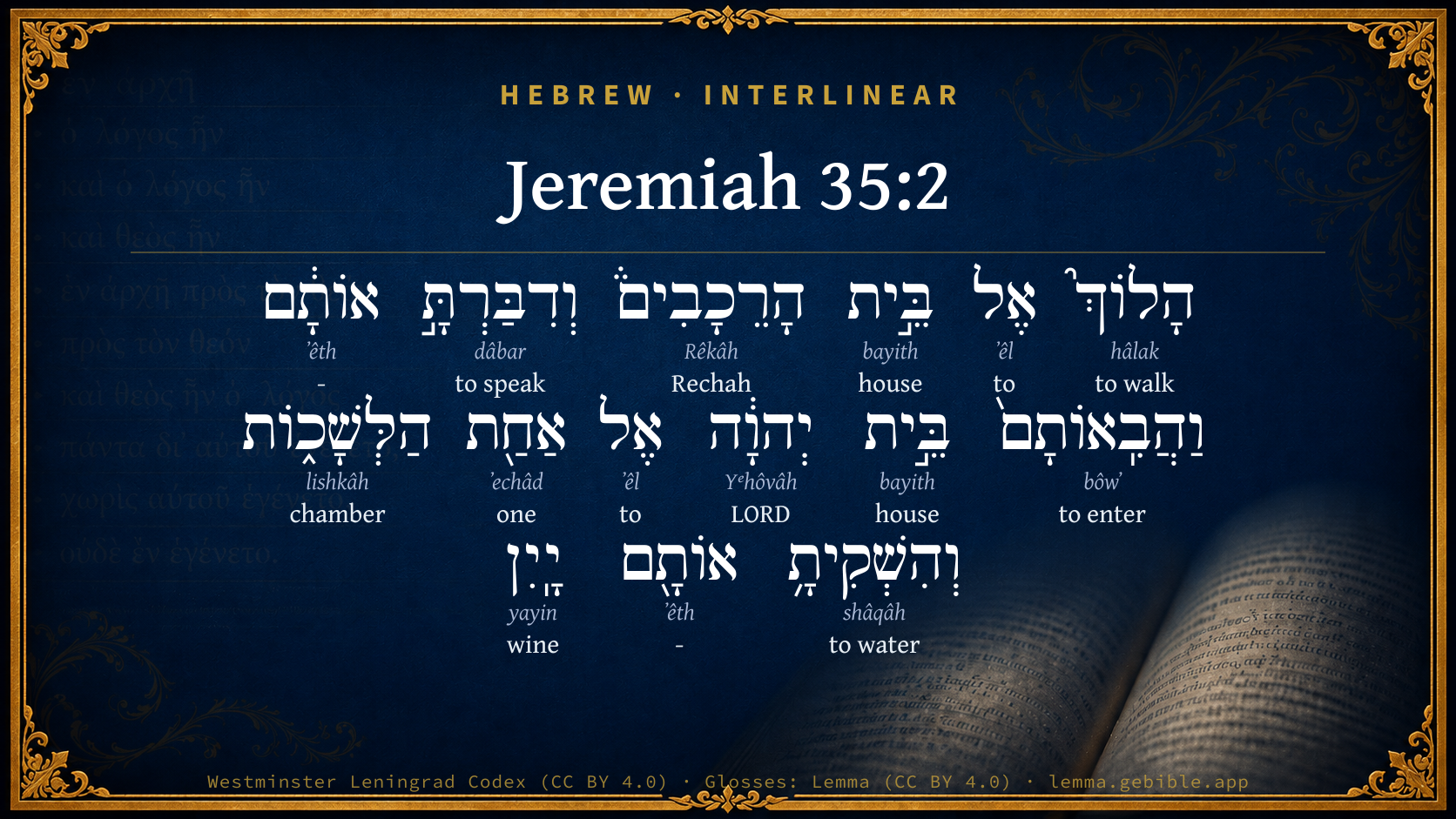
  1. הָלוֹךְ֮ hâlak H1980 “to walk” Verb, Qal, Infinitive Absolute
  2. אֶל ʼêl H413 “to” Preposition
  3. בֵּ֣ית bayith H1004 “house of” Noun, Common, Masculine, Singular, Construct
  4. וְדִבַּרְתָּ֣ dâbar H1696 “and · to speak” Conjunction + Verb, Piel, Sequential Perfect, 2nd Person, Masculine, Singular
  5. אוֹתָ֔ם ʼêth H853 “- · them” Particle, Direct Object + Suffix, Personal, 3rd Person, Masculine, Plural
  6. וַהֲבִֽאוֹתָם֙ bôwʼ H935 “and · to enter · them” Conjunction + Verb, Hiphil, Sequential Perfect, 2nd Person, Masculine, Singular + Suffix, Personal, 3rd Person, Masculine, Plural
  7. בֵּ֣ית bayith H1004 “house of” Noun, Common, Masculine, Singular, Construct
  8. יְהוָ֔ה Yᵉhôvâh H3068 “LORD” Noun, Proper
  9. אֶל ʼêl H413 “to” Preposition
  10. אַחַ֖ת ʼechâd H259 “one” Adjective, Cardinal number, Feminine, Singular, Absolute
  11. הַלְּשָׁכ֑וֹת lishkâh H3957 “the · chambers” Particle, Definite Article + Noun, Common, Feminine, Plural, Absolute
  12. וְהִשְׁקִיתָ֥ shâqâh H8248 “and · to water” Conjunction + Verb, Hiphil, Sequential Perfect, 2nd Person, Masculine, Singular
  13. אוֹתָ֖ם ʼêth H853 “- · them” Particle, Direct Object + Suffix, Personal, 3rd Person, Masculine, Plural
  14. יָֽיִן yayin H3196 “wine” Noun, Common, Masculine, Singular, Absolute

About this verse

These counts appear in no published source. They are computed here, from the morphology-tagged text and Lemma’s own curated glosses. What Lemma adds →

15
words
12
distinct lemmas
Prophets
section

Notable vocabulary

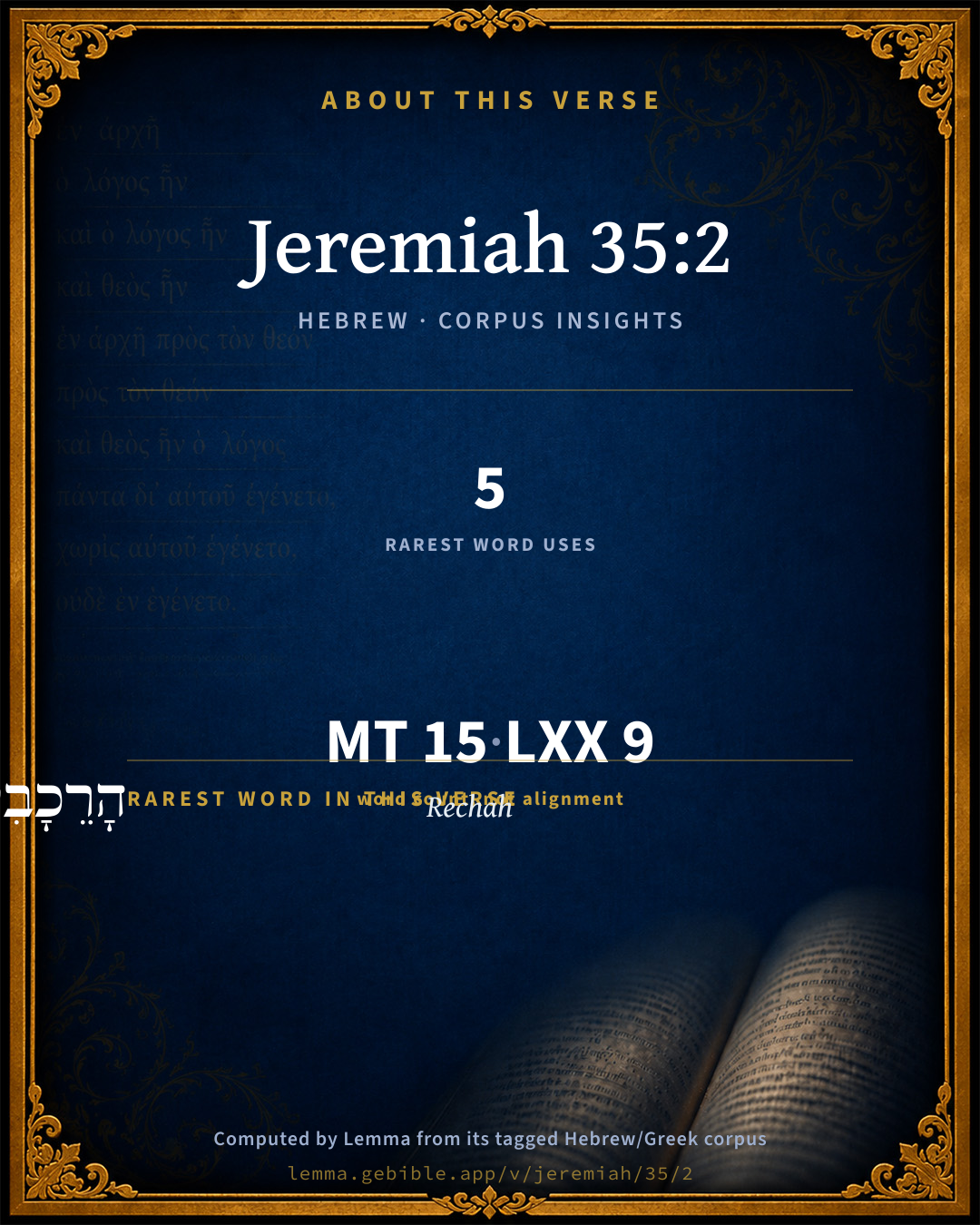
The rarest word here is הָרֵכָבִים֒ Rechah H7397 — appearing just 5 times in the whole Hebrew Bible.

Shared distinctive vocabulary

הָרֵכָבִים֒ Rechah H7397 occurs in 5 verses of the Hebrew Bible. Also found in:

Grammatical profile

  • 4 verbs
  • 6 nouns
  • 1 adjective
  • 2 prepositions
  • 2 particles

Verb forms

  • הָלוֹךְ֮ Qal · Infinitive Absolute
  • וְדִבַּרְתָּ֣ Piel · Sequential Perfect
  • וַהֲבִֽאוֹתָם֙ Hiphil · Sequential Perfect
  • וְהִשְׁקִיתָ֥ Hiphil · Sequential Perfect

Repetition

Words recur within this verse — often emphatic in Hebrew:

  • בֵּ֣ית house H1004 ×2
  • אֶל to H413 ×2

Hebrew & Septuagint length

In the original languages it is 15 Hebrew tokens and 9 Greek tokens — but the two are counted differently (Hebrew bundles its prefixes and suffixes into one token; the Greek is in lemma form), so that isn’t a like-for-like length.

Cross-references

18

Topical passages linked to Jeremiah 35:2 in the Treasury of Scripture Knowledge — connected by theme and wording, ordered by reader-vote popularity; previews shown in the World English Bible.

  • 1 Chronicles 2:55 The families of scribes who lived at Jabez: the Tirathites, the Shimeathites, the Sucathites. These are the Kenites who came of Hammath, the father of the house of Rechab.
  • 1 Chronicles 9:26 for the four chief porters, who were Levites, were in an office of trust, and were over the chambers and over the treasuries in the house of God.
  • 1 Kings 6:5–6 Against the wall of the house he built stories round about, against the walls of the house round about, both of the temple and of the oracle; and he made side-chambers round about.
  • 1 Kings 6:10 He built the stories against all the house, each five cubits high: and they rested on the house with timber of cedar.
  • 2 Kings 10:15–16 When he was departed there, he lighted on Jehonadab the son of Rechab coming to meet him; and he greeted him, and said to him, Is your heart right, as my heart is with your heart? Jehonadab answered, It is. If it be, give me your hand. He gave him his hand; and he took him up to him into the chariot.
  • 1 Chronicles 9:33 These are the singers, heads of fathers' [houses] of the Levites, [who lived] in the chambers [and were] free [from other service]; for they were employed in their work day and night.
  • 1 Chronicles 23:28 For their office was to wait on the sons of Aaron for the service of the house of Yahweh, in the courts, and in the chambers, and in the purifying of all holy things, even the work of the service of the house of God;
  • 2 Chronicles 3:9 The weight of the nails was fifty shekels of gold. He overlaid the upper chambers with gold.
  • 2 Chronicles 31:11 Then Hezekiah commanded to prepare chambers in the house of Yahweh; and they prepared them.
  • Ezra 8:29 Watch you, and keep them, until you weigh them before the chiefs of the priests and the Levites, and the princes of the fathers' [houses] of Israel, at Jerusalem, in the chambers of the house of Yahweh.
  • Nehemiah 13:5 had prepared for him a great chamber, where before they laid the meal-offerings, the frankincense, and the vessels, and the tithes of the grain, the new wine, and the oil, which were given by commandment to the Levites, and the singers, and the porters; and the heave-offerings for the priests.
  • Nehemiah 13:8–9 It grieved me sore: therefore I cast forth all the household stuff of Tobiah out of the chamber.
  • Jeremiah 35:4 and I brought them into the house of Yahweh, into the chamber of the sons of Hanan the son of Igdaliah, the man of God, which was by the chamber of the princes, which was above the chamber of Maaseiah the son of Shallum, the keeper of the threshold.
  • Jeremiah 35:8 We have obeyed the voice of Jonadab the son of Rechab, our father, in all that he charged us, to drink no wine all our days, we, our wives, our sons, or our daughters;
  • Ezekiel 40:7–13 Every lodge was one reed long, and one reed broad; and [the space] between the lodges was five cubits; and the threshold of the gate by the porch of the gate toward the house was one reed.
  • Ezekiel 40:16 There were closed windows to the lodges, and to their posts within the gate round about, and likewise to the arches; and windows were round about inward; and on [each] post were palm trees.
  • Ezekiel 41:5–11 Then he measured the wall of the house, six cubits; and the breadth of every side-chamber, four cubits, round about the house on every side.
  • Ezekiel 42:4–13 Before the chambers was a walk of ten cubits' breadth inward, a way of one cubit; and their doors were toward the north.

Cross-references courtesy of OpenBible.info (CC BY 4.0).

Hebrew and Greek witnesses Masoretic Hebrew ↔ Greek Septuagint

The same verse in the two great witnesses to the Old Testament, shown verse-for-verse.

These are two independent witnesses, not word-aligned to each other, and the Septuagint is shown in lemma (dictionary) form.

Hebrew Jeremiah 35:2 Masoretic · Westminster Leningrad Codex

הָלוֹךְ֮ אֶל בֵּ֣ית הָרֵכָבִים֒ וְדִבַּרְתָּ֣ אוֹתָ֔ם וַהֲבִֽאוֹתָם֙ בֵּ֣ית יְהוָ֔ה אֶל אַחַ֖ת הַלְּשָׁכ֑וֹת וְהִשְׁקִיתָ֥ אוֹתָ֖ם יָֽיִן

Go to the house of the Rechabites, and speak to them, and bring them into the house of Yahweh, into one of the chambers, and give them wine to drink.

World English Bible · Public Domain

Greek LXX Structure differs

In the Septuagint, Jeremiah is about an eighth shorter than the Hebrew and arranges its material differently — the Oracles Against the Nations (Hebrew chapters 46–51) appear in the middle of the Greek book, after 25:13. Because the chapter and verse boundaries do not line up, a verse-for-verse comparison with the Hebrew is not shown.

A verse-for-verse comparison isn’t shown here because the chapters and verses don’t line up. Switch to the LXX edition with the MT / LXX toggle above to read the Greek directly.

Hebrew: Westminster Leningrad Codex (CC BY 4.0). Greek: Septuagint (public domain); English from a public-domain English Septuagint. How the Septuagint differs from the Hebrew →

Targum (Aramaic paraphrase)

1

The Targum is the ancient Jewish Aramaic paraphrase of the Hebrew Scriptures — an interpretive translation, not the Hebrew text itself. Onkelos (literal) and Pseudo-Jonathan (expansive) render the Torah, and Jonathan the Prophets. Coverage is partial: where no permissively-licensed English translation exists for a verse, only the Aramaic is shown. This is verse-level text, not a word-by-word alignment to the Hebrew.

  1. Targum Jonathan Prophets (Joshua–Malachi)
    אֱזֵיל לְוַת בְּנֵי בֵית רֵכָב וּתְמַלֵל עִמְהוֹן וְתַעֲלִינוּן לְבֵית מַקְדְשָׁא דַייָ לַחֲדָא מִן לִשְׁכָּתָא וְתַשְׁקֵי יַתְהוֹן חַמְרָא:

    (no public-domain English translation for this verse)

    Targum Jonathan — Aramaic: “Mikraot Gedolot” (public domain). English: “Sefaria Community Translation” (CC0 1.0 (public-domain dedication)); “London "Chaldee Paraphrase," 1871” (public domain). Text via Sefaria.

Commentary

Notes on Jeremiah 35:2 from classic Christian and Jewish commentators (each source and its license shown beneath its notes). The classic Christian expositions comment on the surrounding passage and are grouped to its opening verse, so a note may address several verses; the Jewish commentaries on the Tanakh (Rashi and others) are per-verse, so they appear only where the commentator wrote on this verse.

Lemma curates 59 commentaries, every one of them public domain or Creative Commons licensed, each selected and text-cleaned for this edition rather than reprinted as found. About our sources →

Trapp's Complete Commentary

John Trapp

Jer 35:2 Go unto the house of the Rechabites, and speak unto them, and bring them into the house of the LORD, into one of the chambers, and give them wine to drink.

Ver. 2. Go unto the house of the Rechabites.] So called of one Rechab, the father of, Jonadab, who was famous for his piety in Jehu’s days, {2Ki 10:15} three hundred years at least before this prophecy of Jeremiah. They were of the posterity of Jethro, Moses’ father-in-law, and lived up and down in the land upon their employments, weaned from the world, and exercising themselves in the law of God. See 1Ch 2:55, where they are called the "families of the scribes that dwelt at Jabez," as being men learned in the laws of God. Of them came the Essenes, a studious and abstemious sect among the Jews; and they might better than those Donatists have taken to themselves the title of Apotactici, so called from their renouncing the world.

And give them wine to drink.] Heb., Make them drink wine - i.e., set it before them, and then leave them to their own liberty.

John Trapp, A Commentary or Exposition upon All the Books of the Old and New Testament (1647–1656) — public domain. Text from a community e-Sword module.

Joseph Benson's Commentary

Jer 35:2-4. Go to the house of the Rechabites — “The Rechabites, as may be collected from Jer 35:7, were not of the children of Israel, but strangers of another race that dwelt among them. From 1Ch 2:55, they appear to have been Kenites, a people originally settled in that part of Arabia Petræa which was called the land of Midian. At what time Rechab lived, who gave his name to the family, is not certain, nor whether he was the immediate father, or remote ancestor of Jonadab; for the word son often denotes nothing more than a lineal descendant. But it is most likely that the Jonadab here spoken of, as having dictated a rule of living to the Rechabites, was the same person of whom mention is made 2Ki 10:15. For that this latter was a man of considerable eminence is manifest from the respect shown him by Jehu; and his being taken along with that prince to witness his zeal for the honour of the true God, shows him to have been a man of right and religious principles. The institutions he left with his posterity bespeak a principal concern for the purity of their morals, which he might rightly suppose would be less liable to be corrupted whilst they adhered to the simplicity of their ancient usages, than if they adopted the refinements of modern luxury. He, therefore, enjoined them not only to abstain from the use of wine, but to live as the patriarchs did of old, and as many of their countrymen, the Scenite Arabs, continue to do at this day, without any fixed habitations or possessions, far from the society of cities, in the open country, feeding their flocks, and maintaining themselves by the produce of them.” — Blaney. And bring them into the house of the Lord — Into one of the chambers adjoining to the temple. By this it appears that the Rechabites were not idolaters, for it was not lawful for such persons to come within the precincts of the temple. I brought them into the chamber of the sons of Hanan — The chambers adjoining to the temple, of which there were several, were for the use of the priests and Levites, during the time of their ministrations. They were also used as repositories for laying up the holy vestments, and vessels, and whatever stores were necessary for the daily sacrifices, and the other parts of the temple service. The son of Igdaliah, a man of God — That is, as this name usually imports, a prophet, or one who had been employed upon a divine commission. Which was by the chamber of the princes — The chamber where the princes, or the members of the sanhedrim, or great council, used to assemble. Above the chamber of Maaseiah, the keeper of the door — That is, one of the keepers; for there were several Levites appointed to that office, both to open and shut the gates of the temple in due time, and likewise to attend at them all day, for preventing any thing that might happen to the prejudice of the purity, or safety of that holy place. Some of these officers had likewise the custody of the holy vessels.

Joseph Benson's Commentary on the Old and New Testaments (1811–1818) — public domain. Text from a community e-Sword module.

Tyndale Open Study Notes

Tyndale Open Resources

35:2 The Recabites were descendants of Jehonadab son of Recab, a Kenite who had served under Jehu, king of Israel (2 Kgs 10:15, 23; 1 Chr 2:55). Jeremiah probably knew that the Recabites did not drink wine, but he obeyed the Lord’s command.

Tyndale Open Study Notes — © Tyndale Open Resources, licensed CC BY-SA 4.0. Text via the HelloAO Bible API.

Geneva Bible (1599)

Geneva Bible translators

They came of Hobab Moses’ father-in-law, who was no Israelite, but after joined with them in the service of God.

Geneva Bible (1599) marginal notes — public domain. Text via Bolls.life.

Adam Clarke's Commentary

Verse 2. The house of the Rechabites] The Rechabites were not descendants of Jacob; they were Kenites, 1Ch 2:55, a people originally settled in that part of Arabia Petraea, called the land of Midian; and most probably the descendants of Jethro, the father-in-law of Moses. Compare Nu 10:29-32, with Jdg 1:16; Jdg 4:11.

Those mentioned here seem to have been a tribe of Nomades or Scenite Arabs, who fed their flocks in the deserts of Judea; they preserved the simple manners of their ancestors, considering the life of the inhabitants of cities and large towns as the death of liberty; believing that they would dishonour themselves by using that sort of food that would oblige them to live a sedentary life. Jonadab, one of their ancestors, had required his children and descendants to abide faithful to the customs of their forefathers; to continue to live in tents, and to nourish themselves on the produce of their flocks; to abstain from the cultivation of the ground, and from that particularly of the vine and its produce. His descendants religiously observed this rule, till the time when the armies of the Chaldeans had entered Judea; when, to preserve their lives, they retired within the walls of Jerusalem. But even there we find, from the account in this chapter, they did not quit their frugal manner of life: but most scrupulously observed the law of Jonadab their ancestor, and probably of this family.

When the children of Hobab, or Jethro, the father-in-law of Moses, were invited by him to accompany them in their journeying to the Promised Land, it is very likely that they continued their ancient usages, and lived a patriarchal life. Their property, consisting in nothing but their cattle and tents, was easily removable from place to place; and their manner of living was not likely to excite the envy or jealousy of those who had learnt to relish the luxuries of life; and therefore we may naturally conclude that as they were enemies to none, so they had no enemies themselves. Nature has few wants. Most of those which we feel are factitious; and howsoever what we call civilization may furnish us with the conveniences and comforts of life, let us not deceive ourselves by supposing that these very things do not create the very wants which they are called in to supply; and most certainly do not contribute to the comfort of life, when the term of life is considerably abridged by their use. But it is time to return to the case of the Rechabites before us.

Adam Clarke's Commentary on the Bible (1810–1826) — public domain. Text from a community e-Sword/MySword module.

John Calvin's Commentaries

Go, said he, to the house of Rechab, (we have said that they dwelt then at Jerusalem, and this will appear hereafter) and bring them unto the house of Jehovah But we must inquire why the Prophet was ordered to lay wine before them in the Temple rather than in a private house. The reason, indeed, is evident; for God’s purpose was to shew how wicked and perverse the Jews were, for not even the priests abstained from wine except when they were performing their duties. The Law commanded them to abstain then from wine; but the Levites, who took care of the Temple, and also the priests, when not engaged in the discharge of their office, were fully allowed to drink wine. As, then, the priests were permitted to drink wine even in the Temple, that is, in the chambers adjoining the priests’ court, what excuse could have been made when the Rechabites, who were yet of the common people, and even aliens among the Jews, refused wine according to the command of their father Jenadab? Had God forbidden the whole people the use of wine, the Law might have appeared too rigid; but God not only permitted the people to drink wine, but also the priests; nay, no religious reverence prevented them from drinking wine close to the Temple when they were not engaged in their duties. We now, then, perceive why the place has been mentioned, that is, that the Prophet relates that he brought the Rechabites into the Temple.

Go, then, and bring them into the house of Jehovah, into one of the chambers, and offer them wine to drink We have said that the chambers were nigh the priests’ court; for many of the Levites were always keeping watch, guarding the Temple, and also some of the priests. The priests, while serving their turn, alone abstained from wine; but a permission was given by the Law to the Levites to drink wine, and in those very chambers, which were on both sides a sort of appendages to the Temple.

John Calvin's Commentaries (1540-1563) — public domain. Text from the Calvin Translation Society English edition (1840s-50s) via the Christian Classics Ethereal Library (ccel.org). Calvin's coverage is partial (roughly two-thirds of the Bible); uncommented books and verses are honest gaps, never fabricated. The 19th-century editor's footnotes and remarks are omitted so the notes are faithfully Calvin's own voice.

Ellicott's Commentary for English Readers

(2) Go unto the house of the Rechabites . . .—The word “house” is used throughout the chapter in the sense of “family.” Among those who had thus taken refuge were the tribe, or sect, or even fraternity known by this name. Their founder was the Jonadab, or Jehonadab, who appears as the ally of Jehu in the overthrow of the house of Ahab (2Ki_10:15). It is clear from that history that he exercised an influence over the people which Jehu was glad to secure, and that he welcomed “the zeal for the Lord” which led Jehu to the massacre of the worshippers of Baal. He is described as the “son of Rechab,” but seeing that that name, which means “chariot,” was applied to the great Tishbite prophet, as in “the chariot of Israel, and the horsemen thereof” (2Ki_2:12), it has been thought, with some probability, that the name “son of Rechab” means “Son of the chariot” (so in later Jewish history we have Bar-cochba = son of the star), i.e., “disciple of the great prophet.” Anyhow, the life which Jonadab enforced on his followers presented all the characteristic features of that of Elijah. It was a protest against the Baal-worship that had flowed into Israel from Phoenicia, against the corruption of the life of cities, against the intemperance which was tainting the life of Israel (Amo_6:4-6). It reminds us in this respect of the more ascetic sects, such as the Wahabees of Arabia in the eighteenth century (see Burckhardt’s Bedouins and Wahabys, p. 283; Palgrave’s Arabia), that have at times arisen among the followers of Mahomet. It has some points of resemblance to the Mendicant Orders of mediaeval Christendom. From 1Ch_2:55 it appears that “the house of Rechab” belonged to the Kenites who had joined the Israelites on their exodus from Egypt, and had settled in their lands, retaining their old habits (Jdg_1:16; Jdg_4:11; Num_10:29-32; 1Sa_15:6; 1Sa_27:10). Such a people naturally retained many of the habits of patriarchal life, and it is not improbable that Elijah himself issued from their tents.

A Bible Commentary for English Readers, edited by Charles John Ellicott (1878–1897) — public domain. Text from a community e-Sword module.

The Cambridge Bible for Schools and Colleges

gen. ed. J. J. S. Perowne

2. Go unto the house] The family (so in 3, 5, 18; Gen_7:1, etc.) are meant, not the dwelling-houses. See Jer_35:7. It was some years after the burning of the Roll (in Jehoiakim’s fourth year), and it appears that the prophet could again appear in public without risk (see Jer_36:19; Jer_36:26).

of the Rechabites] They were a wandering tribe of Kenite descent (1Ch_2:55) and thus connected with Moses’ brother-in-law (Jdg_1:16). Some of that family had settled in the south of Judah (ib.), others near Kedesh in Naphtali (Jdg_4:11). This branch however were nomad.

The Cambridge Bible for Schools and Colleges (gen. ed. J. J. S. Perowne; Cambridge University Press, 1878–1918) — public domain. Text from a community e-Sword module.

John Gill's Exposition

Go unto the house of the Rechabites,.... Or "family" (c); these are the same with the Kenites, who descended from Hobab or Jethro, Moses's father in law, Jdg 1:16; these, as their ancestors, became proselytes to Israel, and always continued with them, though a distinct people from them; these here had their name from Rechab, a famous man in his time among those people:

and speak unto them, and bring them into the house of the Lord; into the temple; for they were worshippers of the true God, though foreigners and uncircumcised persons; and so might be admitted into places belonging to the temple:

into one of the chambers; of the temple, where there were many; some for the sanhedrim to sit in; others for the priests to lay up their garments and the vessels of the sanctuary in; and others for the prophets and their disciples to converse in together about religious matters:

and give them wine to drink; set it before them, and invite them to drink of it, and thereby try their steady obedience to their father's commands. Now this family was brought to the temple either in vision, as it seemed to the prophet; or really, which latter is most probable; and that for this reason, that this affair might be transacted publicly, and many might he witnesses of it, and take the rebuke given by it; and, as some think, to reproach the priests for their intemperance.

(c) "ad familiam", Junius & Tremellius, Piscator.

John Gill's Exposition of the Whole Bible (1746–1763) — public domain (CC PDM 1.0). Text via the HelloAO Bible API.

Albert Barnes' Notes on the Bible

The house - The family.

The Rechabites - The Rechabites were a nomadic tribe not of Jewish but of Kenite race, and connected with the Amalekites Num 24:21; 1Sa 15:6, from whom however they had separated themselves, and made a close alliance with the tribe of Judah Jdg 1:16, on whose southern borders they took up their dwelling 1Sa 27:10. While, however, the main body of the Kenites gradually adopted settled habits, and dwelt in cities 1Sa 30:29, the Rechabites persisted in leading the free desert life, and in this determination they were finally confirmed by the influence and authority of Jonadab, who lived in Jehu’s reign. He was a zealous adherent of Yahweh 2Ki 10:15-17, and possibly a religious reformer; and as the names of the men mentioned in the present narrative are all compounded with Yah, it is plain that the tribe continued their allegiance to Him.

The object of Jonadab in endeavoring to preserve the nomad habits of his race was probably twofold. He wished first to maintain among them the purer morality and higher feeling of the desert contrasted with the laxity and effeminacy of the city life; and secondly he was anxious for the preservation of their freedom. Their punctilious obedience Jer 35:14 to Jonadab’s precepts is employed by Jeremiah to point a useful lesson for his own people.

The date of the prophecy is the interval between the battle of Carchemish and the appearance of Nebuchadnezzar at Jerusalem, Jer 35:11 at the end of the same year. It is consequently 17 years earlier than the narrative in Jer 34:8 ff

Albert Barnes' Notes on the Bible (1834–1885) — public domain. Text from a community e-Sword/MySword module.

Haydock's Catholic Bible Commentary

Rechabites. These were of the race of Jethro, father-in-law to Moses. (Challoner) --- All the Hebrew and Latin doctors agree that the Rechabites were strangers, ver. 7, 19. (Worthington) --- Treasures of corn, wine, &c. Jeremias, as a priest, had free access.

George Leo Haydock (1774–1849), Haydock's Catholic Family Bible and Commentary, 1859 edition — public domain. Excludes Psalms (Douay-Rheims chapter numbering differs from Protestant) and Deuterocanonical books (Catholic canon only).

Matthew Poole's English Annotations

These

Rechabites had their name from Rechab their father, who, as appears from 1Ch 2:55, descended from Hemath, who was a Kenite, who is also called Hobab, Jdg 4:11 (unless it may be Hameth who was the son of Hobab). This Hobab was Jethro, the father-in-law of Moses, as appears from Jdg 4:11. We read, Jdg 1:16, that his children went up out of the city of palm trees with the children of Judah, which lieth in the south of Arad, and they went and dwelt among the people. The Rechabites here mentioned descended from this stock. Jehonadab, mentioned 2Ki 10:15, was of this family, a man of some note, as appeareth by Jehu’s taking him there into his chariot. God commandeth the prophet to bring some of this family into the temple, into some of the chambers; for in and about the temple were several chambers for the priests, and where they disposed of the holy garments and several oblations, 1Ki 6:5,6,10; 1Ch 28:11,12. God commands Jeremiah to bring these Rechabites into some of these chambers, and to set wine before them. This was either for the more publicness of the thing, or, it may be, for the reproof of the priests who drank too much wine.

Matthew Poole's English Annotations on the Holy Bible (1683–1685) — public domain. Text from a community e-Sword/MySword module.

Whedon's Commentary on the Bible

Daniel D. Whedon

2. House of the Rechabites — Their family. By the example of their obedience Jeremiah condemned the disobedience of the Jews. Bring them into the house of the Lord, etc. — First that the test might be a public one, and so the result known: and second, possibly because there may have been in this an implied censure of the loose ways of the priests, who made the chambers of the temple scenes of conviviality.

Daniel D. Whedon (gen. ed.), Commentary on the Old and New Testaments (1874–1909) — public domain. Text from a community e-Sword module.

The Pulpit Commentary

The house of the Rechabites ("house" equivalent to "family"). From a notice in 1Ch_2:55 it appears that the Rechabites were a subdivision of the Kenites, the nomad tribe so closely connected with the Israelites, (Jud_1:16 4:18-22; comp. Num_10:29) especially with the tribe of Judah. (1Sa_27:10 1Sa_30:29) The names of Jonadab and of Jaazaniah and his progenitors (which include the sacred Name), together with the zeal of Jonadab for the worship of Jehovah, (2Ki_10:15, 2Ki_10:23) seem to indicate that the religion of the Rechabites approximated closely to that of the Israelites. There seem, in fact, to have been two branches of the Kenites one having Edomitish, the other Israelitish, affinities. Records of the former still exist in the Sinaitic inscriptions, and in the Arabian histories; indeed, there is still a tribe called Benu-l-Qain (often contracted into Belqein) in the Belqa (the ancient land of Ammon); and it would seem that there is an Arab tribe in Arabia Petraea, eastward of Kerak, which traces itself to Heber the Kenite. and goes by the name of Yehud Chebr, though it now denies any connection with Jews. There were also Jews of Khaibar, near Mecca, who played an important part in the early history of Islam (see further "Zeitschr. der deutschen morgenland. Gesellschaft," 8:706; 14:438; 28:568, 571). Into one of the chambers. There were many "chambers" of different sizes attached to the temple, and employed partly for stores, partly for councils and assemblies, partly for guard chambers, and other official purposes. (1Ch_28:12 Eze_40:17) In Jer_36:10we even find a private person occupying one of the "chambers." That into which Jeremiah conducted the Rechabites was, no doubt, one of the largest size; it was appropriated to the use of a single priestly family the "sons of Hanan" (ver. 4).

The Pulpit Commentary (1880–1919), ed. H.D.M. Spence-Jones & Joseph S. Exell — public domain. Text from a community e-Sword module.

John Wesley's Explanatory Notes

Rechabites - These Rechabites had their name from Rechab their father, descended from Hemath, a Kenite, who is also called Hobab, Judg. iv, 11, or Jethro the father in law of Moses.

John Wesley, Explanatory Notes Upon the Whole Bible (1754–1765) — public domain. Text via the GEBible commentary corpus.

Rashi

Rabbi Shlomo Yitzchaki (Rashi)

to the house of the Rechabites The sons of Jonadab the son of Rechab, and they were of the sons of Jethro.

Rashi on the Tanakh — English translations: “The Judaica Press complete Tanach with Rashi, translated by A. J. Rosenberg” (CC BY 4.0); “Pentateuch with Rashi's commentary by M. Rosenbaum and A.M. Silbermann, 1929-1934” (public domain); “The Metsudah Tanach series, Lakewood, N.J” (CC BY 4.0); and “The Book of Joshua, Metsudah Publications, 1997” (CC BY 4.0). Text via Sefaria.

Lesson kit

Teaching starters — assembled from the data on this page, not authored interpretation. Every prompt links to the verse data it draws on. Edit before teaching.

Jeremiah, in the Prophets, opens this verse with 15 words (12 distinct Hebrew lemmas). Its most distinctive word is Rêkâh (“Rechah”). A historical commentator’s framing appears above. Read the whole chapter for the surrounding context.

Discussion questions

  1. How does “Rechah” (Rêkâh) shape what this verse is saying?
  2. How does 1 Chronicles 4:12, which shares the word «Rechah», read alongside this verse?
  3. What does the repetition of “house” (2× in this one verse) do in this verse?
  4. These translations render this verse differently; the difference is in the English rendering, not the original. What questions does that raise?
  5. «הָלוֹךְ֮» is a Qal Infinitive Absolute verb. How does that grammatical form shape the action described?
  6. Compare how Trapp's Complete Commentary and Joseph Benson's Commentary read this verse. Where do they agree or differ?

Things to notice

Reading settings

Reading text

Shown beneath each verse's original-language words.

Old Testament
Old Testament edition

Read the OT as the Masoretic Hebrew (MT) or the Greek Septuagint (LXX).

English shown for the Greek Septuagint (in the Hebrew ↔ Greek comparison).

Comparing translations? Open the Compare panel on any verse page to stack up to four side by side.