
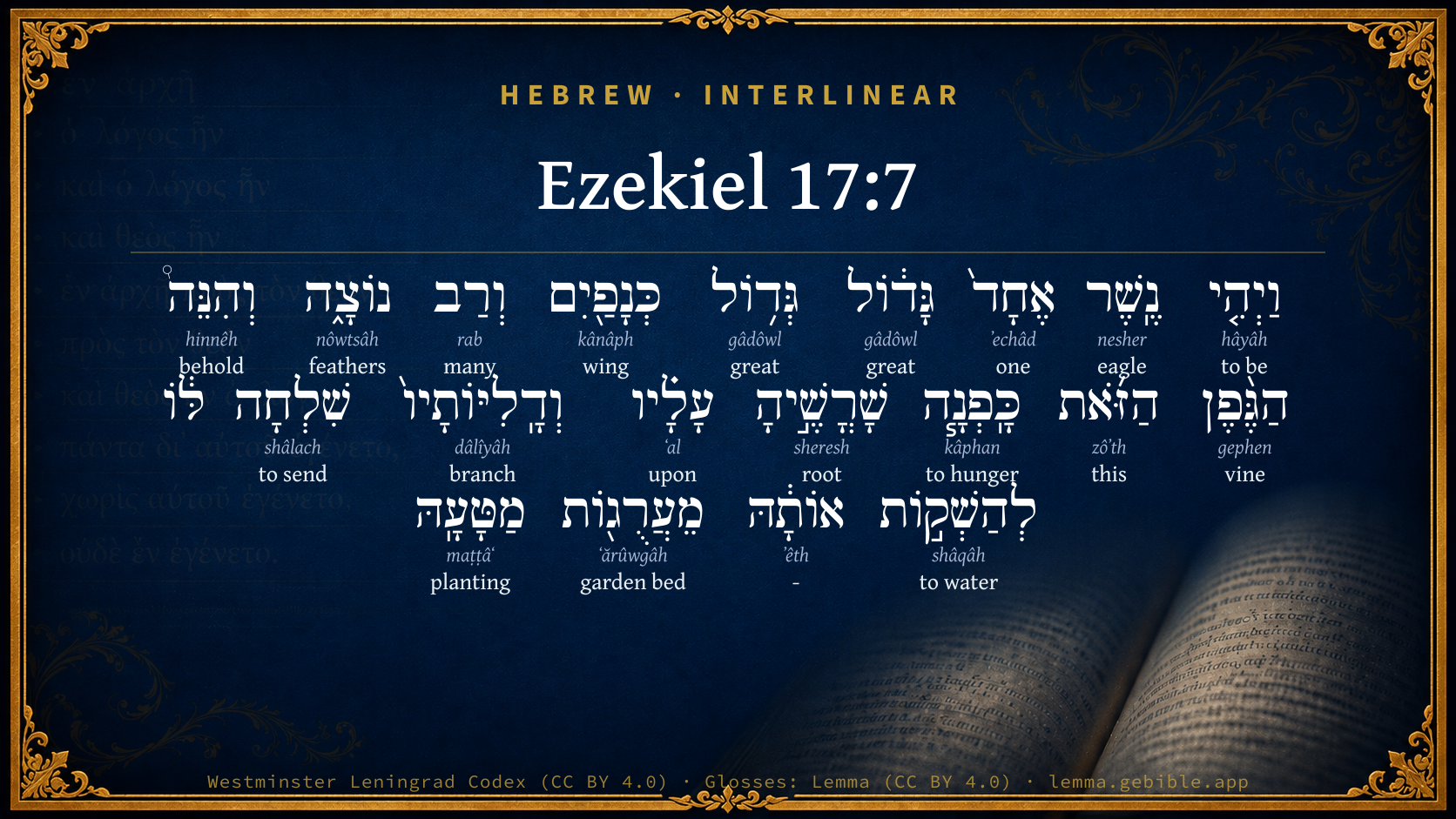
Ezekiel 17:7

Hebrew (Westminster Leningrad Codex) Ezekiel 17:7 appears in the Hebrew Old Testament. The text above is from the Westminster Leningrad Codex. Each word links to its Strong’s number, a concise gloss, and parsing drawn from the Open Scriptures Hebrew Bible morphology. Click any word for its full Brown-Driver-Briggs (BDB) entry.
Download image
Cite this verse

Ezekiel 17:7 (World English Bible). Public Domain. Lemma interlinear Bible study tool, https://lemma.gebible.app/v/ezekiel/17/7.

Show BibTeX & RIS
BibTeX
RIS
English Translation
There was also another great eagle with great wings and many feathers: and, behold, this vine did bend its roots toward him, and shot forth its branches toward him, from the beds of its plantation, that he might water it.
World English Bible · Public Domain
Highlights
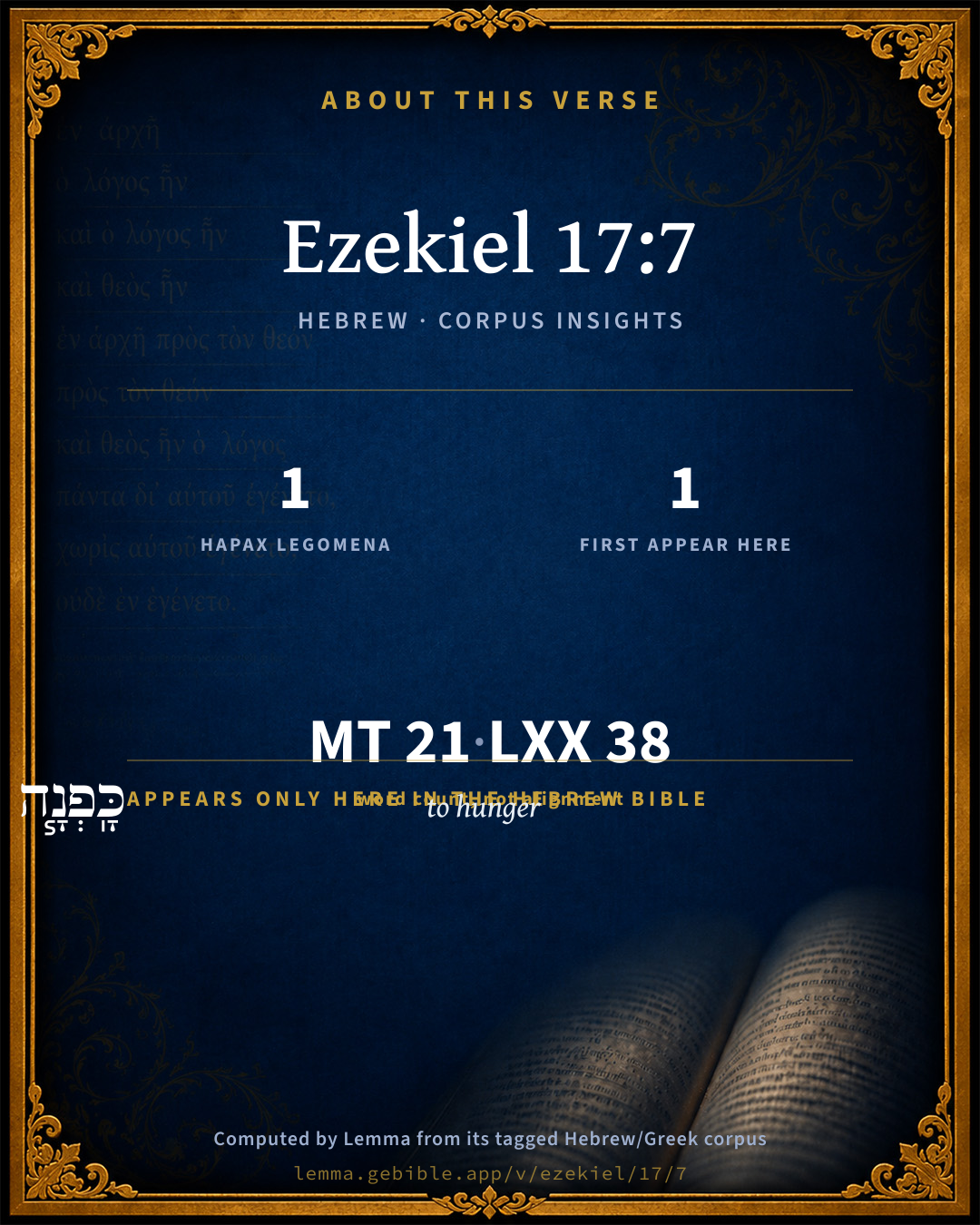
  • 1 hapax legomenon — only here in the Hebrew Bible
  • 1 first appearance in the Hebrew Bible
Full analysis ↓
Download a study sheet

One document with this verse’s original text, its word-by-word gloss line, the meaning frame, cross-references with their text, attributed commentary, and full source and license credits — printable, and it pastes into notes with its structure intact.

This verse Autodidact and up

Study sheet (.html) Plain text (.txt)

A passage Seminary Student

Up to 50 verses in one chapter. A passage sheet keeps up to 6 commentary sources and 12 cross-references per verse, in the order this page ranks them, and says so on the sheet whenever that leaves anything out. Ask for a single verse and you get the Autodidact verse sheet above.

Everything on this page stays free to read, with no account — the sheet is a download of what is already on screen, not access to it.

Want to remove ads? Support Godless Engineer
Compare translations 3

The same verse in 3 English versions, stacked beneath the original-language interlinear above. Click any original word for its lexicon entry.

Each is an independent rendering of the whole verse — the interlinear is not word-aligned to these translations.

Highlighted words mark where these versions differ — a whole-verse word diff, not a word-by-word alignment.

  • World English Bible Public Domain
    There was also another great eagle with great wings and many feathers: and, behold, this vine did bend its roots toward him, and shot forth its branches toward him, from the beds of its plantation, that he might water it.
  • King James Version Public Domain
    There was also another great eagle with great wings and many feathers: and, behold, this vine did bend her roots toward him, and shot forth her branches toward him, that he might water it by the furrows of her plantation.
  • unfoldingWord Literal Text CC BY-SA 4.0
    But there was another great eagle with large wings and many feathers. Behold! This vine turned its roots toward the eagle, and it spread out its branches toward the eagle from the place it had been planted so it would be watered.

unfoldingWord Literal Text — © unfoldingWord, licensed CC BY-SA 4.0. Word-aligned USFM3 via Door43 (git.door43.org/unfoldingWord/en_ult).

Versions to compare (up to 4)

3 of 4 selected

Show all 18 translations

Every available English version of this verse, each an independent rendering of the whole verse.

  • World English Bible Public Domain
    There was also another great eagle with great wings and many feathers: and, behold, this vine did bend its roots toward him, and shot forth its branches toward him, from the beds of its plantation, that he might water it.
  • Berean Standard Bible Public Domain
    But there was another great eagle with great wings and many feathers. And behold, this vine bent its roots toward him. It stretched out its branches to him from its planting bed, so that he might water it.
  • Majority Standard Bible Public Domain
    But there was another great eagle with great wings and many feathers. And behold, this vine bent its roots toward him. It stretched out its branches to him from its planting bed, so that he might water it.
  • King James Version Public Domain
    There was also another great eagle with great wings and many feathers: and, behold, this vine did bend her roots toward him, and shot forth her branches toward him, that he might water it by the furrows of her plantation.
  • American Standard Version (1901) Public Domain
    There was also another great eagle with great wings and many feathers: and, behold, this vine did bend its roots toward him, and shot forth its branches toward him, from the beds of its plantation, that he might water it.
  • Revised Version (1885) Public Domain
    There was also another great eagle with great wings and many feathers: and, behold, this vine did bend its roots toward him, and shot forth its branches toward him, from the beds of its plantation, that he might water it.
  • Geneva Bible (1599) Public Domain
    There was also another great eagle with great wings and many feathers, and beholde, this vine did turne her rootes toward it, and spred foorth her branches toward it, that she might water it by the trenches of her plantation.
  • Douay-Rheims (1899) Public Domain
    And there was another large eagle, with great wings, and many feathers: and behold this vine, bending as it were her roots towards him, stretched forth her branches to him, that he might water it by the furrows of her plantation.
  • Young's Literal Translation Public Domain
    And there is another great eagle, Great-winged, and abounding with feathers, And lo, this vine hath bent its roots toward him, And its thin shoots it hath sent out toward him, To water it from the furrows of its planting,
  • Literal Standard Version CC BY-SA 4.0
    And there is another great eagle, || Great-winged, and abounding with feathers, || And behold, this vine has bent its roots toward him, || And it has sent out its thin shoots toward him, || To water it from the furrows of its planting,
  • Unlocked Literal Bible CC BY-SA 4.0
    But there was another great eagle with large wings and many feathers. Behold! This vine turned its roots toward the eagle, and it spread out its branches toward the eagle from the place it had been planted so it would be watered.
  • unfoldingWord Literal Text CC BY-SA 4.0
    But there was another great eagle with large wings and many feathers. Behold! This vine turned its roots toward the eagle, and it spread out its branches toward the eagle from the place it had been planted so it would be watered.
  • Darby Bible Public Domain
    And there was another great eagle with great wings and many feathers; and behold, from the beds of her plantation, this vine did bend her roots unto him, and shot forth her branches toward him, that he might water it.
  • World Messianic Bible Public Domain
    “‘“There was also another great eagle with great wings and many feathers. Behold, this vine bent its roots toward him, and shot out its branches toward him, from the ground where it was planted, that he might water it.
  • Webster's Bible Public Domain
    There was also another great eagle with great wings and many feathers: and behold, this vine did bend her roots towards him, and shot forth her branches towards him, that he might water it by the furrows of her plantation.
  • Free Bible Version CC BY-SA 4.0
    But there was another great eagle that had large wings and many feathers. This vine sent out its roots toward him. It stretched out its branches to him from where it had been planted, wanting him to water it.
  • Bible in Basic English Public Domain
    And there was another eagle with great wings and thick feathers: and now this vine, pushing out its roots to him, sent out its branches in his direction from the bed where it was planted, so that he might give it water.
  • JPS Tanakh (1917) Public Domain
    There was also another great eagle with great wings and many feathers; and, behold, this vine did bend its roots toward him, and shot forth its branches toward him, from the beds of its plantation, that he might water it.

Literal Standard Version (2020), Covenant Press — licensed CC BY-SA 4.0. Text via the HelloAO Bible API (eBible.org). Unlocked Literal Bible (unfoldingWord) — licensed CC BY-SA 4.0. Text via the HelloAO Bible API (eBible.org). unfoldingWord Literal Text — © unfoldingWord, licensed CC BY-SA 4.0. Word-aligned USFM3 via Door43 (git.door43.org/unfoldingWord/en_ult). Free Bible Version, Dr. Jonathan Gallagher — licensed CC BY-SA 4.0. Text via the HelloAO Bible API (eBible.org).

Word by word

More ways to search: Search by grammar → Find every occurrence → Compare this word →

Practice this passage: Drill this verse → Learn its vocabulary →

כָּֽפְנָ֧ה
kâphan
H3719
“to hunger”
Verb, Qal, Perfect, 3rd Person, Feminine, Singular
Part of Speech
Verb
Stem
Qal
Form
Perfect
Person
3rd Person
Gender
Feminine
Number
Singular
Full BDB Definition

Origin: a primitive root

TWOT: 1020

(Qal) to hunger, be hungry, hungrily desire - (CLBL) to twist, bend
  1. וַיְהִ֤י hâyâh H1961 “and · to be” Conjunction + Verb, Qal, Sequential Imperfect, 3rd Person, Masculine, Singular
  2. נֶֽשֶׁר nesher H5404 “eagle” Noun, Common, Masculine, Singular, Absolute
  3. אֶחָד֙ ʼechâd H259 “one” Adjective, Cardinal number, Masculine, Singular, Absolute
  4. גָּד֔וֹל gâdôwl H1419 “great” Adjective, Adjective, Masculine, Singular, Absolute
  5. גְּד֥וֹל gâdôwl H1419 “great of” Adjective, Adjective, Masculine, Singular, Construct
  6. כְּנָפַ֖יִם kânâph H3671 “wings” Noun, Common, Feminine, Dual, Absolute
  7. וְרַב rab H7227 “and · many of” Conjunction + Adjective, Adjective, Masculine, Singular, Construct
  8. נוֹצָ֑ה nôwtsâh H5133 “feathers” Noun, Common, Feminine, Singular, Absolute
  9. וְהִנֵּה֩ hinnêh H2009 “and · behold” Conjunction + Particle, Demonstrative
  10. הַגֶּ֨פֶן gephen H1612 “the · vine” Particle, Definite Article + Noun, Common, Both, Singular, Absolute
  11. הַזֹּ֜את zôʼth H2063 “the · this” Particle, Definite Article + Pronoun, Demonstrative, Feminine, Singular
  12. שָׁרֳשֶׁ֣יהָ sheresh H8328 “roots · her” Noun, Common, Masculine, Plural, Construct + Suffix, Personal, 3rd Person, Feminine, Singular
  13. עָלָ֗יו ʻal H5921 “upon · him” Preposition + Suffix, Personal, 3rd Person, Masculine, Singular
  14. וְדָֽלִיּוֹתָיו֙ dâlîyâh H1808 “and · branches · his” Conjunction + Noun, Common, Feminine, Plural, Construct + Suffix, Personal, 3rd Person, Masculine, Singular
  15. שִׁלְחָה shâlach H7971 “to send” Verb, Piel, Perfect, 3rd Person, Feminine, Singular
  16. לְהַשְׁק֣וֹת shâqâh H8248 “to water” Preposition + Verb, Hiphil, Infinitive Construct
  17. אוֹתָ֔הּ ʼêth H853 “- · her” Particle, Direct Object + Suffix, Personal, 3rd Person, Feminine, Singular
  18. מֵעֲרֻג֖וֹת ʻărûwgâh H6170 “from · garden beds of” Preposition + Noun, Common, Feminine, Plural, Construct
  19. מַטָּעָֽהּ maṭṭâʻ H4302 “planting · her” Noun, Common, Masculine, Singular, Construct + Suffix, Personal, 3rd Person, Feminine, Singular

About this verse

These counts appear in no published source. They are computed here, from the morphology-tagged text and Lemma’s own curated glosses. What Lemma adds →

21
words
19
distinct lemmas
Prophets
section

Notable vocabulary

1 hapax legomenon — a word that appears only here in the entire Hebrew Bible:

  • כָּֽפְנָ֧ה to hunger H3719

First appearance in Scripture

This word makes its first canonical appearance in the Hebrew Bible here:

  • כָּֽפְנָ֧ה to hunger H3719

Shared distinctive vocabulary

נוֹצָ֑ה feathers H5133 occurs in 4 verses of the Hebrew Bible. Also found in:

Grammatical profile

  • 4 verbs
  • 8 nouns
  • 4 adjectives
  • 1 pronoun
  • 2 prepositions
  • 2 particles

Verb forms

  • וַיְהִ֤י Qal · Sequential Imperfect
  • כָּֽפְנָ֧ה Qal · Perfect
  • שִׁלְחָה Piel · Perfect
  • לְהַשְׁק֣וֹת Hiphil · Infinitive Construct

Repetition

A word recurs within this verse — often emphatic in Hebrew:

  • גָּד֔וֹל great H1419 ×2

Hebrew & Septuagint length

In English translation the verse runs 40 words from the Hebrew and 48 from the Septuagint (LXX English) — closely comparable.

A rough comparison of the two English renderings, which tokenize alike — not a word-level alignment.

Word counts can differ between the Hebrew and the Greek without any difference in meaning — e.g. the Hebrew direct-object marker אֵת has no separate Greek word, and Greek often adds the article ὁ.

In the original languages it is 21 Hebrew tokens and 38 Greek tokens — but the two are counted differently (Hebrew bundles its prefixes and suffixes into one token; the Greek is in lemma form), so that isn’t a like-for-like length.

Cross-references

5

Topical passages linked to Ezekiel 17:7 in the Treasury of Scripture Knowledge — connected by theme and wording, ordered by reader-vote popularity; previews shown in the World English Bible.

  • Ezekiel 17:15 But he rebelled against him in sending his ambassadors into Egypt, that they might give him horses and much people. Shall he prosper? shall he escape who does such things? shall he break the covenant, and yet escape?
  • Ezekiel 31:4 The waters nourished it, the deep made it to grow: the rivers of it ran round about its plantation; and it sent out its channels to all the trees of the field.
  • 2 Kings 24:20 For through the anger of Yahweh did it happen in Jerusalem and Judah, until he had cast them out from his presence. Zedekiah rebelled against the king of Babylon.
  • 2 Chronicles 26:13 Under their hand was an army, three hundred thousand and seven thousand and five hundred, who made war with mighty power, to help the king against the enemy.
  • Jeremiah 37:5–7 Pharaoh's army was come forth out of Egypt; and when the Chaldeans who were besieging Jerusalem heard news of them, they broke up from Jerusalem.

Cross-references courtesy of OpenBible.info (CC BY 4.0).

Hebrew and Greek witnesses Masoretic Hebrew ↔ Greek Septuagint

The same verse in the two great witnesses to the Old Testament, shown verse-for-verse.

These are two independent witnesses, not word-aligned to each other, and the Septuagint is shown in lemma (dictionary) form.

Hebrew Ezekiel 17:7 Masoretic · Westminster Leningrad Codex

וַיְהִ֤י נֶֽשֶׁר אֶחָד֙ גָּד֔וֹל גְּד֥וֹל כְּנָפַ֖יִם וְרַב נוֹצָ֑ה וְהִנֵּה֩ הַגֶּ֨פֶן הַזֹּ֜את כָּֽפְנָ֧ה שָׁרֳשֶׁ֣יהָ עָלָ֗יו וְדָֽלִיּוֹתָיו֙ שִׁלְחָה לּ֔וֹ לְהַשְׁק֣וֹת אוֹתָ֔הּ מֵעֲרֻג֖וֹת מַטָּעָֽהּ

There was also another great eagle with great wings and many feathers: and, behold, this vine did bend its roots toward him, and shot forth its branches toward him, from the beds of its plantation, that he might water it.

World English Bible · Public Domain

Greek LXX Ezekiel 17:7 Septuagint · lemma form

καί γίγνομαι ἀετός ἕτερος μέγας μεγαλοπτέρυγος πολύς ὄνυξ καί ἰδού ὁ ἄμπελος οὗτος περιπλέκω πρός αὐτός καί ὁ ῥίζα αὐτός πρός αὐτός καί ὁ κλῆμα αὐτός ἐκ ἀποστέλλω αὐτός ὁ ποτίζω αὐτός σύν ὁ βῶλος ὁ φυτεία αὐτός

And there was another great eagle, with great wings and many claws: and, behold, this vine bent itself round toward him, and her roots were turned towards him, and she sent forth her branches towards him, that he might water her together with the growth of her plantation.

LXX2012 (modern English Septuagint) · Public Domain

Hebrew: Westminster Leningrad Codex (CC BY 4.0). Greek: Septuagint (public domain); English from LXX2012 (modern English Septuagint) (Public Domain). How the Septuagint differs from the Hebrew →

Targum (Aramaic paraphrase)

1

The Targum is the ancient Jewish Aramaic paraphrase of the Hebrew Scriptures — an interpretive translation, not the Hebrew text itself. Onkelos (literal) and Pseudo-Jonathan (expansive) render the Torah, and Jonathan the Prophets. Coverage is partial: where no permissively-licensed English translation exists for a verse, only the Aramaic is shown. This is verse-level text, not a word-by-word alignment to the Hebrew.

  1. Targum Jonathan Prophets (Joshua–Malachi)
    וַהֲוָה נִשְׁרָא חַד רַבָּא רַב גַפִּין וַחֲפֵי כַנְפִין וְהָא גוּפְנָא הָדָא כַּפַּת שָׁרְשׁוֹהִי עֲלוֹהִי וְעוֹבַרְתֵּהּ שְׁלָחַת לֵיהּ לְאַשְׁקָאָה יָתָהּ מֵעוּגְיַת נִצְבָתָהּ:

    (no public-domain English translation for this verse)

    Targum Jonathan — Aramaic: “Mikraot Gedolot” (public domain). English: “Sefaria Community Translation” (CC0 1.0 (public-domain dedication)); “London "Chaldee Paraphrase," 1871” (public domain). Text via Sefaria.

Commentary

Notes on Ezekiel 17:7 from classic Christian and Jewish commentators (each source and its license shown beneath its notes). The classic Christian expositions comment on the surrounding passage and are grouped to its opening verse, so a note may address several verses; the Jewish commentaries on the Tanakh (Rashi and others) are per-verse, so they appear only where the commentator wrote on this verse.

Lemma curates 59 commentaries, every one of them public domain or Creative Commons licensed, each selected and text-cleaned for this edition rather than reprinted as found. About our sources →

Trapp's Complete Commentary

John Trapp

Eze 17:7 There was also another great eagle with great wings and many feathers: and, behold, this vine did bend her roots toward him, and shot forth her branches toward him, that he might water it by the furrows of her plantation.

Ver. 7. There was also another great eagle,] sc., Pharaoh, another potent monarch; why called an eagle, see on Eze 17:3.

And, behold, this vine did bend her roots toward him.] Which was the worst chare for herself that ever she did. The devil of discontent put her upon this unhappy project, whereby, instead of mending herself, she soon marred all; so true is that of Solomon, "Wisdom is better than weapons of war: but one sinner destroyeth much good." {Ecc 9:18} Zedekiah little thought once ever to have been a king; Nebuchadnezzar made him so, whenas he might as well have refused him for the rebellions of his two predecessors. He had also dealt nobly with him, though his vassal, and would have defended him against any adverse power, &c., so that he had no reason at all to rebel, but that he was infatuated and besotted by ambition and avarice, which Plutarch finely and fitly calleth νοσηματα συμφυτα ταις δυναστειαις, diseases natural to potentates.

John Trapp, A Commentary or Exposition upon All the Books of the Old and New Testament (1647–1656) — public domain. Text from a community e-Sword module.

Joseph Benson's Commentary

Eze 17:7-8. There was also another great eagle — Namely, Pharaoh, king of Egypt, with whom Zedekiah made an alliance; whereupon that king sent an army to raise the siege of Jerusalem, 2Ch 36:13; Jer 37:5; Jer 37:7. With great wings and many feathers — Having a great army and many people to support him. And this vine (namely, Zedekiah) did bend her roots toward him, &c. — Zedekiah sought the assistance and protection of the king of Egypt. Dr. Waterland renders this clause, And shot forth her branches under him, from the furrows where she was planted, that he might water it: that is, give it assistance. The auxiliary forces which Zedekiah expected from Egypt are here intended. It was planted in a good soil, &c. — The words are to the same purpose with Eze 17:5, to show that Zedekiah’s condition was so good under the king of Babylon, that he needed not to have broken his oath out of a desire to better it, whereby he involved himself and his country in ruin: see notes on 2Ki 24:20; and Jer 17:25.

Joseph Benson's Commentary on the Old and New Testaments (1811–1818) — public domain. Text from a community e-Sword module.

Tyndale Open Study Notes

Tyndale Open Resources

17:7-9 There was a second great eagle like the first, although not quite so glorious. • The fate of the vine was predictable. In seeking to gain more, it would lose what it already had. The second eagle would not do anything for it, and the anger of the first eagle would be justly aroused.

Tyndale Open Study Notes — © Tyndale Open Resources, licensed CC BY-SA 4.0. Text via the HelloAO Bible API.

Geneva Bible (1599)

Geneva Bible translators

Meaning, the king of Egypt, of whom Zedekiah sought succor against Nebuchadnezzar.

Geneva Bible (1599) marginal notes — public domain. Text via Bolls.life.

Jamieson, Fausset & Brown

Robert Jamieson, A. R. Fausset & David Brown

another . . . eagle--the king of Egypt (Eze 17:15). The "long-winged" of Eze 17:3 is omitted, as Egypt had not such a wide empire and large armies as Babylon.

vine . . . bend . . . roots towards him--literally, "thirsted after him with its roots"; expressing the longings after Egypt in the Jewish heart. Zedekiah sought the alliance of Egypt, as though by it he could throw off his dependence on Babylon (Kg2 24:7, Kg2 24:20; Ch2 36:13; Jer 37:5, Jer 37:7).

water it by . . . furrows of . . . plantation--that is, in the garden beds (Judea) wherein (the vine) it was planted. Rather, "by" or "out of the furrows." It refers to the waters of Egypt, the Nile being made to water the fields by means of small canals or "furrows"; these waters are the figure of the auxiliary forces wherewith Egypt tried to help Judah. See the same figure, Isa 8:7. But see on Eze 17:10, "furrows where it grew."

Jamieson, Fausset & Brown — Commentary Critical and Explanatory on the Whole Bible (1871) — public domain (CC PDM 1.0). Text via the HelloAO Bible API.

Adam Clarke's Commentary

Verse 7. Another great eagle] Pharaoh-hophra, or Apries, king of Egypt.

With great wings] Extensive dominion.

And many feathers] Numerous subjects.

Did bend her roots] Looked to him for support in her intended rebellion against Nebuchadnezzar.

Adam Clarke's Commentary on the Bible (1810–1826) — public domain. Text from a community e-Sword/MySword module.

John Calvin's Commentaries

He now detects, under a figure, the perfidy of Zedekiah, since he very soon applied himself to the king of Egypt, and bent his roots and branches towards him, that they might be irrigated. I do not disagree with the opinion of those who think that the Prophet alludes to an Egyptian custom; for we know that they dug furrows through which water flowed through the whole region: hence the fruitfulness of the soil; and thus Egypt is elsewhere compared to a garden. (Deuteronomy 11:10.) Whatever the meaning is, the Prophet shows that Zedekiah was deceived by a foolish confidence when he thought himself safe under the protection of the king of Egypt; for he had said that the seed was so planted that the vine did not rise to a great height, but spread itself under the wings of the eagle. But Zedekiah despised the king of Babylon, thinking that he should improve his condition by entering into a treaty with the king of Egypt. It now follows —

John Calvin's Commentaries (1540-1563) — public domain. Text from the Calvin Translation Society English edition (1840s-50s) via the Christian Classics Ethereal Library (ccel.org). Calvin's coverage is partial (roughly two-thirds of the Bible); uncommented books and verses are honest gaps, never fabricated. The 19th-century editor's footnotes and remarks are omitted so the notes are faithfully Calvin's own voice.

Ellicott's Commentary for English Readers

(7) Another great eagle.—This is explained in Eze_17:15 of Pharaoh. He was also powerful, ruling a populous land, but is not described as with the variegated feathers of Eze_17:3, because he did not rule over the same diversity of people with Nebuchadnezzar. Zedekiah, while owing his position to Nebuchadnezzar, treacherously sought the aid of Egypt, as mentioned in Eze_17:15, and more fully in the historical passages referred to in the note at the beginning of this chapter. A chief task of the prophet Jeremiah was to endeavour to dissuade Zedekiah from this Egyptian alliance.

A Bible Commentary for English Readers, edited by Charles John Ellicott (1878–1897) — public domain. Text from a community e-Sword module.

The Cambridge Bible for Schools and Colleges

gen. ed. J. J. S. Perowne

7. The other great eagle, which however is not described with such imposing epithets as the former, is the king of Egypt. The vine bent its roots toward him—sought to draw nourishment from him.

by the furrows] Rather: from the beds of its plantation—i.e. where it was planted. The words are connected with “did bend her roots.” The comparative sense: to water it more than the beds, has less probability; though it would express the uneasiness of Zedekiah and his vain political dreams.

The Cambridge Bible for Schools and Colleges (gen. ed. J. J. S. Perowne; Cambridge University Press, 1878–1918) — public domain. Text from a community e-Sword module.

John Gill's Exposition

It was planted in, a good soil, by great waters,.... As is expressed in Eze 17:5; this was done by the king of Babylon, who had raised Zedekiah from a low estate to a high one, and set him on the throne of Judah, over many people; and put him in such a condition, and in such circumstances, that he and his people might have been very happy, could they have been content:, for his view was,

that he might bring forth branches, and that it might bear fruit, that it might be a goodly vine; that he and his people might grow numerous and rich, and be a prosperous and flourishing kingdom; this is mentioned to aggravate the ingratitude of Zedekiah, and the people of the Jews, in rebelling against the king of Babylon, who had used them well, and of whom they had no reason to complain.

John Gill's Exposition of the Whole Bible (1746–1763) — public domain (CC PDM 1.0). Text via the HelloAO Bible API.

Albert Barnes' Notes on the Bible

Another great eagle - This is the king of Egypt, mighty indeed but not like the first.

By the furrows of her plantation - From the beds, where it was planted to bring forth fruit for another, it shot forth its roots to him that he might water it. Zedekiah was courting the favor of Egypt while he owed his very position to the bounty of Assyria.

Albert Barnes' Notes on the Bible (1834–1885) — public domain. Text from a community e-Sword/MySword module.

Haydock's Catholic Bible Commentary

Eagle. The king of Egypt, (Challoner) Vaphres, who came at the request of Sedecias, to oppose the Chaldeans, but was routed; and they returned to the siege of Jerusalem, Jeremias xxxvii. 4. --- Plantation, as the waters of the Nile were conducted to different parts by ditches, Deuteronomy xi. 10.

George Leo Haydock (1774–1849), Haydock's Catholic Family Bible and Commentary, 1859 edition — public domain. Excludes Psalms (Douay-Rheims chapter numbering differs from Protestant) and Deuterocanonical books (Catholic canon only).

Matthew Poole's English Annotations

This is the second part of the parable.

Another great eagle, i.e. the king of Egypt, whether Apries, or Hophra, or what other was his name we need not curiously inquire, it was king of Egypt, Eze 17:15.

Great wings: see Eze 17:3.

This vine; Zedekiah, his nobles and people.

Did bend her roots towards him; sought the friendship and help of the king of Egypt.

Shot forth her branches; sent ambassadors, made a covenant, and trusted to the power of Egypt to defend her branches.

That he might water it; that they might add to their greatness and prosperous condition, as trees grow by due and seasonable watering them.

By the furrows; alluding to the manner of irrigation used in Egypt, by furrows or trenches to convey the water unto their plantations from the river Nile.

Matthew Poole's English Annotations on the Holy Bible (1683–1685) — public domain. Text from a community e-Sword/MySword module.

Whedon's Commentary on the Bible

Daniel D. Whedon

7. Another great eagle — The king of Egypt.

This vine did bend her roots toward him — Zedekiah began to look for nourishment to Egypt, although he had received his crown from Babylon (Eze_17:5; Eze_17:8; Eze_17:13; Eze_17:15). The figure is that this vinelike cedar, instead of striking its roots deep into its own native soil, where the Babylonian eagle had planted it, threw out its roots toward the Nile.

By the furrows — R.V., “from the beds;” or as Cornill, “more than the beds in which it was planted.”

Daniel D. Whedon (gen. ed.), Commentary on the Old and New Testaments (1874–1909) — public domain. Text from a community e-Sword module.

The Pulpit Commentary

The other great eagle is, of course, Egypt, then under Apries, or Pharaoh-Hophra. (Jer_44:30) We note the absence of the "long pinions" and the "many colours" of the first eagle. Egypt was not so strong, nor did her sway extend over so great a variety of nations as Babylon. To that eagle the vine bent its roots, i.e., as in ver. 15, Zedekiah courted the alliance of Pharaoh (Apries), and trusted in his chariots, lie was to water the vine, which so turned to him from the beds of her plantation (Revised Version).

The Pulpit Commentary (1880–1919), ed. H.D.M. Spence-Jones & Joseph S. Exell — public domain. Text from a community e-Sword module.

John Wesley's Explanatory Notes

Another - The king of Egypt. This vine - Zedekiah, his nobles and people. Did bend - Sought his friendship. Shot forth - Sent ambassadors, and trusted to the power of Egypt. Water it - That they might add to their greatness, as trees grow by seasonable watering them. By the furrows - Alluding to the manner of watering used in Egypt, by furrows or trenches to convey the water from the river Nile.

John Wesley, Explanatory Notes Upon the Whole Bible (1754–1765) — public domain. Text via the GEBible commentary corpus.

unfoldingWord translationNotes

Door43 World Missions Community

General Information:

The introductory "but" shows that a different eagle is being described other than the one before.

another great eagle

"another large eagle"

Behold!

The word "behold" here alerts us to pay attention to the surprising information that follows.

This vine turned its roots toward the eagle

Yahweh speaks of the vine as if it were able to behave like a person and intentionally turned its roots toward the other eagle to receive nourishment from it. AT: "The roots of the vine grew toward the eagle" (See: Personification)

from the place it had been planted so it would be watered

This can be stated in active form. AT: "from the place that the first eagle had planted it so that it would have water" (See: Active or Passive)

It had been planted

This can be stated in active form. AT: "The first eagle had planted the vine" (See: Active or Passive)

translationWords

vine

fruit

unfoldingWord translationNotes — © Distant Shores Media and the Door43 World Missions Community, licensed CC BY-SA 4.0. Source: git.door43.org/Door43/en_tn.

Rashi

Rabbi Shlomo Yitzchaki (Rashi)

Now there was one...eagle The king of Egypt.

gathered its roots Heb. כָּפְנָה, an expression of hunger, like (Job 5:22): “plunder and famine (וּלְכָפָן).” The roots of this vine hungered and longed for that eagle. (Addendum:) Some explain כָּפְנָה like אָסְפָה, gathered, the letters [of כָּפְנָה] being transposed. In the words of our Sages there is something similar to it, for they call a public gathering כְּנוּפְיָא. כָּפְנָה is like כָּנְפָה, amassa in French, brought in, gathered.

and its tendrils it sent forth to him And her emissaries she sent to him, to come to her and water her.

from the furrows of its planting From the water ditches that the first eagle had made for it.

Rashi on the Tanakh — English translations: “The Judaica Press complete Tanach with Rashi, translated by A. J. Rosenberg” (CC BY 4.0); “Pentateuch with Rashi's commentary by M. Rosenbaum and A.M. Silbermann, 1929-1934” (public domain); “The Metsudah Tanach series, Lakewood, N.J” (CC BY 4.0); and “The Book of Joshua, Metsudah Publications, 1997” (CC BY 4.0). Text via Sefaria.

Lesson kit

Teaching starters — assembled from the data on this page, not authored interpretation. Every prompt links to the verse data it draws on. Edit before teaching.

Ezekiel, in the Prophets, opens this verse with 21 words (19 distinct Hebrew lemmas). Its most distinctive word is kâphan (“to hunger”). A historical commentator’s framing appears above. Read the whole chapter for the surrounding context.

Discussion questions

  1. What does “to hunger” (kâphan) contribute to the verse as a whole?
  2. This verse holds 1 word here found nowhere else in the Hebrew Bible. What might the rare word draw attention to?
  3. The word “to hunger” first appears here in Scripture. What is being introduced at this debut?
  4. Leviticus 1:16 shares the word «feathers» with this verse. How do the two illuminate each other?
  5. “great” occurs 2× in this one verse. What is the effect of the repetition?
  6. These translations render this verse differently. What is at stake in choosing one wording over another?
  7. The verb «וַיְהִ֤י» is Qal Sequential Imperfect. How does its form color the action?
  8. Reading how Trapp's Complete Commentary and Joseph Benson's Commentary read this verse, where do the two commentators agree and where do they part?

Things to notice

  • 1 word in this verse appears nowhere else in the Hebrew Bible.
  • 1 word makes its first canonical appearance in Scripture here.
  • This verse counts 21 Hebrew ↔ 38 Greek words.
  • These translations choose different wording for 21 words in this verse.
  • “great” occurs 2× in this single verse.

Reading settings

Reading text

Shown beneath each verse's original-language words.

Old Testament
Old Testament edition

Read the OT as the Masoretic Hebrew (MT) or the Greek Septuagint (LXX).

English shown for the Greek Septuagint (in the Hebrew ↔ Greek comparison).

Comparing translations? Open the Compare panel on any verse page to stack up to four side by side.