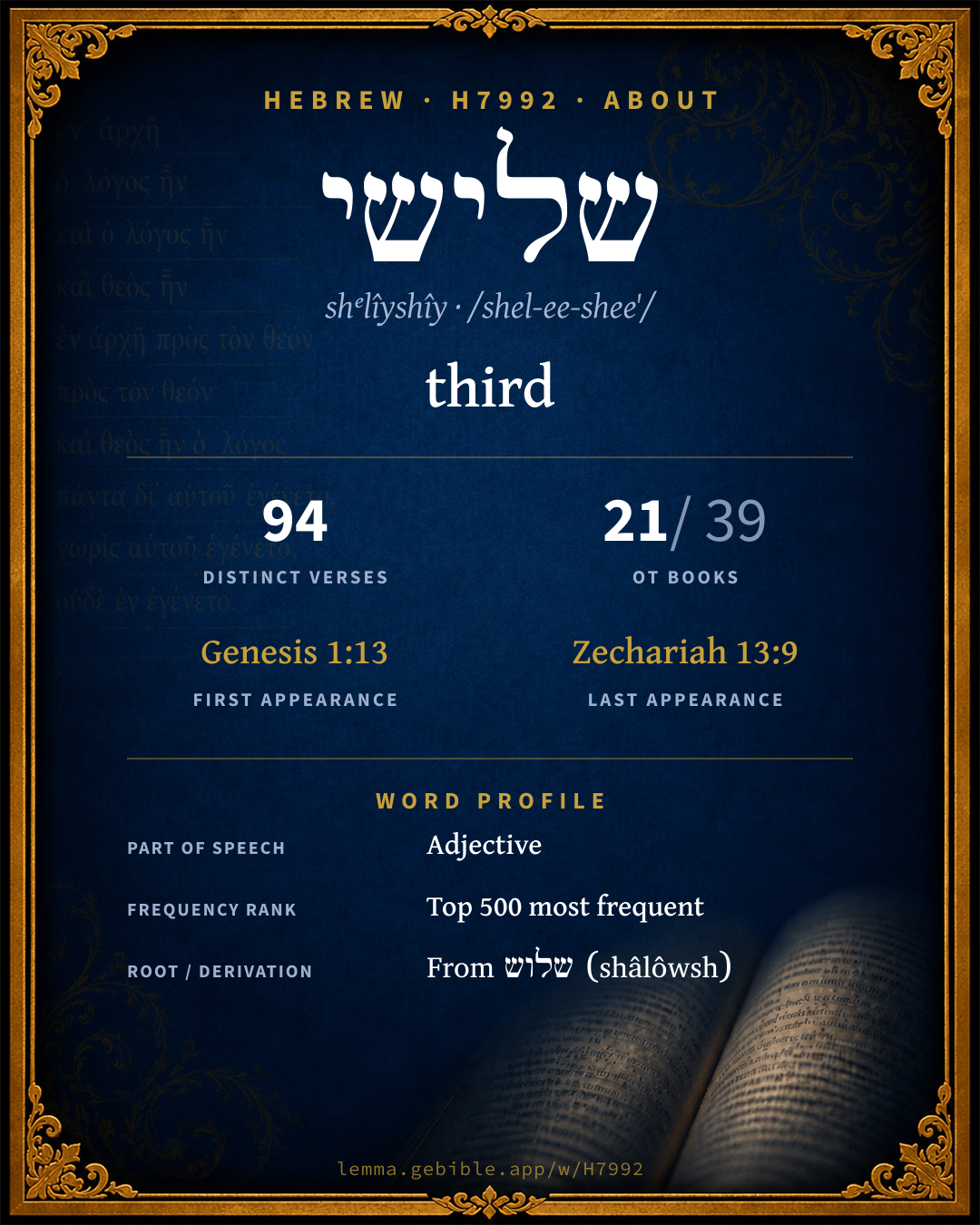
שְׁלִישִׁי
third
also: one third, third part, third time fuller range ↓
Full lexicon entry — Brown-Driver-Briggs (BDB)
From Brown-Driver-Briggs (BDB)
Where this word appears
See every Absolute-state word in the Hebrew Bible →
Grammar key — what these labels mean
Part of speech
- Adjective
- A word that describes or qualifies a noun.
- Noun
- A naming word — a person, place, thing, or idea.
Noun type
- Common
- A common noun — a general class of person, place, or thing (“king,” “city,” “water”), not a specific name.
- Proper
- A name of a specific person, place, or people (e.g. Abraham, Zion, Israel).
State
- Absolute
- The independent form of a noun, not bound to a following word.
- Construct
- A noun bound to a following noun in a possessive / “of” relationship (the construct chain).
Gender
- Masculine
- Grammatically masculine.
- Feminine
- Grammatically feminine.
Number
- Singular
- One.
- Plural
- More than one (in Hebrew, generally three or more).
8 verses where H7992 appears in the Absolute state in the Book of Numbers. Filtered view — show all forms. Click any verse to open its interlinear word-by-word view. Verse text shown in the World English Bible for context — . Each verse’s Hebrew form is shown with its reference; the English is not keyword-highlighted, since the data carries no word-level English alignment. Use “Compare translations” on any verse to read it across multiple English versions. This concordance covers the Hebrew Bible; Septuagint (Greek Old Testament) occurrences are not indexed here.
Numbers
- Numbers 2:24 וּ/שְׁלִשִׁ֖ים conj + Adjective Ordinal number mp "All who were numbered of the camp of Ephraim were one hundred eight thousand one hundred, according to their divisions. They shall set out third.
- Numbers 7:24 הַ/שְּׁלִישִׁ֔י ptcl def.art + Adjective Ordinal number ms On the third day Eliab the son of Helon, prince of the children of Zebulun
- Numbers 15:6 שְׁלִשִׁ֥ית adj Ordinal number fs Or for a ram, you shall prepare for a meal-offering two tenth parts [of an ephah] of fine flour mixed with the third part of a hin of oil:
- Numbers 15:7 שְׁלִשִׁ֣ית adj Ordinal number fs and for the drink-offering you shall offer the third part of a hin of wine, of a sweet savor to Yahweh.
- Numbers 19:12 הַ/שְּׁלִישִׁ֛י הַ/שְּׁלִישִׁ֛י ptcl def.art + Adjective Ordinal number ms ptcl def.art + Adjective Ordinal number ms the same shall purify himself therewith on the third day, and on the seventh day he shall be clean: but if he doesn't purify himself the third day, then the seventh day he shall not be clean.
- Numbers 19:19 הַ/שְּׁלִישִׁ֖י ptcl def.art + Adjective Ordinal number ms and the clean person shall sprinkle on the unclean on the third day, and on the seventh day: and on the seventh day he shall purify him; and he shall wash his clothes, and bathe himself in water, and shall be clean at even.
- Numbers 29:20 הַ/שְּׁלִישִׁ֛י ptcl def.art + Adjective Ordinal number ms On the third day eleven bulls, two rams, fourteen he-lambs a year old without blemish;
- Numbers 31:19 הַ/שְּׁלִישִׁי֙ ptcl def.art + Adjective Ordinal number ms Encamp you outside of the camp seven days: whoever has killed any person, and whoever has touched any slain, purify yourselves on the third day and on the seventh day, you and your captives.
About this entry
At a glance — auto-summarized from this page’s data, not written by a person. Every figure links to its source below. This summary describes the numbers; it doesn’t interpret them.
The Hebrew adjective שלישי centers on the idea of “third.” “third part” is the historic King James Version rendering; modern versions use “third.” See the renderings breakdown. Spanning 94 verses in 21 books, it ranks among the moderately common words of the Hebrew Bible. Debuting at Genesis 1:13, it then recurs through the corpus. BDB distinguishes 2 senses; alongside “third” it spans “one third”, “third part”, and “third time”. For the data behind this summary, explore the sense tree and the renderings breakdown below.
Gloss history
Strong's 1890 vs modern scholarship
About this word
Strong's H7992 catalogs a Hebrew word from the Hebrew Old Testament.
These counts are not copied from any lexicon or concordance. They are computed here, from the morphology-tagged Hebrew Old Testament. What Lemma adds →
- 94
- distinct verses
- The word appears in 94 distinct verses.
- 21 / 39
- OT books
- The word appears in 21 of 39 Old Testament books.
- #401
- by frequency
- Top 500 most frequent Hebrew words (rank 401 of 8,640 Hebrew words by occurrence).
View all 94 occurrences in the concordance →
Most concentrated in
- 1 Chronicles 14 verses 15%
- Genesis 9 verses 10%
- Numbers 9 verses 10%
By section of the Old Testament
By traditional corpus
Conventional, traditional groupings — biblical authorship is debated, so this is a traditional corpus grouping, not an authorship claim. Each share is this word’s portion of its verses in that division of the Hebrew canon. Each figure is a share of the word’s 94 distinct verses.
- Prophets (Nevi'im) 41 verses · 44%
- Torah (Pentateuch) 29 verses · 31%
- Writings (Ketuvim) 24 verses · 26%
How translations render this word
Counts come from each version’s own published word-to-Strong’s tagging or interlinear alignment — an approximate guide to how each version renders this word, not a word-level alignment the data otherwise carries. Because each total is that version’s own tagged count, the per-version totals vary from one another and need not match the appearance or distinct-verse counts above. These counts may also differ from a printed concordance because Lemma counts each distinctly tagged rendering and does not collapse phrase taggings into a single head-word total. This is a fixed set of word-tagged versions (KJV, ASV, BSB, ULT) and does not change with the reading translation you choose elsewhere. Each version’s license is shown beside its name below (and on Sources).
- King James Version: Third 67×, Third part 17×, Came to pass on the third 2×
- American Standard Version: Third 64×, Third part 15×, Came to pass on the third 3×
- Berean Standard Bible: Third 93×, Three 3×, After three 2×
- unfoldingWord Literal Text: Third 89×, Third of 7×, Third day 4×
King James Version Public Domain
Renders H7992 across 108 tagged occurrences — most commonly:
Plus 16 renderings that appear only once — usually multi-word phrases or single function words the recovered tagging swept in, not distinct renderings.
American Standard Version Public Domain
Renders H7992 across 108 tagged occurrences — most commonly:
Plus 20 renderings that appear only once — usually multi-word phrases or single function words the recovered tagging swept in, not distinct renderings.
Berean Standard Bible Public Domain
Renders H7992 across 106 tagged occurrences — most commonly:
Plus 8 renderings that appear only once — usually multi-word phrases or single function words the recovered tagging swept in, not distinct renderings. Not rendered by a distinct English word in 2 further occurrences.
unfoldingWord Literal Text CC BY-SA 4.0
Renders H7992 across 112 tagged occurrences — most commonly:
Plus 7 renderings that appear only once — usually multi-word phrases or single function words the recovered tagging swept in, not distinct renderings.
Senses in BDB
The 2 senses BDB distinguishes for this word, in lexicon order (not ranked by frequency or importance). The full entry — with sub-senses — is in the Lexicon Entry tab.
- third, one third, third part, third time
- ordinal number
Word origin
m. שְׁלִישִׁית f. adj.num. ord.108 third;—יוֹם שְׁלִישִׁי Gn 1:13 + 31 times, etc. (64 times, rarely שְׁלִשִׁי); pl. שְׁלִשִׁים (third 50, set of messengers, etc.) 1 S 19:21; 2 K 1:13 + 4 times; בַּשָּׁנָה הַשְּׁלִישִׁית 1 K 18:1 + 4 times, etc. (33 times; sometimes שְׁלִשִׁית, שְׁלִשִׁת, etc.); = third part, a third 2 S 18:2(×3) + 13 times, + (cstr.) Nu 15:6 + 4 times, + שְׁלִשִׁתֵיךְ (Ges§ 911) Ez 5:12 third part of thee; = third time 1 S 3:8; also שְׁלִישִׁיָּה Is 19:24 third (on par with other two); בַּשְּׁלֵישִׁים Ez 42:3 in the thirds, i.e. third story;—שְׁלִשִׁיָּה עֶגְלַת Is 15:5; Je 48:34, v. ע׳ p. 722.—שְׁלִישִׁתָה Ez 21:19 is corrupt; Krae proposes וְשֻׁלְּשָׁה the sword shall be doubled and trebled; other conj. in Co Toy. 1 S 20:5 del. הַשּׁ׳ 𝔊 We Dr al., so v 12 2 S 23:18 read הַשְּׁלשִׁם 𝔖 We Dr al.
— Brown-Driver-Briggs (Oxford 1906, public domain), digitized via Sefaria, supplemented by the OpenScriptures HebrewLexicon (CC BY 4.0). See Sources.
Derived from שלוש (shâlôwsh) (H7969) — three.
Jastrow Dictionary
A second Hebrew/Aramaic lexicon for comparison, covering Aramaic and post-biblical (Talmudic, Targumic, Midrashic) usage that the biblical-Hebrew BDB does not. Matched by lemma rather than by Strong’s number, so a lemma may carry more than one Jastrow headword (shown separately below), and the entries cover usage well beyond the Bible.
שְׁלִישִׁי
- preced. wds.) third. Mekh. B’shall., s. 1, v. שָׁלִישׁ. Tam. VII, 4 בַּשְּׁ׳ היו וכ׳ on the third day of the week they recited &c. Meg. I, 2. Gen. R. s. 3. Gen. R. s. 4; a. v. fr.—Esp. a) ש׳ לטומאה (or sub. לטומאה) unclean in the third degree by contact with uncleanness of the second degree (שֵׁנִי). Toh. II, 2, sq. Ḥag. III, 2, v. רְבִיעִי; a. fr.—b) ש׳ relation in the third degree, second cousin. Snh. 28ᵃ, a. e., v. שֵׁנִי.—c) talk about a third (absent) person, gossip, calumny (v. לִישָׁן). Midr. Till. to Ps. CXX לשון הרע קורין אותו ש׳ וכ׳ we call the evil tongue sh’lishi, because it slays three: himself (the maligner), the receiver, and the maligned.—Pl. שְׁלִישִׁין. Deut. R. s. 233, v. שָׁלַשׁ.—Fem. שְׁלִישִׁית. Taan. II, 4 על הש׳ וכ׳ when blowing the Shofar at the third benediction, one says &c. Meg. III, 4 בש׳ וכ׳ on the third Sabbath of the month we read &c. Tanḥ. Vaëthḥ. 6 ש׳ הצאן וכ׳ the third time (didst thou sin, when thou didst say,) shall flocks &c. (Num. XI, 22); a. v. fr.—Par. I, 1 אם אתה אומר ש׳ … כשאתה אומר שְׁלשִׁית וכ׳ when you say sh’lishith, it means the third in the count with others; when you say sh’loshith, it means in its third year. e.g. Numbers 11:22
A Dictionary of the Targumim, the Talmud Babli and Yerushalmi, and the Midrashic Literature (Marcus Jastrow; London, Luzac, 1903) — Public Domain. Digitized via Sefaria. Digitized via Sefaria. Full attribution on Sources.
Forms in the corpus
The 57 distinct written forms H7992 takes in the Hebrew Bible, most frequent first — each parse links to that state’s occurrences in the concordance. Hebrew forms include their vowel points and cantillation, so a single lemma takes many written forms.
Same root — word family
Other BDB entries built from the same root as H7992, grouped by Strong’s listed origin. These share a root / origin per the lexicon — not necessarily a shared meaning. Each links to that word’s own entry.
Derives from
Shares the same root
Compare all same-root words → Showing 4 of 5 — not the complete family. They share a root, not necessarily a meaning.
Septuagint verse parallels
This word appears in 91 verses that also exist in the Greek Old Testament (Septuagint), out of the 94 Hebrew verses it occurs in. You can read those verses in Greek by switching the Old Testament edition to the Septuagint.
Read these verses in the Septuagint
- Genesis 1:13
- Exodus 19:1
- Leviticus 7:17
- Numbers 2:24
- Deuteronomy 23:8
- Joshua 9:17
- Judges 20:30
- 1 Samuel 3:8
- 2 Samuel 1:2
- 1 Kings 3:18
- 2 Kings 1:13
- 1 Chronicles 2:13
This is a verse-level parallel only — the same verses exist in both the Hebrew and Greek Old Testaments. No word-level Hebrew↔Greek correspondence is claimed: the data carries no such alignment, so no Greek word is shown as this Hebrew word’s translation. Coverage is not total — the Septuagint omits the deuterocanon and renumbers the Psalms, so some Hebrew verses have no direct Greek parallel.