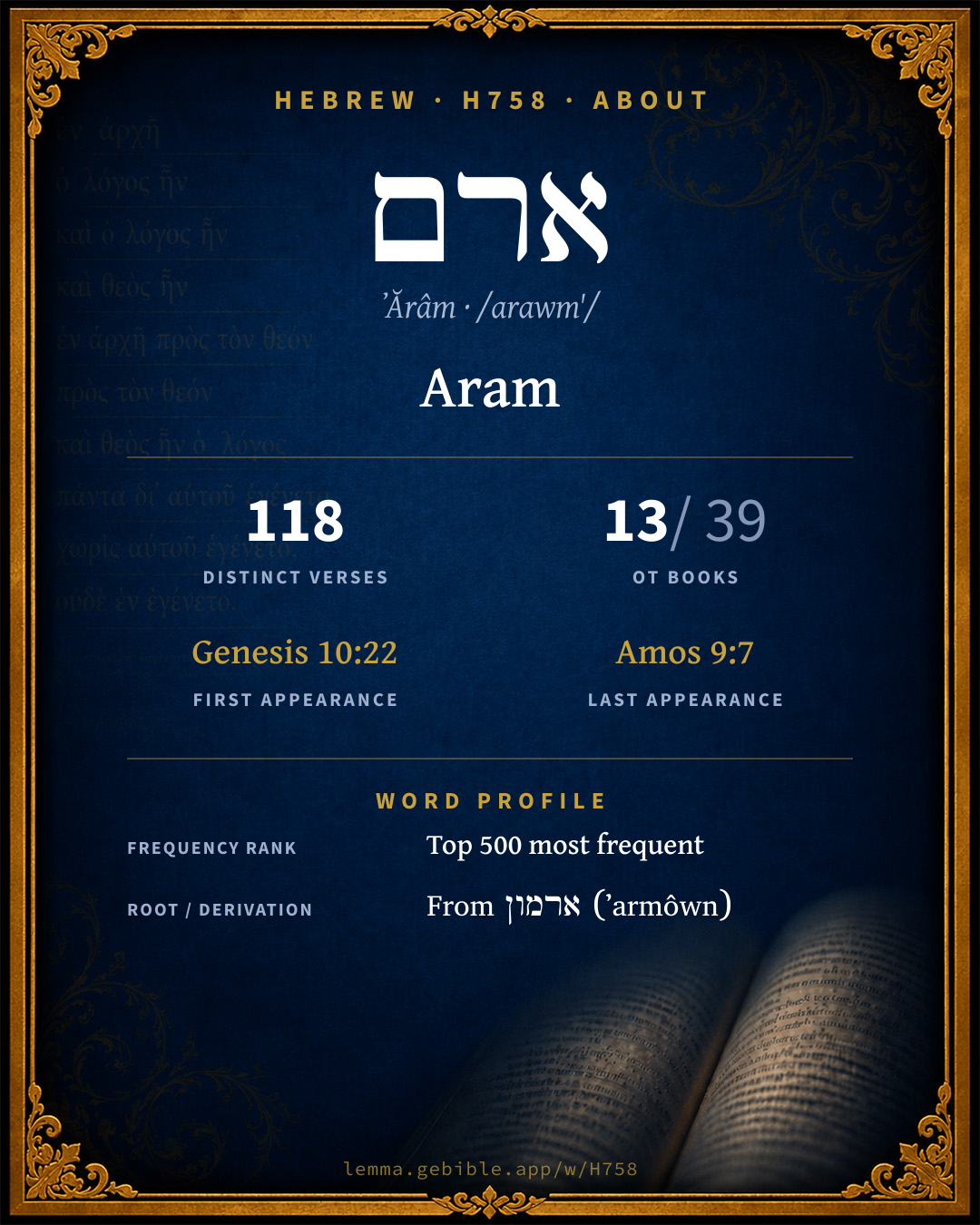
אֲרָם
Aram
BDB lists 6 entries for ‘Aram’ fuller range ↓
Full lexicon entry — Brown-Driver-Briggs (BDB)
From Brown-Driver-Briggs (BDB)
Where this word appears
Grammar key — what these labels mean
Part of speech
- Noun
- A naming word — a person, place, thing, or idea.
Noun type
- Proper
- A name of a specific person, place, or people (e.g. Abraham, Zion, Israel).
Every verse where H758 appears in the Book of 1 Kings — 18 distinct verses. Click any verse to open its interlinear word-by-word view. Verse text shown in the World English Bible for context — . Each verse’s Hebrew form is shown with its reference; the English is not keyword-highlighted, since the data carries no word-level English alignment. Use “Compare translations” on any verse to read it across multiple English versions. This concordance covers the Hebrew Bible; Septuagint (Greek Old Testament) occurrences are not indexed here.
1 Kings
- 1 Kings 10:29 אֲרָ֖ם n Proper A chariot came up and went out of Egypt for six hundred [shekels] of silver, and a horse for one hundred fifty; and so for all the kings of the Hittites, and for the kings of Syria, did they bring them out by their means.
- 1 Kings 11:25 אֲרָֽם n Proper He was an adversary to Israel all the days of Solomon, besides the mischief that Hadad [did]: and he abhorred Israel, and reigned over Syria.
- 1 Kings 15:18 אֲרָ֔ם n Proper Then Asa took all the silver and the gold that were left in the treasures of the house of Yahweh, and the treasures of the king's house, and delivered them into the hand of his servants; and king Asa sent them to Ben Hadad, the son of Tabrimmon, the son of Hezion, king of Syria, who lived at Damascus, saying,
- 1 Kings 19:15 אֲרָֽם n Proper Yahweh said to him, Go, return on your way to the wilderness of Damascus: and when you come, you shall anoint Hazael to be king over Syria;
- 1 Kings 20:1 אֲרָ֗ם n Proper Ben Hadad the king of Syria gathered all his host together; and there were thirty-two kings with him, and horses and chariots: and he went up and besieged Samaria, and fought against it.
- 1 Kings 20:20 אֲרָ֔ם אֲרָ֔ם n Proper n Proper They killed everyone his man; and the Syrians fled, and Israel pursued them: and Ben Hadad the king of Syria escaped on a horse with horsemen.
- 1 Kings 20:21 בַ/אֲרָ֖ם prep + n Proper The king of Israel went out, and struck the horses and chariots, and killed the Syrians with a great slaughter.
- 1 Kings 20:22 אֲרָ֖ם n Proper The prophet came near to the king of Israel, and said to him, Go, strengthen yourself, and mark, and see what you do; for at the return of the year the king of Syria will come up against you.
- 1 Kings 20:23 אֲרָ֜ם n Proper The servants of the king of Syria said to him, Their god is a god of the hills; therefore they were stronger than we: but let us fight against them in the plain, and surely we shall be stronger than they.
- 1 Kings 20:26 אֲרָ֑ם n Proper It happened at the return of the year, that Ben Hadad mustered the Syrians, and went up to Aphek, to fight against Israel.
- 1 Kings 20:27 וַ/אֲרָ֖ם conj + n Proper The children of Israel were mustered, and were provisioned, and went against them: and the children of Israel encamped before them like two little flocks of kids; but the Syrians filled the country.
- 1 Kings 20:28 אֲרָם֙ n Proper A man of God came near and spoke to the king of Israel, and said, Thus says Yahweh, Because the Syrians have said, Yahweh is a god of the hills, but he is not a god of the valleys; therefore will I deliver all this great multitude into your hand, and you shall know that I am Yahweh.
- 1 Kings 20:29 אֲרָ֛ם n Proper They encamped one over against the other seven days. So it was, that in the seventh day the battle was joined; and the children of Israel killed of the Syrians one hundred thousand footmen in one day.
- 1 Kings 22:1 אֲרָ֖ם n Proper They continued three years without war between Syria and Israel.
- 1 Kings 22:3 אֲרָֽם n Proper The king of Israel said to his servants, "You know that Ramoth-gilead is ours, and we are still, and don't take it out of the hand of the king of Syria?"
- 1 Kings 22:11 אֲרָ֖ם n Proper Zedekiah the son of Chenaanah made him horns of iron, and said, Thus says Yahweh, With these shall you push the Syrians, until they be consumed.
- 1 Kings 22:31 אֲרָ֡ם n Proper Now the king of Syria had commanded the thirty-two captains of his chariots, saying, Fight neither with small nor great, save only with the king of Israel.
- 1 Kings 22:35 אֲרָ֑ם n Proper The battle increased that day: and the king was stayed up in his chariot against the Syrians, and died at even; and the blood ran out of the wound into the bottom of the chariot.
About this entry
At a glance — auto-summarized from this page’s data, not written by a person. Every figure links to its source below. This summary describes the numbers; it doesn’t interpret them.
“Aram” is the headline sense of the Hebrew name ארם (ʼĂrâm). Scripture first uses it in Genesis 10:22. With 118 verses in 13 books, it is a common word in the Hebrew Bible. It concentrates in 2 Kings, which alone accounts for 32% of its uses. The sections below give every occurrence and version rendering.
Gloss history
Strong's 1890 vs modern scholarship
About this word
Strong's H758 catalogs a Hebrew word from the Hebrew Old Testament.
These counts are not copied from any lexicon or concordance. They are computed here, from the morphology-tagged Hebrew Old Testament. What Lemma adds →
- 118
- distinct verses
- The word appears in 118 distinct verses.
- 13 / 39
- OT books
- The word appears in 13 of 39 Old Testament books.
- #339
- by frequency
- Top 500 most frequent Hebrew words (rank 339 of 8,640 Hebrew words by occurrence).
View all 118 occurrences in the concordance →
By section of the Old Testament
By traditional corpus
Conventional, traditional groupings — biblical authorship is debated, so this is a traditional corpus grouping, not an authorship claim. Each share is this word’s portion of its verses in that division of the Hebrew canon. Each figure is a share of the word’s 118 distinct verses.
- Prophets (Nevi'im) 87 verses · 74%
- Writings (Ketuvim) 27 verses · 23%
- Torah (Pentateuch) 4 verses · 3%
How translations render this word
Counts come from each version’s own published word-to-Strong’s tagging or interlinear alignment — an approximate guide to how each version renders this word, not a word-level alignment the data otherwise carries. Because each total is that version’s own tagged count, the per-version totals vary from one another and need not match the appearance or distinct-verse counts above. These counts may also differ from a printed concordance because Lemma counts each distinctly tagged rendering and does not collapse phrase taggings into a single head-word total. This is a fixed set of word-tagged versions (KJV, ASV, BSB, ULT) and does not change with the reading translation you choose elsewhere. Each version’s license is shown beside its name below (and on Sources).
- King James Version: Syria 62×, Syrians 53×, Aram 7×
- American Standard Version: Syria 57×, Syrians 51×, Aram 8×
- Berean Standard Bible: Aram 68×, Arameans 43×, Paddan-aram 10×
- unfoldingWord Literal Text: Aram 120×, Aram of 5×, Against aram 2×
King James Version Public Domain
Renders H758 across 132 tagged occurrences — most commonly:
Plus 7 renderings that appear only once — usually multi-word phrases or single function words the recovered tagging swept in, not distinct renderings.
American Standard Version Public Domain
Renders H758 across 130 tagged occurrences — most commonly:
Plus 10 renderings that appear only once — usually multi-word phrases or single function words the recovered tagging swept in, not distinct renderings.
Berean Standard Bible Public Domain
Renders H758 across 136 tagged occurrences — most commonly:
Plus 6 renderings that appear only once — usually multi-word phrases or single function words the recovered tagging swept in, not distinct renderings. Not rendered by a distinct English word in 7 further occurrences.
unfoldingWord Literal Text CC BY-SA 4.0
Renders H758 across 133 tagged occurrences — most commonly:
Plus 4 renderings that appear only once — usually multi-word phrases or single function words the recovered tagging swept in, not distinct renderings.
7 senses and sub-senses in the full BDB
What do BDB’s symbols mean?
BDB uses these scholarly abbreviations:
| Symbol | Meaning |
|---|---|
| 𝔊 | the Septuagint (the ancient Greek translation, LXX) |
| 𝔙 | the Vulgate (the Latin translation) |
| 𝔖 | the Syriac version (the Peshitta) |
| 𝔗 | the Targum (the Aramaic translation) |
| ψ | the Psalms |
| √ | root (the underlying root or stem) |
| ‖ | parallel passage (a synonymous or contrasted parallel) |
| † | the dagger: every passage where the word occurs is cited |
The 7 senses and sub-senses the full Brown-Driver-Briggs lexicon distinguishes for this word, in lexicon order (not ranked by frequency), with BDB’s own verbatim wording and sub-sense lettering. Shown in Hebrew script with BDB’s own scholarly abbreviations. The condensed entry is in the Lexicon Entry tab. See also the Forms in the corpus table below.
- 1. 5th son of Shem Gn 10:22, 23; 1 Ch 1:17. e.g. Genesis 10:22
- 2. grandson of Nahor Gn 22:21. e.g. Genesis 22:21
- 3. 1 Ch 2:23. e.g. 1 Chronicles 2:23
- 4. a descendant of Asher 1 Ch 7:34.—Elsewhere only of Aramæan people & land (= 1 supr.), f. 2 S 8:5 m. 2 S 10:14. e.g. 1 Chronicles 7:34
- a. people, sg. coll. = the Aramæans, a leading branch of the Shemitic stock inhabiting Mesopotamia & northern Syria, in many tribes & settlements; 2 S 8:5(×2), 6 + 1 K 20:20, 21 + 1 Ch 19:10, 12 + (64 times S K Ch) Am 9:7 Is 7:2, 4, 5, 8; 9:11; 17:3 Je 35:11; so Ez 16:57; 27:16, but Co in both אדום; עַם אֲרָם Am 1:5; of particular divisions of Aramaic, א׳ בית רְחוֹב 2 S 10:6, א׳ צוֹבָא 2 S 10:6, 8 ψ 60:2 (title), א׳ דַּמֶּשֶׂק 2 S 8:5 cf. 1 Ch 18:5, even א׳ נַהֲרַיִם ψ 60:2 (title); (note that Assyrian never gives name Aramu to people W. of Euphrates, but Chatti instead, with other particular names, COT Gn 10:22, also Dl l.c.); on 2 S 8:12, 13 1 Ch 18:11 v. אֱדוֹם. e.g. 2 Samuel 8:5
- b. less often clearly of land, Aramaic Nu 23:7 2 S 15:8 + 2 Ch 20:2 (read however here אדום Thes Add al.), שְׂדֵה א׳ Ho 12:13; also of particular divisions of the territory א׳ נַהֲרַיִם ‘Mesopotamia,’ i.e. prob. land between Euphrates & Chaboras, so Di after Kiep, Gn 24:10; Dt 23:5; Ju 3:8 (cf. ψ 60:2 supr.); cf. פַּדַּן א׳ Paddan-Aram Gn 25:20; 31:18; 33:18; 35:9, 26; 46:15, פַּדֶּ֫נָה א׳ 28:2, 5, 6, 7 v. פדן; א׳ דַּמֶּשֶׂק 2 S 8:6 cf. 1 Ch 18:6. e.g. Numbers 23:7
- c. often indeterminate, especially in מֶלֶךְ א׳ etc., perhaps primarily land but often including people: so Ju 2:10; 10:6 (אֱלֹהֵי א׳) 1 K 10:29 + 2 Ch 1:17 + (41 times K & Ch) Is 7:1.—(Cf. especially NöSchenkel BL, ZMG 1871, 113; Hermes v. 3, 443 f. DlPa 257.) e.g. Judges 2:10
Senses from the full Brown-Driver-Briggs lexicon (Brown, Driver, Briggs; Oxford 1906 — public domain), digitized via Sefaria, supplemented by the OpenScriptures HebrewLexicon (CC BY 4.0). Full attribution on Sources.
Word origin
n.pr.m. Aram (Assyrian Aramu, etc., v. DlPa 257; Thes al. proposes √ארם = רום but cf. Nö as below)—
— Brown-Driver-Briggs (Oxford 1906, public domain), digitized via Sefaria, supplemented by the OpenScriptures HebrewLexicon (CC BY 4.0). See Sources.
Derived from ארמון (ʼarmôwn) (H759) — citadel.
Jastrow Dictionary
A second Hebrew/Aramaic lexicon for comparison, covering Aramaic and post-biblical (Talmudic, Targumic, Midrashic) usage that the biblical-Hebrew BDB does not. Matched by lemma rather than by Strong’s number, so a lemma may carry more than one Jastrow headword (shown separately below), and the entries cover usage well beyond the Bible.
אֲרָם
- (b. h.)
- 1. Aram, son of Shem., son of Shem. Targ. Gen. X, 22; a. e.
- 2. Aramaea, Syria. Targ. I Kings XX, 1; a. fr.
- 3. (a disguise for רוֹמָא) Rome, Roman empire (cmp. אֱדוֹם). Pes. 87ᵇ לקבל גזרות אכזריות א׳ ed. (read לסבול … של א׳; in Ms. M. 1 only לסבול גזיר׳, Ms. 2 … של רומיים; oth. var., v. Rabb. D. S. a. l. note; Gitt. 17ᵃ אֲרוֹמִיִּים) to endure the severe decrees of Rome.
A Dictionary of the Targumim, the Talmud Babli and Yerushalmi, and the Midrashic Literature (Marcus Jastrow; London, Luzac, 1903) — Public Domain. Digitized via Sefaria. Digitized via Sefaria. Full attribution on Sources.
Forms in the corpus
The 39 distinct written forms H758 takes in the Hebrew Bible, most frequent first — each parse links to that state’s occurrences in the concordance. Hebrew forms include their vowel points and cantillation, so a single lemma takes many written forms.
| Form | Parsing | Example | Uses |
|---|---|---|---|
| אֲרָ֔ם | Noun, Proper | Ezekiel 16:57 | 22 |
| אֲרָ֖ם | Noun, Proper | 1 Chronicles 19:14 | 18 |
| אֲרָ֑ם | Noun, Proper | Genesis 10:23 | 16 |
| אֲרָם֙ | Noun, Proper | 1 Chronicles 18:6 | 12 |
| אֲרָֽם | Noun, Proper | Genesis 22:21 | 10 |
| אֲרָ֗ם | Noun, Proper | 1 Chronicles 19:16 | 6 |
| אֲרָ֛ם | Noun, Proper | Amos 1:5 | 4 |
| אֲ֠רָם | Noun, Proper | 2 Kings 16:5 | 3 |
| אֲרַ֣ם | Noun, Proper | 1 Chronicles 18:5 | 3 |
| אֲרָ֜ם | Noun, Proper | 1 Kings 20:23 | 3 |
| אֲרָ֡ם | Noun, Proper | 1 Kings 22:31 | 2 |
| אֲרָ֥ם | Noun, Proper | Ezekiel 27:16 | 2 |
| אֲרָם֒ | Noun, Proper | 2 Chronicles 24:23 | 2 |
| אֲרָם֮ | Noun, Proper | 1 Chronicles 19:18 | 2 |
| בַּ/אֲרַ֣ם | Noun, Proper | 1 Chronicles 18:6 | 2 |
| וַ/אֲרָ֖ם | Noun, Proper | 1 Kings 20:27 | 2 |
| מֵ/אֲרָ֗ם | Noun, Proper | 1 Chronicles 19:18 | 2 |
| אֲרַ֤ם | Noun, Proper | 1 Chronicles 19:6 | 1 |
| אֲרַ֨ם | Noun, Proper | 2 Samuel 10:6 | 1 |
| אֲרָ֣ם | Noun, Proper | Isaiah 9:12 | 1 |
| אֲרָ֤ם | Noun, Proper | 2 Kings 16:6 | 1 |
| אֲרָם֩ | Noun, Proper | Judges 10:6 | 1 |
| בַ/אֲרָ֖ם | Noun, Proper | 1 Kings 20:21 | 1 |
| בַֽ/אֲרָ֔ם | Noun, Proper | 2 Kings 13:17 | 1 |
| בַּ/אֲרָ֔ם | Noun, Proper | 1 Chronicles 18:5 | 1 |
| בַּ/אֲרָ֖ם | Noun, Proper | 2 Samuel 15:8 | 1 |
| בַּֽ/אֲרָ֔ם | Noun, Proper | 2 Samuel 8:5 | 1 |
| בַּֽ/אֲרָ֑ם | Noun, Proper | 2 Samuel 10:13 | 1 |
| וַ/אֲרַ֨ם | Noun, Proper | 2 Samuel 10:8 | 1 |
| וַ/אֲרָ֑ם | Noun, Proper | 1 Chronicles 1:17 | 1 |
| וַ/אֲרָ֥ם | Noun, Proper | Amos 9:7 | 1 |
| וַ/אֲרָֽם | Noun, Proper | 1 Chronicles 7:34 | 1 |
| וַ/אֲרָם֙ | Noun, Proper | 2 Kings 5:2 | 1 |
| וַ֠/אֲרָם | Noun, Proper | 1 Chronicles 2:23 | 1 |
| וַֽ/אֲרָֽם | Noun, Proper | Genesis 10:22 | 1 |
| לַ/אֲרָ֑ם | Noun, Proper | 2 Kings 5:1 | 1 |
| לַֽ/אֲרָ֔ם | Noun, Proper | 2 Kings 16:6 | 1 |
| מֵ/אֲרָ֑ם | Noun, Proper | 2 Chronicles 20:2 | 1 |
| מֵ/אֲרָ֤ם | Noun, Proper | 2 Samuel 8:12 | 1 |
Same root — word family
Other BDB entries built from the same root as H758, grouped by Strong’s listed origin. These share a root / origin per the lexicon — not necessarily a shared meaning. Each links to that word’s own entry.
Derives from
Proper names from this root
People and places named from this root — a name, not an additional meaning of the word.
- ארמני ʼArmônîy H764 Armoni
- ארם צובה ʼĂram Tsôwbâh H760 Aram-zobah
- ארמי ʼĂrammîy H761 Syrian
- ארם נהרים ʼĂram Nahărayim H763 Aram-naharaim
Compare all same-root words → Showing 4 of 6 — not the complete family. 4 of the same-root words are proper names (people or places). They share a root, not necessarily a meaning.
Bible dictionary
Public-domain dictionary articles matched to this entry by name (Aram). A biblical name can be shared by more than one person or place, so an article may treat several.
Easton's Bible Dictionary · M. G. Easton, 1897
The son of Shem (Gen. 10:22); according to Gen. 22:21, a grandson of Nahor. In Matt. 1:3, 4, and Luke 3:33, this word is the Greek form of Ram, the father of Amminadab (1 Chr. 2:10).
The word means high, or highlands, and as the name of a country denotes that elevated region extending from the northeast of Palestine to the Euphrates. It corresponded generally with the Syria and Mesopotamia of the Greeks and Romans. In Gen. 25:20; 31:20, 24; Deut. 26:5, the word "Syrian" is properly "Aramean" (R.V., marg.). Damascus became at length the capital of the several smaller kingdoms comprehended under the designation "Aram" or "Syria."
Smith's Bible Dictionary · William Smith, 1863
(high).
+ The name by which the Hebrews designated, generally, the country lying to the northeast of Palestine; the great mass of that high tableland which, rising with sudden abruptness from the Jordan and the very margin of the Lake of Gennesaret, stretched at an elevation of no less than 2000 feet above the level of the sea, to the banks of the Euphrates itself. Throughout the Authorized Version the word is, with only a very few exceptions, rendered, as in the Vulgate and LXX., Syria. Its earliest occurrence in the book of Genesis is in the form of Aram-naharaim, i.e. the "highland of or between the two rivers." (Genesis 24:10) Authorized Version "Mesopotamia." In the later history we meet with a number of small nations or kingdoms forming parts of the general land of Aram; but as Damascus increased in importance it gradually absorbed the smaller powers, (1 Kings 20:1) and the name of Aram was at last applied to it alone. (Isaiah 7:8) also 1Kin 11:24,25; 15:18 etc. + Another Aram is named in (Genesis 22:21) as a son of Kemuel and descendant of Nahor. + An Asherite, one of the sons of Shamer. (1 Chronicles 7:34) + Son of Esrom or Hezron, and the Greek form of the Hebrew Ram. (Matthew 1:3,4; Luke 3:33)
Hitchcock's Bible Names Dictionary · Roswell D. Hitchcock, 1869
highness, magnificence, one that deceives; curse
Classic public-domain reference works; full attribution on Sources.
Septuagint verse parallels
This word appears in 118 verses that also exist in the Greek Old Testament (Septuagint), out of the 118 Hebrew verses it occurs in. You can read those verses in Greek by switching the Old Testament edition to the Septuagint.
Read these verses in the Septuagint
- Genesis 10:22
- Numbers 23:7
- Judges 3:10
- 2 Samuel 8:5
- 1 Kings 10:29
- 2 Kings 5:1
- 1 Chronicles 1:17
- 2 Chronicles 1:17
- Isaiah 7:1
- Jeremiah 35:11
- Ezekiel 16:57
- Hosea 12:12
This is a verse-level parallel only — the same verses exist in both the Hebrew and Greek Old Testaments. No word-level Hebrew↔Greek correspondence is claimed: the data carries no such alignment, so no Greek word is shown as this Hebrew word’s translation. Coverage is not total — the Septuagint omits the deuterocanon and renumbers the Psalms, so some Hebrew verses have no direct Greek parallel.