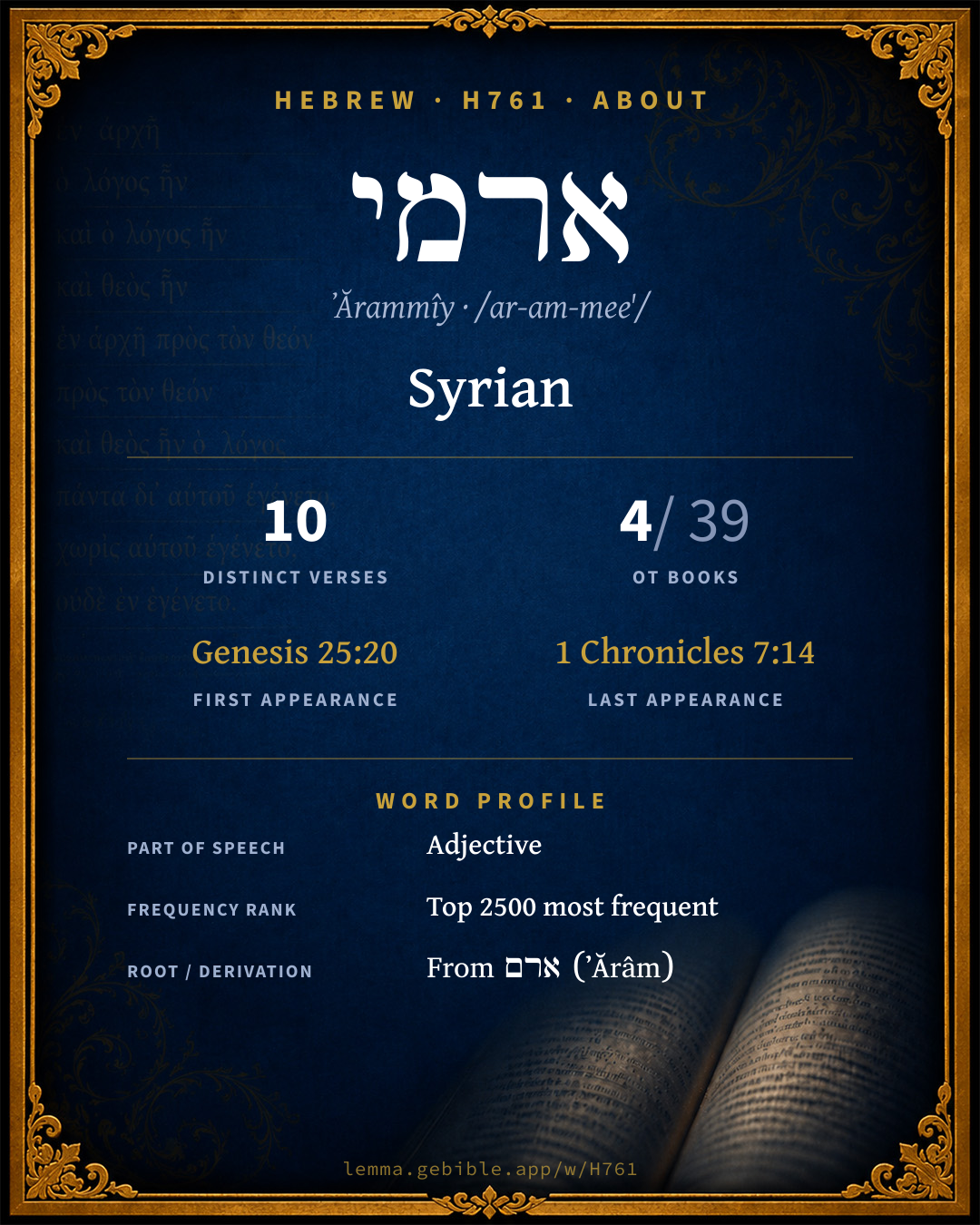
אֲרַמִּי
Syrian
BDB lists 2 entries for ‘Syrian’ fuller range ↓
Full lexicon entry — Brown-Driver-Briggs (BDB)
From Brown-Driver-Briggs (BDB)
Where this word appears
Grammar key — what these labels mean
Part of speech
- Noun
- A naming word — a person, place, thing, or idea.
Noun type
- Gentilic
- A noun naming a member of a people, tribe, or region of origin (e.g. an Israelite, a Moabite).
State
- Absolute
- The independent form of a noun, not bound to a following word.
Gender
- Masculine
- Grammatically masculine.
- Feminine
- Grammatically feminine.
Number
- Singular
- One.
- Plural
- More than one (in Hebrew, generally three or more).
Grammatical forms
- Noun, Gentilic, Masculine, Singular, Absolute 7 times (64%)
- Noun, Gentilic, Masculine, Plural, Absolute 3 times (27%)
- Noun, Gentilic, Feminine, Singular, Absolute 1 time (9%)
Parsed forms decoded from the imported morphology (morphhb / Westminster Leningrad Codex — WLC text public domain, morphhb tagging CC BY 4.0), counted across 11 parsed occurrences — not distinct verses.
Every verse where H761 appears — 10 distinct verses across 4 books. Click any verse to open its interlinear word-by-word view. Verse text shown in the World English Bible for context — . Each verse’s Hebrew form is shown with its reference; the English is not keyword-highlighted, since the data carries no word-level English alignment. Use “Compare translations” on any verse to read it across multiple English versions. This concordance covers the Hebrew Bible; Septuagint (Greek Old Testament) occurrences are not indexed here.
Genesis 4 verses
- Genesis 25:20 הָֽ/אֲרַמִּ֔י הָ/אֲרַמִּ֖י ptcl def.art + n Gentilic ms ptcl def.art + n Gentilic ms Isaac was forty years old when he took Rebekah, the daughter of Bethuel the Syrian of Paddan Aram, the sister of Laban the Syrian, to be his wife.
- Genesis 28:5 הָֽ/אֲרַמִּ֔י ptcl def.art + n Gentilic ms Isaac sent Jacob away. He went to Paddan Aram to Laban, son of Bethuel the Syrian, Rebekah's brother, Jacob's and Esau's mother.
- Genesis 31:20 הָ/אֲרַמִּ֑י ptcl def.art + n Gentilic ms Jacob deceived Laban the Syrian, in that he didn't tell him that he was running away.
- Genesis 31:24 הָ/אֲרַמִּ֖י ptcl def.art + n Gentilic ms God came to Laban, the Syrian, in a dream of the night, and said to him, "Take heed to yourself that you don't speak to Jacob either good or bad."
Deuteronomy 1 verse
2 Kings 4 verses
- 2 Kings 5:20 הָֽ/אֲרַמִּי֙ ptcl def.art + n Gentilic ms But Gehazi the servant of Elisha the man of God, said, Behold, my master has spared this Naaman the Syrian, in not receiving at his hands that which he brought: as Yahweh lives, I will run after him, and take somewhat of him.
- 2 Kings 8:28 אֲרַמִּ֖ים n Gentilic mp He went with Joram the son of Ahab to war against Hazael king of Syria at Ramoth-gilead: and the Syrians wounded Joram.
- 2 Kings 8:29 אֲרַמִּים֙ n Gentilic mp King Joram returned to be healed in Jezreel of the wounds which the Syrians had given him at Ramah, when he fought against Hazael king of Syria. Ahaziah the son of Jehoram king of Judah went down to see Joram the son of Ahab in Jezreel, because he was sick.
- 2 Kings 9:15 אֲרַמִּ֔ים n Gentilic mp but king Joram was returned to be healed in Jezreel of the wounds which the Syrians had given him, when he fought with Hazael king of Syria.) Jehu said, If this be your mind, then let none escape and go forth out of the city, to go to tell it in Jezreel.
1 Chronicles 1 verse
About this entry
At a glance — auto-summarized from this page’s data, not written by a person. Every figure links to its source below. This summary describes the numbers; it doesn’t interpret them.
“Syrian” is the headline sense of the Hebrew name ארמי (ʼĂrammîy). First canonically at Genesis 25:20, it enters the text early. With 10 verses in 4 books, it is an uncommon word in the Hebrew Bible. It concentrates in Genesis, which alone accounts for 40% of its uses. The sections below give every occurrence and version rendering.
Gloss history
Strong's 1890 vs modern scholarship
About this word
Strong's H761 catalogs a Hebrew word from the Hebrew Old Testament.
These counts are not copied from any lexicon or concordance. They are computed here, from the morphology-tagged Hebrew Old Testament. What Lemma adds →
- 10
- distinct verses
- The word appears in 10 distinct verses.
- 4 / 39
- OT books
- The word appears in 4 of 39 Old Testament books.
- #2,210
- by frequency
- Top 2500 most frequent Hebrew words (rank 2,210 of 8,640 Hebrew words by occurrence).
View all 10 occurrences in the concordance →
Most concentrated in
- Genesis 4 verses 40%
- 2 Kings 4 verses 40%
- Deuteronomy 1 verse 10%
By section of the Old Testament
By traditional corpus
Conventional, traditional groupings — biblical authorship is debated, so this is a traditional corpus grouping, not an authorship claim. Each share is this word’s portion of its verses in that division of the Hebrew canon. Each figure is a share of the word’s 10 distinct verses.
- Torah (Pentateuch) 5 verses · 50%
- Prophets (Nevi'im) 4 verses · 40%
- Writings (Ketuvim) 1 verse · 10%
How translations render this word
Counts come from each version’s own published word-to-Strong’s tagging or interlinear alignment — an approximate guide to how each version renders this word, not a word-level alignment the data otherwise carries. Because each total is that version’s own tagged count, the per-version totals vary from one another and need not match the appearance or distinct-verse counts above. These counts may also differ from a printed concordance because Lemma counts each distinctly tagged rendering and does not collapse phrase taggings into a single head-word total. This is a fixed set of word-tagged versions (KJV, ASV, BSB, ULT) and does not change with the reading translation you choose elsewhere. Each version’s license is shown beside its name below (and on Sources).
- King James Version: Syrian 7×, Syrians 3×
- American Standard Version: Syrian 7×, Syrians 3×
- Berean Standard Bible: Aramean 7×, Arameans 3×
- unfoldingWord Literal Text: Aramean 8×, Arameans 3×
King James Version Public Domain
Renders H761 across 11 tagged occurrences — most commonly:
Plus 1 rendering that appears only once — usually multi-word phrases or single function words the recovered tagging swept in, not distinct renderings.
American Standard Version Public Domain
Renders H761 across 11 tagged occurrences — most commonly:
Plus 1 rendering that appears only once — usually multi-word phrases or single function words the recovered tagging swept in, not distinct renderings.
Berean Standard Bible Public Domain
Renders H761 across 12 tagged occurrences — most commonly:
Plus 2 renderings that appear only once — usually multi-word phrases or single function words the recovered tagging swept in, not distinct renderings.
unfoldingWord Literal Text CC BY-SA 4.0
Renders H761 across 12 tagged occurrences — most commonly:
Plus 1 rendering that appears only once — usually multi-word phrases or single function words the recovered tagging swept in, not distinct renderings.
Senses in BDB
The 2 senses BDB distinguishes for this word, in lexicon order (not ranked by frequency or importance). The full entry — with sub-senses — is in the Lexicon Entry tab.
- Syrian or Aramean = "exalted"
- a thing or a person from Syria or Aram
Word origin
adj.gent. Aramæan, c. art. הָא׳ Gn 25:20(×2); 28:5; 31:20, 24 2 K 5:20; of Israel א׳ אֹבֵד Dt 26:5; pl. אֲרַמִּים 2 K 8:28, 29 (‖ אֲרָם) 9:15 (‖ id.); הָרַמִּים (= הָא׳) 2 Ch 22:5 (‖ id.); פִּילַגְשׁוֹ הָאֲרַמִּיָּה 1 Ch 7:14 his Aramæan concubine.—(ארומים Kt 2 K 16:6 read rather Qr אֲדוֹמִים.)
— Brown-Driver-Briggs (Oxford 1906, public domain), digitized via Sefaria, supplemented by the OpenScriptures HebrewLexicon (CC BY 4.0). See Sources.
Derived from ארם (ʼĂrâm) (H758) — Aram.
Jastrow Dictionary
A second Hebrew/Aramaic lexicon for comparison, covering Aramaic and post-biblical (Talmudic, Targumic, Midrashic) usage that the biblical-Hebrew BDB does not. Matched by lemma rather than by Strong’s number, so a lemma may carry more than one Jastrow headword (shown separately below), and the entries cover usage well beyond the Bible.
אֲרַמִּי
- , אֲרָמִית f.
- 1. (b. h.) Aramaean, Aramaic, Chaldaic. [Targ. II Kings XVIII, 26.]—לשון א׳ Chaldaic. Sabb. 12ᵇ; a. fr.
- 2. (= אֲרוֹמִי; v. אֲרָם
- 3. Romish, Roman, heathen. [Owing to Christian censors as well as timid Jewish copyists, many of the passages originally referring to Romans, Christians, &c., have been altered by substituting Arammi, Kuthi, Goy &c., so that only by keen criticism their real application can be ascertained.]—Fem. gentile woman. Ber. 8ᵇ (Ms. M. ארמאית). Snh. IX, 6; a. fr.—Y. Meg. I, 71ᶜ top ארמית Latin; v. בָּדָא.—Pl. אֲרַמִּים Meg. 11ᵃ (some ed. פרסיים; Ms. M. רוֹמִיִּים; Sifra B’ḥukk. Par. II, ch. 8 אספסיינוס). V. אֲרוֹמִי.
אַרְמַי
- , v. אַרְמַאי
רְמֵי
- 1. to throw, swing; to put on; to impose. Targ. Ex. XV, 1. Targ. Ez. XVI, 5. Targ. II Kings XVIII, 14. Targ. Ps. LXXVIII, 57 (h. text רְמִיָּה!); a. fr.—Men. 42ᵃ ר׳ חוטי threw (attached) threads as show fringes; ר׳ ארבע put four threads on. Sabb. 10ᵃ, v. פּוּזְמְקֵי. Nidd. 33ᵇ ר׳ ליה תורא threw an ox down (slaughtered an ox) in his honor. Men. 42ᵇ רְמִינָן להו ביורה we cast them into the boiler.—Part. pass. רְמֵי, רַמְיָא thrown down, lying. Targ. Deut. XXI, 1 (O. ed. Vien. רָמֵי). Targ. Jud. XIX, 27; a. e.—Zeb. 5ᵃ ר׳ ריש לקיש וכ׳ Resh Laḳish was lying on his belly in the college hall and asked &c. Shebu. 34ᵇ כל מילתא דלא ר׳ עליה וכ׳ a thing which does not rest upon a man (in which he is not interested), he will do unconsciously; ib. 41ᵇ, sq.; B. Bath. 39ᵃ; a. fr.—ר׳ לבני [to put up bricks,] to make bricks. Targ. Gen. XI, 3. Targ. Ex. V, 7; a. e.—ר׳ תיגרא to create discord; to dispute. Targ. Prov. VI, 14; 19; a. e.—Sabb. 130ᵃ ליכא … דלא רָמוּ בה ת׳ there is no marriage contract at which the parties do not quarrel.
- 2. to lift, remove. Y. Snh. X, 29ᵃ bot. בעי מִירְמִיתֵיה wanted to lift it; a. e.
- 3. [to pitch one thing against another,] to show an incongruity; to object. Nidd. l. c. ר׳ … מתניתין אהדדי pointed out an incongruity between two Mishnahs. Taan. 4ᵇ גברא אגברא קא רָמִית thou provest an incongruity between two authorities (why can they not differ in opinion)? B. Mets. 22ᵇ רב פפא ר׳ כתיב וכ׳ Rab Papa raised an objection: it is written (Lev. XI, 38) ki yitten, and we read ki yuttan, how is this to be explained? Yeb. 108ᵇ ורְמִינְהִי וכ׳ and we shall show an incongruity in it, i.e. this disagrees with the Mishnah, &c. Succ. 16ᵃ איכא דר׳ ליה מִירְמָא some put it in the shape of pointing out a contradiction (between a Mishnah and a Boraitha); a. v. fr. e.g. Leviticus 11:38
- 1. to cast. Targ. Jud. XX, 16. Targ. Prov. I, 14; a. e.—Sabb. 156ᵇ הוה מַרְמִינָן וכ׳ we used to cast our bread together (into one basket) and eat. Ib. אנא קאים וארמינא I will stand up and put the bread into the basket; a. e.
- 2. to tear away, remove with force. Pes. 10ᵇ אַרְמוּיֵי אַרְמֵיה מיניה (not ארמוייה) it (the mouse) may have snatched it from the other mouse. Ḥag. 15ᵇ אי … מאן מַרְמֵי ליה מאן if I take him by the hand, who will tear him away from me? who?
- 3. to lift up. Ab. Zar. 34ᵇ תַּרְמִינָךְ שעתך (Ms. M. תור מינך, v. Rabb. D. S. a. l. note) may thy hour lift thee up (i.e. may thy luck be high)!
- to impose, deceive. Targ. Y. Num. XXV, 18. Targ. Prov. XXVI, 19.—Lev. R. s. 5 הוה מְרַמֵּי במצוותה, v. preced.; a. e.
- 1. to throw one’s self, be thrown. Targ. I Chr. X, 4, sq. Targ. Josh. X, 11.—[Targ. Prov. VI, 6 אתרמי some ed., read: אתד׳, v. דְּמֵי I.]
- 2. (cmp. קְלַע I) to happen, chance. Ḥull. 13ᵃ מקום … איתרמי ליה (not איתרמו) because no suitable place (for slaughtering) offered itself there. Shebu. 41ᵇ עד דמִתְרְמוּ בי תרי וכ׳ until two persons shall happen to come that have studied &c.; a. e.
A Dictionary of the Targumim, the Talmud Babli and Yerushalmi, and the Midrashic Literature (Marcus Jastrow; London, Luzac, 1903) — Public Domain. Digitized via Sefaria. Digitized via Sefaria. Full attribution on Sources.
Forms in the corpus
The 10 distinct written forms H761 takes in the Hebrew Bible, most frequent first — each parse links to that state’s occurrences in the concordance. Hebrew forms include their vowel points and cantillation, so a single lemma takes many written forms.
| Form | Parsing | Example | Uses |
|---|---|---|---|
| הָ/אֲרַמִּ֖י | Noun, Gentilic, Masculine, Singular, Absolute | Genesis 25:20 | 2 |
| אֲרַמִּ֔ים | Noun, Gentilic, Masculine, Plural, Absolute | 2 Kings 9:15 | 1 |
| אֲרַמִּ֖ים | Noun, Gentilic, Masculine, Plural, Absolute | 2 Kings 8:28 | 1 |
| אֲרַמִּי֙ | Noun, Gentilic, Masculine, Singular, Absolute | Deuteronomy 26:5 | 1 |
| אֲרַמִּים֙ | Noun, Gentilic, Masculine, Plural, Absolute | 2 Kings 8:29 | 1 |
| הָ/אֲרַמִּ֑י | Noun, Gentilic, Masculine, Singular, Absolute | Genesis 31:20 | 1 |
| הָֽ/אֲרַמִּ֔י | Noun, Gentilic, Masculine, Singular, Absolute | Genesis 28:5 | 1 |
| הָֽ/אֲרַמִּי֙ | Noun, Gentilic, Masculine, Singular, Absolute | 2 Kings 5:20 | 1 |
| הָֽ/אֲרַמִּיָּ֔ה | Noun, Gentilic, Feminine, Singular, Absolute | 1 Chronicles 7:14 | 1 |
| הָֽ/אֲרַמִּ֔י | Noun, Gentilic, Masculine, Singular, Absolute | Genesis 25:20 | 1 |
Same root — word family
Other BDB entries built from the same root as H761, grouped by Strong’s listed origin. These share a root / origin per the lexicon — not necessarily a shared meaning. Each links to that word’s own entry.
Derives from
Proper names from this root
People and places named from this root — a name, not an additional meaning of the word.
- ארם צובה ʼĂram Tsôwbâh H760 Aram-zobah
- ארם נהרים ʼĂram Nahărayim H763 Aram-naharaim
- ארמית ʼĂrâmîyth H762 Aramaic
- רמי rammîy H7421 Syrian
Compare all same-root words → Showing 4 of 6 — not the complete family. 5 of the same-root words are proper names (people or places). They share a root, not necessarily a meaning.
Septuagint verse parallels
This word appears in 10 verses that also exist in the Greek Old Testament (Septuagint), out of the 10 Hebrew verses it occurs in. You can read those verses in Greek by switching the Old Testament edition to the Septuagint.
Read these verses in the Septuagint
This is a verse-level parallel only — the same verses exist in both the Hebrew and Greek Old Testaments. No word-level Hebrew↔Greek correspondence is claimed: the data carries no such alignment, so no Greek word is shown as this Hebrew word’s translation. Coverage is not total — the Septuagint omits the deuterocanon and renumbers the Psalms, so some Hebrew verses have no direct Greek parallel.