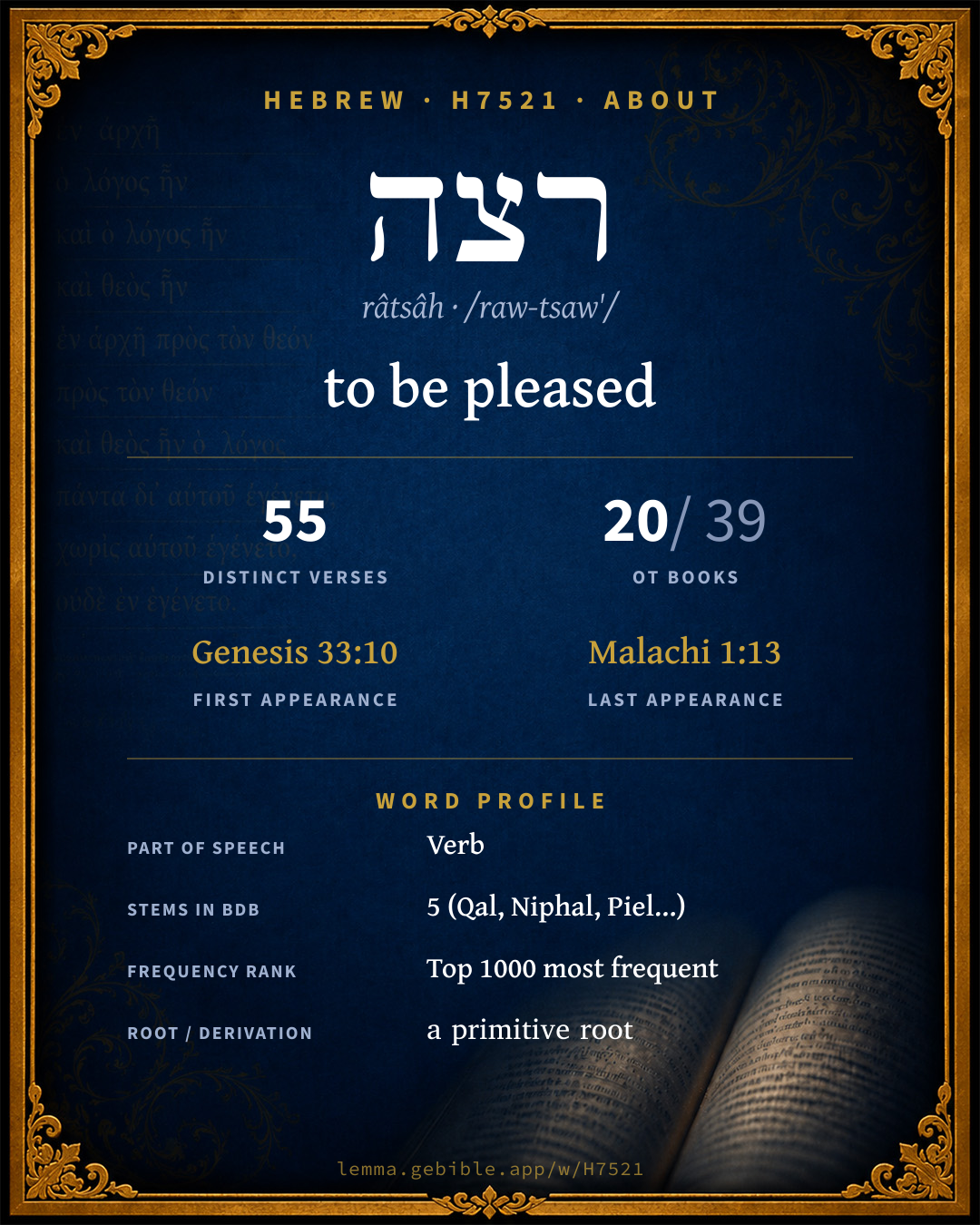
רָצָה
to be pleased
‘to be pleased’ is one of 5 main senses fuller range ↓
Full lexicon entry — Brown-Driver-Briggs (BDB)
From Brown-Driver-Briggs (BDB)
Where this word appears
See every Qal verb in the Hebrew Bible →
Grammar key — what these labels mean
Part of speech
- Verb
- An action or state-of-being word.
Stem
- Niphal
- Usually the simple passive or reflexive of the Qal (“he was written”). Here: ‘of Qal 2’
- Qal
- The basic, simple active stem — the plain form of the verb (“he wrote”). Here: ‘be pleased with’
- Hiphil
- The causative active stem (“he caused / brought about”).
- Piel
- An intensive or resultative active stem.
- Hithpael
- The reflexive or reciprocal stem (the subject acts on itself).
Form
- Imperfect
- An incomplete, ongoing, or future action (“he will / would write”).
- Infinitive Construct
- A bound verbal noun, frequently with prepositions (“to write / in writing”).
- Perfect
- A completed action or state — Hebrew marks aspect (completeness) more than strict tense (“he wrote”).
- Participle Active
- A verbal adjective expressing ongoing or characteristic action (“writing / one who writes”).
- Imperative
- A direct command (“write!”).
- Sequential Perfect
- A perfect with prefixed waw continuing a preceding imperfect or command (waw-consecutive perfect).
- Participle Passive
- A verbal adjective expressing action received (“written”).
- Sequential Imperfect
- An imperfect with prefixed waw — the standard past-narrative form (waw-consecutive imperfect).
- Jussive
- A third- or second-person volitional form expressing wish or command (“let him write”).
State
- Absolute
- The independent form of a noun, not bound to a following word.
- Construct
- A noun bound to a following noun in a possessive / “of” relationship (the construct chain).
Person
- 3rd Person
- The one spoken about (“he / she / it / they”).
- 1st Person
- The speaker (“I / we”).
- 2nd Person
- The one addressed (“you”).
Gender
- Masculine
- Grammatically masculine.
- Common
- Either gender — not distinguished for this form.
- Feminine
- Grammatically feminine.
Number
- Singular
- One.
- Plural
- More than one (in Hebrew, generally three or more).
46 distinct verses where H7521 appears in the Qal stem, across 19 books. Filtered view — show all forms. Click any verse to open its interlinear word-by-word view. Verse text shown in the World English Bible for context — . Each verse’s Hebrew form is shown with its reference; the English is not keyword-highlighted, since the data carries no word-level English alignment. Use “Compare translations” on any verse to read it across multiple English versions. This concordance covers the Hebrew Bible; Septuagint (Greek Old Testament) occurrences are not indexed here.
Genesis 1 verse
Leviticus 3 verses
- Leviticus 26:34 תִּרְצֶ֨ה וְ/הִרְצָ֖ת Qal impf 3fs conj + Hiphil wpf 3fs Then the land will enjoy its sabbaths as long as it lies desolate and you are in your enemies' land. Even then the land will rest and enjoy its sabbaths.
- Leviticus 26:41 יִרְצ֥וּ Qal impf 3mp I also walked contrary to them, and brought them into the land of their enemies: if then their uncircumcised heart is humbled, and they then accept the punishment of their iniquity;
- Leviticus 26:43 וְ/תִ֣רֶץ יִרְצ֣וּ conj + Qal impf 3fs Qal impf 3mp The land also will be left by them, and will enjoy its sabbaths while it lies desolate without them: and they will accept the punishment of their iniquity; because, even because they rejected my ordinances, and their soul abhorred my statutes.
Deuteronomy 2 verses
- Deuteronomy 33:11 תִּרְצֶ֑ה Qal impf 2ms Bless, Yahweh, his substance, Accept the work of his hands: Smite through the loins of those who rise up against him, Of those who hate him, that they not rise again.
- Deuteronomy 33:24 רְצוּי֙ Qal ptcp.pass ms cs Of Asher he said, Blessed be Asher with children; Let him be acceptable to his brothers, Let him dip his foot in oil.
2 Samuel 1 verse
1 Chronicles 3 verses
- 1 Chronicles 28:4 רָצָ֔ה Qal pf 3ms However Yahweh, the God of Israel, chose me out of all the house of my father to be king over Israel forever: for he has chosen Judah to be prince; and in the house of Judah, the house of my father; and among the sons of my father he took pleasure in me to make me king over all Israel;
- 1 Chronicles 29:3 בִּ/רְצוֹתִ/י֙ prep + Qal inf.cs + sfx pers 1cs In addition, because I have set my affection on the house of my God, seeing that I have a treasure of my own of gold and silver, I give it to the house of my God, over and above all that I have prepared for the holy house,
- 1 Chronicles 29:17 תִּרְצֶ֑ה Qal impf 2ms I know also, my God, that you try the heart, and have pleasure in uprightness. As for me, in the uprightness of my heart I have willingly offered all these things: and now have I seen with joy your people, that are present here, offer willingly to you.
2 Chronicles 2 verses
- 2 Chronicles 10:7 וּ/רְצִיתָ֔/ם conj + Qal wpf 2ms + sfx pers 3mp They spoke to him, saying, If you are kind to this people, and please them, and speak good words to them, then they will be your servants forever.
- 2 Chronicles 36:21 רָצְתָ֥ה Qal pf 3fs to fulfill the word of Yahweh by the mouth of Jeremiah, until the land had enjoyed its Sabbaths: [for] as long as it lay desolate it kept Sabbath, to fulfill seventy years.
Esther 1 verse
Job 3 verses
- Job 14:6 יִ֝רְצֶ֗ה Qal impf 3ms Look away from him, that he may rest, Until he shall accomplish, as a hireling, his day.
- Job 33:26 וַ/יִּרְצֵ֗/הוּ conj + Qal wimpf 3ms + sfx pers 3ms He prays to God, and he is favorable to him, So that he sees his face with joy: He restores to man his righteousness.
- Job 34:9 בִּ֝/רְצֹת֗/וֹ prep + Qal inf.cs + sfx pers 3ms For he has said, 'It profits a man nothing That he should delight himself with God.'
Psalms 13 verses
- Psalms 40:13 רְצֵ֣ה Qal impv 2ms Be pleased, Yahweh, to deliver me. Hurry to help me, Yahweh.
- Psalms 44:3 רְצִיתָֽ/ם Qal pf 2ms + sfx pers 3mp For they didn't get the land in possession by their own sword, Neither did their own arm save them; But your right hand, and your arm, and the light of your face, Because you were favorable to them.
- Psalms 49:13 יִרְצ֣וּ Qal impf 3mp This is the destiny of those who are foolish, And of those who approve their sayings. Selah.
- Psalms 50:18 וַ/תִּ֣רֶץ conj + Qal wimpf 2ms When you saw a thief, you consented with him, And have participated with adulterers.
- Psalms 51:16 תִרְצֶֽה Qal impf 2ms For you don't delight in sacrifice, or else I would give it. You have no pleasure in burnt offering.
- Psalms 62:4 יִרְצ֪וּ Qal impf 3mp They fully intend to throw him down from his lofty place. They delight in lies. They bless with their mouth, but they curse inwardly. Selah.
- Psalms 77:7 לִ/רְצ֣וֹת prep + Qal inf.cs "Will the Lord reject us forever? Will he be favorable no more?
- Psalms 85:1 רָצִ֣יתָ Qal pf 2ms Yahweh, you have been favorable to your land. You have restored the fortunes of Jacob.
- Psalms 102:14 רָצ֣וּ Qal pf 3cp For your servants take pleasure in her stones, And have pity on her dust.
- Psalms 119:108 רְצֵה Qal impv 2ms Accept, I beg you, the willing offerings of my mouth. Yahweh, teach me your ordinances.
- Psalms 147:10 יִרְצֶֽה Qal impf 3ms He doesn't delight in the strength of the horse. He takes no pleasure in the legs of a man.
- Psalms 147:11 רוֹצֶ֣ה Qal ptcp.act ms Yahweh takes pleasure in those who fear him, In those who hope in his loving kindness.
- Psalms 149:4 רוֹצֶ֣ה Qal ptcp.act ms For Yahweh takes pleasure in his people. He crowns the humble with salvation.
Proverbs 3 verses
- Proverbs 3:12 יִרְצֶֽה Qal impf 3ms For whom Yahweh loves, he reproves; Even as a father reproves the son in whom he delights.
- Proverbs 16:7 בִּ/רְצ֣וֹת prep + Qal inf.cs When a man's ways please Yahweh, He makes even his enemies to be at peace with him.
- Proverbs 23:26 תרצנה Qal juss 3fp My son, give me your heart; And let your eyes keep in my ways.
Ecclesiastes 1 verse
Isaiah 1 verse
Jeremiah 2 verses
- Jeremiah 14:10 רָצָ֔/ם Qal pf 3ms + sfx pers 3mp Thus says Yahweh to this people, Even so have they loved to wander; they have not refrained their feet: therefore Yahweh does not accept them; now will he remember their iniquity, and visit their sins.
- Jeremiah 14:12 רֹצָ֑/ם Qal ptcp.act ms cs + sfx pers 3mp When they fast, I will not hear their cry; and when they offer burnt offering and meal-offering, I will not accept them; but I will consume them by the sword, and by the famine, and by the pestilence.
Ezekiel 3 verses
- Ezekiel 20:40 אֶרְצֵ֔/ם Qal impf 1cs + sfx pers 3mp For in my holy mountain, in the mountain of the height of Israel, says the Lord Yahweh, there shall all the house of Israel, all of them, serve me in the land: there will I accept them, and there will I require your offerings, and the first fruits of your offerings, with all your holy things.
- Ezekiel 20:41 אֶרְצֶ֣ה Qal impf 1cs As a sweet savor will I accept you, when I bring you out from the peoples, and gather you out of the countries in which you have been scattered; and I will be sanctified in you in the sight of the nations.
- Ezekiel 43:27 וְ/רָצִ֣אתִי conj + Qal wpf 1cs When they have accomplished the days, it shall be that on the eighth day, and forward, the priests shall make your burnt offerings on the altar, and your peace-offerings; and I will accept you, says the Lord Yahweh.
Hosea 1 verse
Amos 1 verse
Micah 1 verse
Haggai 1 verse
Malachi 3 verses
- Malachi 1:8 הֲ/יִּרְצְ/ךָ֙ ptcl inter + Qal impf 3ms + sfx pers 2ms When you offer the blind for sacrifice, isn't that evil? And when you offer the lame and sick, isn't that evil? Present it now to your governor! Will he be pleased with you? Or will he accept your person?" says Yahweh of Hosts.
- Malachi 1:10 אֶרְצֶ֥ה Qal impf 1cs "Oh that there were one among you who would shut the doors, that you might not kindle fire on my altar in vain! I have no pleasure in you," says Yahweh of hosts, "neither will I accept an offering at your hand.
- Malachi 1:13 הַ/אֶרְצֶ֥ה ptcl inter + Qal impf 1cs You say also, 'Behold, what a weariness it is!' and you have sniffed at it," says Yahweh of Hosts; "and you have brought that which was taken by violence, the lame, and the sick; thus you bring the offering. Should I accept this at your hand?" says Yahweh.
About this entry
At a glance — auto-summarized from this page’s data, not written by a person. Every figure links to its source below. This summary describes the numbers; it doesn’t interpret them.
The Hebrew verb רצה centers on the idea of “to be pleased.” Across 5 stems, its meaning turns on the binyan (Qal, Niphal). It appears 55 verses across 20 books of the Hebrew Bible, among its moderately common vocabulary. Debuting at Genesis 33:10, it then recurs through the corpus. It shares a root with רצון, רציא and תרצה. Dig into 55-verse concordance and the renderings breakdown below.
Gloss history
Strong's 1890 vs modern scholarship

About this word
Strong's H7521 catalogs a Hebrew word from the Hebrew Old Testament.
These counts are not copied from any lexicon or concordance. They are computed here, from the morphology-tagged Hebrew Old Testament. What Lemma adds →
- 55
- distinct verses
- The word appears in 55 distinct verses.
- 20 / 39
- OT books
- The word appears in 20 of 39 Old Testament books.
- #671
- by frequency
- Top 1000 most frequent Hebrew words (rank 671 of 8,640 Hebrew words by occurrence).
View all 55 occurrences in the concordance →
By section of the Old Testament
By traditional corpus
Conventional, traditional groupings — biblical authorship is debated, so this is a traditional corpus grouping, not an authorship claim. Each share is this word’s portion of its verses in that division of the Hebrew canon. Each figure is a share of the word’s 55 distinct verses.
- Writings (Ketuvim) 27 verses · 49%
- Prophets (Nevi'im) 16 verses · 29%
- Torah (Pentateuch) 12 verses · 22%
How translations render this word
Counts come from each version’s own published word-to-Strong’s tagging or interlinear alignment — an approximate guide to how each version renders this word, not a word-level alignment the data otherwise carries. Because each total is that version’s own tagged count, the per-version totals vary from one another and need not match the appearance or distinct-verse counts above. These counts may also differ from a printed concordance because Lemma counts each distinctly tagged rendering and does not collapse phrase taggings into a single head-word total. This is a fixed set of word-tagged versions (KJV, ASV, BSB, ULT) and does not change with the reading translation you choose elsewhere. Each version’s license is shown beside its name below (and on Sources).
BDB lists this Strong’s number as 2 distinct words (homographs). Each count above pools all of them and is not split by sense — see the Senses section below. A low-frequency rendering may belong to a different one of those words, not the primary meaning.
- King James Version†: Accept 3×, Shall not be accepted 3×, Accepteth 2×
- American Standard Version†: Shall not be accepted 3×, Will i accept 3×, Accept 2×
- Berean Standard Bible†: Accept them 4×, Delight 4×, Be accepted 3×
- unfoldingWord Literal Text†: Accept them 4×, Be accepted 4×, Will 4×
King James Version Public Domain
Renders H7521 across 57† tagged occurrences — most commonly:
Plus 33 renderings that appear only once — usually multi-word phrases or single function words the recovered tagging swept in, not distinct renderings.
American Standard Version Public Domain
Renders H7521 across 57† tagged occurrences — most commonly:
Plus 35 renderings that appear only once — usually multi-word phrases or single function words the recovered tagging swept in, not distinct renderings.
Berean Standard Bible Public Domain
Renders H7521 across 57† tagged occurrences — most commonly:
Plus 39 renderings that appear only once — usually multi-word phrases or single function words the recovered tagging swept in, not distinct renderings.
unfoldingWord Literal Text CC BY-SA 4.0
Renders H7521 across 72† tagged occurrences — most commonly:
Plus 45 renderings that appear only once — usually multi-word phrases or single function words the recovered tagging swept in, not distinct renderings.
15 senses and sub-senses in the full BDB
Hebrew verbs can shift meaning by stem (binyan): Qal is the basic action, Niphal is often passive or reflexive, Piel often intensifies or makes it factitive, and Hiphil is typically causative. The senses below are grouped under the stem BDB assigns to each. This entry also uses Hithpael (reflexive or reciprocal).
What do BDB’s symbols mean?
BDB uses these scholarly abbreviations:
| Symbol | Meaning |
|---|---|
| 𝔊 | the Septuagint (the ancient Greek translation, LXX) |
| 𝔙 | the Vulgate (the Latin translation) |
| 𝔖 | the Syriac version (the Peshitta) |
| 𝔗 | the Targum (the Aramaic translation) |
| ψ | the Psalms |
| √ | root (the underlying root or stem) |
| ‖ | parallel passage (a synonymous or contrasted parallel) |
| † | the dagger: every passage where the word occurs is cited |
The 15 senses and sub-senses the full Brown-Driver-Briggs lexicon distinguishes for this word, in lexicon order (not ranked by frequency), with BDB’s own verbatim wording and sub-sense lettering. Shown in Hebrew script with BDB’s own scholarly abbreviations. The condensed entry is in the Lexicon Entry tab. See also the Forms in the corpus table below.
רצה I si vera l., ‖ form of רוּץ run, inf. abs. רָצוֹא Ez 1
רצה II be pleased with, accept favourably (NH id., will, be willing
Qal
- Pf. 3 ms. ר׳ Ec 9:7; sf. רָצָם Je 14:10; 1 s. וְרָצִאתִי Ez 43:27 consec. (metapl. Ges§ 75 rr; Aramaism, Krae; but Co וְרָצִיתִי), etc.; Impf. 3 ms. יִרְצֶה ψ 147:10 +, sf. יִרְצְךָ Mal 1:8; 3 fs. juss. תִּ֫רֶץ Lv 26:43; 3 fpl. תִּרְצֶנָה Pr 23:26 Kt (תִּצֹּרְנָה, √ נצר, cf. Toy), etc.; Imv. רְצֵה ψ 40:14; 119:108; inf. cstr. רְצוֹת Pr 16:7 ψ 77:8, etc.; Pt. רוֹצֶה 147:11; 149:4, sf. רֹצָם Je 14:12; pass. רָצוּי Est 10:3, cstr. רְצוּי Dt 33:24;— e.g. Ecclesiastes 9:7
- 1. be pleased with, favourable to:
- a. of God, c. acc. pers. Is 42:1 ψ 44:4; 147:11; Jb 33:26; c. acc. rei ψ 85:2 1 Ch 29:17; Pr 16:7; Ec 9:7; c. ב pers. ψ 149:4; ב rei 147:10; Hg 1:8; abs. ψ 77:8. e.g. Isaiah 42:1
- b. of men: c. acc. pers., subj. father Mal 1:8, ‖ אהב Pr 3:12; of brother Gn 33:10 (JE), monarch 2 Ch 10:7; c. acc. rei ψ 62:5; 102:15; Jb 14:6; Pr 23:26 (but v. supr.); c. בְּ rei 1 Ch 29:3 ψ 49:14; עִם pers. Jb 34:9 ψ 50:18; pt. pass. רָצוּי favoured, acceptable to Dt 33:24 (poem), Est 10:3. e.g. Malachi 1:8
- 2. accept: of God, c. acc. pers., sacrificing, 2 S 24:23; Ho 8:13; Je 14:10, 12; Ez 20:40, 41; 43:27; c. acc. of sacrifice Dt 33:11; Mal 1:10, 13 ψ 51:18; 119:108; c. בְ of sacrifice Mi 6:7; abs. Am 5:22. e.g. 2 Samuel 24:23
- 3. be pleased:
- a. determined, c. inf. ψ 40:14. e.g. Psalms 40:14
- b. c. בּ pers. 1 Ch 28:4. e.g. 1 Chronicles 28:4
- 4. make acceptable, satisfy (by paying off debt), subj. land, paying off its sabbaths (Di Dr al. accept, be satisfied with [in payment]) Lv 26:34, 43; 2 Ch 36:21, c. acc. of guilt incurred (עָוֹן) Lv 26:41, 43 (Hiph., so SS Gerber). e.g. Leviticus 26:34
Niphal
- Pf. 3 ms. נִרְצָה Lv 1:4 Is 40:2; Impf. 3 ms. יֵרָצֶה Lv 7:18 +, etc.;— e.g. Leviticus 1:4
- 1. pass. of Qal 2, be accepted, of sacrifices, c. ל pers., Lv 1:4; 22:25; c. ל of sacrifice 22:23, 27; abs. 7:18; 19:7. e.g. Leviticus 1:4
- 2. pass. of Qal 4: נִרְצָה עֲוֹנָהּ Is 40:2 her punishment is accepted (as satisfactory). e.g. Isaiah 40:2
Piel
- Impf. 3 mpl. יְרַצּוּ Jb 20:10, c. acc. דַּלִּים seek the favour of the poor (but Bu SS Gerber from רצץ). e.g. Job 20:10
Hiphil
- Pf. 3 fs. וְהִרְצָת (Ges§ 75 m) consec. Lv 26:34 the land shall pay off her sabbaths (acc.), cf. Qal 4. e.g. Leviticus 26:34
Hithpael
- Impf. 3 ms. יִתְרַצֶּה 1 S 29:4 with what shall he make himself acceptable unto (אֶל) his lord? + 3 mpl. יִתְרַצּוּ Ho 4:10 𝔊 We Now (for MT יפרצו) they shall not have delight. e.g. 1 Samuel 29:4
Senses from the full Brown-Driver-Briggs lexicon (Brown, Driver, Briggs; Oxford 1906 — public domain), digitized via Sefaria, supplemented by the OpenScriptures HebrewLexicon (CC BY 4.0). Full attribution on Sources.
Word origin
I. vb. si vera l., ‖ form of רוּץ run, inf. abs. רָצוֹא Ez 1:14, but read יָצוֹא (יֵֽצְאוּ) Hi-Sm Co Toy, cf. Krae Berthol al.; 𝔊 om. verse and most mod. think interpol.—Vid. also רצה.
I. vb. be pleased with, accept favourably (NH id., will, be willing; Arabic رَضِىَ (orig. و) be well pleased with, NöZMG liv (1900), 155; Sab. רצֿו favour CIS iv. no. 77, 9 al., cf. HomSüdar. Chrest. 123, רצֿים good, acceptable, CIS iv, no. 73, 9. al., of a coin, good, id.ib. no. 21, 5; Aramaic ܪܥܳܐ רְעָא, ܪܥܳܐ have pleasure in, cf. II. רָעָה supr.);—
— Brown-Driver-Briggs (Oxford 1906, public domain), digitized via Sefaria, supplemented by the OpenScriptures HebrewLexicon (CC BY 4.0). See Sources.
Origin: a primitive root
Jastrow Dictionary
A second Hebrew/Aramaic lexicon for comparison, covering Aramaic and post-biblical (Talmudic, Targumic, Midrashic) usage that the biblical-Hebrew BDB does not. Matched by lemma rather than by Strong’s number, so a lemma may carry more than one Jastrow headword (shown separately below), and the entries cover usage well beyond the Bible.
רָצָה
- , v. רצי
רצי
- v. רְעֵי II)
- 1. to favor, pardon. Midr. Till. to Ps. XLIV אף בניו … ולהם רָצִיתָ ולא לנו thou hast also done great things for his (Abraham’s) children in the desert, and to them thou hast been benevolent, but not to us. Sifra Vayikra, N’dab., Par. 3, ch. IV (ref. to Lev. I, 4) המקום רוֹצֶה לו the Lord will receive his offering with favor (pardon him); ועל מה המקום רוצה וכ׳ and for what sins will the Lord pardon him? For sins of omission &c.; Yalk. Lev. 438. Ab. V, 11 נוח לִרְצוֹת easily appeased; a. e. e.g. Leviticus 1:4
- 2. to please, desire, be willing, consent. Lev. R. s. 34 רְצֵה והחליצנו, v. חָלַץ. Meg. 29ᵃ (play on תר̇צ̇ד̇וןֹ, Ps. LXVIII, 17) למה תִרְ֗צ̇וּ ד̇ין̇ עם סיני why do you desire a contest with Sinai?; Yalk. Jud. 47 למה אתם ר̇ו̇צִ֗ים ומד̇יינ̇ים why are you so willing to contest? Macc. 10ᵇ, a. e. בדרך שאדם רוצה וכ׳ on what way a man wants to go, they (heavenly powers) lead him. Keth. 12ᵇ אם רָצוּ לעשות וכ׳ if they wish to follow the usage of priests &c. Yeb. IV, 5 לא ר׳ if he declines (to act as yabam). Ab. Zar. 32ᵃ רוצה בקיומו ע"י דבר אחר if he wants the preservation of an idolatrous object for some other purpose. Ber. 7ᵃ כשרָצִיתִי לא רָצִיתָ וכ׳ when I was willing (to reveal myself), thou wast unwilling (didst hide thy face) &c.; a. v. fr. e.g. Psalms 68:17
- 1. to appease, to procure pardon. Ex. R. s. 45 יהיו פני מְרַצִּין את פניך my countenance shall appease thy countenance, v. כָּעַס. Ib. כשהיה … הקב"ה מְרַצֶּה אותו וכ׳ when Moses was angry with Israel, the Lord appeased him &c. Ib. אהיה מְרַצְּךָ I shall appease thee; (Tanḥ. Ki Thissa 27 אני ברצון, v. רָצוֹן). Ab. IV, 18 אל תְּרַצֶּה וכ׳, v. כַּעַס. Ber. l. c. מנין שאין מְרַצִּין וכ׳ whence do we learn that we must not attempt to appease a man at the moment of his excitement? Sifra l. c. אע"פ שלא סמך הזבח מרצה although he has not put his hand on the victim, the sacrifice produces pardon; Yalk. Lev. l. c. נרצה הזבח the sacrifice is accepted. Pes. 16ᵇ על מה הציץ מרצה for what (mistake at sacrifices) does the high priest’s plate effect pardon (make the sacrifice acceptable)?; Men. 25ᵇ. Ib. III, 3. Sifré Deut. 32 כשם שקרבנות מְרַצִּים וכ׳ as sacrifices are the means of atonement, so are sufferings &c.; a. fr.
- 2. to make pleasing, acceptable. Midr. Till. to Ps. LXXXV הקב"ה … עד שתְּרַצֶּה מעשיה להקב"ה the Lord turns around and observes and puts his eye on her (the earth), until she makes her deeds pleasing unto the Lord; ib. אותה שעה היא מְרַצָּה וכ׳ then she makes her deeds pleasing &c.; Yalk. ib. 833.
- 1. to be acceptable, be accepted. Sifra l. c. ונרצה לו לו ולזבחו ‘it shall be accepted for him’ (Lev. I, 4) he and his sacrifice shall be accepted; Yalk. Lev. l. c. Ib. נ׳ הזבח, v. supra; a. e. e.g. Leviticus 1:4
- 2. to be appeased. Lam. R. to I, 2 (ref. to Ps. LXXVII, 8) לא לְרַצּוֹת ולא לֵירָצוֹת never to appease and never to be appeased; a. e. e.g. Psalms 77:8
- 1. to satisfy (a debt), to make up for. Yalk. Lev. 675 (ref. to Lev. XXVI, 34) the land shall rest of itself עד שתַּרְצֶח לפני … היא חייבת לי until it shall have made up before me for all the Sabbatical years which it owes me. Sifré Deut. 355 (ref. to רצוי, Deut. XXXIII, 24) שהיה מִתְרַצֶּה … והן מַרְצִים לו בתבואה he showed himself accommodating to his brethren with oil …, and they settled their account with grain; Yalk. ib. 962. e.g. Leviticus 26:34
- 2. [to combine,] to assort coins; to count; to pay. Sabb. 22ᵃ להַרְצוֹת מעות וכ׳ to assort coins by the Ḥanuckah lights. Ber. 61ᵃ; Erub. 18ᵇ המַרְצֶה מעות לאשה וכ׳ he who pays money to a woman counting from his to her hand for the sake of gazing at her. Snh. 68ᵃ הרבה מעות … שולחני להַרְצוֹתָן I have many coins, but no money-changer to assort them (many questions to ask but none to solve them); a. fr.
- 3. (trnsf.) to arrange subjects for debate, to discourse. Tosef. Nidd. VI, 6 כשבאתי והִרְצֵיתִי דברים לפני וכ׳ when I came and discussed the subject before R. A. &c.; Ab. Zar. 36ᵇ והִרְצֵתִי דברי וכ׳; Y. Peah VI, 19ᵇ bot.; Tosef. Ḥall. I, 6; Pes. 38ᵇ; Y. Shek. V, 49ᵃ והריציתי (corr. acc.). Ḥag. 14ᵇ ר׳ יהושע ה׳ דברים וכ׳ R. Joshua discoursed (on theosophy) before &c.; a. e., v. הַרְצָאָה.
- to be favorably received. Yoma 7ᵃ דם … ה׳ במזיד לא ה׳ if blood became unclean, and one sprinkled it, if by mistake, it is received (and the flesh may be eaten), if wilfully, it is not; Pes. 16ᵇ; a. fr.
- 1. to be reconciled, be satisfied; to comply with. Ex. R. s. 45 לך והִתְרַצֶּה להם go and comply with their wish, go back to the camp. Kidd. 45ᵃ שמא נ׳ האב בקידושי שני perhaps the father was satisfied with (confirmed) the betrothal of the second man. Ib.ᵇ שמא נ׳ הבן perhaps the son sanctioned (his father’s action in his behalf). Y. Ber. IV, 7ᵈ top; Y. Taan. IV, 67ᵈ bot. נִתְרַצֵיתֶם אני ואתם וכ׳ if you are satisfied, let me and you go early to &c.; (Ber. 28ᵃ נתפייסת); a. fr.
- 2. to be gratified, enjoy. Ber. 58ᵃ bot. נ׳ להריח if he smelt (the idolatrous frankincense) with enjoyment.
A Dictionary of the Targumim, the Talmud Babli and Yerushalmi, and the Midrashic Literature (Marcus Jastrow; London, Luzac, 1903) — Public Domain. Digitized via Sefaria. Digitized via Sefaria. Full attribution on Sources.
Forms in the corpus
The 52 distinct written forms H7521 takes in the Hebrew Bible, most frequent first — each parse links to that stem’s occurrences in the concordance. Hebrew forms include their vowel points and cantillation, so a single lemma takes many written forms.
Same root — word family
Other BDB entries built from the same root as H7521, grouped by Strong’s listed origin. These share a root / origin per the lexicon — not necessarily a shared meaning. Each links to that word’s own entry.
Derived from this word
Proper names from this root
People and places named from this root — a name, not an additional meaning of the word.
Compare all same-root words → 2 of the same-root words are proper names (people or places). They share a root, not necessarily a meaning.
Septuagint verse parallels
This word appears in 51 verses that also exist in the Greek Old Testament (Septuagint), out of the 55 Hebrew verses it occurs in. You can read those verses in Greek by switching the Old Testament edition to the Septuagint.
Read these verses in the Septuagint
- Genesis 33:10
- Leviticus 1:4
- Deuteronomy 33:11
- 1 Samuel 29:4
- 2 Samuel 24:23
- 1 Chronicles 28:4
- 2 Chronicles 10:7
- Esther 10:3
- Job 14:6
- Psalms 40:13
- Proverbs 3:12
- Ecclesiastes 9:7
This is a verse-level parallel only — the same verses exist in both the Hebrew and Greek Old Testaments. No word-level Hebrew↔Greek correspondence is claimed: the data carries no such alignment, so no Greek word is shown as this Hebrew word’s translation. Coverage is not total — the Septuagint omits the deuterocanon and renumbers the Psalms, so some Hebrew verses have no direct Greek parallel.