

Psalms 77:8

Hebrew (Westminster Leningrad Codex) Psalms 77:8 appears in the Hebrew Old Testament. The text above is from the Westminster Leningrad Codex. Each word links to its Strong’s number, a concise gloss, and parsing drawn from the Open Scriptures Hebrew Bible morphology. Click any word for its full Brown-Driver-Briggs (BDB) entry.
Download image
Cite this verse

Psalms 77:8 (World English Bible). Public Domain. Lemma interlinear Bible study tool, https://lemma.gebible.app/v/psalms/77/8.

Show BibTeX & RIS
BibTeX
RIS
English Translation
Has his loving kindness vanished forever? Does his promise fail for generations?
World English Bible · Public Domain
Download a study sheet

One document with this verse’s original text, its word-by-word gloss line, the meaning frame, cross-references with their text, attributed commentary, and full source and license credits — printable, and it pastes into notes with its structure intact.

This verse Autodidact and up

Study sheet (.html) Plain text (.txt)

A passage Seminary Student

Up to 50 verses in one chapter. A passage sheet keeps up to 6 commentary sources and 12 cross-references per verse, in the order this page ranks them, and says so on the sheet whenever that leaves anything out. Ask for a single verse and you get the Autodidact verse sheet above.

Everything on this page stays free to read, with no account — the sheet is a download of what is already on screen, not access to it.

Want to remove ads? Support Godless Engineer
Compare translations 3

The same verse in 3 English versions, stacked beneath the original-language interlinear above. Click any original word for its lexicon entry.

Each is an independent rendering of the whole verse — the interlinear is not word-aligned to these translations.

Highlighted words mark where these versions differ — a whole-verse word diff, not a word-by-word alignment.

  • World English Bible Public Domain
    Has his loving kindness vanished forever? Does his promise fail for generations?
  • King James Version Public Domain
    Is his mercy clean gone for ever? doth his promise fail for evermore?
  • unfoldingWord Literal Text CC BY-SA 4.0
    Has his covenant faithfulness ceased forever? Has a promise ended for generation and generation?

unfoldingWord Literal Text — © unfoldingWord, licensed CC BY-SA 4.0. Word-aligned USFM3 via Door43 (git.door43.org/unfoldingWord/en_ult).

Versions to compare (up to 4)

3 of 4 selected

Show all 18 translations

Every available English version of this verse, each an independent rendering of the whole verse.

  • World English Bible Public Domain
    Has his loving kindness vanished forever? Does his promise fail for generations?
  • Berean Standard Bible Public Domain
    Is His loving devotion gone forever? Has His promise failed for all time?
  • Majority Standard Bible Public Domain
    Is His loving devotion gone forever? Has His promise failed for all time?
  • King James Version Public Domain
    Is his mercy clean gone for ever? doth his promise fail for evermore?
  • American Standard Version (1901) Public Domain
    Is his lovingkindness clean gone for ever? Doth his promise fail for evermore?
  • Revised Version (1885) Public Domain
    Is his mercy clean gone for ever? doth his promise fail for evermore?
  • Geneva Bible (1599) Public Domain
    Is his mercie cleane gone for euer? doeth his promise faile for euermore?
  • Douay-Rheims (1899) Public Domain
    Will God then cast off for ever? or will he never be more favourable again?
  • Young's Literal Translation Public Domain
    Hath His kindness ceased for ever? The saying failed to all generations?
  • Literal Standard Version CC BY-SA 4.0
    Has His kindness ceased forever? The saying failed from generation to generation?
  • Unlocked Literal Bible CC BY-SA 4.0
    Was his covenant faithfulness gone forever? Had his promise failed forever?
  • unfoldingWord Literal Text CC BY-SA 4.0
    Has his covenant faithfulness ceased forever? Has a promise ended for generation and generation?
  • Darby Bible Public Domain
    Hath his loving-kindness ceased for ever? hath [his] word come to an end from generation to generation?
  • World Messianic Bible Public Domain
    Has his loving kindness vanished forever? Does his promise fail for generations?
  • Webster's Bible Public Domain
    \\77:7\\Will the Lord cast off for ever? and will he be favorable no more?
  • Free Bible Version CC BY-SA 4.0
    Has his trustworthy love disappeared forever? Have his promises permanently ended?
  • Bible in Basic English Public Domain
    Is his mercy quite gone for ever? has his word come to nothing?
  • JPS Tanakh (1917) Public Domain
    (77-9) Is His mercy clean gone for ever? Is His promise come to an end for evermore?

Literal Standard Version (2020), Covenant Press — licensed CC BY-SA 4.0. Text via the HelloAO Bible API (eBible.org). Unlocked Literal Bible (unfoldingWord) — licensed CC BY-SA 4.0. Text via the HelloAO Bible API (eBible.org). unfoldingWord Literal Text — © unfoldingWord, licensed CC BY-SA 4.0. Word-aligned USFM3 via Door43 (git.door43.org/unfoldingWord/en_ult). Free Bible Version, Dr. Jonathan Gallagher — licensed CC BY-SA 4.0. Text via the HelloAO Bible API (eBible.org).

Word by word

More ways to search: Search by grammar → Find every occurrence → Compare this word →

Practice this passage: Drill this verse → Learn its vocabulary →

About this verse

These counts appear in no published source. They are computed here, from the morphology-tagged text and Lemma’s own curated glosses. What Lemma adds →

7
words
6
distinct lemmas
Wisdom
section

Notable vocabulary

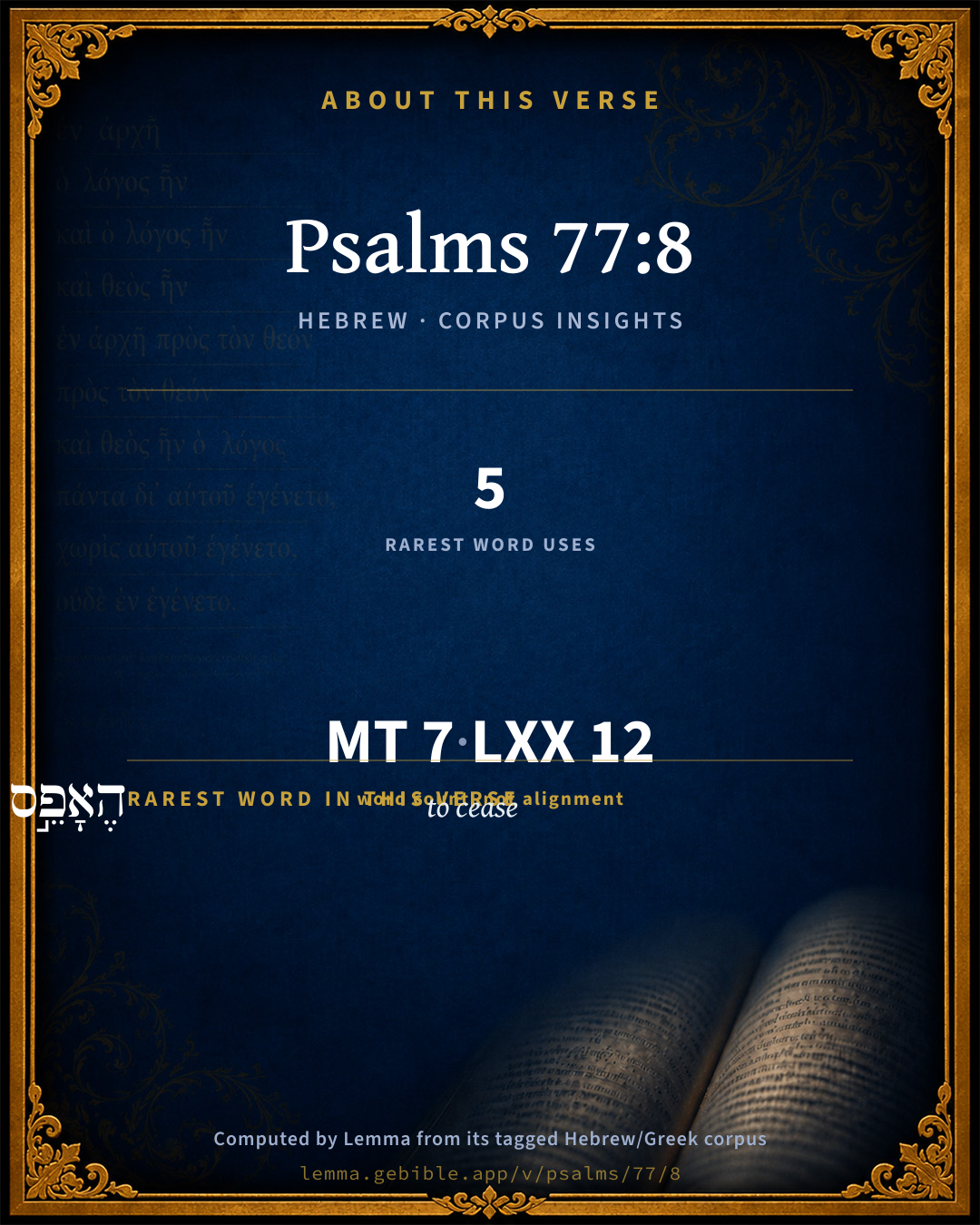
The rarest word here is הֶאָפֵ֣ס to cease H656 — appearing just 5 times in the whole Hebrew Bible.

Shared distinctive vocabulary

הֶאָפֵ֣ס to cease H656 occurs in 5 verses of the Hebrew Bible. Also found in:

Grammatical profile

  • 2 verbs
  • 5 nouns

Verb forms

  • הֶאָפֵ֣ס Qal · Perfect
  • גָּ֥מַר Qal · Perfect

Repetition

A word recurs within this verse — often emphatic in Hebrew:

  • לְדֹ֣ר generation H1755 ×2

Hebrew & Septuagint length

In English translation the verse runs 12 words from the Hebrew and 13 from the Septuagint (LXX English) — closely comparable.

A rough comparison of the two English renderings, which tokenize alike — not a word-level alignment.

Word counts can differ between the Hebrew and the Greek without any difference in meaning — e.g. the Hebrew direct-object marker אֵת has no separate Greek word, and Greek often adds the article ὁ.

In the original languages it is 7 Hebrew tokens and 12 Greek tokens — but the two are counted differently (Hebrew bundles its prefixes and suffixes into one token; the Greek is in lemma form), so that isn’t a like-for-like length.

Cross-references

7

Topical passages linked to Psalms 77:8 in the Treasury of Scripture Knowledge — connected by theme and wording, ordered by reader-vote popularity; previews shown in the World English Bible.

  • Numbers 23:19 God is not a man, that he should lie, Neither the son of man, that he should repent: Has he said, and will he not do it? Or has he spoken, and will he not make it good?
  • Romans 9:6 But it is not as though the word of God has come to nothing. For they are not all Israel, that are of Israel.
  • 2 Peter 3:9 The Lord is not slow concerning his promise, as some count slowness; but is patient with us, not wishing that any should perish, but that all should come to repentance.
  • Numbers 14:34 After the number of the days in which you spied out the land, even forty days, for every day a year, shall you bear your iniquities, even forty years, and you shall know my alienation.
  • Jeremiah 15:18 Why is my pain perpetual, and my wound incurable, which refuses to be healed? will you indeed be to me as a deceitful [brook], as waters that fail?
  • Luke 16:25–26 "But Abraham said, 'Son, remember that you, in your lifetime, received your good things, and Lazarus, in like manner, bad things. But now here he is comforted and you are in anguish.
  • Isaiah 27:11 When the boughs of it are withered, they shall be broken off; the women shall come, and set them on fire; for it is a people of no understanding: therefore he who made them will not have compassion on them, and he who formed them will show them no favor.

Cross-references courtesy of OpenBible.info (CC BY 4.0).

Hebrew and Greek witnesses Masoretic Hebrew ↔ Greek Septuagint

The same verse in the two great witnesses to the Old Testament, shown verse-for-verse.

You’re reading Greek Psalm 76 (Hebrew Psalm 77). The Septuagint counts the superscription, so verse numbers can differ from the Hebrew — chapter-level alignment, not verse-by-verse. Numbering follows Rahlfs.

These are two independent witnesses, not word-aligned to each other, and the Septuagint is shown in lemma (dictionary) form.

Hebrew Psalms 77:8 Masoretic · Westminster Leningrad Codex

הֶאָפֵ֣ס לָנֶ֣צַח חַסְדּ֑וֹ גָּ֥מַר אֹ֝֗מֶר לְדֹ֣ר וָדֹֽר

Has his loving kindness vanished forever? Does his promise fail for generations?

World English Bible · Public Domain

Greek LXX Greek Psalm 76:8 Septuagint · lemma form

μή εἰς ὁ αἰών ἀποὠθέω κύριος καί οὐ προςτίθημι ὁ εὐδοκέω ἔτι

Will he cut off his mercy for ever, even for ever and ever?

LXX2012 (modern English Septuagint) · Public Domain

Hebrew: Westminster Leningrad Codex (CC BY 4.0). Greek: Septuagint (public domain); English from LXX2012 (modern English Septuagint) (Public Domain). How the Septuagint differs from the Hebrew →

Commentary

Notes on Psalms 77:8 from classic Christian and Jewish commentators (each source and its license shown beneath its notes). The classic Christian expositions comment on the surrounding passage and are grouped to its opening verse, so a note may address several verses; the Jewish commentaries on the Tanakh (Rashi and others) are per-verse, so they appear only where the commentator wrote on this verse.

Lemma curates 59 commentaries, every one of them public domain or Creative Commons licensed, each selected and text-cleaned for this edition rather than reprinted as found. About our sources →

Trapp's Complete Commentary

John Trapp

Psa 77:8 Is his mercy clean gone for ever? doth [his] promise fail for evermore?

Ver. 8. Is his mercy clean gone for ever?] They that go down into the pit (of despair) cannot hope for God’s truth, Isa 38:18, but so doth not any saint in his deepest desertions.

Doth his promise fail for evermore?] Hath he retracted his promises, recalled his oracles confirmed with oath, seal? No, he will not suffer his faithfulness to fail, nor alter the thing that is gone out of his mouth, Psa 89:33.

John Trapp, A Commentary or Exposition upon All the Books of the Old and New Testament (1647–1656) — public domain. Text from a community e-Sword module.

J. A. Alexander on Psalms

Joseph Addison Alexander

9. (Psa 77:8). Ceased for ever has his mercy, failed (his) word to generation and generation? The general term word here denotes specifically a word of promise. See above on Psa 18:30). Generation and generation, i.e. all generations in succession, are not mentioned as the objects of the promise, to whom God's word was pledged, but as the period of its failure.

Joseph Addison Alexander, The Psalms Translated and Explained (1850) — public domain. Text from a community e-Sword module.

Geneva Bible (1599)

Geneva Bible translators

As if he should say, It is impossible: whereby he exhorteth himself to patience.

Geneva Bible (1599) marginal notes — public domain. Text via Bolls.life.

Adam Clarke's Commentary

Verse 8. For evermore?] לדר ודר ledor vador, "to generation and generation." From race to race. Shall no mercy be shown even to the remotest generation of the children of the offenders?

Adam Clarke's Commentary on the Bible (1810–1826) — public domain. Text from a community e-Sword/MySword module.

The Cambridge Bible for Schools and Colleges

gen. ed. J. J. S. Perowne

8. Is his lovingkindness at an end for ever?

Hath his promise failed for all generations?

Cp. Psa_85:5; Psa_105:8.

The Cambridge Bible for Schools and Colleges (gen. ed. J. J. S. Perowne; Cambridge University Press, 1878–1918) — public domain. Text from a community e-Sword module.

John Gill's Exposition

Is his mercy clean gone for ever?.... Or "his grace" (q); and mercy is no other than grace to objects in misery; Unbelief says it is gone, that no more will be shown, and that the treasures of it are exhausted; but Faith says it is not gone, and observes that God is the God of all grace, is rich in mercy, and abundant in goodness; that his Son is full of grace and truth, and so is the covenant; and that though there is an abundance of it given in conversion, and there are continual supplies of it afterwards; yet this grace is still sufficient, and this mercy abundant; salvation is by it, as for millions past, so for millions present and to come; the mercy of God is new every morning, it endures for ever, it is from everlasting to everlasting:

doth his promise fail for evermore? or word (r); his words of consolation, as Kimchi interprets it; the sense may be, will he speak never a word of comfort more? Unbelief says he will not, but Faith says he will; and that though he brings into the wilderness, yet he will speak comfortably there; and as he answered the Angel of the covenant with good and comfortable words, so he orders his ministers to speak, and by them he does speak comfortably to his people: or, in general, the word of the Gospel is meant; which though it may be sometimes scarce and rare, and there may be few preachers of it; yet it lives and abides for ever, it is the everlasting Gospel; or, in particular, the promise or promises of the Gospel: Faith says not one of these shall fail, grounding it upon the ability of God, and his power to perform: and upon his faithfulness, which he will never suffer to fail; and the promises of God are so far from failing for evermore, that they never fail at all; there never was any instance of any; not one of the good things which God has spoken of, from the creation of the world to this present time, have ever failed; the promises are yea and amen in Christ; see Jos 23:14. The Targum interprets it differently of his evil word being fulfilled on every generation.

(q) "gratia ipsius", Cocceius, Gejerus. (r) "eloquim", Pagninus, Montanus; "sermo", Junius & Tremellius, Piscator; "verbum", Vatablus, Gejerus, Michaelis; "oraculum", Tigurine version, Musculus.

John Gill's Exposition of the Whole Bible (1746–1763) — public domain (CC PDM 1.0). Text via the HelloAO Bible API.

Albert Barnes' Notes on the Bible

Is his mercy clean gone for ever? - The word rendered “clean gone” means to fail; to fail utterly. The idea is, Can it be that the compassion of God has become exhausted - that no more mercy is to be shown to mankind - that henceforth all is to be left to stern and severe justice? What would the world be if this were so! What must be the condition of mankind if mercy were no more to be shown to the race!

Doth his promise fail for evermore? - Margin, as in Hebrew, “to generation and generation.” The original Hebrew rendered “promise” means “word;” and the question is, whether it can be that what God has spoken is to be found false. Can we no longer rely on what he has said? All the hopes of mankind depend on that, and if that should fail, all prospect of salvation in regard to our race must be at an end.

Albert Barnes' Notes on the Bible (1834–1885) — public domain. Text from a community e-Sword/MySword module.

Matthew Poole's English Annotations

Are all the stores of his mercy quite spent? Doth he now cease to be what he hath styled himself, the Lord gracious and merciful, long-suffering, and abundant in goodness? Will he never more make good those gracious promises upon which he hath commanded us to hope?

Matthew Poole's English Annotations on the Holy Bible (1683–1685) — public domain. Text from a community e-Sword/MySword module.

The Treasury of David

Charles H. Spurgeon

Ver. 8. Is his mercy clean gone for ever? If he has no love for his elect, has he not still his mercy left? Has that dried up? Has he no pity for the sorrowful?

Doth his promise fail for evermore? His word is pledged to those who plead with him; is that become of none effect? Shall it be said that from one generation to another the Lord's word has fallen to the ground; whereas aforetime he kept his covenant to all generations of them that fear him? It is a wise thing thus to put unbelief through the catechism. Each one of the questions is a dart aimed at the very heart of despair. Thus have we also in our days of darkness done battle for life itself.

Whole Psalm. Whenever, and by whomsoever, the Psalm may have been written, it clearly is individual, not national. It utterly destroys all the beauty, all the tenderness and depth of feeling in the opening portion, if we suppose that the people are introduced speaking in the first person. The allusions to the national history may indeed show that the season was a season of national distress, and that the sweet singer was himself bowed down by the burden of the time, and oppressed by woes which he had no power to alleviate; but it is his own sorrow, not the sorrow of others under which he sighs, and of which he has left the pathetic record. J. J. Stewart Perowne.

Ver. 8. Doth his promise fail for evermore? Let no appearing impossibilities make you question God's accomplishment of any of his gracious words. Though you cannot see how the thing can be done, it is enough, if God has said that he will do it. There can be no obstructions to promised salvation, which we need to fear. He who is the God of this salvation, and the Author of the promise, will prepare his own way for the doing of his own work, so that "every valley shall be filled, and every mountain and hill brought low." Lu 3:5. Though the valleys be so deep that we cannot see the bottom, and the mountains so high that we cannot see the tops of them, yet God knows how to raise the one and level the other; Isa 53:1: "I that speak in righteousness (or faithfulness) am mighty to save." If anything would keep back the kingdom of Christ, it would be our infidelity; but he will come, though he should find no faith on the earth. See Ro 3:3. Cast not away your confidence because God defers his performances. Though providence run cross, though they move backwards and forwards, you have a sure and faithful word to rely upon. Promises, though they be for a time seemingly delayed, cannot be finally frustrated. Dare not to harbour such a thought within yourselves. The being of God may as well fail as the promise of God. That which does not come in your time, will be hastened in his time, which is always the more convenient season. Timothy Cruso.

Ver. 8. These questions,

I. Suppose a change in the immutable Jehovah in two

glorious attributes.

II. Are contrary to all past evidence.

III. Can only arise from the flesh and Satan; and,

therefore,

IV. Are to be met in the power of the Spirit, with strong

faith in the Eternal God.

Psalms 77:9*

Charles H. Spurgeon's The Treasury of David (1869–1885) — public domain. Psalms only. Text from a community e-Sword/MySword module.

Whedon's Commentary on the Bible

Daniel D. Whedon

8. Is his mercy… gone for ever— “For ever,” here, is another of the class of strongest Hebrew words to denote eternal duration, and never occurs but once (Psa_44:23) in such connexion, except in the psalms of the captivity. In Psalms 74 it occurs four times, (Psa_77:1; Psa_77:3; Psa_77:10; Psa_77:19,) also in Psa_79:5; Psa_89:46.

For evermore—Hebrew, to generation and generation.

Daniel D. Whedon (gen. ed.), Commentary on the Old and New Testaments (1874–1909) — public domain. Text from a community e-Sword module.

The Pulpit Commentary

Is his mercy clean gone forever? The mercy which he has so long shown towards Israel. (comp. Ps 78) Doth his promise fail forevermore? The promise which he made to Abraham, Isaac, and Jacob, that he would be with their seed forever. (Gen_17:7-13 Gen_26:24 Gen_35:11, Gen_35:12)

Possible exhaustion of God"s mercies.

So fully was the thought of God woven into the whole life and relations of a pious Jew, that to him the unbearable distress was the lost sense of God"s presence and interest. We have two striking instances of this. The supreme point of David"s distress, when fleeing from his son Absalom, lay in this his enemies taunted him with the lost favour of God, saying, "Where is now thy God?" And Isaiah closes his magnificent fortieth chapter with this sublime appeal, "Why sayest thou, O Jacob, and speakest, O Israel, My way is hid from the Lord, and my judgment is passed over from my God?" Imagined change in God"s relation, and the failure of God"s mercy, are the supreme woes to all God-fearing men still.

I THE CHRISTIAN"S GREAT TROUBLES ARE DOUBTS ABOUT GOD, NOT AFFLICTIONS SENT BY GOD. The distinction between these two is this doubts are inward, afflictions are outward. It is not a very great thing for the soul to master mere circumstances especially since God never permits them to be overwhelming. The great thing is for the soul to master itself. When our circumstances start doubts, then we get humbled and broken. It is doubt, suspicion, fear, that really crushes our spirits, and forces tears. Our doubtings usually concern:

1. God"s Personality. Like David, we cry for assurance that God is a "living God;" not a vain idol; not an abstraction of science; not the vague "eternal that makes for righteousness.

2. God"s relationship. He may be God, but is he my God?

3. God"s faithfulness. For God ever sets out promises for faith to grasp; and what can faith do if God does not keep his promises?

4. God"s actual present nearness. "Where is now thy God?" "Thou hast covered thyself with a cloud, that our prayer might not pass through.

II THE STING OF DOUBTING TIMES IS THE CONSCIOUSNESS OF SIN. Illustrate from the case of David, who lost the sense of God, lost his hope in God, filled his soul with questionings and fears, when he had stepped aside from the ways of righteousness and good self-restraint. Sin clouds the mind with doubts.

III NEITHER AFFLICTIONS, NOR DOUBTS, NOR CONSCIOUS SIN DO MAKE GOD"S MERCIES FAIL. Precisely in those scenes Divine mercies most abound. Things, and conditions of mind and feeling, may affect our vision of him; they cannot affect him. We may project our shadows over him, and then find we can only see the shadows. God is not moved to change by our change. "He abideth faithful." "His mercies aye endure, Ever faithful, ever sure.

Ask, "Is his mercy clean gone forever?" and you cannot want any answer. To state the question is to be ashamed of the doubting that suggested it. R.T.

The Pulpit Commentary (1880–1919), ed. H.D.M. Spence-Jones & Joseph S. Exell — public domain. Text from a community e-Sword module.

unfoldingWord translationNotes

Door43 World Missions Community

General Information:

Because Asaph was not sure of the answer to these questions, they are probably literal questions and should be translated literally.

Was his covenant faithfulness gone forever?

Asaph speaks of Yahweh no longer acting faithfully to his covenant as if Yahweh's covenant faithfulness had gone away. The abstract noun "faithfulness" can be translated with an adjective. AT: "Has he stopped being faithful to his covenant forever?" (See: Abstract Nouns)

Had God forgotten to be gracious? Had his anger shut off his compassion?

These are two expressions stating similar concept of God not showing compassion. (See: Doublet)

Had his anger shut off his compassion

Asaph speaks of anger as if it were a person shutting a door to keep another person, compassion, from coming out, AT: "Had God stopped showing us compassion because he was angry with us" (See: Personification and Rhetorical Question)

translationWords

promise

grace

anger

compassion

selah

unfoldingWord translationNotes — © Distant Shores Media and the Door43 World Missions Community, licensed CC BY-SA 4.0. Source: git.door43.org/Door43/en_tn.

Lesson kit

Teaching starters — assembled from the data on this page, not authored interpretation. Every prompt links to the verse data it draws on. Edit before teaching.

Psalms, in the Wisdom, opens this verse with 7 words (6 distinct Hebrew lemmas). Its most distinctive word is ʼâphêç (“to cease”). A historical commentator’s framing appears above. Read the whole chapter for the surrounding context.

Discussion questions

  1. How does “to cease” (ʼâphêç) shape what this verse is saying?
  2. Genesis 47:15 shares the word «to cease» with this verse. How do the two illuminate each other?
  3. “generation” occurs 2× in this one verse. What is the effect of the repetition?
  4. These translations render this verse differently; the difference is in the English rendering, not the original. What questions does that raise?
  5. The verb «הֶאָפֵ֣ס» is Qal Perfect. How does its form color the action?
  6. Reading how Trapp's Complete Commentary and J. A. Alexander on Psalms read this verse, where do the two commentators agree and where do they part?

Things to notice

Reading settings

Reading text

Shown beneath each verse's original-language words.

Old Testament
Old Testament edition

Read the OT as the Masoretic Hebrew (MT) or the Greek Septuagint (LXX).

English shown for the Greek Septuagint (in the Hebrew ↔ Greek comparison).

Comparing translations? Open the Compare panel on any verse page to stack up to four side by side.